Who Says There Is No Growth In Banking

Two big takeaways from the second day of Bank Director’s 2nd annual Growth conference (#BDGrow14): institutions of all sizes are challenged when it comes to standing out from the crowd & enhancing your mobile banking presence should be a top priority for all boards of directors.

A 2 Minute Recap on the Past 4 Months


Take No Risk, Make No Money
While some may not think about enterprise risk management in the context of growing one’s bank, Crowe’s Jennifer Burke made clear that proactively identifying, mitigating, and in some cases, capitalizing on risks provides a distinct advantage to a bank.  Keep in mind that even smaller institutions — with less complex business structures — face myriad risks that might significantly affect their ability to meet their growth plans.  As Jennifer shared, those that proactively identify and respond to risks and opportunities gain a competitive advantage over their peers, especially in responding to our ever-changing business environment.

Millennial and the End of Banking?

The Times-Picayune ran a nice story in today’s edition based on The Growth Conference.  The newspaper noted that “younger generations report more comfort with online and mobile banking tools, posing a hurdle for banks used to ginning up business through face-to-face interactions.”  So it is fair to ask if banks should be scared of the millennial generation.  According to Daryl Byrd, president and CEO of IberiaBank, the answer is no.  As mentioned in this piece (Will Millennials be the end of banking as we know it? Bank execs weigh in at Growth Conference in New Orleans), Byrd was among a panel of industry leaders gathered at the Bank Director Growth Conference to discuss business trends, including the challenges in reaching younger customers.  Byrd, “who noted he is the father of three Millennials, said his children, like many in their generation, aren’t building wealth as much as they are taking on debt. That means their demand for banking services will be limited in the near term,” he said.

Trending Topics

The issues I took note of this morning were, in no particular order:

  • Just like “synergy” became a cliché, so too might “omni” when it comes to delivering a consistent customer experience (e.g. omni-screen, omni-channel, etc);
  • Not all customers are created equally;
  • A bank’s board has the chance to re-set strategies to target, acquire, engage, grow and retain customers… but need to look ahead to what’s possible as opposed to the past to see what has historically delivered results.

To comment on this piece, click on the green circle with the white plus sign on the bottom right. Safe travels home to all who joined us in New Orleans this week (and yes, Aloha Friday!)

Let the Good Times Roll

Checking in from a rain-soaked Reagan National airport, where I think I see the plane I’ll take down to New Orleans taxiing towards its gate.  Yes, it’s “Growth Week” at Bank Director, and I’m heading to the Crescent City to host bank CEOs, Chairmen and board members keen to focus on big picture business issues surrounding growth (not necessarily associated with mergers and acquisitions) and profitability.

New Orleans

A Deep Dive

I realize the phrase “let the good times roll” is most frequently heard during Mardi Gras celebrations in New Orleans; I’m using it to tee up Bank Director’s Growth Conference that kicks off tomorrow morning at the Ritz-Carlton.  Once the lights come up, I’ll be interested to hear:

  • How growth is driving pricing;
  • Why efficiency & productivity are both key elements in positioning a bank to grow; and
  • If “overcapacity” in the US banking industry offers opportunities.

I’m particularly excited for our opening session with Thomas Brown, CEO, Second Curve Capital.  We’ve asked him to help us “set the table” for the next two days of conversations with an outlook for banks across the country by reviewing the current capital market and operating conditions, thereby providing financial context to the next two days’ presentations.  If I don’t cover his remarks in my post tomorrow, you can bet our editor, Jack Milligan, will on his must-read blog The Bank Spot.

A Look Back

Much of last year’s conversation revolved around technology and the need to adapt to a changing marketplace, as well as the importance of creating a unique niche in a competitive landscape dominated by the biggest banks.  Many of our bank speakers at the conference had a more nuanced view of technological change. Richard Hill, the chief retail banking officer for the $19-billion asset Hancock Holding Co. in Baton Rouge, Louisiana, said when he got into banking in the 1970s, the prediction was that checks would go away and branch banking would go away. That clearly didn’t happen, or at least not at the accelerated pace that many predicted. The problem for his bank and for many others is that profits are getting squeezed with low interest rates, and the bank needs to make investments that expand revenue. As he said, “a great challenge we have is figuring all this out.”

Take Our Your Crystal Balls

Let me wrap up by sharing a 2 minute video our team compiled on the “future” of banking.  We played it at our Acquire or Be Acquired conference in January and the perspectives of KPMG’s national banking leader, the CEO of Congressional Bank, etc. are worth a watch and listen.

Laissez les bons temps rouler!

The Single Greatest Constraint on Growth

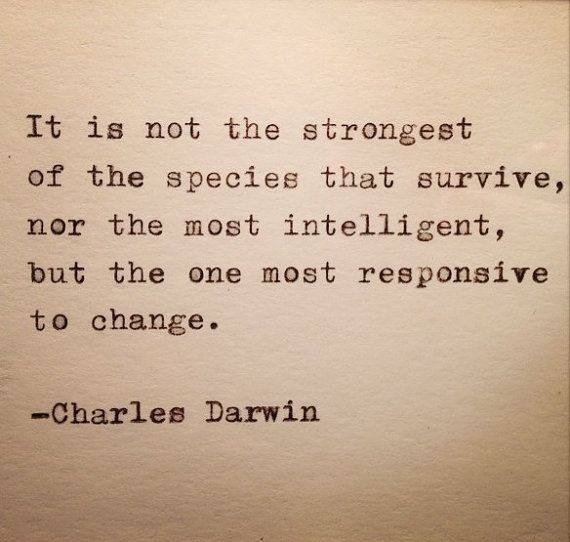
With the revenue pressures facing the banking industry being some of the most intense in decades, banks need to think more constructively about their businesses. At the same time, changing consumer behavior could drive the industry to reallocate its resources to less traditional growth channels in order to stay ahead.  In my view, the words of an English naturalist reflect the single greatest constraint on growth today.

photo-6

Powerful Forces

One of our long-term corporate sponsors, PwC, recently shared their thoughts on the future of the retail banking industry.  In their view, “powerful forces are reshaping the banking industry, creating an imperative for change. Banks need to choose what posture they want to adopt – to lead the change, to follow fast, or to manage for the present. Whatever their chosen strategy, leading banks will need to balance execution against… critical priorities and have a clear sense of the posture they wish to adopt.”  If you, like our friends from PwC, are joining us in New Orleans later this week to dive into this very topic, their compelling “Retail Banking 2020” report might make for good airplane company.

Looking Back in Order to Look Ahead

Last year, John Eggemeyer, a Founder and Managing Principal of Castle Creek Capital LLC, helped me to kick off our inaugural Growth Conference.  As a lead investor in the banking industry since 1990, he shared his views on our “mature industry,” That is, banking follows a historic pattern of other mature industries: excess capacity creates fierce competition for business which in turn makes price, not customer service, the key differentiator.  While offering myriad thoughts on what makes for a great bank,  John did share some hard-to-swallow statistics and opinions for a crowd of nearly 200 bankers and industry executives:

  • Publicly traded banks from $1 billion to $5 billion in assets saw their stock values rise at about half the rate of the broader market as a whole since early 2009.
  • Of the 300 or so publicly traded banks in that size range, only about 60 of them traded at their pre-recession price multiples.
  • In the last 40 years, bank stocks always followed the same pattern in a recession: falling in value quicker than the rest of the market and recovering quicker.

I share these three points to provide context for certain presentations later this week.  Some build on his perspectives while others update market trends and behavior.  Still, an interesting reminder of where we were at this time last year.

Getting Social-er

Yesterday, I shared the hashtag for The Growth Conference (#BDGrow14).  Thanks to our Director of Research — @ehmccormick — and Director of Marketing — @Michelle_M_King — I can tell you that nearly 30% of the attending banks have an active twitter account; 78% of sponsors do.  On the banking side, these include the oldest and largest institution headquartered in Louisiana — @IBERIABANK, a Connecticut bank first chartered in 1825 with over $3.5 billion in assets — @LibertyBank_CT and a Durham, NC-based bank that just went public last month — @Square1Bank.  On the corporate side of things, one of the top marketing and communications firms for financial companies —@wmagency, a tech company that shares Bank Director’s love of orange — @Fiserv and a leading provider of personal financial management — @MoneyDesktop join us.  Just six of many institutions and service providers I’m looking forward to saying hello to.

##

More to come — from New Orleans, not D.C. — tomorrow afternoon.

Its Growth Week

Its finally here… “Growth Week” at Bank Director.  Yes Discovery Channel, you can keep your shark week.  What we’re about to get into is far more interesting (at least, to some): what’s working in banking today.  Most of our team heads down to the Ritz-Carlton in New Orleans tomorrow and Wednesday for our 2014 Growth Conference.  Before they do, the first of five posts dedicated to building a business.

Growth-Key-Card-1

Think Distinct

Innovation means doing things differently.  Not just offering new products or offerings — but doing things differently across the entire business model.  Going into this event, I know many believe there are simply too many banks offering similar products and services.  I tend to think institutions are challenged when it comes to being distinctive compared with the competitor across the street.  This is not a new issue; however, there are more and more strategies emerging and enablers coming to market that can drive brand value, customer satisfaction and profitable growth.  Case-in-point: the work of our friends at StrategyCorps, whose idea is “be bold… go beyond basic mobile banking.”  One of the sponsors of the conference, I am excited to hear how  financial institutions, like First Financial, benefit from their mobile & online consumer checking solutions in order to enhance customer engagement and increase fee income.

Looking Back in Order to Look Ahead

While easy to frame the dynamics of our industry in terms of asset size, competing for business today is more of a “smart vs. not-so-smart” story than a “big vs. small.” During one of my favorite sessions last year — David AND Goliath — Peter Benoist, the president and CEO of St. Louis-based Enterprise Financial Services Corp, reminded his peers that as more banks put their liquidity to work, fierce competition puts pressures on rates and elevates risk.  As I went back to my notes in advance of this week’s event, my biggest takeaway from his presentation was we all talk about scale and net interest margins… but it’s clear that you need growth today regardless of who you are.  It is growth for the sake of existence.

Getting Social

To keep track of the conversation pre-, on-site and post-event on Twitter, use #BDGrow14 and/or @bankdirector + @aldominick.  In addition, I plan to post every day this week to About That Ratio, with tomorrow’s piece touching on the diminished importance of branch networks to underscore the importance of investments in technology.

The Three Ds of Banking

Just as the cherry blossoms provide a welcome personal respite from winter’s cold embrace, so too have stories of creativity and growth diverted my professional attention away from compliance issues and regulatory updates.  As I travel across the country, I’m continually impressed by the close attention being paid by leaders at financial institutions to non-traditional sources of revenue — particularly fee-based income.  Today’s tip sheet reflects these recent travels and commensurate “lessons learned” with three words, a big three if you will, that tie-in to growing one’s business.

photo-4

Diversify

In order for banks to thrive in what, in many regions, remains a crowded marketplace, diversified growth is key.  I’ve heard from a few community bank CEOs that given the nature of the economic recovery and uncertainty over interest rates, quality growth requires a balance between real estate and operating company borrowers and between fixed and floating rate loans.  Without such balance, earnings and shareholder value are at increased risk.

Differentiate

The general public still does not distinguish enough between Wall Street banks and Main Street community banks.  Nonetheless, more and more bankers are making this distinction, thereby helping customers (and potential customers) to understand how important community banks are to the economy and the local region.  It strikes me such efforts will not only educate, but also encourage, more and more people to support community banks with their business.

Deliver

As the workplace becomes more mobile, so must the tools to deliver the financial services to business owners and individuals.  Clearly, the “new generation of consumers” does everything on their mobile phone.  If a bank doesn’t have a mobile app — and a quality mobile offering — I have to believe the bank does not even register to this up and coming audience.  In fact, as more Gen X and Gen Y’rs become a more sizable force in terms of total GDP, I’ve heard that one’s mobile banking solutions will be directly proportional to the amount of clients a bank is able to attract and retain.

Aloha Friday!

FI Tip Sheet: The Innovator’s Dilemma

Over the past few years, I have seen significant change within the banking community — much of it defensive or in response to government intervention and oversight.  According to a white paper recently published by McLagan, “a great deal has been said about the excesses and errors of the past; however (sic), the current focus for banks, in particular, must be on the need to innovate or risk becoming stagnant and losing the ability to compete for exceptional talent.”  This morning’s column focuses on the “innovator’s dilemma,” vis-a-vis three questions.

Everything is AwesomeDo We Need Sustainable or Disruptive Technology ?

I have talked with a number of Chairmen and CEOs about their strategic plans that leverage financial technology to strengthen and/or differentiate their bank.  After one recent chat, I went to my bookshelf in search of Clayton Christensen’s “The Innovator’s Dilemma: When New Technologies Cause Great Firms to Fail.”  His book inspired today’s title — and fuels this first question.  Christensen writes about two types of technologies: sustaining and disruptive.  Sustaining technologies are those that improve product performance.  As he sees it, these are technologies that most large companies are familiar with; technologies that involve improving a product that has an established role in the market.  Most large companies are adept at turning sustaining technology challenges into achievements.  However, large companies have problems dealing with disruptive technologies — an observation that, in my view, does not bode well for many traditionally established banks.

“Discovering markets for emerging technologies inherently involves failure, and most individual decision makers find it very difficult to risk backing a project that might fail because the market is not there.”

While risk is inherent to banks of all sizes, taking chances on emerging technologies continues to challenge many officers and directors.  To this end, I thought about the themes explored in Christensen’s book after spending time in Microsoft’s New York City offices last week.  While there, I heard how big banks are generating revenues by acquiring new customers while retaining, up-selling and cross-selling to existing customers.  I left impressed by the various investments being made by the JP Morgans of the banking world, at least in terms of customer relationships and experience management along with analytics and core system modernization.  I do, however, wonder how any entrenched bank can realistically embrace something “uber-esque” (read: disruptive) that could truly transform the industry.

Do We Have the Staff We Need?

Consider the following question from the perspective of a relatively new hire: “I have a great idea for a product or service… who can I talk with?”  A few months ago, Stephen Steinour, the President & Chief Executive Officer at Huntington Bancshares, keynoted Bank Director’s annual Bank Executive & Board Compensation conference and addressed this very thing.  As he shared to an audience of his peers: “the things I assumed from my era of banking are no longer valid.”  Rather than tune out ideas from the field in favor of age and experience, he explained how his $56Bn+ institution re-focused on recruiting “the right” employees for the company they wanted (not necessarily what they had), with a particular emphasis on attracting the millennial generation into banking.  He admitted it’s a challenge heightened by public perception of the industry as one that “takes advantage of people and has benefited from government bailouts.”  Still, he made clear the team they are hiring for reflects a new cultural and staffing model designed to drive real, long-term change.  I wonder how many banks would (or could) be so bold?

Do We Have The Right Business Model?

I’ve heard it said that “forces of change” will compel banks to reinvent their business models.  Take the business model of core retail banking. According to a piece authored by McKinsey (Why U.S. Banks Need a New Business Model), over the past decade, banks continued to invest in branches as a response to free checking and to the rapid growth in consumer borrowing.  But regulations “undermining the assumptions behind free checking and a significant reduction in consumer borrowing have called into question the entire retail model.  In five years, branch banking will probably look fundamentally different as branch layouts, formats, and employee capabilities change.”  Now, I’m not sure banking’s overall business model needs a total overhaul; after all, it still comes back to relationships and reputations.  Nonetheless, many smaller banks appear ripe for a change.  And yes, the question of how they have structured their business is one some are beginning to explore.

##

To comment on this piece, click on the green circle with the white plus sign on the bottom right.  Looking ahead, expect a daily post on About That Ratio next week.  I’ll be in Nashville at the Hermitage Hotel for Bank Director’s Bank Board Training Program.  Leading up to, and at, this educational event, I’ll provide an overview on the various issues being covered.  Namely, risk management and auditing issues, compensation, corporate governance, regulation and strategic planning.  Thanks for reading, and Aloha Friday!

FI Tip Sheet: The Size of the Sandbox

Just as an Apple store conveys a community and market presence, so too does a bank’s branch.  While younger customers may no longer visit more than a front-of-the-house ATM, I do think many of us choose our bank based on their proximity to where we live and work.  Today’s tip sheet builds on this thought — beginning with a look at the economics of deposit taking, followed by a visual reminder of our industry’s size before ending with an acquisition by a a big-bank based in Madrid.

photo

Face-to-Face Trumps Technology?

To borrow a few lines from a recent CDW white paper, as the U.S. financial industry emerges from the recent financial crisis, “the surviving institutions are leaner and more focused than ever before. In some cases, this means lowering overhead — doing more with less — to effectively maintain operations.” While the future of banks proved a popular conversation starter during my travels around Washington D.C. and New York City this week, it is a report shared by Fred Cannon — the Director of Research at Keefe, Bruyette and Woods — that caught my eye. I am a big fan of Fred’s prose and the perspectives he offered in “Branch Banking in Retreat” demonstrates that real branch transformation continues to elude many financial institutions. To wit:

“The economics of bank deposit taking is poor in the age of Bernanke and Yellen (low rates) and Durbin (reduced fees). But beyond rates and politics, technology is also undermining the role of traditional branches as the payment system has moved sharply towards electronics in the last decade… Yet, overall banks are responding slowly to the changes in economics and technology of branching. While the number of bank branches has fallen since 2009, the population per branch in the U.S. is still at the same level as the mid-1990s.”

Most branch transformation initiatives I have seen seek to simultaneously reduce costs while improving sales. Here, size matters. Smaller banks can re-invent themselves faster than the big guys; however, its the biggest banks that can financially absorb the most risk in terms of rolling out something new (and expensive).

A Visual Reminder That Financial Size Matters

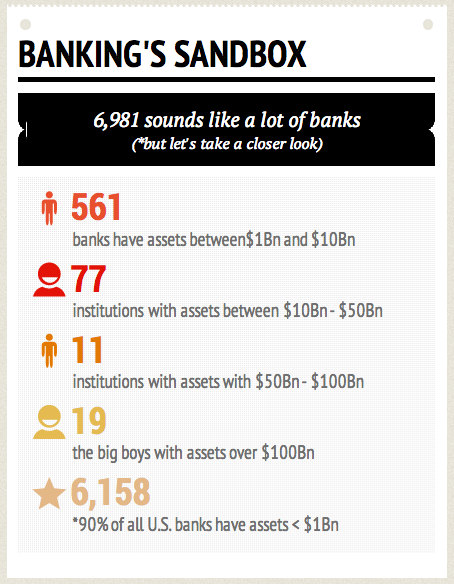
Fred’s research piece, focused on small and mid-sized banks along with the BofA’s and Wells Fargo’s of the country, inspired me to create the following infographic.  I’ve shared variations of these statistics in prior posts — and thought to illustrate how our industry breaks down in terms of asset size.

Screen Shot 2014-02-21 at 9.42.29 AM

(*note: while I hoped to serve this infographic up in a dynamic way, the image I created from Infogr.am isn’t embedding in WordPress.  Still, you get an idea of the market with this screenshot)

Old School Acquires New School

For smaller institutions, the size (and ability to scale) of their larger counterparts can be cause for alarm.  Indeed, Accenture shared “becoming a truly digital business is key to how we innovate and differentiate ourselves from our competitors. And if the last decade has been the playground of the digital start-ups, the coming decade will see the emergence of the traditional companies as the digital giants.”  I was thinking about this as I read the New York Times’ Dealbook story “BBVA Buys Banking Start-Up Simple for $117 Million.

This acquisition is notable as the buyer of this upstart is a 150-year old financial services corporation that operates in a number of markets, is a leading player in the Spanish market, as well as one of the top 15 banks in the U.S. and a strategic investor in banks in Turkey and China.  As noted by TechCrunch, “while not itself a bank, Simple operates as an intermediary between users and FDIC-insured institutions to provide users with access to data around their financial history, as well as tracking of expenditures and savings goals, with automated purchase data collected when its customers use their Simple Visa debit card.”  I wonder if this acquisition starts a consolidation trend of bigger banks buying newer fintech players to accelerate — while differentiating — their offerings…

Aloha Friday!

Can Banking Be Right-Sized?

Size matters?
Size matters?

Although its been said many times, many ways, I can’t tell you what size really matters in banking today. Pick a number…  $500M in asset size?  $1Bn?  $9.9Bn?  Over $50Bn?  7,000 institutions?  6,000?  3,000? Less?  As a follow-up to last week’s guest post by Bank Director magazine’s editor, I spent some extra time thinking about where we are heading as an industry — and the size and types of banks + bankers leading the way.  What follows are three things I’m thinking about to wrap up the week that shows that size matters; albeit, in different ways.

(1) Not a single de novo institution has been approved in more than two years (astonishing considering 144 were chartered in 2007 alone) and the banking industry is consolidating.  Indeed, the number of federally insured institutions nationwide shrank to 6,891 in the third quarter after this summer — falling below 7,000 for the first time since federal regulators began keeping track in 1934, according to the FDIC.  Per the Wall Street Journal, the decline in bank numbers, from a peak of more than 18,000, has come almost entirely in the form of exits by banks with less than $100 million in assets, with the bulk occurring between 1984 and 2011.   I’ve written about how we are “over-capacity;” however, an article on Slate.com takes things to an entirely different level.  In America’s Microbank Problem, Matthew Yglesias posits America has “far far far too many banks…. (that) are poorly managed… can’t be regulated… can’t compete.”  He says we should want the US Bankcorps and PNCs and Fifth Thirds and BancWests of America to swallow up local franchises and expand their geographical footprints.  He sees the ideal being “effective competition in which dozens rather than thousands of banks exist, and they all actually compete with each other on a national or regional basis rather than carving up turf.”  While I have no problem with fewer banks, limiting competition to just the super regional and megabanks is a terrible thought.  Heck, the CEO of Wells Fargo & Co. wrote in the American Banker this August how vital community banks are to the economy.  So let me cite a rebuttal to Slate’s piece by American Banker’s Washington bureau chief Rob Blackwell.  Rob, I’m 100% with you when you write “small banks’ alleged demise is something to resist, not cheer on” and feel compelled to re-share Mr. Stumpf’s opinion:

…we need well-managed, well-regulated banks of all sizes—large and small—to meet our nation’s diverse financial needs, and we need public policies that don’t unintentionally damage the very financial ecosystem they should keep healthy.

(2) To the consolidation side of things, a recent Bank Director M&A survey found 76% of respondents expect to see more bank deals in 2014.  Within this merger mix exists strategic affiliations.  While the term “merger of equals” is a misnomer, there are real benefits of a strategic partnership when two like-sized banks join forces.  Case-in-point, the recent merger between Rockville Bank and United Bank (which will take the United name).  Once completed, the institution will have about $5 billion in assets and be the 4th largest bank in the Springfield, MA and Hartford, CT metropolitan area.  According to a piece authored by  Jim Kinney in The Republican, United Bank’s $369 million merger with the parent of Connecticut’s Rockville Bank “is a ticket to the big leagues for both banks.”  In my opinion, banks today have a responsibility to invest in their businesses so that they can offer the latest products and services while at the same time keep expenses in check to better weather this low interest rate environment.  United Bank’s president-to-be echoed this sentiment.  He shared their “dual mandate in the banking industry these days is to become more efficient, because it is a tough interest rate environment, and continue to grow… But it is hard to grow and save money because you have to spend money to make money.”   Putting together two banks of similar financial size gives the combined entity a better chance to this end.

(3) In terms of growth — and by extension, innovation — I see new mobile offerings, like those from MoneyDesktop, adding real value to community banks nationwide.  This Utah-based tech firm provides banks and credit unions with a personal financial management solution that integrates directly with online banking platforms.  As they share, “account holders are changing. There is an ongoing shift away from traditional brick & mortar banking. Technology is providing better ways for account holders to interact with their money, and with financial institutions.”  By working directly with online banking, core and payment platforms, MoneyDesktop positions institutions and payment providers as financial hubs and offers marketing tools that dramatically impact loan volume, user acquisition and wallet-share.  As technology levels the playing field upon which institutions compete, banks that leverage account holder banking information to solidify relationships bodes well for bank and customer alike.

Aloha Friday!

A Build vs Buy Banking Story

For the first time in a while, I get the sense that members of the boards at financial institutions across the country are not just ready, but also eager, to embrace various strategies that leverage emerging technologies.  Accordingly, what follows are three things I’m thinking about as the week wraps up that have a distinctly tech spin to them.

pyramid-on-the-us-one-dollar-bill

Bringing IT In-House

Kudos to Scott Mills — President of The William Mills Agency — for sharing this American Banker profile of FirstBank, a $13 billion Denver institution.  With more than 115 locations in Colorado, Arizona and California, the bank is unusual in that it develops its own core banking software — made possible by an in-house IT team of 250+, or 12% of the bank’s 2,100 workers.  According to the piece, having a “homegrown core and in-house expertise enables the bank to be nimble and make changes quickly.”  Obviously, banks continue to use technology to generate efficiencies.  In fact, I’m seeing some community banks come up with creative solutions to meet their needs.  Case-in-point, this recent Bank Board & Executive Survey — conducted by Bank Director and sponsored by consulting firm Grant Thornton LLP — shows 84% of bankers surveyed plan investments in new technologies to make their institutions more efficient.  Still, FirstBank’s efforts to build instead of buying from outside vendors trumps any other bank’s effort that I’ve come across this year.  Oh yeah, their blog is pretty darn good too.

Finding the Right Partner(s)

For those more comfortable collaborating with firms who specialize in developing IT solutions, let me pass along an observation from my time with CEOs in San Francisco and Chicago.  Over the last month or so, I’ve talked with at least 13 CEOs about how they plan to stay — or potentially become — relevant in the markets they serve.  I’m not that surprised to hear that many want to get rid of branches — but do wonder as they turn to technology to fill in the gap if they have the right people in leadership positions.  Many smaller banks are focused on C&I lending and serving their business communities, so I don’t wonder about their branching focus, but do wonder about their hiring practices.  Certainly, it will become even more imperative to understand the various technology opportunities — and risks — what with so many “non-technical” executives and board members setting paths forward.

Square Peg, Round Hole?

Finally, I have something of a payments-focused writing streak going on this site, and I’m keeping it going thanks to this WSJ report vis-a-vis Square, the payments startup with a square credit-card reader.  As I found out, the company is eliminating a monthly flat-fee option for smaller businesses in favor of its usual “per swipe” fee.  The change is “prompting concern among some of Square’s more than four million customers, which include small businesses that were attracted to Square because it offered a cheaper alternative to traditional credit-card processors, which charge swipe fees of 1.5% to 3%.”  I wonder if this is opportunity knocking for community banks?  Certainly other point-of-sale vendors have seen it that way.

##

To comment on this piece, click on the green circle with the white plus (+) sign on the bottom right. If you are on twitter, I’m @aldominick.  Aloha Friday!

Building for the Future

Typically, my Friday columns on About That Ratio highlights three thoughts from the previous week; case-in-point, “On Fee Income + Staying Relevant.”  To vary things up, I’m expanding today’s piece by looking to five of the leading financial technology companies for inspiration.  In no particular order, something I learned from each specific to financial institutions’ efforts or opportunities to build for the future.

(1) Let me open with this visual representation about “engaging with digital consumers.”  Infograhphically speaking (their words, not mine), Infosys took a look at the complex behaviors consumers display when sharing their personal data.  Specifically, the technology company polled 5,000 “digitally savvy consumers” in five countries about how they trade personal data in the retail, banking and healthcare sectors. Their resulting study shows the key challenge facing business is to navigate the complex behaviors consumers display when sharing their personal data.

digital-consumer-circle

(2) Given these digital consumers’ growing use of smartphones — and comfort with their built-in cameras — image capture is a logical next step for bill enrollment and payments via mobile devices.  So it makes sense that Fiserv recently launched “Snap-to-Pay” — a feature that enables consumers to pay bills with a snap of their smartphone cameras.  Essential bill information, such as the company to be paid and the amount due, is captured by taking a picture of a paper bill and then used to automatically populate the appropriate fields on the smartphone screen.  Yup, another cool addition to the payments space.

(3) Competing with Infosys and Fiserv for financial institutions’ business and loyalty is FIS, the world’s largest provider of banking and payments technology.  For the third year in a row, the company achieved the No. 1 ranking on the FinTech 100, an annual listing of the top technology providers to the financial services industry compiled by American Banker, Bank Technology News and research firm IDC Financial Insights.  As I perused their site, I paused on their mobile prepaid solutions to see what they offer for the un-banked and under-banked consumers.  These potential customers represent a significant opportunity to financial institutions, and the suite of mobile offerings offered by FIS looks to robust and user-friendly.

(4) I’m a loyal American Airlines frequent flier (1,417,248 program miles to-date and going strong) and frequent user of their mobile app.  So when I saw that American Airlines Federal Credit Union completed its conversion to a new core processing system offered by Jack Henry & Associates earlier this week, I took note.  While I’m not a customer, I knew about the credit union thanks to in-flight magazines and connections through DFW.  What I didn’t realize is the size of the Texas-based credit union. It has more than $5.6 billion in assets and operates as the thirteenth largest in the United States.  Likewise, I didn’t realize that Jack Henry & Associates’ products and services are delivered through just three business units, with one supporting more than 750 credit unions of all asset sizes.

(5) Thinking about the airlines makes me think of government control and oversight (hello FAA, TSA, etc).  Just as some try to treat the airline industry as a public utility (it is not), so do some look at the banking space (again, it is not).  Still, increased regulatory involvement and tighter credit markets require greater emphasis on IT governance and risk compliance.  For this reason, numerous North American and European banks rely on Cognizant for risk management solutions across their operations in credit risk, operational risk and market risk.  As they share in Tackling Financial Crime, financial institutions seeking new revenue streams have “taken refuge in technologically advanced IT-enabled solutions… to stay ahead of the competition.”  However, the increasing use of plastic money, e-commerce, online banking and high-tech payment processing infrastructure has opened up new opportunities for financial criminals.  Hm, how to end on a positive.  Perhaps a link to the governance, risk and compliance solutions bank officers & directors might want to learn more about to defend against such cyber crime…

Aloha Friday!

Disrupt (or die trying)

Georgia peaches...
Georgia peaches…

If you’ve been on this site before, you probably recognize a pattern to my writing. Each Friday, I share three things I heard, learned or saw during the week.  In past posts, I’ve penned a number of “disruptive” stories that ranged from Brett King’s perspectives on banks (“Does Banking Need a Re-boot”) to John Cantarella’s on Time Inc.’s digital strategies (“Dass de Thing”).  So it should come as no surprise that I furiously began writing today’s column on a flight home from Atlanta on Wednesday evening.  I’d just spent several hours in the offices of the William Mills Agency, one of the nation’s preeminent financial public relations and marketing firms, and left inspired.  What follows are just three of the many Fintech companies the agency represents that are doing some pretty cool things.  IMHO, banks of all sizes might pay attention to these tech companies if they want to disrupt the status quo rather than have their status quo disrupted.

(1) In Bank Director’s home town of Nashville, TN resides the corporate marketing team for CSI, a leading provider of end-to-end technology solutions.  The public company delivers core processing, managed services, mobile and Internet solutions, payments processing along with print and electronic distribution & regulatory compliance solutions to financial institutions.  I like their resource center, but really appreciate their blog that highlights myriad client success stories.  For instance, “How One Bank “does” Social Media Right” shines a light on First Kentucky’s one and only social media strategy.  To wit: not a word about CSI’s involvement with the bank in favor of why the bank decided not to sell things to its social fans and followers.  A “fun and light” client example that shows a more intimate side of the bank vis-a-vis one of their preferred service providers.

(2) For many financial institutions, the gap between the strategy set by the board and subsequent execution can be quite wide.  As Steve Hovde (an investment banker and regular speaker at some of our larger events) shared with us, “bankers are conservative by nature, and the credit crisis served as a stark reminder why they should be. Still, many banks—particularly smaller, community banks—are reluctant to take advantage of strategic opportunities that could significantly enhance shareholder value.” So when First Midwest Bank (a not-so-small $9 billion institution based in Illinois) needed to measure product and customer profitability to support pricing and product offering decisions with accurate contribution margin results, I learned they turned to Axiom EPM.  The company, a provider of financial planning and performance management software, affords “visibility into profitability across the organization.” If you’re keen to learn how First Midwest analyzes profitability at their bank, you might take a look at this on-demand video.

(3) To wrap things up, let me pose a question: how fast would you switch to a different bank if you were the victim of online banking fraud?  Before you answer below (hint, hint), can you guess the percentage of your peers that would immediately?  From a banker’s perspective, such cyber risk poses a real threat to a business model.  Having worked in the IT space for 5+ years, I was curious if its possible to offer online and mobile banking with no possibility of this happening to a customer… ever.  Entersekt, a South African company with designs on the U.S. market, believes it is.  According to a few of the good folks at William Mills, the folks there are the pioneers in transaction authentication.  That is, the company “harnesses the power of electronic certificate technology with the convenience of mobile phones” to provide financial institutions and their customers with full protection from online banking fraud.  Authenticating millions of transactions globally, none of Entersekt’s clients have experienced a successful phishing attack on their systems since implementing the company’s technology.  A pretty impressive accomplishment, and nice way for me to wrap up this week’s column.

Aloha Friday!

Three out of Four Say…

rotary-phone

Last week, I shared that Cullen/Frost acquired another institution in Texas.  A stalwart of community banks, many analysts and investors cite their strength as proof that M&A isn’t a necessity to grow one’s business.  Still, organic growth has yet to return to the degree to which was hoped for by many other bankers at this point.  So with apologies to Deloitte, the following three points from members of the accounting world’s “Big Four” focus on the strategies some might consider to build their franchise value without requiring an acquisition.

(1) KPMG’s John Depman writes about the “unprecedented change afoot in the banking industry.”  In his view, technology is rapidly evolving and it’s changing consumer expectations about how banks should be serving them.  He carries this message throughout his “Community Banks That Fail to Leverage Technology May Become Obsolete” piece that is up on BankDirector.com.  According to John, community banks have been slower to embrace technology as a means to interact with and serve customers.  In doing so, they risk becoming obsolete.  To this end, he shares a number of key issues that directors and boards need to consider and subsequently work with senior management to address.  These range from “customer loss vs. investment return” to evaluating bank branch strategies.  Ultimately, “the model that defined our industry for generations has now been turned on its head.  The road to transforming your community bank won’t be short.  But, it’s a road that must be taken.”

(2) Keeping to this transformation theme, PwC’s Financial Services Managing Director, Nate Fisher, highlights how banks can align their pricing structure by using data from customer preferences, purchasing patterns and price sensitivity.


(3) Finally, banks continue to report increases in mobile banking usage, at least, according to a July 30th piece that ran in American Banker’s “Bank Technology News.”  There, they recognize the latest “Mobile Banking Intensity Index” which shows how features like mobile check deposit continue to be adopted quickly.  This lines up with a number of tweets I’ve recently seen from Ernst & Young (“EY”).  Some relate to the banking industry coping with the challenges of the mobile money ecosystem.  Others refer to the strategies that are emerging, and potential pitfalls to be avoided “in a landscape where competitors include businesses (telecoms and tech firms, for instance) that until recently had nothing to do with financial services.”  According to EY, in 2001, there was only one mobile payment system in the market. Today, there are 150 in everyday use and 90 more in development. Wow…

Aloha Friday!