10 Banks and Fintechs Doing it Right

In advance of April’s FinXtech Summit
By Al Dominick, CEO of DirectorCorps (parent co. to Bank Director & FinXTech) | @aldominick

Quickly:

  • An increasing number of financial institutions are using partnerships with technology companies to improve operations and better meet customer needs.
  • For the past few months, banks and/or fintechs submitted case studies on specific technology solutions helping financial institutions produce real, quantifiable results to our team at FinXTech.
  • With more then 100 submissions in hand, a committee of FinXTech advisors worked with our team to compile a top-10 list during Bank Director’s Acquire or Be Acquired Conference in Arizona last week.

_ _ _

Throughout Bank Director’s annual Acquire or Be Acquired conference, I found myself in quite a few conversations about the continually changing nature of financial services. Many of these discussions revolved around the possibilities generated by traditional institutions partnering with emerging technology firms.  Some of these took place on-stage; for instance, I opened the second full day of the conference by polling an audience of 900+ on a variety of technology-related issues:

screen-shot-2017-02-08-at-5-06-44-pm

With results like these precipitating editorial coverage from our team and attendees alike, you’ll probably understand why I find the just-released ten finalists for our “Best of FinXTech Awards” so compelling.  Indeed, as the financial landscape continues to evolve, and executives grapple with a fast-changing operating environment that requires partnerships and collaboration, each of these relationships shows what is really possible when leaders explore something new together.

  • Bank of Nova Scotia (Scotiabank) + Sensibill: Scotiabank’s customers can store, organize and retrieve paper and electronic receipts through the Toronto, Canada bank’s mobile banking app and wallet, the result of a partnership with Sensibill, also based in Toronto. The service was launched in October 2016.
  • Franklin Synergy Bank + Built Technologies, Inc.: Built Technologies, in Nashville, Tennessee, improved the loan administration process for Franklin Synergy Bank, in Franklin, Tennessee. The $3 billion asset bank now manages a greater number of construction loans with fewer staff.
  • Green Dot (Go Bank) + Uber: Pasadena, California-based Green Dot Corp., which issues prepaid credit cards, partnered with Uber to provide the San Francisco transportation company’s drivers a fee-free debit card and an instant pay solution that allows drivers to be paid instantly.
  • IDFC Bank + TATA Consultancy Services (TCS): Due to a regulatory mandate, India’s IDFC Bank had just 18 months to expand into rural areas to better serve unbanked customers. The bank’s partnership with TCS, based in Mumbai, India, included the use of micro ATMs, which are modified point-of-sale terminals that expand the bank’s reach in rural areas.
  • National Bank of Kansas City + Roostify: San Francisco-based Roostify improved National Bank of Kansas City’s formerly inefficient and incomplete digital mortgage application process. Customers at the bank, based in Overland Park, Kansas with more than $600 million in assets, can now fill out a mortgage application in a little as 20 minutes, with no need for a phone call or trip to the branch to visit a loan officer.
  • Somerset Trust Company + BOLTS Technologies: BOLTS, based in Bethlehem, Pennsylvania, improved the account opening process at Somerset Trust Company, saving the $1 billion asset community bank in Somerset, Pennsylvania, roughly $200,000 in the first year by better automating the process and reducing error rates. Customers can start and complete the process on multiple channels.
  • Toronto-Dominion Bank (TD Bank) + Moven: TD Bank, based in Toronto, Canada, launched a real-time money management application in April 2016, developed by Moven in New York.
  • USAA + Nuance: USAA, based in San Antonio, Texas, made its website a little smarter in 2016 with the virtual assistant Nina, which provides support for USAA’s members. This use of artificial intelligence is the result of a collaboration with Nuance in Burlington, Massachusetts.
  • Woodforest National Bank + PrecisionLender: Partnering with Charlotte, North Carolina-based PrecisionLender to improve its loan pricing strategy helped $4.8 billion asset Woodforest National Bank, in The Woodlands, Texas, grow commercial loans by 16 percent and gain almost 20 basis points in net interest margin.
  • WSFS Bank + LendKey: WSFS Financial Corp., headquartered in Wilmington, Delaware, with $6.6 billion in assets, partnered with the lending platform LendKey, in New York, to expand the bank’s consumer loan portfolio with a student loan and refinancing product.

All ten of these partnerships demonstrate the strongest combination of collaboration and results.  For those interested, my colleague Kelsey Weaver (the President of our FinXTech platform) announces the three “winners” on April 26, 2017, during the FinXTech Annual Summit, at the Nasdaq MarketSite.
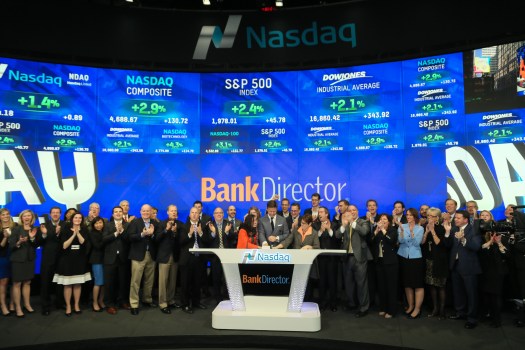
mc_030116_hires-4
Closing bell ceremony at Nasdaq / Bank Director + FinXTech’s FinTech Day (March 1, 2016)

In advance of that announcement, I invite you to follow me on Twitter via @AlDominick, FinXTech’s President, Kelsey Weaver @KelseyWeaverFXT, @BankDirector and our @Fin_X_Tech platform and/or check out where and how this annual Summit — and these awards — fits into FinTech Week New York that we are hosting along with Empire Startups starting April 24.
We Are On To FinTech Week

#AOBA17 conference intel (Friday)
By Al Dominick, CEO of Bank Director | @aldominick

Quickly

  • The “bank of the future” is not about technology, it is all about customers.
  • For many financial institutions, the time may be right to retire legacy systems for cloud-based platforms.
  • Numerous financial technology companies are developing new strategies, practices and products that will dramatically influence the future of banking..

_ _ _

The intersection of technological innovation with strong depository franchises may lead to more efficient banking processes, reductions in fraud and a win/win/win for banks, financial technology firms (fintechs) and consumers.  Globally, nearly $23 billion of venture capital and growth equity has been deployed to fintechs over the past five years, and this number is growing quickly. Still, the nature and extent of impact that fintechs have on the industry remains unclear.

Throughout this week’s Acquire or Be Acquired conference, bank CEOs talked about the continually changing nature of financial services — with fintech often front and center.  For many, collaboration between traditional institutions and emerging technology firms bodes well for their future.  Here, Bank Director’s FinXTech provides authoritative, relevant and trusted content to a hugely influential audience, specifically:

  • Fintechs who view banks as potentially valuable channels or distribution partners;
  • Banks looking to grow and/or innovate with fintech companies’ help and support; and
  • Institutional investors, venture capitalists, state & federal regulators, government officials and academicians helping to shape the future of banking.

We designed FinXTech as a peer-to-peer resource that connects this hugely influential audience around shared areas of interest and innovation.  As a host of FinTech Week in New York City this April 24 – 28 (along with Empire Startups), we bring together senior executives from banks, technology companies and investment firms from across the U.S. to shine a light on what is really generating top line growth and bottom line profits through partnerships, collaboration and investments.

bank-slide-05

Given the changing nature of banking today, this week-long event in New York City looks at the various issues impacting banks, non-banks and technology companies alike.  So as we move towards FinTech Week in New York City, I invite you to follow me on Twitter via @AlDominick, FinXTech’s President, Kelsey Weaver @KelseyWeaverFXT@BankDirector and our @Fin_X_Tech platform and/or check out the FinTech Week New York website for more.

Bank Director’s new Tech Issue

Earlier this week, we published the December issue of Bank Director Magazine, our annual Tech Issue.  Stories range from the changing nature of mobile banking to institutions moving into the cloud to a venture capitalist’s perspective on the future of banking.  I invite you to take a look.

Since starting this blog in 2012, I’ve shared my optimism that the intersection of technological innovation with strong depository franchises may lead to more efficient banking processes, reductions in fraud and a win/win/win for banks, FinTechs and consumers.  So as I read through this current digital issue, a few key takeaways:

  • When San Francisco-based Bank of the West, an $80.7 billion asset subsidiary of BNP Paribas Group, analyzed last year the bottom line impact of customers who are engaged in online banking and mobile banking, it found some surprising results. Digital customers, or those who were active online or on their mobile phones during the previous 90 days, had lower attrition rates than nondigital customers, and they contributed higher levels of revenue and products sold, said Jamie Armistead, head of digital channels at Bank of the West.
  • Automating the small-business lending process requires some deep thinking from boards and management about how much faith they’re willing to place in technology, and their ability to embrace the cultural change implicit in basing lending decisions more on data than judgment. “The marketplace is demanding quicker decisions through technology,” says Pierre Naude, CEO of nCino, a maker of bank operating systems. Bank customers, he says, are clamoring for special products and specialized coding that enable greater automation of the small-business lending process. “Bankers are waking up to the fact that speed and convenience will trump price. You can lose a customer to an alternative lender if you don’t have it.”
  • As our Editor, Naomi Snyder, shares in her welcoming letter, banks tend to have the usual board committees (think audit, compensation and risk).  But we know that few have a board-level technology committee.  So I wonder if 2017 is the year that more institutions decide to create such a group to become better informed and better prepared as the digitization of the banking industry continues?

Concomitant to this issue’s release, Chris Skinner shared his perspectives on the state of FinTech our FinXTech platform.  In his words, “it is apparent that the fintech industry has become mainstream just as fintech investing cools. What I mean by this is that fintech has matured in the last five years, going from something that was embryonic and disruptive to something that is now mainstream and real. You only have to look at firms like Venmo and Stripe to see the change. Or you only have to consider the fact that regulators are now fully awake to the change and have deployed sandboxes and innovation programs. Or that banks are actively discussing their fintech innovation and investment programs… Fintech and innovation is here to stay.”

Clearly, the pace of change in the banking space continues to accelerate.  Accordingly, I encourage you to check out what we’re doing with both Bank Director and FinXTech to help companies who view banks as potentially valuable channels or distribution partners, banks looking to grow and/or innovate with tech companies’ help and support; and institutional investors, venture capitalists, state & federal regulators, government officials and academicians helping to shape the future of banking.

Without A Destination, What Good Is A Map?

Highlight: as executives grapple with a fast-changing operating environment that requires partnerships and collaboration, many wrestle with where they want to be vs. where they need to be.

In this video, I share my thoughts on growing through partnerships (between traditional banks and financial technology firms), becoming “data richer” and enhancing the customer experience you’re delivering.

FWIW, this video lives on FinXTech.com, a site designed to provide authoritative, relevant and trusted content to a hugely influential audience, specifically:

  • Fintech companies who view banks as potentially valuable channels or distribution partners;
  • Banks looking to grow and/or innovate with fintech companies’ help and support; and
  • Institutional investors, venture capitalists, state & federal regulators, government officials and academicians helping to shape the future of banking.

As a platform powered by Bank Director, FinXTech connects this hugely influential audience around shared areas of interest and innovation.  FinXTech specializes in (1) bringing valuable bank relationships to fintechs, and (2) offering banks valuable relationships with fintechs in a way no one else does.

Early Takeaways from Bank Director’s Growing the Bank Conference

With continuous pressure on bankers to grow earnings, developing clear strategies, repeatable practices and incorporating exceptional user-experience technologies has to be high on almost every executives to-do list.

How do you bank?

By taking a pause before answering this question, you will appreciate how, regardless of age, we all expect greater pricing transparency, ease of use and always-on access to personal information as part of an integrated banking experience.  The challenge for most bankers?  What many consider state-of-the-art today — in terms of features and services — quickly becomes part of the norm that will be expected and insisted upon in the coming years.

At this morning’s Growing the Bank Conference, I jotted down a few thoughts that builds on this “how do you bank” query.

  • When it comes to the classic build or buy technology decision, partnerships are now de rigueur — with 87% of our 240+ person audience indicating they see technology as presenting opportunities to banks (and not threats).
  • Historically, banks organize themselves along a line of products; however, many have suggested re-orienting operations around customer needs and expectations.
  • To retain deposits, banks should ramp up their customer relationship programs, increase cross-selling efforts and invest in product lines that attract stable deposits.

While we haven’t gotten deep into the payments space (yet), I do encourage bank executives to think about the dramatic growth in that area of banking  — which continues to transform how efficiently banks connect with their customers.  Likewise, I wasn’t kidding when I suggested attendees spend some time reading the OCC’s “Supporting Responsible Innovation” white paper.

Finally, a “did-you-know” that I meant to share from the stage during my conversation with Brian Read, Executive Vice President, Retail Banking, Umpqua Holdings Corp. and Umpqua Bank.  According to the Federal Reserve, 85% of mobile banking users — a bank’s “most advanced” clients — still use branches from time to time. So as he shared with us, there really is a place for a physical presence in banking today.

##

*FWIW, we’re in Dallas at the Four Seasons Resort and Club Las Colinas in Dallas, Texas where the annual Byron Nelson golf tournament wrapped up yesterday evening.  The picture above is of Jordan Spieth — the former number one player in the Official World Golf Ranking and two-time major winner — a gift to some of my team who were intent on getting a photo of him.  As a former student of St. Marks, I will not hold it against him that he went to Jesuit, a rival high school.

Banking on Fintech DNA

As we talked about at FinTech Day last Tuesday, technology will play a fundamental role in changing the dynamics of banking, be it shining a light on out-dated practices to dramatically enriching the services and experiences being offered to customers.

By Al Dominick, President & CEO, Bank Director

As our editor-in-chief recently wrote, “technology has always been integral to banking, bringing both speed and efficiency to a transaction-intensive business. But in recent years, technology has stepped onto center stage as a prime component in every bank’s growth and distribution strategy. Technology has, in effect, gone from being a way to save money (a crucial function that it still fulfills) to a way to make money. Much of this activity is being driven by the continued growth of mobile and online banking.”

During a panel session entitled “Banking’s New DNA,” I noted how numerous financial technology companies are developing new strategies, practices and products that will dramatically influence the future of banking.  Within this period of transformation, where considerable market share is up for grabs, I believe ambitious banks can leapfrog both traditional and new rivals.

I find the narrative that relates to banks and fintech companies has changed from the confrontational talk that existed just a year or two ago.  As we found at this year’s FinTech Day in New York City, far more fintech players are expressing their enthusiasm to partner and collaborate with banking institutions who count their strengths and advantages as strong adherence to regulations, brand visibility, size, scale, trust and security.  For me, considering such a partnership affords a bank’s leadership team an important chance to look in the mirror and ask:

  1. Are we exceeding our customer’s digital experience expectations?
  2. How do we know if we’re staying relevant?
  3. Do we have a “Department of No” mindset?

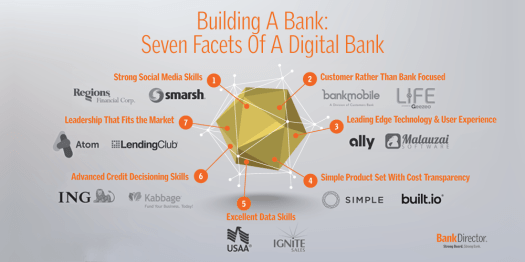
I elaborate on these pieces in an article now up on BankDirector.com; to read it, please click here.  Likewise, take a look at the seven facets of building a digital bank.  When it comes to the DNA one needs to compete in the future, I find these elements essential to any operation. 7 elements of a digital bank - by Bank Director and FinXTech

Feel free to comment on these questions and the elements shared above.  What else do you think could/should be added and considered?

Bank Director’s annual Tech Issue is now available for free

Take a look at Bank Director’s just-published “Tech Issue.” In it, we look at how bank CEOs and executive teams can better engage with fintech companies, what the biggest banks are doing in terms of technology strategy and what the Internet of Things (IoT) means for financial institutions in 2016.

To download this free issue:

  1. On Your Tablet or Mobile Device, Select Apple’s AppStore, Google Play or Amazon’s Apps;
  2. Search “Bank Director Digital Magazine;” and
  3. Download the App to Your Digital Device & Enjoy.

Happy Holidays!

How We Are Taking a Lean Startup Approach to our Grown-up Business

A lean startup methodology enables entrepreneurs to efficiently build a company by searching for product and/or market fit rather than blindly trying to execute.  I find it helps mature companies too — and thought the perspectives of Stanford Professor Steve Blank, Silicon Valley entrepreneur Ben Horowitz and Y Combinator’s Sam Altman might resonate with bankers, fintech companies and other small business CEOs that are thinking about how to adapt their businesses to new challenges and opportunities. 

Paying It Forward

By Al Dominick // @aldominick

As someone who long aspired to build and run a company, I take great pride in leading a profitable, privately-held, twenty-person-strong small business.  In the past, I have written about my “people > products > performance” approach to leading the Bank Director team.  So when Ben Horowitz (co-founder and Partner of the venture capital firm Andreessen Horowitz) shares on his blog, “it’s not about how smart you are or how well you know your business; it’s about how that translates to the team’s performance and output,” I find myself nodding in total agreement.

Look, I am so very proud of our team’s accomplishments… but I am even more excited to adapt the lean startup methodology to scale our business.  The approach we are taking builds on the wisdom and experience of others. So for anyone responsible for growing their business, allow me to recommend two “must reads:”

For me, we are “all-in” in terms of taking a lean startup approach to expanding our business without compromising our reputation for going narrow & deep, providing a “Four Seasons” level of experience at our events and delivering outstanding ideas and insights to a hugely influential audience.  In addition, we are supremely mindful to do as Sam Altman says.  That is, create something that a small number of people love rather than a product that a large number of people simply like.

H1: The Core Business

Admittedly, I am hesitant to call our approach to growing Bank Director a bootstrapping effort since the brand, relationships and revenue being generated enable us certain luxuries that many start-ups simply do not have.  Nonetheless, let me show you how we adapted the Horizon 1 (H1) and Horizon 3 (H3) framework depicted above to our business.

What began in 1991 as a traditional publishing company now operates as a privately-held media enterprise delivering original content to CEOs, executives and board members of financial services companies via digital platforms, exclusive conferences and award-winning publications.  Below is a visual example of our transformation vis-a-vis three magazine covers.  As you can see, we have matured in style while expanding our frequency (from quarterly to monthly) as we expanded our distribution channels.

Going narrow and deep works for us since we generate our revenue from the annual conferences & events we host (e.g. our 800+ person Acquire or Be Acquired conference), publications and research we publish and education & training services we provide.

H3: Where the Wild Ideas Live

With three consecutive years of top line growth (and healthy bottom line results to boot), we are in the wonderful position to grow in some pretty cool ways.  But doing so will take more than simple process improvements and expense control.  As we have a strong business foundation in place, I did have to restructure my management team’s individual roles and responsibilities to better suit our H1/H3 setup.  I did so because as Steve Blank points out, “Horizon 3 is where companies put their crazy entrepreneurs… these innovators want to create new and potentially disruptive business models.” As fun as living/working in H3 sounds, let me emphasize how much I rely on the H1 team to “defend, extend and increase” our core business.

Is it working?  Well, we will formally announce a new venture, FinXTech, on March 1, 2016 at Nasdaq’s MarketSite in New York City.  This is the first — and surely not last — project to emerge from our H3 world.  But time will ultimately tell.

We are a collection of creative men and women and I am very optimistic about our future.  Realizing that we want to continuously push to grow and innovate led me to appreciate “the need to execute (to the) core business model while innovating in parallel.”  So today’s post isn’t an attempt to make me look smart; rather, my attempt to acknowledge the inspiration of others and share what’s working for us.

The 5 Corners of Technological Innovation in Financial Services

To grasp what the future of banking holds, look no further than the five areas of focus for Wells Fargo.  Last week, the best performing large bank in the United States launched an “Innovation Group” in San Francisco.  As they share, this team will will work in partnership with its major businesses to meet evolving customer needs and stay ahead of the shifting competitive landscape.  Initially, such efforts will center on five areas:

  • Research and development;
  • Innovation strategies;
  • Payment strategies;
  • Design and delivery; and
  • Analytics.

As a nationwide, diversified, community-based financial services company with $1.7 trillion in assets, Wells Fargo now has six innovation labs along with its startup “accelerator.”  Given that a number of the world’s largest finance sector companies are reviewing their business models following the rapid growth of “fintech” entrants in the sector, the investment in both time and resources by Wells Fargo gives shape to the potential future of banking.

Wells Fargo Labs invite customers to “Come out and Play: Be one of the first to test out latest ideas and technologies – from still-in-development beta offerings to newly launched products.”

Personally, I’m drawn to this new addition to the Wells family in light of a report by the World Economic Forum, supported by Deloitte Consulting, entitled The Future of Financial Services:How disruptive innovations are reshaping the way financial services are structured, provisioned and consumed.

As noted by the paper’s lead author, “for decades, banks and insurers have employed similar, highly profitable business models. But they realize those models are coming under pressure due to fintech innovations… Financial technology companies are deploying online platforms, have small capital bases, and make strategic use of data, to acquire customers and revenues at a fast pace. Banks and insurers noted that, and are contemplating their response.”  So as major players like Wells Fargo explore the “transformative potential of new entrants and innovations on business models in financial services,” seeing the cards they are putting on the table provides real color for what the future holds for many here in the U.S.