Trending at #BDComp14

This January, at Acquire or Be Acquired, I wrote that most successful banks have a clear understanding and focus of their market, strengths and opportunities.  So one big takeaway that builds on this idea from our annual Bank Executive & Board Compensation conference (#BDComp14 via @BankDirector): it is time for a bank’s compensation committee and HR officer to reassess their viability of their performance plans and incentive programs.

Today’s agenda covered a lot of ground; namely, how economic, technological and demographic trends are reshaping the financial community. With nearly 300 attendees with us in Chicago, I heard a lot of interesting comments and questions made throughout the day. Three that stood out to me from our “on-the-record” presentations:

  • The Fed’s policies are forcing banks to ask tough questions: When will rates rise? Should I make fixed rate loans in the 4% range? How will this play out? How does it affect my stock value? (Steve Hovde, the CEO of the Hovde Group)
  • It is not what you do for people that they remember; it is how you make them feel. (Scott Dueser, the Chairman & CEO of First Financial Bankshares)
  • When it comes to Dodd-Frank, I thought we’d be through it all, but its still going full force (Susan O’Donnell, a Partner at Meridian Compensation Partners)

Trending topics
Overall, the issues I took note of were, in no particular order: loan growth is now paramount to profitability; with cybersecurity risks growing, protection is becoming more and more costly (especially in terms of time & resources); standardized loan products are reducing competitive advantages of community banks (naturally impacting compensation plan participants); if compensation plans are overly complicated, step back and ask if your are trying to solve for something else; culture and performance is what it’s all about.

More to come from Chicago tomorrow…

Let’s Talk Compensation

This Sunday, I fly to Chicago for Bank Director’s annual Bank Executive & Board Compensation Conference.  As I prepare to head towards the city that splits its allegiance between the Cubs & WhiteSox, my thoughts move from baseball — congratulations to the new World Series champion San Francisco Giants — to the people, products and performances of various financial institutions.  As I will be blogging and tweeting from our annual event, I thought to use today’s post to tee-up what you can expect on AboutThatRatio.com next Monday, Tuesday and Wednesday.

FullSizeRender

Since the demise of AIG, Bear Sterns and Lehman Brothers in 2008, take a minute and think about how many significant changes have occurred throughout the entire financial community.  From new capital requirements to greater scrutiny on executive compensation, these “Dodd-Frank” years remind me of the aftermath of Sarbanes-Oxley’s introduction in the early 2000s in as much as board members continue to wrestle with the ‘what ifs’ and ‘how comes’ of the regulatory environment.

While much of the action taken by nearly every institutions a few years ago can best be described as reactionary and defensive, it strikes me that there are quite a few banks transforming their operating models to stay both relevant and competitive today.   For this reason, I am excited for our team to host several hundred bank executives and outside directors focused on the creation of sustainable long-term value for shareholders next week.  In terms of posts:

  • Monday’s looks at the recruitment, development and compensation of a bank’s most essential talent — both within a bank and on its board.
  • On Tuesday, the “main day” of our conference, I will share the trending topics from the day.  Last year, I wrote how board members and executives continued to struggle with measuring executive performance and retaining key talent.
 At the same time, I made note that many felt the environment in which banks operate in demands productivity, proficiency with technology and the ability to sell.  So I’ll juxtapose last year’s findings with this year’s themes.
  • Wednesday’s piece will be a bit simpler, a 90 second video I’ll have filmed from the conference.

Next Friday’s column?  More of a behind-the-scenes picture recap of the conference as I recently did for Bank Director’s “anniversary.”  Throughout, you can keep track of various conversations on Twitter by following @BankDirector and me, @AlDominick and/or by using #BDComp14.

Happy Halloween!

In advance of Washington & Lee’s annual Entrepreneurship Summit

Good morning from the campus of the 9th oldest university in the United States: Washington & Lee. Yes, I am back in Lexington, VA to speak at my alma mater’s 3rd annual Entrepreneurship Summit. So in lieu of my traditional Friday post on banking, today’s column highlights three points (specific to social media) that I will expand upon in a few hours.

W&L

I am fortunate to share today’s stage with a number of successful fellow Generals.  I love this school, and thought to share the presentation I put together for this two-day event (see: W&L 2014 Presentation). As you will see — and maybe hear — I’ve broken it into three parts that all relate to leveraging social media in a small, growing and profitable business:

  1. You can’t manage what you can’t measure — with a look at “the stats” we use at Bank Director to gauge progress and success;
  2. A juxtaposition of JPMorgan Chase’s #AskJPM fail with TD Bank’s wildly popular Automated Thank You Machine; and
  3. Inspiration from our recent FinTech day at the NASDAQ MarketSite and a conversation I had with BNY Mellon’s head of innovation about Staying Relevant While Standing Out.

If you are a student at W&L, I hope you will pay close attention to the final slide in this shared presentation. It speaks to the internship opportunities we have for interested and qualified applicants looking for a paid position in Nashville next summer.

Aloha Friday!

Today is FinTech Day at NASDAQ (here’s what you need to know)

The who, what, when, where and why of FinTech Day at NASDAQ, a collaboration between the exchange and my company, Bank Director, that celebrates the contributions of financial technology companies — fintech for short — to banks across the U.S.


photo-18

Who: Bank Director, a privately-held media & publishing company focused on issues fundamental to a bank’s CEO, senior leadership team and board members, teams up with the NASDAQ OMX to showcase various technology-driven strategies and tactics successful banks use to fuel profitable, sustainable growth.

What: FinTech Day at the NASDAQ

When: Today, September 8

Where: The NASDAQ MarketSite (4 Times Square – 43rd & Broadway)

Why: Because who says there is no innovation in banking?  During this day-long event, we keep our focus on a board’s level, exploring growth opportunities made possible by various technology products and services.

To Watch: We will welcome a number of executives from the Fintech community throughout the day, along with one of the country’s biggest (and actually, oldest) institutions: BNY Mellon.  Personally, I’m looking forward to chatting with their Managing Director – Strategic Growth Initiatives, Declan Denehan, at 2 PM ET for an hour-long session focused on innovation, competition and staying relevant. Thanks to our friends at NASDAQ, you can watch the live feed for free (click here to register and watch).  At 3:55 ET, I’ll join our publisher, Kelsey Weaver, to ring the closing bell. A webcast of the NASDAQ Closing Bell will be available (click here or here) if you are keen to see how we wrap up FinTech day.

Of Social Note: To follow the conversation, let me suggest these twitter handles: @bankdirector, @nasdaqomx, @bankdirectorpub and @aldominick. For photos from the ceremony and event, you can visit NASDAQ’s Instagram Page or Facebook page later today.  As we are all about being a part of the community and broader conversations, Bank Director will use #fintech for its tweets.

A Pop Quiz on the Future of Banking

I was not planning on a sixth consecutive column focused on non-bank competition; however, as I prepare to present at Moss Adams’ 14th Annual Community Banking conference in Huntington Beach, California on August 26, a “bonus” post on this topic.  As you will see, today’s piece builds on the premise that many community bank leaders have real opportunities to expand what banking means to individual and business customers by offering services that go beyond a traditional business model. So to wrap up this week, sharpen your pencils for this pop quiz.

1280px-Flag_of_California.svg

Are WE the generation that has learned how to live without a bank?
So much has been written about millenials learning to live without a bank… but ask yourself: have you learned how to live without your bank?  If you could not direct deposit your paycheck, do you have ready alternatives?  I thought so.  Financing for your house? Your business?  I am simply pointing out the inconvenient truth that it is not just the wet-behind-the-ears customers that might already know how to live without a bank.  That said, just because many have learned to live “without” a traditional banking relationship doesn’t mean most want to.  I will let a thought from Diebold support this thought, but before I do, have to ask:

Who’s getting that Kabbage?

As a platform for online merchants to borrow working capital, Kabbage fills a small business lending gap that I have to imagine many community banks should desire (h/t Mitchell Orlowsky @ Ignite Sales).  As I learned this week, Kabbage works with small businesses that are unable to obtain credit from traditional sources. According to TechCrunch, “the startup has closed a $270 million credit facility from Guggenheim Securities, the investment banking and capital markets division of Guggenheim Partners. Atlanta, Georgia-based Kabbage will use the funds to build out its financing business both in the U.S. and beyond. This is one of the largest credit facilities ever issued to a small business lender, and possibly the biggest in the online lending space.” Since opening for business almost three years ago, Kabbage has advanced more than $250 million to small businesses, the company says   Just another example of competition facing many business-oriented banks today.

If Diebold can change, why can’t you?
From the outside looking in, one can make the case that the last truly disruptive technology for banks was the ATM. And when you think ATMs, Diebold has to be top-of-mind.  So when the technology company acknowledges the following, why can’t more banks course correct and be where people are going (and not where they might appear to be)?

The retail financial services industry is in the midst of an epic change and will soon look very different than it did just a few years ago. Consumers are changing what they want out of their banks. Our research proves that consumers want additional convenience to access their bank anytime, anywhere, anyhow, all while maintaining a personal connection with their bank.

##

Regardless of how you did on this pop quiz, please feel free to leave a comment below by clicking on the white plus sign (within the grey circle at the bottom of this page).  I invite you to follow me on Twitter (@aldominick) where you can publicly or privately share your thoughts with me.

Aloha Friday!

In the Face of Intense Competition

Financial institutions face intense competition from non-banks like PayPal, American Express, Walmart and Quicken Loans…  and a rapidly changing demographic that demands new approaches to attract and retain customers (be it individual or business).  Today’s post takes a look at two financial technology companies working to keep banks relevant as customers increasingly expect a“one stop shop” in all areas of their lives.

American-Flag-Wallpaper-Phone

Over on FiveThirtyEight.com

On FiveThirtyEight, Nate Silver’s newly launched website at ESPN, the editorial team leverages statistical analysis to tell compelling stories about politics, science and yes, sports.  While much digital ink has been spilled on this week’s NFL draft,  the site’s chief economics writer, Ben Casselman, authored a piece that caught my eye.  Thanks to a keynote presentation by Fox News’ Juan Williams at this January’s Acquire or Be Acquired conference, I’m far more aware of the changing demographics of the United States — and what that means for financial institutions.


Based on my conversations with Juan in the desert, I found early inspiration for today’s piece while pouring over Ben’s What Baby Boomers’ Retirement Means For the U.S. Economy.  In combination with economic shifts — both domestically and globally — it is clear that changing demographics are transforming businesses.  As we trend towards a younger populace, Ben writes “all else equal, fewer workers means less economic growth… If more of the population is young or old that leaves fewer working-age people to support them and contribute to the economy.”  Clearly, banks need to be prepared to serve a population that will live longer.  Maybe more importantly, they need to court their most valuable customers — Gen X&Y and Millennials (relationships built, “gulp” through online & mobile experiences).

Putting Checks into the Cloud

In the world of checks, VerifyValid acknowledges that “paper is simply a vessel for holding information. The real check is the data fields it contains: the check number, the amount, the routing number, the recipient, and most important of all, the authorizing action which says that the account holder agrees to pay the stated amount to the payee.”  I had a chance to see Paul Doyle, the company’s Founder & CEO, inspire a crowd of CEOs and board members at The Growth Conference last week.  Flying home from New Orleans, I spent some time learning how the company overcame the challenge in providing this information electronically in such a way that prevents fraud.  As I see it, VerifyValid lowers an organization’s costs while increasing efficiency and financial security with every payment.  IMHO, their 2 minute, 25 second video is worth a watch.

Making Money Simple, Attractive and Intelligent

Located “in the heart of Utah’s Silicon Slopes,” MoneyDesktop is redefining the way millions of people interact with their finances.  As one of the fastest-growing financial technology providers, MoneyDesktop positions banks and credit unions as the financial hub of their account holders — think Mint on steroids — with its personal financial management, data-driven analytics and marketing technologies.  Some 450 financial institutions rely on this software-as-a-service vendor… and I saw last night they have plans to grow significantly in the months to come.  They write, and I agree, that account holders are changing.  “There is an ongoing shift away from traditional brick & mortar banking (and) technology is providing better ways for account holders to interact with their money, and with financial institutions.”  An interesting company delivering a very clean and user-friendly experience.

Aloha Friday!

Who Says There Is No Growth In Banking

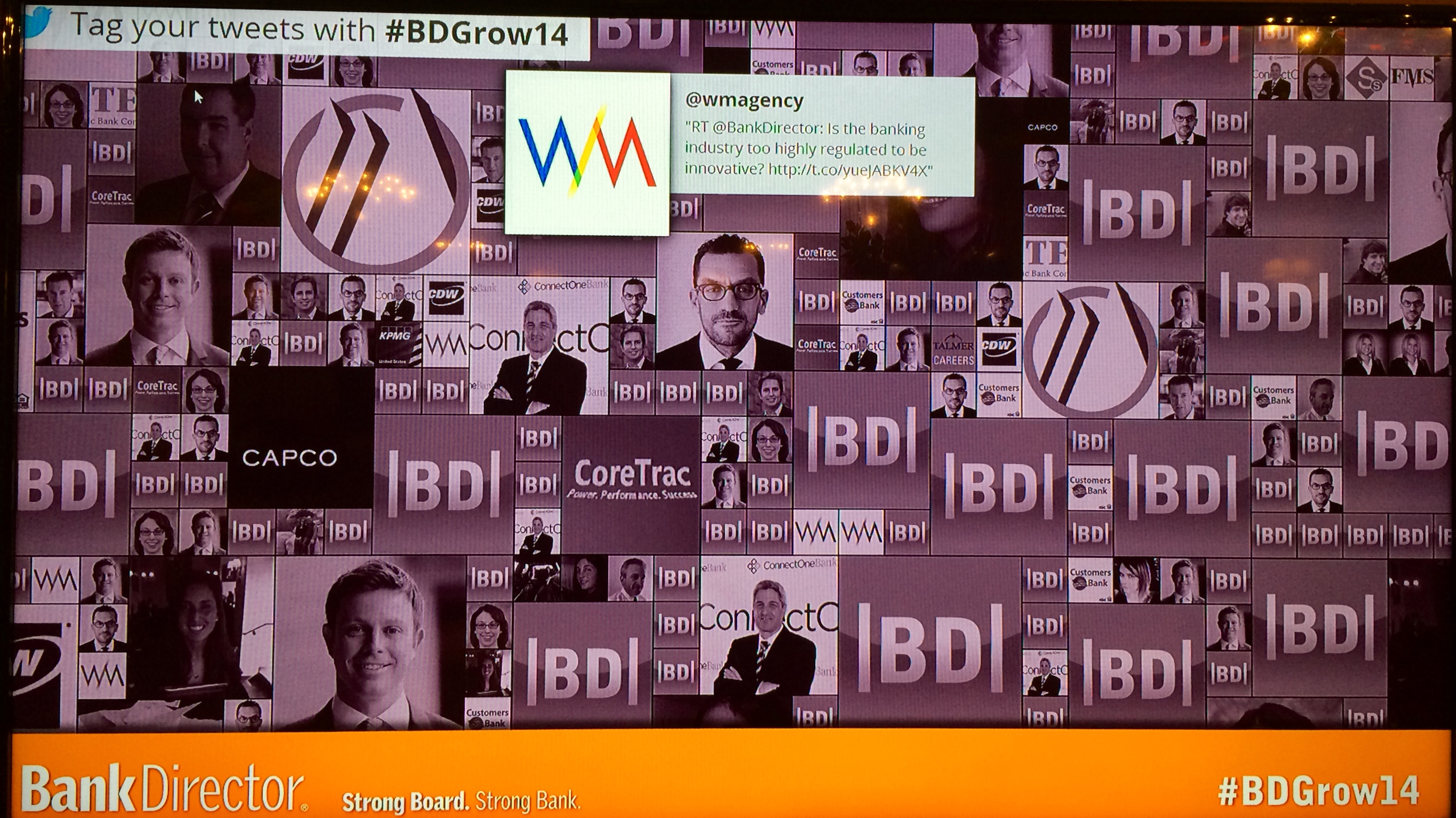
Two big takeaways from the second day of Bank Director’s 2nd annual Growth conference (#BDGrow14): institutions of all sizes are challenged when it comes to standing out from the crowd & enhancing your mobile banking presence should be a top priority for all boards of directors.

A 2 Minute Recap on the Past 4 Months


Take No Risk, Make No Money
While some may not think about enterprise risk management in the context of growing one’s bank, Crowe’s Jennifer Burke made clear that proactively identifying, mitigating, and in some cases, capitalizing on risks provides a distinct advantage to a bank.  Keep in mind that even smaller institutions — with less complex business structures — face myriad risks that might significantly affect their ability to meet their growth plans.  As Jennifer shared, those that proactively identify and respond to risks and opportunities gain a competitive advantage over their peers, especially in responding to our ever-changing business environment.

Millennial and the End of Banking?

The Times-Picayune ran a nice story in today’s edition based on The Growth Conference.  The newspaper noted that “younger generations report more comfort with online and mobile banking tools, posing a hurdle for banks used to ginning up business through face-to-face interactions.”  So it is fair to ask if banks should be scared of the millennial generation.  According to Daryl Byrd, president and CEO of IberiaBank, the answer is no.  As mentioned in this piece (Will Millennials be the end of banking as we know it? Bank execs weigh in at Growth Conference in New Orleans), Byrd was among a panel of industry leaders gathered at the Bank Director Growth Conference to discuss business trends, including the challenges in reaching younger customers.  Byrd, “who noted he is the father of three Millennials, said his children, like many in their generation, aren’t building wealth as much as they are taking on debt. That means their demand for banking services will be limited in the near term,” he said.

Trending Topics

The issues I took note of this morning were, in no particular order:

  • Just like “synergy” became a cliché, so too might “omni” when it comes to delivering a consistent customer experience (e.g. omni-screen, omni-channel, etc);
  • Not all customers are created equally;
  • A bank’s board has the chance to re-set strategies to target, acquire, engage, grow and retain customers… but need to look ahead to what’s possible as opposed to the past to see what has historically delivered results.

To comment on this piece, click on the green circle with the white plus sign on the bottom right. Safe travels home to all who joined us in New Orleans this week (and yes, Aloha Friday!)

The Growth Conference – Thursday Recap

It is obvious that the most successful banks today have a clear understanding of, and laser-like focus on, their markets, strengths and opportunities.  One big takeaway from the first full day of Bank Director’s Growth Conference (#BDGrow14 via @bankdirector): banking is absolutely an economies of scale business.

photo-7

A 2 Minute Recap


Creating Revenue Growth

At events like these, our Publisher, Kelsey Weaver, has a habit of saying “well, that’s the elephant in the room” when I least expect it.  Today, I took her quip during a session about the strategic side of growth as her nod to the significant challenges facing most financial institutions — e.g. tepid loan growth, margin compression, higher capital requirements and expense pressure & higher regulatory costs.  While she’s right, I’m feeling encouraged by anecdotes shared by growth-focused bankers considering (or implementing) strategies that create revenue growth from both net interest income and fee-based revenue business lines. Rather than lament the obstacles preventing a business from flourishing, we heard examples of how and why government-guaranteed lending, asset based lending, leasing, trust and wealth management services are contributing to brighter days.

Trending Topics
Overall, the issues I took note of were, in no particular order: bank executives and board members need to fully embrace technology; there is real concern about non-bank competition entering financial services; the board needs to review its offerings based on generational expectations and demands;  and those that fail to marry strategy with execution are doomed. Lastly, Tom Brown noted that Bank of America’s “race to mediocrity” actually makes it an attractive stock to consider.  Who knew being average can pay off?

##

To comment on this piece, click on the green circle with the white plus (+) sign on the bottom right.  More tomorrow from the Ritz-Carlton New Orleans.

The Single Greatest Constraint on Growth

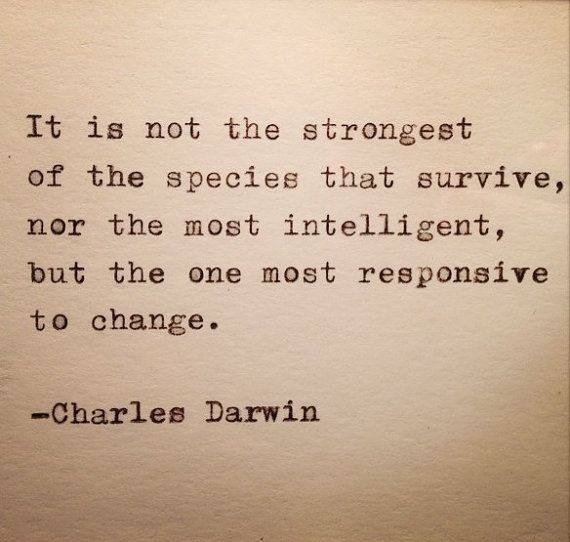
With the revenue pressures facing the banking industry being some of the most intense in decades, banks need to think more constructively about their businesses. At the same time, changing consumer behavior could drive the industry to reallocate its resources to less traditional growth channels in order to stay ahead.  In my view, the words of an English naturalist reflect the single greatest constraint on growth today.

photo-6

Powerful Forces

One of our long-term corporate sponsors, PwC, recently shared their thoughts on the future of the retail banking industry.  In their view, “powerful forces are reshaping the banking industry, creating an imperative for change. Banks need to choose what posture they want to adopt – to lead the change, to follow fast, or to manage for the present. Whatever their chosen strategy, leading banks will need to balance execution against… critical priorities and have a clear sense of the posture they wish to adopt.”  If you, like our friends from PwC, are joining us in New Orleans later this week to dive into this very topic, their compelling “Retail Banking 2020” report might make for good airplane company.

Looking Back in Order to Look Ahead

Last year, John Eggemeyer, a Founder and Managing Principal of Castle Creek Capital LLC, helped me to kick off our inaugural Growth Conference.  As a lead investor in the banking industry since 1990, he shared his views on our “mature industry,” That is, banking follows a historic pattern of other mature industries: excess capacity creates fierce competition for business which in turn makes price, not customer service, the key differentiator.  While offering myriad thoughts on what makes for a great bank,  John did share some hard-to-swallow statistics and opinions for a crowd of nearly 200 bankers and industry executives:

  • Publicly traded banks from $1 billion to $5 billion in assets saw their stock values rise at about half the rate of the broader market as a whole since early 2009.
  • Of the 300 or so publicly traded banks in that size range, only about 60 of them traded at their pre-recession price multiples.
  • In the last 40 years, bank stocks always followed the same pattern in a recession: falling in value quicker than the rest of the market and recovering quicker.

I share these three points to provide context for certain presentations later this week.  Some build on his perspectives while others update market trends and behavior.  Still, an interesting reminder of where we were at this time last year.

Getting Social-er

Yesterday, I shared the hashtag for The Growth Conference (#BDGrow14).  Thanks to our Director of Research — @ehmccormick — and Director of Marketing — @Michelle_M_King — I can tell you that nearly 30% of the attending banks have an active twitter account; 78% of sponsors do.  On the banking side, these include the oldest and largest institution headquartered in Louisiana — @IBERIABANK, a Connecticut bank first chartered in 1825 with over $3.5 billion in assets — @LibertyBank_CT and a Durham, NC-based bank that just went public last month — @Square1Bank.  On the corporate side of things, one of the top marketing and communications firms for financial companies —@wmagency, a tech company that shares Bank Director’s love of orange — @Fiserv and a leading provider of personal financial management — @MoneyDesktop join us.  Just six of many institutions and service providers I’m looking forward to saying hello to.

##

More to come — from New Orleans, not D.C. — tomorrow afternoon.

Since You Can’t Own a Car Dealership

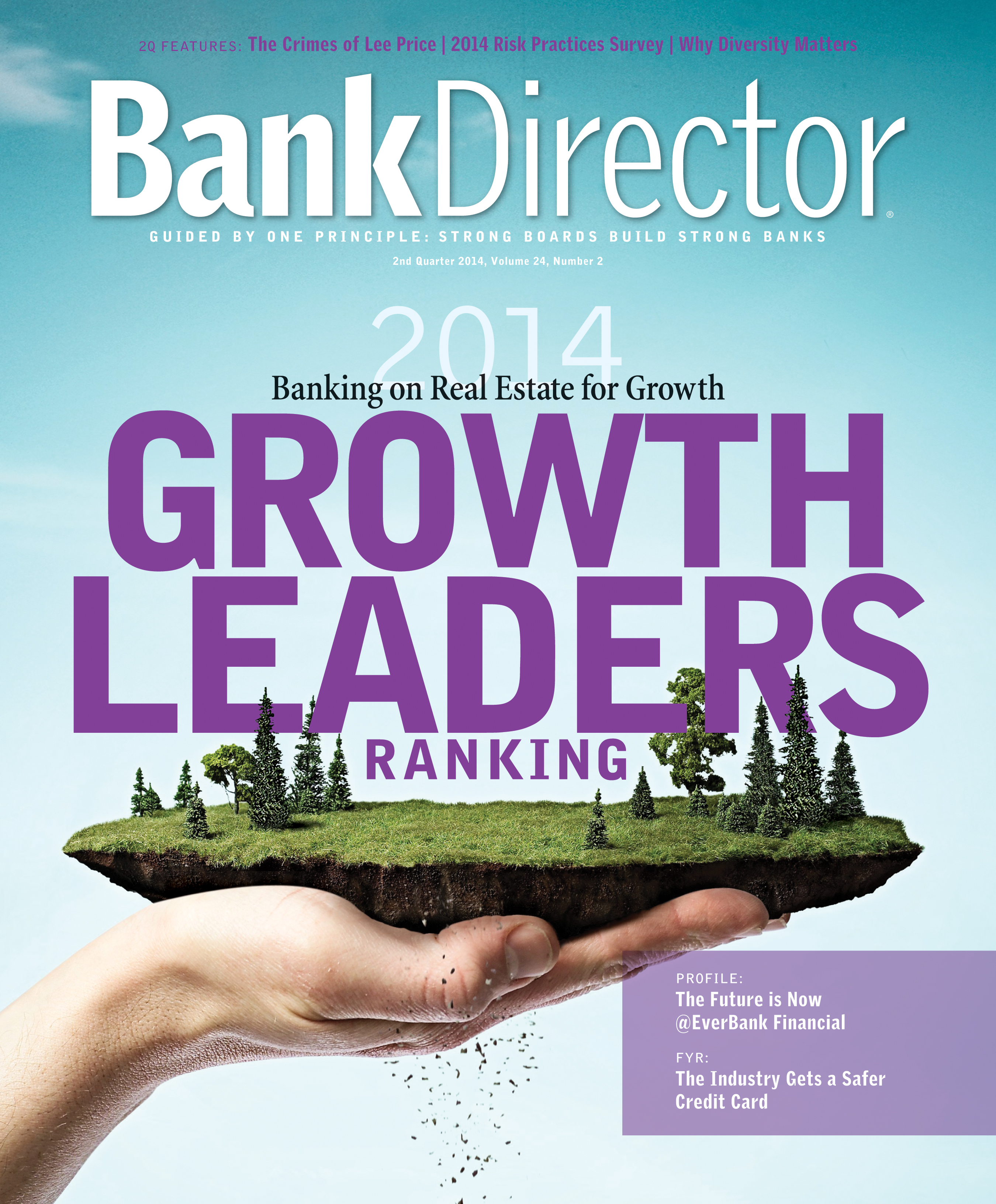
As my colleague Jack Milligan writes in our 2nd quarter issue of Bank Director magazine, just because a bank can’t own a car dealership doesn’t mean there isn’t “enormous flexibility in determining a bank’s strategy.” Curious what this means? Read on.

2Q14

A Sneak Peek at the Core Revenue Champs

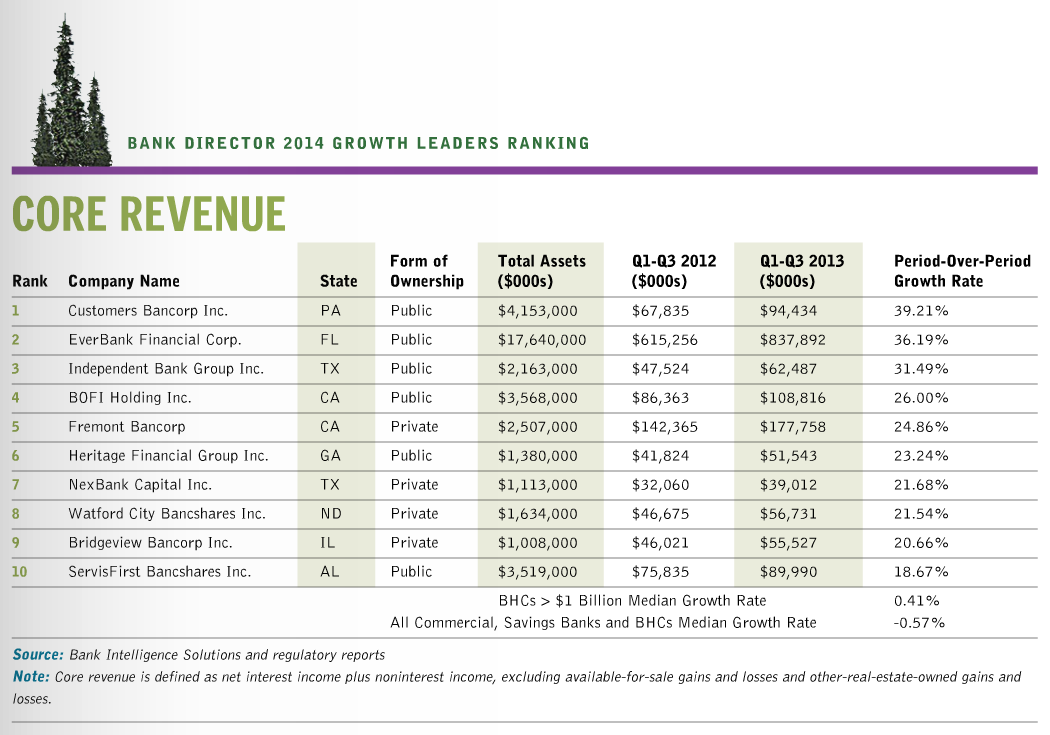
Each year, Bank Director magazine looks at all U.S. banks and thrifts to identify the strongest growth banks. We rank the top performers across four separate categories: core deposits, core noninterest income, net loans and leases and the most important, core revenue. Since the magazine mails today, I thought to offer a sneak peek of the results:

Screen Shot 2014-04-24 at 6.06.07 AM

What I find interesting about the top two banks on this very strong list: both Customers Bank and EverBank Financial designed their business models around technology from their very beginnings.

Find Your Balance

As I read through an advance copy of the issue, it strikes me that many business areas that historically provided revenue growth are simply not growing fast enough to overcome new capital and regulatory requirements.  In this light, you can understand why many say times couldn’t be more challenging for growth in community or regional banking. The corollary to this? Balancing organic and external growth is a key focus area for bank management and boards.

Increasingly, I hear that growth-focused banks are considering (or implementing) strategies that create revenue growth from both net interest income and fee based revenue business lines — think government guaranteed lending, asset based lending, leasing, trust and wealth management services. Clearly, as interest margins and loan volumes remain subject to compression and intense competition, the “optimization” of fee-based revenue is becoming pivotal in enhancing shareholder value.

‘Sup Big Easy

True, a number of banks seek to extend their footprint and franchise value through acquisition. Yet, many more aspire to build the bank internally.  Some show organic growth as they build their base of core deposits and expand their customer relationships; others leverage product innovation or focus on their branch network. I bring these approaches up in advance of next week’s Growth Conference at the Ritz-Carlton, New Orleans. We designed this event to showcase strategies, structures, processes and technologies that a bank’s CEO and board might consider to fuel their own growth.

Unlike trade shows and other events, we limit participation to a financial institution’s key officers and directors to ensure those joining us are not just committed to distinguishing their performance and reputation, but also are appropriate peers to share time and ideas with. From companies like StrategyCorps, Ignite Sales and VerifyValid to PwC, Fiserv and IBM, we have a tremendous roster of companies joining us in Louisiana to share “what’s working” at the myriad banks they support. As I’ve done for our other events (e.g. the sister conference to Growth, Acquire or Be Acquired), I’ll be posting a number of pieces next week from the Crescent City and invite you to follow along on Twitter via @aldominick, @bankdirector and using #BDGrow14.

Aloha Friday!

The Three Ds of Banking

Just as the cherry blossoms provide a welcome personal respite from winter’s cold embrace, so too have stories of creativity and growth diverted my professional attention away from compliance issues and regulatory updates.  As I travel across the country, I’m continually impressed by the close attention being paid by leaders at financial institutions to non-traditional sources of revenue — particularly fee-based income.  Today’s tip sheet reflects these recent travels and commensurate “lessons learned” with three words, a big three if you will, that tie-in to growing one’s business.

photo-4

Diversify

In order for banks to thrive in what, in many regions, remains a crowded marketplace, diversified growth is key.  I’ve heard from a few community bank CEOs that given the nature of the economic recovery and uncertainty over interest rates, quality growth requires a balance between real estate and operating company borrowers and between fixed and floating rate loans.  Without such balance, earnings and shareholder value are at increased risk.

Differentiate

The general public still does not distinguish enough between Wall Street banks and Main Street community banks.  Nonetheless, more and more bankers are making this distinction, thereby helping customers (and potential customers) to understand how important community banks are to the economy and the local region.  It strikes me such efforts will not only educate, but also encourage, more and more people to support community banks with their business.

Deliver

As the workplace becomes more mobile, so must the tools to deliver the financial services to business owners and individuals.  Clearly, the “new generation of consumers” does everything on their mobile phone.  If a bank doesn’t have a mobile app — and a quality mobile offering — I have to believe the bank does not even register to this up and coming audience.  In fact, as more Gen X and Gen Y’rs become a more sizable force in terms of total GDP, I’ve heard that one’s mobile banking solutions will be directly proportional to the amount of clients a bank is able to attract and retain.

Aloha Friday!

FI Tip Sheet: First Quarter Favorites

As I come off of a great week in Chicago and Bank Director’s annual Chairman/CEO Peer Exchange, today’s post takes a look back at the first three months of the year.  Yes, certain discussions during this time focused on tepid loan growth, higher capital requirements and expense pressures & higher regulatory costs hitting banks today.  Nonetheless, many more conversations focused on growth, innovation and “what’s working.”  So, to wrap up this week, three points from the past ninety days that inspired me.

AboutThatRatio = image for Jan 10.001

Some of Banking’s Best

To kick off the year, I put together a two-part series on some of the top CEOs in our industry.  Inspired by my coach and an article entitled the “Best CEOs of 2013” that ran on Yahoo Finance, I reached out to a number of colleagues that work for professional services firms to ask their thoughts on the top CEOs at financial institutions — along with why they hold them in such regard.  Part one shared various thoughts on some of the best CEOs in the business today — broken down into three categories: the “biggest banks” with $50Bn+ in assets, those with more than $5Bn but less than $50Bn and finally, those in the $1Bn to $5Bn size range.  Part two built on that piece, highlighting three exceptional CEOs that lead publicly traded banks before shifting to the thoughts and opinions of two very talented colleagues.

Eat or Be Eaten

As the President of Bank Director, I’m lucky to lead one of the industry’s biggest (and dare I say best?) M&A conferences: Acquire or Be Acquired.  Let me first offer up big time props to my many talented colleagues for everything they did to make this year’s the biggest and best yet!  One of the cool new things I did at the Arizona Biltmore this year?  Film a 90 second or less video each evening that summarized the day’s salient points.  As much as I shared big takeaways in written form on this site (e.g. what if I told you that by December 31, 2018, we’d witness a 25% decline in the number of institutions between $500mm and $1Bn), I’m proud of these two videos from the desert that relayed what caught my eyes and attention on two of the three conference days.


.

The Innovator’s Dilemma

In my role, I find myself talking with Chairmen and CEOs about their strategic plans.  This year, quite a few shared their thoughts for leveraging financial technology to strengthen and/or differentiate their bank.  In a piece I shared at the end of February, I cited Clayton Christensen’s “The Innovator’s Dilemma: When New Technologies Cause Great Firms to Fail.”  His book inspired that Friday’s FI Tip Sheet title – and first point.  If you’re not familiar with his work, the Harvard professor writes about two types of technologies: sustaining and disruptive. Sustaining technologies are those that improve product performance. As he sees it, these are technologies that most large companies are familiar with; technologies that involve improving a product that has an established role in the market.

Most large companies are adept at turning sustaining technology challenges into achievements.  However, large companies have problems dealing with disruptive technologies — an observation that, in my view, does not bode well for many traditionally established banks.  While risk is inherent to banks of all sizes, taking chances on emerging technologies continues to challenge many officers and directors… a theme I anticipate covering in greater detail over the next 90 days.

##

Whether this is your first time or 78th time reading About That Ratio, let me say thank you for doing so.  It is a real treat to share, each Friday, three short stories about what I’m hearing, learning and talking about as I travel around the country.  Being that I meet with so many interesting people — be it a bank’s CEO,  board members or executives at professional services firms and product companies — I find it tremendously rewarding to share anecdotes and insights that might interest others.  As always, Aloha Friday!