Bank Director’s 2015 Acquire or Be Acquired Conference Primer

On Sunday, January 25, we kick off Bank Director’s 21st annual “Acquire or Be Acquired” Conference (@bankdirector and #AOBA15) at the luxurious Phoenician resort in Scottsdale, Arizona.  I am so very excited to be a part of this three day event — and am supremely proud of our team that is gearing up to host more than 800 men and women.  With so many smart, talented and experienced speakers on the agenda, let me share a primer on a few terms and topics that will come up.  In addition, you will find several links to recent research studies that will be cited before I share one example of the type of issues being both presented and addressed at “AOBA.”

Colorful Language

Just as M&A is a colorful — and complex — issue, so too are the words, terms and considerations used by attorneys, investment bankers and consultants in management meetings, in the boardroom or at the negotiating table.  Here are three terms I thought to both share and define in advance of AOBA (ay-o-bah):

  • Triangular merger: This happens when the acquirer creates a holding company to acquire the target and both the acquirer and the target become subsidiaries of the holding company.
  • Cost of capital: You could say this is the cost to a company of its capital, but another way to look at it simply is this: the minimum return you need to generate for your investors, both shareholders and debt holders. This is what it costs you to operate and pay them back for their investment.
  • Fixed exchange ratio: This is the fixed amount for which the seller exchanges its shares for the acquirer’s shares. If the buyer’s stock price falls significantly post-announcement, that could mean the seller is getting significantly less value.

Again, these are but three of the many terms one can expect to hear when it comes to structuring, pricing and negotiating a bank merger or acquisition.

Research Reports

Throughout the year, our team asks officers and directors of financial institutions to share their thoughts on board-specific issues — like growth and more specifically, mergers & acquisitions.  Allow me to share an overview on these two research reports along with links to the full results:

Of note: 84% of the officers and board members who responded to this Growth Strategy Survey, sponsored by the technology firm CDW, say that today’s highly competitive environment is their institutions’ greatest challenge when it comes to organic growth — a challenge further exacerbated by the increasing number of challengers from outside the industry primed to steal business from traditional banks.

Of note: There’s no shortage of financial institutions seeking an acquisition in 2015, but fewer banks plan to sell than last year, according to the bank CEOs, senior officers and board members who completed Bank Director’s 2015 Bank M&A Survey, sponsored by Crowe Horwath LLP.

Valuing a Bank

Understanding what one’s bank is really worth today is hugely important.  Whether buying, selling or simply growing organically, a bank needs metrics in place to know and grow its valuation.  On BankDirector.com this past October, I shared why earnings are becoming more important than tangible book value (Why Book Value Isn’t the Only Way to Measure a Bank). Clearly, a bank that generates greater returns to shareholders is more valuable; thus, the emphasis on earnings and returns rather than book value.  Yes, investors and buyers will always use book value as a way to measure the worth of banks. Still, I anticipate conversations at the conference that builds on the idea that as the market improves and more acquisitions are announced, we should expect to see more attention to earnings and price-to-earnings as a way to value banks.

##

Please feel free to comment on today’s piece below or share a thought via Twitter (I’m @aldominick).  More to come from the “much-warmer-than-Washingon DC” Arizona desert and Acquire or Be Acquired in the days to come.


On Bank Branches and a Bank’s Brand

When I think about top performing banks, I typically consider those with the strongest organic growth in terms of core revenue, core noninterest income, core deposit growth and loan growth.  Sure, there has been a lot of talk about growing through acquisition (heck, last week’s post, “Seeking Size and Scale” looked at BB&T’s recent acquisitions and my monthly column on BankDirector.com was entitled “Why Book Value Isn’t the Only Way to Measure a Bank“).  But going beyond M&A, I’m always interested to dive into the strategies and tactics that put profits on a bank’s bottom line.

Build Your Brand or Build Your Branch

Earlier in the week, KBW’s Global Director of Research and Chief Equity Strategist, Fred Cannon, shared a piece entitled “Branch vs. Brand.”  As he notes, “branch banking in the U.S. is at an inflection point; the population per branch has reached a record level in 2014 and is likely to continue to increase indefinitely. The volume of paper transactions peaked long ago and with mobile payment now accelerating the need for branches is waning. As a result, many banks see closing branches as a way to cut costs and grow the bottom line. However, branches have served as more than transactional locations for banks. The presence of branch networks has projected a sense of identity, solidity and ubiquity to customers that has been critical to maintaining a bank’s brand.”  He then poses this doozy of a question:

“If branch networks are reduced, what is the replacement for a bank’s identity?”

Fred and his colleagues at KBW believe banks need to replace branches with greater investments in brand. As he shares, “some of this investment will be in marketing, (as) a brand is more than a logo. We believe banks will also need to invest in systems, people, and processes to project the sense of identity, solidity, and ubiquity that was projected historically by branch networks.”

United Bank, An Example of a High-Performing Bank

One example of a bank that I think is doing this well is United Bank.  On Wednesday, I had the chance to check out their new financial center in Bethesda, MD.  With dual headquarters in Washington, DC and Charleston, WV, the $12.1 billion regional bank holding company is ranked the 48th largest bank holding company in the U.S. based on market capitalization. NASDAQ-listed, they boast an astonishing 41 consecutive years of dividend increases to shareholders – only one other major banking company in the USA has achieved such a record.  Their acquisition history is impressive — as is their post-integration success.  United continues to outperform its peers in asset quality metrics and profitability ratios and I see their positioning as an ideal alternative to the offices Wells Fargo, SunTrust and PNC (to name just three) operate nearby.

A Universal Priority

Clearly, United’s success reflects a superior long-term total return to its shareholders.  While other banks earn similar financial success, many more continue to wrestle with staying both relevant and competitive today.  Hence my interest in Deloitte’s position that “growth will be a universal priority in 2015, yet strategies will vary by bank size and business line.”  A tip of the hat to Chris Faile for sharing their 2015 Banking Outlook report with me.  Released yesterday, they note banks may want to think about:

  • Investing in customer analytics;
  • Leveraging digital technologies to elevate the customer experience in both business and retail banking;
  • Determining whether or not prudent underwriting standards are overlooked; and
  • Learning from nonbank technology firms and establish an exclusive partnership to create innovation and a competitive edge.

With most banks exhibiting a much sharper focus on boosting profitability, I strongly encourage you to see what they share online.

Aloha Friday!

Seeking Size and Scale

With Wednesday’s announcement that BB&T has a deal in place to acquire Susquehanna Bancshares in a $2.5 billion deal, I felt inspired to focus on the mergers & acquisitions space today.  You see, if 2013 was the year of the merger-of-equals (MOEs), it seems that 2014 has become the year of “seeking size and scale.”

As I’ve shared in past posts, 2013 was characterized by a series of well-structured mergers which produced a dramatic improvement in shareholder reaction to bank M&A.  For example, Umpqua & Sterling,  United Financial Bancorp & Rockville Financial and Bank of Houston & Independent Bank.  Over the past few weeks, we’ve seen some pretty interesting transactions announced that are not MOEs; specifically, Sterling Bancorp buying Hudson Valley Holding in New York, Banner picking up AmericanWest Bank in the Pacific Northwest and the afore-mentioned BB&T deal.

Don’t Be Fooled, Size Matters

As evidenced by the Sterling and Banner acquisitions, the desire for scale and efficiencies is prompting certain institutions to expand.  While regulatory costs and concerns have been cited in previous years as deterents to a transaction, isn’t it interesting that both of these deals position the acquiring institution near the $10Bn threshold (*important as crossing this asset threshold invites new levels of scrutiny and expense).  But like John Thain suggested earlier this year, “the key is being big enough so that you can support all of the costs of regulation.”  Still, comments made by Richard Davis, chairman and chief executive of U.S. Bancorp, about the BB&T agreement should temper some enthusiasm about the biggest players jumping in to the M&A space a la the $185 Bn-in-size BB&T. “This is not a deal you’d ever see us do,” he said at conference in New York hosted by Bank of America Merrill Lynch, adding “it’s both out-of-market and it’s fairly expensive.”

I’m Serious, It Matters?!?

Earlier this year, Deloitte published The Top Ten Issues for Bank M&A.  In light of the BB&T deal, it is worth revisiting.  To open, the authors opine “size matters when it comes to regulatory constraints on the banking sector: The bigger the players, the more restrictions on banking activities, including M&A. Banks with less than $10 billion in total assets face the least restriction, while the very largest Systemically Important Financial Institutions (SIFIs) experience the highest level of constraints. Among the major regulatory actions that are expected to hold considerable sway over bank M&A in 2014 are the Volcker Rule, Basel III capital requirements, global liquidity rules, stress testing, and anti-money laundering (AML) and Bank Secrecy Act (BSA) compliance laws.”

Who I’m Taking to Buy a Lottery Ticket

Finally, a tip of the hat to Frank Cicero, the Global Head of Financial Institutions Group at
Jefferies. He reminded me on Wednesday that every prediction he made in a piece he wrote for BankDirector.com at the beginning of the year has come to pass…fewer MOE’s, bigger premiums, regional banks returning to bank M&A.  Personally, I’m wondering if he wants to walk into the lotto store with me this weekend?

Aloha Friday!

Trending at #BDComp14

This January, at Acquire or Be Acquired, I wrote that most successful banks have a clear understanding and focus of their market, strengths and opportunities.  So one big takeaway that builds on this idea from our annual Bank Executive & Board Compensation conference (#BDComp14 via @BankDirector): it is time for a bank’s compensation committee and HR officer to reassess their viability of their performance plans and incentive programs.

Today’s agenda covered a lot of ground; namely, how economic, technological and demographic trends are reshaping the financial community. With nearly 300 attendees with us in Chicago, I heard a lot of interesting comments and questions made throughout the day. Three that stood out to me from our “on-the-record” presentations:

  • The Fed’s policies are forcing banks to ask tough questions: When will rates rise? Should I make fixed rate loans in the 4% range? How will this play out? How does it affect my stock value? (Steve Hovde, the CEO of the Hovde Group)
  • It is not what you do for people that they remember; it is how you make them feel. (Scott Dueser, the Chairman & CEO of First Financial Bankshares)
  • When it comes to Dodd-Frank, I thought we’d be through it all, but its still going full force (Susan O’Donnell, a Partner at Meridian Compensation Partners)

Trending topics
Overall, the issues I took note of were, in no particular order: loan growth is now paramount to profitability; with cybersecurity risks growing, protection is becoming more and more costly (especially in terms of time & resources); standardized loan products are reducing competitive advantages of community banks (naturally impacting compensation plan participants); if compensation plans are overly complicated, step back and ask if your are trying to solve for something else; culture and performance is what it’s all about.

More to come from Chicago tomorrow…

Bank Mergers and Acquisitions

Before I head out to California to speak at Moss Adams’ annual Community Banking conference, a look at the principal growth strategy for banks: mergers and acquisitions.

photo-17

Over the last few years, bank advisers have made the case that consolidation should increase due to significant regulatory burdens, lack of growth in existing markets and aging boards and management teams that are “fatigued” and ready to exit our industry.  So as I see prices to acquire a bank on the rise, it is interesting to note that demand for a deal hasn’t slowed.  According to Raymond James, there were 136 acquisitions announced in the 1st half of the year versus 115 announced in the first half of 2013.  Moreover, total deal value is reported at $6.1 billion versus $4.6 billion in the first half of 2013.

Taking this a step further… While activity in the first quarter of 2014 was only slightly ahead of prior years, the second quarter saw a dramatic increase — 74 deals were announced, which is the highest of any quarter since the credit crisis of 2008.  According to this piece by Crowe Horwath (Will 2014 Be the Year of M&A?), annualized, the total number of announced transactions will exceed 260, which is on par with many of the pre-crisis years of the 2000s.

When is a “Deal Done Right?”

As competition to acquire attractive banks increases, so too does the short and long-term risks incurred by the board of an acquiring institution to find the right fits.  In many ways, the answer to “what makes a good buy” depends on the acquiring board’s intent.  For those looking to consolidate operations, efficiencies should provide immediate benefit and remain sustainable over time.  If the transaction dilutes tangible book value, investors expect that earn back within three to five years. However, some boards may want to transform their business (for instance, a private bank selling to a public bank) and those boards should consider more than just the immediate liquidity afforded shareholders and consider certain cultural issues that might swing a deal from OK to excellent.

My Thoughts on CIT’s Acquisition of OneWest

No two deals are alike — and as the structure of certain deals becomes more complex, bank executives and boards need to prepare for the unexpected.  The sharply increased cost of regulatory compliance might lead some to seek a buyer; others will respond by trying to get bigger through acquisitions so they can spread the costs over a wider base. So as I consider this summer’s CIT deal for OneWest, I see a real shift happening in the environment for M&A.  I see larger regional banks becoming more active in traditional bank M&A following successful rounds of regulatory stress testing and capital reviews.  Also, it appears that buyers are increasingly eyeing deposits, not just assets.  This may be to prepare for an increase in loan demand and a need to position themselves for rising interest rates.

A “Delay of Game” Warning

While M&A activity levels are picking up in the bank space, the amount of time from announcement of acquisition to the closing of the deal has widened significantly in some cases.  As noted by Raymond James earlier this week, “this has been particularly notable for acquirers with assets greater than $10 billion where there have been notable delays in several instances given the greater regulatory scrutiny for banks above this threshold. M&T’s pending acquisition of Hudson City was originally expected to close in 2Q13, and through August 18, 2014, was 722 days from the original announcement on August 27, 2012. This case stands out as a prime example of issues surrounding Bank Secrecy Act (BSA) and Anti-Money Laundering (AML) compliance. A more recent example is the delay in the expected closing of BancorpSouth’s two pending acquisitions (Ouachita Bancshares and Central Community Corporation) that have both been pushed out due to similar issues.”

##

When it comes to bank M&A, I sometimes feel like everyone has an opinion.  I’d be interested in your thoughts and welcome your feedback.  To leave a comment on this post, simply click on the white plus sign (within the grey circle at the bottom of this page).  I invite you to follow me on Twitter (@aldominick) where you can publicly or privately share your thoughts with me too.

Aloha Friday!

Time To Sell The Bank?

From the the appeal of spreading into new geographies to the attractiveness of acquiring exceptional talent to drive new sources of revenue, the need and desire to grow exists at virtually every financial institution. For those pursuing another bank, a merger or acquisition (M&A) provides an avenue to drive earnings while improving operating leverage, efficiency and scale. I have written about M&A from a potential buyers point-of-view (e.g. Acquire or Be Acquired – Sunday Recap); today’s piece flips the script and highlights three issues that may precipitate a sale.

Compliance Costs

Banks are facing some very significant challenges in the years ahead — and not just from consolidation.  As KPMG shared in its An Industry At a Pivot Point, “the costs and time stresses created by the regulatory environment are not going away, and will continue to affect four areas for banks: strategy and business models, interactions with customers and client assets, data and reporting structures, and governance and risk capabilities.”  Certainly, the sharply increased cost of regulatory compliance might lead some to seek a buyer; others will respond by trying to get bigger through acquisitions so they can spread the costs over a wider base.

Capital Concerns

Some banks will have to raise capital just to meet the Basel III requirements, while others will have to raise capital to do an acquisition or support their organic growth. The required levels are so much higher now that banks will have to manage their capital much more closely than they did before.  (*If you’re looking for a central resource for the many ongoing regulatory changes that are reshaping bank capital and prudential requirements in the United States, take a look at Davis Polk’s excellent Capital and Prudential Standards Blog.)

Earnings Pressure

As the attractiveness of branch networks and deposit franchises dwindles, lack of top-line growth will lead to further industry consolidation. With little overall changes in our economy, in-market mergers between banks with significant overlap in branches and operations offer tremendous cost-saving opportunities when done skillfully.

##

To comment on this piece, click on the green circle with the white plus sign on the bottom right. Aloha Friday!

Since You Can’t Own a Car Dealership

As my colleague Jack Milligan writes in our 2nd quarter issue of Bank Director magazine, just because a bank can’t own a car dealership doesn’t mean there isn’t “enormous flexibility in determining a bank’s strategy.” Curious what this means? Read on.

2Q14

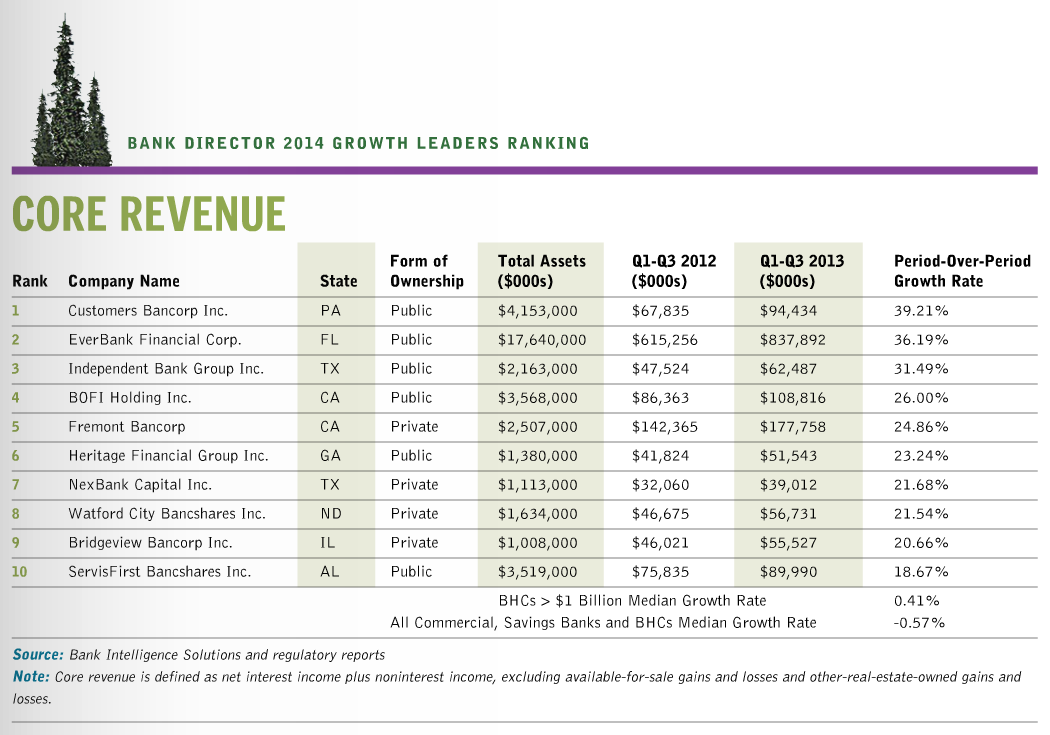
A Sneak Peek at the Core Revenue Champs

Each year, Bank Director magazine looks at all U.S. banks and thrifts to identify the strongest growth banks. We rank the top performers across four separate categories: core deposits, core noninterest income, net loans and leases and the most important, core revenue. Since the magazine mails today, I thought to offer a sneak peek of the results:

Screen Shot 2014-04-24 at 6.06.07 AM

What I find interesting about the top two banks on this very strong list: both Customers Bank and EverBank Financial designed their business models around technology from their very beginnings.

Find Your Balance

As I read through an advance copy of the issue, it strikes me that many business areas that historically provided revenue growth are simply not growing fast enough to overcome new capital and regulatory requirements.  In this light, you can understand why many say times couldn’t be more challenging for growth in community or regional banking. The corollary to this? Balancing organic and external growth is a key focus area for bank management and boards.

Increasingly, I hear that growth-focused banks are considering (or implementing) strategies that create revenue growth from both net interest income and fee based revenue business lines — think government guaranteed lending, asset based lending, leasing, trust and wealth management services. Clearly, as interest margins and loan volumes remain subject to compression and intense competition, the “optimization” of fee-based revenue is becoming pivotal in enhancing shareholder value.

‘Sup Big Easy

True, a number of banks seek to extend their footprint and franchise value through acquisition. Yet, many more aspire to build the bank internally.  Some show organic growth as they build their base of core deposits and expand their customer relationships; others leverage product innovation or focus on their branch network. I bring these approaches up in advance of next week’s Growth Conference at the Ritz-Carlton, New Orleans. We designed this event to showcase strategies, structures, processes and technologies that a bank’s CEO and board might consider to fuel their own growth.

Unlike trade shows and other events, we limit participation to a financial institution’s key officers and directors to ensure those joining us are not just committed to distinguishing their performance and reputation, but also are appropriate peers to share time and ideas with. From companies like StrategyCorps, Ignite Sales and VerifyValid to PwC, Fiserv and IBM, we have a tremendous roster of companies joining us in Louisiana to share “what’s working” at the myriad banks they support. As I’ve done for our other events (e.g. the sister conference to Growth, Acquire or Be Acquired), I’ll be posting a number of pieces next week from the Crescent City and invite you to follow along on Twitter via @aldominick, @bankdirector and using #BDGrow14.

Aloha Friday!

FI Tip Sheet: First Quarter Favorites

As I come off of a great week in Chicago and Bank Director’s annual Chairman/CEO Peer Exchange, today’s post takes a look back at the first three months of the year.  Yes, certain discussions during this time focused on tepid loan growth, higher capital requirements and expense pressures & higher regulatory costs hitting banks today.  Nonetheless, many more conversations focused on growth, innovation and “what’s working.”  So, to wrap up this week, three points from the past ninety days that inspired me.

AboutThatRatio = image for Jan 10.001

Some of Banking’s Best

To kick off the year, I put together a two-part series on some of the top CEOs in our industry.  Inspired by my coach and an article entitled the “Best CEOs of 2013” that ran on Yahoo Finance, I reached out to a number of colleagues that work for professional services firms to ask their thoughts on the top CEOs at financial institutions — along with why they hold them in such regard.  Part one shared various thoughts on some of the best CEOs in the business today — broken down into three categories: the “biggest banks” with $50Bn+ in assets, those with more than $5Bn but less than $50Bn and finally, those in the $1Bn to $5Bn size range.  Part two built on that piece, highlighting three exceptional CEOs that lead publicly traded banks before shifting to the thoughts and opinions of two very talented colleagues.

Eat or Be Eaten

As the President of Bank Director, I’m lucky to lead one of the industry’s biggest (and dare I say best?) M&A conferences: Acquire or Be Acquired.  Let me first offer up big time props to my many talented colleagues for everything they did to make this year’s the biggest and best yet!  One of the cool new things I did at the Arizona Biltmore this year?  Film a 90 second or less video each evening that summarized the day’s salient points.  As much as I shared big takeaways in written form on this site (e.g. what if I told you that by December 31, 2018, we’d witness a 25% decline in the number of institutions between $500mm and $1Bn), I’m proud of these two videos from the desert that relayed what caught my eyes and attention on two of the three conference days.


.

The Innovator’s Dilemma

In my role, I find myself talking with Chairmen and CEOs about their strategic plans.  This year, quite a few shared their thoughts for leveraging financial technology to strengthen and/or differentiate their bank.  In a piece I shared at the end of February, I cited Clayton Christensen’s “The Innovator’s Dilemma: When New Technologies Cause Great Firms to Fail.”  His book inspired that Friday’s FI Tip Sheet title – and first point.  If you’re not familiar with his work, the Harvard professor writes about two types of technologies: sustaining and disruptive. Sustaining technologies are those that improve product performance. As he sees it, these are technologies that most large companies are familiar with; technologies that involve improving a product that has an established role in the market.

Most large companies are adept at turning sustaining technology challenges into achievements.  However, large companies have problems dealing with disruptive technologies — an observation that, in my view, does not bode well for many traditionally established banks.  While risk is inherent to banks of all sizes, taking chances on emerging technologies continues to challenge many officers and directors… a theme I anticipate covering in greater detail over the next 90 days.

##

Whether this is your first time or 78th time reading About That Ratio, let me say thank you for doing so.  It is a real treat to share, each Friday, three short stories about what I’m hearing, learning and talking about as I travel around the country.  Being that I meet with so many interesting people — be it a bank’s CEO,  board members or executives at professional services firms and product companies — I find it tremendously rewarding to share anecdotes and insights that might interest others.  As always, Aloha Friday!

FI Tip Sheet: This Week in Pictures

As I wrap up the week, let me take a look back at Bank Director’s 20th annual Acquire or Be Acquired conference vis-a-vis video recaps and a gallery of pictures from the Arizona Biltmore.

_2441032004

Sunday Recap

If you’re curious for a <90 second summary of our first day in the desert, take a read at what I wrote or look at these two videos. The first, of our talented editor Jack Milligan; the second, my two cents.

.

.

Monday Recap

The second full day of the program built on Sunday’s discussions relative to growth, profitability, efficiency and the need for scale.  Jack and I both shared our thoughts in these video pieces and I also authored a piece that can be found here.

.

.

Photo Gallery

Credit for these great pictures goes to Keith Alstrin of Alstrin Photography.

Aloha Friday!

Wrapping up Acquire or Be Acquired

As we bid adieu to this year’s crowd, it strikes me that efficiency and productivity are key elements in positioning a bank to grow.  While this year’s Acquire or Be Acquired conference (#AOBA14) touched on numerous growth strategies, the common denominator among “organic growth banks” is a robust and diverse lending platform along with a proven credit culture and process.

photo (42)

The future of banking

For those joining us at the Arizona Biltmore on Sunday morning, you saw a video that summarized various thoughts on “the future of banking.”  A number of attendees asked to see the video we used to open the conference again.  Here it is:

Tuesday Takeaways

My “rapid reaction” to this morning’s conversations at the Arizona Biltmore, in no particular order: growth is now driving pricing; efficiency & productivity are both key elements in positioning a bank to grow; and the base reality remains that there is overcapacity in the US banking industry.

Off to the hit ’em long and straight (I hope) as we wrap up our 20th annual conference with our annual golf tournament.  74 and sunny… what a treat!

Acquire or Be Acquired – Sunday Recap

The most successful banks have a clear understanding and focus of their market, strengths and opportunities.  One big takeaway from the first full day of Bank Director’s Acquire or Be Acquired Conference (#AOBA14 via @bankdirector): it is time for a bank’s CEO and board to reassess their strategic opportunities.

_4323183253
thanks to Keith Alstrin of Alstrin Photography

90 Second video recap

Looking for profitability cures

From the strategies and mechanics behind transactions to the many lingering questions regarding industry consolidation, economies of scale, regulatory burdens and how to build long-term value, today featured some pretty fascinating presentations.  One of the common themes from the afternoon sessions: most bankers are looking to cure profitability challenges through some kind of M&A activity.

How much are you worth
Whether buying, selling or simply growing organically until it’s time for a transaction, a bank’s leadership team needs metrics in place to know and grow its valuation.  As we heard today, valuation is a controversial and complex subject.  To wit: it requires an in-depth understanding of a company, its market and competitors, financial and non-financial information.  In addition, factors such as the legal and regulatory environment proves quite a challenge.

Trending topics
Overall, the issues I took note of where, in no particular order: margin compression, deposit funding, efficiency improvements and business model expansion in the context of the current environment. Also, keep an eye on the the Northeast and greater Atlanta area this year for increased merger and acquisition activity.

More to come from the Arizona Biltmore tomorrow…

FI Tip Sheet: Acquire or Be Acquired

So we had a little snow in D.C. this week… and a bit of wind too. Fortunately, I’m heading west towards Bank Director’s 20th annual Acquire or Be Acquired conference this morning. As I wrote about on Wednesday, I will be checking in on a daily basis from the historic Arizona Biltmore with insight and observations from our flagship “AOBA” conference. Before I hit the desert, let me share three thoughts that tie into the conference themes of bank mergers and acquisitions as I make my way from D.C. towards Phoenix.

img_1174

7,000 is so 2013

Let’s simply start with a number: 6,891. Confused? Don’t be. This is the number of federally-insured institutions nationwide as of last Fall — falling below 7,000 for the first time since federal regulators began keeping track in 1934 (according to the FDIC). Now, let me put this into context; specifically, by asset size. 6,158 banks (90% of all U.S. banks) have assets of less than $1 billion. 562 banks have assets between $1 billion and $10 billion and only 108 institutions have assets greater than $10 billion. The kicker? The “distribution of wealth” heavily favors the biggest of the big. Case-in-point: banks with $10 billion or more in assets controlled 24% of total industry assets in 1984 (according to the American Banker). That share has swelled to over 80% today. When you think about things in these terms, its not surprising to hear the majority of bank M&A will occur in the <$1Bn range.

What’s the deal?

According to SNL Financial, there were 227 M&A transactions in 2013 — up from 218 in 2012. Nonetheless, these numbers pale in comparison to “the halcyon days of late 1990s.” As our editor, Jack Milligan, wrote in a post that ran on this site in December, we may “eventually see the emergence of a new tier of banks in the $10 billion to $50 billion range that will consolidate attractive banking markets… and help drive consolidation into yet another phase.” Still, hurdles to doing a deal remain. For instance:

  1. Higher capital and liquidity requirements;
  2. Today’s regulatory environment presents many significant and ongoing challenges; and
  3. Access to capital markets remains limited to many.

That said, I’m sure we will continue to see the combination of really strong companies — think this week’s union between North Jersey banks ConnectOne and Center Bancorp – and do agree with Jack’s perspective on what the future holds.

Ready to raise your hand?

I’m confident that an advisor (or two, or three or ten) will declare a merger or acquisition to be the principal growth strategy for community banks. I’m also anticipating conversations that entail the need for a bank’s CEO and board to re-examine their branch networks and strategies. Steering clear of anything that relates to the actual structure of deal, here are three questions I think will crop up early (and often) at AOBA:

  1. How do you know your bank has the right team in place to implement, and deliver, sustained results?
  2. If I’m not ready to sell — but am not in a position to buy — how can I grow?
  3. How can I, as a potential acquirer, create a strategic advantage vs. my peers?

If you’re joining us in Arizona this weekend, I’m looking forward to saying hello. If you’re not able to make it but want to follow the conversations from afar, #AOBA14 and @aldominick on Twitter should do the trick.

Aloha Friday!