Banking on Fintech DNA

As we talked about at FinTech Day last Tuesday, technology will play a fundamental role in changing the dynamics of banking, be it shining a light on out-dated practices to dramatically enriching the services and experiences being offered to customers.

By Al Dominick, President & CEO, Bank Director

As our editor-in-chief recently wrote, “technology has always been integral to banking, bringing both speed and efficiency to a transaction-intensive business. But in recent years, technology has stepped onto center stage as a prime component in every bank’s growth and distribution strategy. Technology has, in effect, gone from being a way to save money (a crucial function that it still fulfills) to a way to make money. Much of this activity is being driven by the continued growth of mobile and online banking.”

During a panel session entitled “Banking’s New DNA,” I noted how numerous financial technology companies are developing new strategies, practices and products that will dramatically influence the future of banking.  Within this period of transformation, where considerable market share is up for grabs, I believe ambitious banks can leapfrog both traditional and new rivals.

I find the narrative that relates to banks and fintech companies has changed from the confrontational talk that existed just a year or two ago.  As we found at this year’s FinTech Day in New York City, far more fintech players are expressing their enthusiasm to partner and collaborate with banking institutions who count their strengths and advantages as strong adherence to regulations, brand visibility, size, scale, trust and security.  For me, considering such a partnership affords a bank’s leadership team an important chance to look in the mirror and ask:

  1. Are we exceeding our customer’s digital experience expectations?
  2. How do we know if we’re staying relevant?
  3. Do we have a “Department of No” mindset?

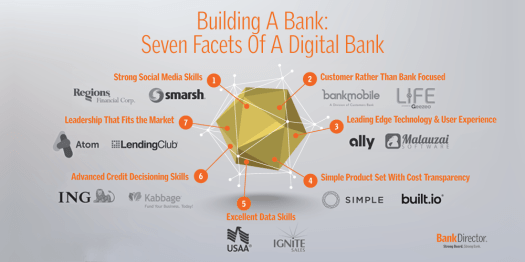
I elaborate on these pieces in an article now up on BankDirector.com; to read it, please click here.  Likewise, take a look at the seven facets of building a digital bank.  When it comes to the DNA one needs to compete in the future, I find these elements essential to any operation. 7 elements of a digital bank - by Bank Director and FinXTech

Feel free to comment on these questions and the elements shared above.  What else do you think could/should be added and considered?

3 Quick Takeaways from #fintech16 (aka Bank Director’s FinTech Day at Nasdaq’s MarketSite)

As evidenced by the various conversations at yesterday’s FinTech Day, the next few years promises to be one of profound transformation in the financial sector.

By Al Dominick, President & CEO, Bank Director

At a time when changing consumer behavior and new technologies are inspiring innovation throughout the financial services community, I had a chance to open this year’s FinTech Day program with a look at how collaboration between traditional institutions and emerging technology firms bodes well for the future.  With continuous pressure to innovate, banks today are learning from new challengers, adapting their offerings and identifying opportunities to collaborate. At the same time, we continue to watch as many fintech companies develop strategies, practices and new technologies that will dramatically influence how banking gets done in the future.

Personally, I believe this is a very exciting time to be in banking — a sentiment shared by the vast majority of the 125+ that were with us at Nasdaq’s MarketSite yesterday.  While I plan to go deeper into some of the presentations made in subsequent posts and columns on BankDirector.com, below are three slides from my welcoming remarks that various attendees asked me to share.

7 elements of a digital bank - by Bank Director and FinXTech

For the above image, my team took a step into an entrepreneurs shoe’s and envisioned an opportunity to build a new, digital-only bank from the ground up.  We consider these seven facets as base elements for success — and the companies listed provide real-life examples of financial institutions & fintechs alike that we see “doing it right.”

FinTech Day Deck1 (dragged)

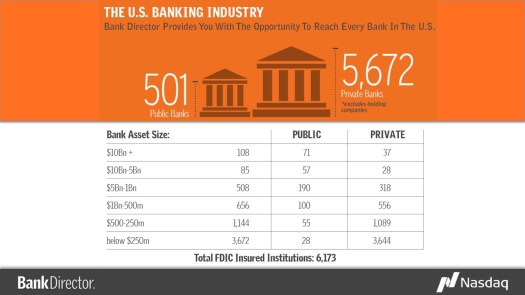
The irony of sharing an idea for a new bank?  Newly chartered banks (de novos) are basically extinct.  So for a program like FinTech Day, I thought it was imperative to provide context to the U.S. banking market by looking at the total number of FDIC-insured institutions.  These numbers are accurate as of last Friday.

FinTech Day Deck1 (dragged) 1

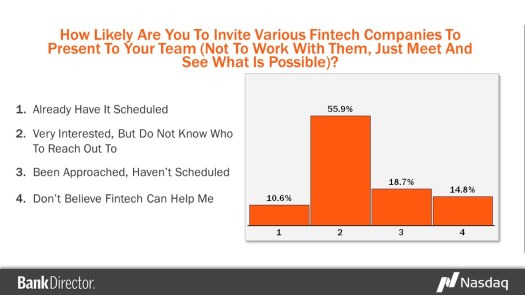
This final slide comes from our annual Acquire or Be Acquired conference in Arizona.  There, we welcomed 930+ to explore financial growth options available to a bank’s CEO and board.  To open our second full day, I polled our audience using a real-time response device to see how likely they are to invite a fintech company in for a conversation.  As you can see from the results above, real opportunities remain for meaningful dialogue and partnership discussions.

##

Thanks to all who joined us, the speakers that shard their insights and opinions and our friends from Nasdaq!

March 1 is FinTech Day

Tomorrow is FinTech Day… here is what you need to know in advance of this exclusive one-day event.

What: Bank Director’s FinTech Day

When: Tuesday, March 1 2016

Where: Nasdaq’s MarketSite (4 Times Square – 43rd & Broadway)

Overview: The next few years promises to be one of profound transformation in the financial sector. Clearly, the fabric of the industry continues to evolve as new technology players emerge and traditional participants transform their business models. At FinTech Day, we address trends like the personalization of banking, the challenges of scaling a company in our highly regulated industry and what shifting customer expectations portend for all.  For the full agenda, click here.

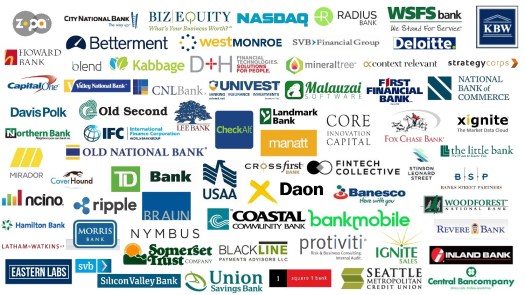
Who is coming: Attendee lists are provided to all confirmed; unfortunately, we are at capacity and cannot accept any additional registrations.  Below, I highlight the various businesses represented.

A look at who is coming to Bank Director and FinXTech's FinTech Day on March 1

FinXTech: In addition to connecting participants from across the community, I am  excited to introduce a new digital division — FinXTech — to provide authoritative, relevant and trusted content for (a) Fintech companies who view banks as potentially valuable channel or distribution partners; (b) Banks over $1B looking to grow and/or innovate with fintech companies’ help and support; and (c) Investors and services firms interested in helping to shape the future of banking.

Misc: To follow the conversation, I invite you to follow me @aldominick or use #FinTech16.  In honor of the occasion, I will be ringing the closing bell (flanked by Joan Susie, Chairman of Bank Director and Kelsey Weaver, Publisher of Bank Director + our speakers and various executives from fintech companies and high performing banks).  So if you want to see how we wrap things up at 4:00 PM ET, I invited you to turn on CNBC, MSNBC, etc.

FinTech Day is One Week Away

The fabric of the financial industry continues to evolve as new technology players emerge and traditional participants transform their business models. Through partnerships, acquisitions or direct investments, incumbents and upstarts alike have many real and distinct opportunities to grow and scale.  If 2015 was all about startups talking less about disruption and more about cooperation, I see 2016 as the year that banks reciprocate.

By Al Dominick, President & CEO, Bank Director

Next Tuesday, at Nasdaq’s MarketSite in Time Square, our team hosts our annual “FinTech Day.” With so many new companies pushing their way into markets and product lines that traditionally have been considered the banking industry’s turf, we look at what fintech means for traditional banks. Likewise, we explore where emerging fintech players may become catalysts for significant change with the support of traditional players.  When it comes to trends like the personalization of banking, the challenges of scaling a company in our highly regulated industry and what shifting customer expectations portend for banks and fintechs alike, we have a full day planned. Take a look at some of the issues we will address.

Riding The Wave Of Change
Al Dominick, President & CEO, Bank Director
Robert H. McCooey, Jr., Senior Vice President of Listing Services, Nasdaq

At a time when changing consumer behavior and new technologies are inspiring innovation throughout the financial services community, we open this year’s program with a look at how collaboration between traditional institutions and emerging technology firms bodes well for the future.

Banking’s New DNA
Michael M. Carter, CEO, BizEquity
Vivian Maese, Partner, Latham & Watkins
Eduardo Vergara, Head of Payments Services & Global Treasury Product Sales, Silicon Valley Bank
Moderated by: Al Dominick, President & CEO, Bank Director

With continuous pressure to innovate, banks today are learning from new challengers, adapting their offerings and identifying opportunities to collaborate.  With this opening session, we focus on the most pressing issues facing banks as they leverage new tools and technologies to compete.

Who Has the Power to Transform Banking
Jeana Deninger, Senior Vice President, Marketing, CoverHound, Inc.
Brooks Gibbins, Co-Founder & General Partner, FinTech Collective
Colleen Poynton, Vice President, Core Innovation Capital
Moderated by: Al Dominick, President & CEO, Bank Director

While fintech startups continue to spearhead the technological transformation of financial services, recent efforts by systemically important financial institutions call into question who reallly has the power to tranform banking. From an investment perspective, recent market turmoil may put some opportunities on hold – while others now have a higher, sharper bar to clear. In this session, we talk to investors about the traits that they look for when backing a venture in the context of a changing economic environment.

Opportunities to Reinvigorate the Banking Industry
Tom Kimberly, General Manager, Betterment Institutional
Thomas Jankovich, Principal & Innovation Leader, US Financial Services Practice, Deloitte Consulting LLP
Pete Steger, Head of Business Development, Kabbage, Inc.
Moderated by: Al Dominick, President & CEO, Bank Director

Many fintech companies are developing strategies, practices and new technologies that will dramatically influence how banking gets done in the future. However, within this period of upheaval – where considerable market share will be up for grabs – ambitious banks can leapfrog both traditional and new rivals. During this hour, we explore various opportunities for financial services companies to reinvigorate the industry.

Opportunities to Financially Participate in Fintech
Joseph S. Berry, Jr., Managing Director, Co-Head of Depositories Investment Banking, Keefe, Bruyette & Woods, Inc. A Stifel Company
Kai Martin Schmitz, Leader FinTech Investment LatAm, Global FinTech Investment Group, International Finance Corporation
Moderated by: Al Dominick, President & CEO, Bank Director

While large, multinational banks have made a series of investments in the fintech community, there is a huge, untapped market for banks to become an early-stage investor in fintech companies. Based on the day’s prior conversations, this session looks at opportunities for banks to better support emerging companies looking to grow and scale with their support.

##

While this special event on March 1 is sold out, you can follow the conversations by using #Fintech16 @aldominick @bankdirector @finxtech and @bankdirectorpub.  And as a fun fact, I’ll be ringing the closing bell next Tuesday flanked by our Chairman and our Head of Innovation.  So if you are by a television and can turn on CNN, MSNBC, Fox, etc at 3:59, you’ll see some smiling faces waving at the cameras.

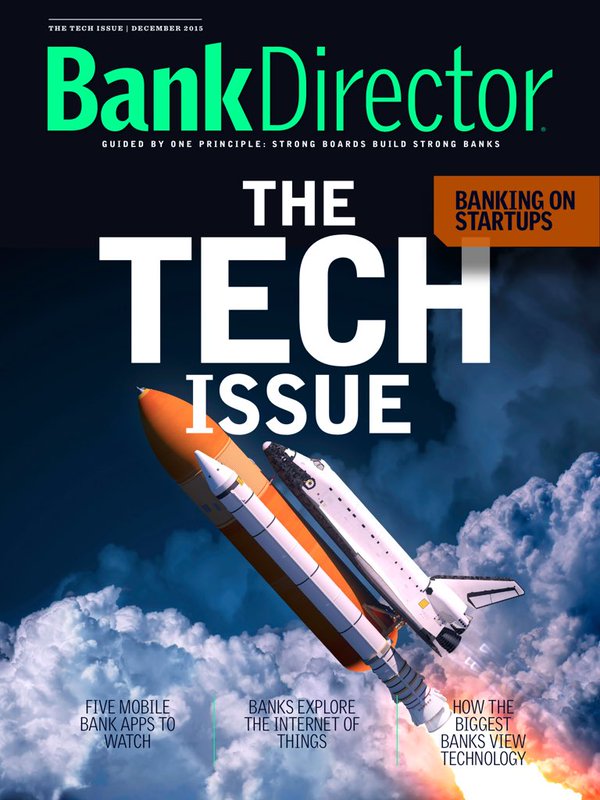
Bank Director’s annual Tech Issue is now available for free

Take a look at Bank Director’s just-published “Tech Issue.” In it, we look at how bank CEOs and executive teams can better engage with fintech companies, what the biggest banks are doing in terms of technology strategy and what the Internet of Things (IoT) means for financial institutions in 2016.

To download this free issue:

  1. On Your Tablet or Mobile Device, Select Apple’s AppStore, Google Play or Amazon’s Apps;
  2. Search “Bank Director Digital Magazine;” and
  3. Download the App to Your Digital Device & Enjoy.

Happy Holidays!

How We Are Taking a Lean Startup Approach to our Grown-up Business

A lean startup methodology enables entrepreneurs to efficiently build a company by searching for product and/or market fit rather than blindly trying to execute.  I find it helps mature companies too — and thought the perspectives of Stanford Professor Steve Blank, Silicon Valley entrepreneur Ben Horowitz and Y Combinator’s Sam Altman might resonate with bankers, fintech companies and other small business CEOs that are thinking about how to adapt their businesses to new challenges and opportunities. 

Paying It Forward

By Al Dominick // @aldominick

As someone who long aspired to build and run a company, I take great pride in leading a profitable, privately-held, twenty-person-strong small business.  In the past, I have written about my “people > products > performance” approach to leading the Bank Director team.  So when Ben Horowitz (co-founder and Partner of the venture capital firm Andreessen Horowitz) shares on his blog, “it’s not about how smart you are or how well you know your business; it’s about how that translates to the team’s performance and output,” I find myself nodding in total agreement.

Look, I am so very proud of our team’s accomplishments… but I am even more excited to adapt the lean startup methodology to scale our business.  The approach we are taking builds on the wisdom and experience of others. So for anyone responsible for growing their business, allow me to recommend two “must reads:”

For me, we are “all-in” in terms of taking a lean startup approach to expanding our business without compromising our reputation for going narrow & deep, providing a “Four Seasons” level of experience at our events and delivering outstanding ideas and insights to a hugely influential audience.  In addition, we are supremely mindful to do as Sam Altman says.  That is, create something that a small number of people love rather than a product that a large number of people simply like.

H1: The Core Business

Admittedly, I am hesitant to call our approach to growing Bank Director a bootstrapping effort since the brand, relationships and revenue being generated enable us certain luxuries that many start-ups simply do not have.  Nonetheless, let me show you how we adapted the Horizon 1 (H1) and Horizon 3 (H3) framework depicted above to our business.

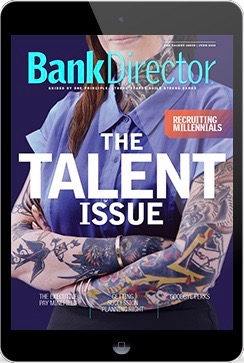
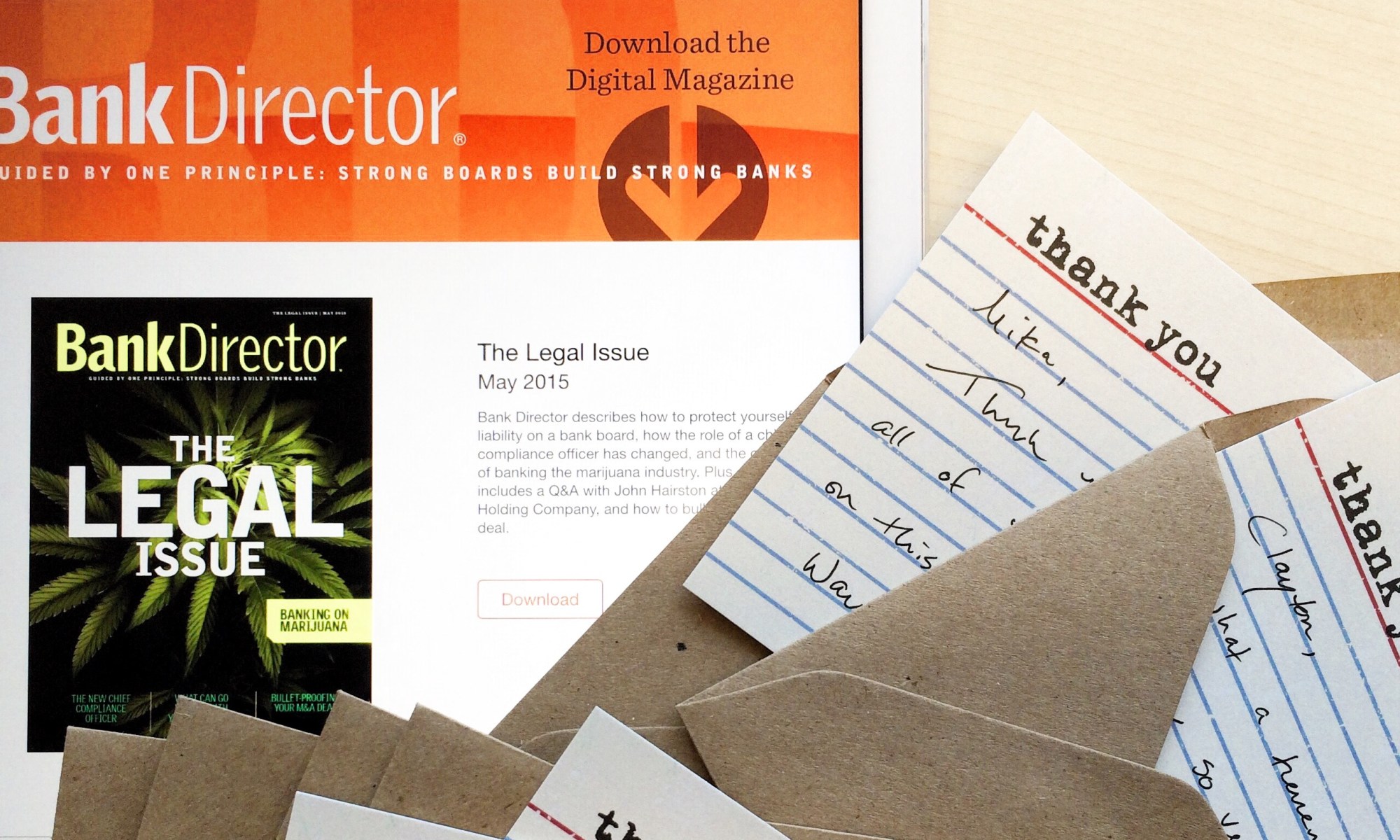
What began in 1991 as a traditional publishing company now operates as a privately-held media enterprise delivering original content to CEOs, executives and board members of financial services companies via digital platforms, exclusive conferences and award-winning publications.  Below is a visual example of our transformation vis-a-vis three magazine covers.  As you can see, we have matured in style while expanding our frequency (from quarterly to monthly) as we expanded our distribution channels.

Going narrow and deep works for us since we generate our revenue from the annual conferences & events we host (e.g. our 800+ person Acquire or Be Acquired conference), publications and research we publish and education & training services we provide.

H3: Where the Wild Ideas Live

With three consecutive years of top line growth (and healthy bottom line results to boot), we are in the wonderful position to grow in some pretty cool ways.  But doing so will take more than simple process improvements and expense control.  As we have a strong business foundation in place, I did have to restructure my management team’s individual roles and responsibilities to better suit our H1/H3 setup.  I did so because as Steve Blank points out, “Horizon 3 is where companies put their crazy entrepreneurs… these innovators want to create new and potentially disruptive business models.” As fun as living/working in H3 sounds, let me emphasize how much I rely on the H1 team to “defend, extend and increase” our core business.

Is it working?  Well, we will formally announce a new venture, FinXTech, on March 1, 2016 at Nasdaq’s MarketSite in New York City.  This is the first — and surely not last — project to emerge from our H3 world.  But time will ultimately tell.

We are a collection of creative men and women and I am very optimistic about our future.  Realizing that we want to continuously push to grow and innovate led me to appreciate “the need to execute (to the) core business model while innovating in parallel.”  So today’s post isn’t an attempt to make me look smart; rather, my attempt to acknowledge the inspiration of others and share what’s working for us.

5 Fintechs I’m Keen On

My first post in 2015 focused on three “up & coming” fintech companies: Wealthfront (an automated investment service), Kabbage (an online business loan provider) and Dwolla (a major player in real-time payment processing).  Since writing that piece, I’ve kept tabs on their successes while learning about other interesting and compelling businesses in the financial community.  So today, five more that I am keen on.

By Al Dominick // @aldominick

With continuous pressure to innovate, I’m not surprised to see traditional financial institutions learning from new challengers, adapting their offerings and identifying opportunities to collaborate with emerging players.  From tokenization to integrated payments, security tools to alternative lending platforms, the investments (and efforts) being made throughout the financial sector continues to impress and amaze me.  As I shared in 15 Banks and Fintechs Doing it Right, there are very real and immediate opportunities to expand what banking means to individual and business customers.  Personally, I am excited by the work being done by quite a few companies and what follows are five businesses I’ve learned more about while recently traveling between D.C., San Francisco and New York City:

logo

i2c, a global card processing company, provides back-end processing and settlement for cards, virtual accounts and mobile payments.  What’s interesting about them? According to a brief shared by Bridge by Deloitte (a web platform connecting enterprises with startups to accelerate innovation and growth), i2c recently teamed up with Oxfam, Visa and Philippines-based UnionBank to channel funds to people in disaster-affected communities through prepaid cards.

adyen-logo

With Money20/20 fast approaching, expect to see a lot of #payments trending on twitter.  Trending in terms of financial investment: Adyen, a company receiving a lot of attention for wrapping up a huge round of funding that values the payment service provider at $2.3B.  Adyen, which provides its services to a number of large organizations including Facebook and Netflix, excels in having a highly integrated platform, unlike others with multiple platforms.

Blend labs

When it comes to technology “powering the new wave of mortgage lending,” take a look at the work being done at BlendLabs.  Developing software & data applications for mortgage lenders, the company acknowledges that “accommodating complex rules and regulation changes is time-consuming and costly.” For this reason, the company has quietly rolled out technology that empowers some of the country’s largest lenders to originate mortgages more efficiently and compliantly than ever before while offering their borrowers a more compelling user experience.

logo

As the head of a company, I know first-hand how much time and effort is spent on efforts and ideas designed to maximize revenue and profits.  So the promise and premise of nCino is hugely attractive.  Co-founded by a fellow W&L grad (and the former CEO of S1) nCino is the leader in cloud banking.  With banks like Enterprise in St. Louis (lead by a CEO that I have huge respect for) as customers, take a look at their Bank Operating System, a comprehensive, fully-integrated banking management system that was created by bankers for bankers that sits alongside a bank’s core operating system.

logo

While not solely focused on the financial industry, Narrative Science is a leader in advanced natural language generation.  Serving customers in a number of industries, including marketing services, education, financial services and government, their relationship with USAA and MasterCard caught my eye.  As FinXTech’s Chief Visionary Officer recently shared with me, the Chicago-based enterprise software company created artificial intelligence that mines data for important information and transforms it into language for written reports.

##

In addition to these U.S.-based companies, you might look at how Fidor, a digital bank in Europe that offers all-electronic consumer banking services, links interest rates to Facebook likes and give cash rewards based on customers’ level of interaction with the bank (e.g. how many customer financial questions answered).  Clearly, the fabric of the financial industry continues to evolve as new technology players emerge, institutions like Fidor expand their footprint and traditional participants transform their business models.  So if you follow me on twitter (@aldominick), let me know of other fintech companies you’re impressed by these days.

Pushing Forward: The Future of Financial Services?

Yesterday, the L.A. Times wrote about a bank that is “part lender, part consultant, part cheerleader and part investor… a nursemaid to countless start-ups — Airbnb, Fitbit, Pinterest and TrueCar, to name some recent ones — as well as banking the venture capitalists who fund them.” Curious to learn more about this California-based innovator with a great reputation for serving software, hardware, biotech and healthcare start-ups? Read on.

By Al Dominick // @aldominick

Bank Director’s managing editor, Naomi Snyder, recently wrote that “banks are used to identifying, monitoring and mitigating risks, more so than they are adept at innovating. But an argument gaining increasing weight is the notion that banks really are technology companies and need to think more like a technology company.”  But what if, instead of transforming one’s business model to resemble a tech firm, an institution instead acted like Silicon Valley Bank, the Santa Clara-based powerhouse that has financed scores of the highest-flying tech companies like those mentioned above.

Certainly, this standout financial institution has a knack for staying close to their customers (*take a look at their Innovation Economy Outlook 2015).  So at a time when many banks are shrinking in relevance despite their important role in local economies, I thought to take a look at this “unusual for an FDIC-regulated bank.”  Billed as the bank of the world’s most innovative companies and their investors, the LA Times shared that with $40.2 billion in assets, Silicon Valley Bank now has “the heft to handle them from start-up to initial public offering, multiplying its profits on larger loans and fees.”  Further,

The bank, which recently opened an office in Santa Monica, is more willing than others to focus on a start-up’s growth prospects rather than its current financial condition and to lend money so businesses can expand while awaiting the next round of venture capital funding, said investor Mark Suster, a client and managing partner at Upfront Ventures in Los Angeles.

Now, this doesn’t preclude the bank from identifying a good thing that can help it to continue to push forward the future of financial services.  Case-in-point, I woke up a few days ago to find, via Twitter, that Standard Treasury team joined SVB Financial’s information technology team “to help it expand the bank’s digital banking platform.”  Just as I looked at Capital One’s recent fintech acquisitions in my last post (How Capital One Can Inspire Your Digital Efforts), the fact that the bank hired the team from startup company Standard Treasury to help accelerate the development of its API (application programming interface) banking services underscores the institutions drive to “enable easier collaboration, product development and integration with… clients.”

While catching up to Silicon Valley Bank — which boasts of having half of all startups in the U.S. as clients — will challenge many traditional institutions, I think it makes far more sense to look at what they have accomplished and suggest banks in markets where venture-backed start-ups are taking off try to pattern their business after SVB’s successes rather than radically shifting the underlying business model to emulate what might work for a technology company.

Of course, the LA Times does remind us that “most also don’t come close to Silicon Valley Bank’s well-connected network of outside experts, mentors, tech executives, venture capitalists and current and former clients ready to help its upstart entrepreneurs — no matter how farfetched an idea might seem.” Nevertheless, at a time when individuals along with business owners have more choices than ever before in terms of where, when and how they bank, I think leadership teams at financial institutions of all sizes should pay attention to how Silicon Valley Bank aligns its services (and product mixes) to suit core customers’ interests and expectations.

The 5 Corners of Technological Innovation in Financial Services

To grasp what the future of banking holds, look no further than the five areas of focus for Wells Fargo.  Last week, the best performing large bank in the United States launched an “Innovation Group” in San Francisco.  As they share, this team will will work in partnership with its major businesses to meet evolving customer needs and stay ahead of the shifting competitive landscape.  Initially, such efforts will center on five areas:

  • Research and development;
  • Innovation strategies;
  • Payment strategies;
  • Design and delivery; and
  • Analytics.

As a nationwide, diversified, community-based financial services company with $1.7 trillion in assets, Wells Fargo now has six innovation labs along with its startup “accelerator.”  Given that a number of the world’s largest finance sector companies are reviewing their business models following the rapid growth of “fintech” entrants in the sector, the investment in both time and resources by Wells Fargo gives shape to the potential future of banking.

Wells Fargo Labs invite customers to “Come out and Play: Be one of the first to test out latest ideas and technologies – from still-in-development beta offerings to newly launched products.”

Personally, I’m drawn to this new addition to the Wells family in light of a report by the World Economic Forum, supported by Deloitte Consulting, entitled The Future of Financial Services:How disruptive innovations are reshaping the way financial services are structured, provisioned and consumed.

As noted by the paper’s lead author, “for decades, banks and insurers have employed similar, highly profitable business models. But they realize those models are coming under pressure due to fintech innovations… Financial technology companies are deploying online platforms, have small capital bases, and make strategic use of data, to acquire customers and revenues at a fast pace. Banks and insurers noted that, and are contemplating their response.”  So as major players like Wells Fargo explore the “transformative potential of new entrants and innovations on business models in financial services,” seeing the cards they are putting on the table provides real color for what the future holds for many here in the U.S.

There’s A New App For That

This morning, my company officially launched a state-of-the-art app to deliver a new monthly digital magazine which complements our quarterly, print-version.  A huge amount of time and effort went into the design, development and approval process, so I am very proud to share that Bank Director’s free app & digital magazine is now available for download through Apple’s App Store, Google Play and Amazon.com.  A HUGE thank you to our team that built it.  Also, my apologies to anyone looking to imitate this new offering.  It is home-grown and totally customized to the informational, educational and training needs of bank officers and directors today.

By Al Dominick // @aldominick

Since 1999, the number of commercial banks and savings institutions in the United States has decreased from 10,220 to approximately 6,500.  On the surface, this would not seem to be a robust market in which to base a business model.  However, among those still in the banking business, there is a tremendous appetite for information that will help a CEO, CFO, General Counsel, Chairman and board of directors to maintain a competitive edge — and that is the role that my team at Bank Director fills.

We designed Bank Director’s digital magazine specifically for tablet devices and incorporate interactive features such as animated infographics, video interviews and real-time polling.  Starting today, it can be accessed for free by downloading the app through Apple iTunes, Google Play or Amazon.com.  Unlike the print version — in circulation since 1991 — these digital issues have a distinct editorial focus each month.  Case-in-point, we light up the first issue with a cover story on the legal and compliance issues facing institutions interested in banking the marijuana industry.  Subsequent issues focus on attracting talent, growing the bank, serving on the audit or risk committee, handling governance and overseeing technology.

While many companies in the content business are moving away from print or simply discontinuing operations, we are ramping up to meet the needs of our audience.  This is not simply a replica of, or replacement for, our print publication.  It is a dynamic new product that allows us to stay on top of emerging trends.  For those of you familiar with our quarterly print publication, I hope this provides you added insight each month to the issues facing our industry.  For those of you not as familiar with Bank Director, I invite you to take a moment to experience this great new content now available anytime, anywhere.

IMG_3447

On Bank Branches and a Bank’s Brand

When I think about top performing banks, I typically consider those with the strongest organic growth in terms of core revenue, core noninterest income, core deposit growth and loan growth.  Sure, there has been a lot of talk about growing through acquisition (heck, last week’s post, “Seeking Size and Scale” looked at BB&T’s recent acquisitions and my monthly column on BankDirector.com was entitled “Why Book Value Isn’t the Only Way to Measure a Bank“).  But going beyond M&A, I’m always interested to dive into the strategies and tactics that put profits on a bank’s bottom line.

Build Your Brand or Build Your Branch

Earlier in the week, KBW’s Global Director of Research and Chief Equity Strategist, Fred Cannon, shared a piece entitled “Branch vs. Brand.”  As he notes, “branch banking in the U.S. is at an inflection point; the population per branch has reached a record level in 2014 and is likely to continue to increase indefinitely. The volume of paper transactions peaked long ago and with mobile payment now accelerating the need for branches is waning. As a result, many banks see closing branches as a way to cut costs and grow the bottom line. However, branches have served as more than transactional locations for banks. The presence of branch networks has projected a sense of identity, solidity and ubiquity to customers that has been critical to maintaining a bank’s brand.”  He then poses this doozy of a question:

“If branch networks are reduced, what is the replacement for a bank’s identity?”

Fred and his colleagues at KBW believe banks need to replace branches with greater investments in brand. As he shares, “some of this investment will be in marketing, (as) a brand is more than a logo. We believe banks will also need to invest in systems, people, and processes to project the sense of identity, solidity, and ubiquity that was projected historically by branch networks.”

United Bank, An Example of a High-Performing Bank

One example of a bank that I think is doing this well is United Bank.  On Wednesday, I had the chance to check out their new financial center in Bethesda, MD.  With dual headquarters in Washington, DC and Charleston, WV, the $12.1 billion regional bank holding company is ranked the 48th largest bank holding company in the U.S. based on market capitalization. NASDAQ-listed, they boast an astonishing 41 consecutive years of dividend increases to shareholders – only one other major banking company in the USA has achieved such a record.  Their acquisition history is impressive — as is their post-integration success.  United continues to outperform its peers in asset quality metrics and profitability ratios and I see their positioning as an ideal alternative to the offices Wells Fargo, SunTrust and PNC (to name just three) operate nearby.

A Universal Priority

Clearly, United’s success reflects a superior long-term total return to its shareholders.  While other banks earn similar financial success, many more continue to wrestle with staying both relevant and competitive today.  Hence my interest in Deloitte’s position that “growth will be a universal priority in 2015, yet strategies will vary by bank size and business line.”  A tip of the hat to Chris Faile for sharing their 2015 Banking Outlook report with me.  Released yesterday, they note banks may want to think about:

  • Investing in customer analytics;
  • Leveraging digital technologies to elevate the customer experience in both business and retail banking;
  • Determining whether or not prudent underwriting standards are overlooked; and
  • Learning from nonbank technology firms and establish an exclusive partnership to create innovation and a competitive edge.

With most banks exhibiting a much sharper focus on boosting profitability, I strongly encourage you to see what they share online.

Aloha Friday!

A 90 Second Look at the ‘Innovation Requirement’ Facing Banks Today

While the larger banks in the U.S. continue to increase in size, many community banks are fighting for survival in today’s regulatory and low-interest rate environment.  Here is one key takeaway from yesterday’s Bank Executive & Board Compensation Conference.

Up next?  Pictures on Friday from the conference.