The Intersection of Leadership and Profitability

By Al Dominick, CEO of DirectorCorps — parent co. to Bank Director & FinXTech

Quickly

  • Key takeaways from one of my favorite summer banking events, Crowe Horwath’s Bank Leadership and Profitability Improvement Conference.

_ _ _

This morning, on the first of my two flights from Washington National to Monterey, California, I learned that Walmart customers might soon be able to get installment loans for big-ticket items through Affirm, a San Francisco-based FinTech I first wrote about in 2014 (For Banks, the Sky IS Falling).  Per the Wall Street Journal, the companies reportedly are nearing an agreement on a pilot program.  This potential partnership caught my eye as I prepared for today and tomorrow’s conference.  Indeed, relationships like these make clear that when it comes to growth and efficiency, the digital distribution of financial goods and services is a significant issue for the banking industry.

This idea took further shape when I walked into the conference center at the Inn at Spanish Bay.  Immediately upon entering the room, I found John Epperson, a partner at Crowe and Jay Tuli, senior vice president retail banking and residential lending at Leader Bank, sharing their opinions on partnership strategies involving banks and FinTechs.  From the stage, they touched on increasing net interest margins via improved pricing strategies on commercial loans, approaches to streamline mortgage application processes, ideas to reduce staff counts for loan administration processes and how to improve customer experiences through online rent payment solutions.

Their perspectives lined up with those we recently shared on BankDirector.com.  To wit, “many banks have realized advantages of bank-FinTech partnerships, including access to assets and customers.  Since most community banks serve discreet markets, even a relatively simple loan purchase arrangement can unlock new customer relationships and diversify geographic concentrations of credit.  Further, a FinTech partnership can help a bank serve its legacy customers; for instance, by enabling the bank to offer small dollar loans to commercial customers that the bank might not otherwise be able to efficiently originate on its own.”

Of all the difficult issues that bank leadership must deal with, I am inclined to place technology at the top of the list.  Banks have long been reliant on technology to run their operations, but in recent years, technology has become a primary driver of retail and small business banking strategy.  John and Jay simply reinforced this belief.

In addition to their thoughts on collaboration, this afternoon’s sessions focused on ‘Liquidity and Balance Sheet Management,’ ‘Fiscal Policy During Regulatory Uncertainty’ and ‘Managing Your Brand in a Digital World.’  While I took note of a number of issues, three points really stood out:

  • Yes, banks can make money while managing decreasing margins and a flat yield curve.
  • Asset growth without earnings growth is a concern for many because of loan pricing.
  • How a CFO sets a target(s) for interest rate risk may start with an “it depends” type response — but gets nuanced quickly thereafter.

Finally, I’m not holding my breath on the industry receiving regulatory relief any time soon.  I get the sense many here aren’t either.  But it would be nice to see some business people brought in to run various agencies and I’m looking forward to the perspectives of tomorrow’s first guest speaker, Congressman John Ratcliffe.

##

My thanks to Crowe Horwath, Stifel, Keefe Bruyette & Woods + Luse Gorman for putting together this year’s Bank Leadership and Profitability Improvement Conference at The Inn at Spanish Bay in Pebble Beach, California.  I’ll check in with additional takeaways based on tomorrow’s presentations.

A Look Back at AOBA: A Week in Pictures

#AOBA17 – final conference intel
By Al Dominick, CEO of DirectorCorps (aka Bank Director and FinXTech) | @aldominick

Quickly:

  • 686 bankers comprised the 1,076 registered attendees — a figure that reflects the participation of 379 financial institutions.
  • 24 of our awesome team were on-site hosting this year’s event — all are celebrating what we affectionately refer to as “AOBA Day” by taking today off as a company holiday.

_ _ _

This has become something of a sharing tradition… a look back at a phenomenal week in Arizona.  New this year?  The welcome video we arranged to introduce our team to our guests on Sunday morning.

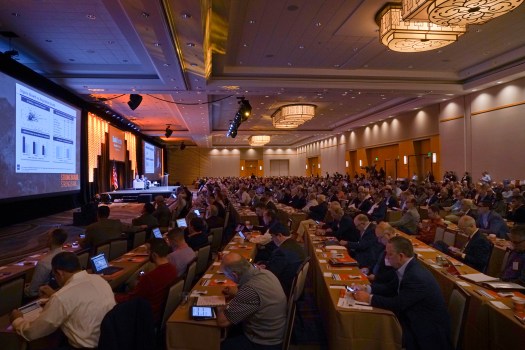
As I shared in a Sunday afternoon post (Trending at Acquire or Be Acquired), the best way to understand this event’s popularity is to look at this picture from Sunday morning at 8:16 AM (e.g. one minute after I turned the stage over to our first speaker, the CEO of KBW, Tom Michaud).  Already, we had 900+ in their seats for this 2.5 day program.  Let me say that one more time… 900+ in their seats on a sunny Sunday Arizona morning.

bank_director_temporary_number_13

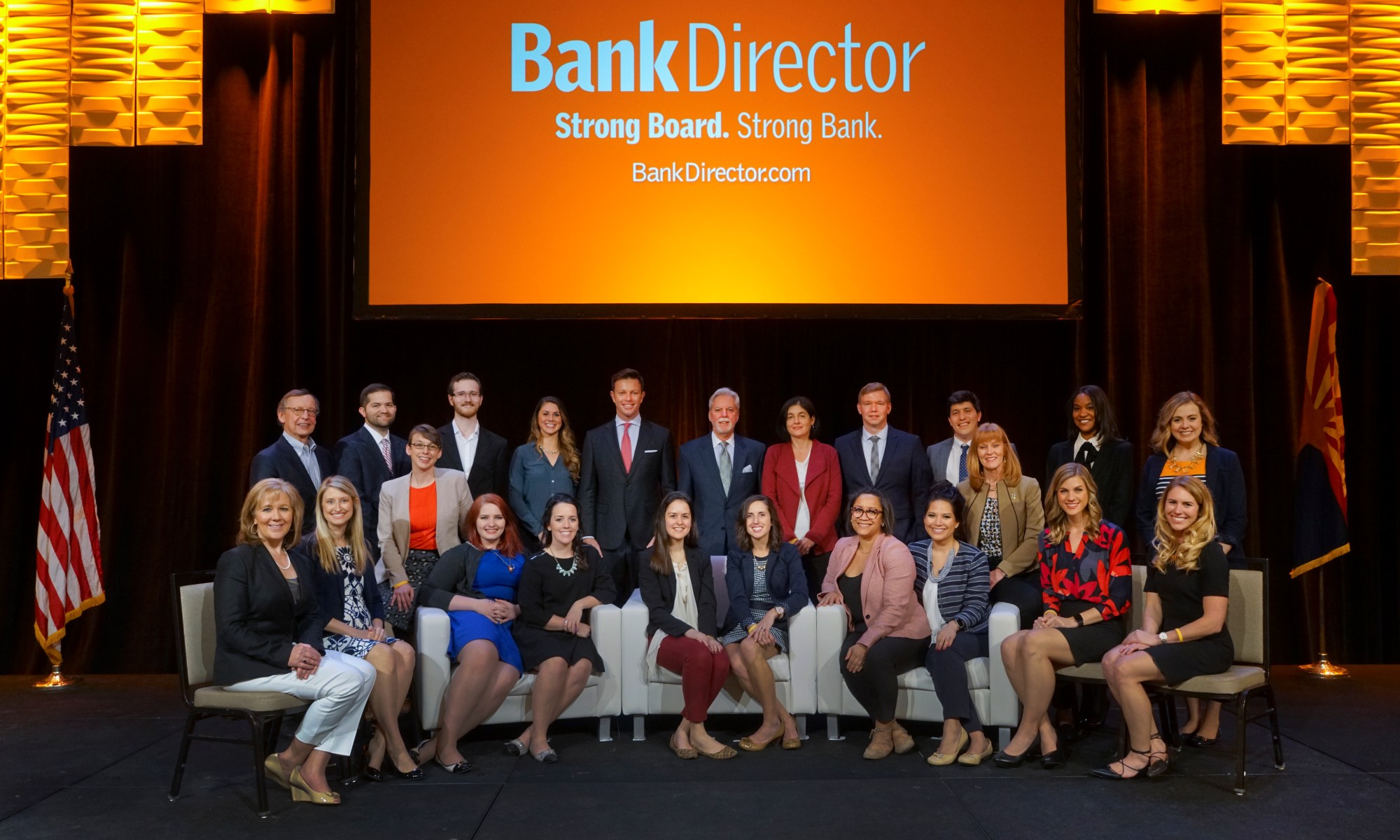
So with that in mind, take a look at some of the photos shared by our on-site photographer, Keith Alstrin (Alstrin Photography).

If you’re interested in what is being discussed for the present + future by some of the industry’s most influential executives, I invite you to follow me on Twitter via @AlDominick along with @BankDirector and its @Fin_X_Tech platform.  To take a further trip back and see what was being shared with (and by) our attendees at Acquire or Be Acquired, we encouraged the use of #AOBA17.  We are excited to do this again next year and hope you’ll save the date!!

bank-slide-01


We Are On To FinTech Week

#AOBA17 conference intel (Friday)
By Al Dominick, CEO of Bank Director | @aldominick

Quickly

  • The “bank of the future” is not about technology, it is all about customers.
  • For many financial institutions, the time may be right to retire legacy systems for cloud-based platforms.
  • Numerous financial technology companies are developing new strategies, practices and products that will dramatically influence the future of banking..

_ _ _

The intersection of technological innovation with strong depository franchises may lead to more efficient banking processes, reductions in fraud and a win/win/win for banks, financial technology firms (fintechs) and consumers.  Globally, nearly $23 billion of venture capital and growth equity has been deployed to fintechs over the past five years, and this number is growing quickly. Still, the nature and extent of impact that fintechs have on the industry remains unclear.

Throughout this week’s Acquire or Be Acquired conference, bank CEOs talked about the continually changing nature of financial services — with fintech often front and center.  For many, collaboration between traditional institutions and emerging technology firms bodes well for their future.  Here, Bank Director’s FinXTech provides authoritative, relevant and trusted content to a hugely influential audience, specifically:

  • Fintechs who view banks as potentially valuable channels or distribution partners;
  • Banks looking to grow and/or innovate with fintech companies’ help and support; and
  • Institutional investors, venture capitalists, state & federal regulators, government officials and academicians helping to shape the future of banking.

We designed FinXTech as a peer-to-peer resource that connects this hugely influential audience around shared areas of interest and innovation.  As a host of FinTech Week in New York City this April 24 – 28 (along with Empire Startups), we bring together senior executives from banks, technology companies and investment firms from across the U.S. to shine a light on what is really generating top line growth and bottom line profits through partnerships, collaboration and investments.

bank-slide-05

Given the changing nature of banking today, this week-long event in New York City looks at the various issues impacting banks, non-banks and technology companies alike.  So as we move towards FinTech Week in New York City, I invite you to follow me on Twitter via @AlDominick, FinXTech’s President, Kelsey Weaver @KelseyWeaverFXT@BankDirector and our @Fin_X_Tech platform and/or check out the FinTech Week New York website for more.

A New Research Report on Marketplace Lending

#AOBA17 conference intel (Wednesday)
By Al Dominick, CEO of Bank Director | @aldominick

Quickly:

  • Lending is an estimated $15 trillion industry in the United States — and the banking industry’s share in this market is estimated to be around $6.6 trillion (~ 44% of the overall market).
  • Within the FinTech sector, lending is the largest segment in terms of funding from investors, and market altered the lending landscape.
  • Marketplace lenders — online platforms that match borrowers with lenders — will likely see some consolidation in ’17 and continue to converge with banks through partnerships, white label contracting and yes, even mergers.

_ _ _

Fintech lending has grown from $12 billion in 2014 to $23.2 billion in 2015 and is expected to reach $36.7 billion in 2016, a year-over-year growth of 93 percent and 58 percent in 2015 and 2016.  This market, according to Morgan Stanley Research, is expected to grow further and reach $122 billion by 2020.

As noted throughout our Acquire or Be Acquired conference, partnerships between a bank and a tech company can take on many forms — largely based on an institution’s available capital, risk appetite and lending goals.  With FinTech solutions gaining momentum, many advisors here have encouraged banks to look at viable alternatives to meet consumer demands, maintain and expand their lending revenue and give formidable competition to those looking to take that marketshare.

With this in mind, I invite you to take a look at a new Fintech Intelligence Report on Marketplace Lending (to download the PDF version, click: fintech-intelligence-report-lending).  The research paper, developed by Bank Director’s FinXTech platform and MEDICI, a subscription-based offering from LetsTalkPayments.com, explores current market dynamics along with technology & partnership models.  As noted in this report, the gains of new FinTech companies were widely thought to be at the expense of banks; however, many banks recognized the potential value from collaboration and built relationships with FinTechs.

##

While our Acquire or Be Acquired conference wrapped up yesterday, you can take a look back on the conversations + presentations that found their way onto Twitter via @AlDominick, the host company, @BankDirector and our @Fin_X_Tech platform, and search #AOBA17 to see what was shared with (and by) our attendees.

Inspired by U.S. Bank’s CEO at Acquire or Be Acquired

#AOBA17 conference intel (Monday/Tuesday)
By Al Dominick, CEO of Bank Director | @aldominick

Quickly

  • Most M&A activity will continue to take place among banks with assets between $1 billion and $10 billion.
  • For an acquirer, the level of underwriting for deposits can be more rigorous then underwriting for loans.  Indeed, because of BSA & AML concerns, it takes a high degree of effort to realistically measure the risk of buying “someone else’s cooking.”
  • This year’s keynote, Richard Davis, is the Chairman & CEO of U.S. Bank — which has $446 billion in assets.  FWIW, he started his career as a bank teller at Security Pacific Bank in Los Angeles on his 18th birthday.

_ _ _

Over the past decade, U.S. Bank’s consistent results made it, according to the Wall Street Journal, a darling with investors and analysts.  While impressive, their CEO’s perspectives on where we are now — and where we might be heading — inspired this short video recap.

In addition to his remarks on building a great team, his perspectives on technology struck a real chord given my background (I worked at great technology company in Bethesda, MD for 6+ years).  Specifically, his encouragement to focus on:

  • Tokenization/EMV/mobile
  • Real time payments
  • Open APIs
  • Identity management
  • Distributed ledger / blockchain
  • Internet of things (IoT)
  • Machine learning

In subsequent posts, I’ll elaborate on these issues.  But for those interested in following the conference conversations that are more M&A-oriented via our social channels, I invite you to follow me on Twitter via @AlDominick, the host company, @BankDirector and its @Fin_X_Tech platform, and search & follow #AOBA17 to see what is being shared with (and by) our attendees.

Opportunities Abound at Acquire or Be Acquired

#AOBA17 conference intel (Monday)
By Al Dominick, CEO of Bank Director | @aldominick

Quickly

  • Earnings pressures, regulatory/compliance costs + the impact of technology will continue to make it more difficult for banks to compete and be profitable, which will continue to generate consolidation.
  • The increase in stock prices and capital raising activity is likely to provide an additional catalyst for M&A in early 2017
  • Raising capital is an immediate and viable option for most banks today

_ _ _

Here at Bank Director’s annual Acquire or Be Acquired conference, it is clear that to maximize shareholder value, a bank’s leadership must not only plan for the future but also take advantage of today’s opportunities.

For those interested in following the conference conversations via social channels, I invite you to follow me on Twitter via @AlDominick, the host company, @BankDirector and its @Fin_X_Tech platform, and search & follow #AOBA17 to see what is being shared with (and by) our attendees.

Trending at Bank Director’s Acquire or Be Acquired Conference

#AOBA17 conference intel (Sunday)
By Al Dominick, CEO of Bank Director | @aldominick

Quickly

  • We could see over 200 merger transactions despite a declining number of banks in 2017.
  • There is a clear trend on M&A pricing multiples being driven by bank profitability and asset quality.
  • For banks, too little capital is not the only issue — too much capital and the inability to produce sufficient returns on capital is equally problematic.

_ _ _

What is my bank worth?  How will the changing tax environment affect bank values?  When is the right time to buy (or sell) a bank?  What are the most significant factors affecting bank value?  These were just some of the questions surfaced this morning here in Arizona.  In this video recap of Sunday morning’s presentations at Bank Director’s Acquire or Be Acquired Conference, I share a few observations about the conversations taking place around issues such as these.

Given the focus of this three-day event, I anticipate many subsequent presentations building off of these points.  For those interested in issues such as these, I invite you to follow me on Twitter via @AlDominick, the host company, @BankDirector and its @Fin_X_Tech platform, and search & follow #AOBA17 to see what is being shared with (and by) our attendees.

Welcome to Bank Director’s 2017 Acquire or Be Acquired Conference

#AOBA17 conference intel (Saturday)
By Al Dominick, CEO of Bank Director | @aldominick

Quickly

  • Banks have benefited from rising stock prices and interest rates, which are expected to boost low net interest margins.
  • The change in the U.S. presidency has resulted in a steepened yield curve, as investors predict improved economic growth.
  • Currently, many anticipate regulatory relief for banks and the prospect of major corporate tax cuts.

_ _ _

As we prepare to kick off our 23rd Acquire or Be Acquired Conference in Phoenix, Arizona, I anticipate the general mood to be good, even as I “Expect the Unexpected.”  686 bankers comprise the 1,076 attendees at Bank Director’s event here at the JW Marriott Phoenix Desert Ridge Resort & Spa — a figure that reflects the participation of 379 financial institutions.

For those interested in following the conference conversations via social channels, I invite you to follow me on Twitter via @AlDominick, the host company, @BankDirector and its @Fin_X_Tech platform, and search & follow #AOBA17 to see what is being shared with (and by) our attendees.

Expect the Unexpected

“If past history was all that is needed to play the game of money, the richest people would be librarians.” – Warren Buffett

#AOBA17 pre-conference intel
By Al Dominick, CEO of Bank Director | @aldominick

This may be a phenomenal—or scary year—for banks. Banks have benefited from rising stock prices and rising interest rates, which are expected to boost low net interest margins. Indeed, the change in the U.S. presidency has resulted in a steepened yield curve, as investors predict improved economic growth. Currently, many anticipate regulatory relief for banks and the prospect of major corporate tax cuts. Such change could have a significant impact on banks; however, those running financial institutions also need to keep an eye on potential challenges ahead.

As we head to our 23rd Acquire or Be Acquired Conference in Phoenix, Arizona, with a record breaking 1,058 attendees Jan. 29-Jan. 31, I am expecting the mood to be good. Why wouldn’t it be? But what is on the horizon are also fundamental changes in technology that will change the landscape for banking. What will your competitors be doing that you won’t be? Our conference has always been a meeting ground for the banking industry’s key leaders to meet, engage with each other and learn what they need to do deals. It is still that. Indeed, most of the sessions and speakers will be talking about M&A and growth.
But this year, more than 100 executives from fintech companies that provide products and services to banks join us in the desert, on our invitation. We want to help banks start thinking about the challenges ahead and how they might solve them.

Here are some things to consider:

  • How will the Office of the Comptroller of the Currency’s limited-purpose fintech charter enable more established fintech companies to compete with some of the incumbents in the room?
  • If smaller banks are indeed relieved of many of the burdens of big bank regulation, will they use the savings to invest in technology and improvements in customer service?
  • How will customer expectations change, and from whom will customers get their financial services?

To this last point, I intend to spotlight three companies that are changing the way their industries operate to inspire conversations about both the risks and rewards of pursuing a path of change. Yes, it’s OK to think a little bit beyond the banking industry.

Spotify
Rather than buying a CD to get their favorite songs, music-lovers today favor curated playlists where people pick, click and choose whom they listen to and in what order. There is a natural parallel to how people might bank in the future. Just as analytics enable media companies to deliver individually tailored and curated content, so too is technology available to banks that might create a more personalized experience. Much like Spotify gives consumers their choice of music when and where they want it, so too are forward-looking banks developing plans to provide consumer-tailored information “on-demand.”

Airbnb
The popular home-rental site Airbnb is reportedly developing a new service for booking airline flights. Adding an entirely new tool and potential revenue stream could boost the company’s outlook. For banks, I believe Airbnb is the “uber-type” company they need to pay attention to, as their expansion into competitive and mature adjacent markets parallels what some fear Facebook and Amazon might offer in terms of financial services.

WeChat
One of China’s most popular apps, the company counts 768 million daily active users (for context, that’s 55 percent of China’s total population). Of those users, roughly 300 million have added payment information to the wallet. So, WeChat Pay’s dominance in the person-to-person payments space is a model others can emulate. PayPal already is attempting such dominance, which Bank Director magazine describes in our most recent issue.

Many of those attending our conference also have done amazing things in banking. I can’t name all of them, but I’d be remiss to not mention CEO Richard Davis of U.S. Bank, our keynote speaker. After a decade leading one of the most phenomenal and profitable banks in the country, he is stepping down in April. We all have something to learn from him, I’m sure.  Let us think about the lessons the past has taught us, but keep an eye on the future. Let’s expect the unexpected.

*note – this piece first ran on BankDirector.com on January 26, 2017

Eagerly Anticipating Bank Director’s Acquire or Be Acquired Conference

In the face of this month’s political transitions, bank executives and their boards face some major issues without clear answers.  For instance, many continue to speculate on the Fed’s interest rate hikes while others pontificate on potential regulatory changes (hello CFPB).  While convenient to cite November’s election results, keep in mind that we, as an industry, were already in a period of significant transformation.  Still, it’s a titanic-sized understatement to say Republican presidential nominee Donald Trump’s surprise victory shook up the world. 

While change remains a constant in life, I am personally and professionally excited to return to the Arizona desert later this month for a great tradition: Bank Director’s annual Acquire or Be Acquired Conference.  With a record turnout joining us at “AOBA,” I’ve begun to assess various business models of institutions I know will be represented.  For instance, those categorized by:

  • Organic Growth vs. Acquisitive Growth;
  • Branch Light Model vs. Traditional Models; and
  • CRE Focused Lenders vs. C&I Focused Lenders.

I am finding there are multiple dimensions to such business structures — and I anticipate conversations later this month will help me to better understand how the market values such companies.

As AOBA helps participants to explore their financial growth options, I am keen to hear perspectives on the “right size” of a bank today — especially if certain asset-based constraints (think $10B, $50B) are removed.  Given a number of recent conversations, I expect increased IPOs and M&A activity in the banking space and look forward to hearing the opinions of others.

Finally, with the advance of digital services, I’m curious how technology trends might impact bank M&A, and more broadly, banking as a whole given the impact on branch networks.  Indeed, as branches become less important, they become less valuable… which impacts deal valuations and pricing going forward.

##

Between now and the start of the conference, I intend to share a whole lot more about Bank Director’s 23rd annual Acquire or Be Acquired Conference on this site, on LinkedIn and via Twitter. If you’re curious to keep track, I invite you to subscribe to this blog, and follow me on twitter where I’m @aldominick and using #AOBA17.

Banks Are Feeling the Pressure to Grow

Bank executives and board members are feeling significant pressures to grow in 2016, according to Bank Director’s 2016 Bank Mergers & Acquisitions Survey, sponsored by Crowe Horwath LLP.

By Al Dominick, President & CEO, Bank Director

Bank CEOs and their boards face some very significant challenges in the years ahead.  The sharply increased cost of regulatory compliance might lead some to seek a buyer; others have responded by trying to get bigger through acquisitions in order to spread the costs over a wider base.  While transforming a franchise through organic growth is desirable, I continue to see mergers & acquisitions (M&A) remaining the fastest avenue for growth in banking today.

For those who joined us at our annual Acquire or Be Acquired Conference last month, you may recall that Bank Director’s team surveyed 260 chief executive officers, chairmen, independent directors and senior executives of U.S. banks in advance of the conference to examine current attitudes and challenges regarding M&A — and what drives banks to buy and sell.  Three points stand out to me:

  1. Of the respondents who served as a board member or executive of a bank that was sold from 2012 to 2015, a full 55% say they sold because shareholders wanted to cash out.
  2. Despite concerns that regulatory costs are causing banks to sell, just 27% cite this burden as a primary motivator.
  3. Credit quality issues are most often cited barriers for banks being able to complete acquisitions.

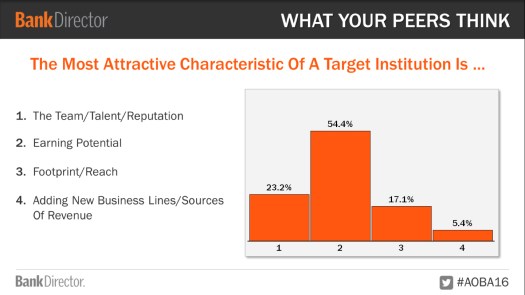
Certainly, “why banks are bought or sold” involves much more than just the numbers making sense.  At AOBA, it was made abundantly clear that M&A remains attractive inasmuch as successful transactions improve operating leverage, earnings, efficiency and scale.  Moreover, attendees shared during one of our interactive sessions that earnings potential is the most attractive characteristic of an institution they are interested in acquiring.

Bank Director and Crowe Horwath LLP AOBA info

In his “Buy Or Die In Phoenix: A Recap Of The 2016 Bank Director’s Acquire Or Be Acquired Conference,” Tim Melvin neatly summarizes the conundrum many bank CEOs face today.  “Competing against their bigger, better funded rivals is… (a) huge obstacle to growth. The days of opening branches on the other side of town, then the next town over and so on to grow a bank are over.”  He concludes by recounting a point made by Steve Hovde, an investment banker we’ve worked with for a number of years: “to thrive, you have to get bigger. To get bigger you probably have to buy and again, if you can’t buy you probably have to sell.”

Acquire or Be Acquired: Don’t Overlook This

Thanks to our keynote speaker, J. Michael Shepherd, pictured above. The Chairman & CEO, Bank of the West and BancWest Corporation, he inspired quite a few with both his wit and wisdom.

Over the past few days at Bank Director’s annual Acquire or Be Acquired conference, various speakers have touched on a number of key strategic growth issues.  From exploring an acquisition to growing loans, controlling expenses to managing capital, the discussions hit the “timely and relevant” standard that we consider essential.  They also reinforced my sense that more boards and their management teams are seriously considering an acquisition as their primary growth plan than at this time last year.

As our editor-in-chief opined, the heightened level of interest could certainly be explained by the continued margin pressure that banks have been operating under for the last several years.  For those thinking about buying another, my short video recap from the mid-way point of AOBA offers a heads up about a pre-deal consideration not to be overlooked.