Do You Know These 3 Cs of Banking?

Quickly:

  • When it comes to talk about bank mergers and acquisitions, It has been written that the questions rarely change — but the conversations prove irresistible.

By Al Dominick, CEO of DirectorCorps — parent co. to Bank Director & FinXTech.

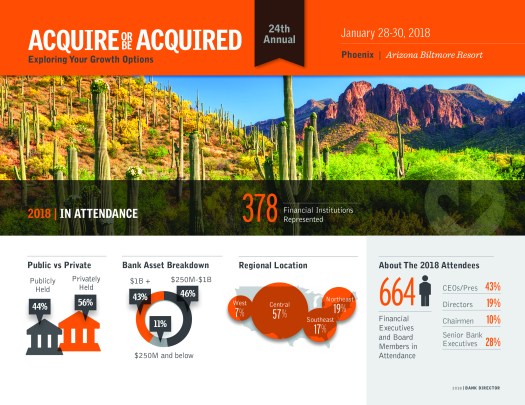
PHOENIX, AZ — If you’re with us here at the Arizona Biltmore for Bank Director’s annual Acquire or Be Acquired Conference, you’ve heard that banks with low‐cost core deposits continue to attract interest from acquirers.  So as banks wrestle with increased funding costs, that observation sparked an idea about what constitutes the “three Cs” of banking today:

  1. Compliance
  2. Cost Control
  3. Consolidation

For instance, having good on-going relations with one’s regulators is hugely important. In fact, I heard several prominent attorneys share that regulatory risk remains the greatest obstacle to completing an M&A deal.  So having the bank in position to act quickly and confidently when an opportunity arises is a major advantage in today’s competitive M&A environment.  I take this to mean no enforcement actions, satisfactory CRA, good HCR results, etc.

As was discussed yesterday afternoon, when an acquirer can present a credible narrative that a potential deal is consistent with a well-considered strategy — and that the company has the infrastructure appropriate to the new organization, you find a well received merger.

In terms of consolidation, we saw a number of presentations note the 261 bank M&A deals, worth an aggregate $26.38 billion, announced in 2017.  As a point of reference, 241 deals were announced — worth an aggregate $26.79 billion — in 2016.  According to S&P Global Market Intelligence, the median deal value-to-tangible common equity ratio climbed significantly in 2017 to 160.6%, compared to 130.6% for 2016.  Last December alone, 32 deals worth a combined $1.84 billion were announced and the median deal value-to-tangible common equity ratio was 156.5%.

Throughout the fourth quarter, there were 74 bank deals announced in the US, which was the most active quarter since 83 deals were announced in the fourth quarter of 2015. However, last quarter’s $4.4 billion aggregate deal value was the lowest since the third quarter of 2015, which totaled $3.43 billion.

These are by no means the only Cs in banking.  Credit, core technology providers, (tax) cuts… all, huge issues.  So along these lines, I made note of a few more issues for buyers, for sellers — and for those wishing to remain independent.  Take a look:

If you are interested in following the final day of the conference via our social channels, I invite you to follow me on Twitter via @AlDominick, the host company, @BankDirector, or search #AOBA18 to see what is being shared with (and by) our nearly 1,200 attendees.

5 Trending Topics at the Acquire or Be Acquired Conference

Quickly:

  • Large buyers are not in the bank M&A game right now; indeed, banks $25Bn and below continue to drive M&A activity. Case-in-point, 95% of total M&A deals since 2011 have buyer assets less than $25Bn. Might this change in 2018?

By Al Dominick, CEO of DirectorCorps — parent co. to Bank Director & FinXTech.

PHOENIX, AZ — Michael Porter, the noted economist, researcher and teacher, once said, “strategy is about making choices, trade-offs; it’s about deliberately choosing to be different. The essence of strategy is choosing what not to do. No one can tell you which rules to break, but you can acquire more skill in determining which rules to break given your talents and circumstances right now.”

Porter’s perspectives came back to me while listening to KBW’s CEO, Tom Michaud. Yesterday morning, Tom talked about the strategic paths that a bank’s CEO might consider in the years to come. As he shared, pressure from investors to deploy capital stimulated M&A discussions in 2017 — and will continue to impact deals in 2018. He also noted that pressure placed on deposit costs, as interest rates rise, contributes to the potential acceleration of bank consolidation. These were just two of the many notes I jotted down during the first day of our annual event. Broadly speaking, what I heard fell into five categories:

1. Economic trends
2. Regulatory trends
3. Small business lending trends
4. Management succession trends
5. Technological innovation trends

Many banks enter 2018 with steady, albeit slow loan growth — while recognizing modest margin improvement as they continue to focus on controlling expenses. Accordingly, I thought to elaborate on the issues I found interesting and/or compelling. Feel free to comment below if other points caught your eye or ear.

Economic Trends

FJ Capital authored a piece in late October that noted how, as the Fed progresses further into the tightening phase of the interest rate cycle, banks will find it more difficult to fund loan growth by raising new low‐cost deposits. Their view, which I heard echoed here, is banks with low‐cost core deposits will become more valuable over the next few years as banks wrestle with increased funding costs. In addition to this idea, I made note that banks with a strong deposit base could be more attractive to buyers as interest rates rise. However, a remark I’ve heard at past events re-emerged here. Namely, making a small bank profitable is hard; exiting, even harder.

Regulatory Trends

Given the audience here, I wasn’t surprised by the continued talk of removing the synthetic $10Bn designation. If the Fed, FDIC and OCC raise the $50Bn threshold as spelled out in Dodd Frank, we could see more banks in the $20Bn – $40Bn range come together. Given that large regional banks usually can pay high prices for smaller targets, unleashing this capacity could reignite more M&A and boost community bank valuations. In addition, the Community Reinvestment Act remains a major headwind in bank mergers. Many here want improvements in the CRA process, which in turn could reduce regulatory risk for bank M&A.

Small business lending

When it comes to the lifeblood of most banks — small business lending — a recurring question has been where and how community banks can take market share from larger banks. My two cents: closing loans faster is key, as is structuring loans to fit specific borrower profiles while being supremely responsive to the customer. Oh, and credit is a big theme right now — and the best clients typically have the best credit.

Management succession

An inescapable comment / observation: aging management teams and board members has been a primary driver of bank consolidation of late. I noted that the average age of a public bank CEO and Chairman is 60 and 66, respectively. It was suggested that this demographic alone plays a key factor in the next few year’s consolidation activity.

Technological trends

When it comes to bank mergers, one of the big drivers of deals is the rise in technology-driven competition (*along with regulatory costs and executive-succession concerns). I sense that most traditional banks haven’t really figured out the digital migration process we’ve embraced as a world. Finally, it appears that the biggest banks are winning the war for retail deposits.  This is an issue that many management teams and boards should be discussing…

_ _ _

For those of you interested in following the conference conversations via our social channels, I invite you to follow me on Twitter via @AlDominick, the host company, @BankDirector and our @Fin_X_Tech platform, and search & follow #AOBA18 to see what is being shared with (and by) our attendees.

10 Questions I Plan To Ask During Acquire Or Be Acquired

Quickly:

  • Despite improving economic conditions, the business of banking remains difficult.

By Al Dominick, CEO of DirectorCorps — parent co. to Bank Director & FinXTech.

PHOENIX, AZ — For all the talk of bank consolidation, there are still 5,700+ banks in the United States.  But let’s not kid ourselves.  For many community banks today, earnings pressures + regulatory and compliance costs + the continued impact of technology = a recurring challenge.

While the number of banks in business will inevitably shrink over the next 10 years — perhaps being cut in half — I remain bullish on the overall future of this industry. If December’s tax reform spurs capital spending and job creation by small- and medium-sized businesses, many of the banks joining us here in Arizona stand to benefit. But will the recent tax cut induce companies to invest more than they already planned to? This is but one of a number of questions I look forward to asking on stage through the first day of Bank Director’s Acquire or Be Acquired Conference.

Below, ten more questions I anticipate asking:

  1. Are FinTechs the industry’s new de novos?
  2. What does it mean that the banking world is deposit rich yet asset poor?
  3. Why are certain credit unions thinking about about buying banks?
  4. In terms of technology spending levels, where are dollars being earmarked and/or spent?
  5. With respect to small business lending, do credit unions or FinTechs pose a more immediate challenge to community banks?
  6. What is an appropriate efficiency ratio for a bank today?
  7. Will big M&A buyers get back in the game this year?
  8. What are some of the critical items in due diligence that are under appreciated?
  9. What does an activist investor look for in a bank?
  10. Is voice recognition the next huge source of growth for banks?

We have an exciting — and full day — coming up at the Arizona Biltmore. To keep track of the conversations via Twitter, I invite you to follow @AlDominick @BankDirector and @Fin_X_Tech.  In addition, to see all that is shared with (and by) our attendees, we’re using the conference hashtag #AOBA18.

21 Reasons I Am Excited About Acquire or Be Acquired

Quickly:

  • Making banking digital, personalized and in compliance with regulatory expectations remains an ongoing challenge for the financial industry. This is just one reason why a successful merger — or acquisition — involves more than just finding the right cultural match and negotiating a good deal.

By Al Dominick, CEO of DirectorCorps — parent co. to Bank Director & FinXTech.

PHOENIX, AZ — As the sun comes up on the Arizona Biltmore, I have a huge smile on my face. Indeed, our team is READY to host the premier financial growth event for bank CEOs, senior management and members of the board: Bank Director’s 24th annual Acquire or Be Acquired Conference. This exclusive event brings together key leaders from across the financial industry to explore merger & acquisition strategies, financial growth opportunities and emerging areas of potential collaboration.

AOBA Demographics

The festivities begin later today with a welcoming reception on the Biltmore’s main lawn for all 1,125 of our registered attendees.  But before my team starts to welcome people, let me share what I am looking forward to over the next 72 hours:

  1. Saying hello to as many of the 241 bank CEOs from banks HQ’d in 45 states as I can;
  2. Greeting 669 members of a bank’s board;
  3. Hosting 127 executives with C-level titles (e.g. CFO, CMO and CTO);
  4. Entertaining predictions related to pricing and consolidation trends;
  5. Hearing how a bank’s CEO & board establishes their pricing discipline;
  6. Confirming that banks with strong tangible book value multiples are dominating M&A;
  7. Listening to the approaches one might take to acquire a privately-held/closely-held institution;
  8. Learning how boards debate the size they need to be in the next five years;
  9. Engaging in conversations about aligning current talent with future growth aspirations;
  10. Juxtaposing economic expectations against the possibilities for de novos and IPOs in 2018;
  11. Getting smarter on the current operating environment for banks — and what it might become;
  12. Popping into Show ’n Tells that showcase models for cooperation between banks and FinTechs;
  13. Predicting the intersection of banking and technology with executives from companies like Salesforce, nCino and PrecisionLender;
  14. Noting the emerging opportunities available to banks vis-a-vis payments, data and analytics;
  15. Moderating this year’s Seidman Panel, one comprised of bank CEOs from Fifth Third, Cross River Bank and Southern Missouri Bancorp;
  16. Identifying due diligence pitfalls — and how to avoid them;
  17. Testing the assumption that buyers will continue to capitalize on the strength of their shares to meet seller pricing expectations to seal stock-driven deals;
  18. Showing how and where banks can invest in cloud-based software;
  19. Encouraging conversations about partnerships, collaboration and enablement;
  20. Addressing three primary risks facing banks — cyber, credit and market; and
  21. Welcoming so many exceptional speakers to the stage, starting with Tom Michaud, President & CEO of Keefe, Bruyette & Woods, Inc., a Stifel Company, tomorrow morning.

For those of you interested in following the conference conversations via our social channels, I invite you to follow me on Twitter via @AlDominick, the host company, @BankDirector and our @Fin_X_Tech platform, and search & follow #AOBA18 to see what is being shared with (and by) our attendees.

Three Things to Know About the Digital Delivery of Financial Products and Services

Quickly:

  • Technology continues to reshape what it means to lead, to innovate and to offer in terms of financial goods and services.

By Al Dominick, CEO of DirectorCorps — parent co. to Bank Director & FinXTech.

WASHINGTON, DC — It is no secret that financial institutions are in a race to figure out how and where innovative technologies can help win and keep loyal customers, improve operational efficiencies and enhance their overall cyber-security measures.  While we might disagree on how fast changes will occur, can we all agree that the ever-expanding expectations for the digital delivery of products and services will dramatically impact banking’s future?

I put this not-quite-rhetorical question out in advance of our annual Acquire or Be Acquired Conference at the Arizona Biltmore.  Indeed, the technological shifts taking place in this industry are significant, and I anticipate quite a few conversations about what our “digital future” might look like.  In the spirit of sharing information and ideas prior to this Sunday’s presentations, this video surfaces a few areas I think a bank’s board needs to pay closer attention to.

If you’re interested in following conversations that focus on issues like these during Acquire or Be Acquired, I invite you to follow me on Twitter via @AlDominick, check out what the team shares through @BankDirector plus our @Fin_X_Tech platform and search & follow #AOBA18 to see what the social shares with (and by) our attendees.

*This video — which is normally available only through our special bank membership program — foreshadows several presentations at Acquire or Be Acquired.  It also tees up our FinXTech Annual Summit.  Held the past few years at the NASDAQ’s MarketSite in NYC, we’ve partnered with Promontory Interfinancial Network to best explore opportunities to generate top line growth and bottom line profits through partnerships, collaboration and investments. Held at The Phoenician in Scottsdale, AZ on May 10th and 11th, I invite you to take a peek at the recently updated agenda.

Ranking the 10 Biggest Banks

Quickly:

  • Bank Director’s year-long Ranking Banking study focuses less on current profitability and market capitalization & more on how the top 10 banks in the U.S. are strategically positioned for success.

By Al Dominick, CEO of DirectorCorps — parent co. to Bank Director & FinXTech

WASHINGTON, DC — It is with tremendous pride that I share the results of Bank Director’s year-long study on America’s 10 largest banks.
  As my colleague, Bill King, wrote to open our inaugural Ranking Banking, we felt that a truly comprehensive analysis of the largest banks was missing, one that includes not just profitability or customer satisfaction ratings, but also compiles numerous measures of strength and financial health — a project to rank each of the largest banks for each major line of business based on qualities that all big banks need.

For instance, we decided to rank banks for branch networks, mobile banking, innovation and wealth management. We analyzed corporate banking and small business lending. We interviewed experts in the field and did secret shopper visits to the biggest banks to find out what the customer experience was like.  Unlike other rankings, we even included complaints lodged with the Consumer Financial Protection Bureau as one of many customer satisfaction metrics that we analyzed.  In other words, there is little about the biggest banks in the nation that we left out.

So who came out on top?

JPMorgan Chase & Co. topped Bank Director’s 2018 Ranking Banking study.

In fact, Chase won five of the ten individual categories and ranked near the top in three more, and was judged by Bank Director to be the most worthy claimant of the title Best of the Biggest Banks.  The individual category winners are:

Best Branch Network: Wells Fargo & Co.

Despite its well-publicized unauthorized account opening scandal, Wells Fargo topped the branch category by showing the best balance of deposit growth and efficiency, and scored well on customer experience reports from Bank Director’s on-site visits.

Best Board: Citigroup

In ranking the boards of directors of the big banks, Bank Director analyzed board composition by factors such as critical skill sets, diversity, median compensation relative to profitability and independence. Citigroup’s board best balanced all components.

Best Brand: JPMorgan Chase & Co.

Chase and runner-up Capital One Financial Corp. stood out for their media spend as a percentage of revenue, and both exhibited strong customer perception metrics.

Best Mobile Strategy: JPMorgan Chase & Co.

Chase has been successful in driving new and existing customers to its mobile products, leading to an impressive digital footprint, measured through mobile app downloads. The bank’s app also scored well with consumers.

Best Core Deposit Growth Strategy: BB&T Corp.

BB&T had a low cost of funds compared to the other ranked banks, and its acquisitions played a strong role in its core deposit growth, which far surpassed the other banks in the ranking.

Most Innovative: JPMorgan Chase & Co.

Chase most successfully balanced actual results with sizeable investments in technological innovation. These initiatives include an in-residence program and a financial commitment to the CFSI Financial Solutions Lab. Chase has also been an active investor in fintech companies.

Best Credit Card Program: JPMorgan Chase & Co.

Chase barely edged out fast-growing Capital One to take the credit card category, outpacing most of its competitors in terms of credit card loan volume and the breadth of its product offering. Chase also scored well with outside brand and market perception studies.

Best Small Business Program: Wells Fargo & Co.

Wells Fargo has long been recognized as a national leader in banking to small businesses, largely because of its extensive branch structure, and showed strong loan growth, which is difficult to manage from a large base. Wells Fargo is also the nation’s most active SBA lender and had the highest volume of small business loans.

Best Bank for Big Business: JPMorgan Chase & Co.

Big banks serve big businesses well, and finding qualitative differences among the biggest players in this category—Chase, Bank of America and Citigroup—is difficult. But Chase takes the category due to its high level of deposit share, loan volume and market penetration.

Best Wealth Management Program: Bank of America Corp.

With Merrill Lynch fueling its wealth management division, Bank of America topped the category by scoring highly in a variety of metrics, including number of advisors (more than 18,000 at last count) and net revenue for wealth and asset management, as well as earning high marks for market perception and from Bank Director’s panel of experts.

FWIW…

The 10 largest U.S. retail banks play an enormously important role in the nation’s economy and the lives of everyday Americans. For example, at the end of 2016, the top 10 banks accounted for over 53 percent of total industry assets, and 57 percent of total domestic deposits, according to the Federal Deposit Insurance Corp. The top four credit card issuers in 2016—JPMorgan Chase & Co., Bank of America Corp., Citigroup and Capital One Financial Corp.—put more than 303 million pieces of plastic in the hands of eager U.S. consumers, according to The Nilson Report.

Bank CEOs and Their Boards Can Lay Claim to These 5 Technologies

Quickly:

▪ Regional and community banks continue to lay claim to innovative technologies that attract new customers, enhance retention efforts, improve efficiencies, cut costs and bolster security.

By Al Dominick, CEO of DirectorCorps — parent co. to Bank Director & FinXTech

ATLANTA — The digital distribution of financial goods and services is a HUGE issue for bank executives and their boards.  Margins on banking products continue to decline due to increased competition.  In my opinion, this provides ample incentivize for banks to seek partnerships with specialized product and service providers.

I shared this thought earlier today at Bank Director’s annual Bank Board Training Forum. During my remarks to an audience of 203 officers and directors (representing 84 financial institutions), I laid out five potential area of collaboration that community bank CEOs and their boards might spend more time discussing:

1. New core technologies;
2. Machine learning / Artificial intelligence applications;
3. RegTech;
4. Payments; and
5. White labeling product offerings.

I elaborated on why I think our audience needs to explore each area before expanding on how banks might take steps to incorporate such technologies into their culture and business.  I wrapped up by providing examples of companies in each space that attendees might learn more about.

For instance, when it comes to the core technological systems offered by Fiserv, Jack Henry and FIS, many banks are investing in “integration layers” to bridge the needs of client‐facing systems with their core system. While these layers have proven valuable, banks are also aware of the need to migrate away from legacy cores should the flexibility they desire not come from these companies.  Hence the advent of companies like Finxact, a cloud banking platform promising to be the most transparent and open core banking system available.

In terms of machine learning and artificial intelligence, I see five potential use cases for banks to consider: smarter customer acquisition, better Know-Your-Customer efforts, improved customer service, smarter and faster account openings and the ability to offer more competitive loans.  Here, I am impressed with the work being done by companies like Kasisto, whose conversational AI platform is pre-loaded with thousands of banking intents and millions of banking sentences.  It promises to fulfill requests, solve problems, predict customers’ needs and improve performance on its own using sophisticated machine learning.

Given the cost and complexity of compliance, RegTech offerings promise to simplify fraud prevention and detection, improve the interpretation of regulation while accelerating reporting functions.  Further, RegTech companies held simplify data access, storage and management while strengthening risk management efforts.  There are quite a few companies in this fast-growing space that I highlighted.  One is Fortress Risk Management, a company whose advanced analytics predict and detect financial crime while its tool enable efficient case management, dispute management, reporting and regulatory compliance.

With respect to payments, our rapidly changing and oh-so-interconnected markets of debit, credit, mobile, prepaid and digital payments proves both a blessing and a potential curse for traditional institutions. As we move toward a cashless society and payments become less visible, banks need to maximize their opportunities to become the default payment method, and keep abreast of innovations in credit scoring, faster payments, analytics, security and fraud detection.  Case-in-point, BluePay delivers non-interest income to banks of all sizes by aggregating customer data coupled with the latest merchant processing technology.

Finally, white label product offerings are nothing new.  However, technology companies like SimplyCredit and StrategyCorps continue to help banks reshape and rethink customer engagement, setting new and higher bars for their’s clients’ experiences.  For banks seeking innovations like rapid loan adjudication, partnering with technology providers like these enables a bank to keep pace with the customer experience expectations set by large technology firms.

##

If you weren’t able to join us in Atlanta and are curious about today’s featured image, here is a link to the pdf: 2017 Bank Board Training Presentation (Tech-focused). As I shared, New Zealand’s All Blacks are the world’s most successful sporting outfit, undefeated in over 75% of their international rugby matches over the last 100 years.  Their willingness to change their game (and their culture) when they were at the top of their game inspired me — and allowed me to challenge our attendees to think if they are willing to do the same with their banks.  I’m also inspired by my colleagues who helped develop this year’s program. From our conference team to editorial group, marketing to data departments, I’m proud to work with a great group dedicated to the idea that a strong board makes contributes to a strong bank.

Strong Board. Strong Bank

Quickly:

  • A bank’s CEO, Chairman and board of directors face a number of challenges in today’s ever competitive, highly regulated and rapidly evolving financial services industry.

By Al Dominick, CEO of DirectorCorps — parent co. to Bank Director & FinXTech

ATLANTA — Complex regulations, technological innovations and a highly competitive environment that leaves little room for error have placed unprecedented demands on the time and talents of bank boards.  Still, no one I’m with today seems interested in pity or sympathy.  To wit, I’m in Atlanta, at the Ritz-Carlton Buckhead, as we host Bank Director’s annual Bank Board Training Forum.  With us are 200+ men and women committed to strengthening their bank’s performance by enhancing the skills and abilities of their boards.

I’m buoyed by their collective optimism, especially having surfaced myriad governance issues, compliance challenges, audit responsibilities, risk concerns and areas of potential liability. What follows are five takeaways from presentations made today that are growth, risk or team-oriented.

  1. When it comes to growing one’s bank, an acquisition of another institution certainly helps a buyer achieve operating scale efficiencies, which in turn increases its valuation.
  2. In addition to traditional M&A as a driver of growth, we are seeing more partnerships with (and outright acquisitions of) non-banks in order to enhance non-interest income and the expansion of net interest margins.
  3. Personally, I appreciated Jim McAlpin (a partner at the law firm of Bryan Cave) for elaborating on the phrase “Strong Governance Culture.” As he explained, the regulatory community takes this to mean a well developed system of internal oversight and a board culture focused on risk management.
  4. When it comes to risk, financial institutions face a quite a few. Indeed, Eve Rogers, a Partner at Crowe Horwath, touched on cybersecurity, economic factors, regulatory changes, shrinking margins and fee restrictions. As she made clear, proactively identifying, mitigating, and, in some cases, capitalizing on these risks provides a distinct advantage to the banks here with us.
  5. In terms of compensation, a good checklist for all banks includes (a) the bank’s compensation philosophy, (b) specific details for how to incorporate a performance plan against a strategic plan and (c) details around how one’s compensation peer group was formed — and when was it last updated.

Tomorrow morning, I share some new ideas for approaching technology in terms of growth and efficiency given the digital distribution of financial goods and services.  As I noted from the stage, we’re seeing some banks, rather than hire from the ground up, take a plug-and-play approach for partnering (or acquiring) FinTech companies. While I certainly intend to talk about the culture and team aspects of technology tomorrow, my focus goes to how and where machine learning, RegTech, payments, white labeling opportunities and core providers allow financial institutions to present a cutting-edge looks and feels to its customers under the bank’s brand.  (*If you’re interested, click here.)

The Paths High Performing Banks Take to Growth and Innovation

Quickly:

  • I’m in Utah at the Montage Deer Valley for the second day of the Association for Financial Technology’s Fall Summit.
  • This afternoon, I shared my thoughts on the pace of change impacting banks as part of AFT’s Fintech Leadership Industry Update.

By Al Dominick, CEO of DirectorCorps — parent co. to Bank Director & FinXTech

PARK CITY — For those that attended Bank Director’s Acquire or Be Acquired conference this January, you may recall slides illustrating the consolidating nature of the banking industry over the past 25 years.  This decrease in the number of banks is the result of several major factors; most notably, changing banking laws, changing technologies, changing economics and changing consumer behaviors.

Given the audience we share information with (e.g. bank CEOs and their leadership teams), I continue to hear talk about steady, albeit slow, loan growth, some margin improvement and a continued emphasis on expense control.  However, it is apparent from the outside looking in that many banks still lack the true flexibility to continually innovate in terms of both products and services — and how they are delivered.

This is downright scary when you consider that Amazon’s Lending Service surpassed $3 billion in loans to small businesses since it was launched in 2011.  As I shared in my remarks, Amazon loaned over $1 billion to small businesses in the past twelve months.  Over 20,000 small businesses have received a loan from Amazon and more than 50% of the businesses Amazon loans to end up taking a second loan.  This is a major threat to the established financial community, because if there is one thing community banks and large banks agree on, it is that the small business market is important.  This will not change any time soon, and for community banks in particular, a greater share of the small business market may be their only path to survival.

So what I shared this afternoon were real-world examples of bank CEOs focused on carrying out a long-term growth strategy in creative, yet highly focused, ways.  For instance, several of the banks I referenced are attempting to re-engineer their technology and data infrastructure using modern systems and processes, developed internally and augmented through partnerships with fintech companies.  For instance, I cited a newer partnership between First Horizon’s First Tennessee bank unit and D3 Banking. In addition, I used examples like US Bancorp, PNC and Fifth Third before highlighting five more institutions that range from $10Bn to $50Bn in asset size.

I did so because we are witnessing an intense struggle on the part of financial services providers to harness technology in order to maintain relevance in the lives of their customers.  The eight banks I cited today have different leadership approaches; all, however, are considered high-performers. For those interested, here is a link to my presentation: Bank Director and FinXTech 2017 AFT Presentation.

The caveat to my presentation, remarks and writing: it might appear easy to create a strategic direction to improve efficiency and bolster growth in the years ahead. But many bank executives and their boards are being cautioned to prepare for false starts, unexpected detours and yes, stretches of inactivity — all of which impacts tech companies like those here in Park City at AFT.  Still, a vision without action is a dream; action without vision, a nightmare.  For these banks, strong leadership have set a clear course for their futures.

A Community Bank Can Build Innovation Into Its Growth Strategy

Quickly:

  • I’m at the Montage Deer Valley for the Association for Financial Technology’s Fall Summit.
  • “Who do we want to be when we grow up in this new digital, always-on financial services environment?” might be the most important question for a bank CEO to strategize on with his or her team.

By Al Dominick, CEO of DirectorCorps — parent co. to Bank Director & FinXTech

PARK CITY, UTAH — For the technology companies looking to make a real difference in the financial services world, let me suggest a stronger focus on regional and community banks.  At a time when JPMorgan Chase, Wells Fargo, BofA and the like are investing heavily in digital engagement strategies to connect with digital-savy customers, there are significant pressures on banks not able to spend what the biggest banks do to develop or adopt digital strategies.

As I listened to an afternoon panel discussion on the need for banks to create sustainable, scalable and relevant business models, I went back to my notes on a newer partnership between First Horizon’s First Tennessee bank unit and D3 Banking.  Developed to overhaul First Tennessee using D3’s API-driven platform, I see this type of partnership as one that positions a strong regional player to better compete with much larger banks.

First Tennessee and D3 is one of a number of bank/fintech arrangements I think technology executives here in Park City should know about.  A smaller bank “doing it right” in terms of partnering with technology companies is Somerset Trust Co., a $1 billion asset bank out of western Pennsylvania.

Their COO, John Gill, participated in the panel that precipitated this post.  As we’ve written about at Bank Director, Somerset has learned to play the innovation game by partnering up with some impressive fintech companies.  For example, they teamed up with Malauzai Software in Austin, Texas, to develop a mobile banking solution that allows Somerset’s retail banking customers to securely check balances, use picture bill pay and remotely deposit checks from any location or device.  More recently, Somerset Trust partnered up with BOLTS Technologies to improve its mobile new account customer experience.

It strikes me that figuring out how to move ones business towards a foundation of flexibility is essential.  So too is being open to new ideas and partnership opportunities. Most importantly, just because a bank is small doesn’t mean it can’t build innovation into its growth strategy.

##

As part of AFT’s Fall Summit, I shared a few stories about bank CEOs leadership styles, their team’s investments in fintech companies and ideas, and several innovative solutions that caught my attention.  Interested?  Here is a link to both my presentation and post.

Consolidation Trends in Banking

By Al Dominick, CEO of DirectorCorps — parent co. to Bank Director & FinXTech

Quickly:

  • Nationwide consolidation in the banking space will continue; at least, that is my sense based on conversations and presentations at Crowe Horwath’s Bank Leadership and Profitability Improvement Conference.

_ _ _

So much of this morning was spent talking about growth through mergers and acquisitions (M&A) that I couldn’t help but flash back to January’s Acquire or Be Acquired conference.  Thematically, I went into that event expecting the unexpected.  Given this morning’s presentations on growing one’s bank, I believe that mindset still holds water.

For example, Tom Michaud, the president and CEO of Keefe, Bruyette & Woods, described 2016 and 2017 as one bumpy ride.  From recession fears to lower-for-longer rates, the initial euphoria after the presidential election (at least in terms of stock prices, which went up 27% – 30%) to the uncertainty of regulatory relief, he reminded us of where we are coming from relative to where we might be heading.  I am always curious to hear what Tom thinks about the state of banking; below, ten things I learned from him this morning:

  1. The interest rate outlook is a bit cloudier than it was in November;
  2. Regional banks have had excellent earnings per share growth relative to the overall market;
  3. We have an active pace of consolidation — nearly 5% of the industry is merging;
  4. The most prolific acquirers can buy 2, maybe 3 banks, at best each year;
  5. M&A deals are getting bigger — not ’97 or ’98 levels, but bigger than where they’ve been;
  6. Large buyers are not in the game right now — buyers $25Bn and below continue to drive M&A activity (case-in-point, 95% of total M&A deals since 2011 have buyer assets less than $25Bn);
  7. Buyers are completing their acquisitions in 6 months or less;
  8. Banks with strong tangible book value multiples are dominating M&A;
  9. There have been 37 bank IPOs since 2013 — and the market today is open to small bank IPOs; and
  10. If you’re running a bank, you better be watching (like a hawk) the FinTech charters being pursued by companies like SoFi.

Following Tom’s presentation, we doubled down on growing-the-bank type topics with a session involving Rick Childs, a partner at Crowe Horwath, Jim Ryan, the CFO at Old National Bancorp, Jim Consagra, EVP and COO at United Bancshares and Bryce Fowler, chief financial officer at Triumph Bancorp.

From pricing discipline to acquisitions of privately-held/closely-held companies, the guys made clear that “there are only so many deals out there.”  They shared how boards need to determine the size they want to be, honestly assess the talent they have relative to such aspirations and determine how growth through M&A aligns with enterprise risk management positioning.  Essentially, their remarks made clear that a successful merger or acquisition involves more than just finding the right match and negotiating a good deal.

##

As I shared with yesterday’s post, my thanks to Crowe Horwath, Stifel, Keefe Bruyette & Woods and Luse Gorman for putting together this year’s Bank Leadership and Profitability Improvement Conference at The Inn at Spanish Bay in Pebble Beach, California.

The Intersection of Leadership and Profitability

By Al Dominick, CEO of DirectorCorps — parent co. to Bank Director & FinXTech

Quickly

  • Key takeaways from one of my favorite summer banking events, Crowe Horwath’s Bank Leadership and Profitability Improvement Conference.

_ _ _

This morning, on the first of my two flights from Washington National to Monterey, California, I learned that Walmart customers might soon be able to get installment loans for big-ticket items through Affirm, a San Francisco-based FinTech I first wrote about in 2014 (For Banks, the Sky IS Falling).  Per the Wall Street Journal, the companies reportedly are nearing an agreement on a pilot program.  This potential partnership caught my eye as I prepared for today and tomorrow’s conference.  Indeed, relationships like these make clear that when it comes to growth and efficiency, the digital distribution of financial goods and services is a significant issue for the banking industry.

This idea took further shape when I walked into the conference center at the Inn at Spanish Bay.  Immediately upon entering the room, I found John Epperson, a partner at Crowe and Jay Tuli, senior vice president retail banking and residential lending at Leader Bank, sharing their opinions on partnership strategies involving banks and FinTechs.  From the stage, they touched on increasing net interest margins via improved pricing strategies on commercial loans, approaches to streamline mortgage application processes, ideas to reduce staff counts for loan administration processes and how to improve customer experiences through online rent payment solutions.

Their perspectives lined up with those we recently shared on BankDirector.com.  To wit, “many banks have realized advantages of bank-FinTech partnerships, including access to assets and customers.  Since most community banks serve discreet markets, even a relatively simple loan purchase arrangement can unlock new customer relationships and diversify geographic concentrations of credit.  Further, a FinTech partnership can help a bank serve its legacy customers; for instance, by enabling the bank to offer small dollar loans to commercial customers that the bank might not otherwise be able to efficiently originate on its own.”

Of all the difficult issues that bank leadership must deal with, I am inclined to place technology at the top of the list.  Banks have long been reliant on technology to run their operations, but in recent years, technology has become a primary driver of retail and small business banking strategy.  John and Jay simply reinforced this belief.

In addition to their thoughts on collaboration, this afternoon’s sessions focused on ‘Liquidity and Balance Sheet Management,’ ‘Fiscal Policy During Regulatory Uncertainty’ and ‘Managing Your Brand in a Digital World.’  While I took note of a number of issues, three points really stood out:

  • Yes, banks can make money while managing decreasing margins and a flat yield curve.
  • Asset growth without earnings growth is a concern for many because of loan pricing.
  • How a CFO sets a target(s) for interest rate risk may start with an “it depends” type response — but gets nuanced quickly thereafter.

Finally, I’m not holding my breath on the industry receiving regulatory relief any time soon.  I get the sense many here aren’t either.  But it would be nice to see some business people brought in to run various agencies and I’m looking forward to the perspectives of tomorrow’s first guest speaker, Congressman John Ratcliffe.

##

My thanks to Crowe Horwath, Stifel, Keefe Bruyette & Woods + Luse Gorman for putting together this year’s Bank Leadership and Profitability Improvement Conference at The Inn at Spanish Bay in Pebble Beach, California.  I’ll check in with additional takeaways based on tomorrow’s presentations.