5 Fintechs I’m Keen On

My first post in 2015 focused on three “up & coming” fintech companies: Wealthfront (an automated investment service), Kabbage (an online business loan provider) and Dwolla (a major player in real-time payment processing).  Since writing that piece, I’ve kept tabs on their successes while learning about other interesting and compelling businesses in the financial community.  So today, five more that I am keen on.

By Al Dominick // @aldominick

With continuous pressure to innovate, I’m not surprised to see traditional financial institutions learning from new challengers, adapting their offerings and identifying opportunities to collaborate with emerging players.  From tokenization to integrated payments, security tools to alternative lending platforms, the investments (and efforts) being made throughout the financial sector continues to impress and amaze me.  As I shared in 15 Banks and Fintechs Doing it Right, there are very real and immediate opportunities to expand what banking means to individual and business customers.  Personally, I am excited by the work being done by quite a few companies and what follows are five businesses I’ve learned more about while recently traveling between D.C., San Francisco and New York City:

logo

i2c, a global card processing company, provides back-end processing and settlement for cards, virtual accounts and mobile payments.  What’s interesting about them? According to a brief shared by Bridge by Deloitte (a web platform connecting enterprises with startups to accelerate innovation and growth), i2c recently teamed up with Oxfam, Visa and Philippines-based UnionBank to channel funds to people in disaster-affected communities through prepaid cards.

adyen-logo

With Money20/20 fast approaching, expect to see a lot of #payments trending on twitter.  Trending in terms of financial investment: Adyen, a company receiving a lot of attention for wrapping up a huge round of funding that values the payment service provider at $2.3B.  Adyen, which provides its services to a number of large organizations including Facebook and Netflix, excels in having a highly integrated platform, unlike others with multiple platforms.

Blend labs

When it comes to technology “powering the new wave of mortgage lending,” take a look at the work being done at BlendLabs.  Developing software & data applications for mortgage lenders, the company acknowledges that “accommodating complex rules and regulation changes is time-consuming and costly.” For this reason, the company has quietly rolled out technology that empowers some of the country’s largest lenders to originate mortgages more efficiently and compliantly than ever before while offering their borrowers a more compelling user experience.

logo

As the head of a company, I know first-hand how much time and effort is spent on efforts and ideas designed to maximize revenue and profits.  So the promise and premise of nCino is hugely attractive.  Co-founded by a fellow W&L grad (and the former CEO of S1) nCino is the leader in cloud banking.  With banks like Enterprise in St. Louis (lead by a CEO that I have huge respect for) as customers, take a look at their Bank Operating System, a comprehensive, fully-integrated banking management system that was created by bankers for bankers that sits alongside a bank’s core operating system.

logo

While not solely focused on the financial industry, Narrative Science is a leader in advanced natural language generation.  Serving customers in a number of industries, including marketing services, education, financial services and government, their relationship with USAA and MasterCard caught my eye.  As FinXTech’s Chief Visionary Officer recently shared with me, the Chicago-based enterprise software company created artificial intelligence that mines data for important information and transforms it into language for written reports.

##

In addition to these U.S.-based companies, you might look at how Fidor, a digital bank in Europe that offers all-electronic consumer banking services, links interest rates to Facebook likes and give cash rewards based on customers’ level of interaction with the bank (e.g. how many customer financial questions answered).  Clearly, the fabric of the financial industry continues to evolve as new technology players emerge, institutions like Fidor expand their footprint and traditional participants transform their business models.  So if you follow me on twitter (@aldominick), let me know of other fintech companies you’re impressed by these days.

18 Banks that Fintech Companies Need to Know

To build on last week’s piece (15 Banks and Fintechs Doing it Right), I put myself in the shoes of an early stage fintech company’s Founder.  Specifically, as someone with a new idea looking to develop meaningful financial relationships with regional and community banks in the United States.  With many exciting and creative fintech companies beginning to collaborate with traditional institutions, what follows is a list of 18 banks — all between $1Bn and $25Bn in size — that I think should attract the tech world’s interest.

By Al Dominick // @aldominick

Believe it or not, but bank CEOs and their teams are working hard to grow revenue, deposits, brand, market size and market share.  So a hypothetical situation to tee-up today’s column.

Imagine we developed a new, non-disruptive but potentially profit-enhancing software product (let’s put it in the “know-your-customer” sector since banks already spend money on this).  As the Founders, we want to approach banks that might be ready to do more than simply pilot our product.  While our first instinct would be to focus on recognizable names known for taking a technology-based, consumer-centric focus to banking, the low hanging fruit might be with CEOs and executive teams at publicly traded community banks — many of whom are above $1Bn in asset size and are just scratching the surface of developing meaningful fintech relationships.

With the idea that smaller banks can act faster to at least consider what we’re selling, we cull the field, knowing that as of June 1 of this year, the total number of FDIC-insured institutions equaled 6,404; within this universe, banks with assets greater than $1Bn totaled just 699.

So now we are focused on a manageable number of potential customers and can spend time getting smart on “who’s-doing-what” in this space.  Can we agree that we want to approach banks that share common characteristics; namely, strong financial performance that sets them apart from their peers and operations in strong local markets or big economic states?  Good, because assuming we are starting from scratch in this space, here are our top prospects (listed in no particular order with approximate asset size):

  1. Citizens Business Bank in California ($7.3Bn)
  2. Pinnacle Financial in Tennessee ($6Bn)
  3. Farmers & Merchants in California ($5.5Bn)
  4. Western Alliance in Arizona ($10Bn)
  5. Eagle Bank in DC ($5.2Bn)
  6. Prosperity in Texas ($21.5Bn)
  7. BankUnited in Florida ($19.2Bn)
  8. BofI “on the internet” ($5.2Bn)
  9. First NBC in Louisiana ($3.7Bn)
  10. Burke & Herbert in Virginia ($2.6Bn)
  11. Banner in Washington ($4.7Bn)
  12. Bank of Marin in California ($1.8Bn)
  13. Cardinal Bank in Virginia ($3.4Bn)
  14. State Bank in Georgia ($2.8Bn)
  15. TCF Financial in Minnesota ($19.3Bn)
  16. United Bank in Connecticut ($5.5Bn)
  17. Boston Private in Massachusetts ($6.8Bn)
  18. Opus Bank in California ($5.1Bn)

At a time when the concept of service is fast changing to reflect highly functional technology and “always-available” customer experiences, these eighteen banks — already successful in their own right — strike me as just the types to think about approaching.

##

*Now I’m not suggesting everyone pick up the phone and call each’s institutions CEO.  But If you are with a fintech thinking about partnerships and collaboration, you could do a whole heckuva lot worse than spending some time learning what makes all of these banks more than just financially strong and consumer relevant.

15 Banks and Fintechs Doing it Right

15 examples - new blog cover image.001

Many bank CEOs and their executive teams are looking for emerging methods, products and services to reach new customer segments to drive growth. Today, I identify fifteen banks in the United States, all under $20Bn in asset size, that are growing with the help of fintech companies.

By Al Dominick // @aldominick

With the rise of many innovative, non-traditional financial services companies, leaders of financial institutions can find themselves overwhelmed when it comes to selecting the right partners.  If you are running a bank that doesn’t have multiple incubators, accelerators and skunk work projects already under way, knowing where to participate with the fintech community can prove quite the challenge.  Should it be with an upstart touting a new credit decisioning models?  What about one with a new lending model?  In the quest to become more “nimble” and responsive to consumer demands, do you partner? Refer business? Accept referrals?  The list of not-so-rhretorical questions goes on and on…

Now, quite a bit of digital ink has been spilled over the creativity and aspirations of the fintech community (and its many investors) to transform banking.  But not nearly as much for banks looking to do the same.  While the efforts of major players like Wells Fargo and Capital One garner well-deserved attention, it is my belief that for fintech companies keen to collaborate (and not compete) with banks, developing relationships with banks from $1Bn to $10Bn — there are approximately 550 — and those from $10Bn to $50Bn — there are approximately 75 — may prove as lucrative over the next few years as working with the 30 banks that have assets from $50Bn up.

With this parameter in mind, I polled a few of my team at Bank Director to compile a list of banks, all under $20Bn in asset size, that “play well” with fintechs to show that you don’t have to be the biggest of the big to benefit from this wave of new market participants.  Here, in no particular order, are fifteen banks with notable relationships and/or efforts.

  1. Eastern Bank checks in at $9.7B in asset size, and the Massachusetts-based bank stands out for bringing on some great fintech talent; notably, hiring ex-Perkstreet CEO Dan O’Malley and several of his colleagues to lead its innovation unit;
  2. California’s Fremont Bank ($2.7B) caught our eye, as the bank was a fast adopter of Apple Pay;
  3. River City Bank ($1.3B, Sacramento) has a fintech guy — Ryan Gilbert, Better Finance — on their board;
  4. The Bancorp ($4.5B) backs a lot of fintech/nonbank firms like Moven and Simple;
  5. Radius Bank (just under $1Bn) is a Boston institution with just two physical locations — but is forming alliances with fintech startups to be “everywhere;”
  6. Union Bank & Trust in Nebraska works with Betterment, an automated investing service, to offer its customers a smart, simple and easy way to invest;
  7. A real pioneer, CBW Bank ($14.5B) is a community bank in Kansas and one of the first U.S. banks to use the Ripple protocol for modern, real-time payments between the U.S. and other countries globally;
  8. In the Pacific Northwest, Washington Trust ($4B) is vocal on being tech-friendly;
  9. In Texas, First Financial ($6B) is big on mobile and being innovative — working with Mitek, they are the first regional bank to offer mobile photo bill pay);
  10. Banc of California ($6B) uses nCino to automate and standardize its commercial and SBA lending;
  11. PacWest ($16B) are all about lending to technology and fintech companies;
  12. The Bank of the Internet, BofI, is a full-service internet bank with $5 billion in assets;
  13. Everbank ($16B) plays well with Fintech while adorning the stadium of the NFL’s Jacksonville Jaguars;
  14. Rockland Trust has a SVP of digital and payments innovation, which is unusual for a $5.6 billion dollar bank; and
  15. The $17 billion-asset First National Bank of Omaha hosts a weekend-long hackathon, a competition common in the tech world but rarely hosted by banks, to attract talent into its ranks.

By no means is this a complete list of community banks collaborating with fintechs in the U.S.  If I was to expand the list up in size, you can bet larger regional standouts like KeyBank would merit recognition for their work with companies like HelloWallet.  In the spirit of learning/sharing, who else should be added to this list?  Let me know via twitter or by leaving a comment below.

The 5 Corners of Technological Innovation in Financial Services

To grasp what the future of banking holds, look no further than the five areas of focus for Wells Fargo.  Last week, the best performing large bank in the United States launched an “Innovation Group” in San Francisco.  As they share, this team will will work in partnership with its major businesses to meet evolving customer needs and stay ahead of the shifting competitive landscape.  Initially, such efforts will center on five areas:

  • Research and development;
  • Innovation strategies;
  • Payment strategies;
  • Design and delivery; and
  • Analytics.

As a nationwide, diversified, community-based financial services company with $1.7 trillion in assets, Wells Fargo now has six innovation labs along with its startup “accelerator.”  Given that a number of the world’s largest finance sector companies are reviewing their business models following the rapid growth of “fintech” entrants in the sector, the investment in both time and resources by Wells Fargo gives shape to the potential future of banking.

Wells Fargo Labs invite customers to “Come out and Play: Be one of the first to test out latest ideas and technologies – from still-in-development beta offerings to newly launched products.”

Personally, I’m drawn to this new addition to the Wells family in light of a report by the World Economic Forum, supported by Deloitte Consulting, entitled The Future of Financial Services:How disruptive innovations are reshaping the way financial services are structured, provisioned and consumed.

As noted by the paper’s lead author, “for decades, banks and insurers have employed similar, highly profitable business models. But they realize those models are coming under pressure due to fintech innovations… Financial technology companies are deploying online platforms, have small capital bases, and make strategic use of data, to acquire customers and revenues at a fast pace. Banks and insurers noted that, and are contemplating their response.”  So as major players like Wells Fargo explore the “transformative potential of new entrants and innovations on business models in financial services,” seeing the cards they are putting on the table provides real color for what the future holds for many here in the U.S.

What To Do With FinTech

For the 699 financial institutions over $1Bn in asset size today, the drive to improve one’s efficiency ratio is a commonly shared goal.  In my mind, so too should be developing relationships with “friendly” financial technology (FinTech) companies.

By Al Dominick // @aldominick

Small banks in the United States — namely, the 5,705 institutions under $1Bn in assets* — are shrinking in relevance despite their important role in local economies.  At last week’s Bank Audit & Risk Committees Conference in Chicago, Steve Hovde, the CEO of the Hovde Group, cautioned some 260 bankers that the risks facing community banks continue to grow by the day, citing:

  • The rapid adoption of costly technologies at bigger banks;
  • Declining fee revenue opportunities;
  • Competition from credit unions and non-traditional financial services companies;
  • Capital (in the sense that larger banks have more access to it);
  • An ever-growing regulatory burden; and
  • The vulnerability all have when it comes to cyber crime.

While many community banks focus on survival, new FinTech companies have captured both consumer interest and investor confidence.  While some of the largest and most established financial institutions have struck relationships with various technology startups, it occurs to me that there are approximately 650 more banks poised to act — be it by taking the fight back to competitive Fintech companies or collaborating with the friendly ones.

According to John Depman, national leader for KPMG’s regional and community banking practice, “it is critical for community banks to change their focus and to look for new methods, products and services to reach new customer segments to drive growth.”  I agree with John, and approach the intersection of the financial technology companies with traditional institutions in the following manner:

For a bank CEO and his/her executive team, knowing who’s a friend, and who’s a potential foe — regardless of size — is hugely important.  It is also quite challenging when, as this article in Forbes shows, you consider that FinTech companies are easing payment processes, reducing fraud, saving users money, promoting financial planning and ultimately moving our giant industry forward.

This is a two-sided market in the sense that for a FinTech founder and executive team, identifying those banks open to partnering with, investing in, or acquiring emerging technology companies also presents great challenges, and also real upside.  As unregulated competition heats up, bank CEOs and their leadership teams continue to seek ways to not just stay relevant but to stand out.  In my opinion, working together benefits both established organizations and those startups trying to navigate the various barriers to enter this highly regulated albeit potentially lucrative industry.

*As of 6/1, the total number of FDIC-insured Institutions equaled 6,404. Within this universe, banks with assets greater than $1Bn totaled 699. Specifically, there are 115 banks with $10Bn+, 76 with $5Bn-$10Bn and 508 with $1Bn – $5Bn.

How to Understand a Bank’s Audit and Risk Committees Issues in Three Steps

I’m in Chicago at Bank Director’s annual Bank Audit & Risk Committees Conference along with more than 260 bankers and some 315 total attendees.  At a time when audit and risk committees have an increasing amount of responsibilities, I’m impressed with the commitments made by attendees and speakers alike to tackle real issues as opposed to sugar coating the challenges before banks today.

As we move into a series of afternoon breakout sessions, I am taking a pause to share my observations on the day so far.  Having moderated a session that touched on how banks can enhance risk oversight capabilities and effectively challenge management on risk, let me try to make sense of the issues being faced by senior bankers and board members if you are not with us.

Step 1: Know Where We Are Coming From

Now that the worst of the financial crisis is behind them, you might think bank boards might finally breathe a sigh of relief.  You would be mistaken.  For example, we have been in an exceptionally low-interest rate environment — one that has caused net interest margins to decline significantly since 2000.  Moreover, growing the bank organically remains challenging with slow loan growth and changing consumer expectations.  Finally,  compliance costs and uncertainties continue to escalate.  So yes, for banks here with us in Chicago, the storm was weathered.  Still, significant risks and challenges remain in place.

Step 2: Accept Where We Are Today

Per our first speaker, Steve Hovde, it has become exceedingly more difficult to maintain net interest margins without growing loan balances.  As he made clear, banks with lower loan-to-deposit ratios operate with less overhead, but they have been unable to translate their lower operating costs into higher profitability over the long run.  In his words, loan growth is now paramount to profitability — and banks will need to find ways to generate loans either organically or (more likely) through M&A activity.

I know that many banks are struggling to find new revenue sources.  I also hear how bank boards are considering diversifying into new loan products and service offerings to attract and retain new and existing customers.  So, for banks considering new lending strategies or launching a new product or service, I made note that the audit committee, risk committee and internal auditor must collaborate to safeguard the organization by understanding an organization’s initiatives, limits and controls, all while understanding the risk monitoring that exists at the institution.

Step 3: Understand Where Things Are Heading

As we look ahead, it is quite clear that the largest banks in the U.S. (e.g. those above $50Bn in assets) have greatly benefited from their ability to spread fixed costs over a larger pool of earning assets.  They have lower efficiency ratios, more non-interest income and stronger earnings.  Since there are at most 30 banks that are above that $50Bn threshold out of some 6,500 banks, the risks facing most of the industry may take various forms but share similar origins.  That is, banks — and their boards — will continue to wrestle with technology issues, find fewer opportunities to replace declining fee revenue, deal with non-regulated “shadow” banks, struggle with regulatory cost burdens and expectations, face new cyber threats and have to address third-party vendor risks.

##

Tomorrow, I will have more to share on this afternoon’s breakout sessions and our final point/counterpoint session.  In between, I invite you to follow the conversation via Twitter using #BDAudit15, @bankdirector and/or @aldominck.

Quick Guide: Bank Mergers & Acquisitions

Mergers & Acquisitions will continue to serve as one of the biggest revenue drivers for banks in the United States.

By Al Dominick // @aldominick

I’m in Chicago to host Bank Director’s annual Bank Audit & Risk Committees Conference, an exclusive event for Chief Executive Officers, Chief Financial Officers, Chief Risk Officers, Chairmen and members of the board serving on an audit or risk committee.  As I reviewed my speaker notes on yesterday’s flight from D.C., it strikes me that of all of the risks facing a bank’s key leadership team today — e.g. regulatory, market, cyber — knowing when to buy, sell or grow independently has to be high on the list.

While we welcome officers and directors to a series of peer exchanges and workshops today, the main conference kicks off tomorrow morning. To open, we look at the strategic challenges, operating conditions and general outlook for those banks attending this annual event.  With public equities and M&A valuations at multi-year highs, numerous institutions having raised capital to position themselves as opportunistic buyers and sellers continuing to take advantage of a more favorable pricing environment, I thought to share three points about bank M&A for attendees and readers alike:

  1. In 2014, there were 289 whole-bank M&A transactions announced (and 18 failed-bank transactions) for a total of 307 deals. Through the first quarter of this year, there have been 67 whole-bank M&A transactions announced and just 4 failed-bank transactions.
  2. KPMG’s annual Community Banking Outlook Survey illustrates that M&A will be one of the biggest revenue drivers for community banks over the next three years, especially as community banks face the need to transform their businesses in an effort to reach new customer segments and streamline their operations.
  3. The continued strengthening of transaction pricing — with 2015 transaction multiples at the highest levels since 2008 — is an important and emerging trend.

According to Tom Wilson, a director of investment banking with the Hovde Groupmany of the factors driving the current M&A cycle have been well documented and remain largely unchanged.  These include improving industry fundamentals, increased regulatory costs, net interest margin compression in a low rate environment, industry overcapacity and economies of scale.  As he notes, while those themes have been playing out in various forms for several years, some additional themes are emerging that are significantly impacting the M&A environment; for example, “the advantages of scale are translating to a significant currency premium. For years we have seen a significant correlation between size, operating performance and currency strength. Lately, that trend has become a significant currency advantage for institutions with greater than $1 billion in assets and resulted in smaller institutions being constrained in their ability to compete for acquisition partners because of a weaker valuation.”

Moreover, an industry outlook published by Deloitte’s Center for Financial Services earlier this year says that the “M&A activity seen in 2014 is likely to continue through 2015, driven by a number of factors: stronger balance sheets, the pursuit of stable deposit franchises, improving loan origination, revenue growth challenges, and limits to cost efficiencies.” However, their 2015 Banking Outlook also acknowledged that “as banks move from a defensive to an offensive position to seek growth and scale, they should view M&A targets with a sharper focus on factors such as efficiencies, growth prospects, funding profile, technology, and compliance.”

##

For those looking for more on bank M&A, let me suggest a read of our current digital issue (available for free download through Apple’s App Store, Google Play and Amazon.com).  In it, we look at how to “bullet-proof” your deal from shareholder lawsuits and have a great video interview with ConnectOne Bank’s CEO, Frank Sorrentino, who talks about how his bank fought back against fee-seeking shareholder activists.  To follow the conversations from the JW Marriott and Bank Director’s annual Bank Audit & Risk Committees Conference, check out #BDAUDIT15, @bankdirector and @aldominick.

There’s A New App For That

This morning, my company officially launched a state-of-the-art app to deliver a new monthly digital magazine which complements our quarterly, print-version.  A huge amount of time and effort went into the design, development and approval process, so I am very proud to share that Bank Director’s free app & digital magazine is now available for download through Apple’s App Store, Google Play and Amazon.com.  A HUGE thank you to our team that built it.  Also, my apologies to anyone looking to imitate this new offering.  It is home-grown and totally customized to the informational, educational and training needs of bank officers and directors today.

By Al Dominick // @aldominick

Since 1999, the number of commercial banks and savings institutions in the United States has decreased from 10,220 to approximately 6,500.  On the surface, this would not seem to be a robust market in which to base a business model.  However, among those still in the banking business, there is a tremendous appetite for information that will help a CEO, CFO, General Counsel, Chairman and board of directors to maintain a competitive edge — and that is the role that my team at Bank Director fills.

We designed Bank Director’s digital magazine specifically for tablet devices and incorporate interactive features such as animated infographics, video interviews and real-time polling.  Starting today, it can be accessed for free by downloading the app through Apple iTunes, Google Play or Amazon.com.  Unlike the print version — in circulation since 1991 — these digital issues have a distinct editorial focus each month.  Case-in-point, we light up the first issue with a cover story on the legal and compliance issues facing institutions interested in banking the marijuana industry.  Subsequent issues focus on attracting talent, growing the bank, serving on the audit or risk committee, handling governance and overseeing technology.

While many companies in the content business are moving away from print or simply discontinuing operations, we are ramping up to meet the needs of our audience.  This is not simply a replica of, or replacement for, our print publication.  It is a dynamic new product that allows us to stay on top of emerging trends.  For those of you familiar with our quarterly print publication, I hope this provides you added insight each month to the issues facing our industry.  For those of you not as familiar with Bank Director, I invite you to take a moment to experience this great new content now available anytime, anywhere.

IMG_3447

This Week in Pictures – New Orleans

It has been said that the best acquisition a bank can make is of a new customer.  But let’s face it: for most banks, organic growth is hard. For those wanting to grow revenue, deposits, brand, market size and market share, we hosted a “Growth” conference at the Ritz-Carlton in New Orleans earlier this week.  Below, some pictures from our time in the Crescent City along with links to organic growth & FinTech-specific content.

By Al Dominick // @aldominick

Clearly, there has been an enormous shift in asset concentration and customer loyalty during the past two decades. Today, the ten biggest banks in the U.S. have more assets than all of the other institutions combined.  Concurrently, major consumer brands such as Apple and Google have emerged as significant non-bank competitors.  As such, we designed this year’s Bank Board Growth & Innovation Conference around the concept of building sustainable franchise value.

To stay both relevant and competitive, I believe that building a culture of disciplined growth that encourages creativity and risk taking is essential. For a bank’s CEO, executive team and board, this requires a combination of knowledge, skill and courage – things we designed this conference, a complement to our annual Acquire or Be Acquired Conference, to provide.  Behind the scenes, our team works hard to deliver a “Four Seasons”-level of service — and I am especially proud of how everyone navigated the weather challenges that hit the city on Monday.  It was great to arrive to so many smiling faces!

For those curious about the topics and trends covered at the event, you can up on what was covered by clicking on:

In addition, take a look at what our editor, Jack Milligan, has shared on his blog, The Bank Spot.  And since its Friday, I’ll take the liberty of closing with laissez les bons temps rouler!

Three Observations from the Bank Board Growth & Innovation Conference

Select news and notes from the first day of Bank Director’s annual growth conference at the Ritz-Carlton New Orleans.

By Al Dominick // @aldominick

I mentioned this from the stage earlier today… every January, Bank Director hosts a huge event in Arizona focused on bank mergers and acquisitions.  Known as “AOBA,” our Acquire or Be Acquired conference has grown significantly over the years (this year, we welcomed some 800 to the desert).  After the banking M&A market tumbled to a 20-year low in 2009 of just 109 transactions, it has gradually recovered from the effects of the crisis. In fact, there were 288 bank and thrift deals last year, which was a considerable improvement on volume of 224 deals in 2013.  As our editorial team has noted, the buying and selling of banks has been the industry’s great game for the last couple of decades, but it’s a game that not all banks can — or want to — play.  Indeed, many bank CEOs have a preference to grow organically, and its to these growth efforts that we base today and tomorrow’s program.

Key Takeaway

To kick things off, we invited Fred Cannon, Executive Vice President & Director of Research at KBW, to share his thoughts on what constitutes franchise value. While he opened with a straight-forward equation to quantify franchise value over time — (ROE – Cost of Equity) × Market Premium — what really stuck with me during his presentation is the fact that a logo does not create franchise value, a brand does.  As he made clear, it is contextual (e.g. by industry’s served, technologies leveraged and clients maintained) and requires focus (e.g. you can’t be all things to all people).  Most notably, small and focused institutions trump small and complex ones.

Trending Topics

Anecdotally, the issues I took note of where, in no particular order:

  • Banks must be selective when integrating new technology into their systems.
  • The ability to analyze data proves fundamental to one’s ability to innovate.
  • When it comes to “data-driven decisions,” the proverbial life cycle can be thought of as (1) capture (2) store (3) analyze (4) act.
  • You don’t need a big deposit franchise to be a strong performing bank (for example, take a look at County Bancorp in Wisconsin)
  • We’ve heard this before, but size does matter… and as the size of bank’s balance sheet progresses to $10 billion, publicly traded banks generate stronger profitability and capture healthier valuations.

Picked Up Pieces

A really full day here in New Orleans, LA — with quite a few spirited discussions/debates.  Here are some of the more salient points I made note of throughout the day:

  • Selling services to large, highly regulated organization is a real challenge to many tech companies.
  • Shadow banking? Maybe its time I start calling them “Challenger banks.”
  • CB Insight’s has a blog called “unbundling the bank” — to understand the FinTech ecosystem, take a look at how they depict how “traditional banks are under attack from a number of emerging specialist startups.”
  • A few sidebar conversations about Wells Fargo’s incubator program, which the San Francisco bank began last August… interest in how the program involves direct investment in a select group of startups and six months of mentoring for their leaders.

To see what’s being written and said here in New Orleans, I invite you to follow @bankdirector, @aldominick + #BDGrow15.

The Fight for Relevancy

I’m sure it is really simple for those not invested in the future of banking to write that CEOs, their boards and executive teams should cut branches and full-time employees to make their banks more efficient.  But I’m of the belief that you can’t save your way to long-term profitability and viability — and not everyone can be like Capital One and reinvent their business model from digital to analog on the fly.

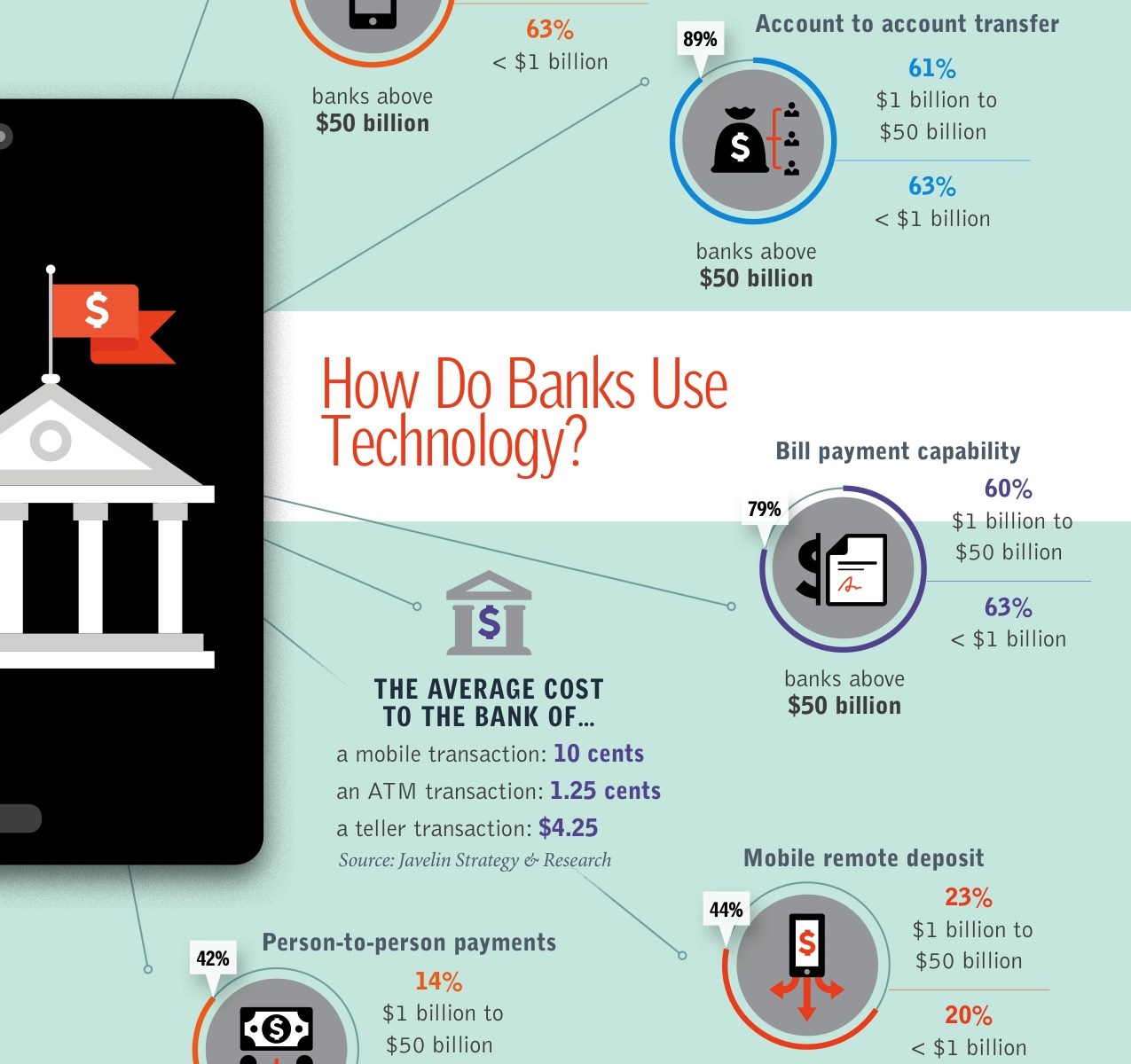
Last October, Richard Fairbank, the Chairman and CEO of Capital One, expressed the following opinion on an earnings call: “Ultimately, the winners in banking will have the capabilities of a world-class software company. Most of the leverage and most of our investment is in building the foundational underpinnings and talent model of a great digital company. To succeed in a digital world (you) can’t just bolt digital capabilities onto the side of an analog business.”  Now, I am a big believer that many banks have immediate opportunities to expand what banking means to individual and business customers. Heck, I wrote as much to open a special supplement to Bank Director magazine that highlights a number of interesting technologies that have re-shaped the fortunes of banks across the U.S.  As you can see in the graphic above (produced for and by our team), the intersection of financial services with technology tools is immense.

Nonetheless, the interaction, communication, coordination and decision-making in regulated banks is vastly different than those of an up-and-coming technology company.  No matter how much both sides want to work with the other (to gain access to a wider customer footprint, to incorporate emerging technologies, etc.), the barriers to both entry and innovation are high.

Keep in mind that there has been an enormous shift in asset concentration and customer loyalty during the past two decades. Today, the ten biggest banks in the U.S. now have more assets than all of the other institutions combined. Concurrently, major consumer brands such as Apple and Google have emerged as significant non-bank competitors while “upstarts” like LendingClub and OnDeck jockey to provide loans to traditional bank customers.

So to stay both relevant and competitive, I believe a bank’s leadership team needs to develop a culture of disciplined growth that encourages creativity and yes, risk taking.  For a leadership team, this requires a combination of knowledge, skill and courage — all things we designed our annual Bank Board Growth & Innovation Conference at the Ritz-Carlton New Orleans to provide (*fwiw, this is a complement to our annual M&A conference — Acquire or Be Acquired).

In the coming days, I’ll be looking at how the processes of interaction, communication, coordination and decision-making in a regulated bank are vastly different than those of a tech firm.  Cleary, the fight for relevancy is on in the banking space… and to see what’s being written and said, I invite you to follow @bankdirector, @aldominick + #BDGrow15.

Mid-April Bank Notes

I recently wrote How the Math Works For Non-Financial Service Companies.  Keeping to the quantitative side of our business, I’m finding more and more advisors opining that banks of $500 – $600M in asset size really need to think about how to get to $2B or $3Bn — and when they get there, how to get to $7Bn, $8Bn and then $9Bn.  With organic growth being a bit of a chore, mergers and acquisitions remain a primary catalyst for those looking to build.  But what happens if you don’t have a board (or shareholder base for that matter) that understands what it takes to grow a company through acquisitions?  This question — not deliberately rhetorical — and two more observations, form today’s post.

A Collection of Individual Relationships

Just because a bank is in a position to consider a merger or acquisition doesn’t mean it is always the best approach to building a business.  This thought crossed my mind with Nashville-based Pinnacle Bank’s recent acquisition of Chattanooga’s CapitalMark Bank & Trust — the first deal struck by the bank in the last eight years (h/t to my fellow W&L’er Scott Harrison at the Nashville Business Journal for his writeup).  Run by Terry Turner, the bank enjoys a great reputation as a place to work and business to invest in.  As Terry shared with the audience at this year’s Acquire or Be Acquired conference, he doesn’t hire someone who’s been shopping their resume, a point that stuck with me and resonated with a number of other executives I was seated near.  So when I think of team building, his institution is one I hold in high regard.

The same can be said for First Republic, who like Pinnacle, is known for organic growth and fielding a standout team.  The bank recently posted a 90 second video from its CEO and Founder, Jim Herbert, that gives his thoughts on culture and teamwork.  Having written about Jim as part of a “Best CEO” series, this clip highlights the foundation for their continued success.

General Electric decides it no longer needs to be a bank

If you somehow missed GE’s announcement, the Wall Street Journal reported this is the conglomerate’s most significant strategic move in years.  While I will let others weigh in on the long-term benefits in selling its finance business that long accounted for around half the company’s profits, it was nice to see our friends at Davis Polk advising GE through the sale of most of GE Capital’s assets.  So the assets of the 7th largest bank in the country, some $500 billion in size, will be sold or spun off over the next two years.  Why?  “The company concluded the benefits aren’t worth bearing the regulatory burdens and investor discontent.”  Feel free to share your comments on this below.