Be Proud Of The Past But Look To The Future

In Charles Dickens’ “Christmas Carol,” Ebenezer Scrooge spends some quality time with the ghosts of Christmases Past, Present and Yet-to-Come.  Inspired by this holiday classic, and these decorative lights adorning Macy’s in New York City, today’s column mirror’s Dickens’ structure with three points on bank M&A, Capital One and Lending Club’s IPO..

Past: Three Bank M&A Deals You May Have Missed

Last week, my monthly M&A column posted on BankDirector.com (A Few Notable Deals You May Have Missed in 2014).  My premise: to successfully negotiate a merger transaction, buyers and sellers normally must bridge the gap between a number of financial, legal, accounting and social challenges. Couple this with significant barriers these days to acquiring another bank—such as gaining regulatory approval— and it’s no wonder that bigger financial deals remained scarce this year.

For as much digital ink as was spilled on BB&T Corp.’s $2.5-billion acquisition of Susquehanna Bancshares a few weeks ago, here are three deals worth noting from 2014: (1) Ford Financial plans to buy up to a 65 percent stake in Mechanics Bank, (2) Sterling Bancorp’s agreement to buy Hudson Valley and (3) United Bankshares completed acquisition of Virginia Commerce Bancorp.

Certainly, banking acquisitions like these three show a commitment to profitability and efficiency—and reflect solid asset quality and sound capital positions. There is more than one way to grow your bank and these banks are proving it.

Present: Catch the Digital Wave While You Can

A few days ago, the Washington Business Journal’s Mark Holan — @WBJHolan — wrote a very timely and relevant piece about Capital One’s Richard Fairbank, who says “the world won’t wait for banks to catch the digital wave.”  As Mark noted, Fairbank recently shared myriad thoughts at the Goldman Sachs U.S. Financial Services Conference in New York, opining:

“Banking is an inherently digital product… Money is digital. Banking is both about money and also about contracts about how money will be moved and managed. There is not a lot of physical inventory. This business is just crying out to be revolutionized and the world won’t wait.”

~Capital One’s CEO

Fairbank also cautioned the banking industry “has had a stunted and slowed evolution relative to the inherent nature of just how digital this product is” due to regulation, massive capital requirements, risk management issues, and other funding constraints.  He also said most banks are too focused on technology’s impact on physical branches or building the coolest app to satisfy customers.

Future: Why Lending Club’s IPO is Important

When it comes to financial innovation, many investors look outside the traditional banking space.  Take Lending Club, which touts itself as “America’s #1 credit marketplace, transforming banking to make it more efficient, transparent and consumer friendly. We operate at a lower cost than traditional bank loans and pass the savings on to borrowers in the form of lower rates and to investors in the form of solid returns.”  So I think their December 11th IPO on the NYSE is very important for bankers to take note of.

Much as Fairbank talks about transforming Capital One to match consumer’s digital demands, the firm stated in a pre-IPO filing that “borrowers are inadequately served by the current banking system.”  By positioning itself as the future of the lending business, it is not surprising to see entire columns dedicated to the the future of the company, as well as the future of the banking industry (see: The Death Of Banking: A LendingClub Story).  Feel free to draw your own conclusions, but certainly pay attention to upstart competitors like these.

Seeking Size and Scale

With Wednesday’s announcement that BB&T has a deal in place to acquire Susquehanna Bancshares in a $2.5 billion deal, I felt inspired to focus on the mergers & acquisitions space today.  You see, if 2013 was the year of the merger-of-equals (MOEs), it seems that 2014 has become the year of “seeking size and scale.”

As I’ve shared in past posts, 2013 was characterized by a series of well-structured mergers which produced a dramatic improvement in shareholder reaction to bank M&A.  For example, Umpqua & Sterling,  United Financial Bancorp & Rockville Financial and Bank of Houston & Independent Bank.  Over the past few weeks, we’ve seen some pretty interesting transactions announced that are not MOEs; specifically, Sterling Bancorp buying Hudson Valley Holding in New York, Banner picking up AmericanWest Bank in the Pacific Northwest and the afore-mentioned BB&T deal.

Don’t Be Fooled, Size Matters

As evidenced by the Sterling and Banner acquisitions, the desire for scale and efficiencies is prompting certain institutions to expand.  While regulatory costs and concerns have been cited in previous years as deterents to a transaction, isn’t it interesting that both of these deals position the acquiring institution near the $10Bn threshold (*important as crossing this asset threshold invites new levels of scrutiny and expense).  But like John Thain suggested earlier this year, “the key is being big enough so that you can support all of the costs of regulation.”  Still, comments made by Richard Davis, chairman and chief executive of U.S. Bancorp, about the BB&T agreement should temper some enthusiasm about the biggest players jumping in to the M&A space a la the $185 Bn-in-size BB&T. “This is not a deal you’d ever see us do,” he said at conference in New York hosted by Bank of America Merrill Lynch, adding “it’s both out-of-market and it’s fairly expensive.”

I’m Serious, It Matters?!?

Earlier this year, Deloitte published The Top Ten Issues for Bank M&A.  In light of the BB&T deal, it is worth revisiting.  To open, the authors opine “size matters when it comes to regulatory constraints on the banking sector: The bigger the players, the more restrictions on banking activities, including M&A. Banks with less than $10 billion in total assets face the least restriction, while the very largest Systemically Important Financial Institutions (SIFIs) experience the highest level of constraints. Among the major regulatory actions that are expected to hold considerable sway over bank M&A in 2014 are the Volcker Rule, Basel III capital requirements, global liquidity rules, stress testing, and anti-money laundering (AML) and Bank Secrecy Act (BSA) compliance laws.”

Who I’m Taking to Buy a Lottery Ticket

Finally, a tip of the hat to Frank Cicero, the Global Head of Financial Institutions Group at
Jefferies. He reminded me on Wednesday that every prediction he made in a piece he wrote for BankDirector.com at the beginning of the year has come to pass…fewer MOE’s, bigger premiums, regional banks returning to bank M&A.  Personally, I’m wondering if he wants to walk into the lotto store with me this weekend?

Aloha Friday!

Innovating the Capital One Way: Do YOU Think This Is The New Normal?

bd8a817e833e9bb01ddf91949fce917bAs shared in Bank Director’s current issue, peer-to-peer lenders, like San Francisco-based Lending Club, are beginning to gain traction as an alternative to banks in both the commercial and consumer loan space.

In the retail sector, well-funded technology companies like Google, Amazon and a host of others are swimming around like sharks looking to tear off chunks of revenue, particularly in the $300 billion a year payments business. These disruptors, as many consultants call them, are generally more nimble and quicker to bring new products to market.

While being “attacked by aggressive competitors from outside the industry is certainly not a new phenomenon for traditional banks,” it is fair to ask what a bank can do today. For inspiration, take a look at what Richard Fairbank, the Chairman and CEO of Capital One, had to say on a recent earnings call.

Ultimately the winners in banking will have the capabilities of a world-class software company. Most of the leverage and most of our investment is in building the foundational underpinnings and talent model of a great digital company. To succeed in a digital world (you) can’t just bolt digital capabilities onto the side of an analog business.

I thought this was particularly interesting given our editor’s take in this quarter’s issue: “if you’re a traditional banker, it’s time to recognize (if you don’t already) that a growing number of consumers — many of them young, well educated and upwardly mobile—can get along just fine without you.”  Clearly, it would be foolish for any bank CEO or director to operate with a false sense of security that their institution won’t need to adapt.

So is Capital One’s “approach” to business the way of the future for many big banks?  

Drop me a line or send me a tweet (@aldominick) and let me know what you think.  Aloha Friday!

This Week in Pictures

As our editor, Jack Milligan, writes in How One Large Bank Fosters Innovation, “conventional wisdom holds that banks are not very good at innovation — and large banks, with their entrenched bureaucracies and clumsy legacy systems, are probably worst of all. It might then come as a surprise that Bank of New York Mellon Corp. has run a highly successful innovation program that has made a meaningful contribution to the bank’s profitability, and also manages to get most of the company’s 10,000 employees involved in the process.”

Earlier this week, I shared how Declan Denehan, BNY Mellon’s managing director for strategy and innovation, provided his thoughts on staying relevant while engaging with the “startup ecosystem” during Monday’s FinTech Day.  Jack’s article offers a great summation of Declan’s perspectives — and for today’s post, I simply wanted to recap the event as a whole.  The fun for our team started well before the doors opened at 9:00; however, FinTech day kicked off with:

  • A number of video shoots in the NASDAQ studio that we will post to BankDirector.com;
  • Continued with a live-streamed discussion focused on innovation with Declan and me; and
  • Wrapped up with a closing bell ceremony and a lot of great company logos rotating on the exchange’s video board in Times Square.

FinTech Day, a collaboration between Bank Director and NASDAQ OMXattracted over 40 participants from 30 financial technology companies.  For those of you that joined us, I am pleased to share the link to the official photo gallery from the ceremony.  We are happy to send over any that you’d like as our way of saying thank you for joining us.  Simply leave a comment below, reach out via LinkedIn or Twitter and let me know what you’d like.  Below, some of the pictures in the gallery…

Before wishing everyone an Aloha Friday, let me thank the entire Bank Director team — and in particular, Kelsey Weaver, Laura Schield, Michelle King, Mika Moser, Jack Milligan and Joan Susie — for your efforts to make the day a success.  Each of you contributed something special and for that, I am very appreciative and already getting excited for next year (dare we call it FinTech 2.0)!

Today is FinTech Day at NASDAQ (here’s what you need to know)

The who, what, when, where and why of FinTech Day at NASDAQ, a collaboration between the exchange and my company, Bank Director, that celebrates the contributions of financial technology companies — fintech for short — to banks across the U.S.


photo-18

Who: Bank Director, a privately-held media & publishing company focused on issues fundamental to a bank’s CEO, senior leadership team and board members, teams up with the NASDAQ OMX to showcase various technology-driven strategies and tactics successful banks use to fuel profitable, sustainable growth.

What: FinTech Day at the NASDAQ

When: Today, September 8

Where: The NASDAQ MarketSite (4 Times Square – 43rd & Broadway)

Why: Because who says there is no innovation in banking?  During this day-long event, we keep our focus on a board’s level, exploring growth opportunities made possible by various technology products and services.

To Watch: We will welcome a number of executives from the Fintech community throughout the day, along with one of the country’s biggest (and actually, oldest) institutions: BNY Mellon.  Personally, I’m looking forward to chatting with their Managing Director – Strategic Growth Initiatives, Declan Denehan, at 2 PM ET for an hour-long session focused on innovation, competition and staying relevant. Thanks to our friends at NASDAQ, you can watch the live feed for free (click here to register and watch).  At 3:55 ET, I’ll join our publisher, Kelsey Weaver, to ring the closing bell. A webcast of the NASDAQ Closing Bell will be available (click here or here) if you are keen to see how we wrap up FinTech day.

Of Social Note: To follow the conversation, let me suggest these twitter handles: @bankdirector, @nasdaqomx, @bankdirectorpub and @aldominick. For photos from the ceremony and event, you can visit NASDAQ’s Instagram Page or Facebook page later today.  As we are all about being a part of the community and broader conversations, Bank Director will use #fintech for its tweets.

Is Walmart the Next Big Bank

Part four of a five piece series on emerging threats to banks from non-financial companies. To read parts one through three, click on “For Banks, the Sky IS Falling,” “PayPal is Eating Your Bank’s Lunch” and “The Bank of Facebook.”

At the risk of crashing through an open door, did you know that the retail juggernaut Wal-Mart Stores Inc. launched Bluebird in partnership with American Express late in 2012 so users can direct deposit their paychecks, make bill payments, withdraw cash from ATMs and write checks?  Yes, customers also have access to mobile banking, which includes features like remote deposit capture and person-to-person (P2P) payments.  So does this position Wal-Mart as the next SIFI (*no disrespect to CIT following their announced acquisition of OneWest in a $3.4Bn stock & cash deal earlier this week)?

Walmart bank logo.001

Cue Robin Thicke

According to Wal-Mart, 95% of Americans live within 15 miles of one of its stores.  So I think its fair to say that Wal-Mart continues to blur lines between banking and shopping as it added yet another financial service to its stores across the country.  Indeed, the retailer announced this spring that customers can transfer money to and from any of its 4,000 stores in the U.S. and Puerto Rico.  As this article in Forbes highlighted, low income workers who don’t have traditional bank accounts are turning to prepaid cards and alternatives to checking accounts.  Banks like JPMorgan Chase and Wells Fargo are trying to fill that gap with prepaid and reload able cards — something Wal-Mart has been offering for years.

Where Is That Achilles Heel?

Unlike online competitors to a bank, Wal-Mart enjoys huge brand recognition and an established customer base that feels comfortable walking into their local “branch.”  In fact, banks that already operate inside Walmarts reap among the highest fees from customers of any banks in the nation, according to a WSJ analysis.  But the very demographic the retail company serves — one that expects and demands rock-bottom pricing — may not favor a “B of W.”

Indeed, banking at Wal-Mart is a lot more expensive than shopping there.  As noted by in the WSJ, most U.S. banks earn the bulk of income through lending.  Among the 6,766 banks in the Journal’s examination, “just 15 had fee income higher than loan income — including the five top banks operating at Wal-Mart.”  Would the company really want to race to the bottom in terms of pricing its financial products (ones that would not be federally insured) and compete with its own tenants?

If At First You Don’t Succeed…

It is worth noting that Wal-Mart has tried to get into banking since the late 1990s.  It was thwarted in attempts to buy a savings-and-loan in Oklahoma and a bank in California — and later dropped a bid for its own banking charter in 2007.  While I’m not suggesting the new logo depicted above is anything more than a simple rendering by yours truly, it wouldn’t surprise me if the company explored even more creative ways to compete with financial institutions in the future.

##

To comment on this piece, please click the white plus sign in the bottom right gray circle on this page or share your thoughts with me via Twitter (I’m @aldominick).  Next up, how crowdsourcing sites like Kiva and Kickstarter allow customers to bypass their bank to get funding for a business idea.

Know Your Tribe

So… I initially planned to dive into interest rate risk this morning. Prevalent in most M&A conversations taking place in bank boardrooms today, I thought to focus on banks working to protect their equity value as interest rates rise. However, in reviewing the outline for today’s piece, I realized a different kind of risk inspired me: the risk of becoming something you are not.  While I do anticipate posting a piece on interest rate risk in the near future, today’s column parallels the thoughts of Seth Godin.  Specifically, a blog he authored this week entitled “In Search of Meaningful.”

cat550006

In his piece, Seth looks at online media and how “people have been transfixed by scale, by numbers, by rankings… how many eyeballs, how big is the audience, what’s the pass along, how many likes, friends, followers, how many hits?  You cannot win this game and I want to persuade you… to stop trying.”  It strikes me that he could just as well be writing about financial institutions competing for relevance in today’s competitive and crowded environment.  While I’ve linked to his post above, see if you follow my logic based on this representative quote:

It’s no longer possible to become important to everyone, not in a reliable, scalable way… But it is possible to become important to a very-small everyone, to a connected tribe that cares about this voice or that story or this particular point of view. It’s still possible to become meaningful, meaningful if you don’t get short-term greedy about any particular moment of mass, betting on the long run instead.

Over the past six months, I have been fortunate to hear how numerous bank CEOs and Chairmen plan to position their institutions for long-term growth.  As I process Godin’s perspective, let me pay his perspectives forward with three of my own specific to community banks:

#1 – You Don’t Have To Be BIG To Be Successful

By this I mean smarts trumps size any day of the week.  While more banks put their liquidity to work, fierce competition puts pressures on rates and elevates risk.  While easy to frame the dynamics of our industry in terms of asset size, competing for business today is more of a “smart vs. stupid” story than a “big vs. small” one.

#2 – You Don’t Have To Be Everywhere

Nor can you be — so stick to what you know best.  I know that margin compression and an extra helping of regulatory burden means times couldn’t be more challenging for growth in community or regional banking.  But that doesn’t mean you have to be all things to all people.  Case-in-point, I was lucky to spend some time with Burke & Herbert Bank’s CEO in Northern Virginia earlier this week.  As they say, “the world has changed quite a bit since 1852 (*the year the bank opened its doors) – that you may be conducting most of your life from your computer, smartphone and/or whatchamajiggy. That’s why we constantly adapt to the way you live and bank.”  Today Burke & Herbert Bank has more than $2 billion in assets and 25 branches throughout Northern Virginia.  Still, they remain a neighborhood bank, choosing to “stay local” as Virginia’s oldest bank.

#3 – You Don’t Have To Do What Everyone Else Does

As Godin writes, the “problem with generic is that it’s easy go as well as easy come.”  Just because USAA rolls out a new mobile offering doesn’t mean you need to — and if BofA decides to reprice a product, can you really compete with them on price?  So which community banks are doing it right in my opinion?  Well, if you’re in Nashville and focused on the medical and music & entertainment industries you probably know Avenue Bank, if you’re a business in the Pacific Northwest, you most likely work with (or at least respect) Banner Bank.  And if you are in the oil and gas business in Texas, First Financial is a big player.  The common thread that binds these three banks together: they have a laser-like focus on their ideal customer base.

##

To comment on this piece, click on the green circle with the white plus (+) sign on the bottom right. If you are on twitter, I’m @aldominick. Aloha Friday!

Three Thoughts on Banks and Risk

I’m heading out to Chicago and Bank Director’s annual Bank Audit & Risk Committees Conference.  The agenda — focused on accounting, risk and regulatory issues — aligns with the information needs of a Chairman of the Board, Audit and/or Risk Committee Chair and Members, Internal Auditors, Chief Financial Officers and Chief Risk Officers.  Before I welcome some 300 attendees (representing over 150 financial institutions from 39 states) to the Palmer House, I thought to share three things that would keep me up at night if I traded roles with our attendees.

The Bean

(1) The Risk of New Competition

For bank executives and board members, competition takes many forms.  Not only are banks burdened with regulation, capital requirements and stress testing, they now have the added pressure of competition from non-financial institutions.  Companies such as Paypal, as well as traditional consumer brands such as Walmart, are aggressively chipping away at the bank’s customer base and threatening many financial institutions’ core business — a fact made clear by Jamie Dimon, the CEO of JPMorgan Chase, at a shareholder meeting this February.

“You’d be an idiot not to think that the Googles and Apples  .  .  .  they all want to eat our lunch.  I mean, every single one of them.  And they’re going to try.”

To this end, I find myself agreeing with Accenture’s Steve Culp, Accenture’s senior managing director of Finance & Risk Services, when he writes “banks need to keep developing their risk capabilities, skills and talents, and align these skills with their agenda around future growth. If they don’t align their growth agenda with their risk capabilities—building a safe path toward growth opportunities—they will miss out on those growth opportunities.”  While I plan on diving much deeper into this topic following the conference, I definitely welcome feedback on the issue below.

(2) The Risk to A Reputation

While the Dodd-Frank Act requires publicly traded banks with more than $10 billion in assets to establish separate risk committees of the board, and banks over $50 billion to additionally hire chief risk officers, I’m seeing smaller banks proactively following suit.  Such additions, however, does not absolve directors and senior managers of financial institutions from preparing for the worst… which is easier said then done.   In some ways, a bank’s reputation is a hard-to-quantify risk.  Anyone can post negative comments online about an institution’s products, services or staff, but one only needs to look at Target’s financial performance post-cyber hack to realize that revenue and reputation goes hand-in-hand.

(3) The Risk of Cyber Criminals

Speaking of Target, earlier this year, Bank Director and FIS collaborated on a risk survey to pinpoint struggles and concerns within the boardrooms of financial institutions.  As we found, tying risk management to a strategic plan and measuring its impact on the organization proves difficult for many institutions, although those that have tried to measure their risk management program’s impact report a positive effect on financial performance.  What jumps out at me in the results of this research are the concerns over cyber and operational security.  Clearly, the number of “bad actors” who want to penetrate the bank’s defenses has increased exponentially, their tools have become remarkably sophisticated, and they learn quickly.  I read an interesting piece by an attorney at Dechert (sorry, registration required) that shows the analytical framework for cyber security is very similar to what most directors have focused on in their successful business careers: people, process and technology.  But theory is one thing, putting into practice a plan to protect your assets, entirely different.

##

To comment on today’s column, please click on the green circle with the white plus sign on the bottom right. If you are on twitter, I’m @aldominick. Aloha Friday!

FI Tip Sheet: You Can Hang Your Hat On It

It’s been a while since I last called Dallas home; still, the white shirts & gray shorts of St. Mark’s proved a welcome and familiar site during a trip to the Texas city earlier this week.  A flashback to my freshman year of high school?  Absolutely.  Dare I reminisce before diving into today’s post with a few random fun facts.  Heck yeah.  Did you know Dallas lies in a large prairie running through the center of the United States?  Ok, anyone who has visited know it is fairly flat… but did you know it is one of the largest cities in the world not located on a navigable river?  Yes, this is a city where I learned about Coke floats, Suburbans and sayings like “if I say a hen dips Skoal, you can look under her wing for the can.”  Curious how I’m going to relate my time in Big D to the banking space?  Read on.

Roping it in
Roping it in

What Happened to Citi’s Hutzpah?

Even with wifi-enabled planes, I still find travel by air the best way to work uninterrupted.  The luxury of my iPhone laying silent this week?  A chance to catch up on various blogs and articles like those authored by Jack Milligan.  The editor of Bank Director magazine, he took a look at how large U.S. banks, specifically Citigroup, are being dogged by intense regulatory scrutiny and have the challenge of preparing for much stricter capital standards in coming years. By noting Citigroup was the only bank of the six largest U.S. banks to flunk the latest round of stress tests, he sets up his must-read “Where Has the Go-Go Bank Gone?”  In his view, cutting expenses and selling off non-core business units doesn’t seem like a bold enough plan for the behemoth.  Per Jack, “maybe what this Citi needs is a little of the old Citi’s hutzpah.”

Pay Attention to Your Sales Process

On Wednesday, I made it to Preston Road and St. Mark’s School of Texas for a few minutes in large part because of Ignite Sales (the company’s offices are a few miles away from the all-boy school where my parents enrolled my brother and me when my father took a job with the then-6th largest bank in the country, Bank One).  As I talked with Ignite’s CEO, Mitchell Orlowsky, he made clear that non-bank competitors are eating away at banks’ customer base, in part because banks have paid little attention to the sales process. As he shared earlier this month, “banking has never had to focus on a comprehensive sales process. Because of healthy margins from loans and fees, banks have historically shied away from proven sales methods found in other industries. However, now that the market has become competitive, the lack of sales infrastructure hurts.”

A Silver Lining

Mitchell shared how more progressive banks have begun to hire experienced sales management from other industries that bring the expertise needed to change this culture.  I thought about this approach as I dug into a Raymond James report on the outlook for the spring (“Banking Industry Overview“) on my flight home to D.C.  In their view, first quarter 2014 results are “likely be highlighted by continued improvement in credit quality, a pickup in commercial loan growth, net interest margin (NIM) stabilization, and improved profitability.  However, these positives will likely be mitigated by weak year-over-year comparisons for market-related revenue, sluggish balance sheet growth, and a continued decline in mortgage banking activity.”  Of particular note: they expect the M&A discussion to gain prominence given the pickup in deal activity and “outperformanceof stronger acquirers who have recently announced transactions” along with the following catalysts:

  • The modest pace of economic recovery
  • Increased regulation
  • Protracted low rate environment
  • Higher capital requirements
  • Aging management teams/boards

I continue to hear that M&A activity will remain largely relegated to smaller deals for banks with assets of $1 billion or less — and this report certainly reinforced this view.

Aloha Friday!

FI Tip Sheet: The Innovator’s Dilemma

Over the past few years, I have seen significant change within the banking community — much of it defensive or in response to government intervention and oversight.  According to a white paper recently published by McLagan, “a great deal has been said about the excesses and errors of the past; however (sic), the current focus for banks, in particular, must be on the need to innovate or risk becoming stagnant and losing the ability to compete for exceptional talent.”  This morning’s column focuses on the “innovator’s dilemma,” vis-a-vis three questions.

Everything is AwesomeDo We Need Sustainable or Disruptive Technology ?

I have talked with a number of Chairmen and CEOs about their strategic plans that leverage financial technology to strengthen and/or differentiate their bank.  After one recent chat, I went to my bookshelf in search of Clayton Christensen’s “The Innovator’s Dilemma: When New Technologies Cause Great Firms to Fail.”  His book inspired today’s title — and fuels this first question.  Christensen writes about two types of technologies: sustaining and disruptive.  Sustaining technologies are those that improve product performance.  As he sees it, these are technologies that most large companies are familiar with; technologies that involve improving a product that has an established role in the market.  Most large companies are adept at turning sustaining technology challenges into achievements.  However, large companies have problems dealing with disruptive technologies — an observation that, in my view, does not bode well for many traditionally established banks.

“Discovering markets for emerging technologies inherently involves failure, and most individual decision makers find it very difficult to risk backing a project that might fail because the market is not there.”

While risk is inherent to banks of all sizes, taking chances on emerging technologies continues to challenge many officers and directors.  To this end, I thought about the themes explored in Christensen’s book after spending time in Microsoft’s New York City offices last week.  While there, I heard how big banks are generating revenues by acquiring new customers while retaining, up-selling and cross-selling to existing customers.  I left impressed by the various investments being made by the JP Morgans of the banking world, at least in terms of customer relationships and experience management along with analytics and core system modernization.  I do, however, wonder how any entrenched bank can realistically embrace something “uber-esque” (read: disruptive) that could truly transform the industry.

Do We Have the Staff We Need?

Consider the following question from the perspective of a relatively new hire: “I have a great idea for a product or service… who can I talk with?”  A few months ago, Stephen Steinour, the President & Chief Executive Officer at Huntington Bancshares, keynoted Bank Director’s annual Bank Executive & Board Compensation conference and addressed this very thing.  As he shared to an audience of his peers: “the things I assumed from my era of banking are no longer valid.”  Rather than tune out ideas from the field in favor of age and experience, he explained how his $56Bn+ institution re-focused on recruiting “the right” employees for the company they wanted (not necessarily what they had), with a particular emphasis on attracting the millennial generation into banking.  He admitted it’s a challenge heightened by public perception of the industry as one that “takes advantage of people and has benefited from government bailouts.”  Still, he made clear the team they are hiring for reflects a new cultural and staffing model designed to drive real, long-term change.  I wonder how many banks would (or could) be so bold?

Do We Have The Right Business Model?

I’ve heard it said that “forces of change” will compel banks to reinvent their business models.  Take the business model of core retail banking. According to a piece authored by McKinsey (Why U.S. Banks Need a New Business Model), over the past decade, banks continued to invest in branches as a response to free checking and to the rapid growth in consumer borrowing.  But regulations “undermining the assumptions behind free checking and a significant reduction in consumer borrowing have called into question the entire retail model.  In five years, branch banking will probably look fundamentally different as branch layouts, formats, and employee capabilities change.”  Now, I’m not sure banking’s overall business model needs a total overhaul; after all, it still comes back to relationships and reputations.  Nonetheless, many smaller banks appear ripe for a change.  And yes, the question of how they have structured their business is one some are beginning to explore.

##

To comment on this piece, click on the green circle with the white plus sign on the bottom right.  Looking ahead, expect a daily post on About That Ratio next week.  I’ll be in Nashville at the Hermitage Hotel for Bank Director’s Bank Board Training Program.  Leading up to, and at, this educational event, I’ll provide an overview on the various issues being covered.  Namely, risk management and auditing issues, compensation, corporate governance, regulation and strategic planning.  Thanks for reading, and Aloha Friday!

FI Tip Sheet: The Size of the Sandbox

Just as an Apple store conveys a community and market presence, so too does a bank’s branch.  While younger customers may no longer visit more than a front-of-the-house ATM, I do think many of us choose our bank based on their proximity to where we live and work.  Today’s tip sheet builds on this thought — beginning with a look at the economics of deposit taking, followed by a visual reminder of our industry’s size before ending with an acquisition by a a big-bank based in Madrid.

photo

Face-to-Face Trumps Technology?

To borrow a few lines from a recent CDW white paper, as the U.S. financial industry emerges from the recent financial crisis, “the surviving institutions are leaner and more focused than ever before. In some cases, this means lowering overhead — doing more with less — to effectively maintain operations.” While the future of banks proved a popular conversation starter during my travels around Washington D.C. and New York City this week, it is a report shared by Fred Cannon — the Director of Research at Keefe, Bruyette and Woods — that caught my eye. I am a big fan of Fred’s prose and the perspectives he offered in “Branch Banking in Retreat” demonstrates that real branch transformation continues to elude many financial institutions. To wit:

“The economics of bank deposit taking is poor in the age of Bernanke and Yellen (low rates) and Durbin (reduced fees). But beyond rates and politics, technology is also undermining the role of traditional branches as the payment system has moved sharply towards electronics in the last decade… Yet, overall banks are responding slowly to the changes in economics and technology of branching. While the number of bank branches has fallen since 2009, the population per branch in the U.S. is still at the same level as the mid-1990s.”

Most branch transformation initiatives I have seen seek to simultaneously reduce costs while improving sales. Here, size matters. Smaller banks can re-invent themselves faster than the big guys; however, its the biggest banks that can financially absorb the most risk in terms of rolling out something new (and expensive).

A Visual Reminder That Financial Size Matters

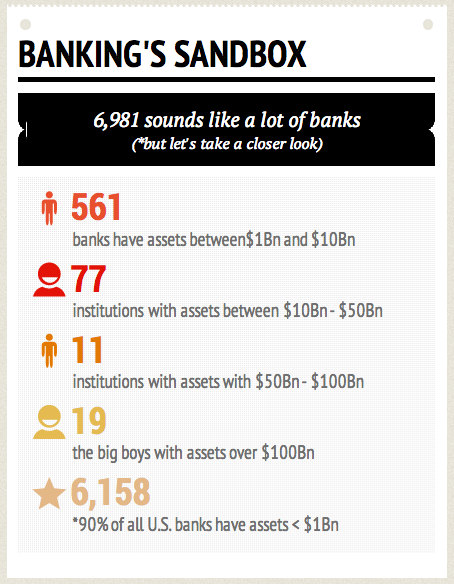
Fred’s research piece, focused on small and mid-sized banks along with the BofA’s and Wells Fargo’s of the country, inspired me to create the following infographic.  I’ve shared variations of these statistics in prior posts — and thought to illustrate how our industry breaks down in terms of asset size.

Screen Shot 2014-02-21 at 9.42.29 AM

(*note: while I hoped to serve this infographic up in a dynamic way, the image I created from Infogr.am isn’t embedding in WordPress.  Still, you get an idea of the market with this screenshot)

Old School Acquires New School

For smaller institutions, the size (and ability to scale) of their larger counterparts can be cause for alarm.  Indeed, Accenture shared “becoming a truly digital business is key to how we innovate and differentiate ourselves from our competitors. And if the last decade has been the playground of the digital start-ups, the coming decade will see the emergence of the traditional companies as the digital giants.”  I was thinking about this as I read the New York Times’ Dealbook story “BBVA Buys Banking Start-Up Simple for $117 Million.

This acquisition is notable as the buyer of this upstart is a 150-year old financial services corporation that operates in a number of markets, is a leading player in the Spanish market, as well as one of the top 15 banks in the U.S. and a strategic investor in banks in Turkey and China.  As noted by TechCrunch, “while not itself a bank, Simple operates as an intermediary between users and FDIC-insured institutions to provide users with access to data around their financial history, as well as tracking of expenditures and savings goals, with automated purchase data collected when its customers use their Simple Visa debit card.”  I wonder if this acquisition starts a consolidation trend of bigger banks buying newer fintech players to accelerate — while differentiating — their offerings…

Aloha Friday!

FI Tip Sheet: Some of Banking’s Best CEOs

Last month on Yahoo Finance, Sydney Finkelstein, professor of management and an associate dean at Dartmouth’s Tuck School of Business, produced a list of the Best CEOs of 2013, one that includes Jeff Bezos of Amazon, Pony Ma of Tencent,  John Idol of Michael Kors, Reed Hastings of Netflix and Akio Toyoda of Toyota.  Inspired by his picks, I reached out to a number of colleagues that work for professional services firms to ask their thoughts on the top CEOs at financial institutions — along with why they hold them in such regard.  What follows in this morning’s tip sheet are myriad thoughts on some of the best CEOs in the business today — broken down into three categories: the “biggest banks” with $50Bn+ in assets, those with more than $5Bn but less than $50Bn and finally, those in the $1Bn to $5Bn size range.

AboutThatRatio = image for Jan 10.001

(1) Top CEOs at financial institutions over $50Bn

The names and logos of institutions over $50Bn — think M&T with some $83Bn in assets, KeyCorps with $90Bn, PNC with $305Bn and US Bancorp with $353Bn — are familiar to most.  Leading these massive organizations are some tremendously talented individuals; for example, John Stumpf, the CEO at Wells Fargo.  Multiple people shared their respect for his leadership of the fourth largest bank in the U.S. (by assets) and the largest bank by market capitalization.  According to Fred Cannon, the Director of Research at Keefe, Bruyette & Woods, John “has created and maintains a unified culture around one brand, (one) that demonstrates strength and stability.  Wells is exhibit #1 in the case for large banks not being bad.”

Similarly, U.S. Bancorp’s Richard Davis garnered near universal respect, with PwC’s Josh Carter remarking “Richard has continued to steer US bank through stormy seas, continuing to stay the course running into the downturn, taking advantage of their position of relative strength, weathering the National Foreclosure issues and managing to avoid being considered part of ‘Wall Street’ even though US Bank is one of the 6 largest banks in the U.S.”

Finally, Steve Steinour, the CEO at Huntington Bancshares, inspired several people to comment on his work at the $56Bn institution.  Case-in-point, Bill Hickey, the co-Head of the Investment Banking Group at Sandler O’Neill, pointed out that since taking the helm in 2009, Steve has led a “remarkable turnaround… Huntington is now a top performer and is positioned to be the dominant regional bank in the Midwest.”

(2) Top CEOs at financial institutions between $5Bn and $50Bn

For banks between $5Bn and $50Bn, Greg Becker at Silicon Valley Bank garnered quite a few votes.  Headquartered in Santa Clara, California, I think they are one of the most innovative banks out there — and several people marveled that it has only grown and diversified under Greg’s leadership.  According to Josh Carter, “what they’re doing is a good example of how a bank can diversify their lending approach while maintaining a prudent credit culture.”  This echoes what Fred Cannon shared with me; specifically, that the $23Bn NASDAQ-listed institution is “the premier growth bank with a differentiated product.”  

Fred also cited the leadership of David Zalman, the Chairman & Chief Executive Officer at Prosperity Bancshares Inc., a $16 billion Houston, Texas-based regional financial holding company listed on the NYSE.  According to Fred, David demonstrates how to grow and integrate through acquisitions that is a model for other bank acquirors.  C.K. Lee, Managing Director for Investment Banking at Commerce Street Capital, elaborated on David’s successes, noting their development “from a small bank outside Houston to one of the most disciplined and practiced acquirers in the country and more than $20 billion in assets. The stock has performed consistently well for investors and the acquired bank shareholders – and now they are looking for additional growth outside Texas.”

Keeping things in the Lone Star state, C.K. also mentioned Dick Evans at Frost Bank.  In C.K.’s words, “this is a bank that stayed true to its Texas roots, maintained a conservative lending philosophy, executed well on targeted acquisitions and a created distinctive brand and culture. As Texas grew into an economic powerhouse, Frost grew with it and Mr. Evans was integral to that success.”

Finally, Nashville’s Terry Turner, the CEO of Pinnacle Financial Partners, drew Bill Hickey’s praise, as he “continues to successfully take market share from the larger regional competitors in Nashville and Knoxville primarily as the result of attracting and retaining high quality bankers. Financial performance has been impressive and as a result, continues to trade at 18x forward earnings and 2.4x tangible book value.”

(3) Top CEOs at financial institutions from $1Bn to $5Bn

For CEOs at banks from $1Bn to $5Bn, men like Rusty Cloutier of MidSouth Bank (“a banker’s banker”), David Brooks of Independent Bank Group (“had a breakout year in 2013”) and Leon Holschbach from Midland States Bancorp (“they’ve not only grown the bank but added significant presence in fee-income businesses like trust/wealth management and merchant processing”) drew praise.  So too did Jorge Gonzalez at City National Bank of Florida.  According to PwC’s Josh Carter, Jorge took over a smaller bank in 2007 “with significant deposit concentrations, large exposures to South Florida Real Estate, weathered a pretty nasty turn in the economy and portfolio value and emerged with a much stronger bank, diversified loan portfolio and retained key relationships.  Jorge has also managed to maintained an exceptional service culture, with a significant efficiency level and has combined relationship driven sales to grow the bank.  Jorge has also diversified the product mix and is one of the few smaller banks that can really deliver on the small bank feel with big bank capabilities.”

In addition, Banner Bank’s CEO, Mark Grescovich, won points for his work at the commercial bank headquartered in Walla Walla, Washington.  Mark became CEO in August 2010 (prior to joining the bank, Mark was the EVP and Chief Corporate Banking Officer for the $24Bn, Ohio-based standout FirstMerit). In Fred Cannon’s words, the transformation “is truly exceptional and Mark accomplished this by encouraging and utilizing a talented team of bankers from legacy Banner.”

Finally, Ashton Ryan at First NBC in New Orleans is one I’ve been told to watch.  Indeed, C.K. Lee shared how “Ryan capitalized on the turmoil in New Orleans banking to turn in strong organic growth, with targeted acquisitions along the way. The bank is recently public and has been rewarded by the market with a strong currency to go with its strong balance sheet and earnings.”

##

In addition to the list above, I have been very impressed by Peter Benoist at Enterprise Bank in St. Louis, look up to Michael Shepherd, the Chairman and Chief Executive Officer for Bank of the West and BancWest Corporation and respect the vision of Frank Sorrentino at ConnectOne.  This is by no means a comprehensive list, and I realize there are many, many more leaders who deserve praise and recognition.  Click the “+” button on the bottom right of this page to comment on this piece and let me know who else might be recognized for their leadership prowess.

Aloha Friday!