The Fight for Relevancy

I’m sure it is really simple for those not invested in the future of banking to write that CEOs, their boards and executive teams should cut branches and full-time employees to make their banks more efficient.  But I’m of the belief that you can’t save your way to long-term profitability and viability — and not everyone can be like Capital One and reinvent their business model from digital to analog on the fly.

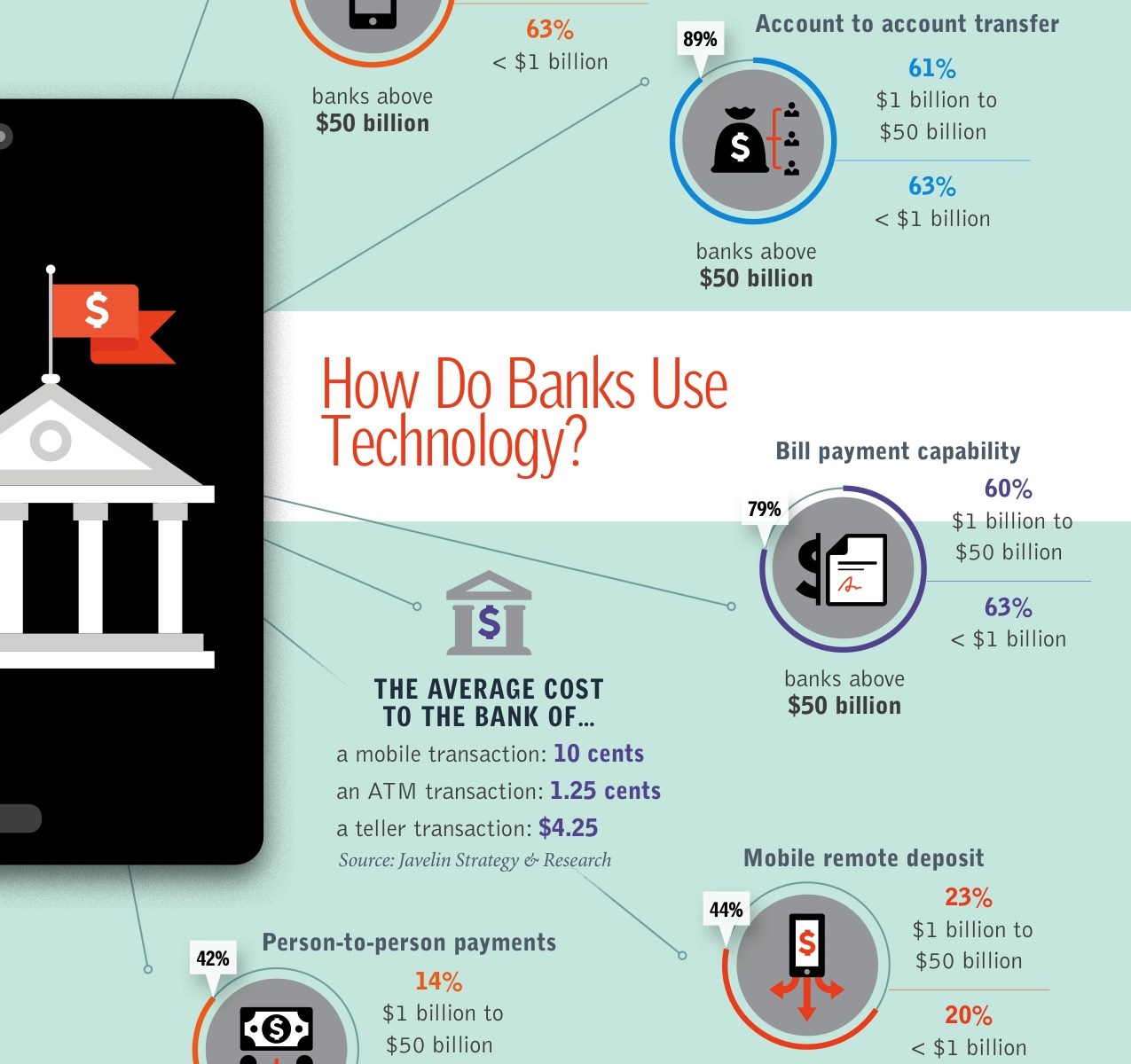
Last October, Richard Fairbank, the Chairman and CEO of Capital One, expressed the following opinion on an earnings call: “Ultimately, the winners in banking will have the capabilities of a world-class software company. Most of the leverage and most of our investment is in building the foundational underpinnings and talent model of a great digital company. To succeed in a digital world (you) can’t just bolt digital capabilities onto the side of an analog business.”  Now, I am a big believer that many banks have immediate opportunities to expand what banking means to individual and business customers. Heck, I wrote as much to open a special supplement to Bank Director magazine that highlights a number of interesting technologies that have re-shaped the fortunes of banks across the U.S.  As you can see in the graphic above (produced for and by our team), the intersection of financial services with technology tools is immense.

Nonetheless, the interaction, communication, coordination and decision-making in regulated banks is vastly different than those of an up-and-coming technology company.  No matter how much both sides want to work with the other (to gain access to a wider customer footprint, to incorporate emerging technologies, etc.), the barriers to both entry and innovation are high.

Keep in mind that there has been an enormous shift in asset concentration and customer loyalty during the past two decades. Today, the ten biggest banks in the U.S. now have more assets than all of the other institutions combined. Concurrently, major consumer brands such as Apple and Google have emerged as significant non-bank competitors while “upstarts” like LendingClub and OnDeck jockey to provide loans to traditional bank customers.

So to stay both relevant and competitive, I believe a bank’s leadership team needs to develop a culture of disciplined growth that encourages creativity and yes, risk taking.  For a leadership team, this requires a combination of knowledge, skill and courage — all things we designed our annual Bank Board Growth & Innovation Conference at the Ritz-Carlton New Orleans to provide (*fwiw, this is a complement to our annual M&A conference — Acquire or Be Acquired).

In the coming days, I’ll be looking at how the processes of interaction, communication, coordination and decision-making in a regulated bank are vastly different than those of a tech firm.  Cleary, the fight for relevancy is on in the banking space… and to see what’s being written and said, I invite you to follow @bankdirector, @aldominick + #BDGrow15.

About That Elephant Coming Out of the Corner (*hello cyber security & banking)

Last summer, a cyberattack on JPMorgan Chase by Russian hackers compromised the accounts of 83 million households and seven million small businesses.  While the New York Times reports the crime did not result in the loss of customer money or the theft of personal information, it was one of the largest such attacks against a bank.  A data breach like this illustrates the clear and present danger cyber criminals pose to the safety and soundness of the financial system.  In my opinion, there can be nothing more damaging to the reputation of, and confidence in, the industry as a whole than major security breaches.

Yesterday, Bank Director released its annual Risk Practices Survey, sponsored by FIS, the world’s largest global provider dedicated to banking and payments technologies. As I read through the results, it became immediately apparent that cyber security is the most alarming risk issue for individuals today.  So while I layout the demographics surveyed at the end of this piece, it is worth noting that 80% of those directors and officers polled represent institutions with between $500 million and $5 billion in assets — banks that are, in my opinion, more vulnerable than their larger counterparts as their investment in cyber protection pales to what JPMorgan Chase, Wells Fargo, etc are spending.  In fact, the banks we surveyed allocated less than 1% of revenues to cybersecurity in 2014.  Accordingly, I’m gearing my biggest takeaway to community bankers since those individuals most frequently cited cyber attacks as a top concern.

Interestingly, individual concern hasn’t yet translated into more focus by bank boards. Indeed, less than 20% say cybersecurity is reviewed at every board meeting — and 51% of risk committees do not review the bank’s cybersecurity plan.  As I read through our report, this has to be a wakeup call for bank boards. While a number of retailers have made the news because of hacks and data thefts, this remains an emerging, nuanced and constantly evolving issue.

It would not surprise me if bank boards start spending more time on this topic as they are more concerned than they were last year. But I do see the need to start requiring management to brief them regularly on this issue, and start educating themselves on the topic.  In terms of where to focus early conversations if you’re not already, let me suggest bank boards focus on:

  • The detection of cyber breaches and penetration testing;
  • Corporate governance related to cyber security;
  • The bank’s current (not planned) defenses against breaches; and
  • The security of third-party vendors.

Personally, I don’t doubt that boards will spend considerably more time on this issue — but things have changed a lot in the last year in terms of news on data breaches.  If bankers want to start assessing the cybersecurity plan in the same way they look at the bank’s credit policies and business plan, well, I’d sleep a lot sounder.

So I’ll go on record and predict that boards will become more aware and take on a more active role in the coming months — and also expect that regulators will start demanding that boards review cybersecurity plans, and that all banks have a cybersecurity plans.  To take this a step further, check out this piece by the law firm Arnold & Porter: Cybersecurity Risk Preparedness: Practical Steps for Financial Firms in the Face of Threats.

About this report

Bank Director’s research team surveyed 149 independent directors and senior executives of U.S. banks with more than $500 million in assets to examine risk management practices and governance trends, as well as how banks govern and manage cybersecurity risk. 43% of participants serve as an independent director or chairmen at their bank. 21% are CEOs, and 17% serve as the bank’s chief risk officer.

Finding That Competitive (FinTech) Edge

On a flight to Boston yesterday morning, I found myself reading various research and analyst reports about forces effecting change on the banking community.  As Bruce Livesay, executive vice president and chief information officer for First Horizon National Corp. in Memphis, Tennessee recently shared with our team, “you can’t have a discussion about banking without having a discussion about technology.”  As such, today’s piece about finding your FinTech edge.

A simple truth with a profound impact: the interaction, communication, coordination and decision-making in a large, regulated bank is vastly different than those of an up-and-coming FinTech company.  No matter how much both sides want to work with the other (to gain access to a wider customer footprint, to incorporate emerging technologies, etc.), the barriers to both entry and innovation are high.  Still, the need for institutions to better target customer segments while rolling out product offerings that differentiate and cross-sell naturally intersect with the use of technology.

Over the past few months, I’ve looked at nine technology companies that I think are doing interesting work (you can find write ups here, here and here).  As I go deeper into this space, I realize defining the FinTech sector might prove as elusive as understanding the genesis of each company’s name.  Still, let me take a crack at it and define “FinTech” as those financial technology companies that sell or enable:

  • Acquisition & engagement tools
  • Mobile payments offerings
  • Lending options
  • Security products
  • Wealth management support
  • Analytics
  • Money transfers
  • Asset management
  • Automated planning / advice

Regardless of the FinTech companies populating each product line, it is clear that the cumulative effect is a transformation of the fabric of the financial industry.   As I read in a recent Deloitte report (2015 Banking Industry Outlook), FinTech applies not just to customer-facing activities, but also to “internal processes, including balance sheet management, risk, and compliance.”  Moreover, learning from non-bank technology firms and establishing partnerships is fait accompli for most bank executives and board members today.

##

As I’ve shared in the past, I am a big believer that many banks of all sizes have immediate opportunities to expand what banking means to individual and business customers.  If you’re curious for examples on what’s working — and why, take a look at this special supplement to Bank Director magazine that highlights a number of interesting technologies that have re-shaped the fortunes of various community banks.  For more on the board’s role in oversight of this important sector, take a look at our Editor, Jack Milligan’s, white paper on the topic.

Three FinTech Companies I’m Keen On

It seems not a day goes by where I’m not coming across a story about Venmo.  Maybe I should thank holiday shoppers; more specifically, friends or family member that go in on a joint present for someone.  Rather than accept an IOU, the social payments company has made story titles like “Cash is For Losers!” en vogue by allowing its users to settle debts without cash or check.  So the company’s success had me exploring the world of FinTech and other companies worth taking a look at.  Here are three I’m keen on along with a short overview on what they offer.

wealthfront-logo-e1396828112845

Wealthfront is an automated investment service with over $1 billion in client assets.  The Palo Alto-based company manages a “diversified, continually rebalanced portfolio of index funds” on behalf of its clients.” Their proposition: “Wealthfront takes the guesswork out of sound, long-term investing through effortless automation. Wealthfront manages a personalized online investment account for you that is fully diversified and periodically rebalanced – accessible anytime and anywhere from your desktop, tablet or phone.” For an individual, their service premise is quite attractive, given “the consistent and overwhelming research that proves index funds significantly outperform an actively managed portfolio.”

Unknown

I wrote about Kabbage last year (A Pop Quiz on the Future of Banking) as a platform for online merchants to borrow working capital. Per Time’s Business & Money site, “Kabbage financing resembles a line of credit in that customers only pay for what they use, but it isn’t a loan and doesn’t require merchants to use their personal assets as collateral. Rather, as with a business factor, a Kabbage financing is structured as a cash advance against future sales.”

dwolla-logo

Dwolla is a payment network that allows any business or person to send, request and accept money. As they say, they are “not like those other big payment companies that rely on plastic cards and charge hefty fees.” Instead, the company built its own network that “securely connects to your bank account and allows you to move money for just $0.25 per transaction, or free for transactions $10 or less.”

##

I’m on record with my feelings that bank leaders have real and immediate opportunities to expand what banking means to individual and business customers by offering services that go beyond a traditional business model.  These three companies provide alternatives to traditional lines of business, and are just a few of the many that are working to create a “newer” normal for individuals and businesses.  If you are interested to share your thoughts on FinTechs worth watching, feel free to comment below about those companies you find compelling.

Be Proud Of The Past But Look To The Future

In Charles Dickens’ “Christmas Carol,” Ebenezer Scrooge spends some quality time with the ghosts of Christmases Past, Present and Yet-to-Come.  Inspired by this holiday classic, and these decorative lights adorning Macy’s in New York City, today’s column mirror’s Dickens’ structure with three points on bank M&A, Capital One and Lending Club’s IPO..

Past: Three Bank M&A Deals You May Have Missed

Last week, my monthly M&A column posted on BankDirector.com (A Few Notable Deals You May Have Missed in 2014).  My premise: to successfully negotiate a merger transaction, buyers and sellers normally must bridge the gap between a number of financial, legal, accounting and social challenges. Couple this with significant barriers these days to acquiring another bank—such as gaining regulatory approval— and it’s no wonder that bigger financial deals remained scarce this year.

For as much digital ink as was spilled on BB&T Corp.’s $2.5-billion acquisition of Susquehanna Bancshares a few weeks ago, here are three deals worth noting from 2014: (1) Ford Financial plans to buy up to a 65 percent stake in Mechanics Bank, (2) Sterling Bancorp’s agreement to buy Hudson Valley and (3) United Bankshares completed acquisition of Virginia Commerce Bancorp.

Certainly, banking acquisitions like these three show a commitment to profitability and efficiency—and reflect solid asset quality and sound capital positions. There is more than one way to grow your bank and these banks are proving it.

Present: Catch the Digital Wave While You Can

A few days ago, the Washington Business Journal’s Mark Holan — @WBJHolan — wrote a very timely and relevant piece about Capital One’s Richard Fairbank, who says “the world won’t wait for banks to catch the digital wave.”  As Mark noted, Fairbank recently shared myriad thoughts at the Goldman Sachs U.S. Financial Services Conference in New York, opining:

“Banking is an inherently digital product… Money is digital. Banking is both about money and also about contracts about how money will be moved and managed. There is not a lot of physical inventory. This business is just crying out to be revolutionized and the world won’t wait.”

~Capital One’s CEO

Fairbank also cautioned the banking industry “has had a stunted and slowed evolution relative to the inherent nature of just how digital this product is” due to regulation, massive capital requirements, risk management issues, and other funding constraints.  He also said most banks are too focused on technology’s impact on physical branches or building the coolest app to satisfy customers.

Future: Why Lending Club’s IPO is Important

When it comes to financial innovation, many investors look outside the traditional banking space.  Take Lending Club, which touts itself as “America’s #1 credit marketplace, transforming banking to make it more efficient, transparent and consumer friendly. We operate at a lower cost than traditional bank loans and pass the savings on to borrowers in the form of lower rates and to investors in the form of solid returns.”  So I think their December 11th IPO on the NYSE is very important for bankers to take note of.

Much as Fairbank talks about transforming Capital One to match consumer’s digital demands, the firm stated in a pre-IPO filing that “borrowers are inadequately served by the current banking system.”  By positioning itself as the future of the lending business, it is not surprising to see entire columns dedicated to the the future of the company, as well as the future of the banking industry (see: The Death Of Banking: A LendingClub Story).  Feel free to draw your own conclusions, but certainly pay attention to upstart competitors like these.

On Bank Branches and a Bank’s Brand

When I think about top performing banks, I typically consider those with the strongest organic growth in terms of core revenue, core noninterest income, core deposit growth and loan growth.  Sure, there has been a lot of talk about growing through acquisition (heck, last week’s post, “Seeking Size and Scale” looked at BB&T’s recent acquisitions and my monthly column on BankDirector.com was entitled “Why Book Value Isn’t the Only Way to Measure a Bank“).  But going beyond M&A, I’m always interested to dive into the strategies and tactics that put profits on a bank’s bottom line.

Build Your Brand or Build Your Branch

Earlier in the week, KBW’s Global Director of Research and Chief Equity Strategist, Fred Cannon, shared a piece entitled “Branch vs. Brand.”  As he notes, “branch banking in the U.S. is at an inflection point; the population per branch has reached a record level in 2014 and is likely to continue to increase indefinitely. The volume of paper transactions peaked long ago and with mobile payment now accelerating the need for branches is waning. As a result, many banks see closing branches as a way to cut costs and grow the bottom line. However, branches have served as more than transactional locations for banks. The presence of branch networks has projected a sense of identity, solidity and ubiquity to customers that has been critical to maintaining a bank’s brand.”  He then poses this doozy of a question:

“If branch networks are reduced, what is the replacement for a bank’s identity?”

Fred and his colleagues at KBW believe banks need to replace branches with greater investments in brand. As he shares, “some of this investment will be in marketing, (as) a brand is more than a logo. We believe banks will also need to invest in systems, people, and processes to project the sense of identity, solidity, and ubiquity that was projected historically by branch networks.”

United Bank, An Example of a High-Performing Bank

One example of a bank that I think is doing this well is United Bank.  On Wednesday, I had the chance to check out their new financial center in Bethesda, MD.  With dual headquarters in Washington, DC and Charleston, WV, the $12.1 billion regional bank holding company is ranked the 48th largest bank holding company in the U.S. based on market capitalization. NASDAQ-listed, they boast an astonishing 41 consecutive years of dividend increases to shareholders – only one other major banking company in the USA has achieved such a record.  Their acquisition history is impressive — as is their post-integration success.  United continues to outperform its peers in asset quality metrics and profitability ratios and I see their positioning as an ideal alternative to the offices Wells Fargo, SunTrust and PNC (to name just three) operate nearby.

A Universal Priority

Clearly, United’s success reflects a superior long-term total return to its shareholders.  While other banks earn similar financial success, many more continue to wrestle with staying both relevant and competitive today.  Hence my interest in Deloitte’s position that “growth will be a universal priority in 2015, yet strategies will vary by bank size and business line.”  A tip of the hat to Chris Faile for sharing their 2015 Banking Outlook report with me.  Released yesterday, they note banks may want to think about:

  • Investing in customer analytics;
  • Leveraging digital technologies to elevate the customer experience in both business and retail banking;
  • Determining whether or not prudent underwriting standards are overlooked; and
  • Learning from nonbank technology firms and establish an exclusive partnership to create innovation and a competitive edge.

With most banks exhibiting a much sharper focus on boosting profitability, I strongly encourage you to see what they share online.

Aloha Friday!

Innovating the Capital One Way: Do YOU Think This Is The New Normal?

bd8a817e833e9bb01ddf91949fce917bAs shared in Bank Director’s current issue, peer-to-peer lenders, like San Francisco-based Lending Club, are beginning to gain traction as an alternative to banks in both the commercial and consumer loan space.

In the retail sector, well-funded technology companies like Google, Amazon and a host of others are swimming around like sharks looking to tear off chunks of revenue, particularly in the $300 billion a year payments business. These disruptors, as many consultants call them, are generally more nimble and quicker to bring new products to market.

While being “attacked by aggressive competitors from outside the industry is certainly not a new phenomenon for traditional banks,” it is fair to ask what a bank can do today. For inspiration, take a look at what Richard Fairbank, the Chairman and CEO of Capital One, had to say on a recent earnings call.

Ultimately the winners in banking will have the capabilities of a world-class software company. Most of the leverage and most of our investment is in building the foundational underpinnings and talent model of a great digital company. To succeed in a digital world (you) can’t just bolt digital capabilities onto the side of an analog business.

I thought this was particularly interesting given our editor’s take in this quarter’s issue: “if you’re a traditional banker, it’s time to recognize (if you don’t already) that a growing number of consumers — many of them young, well educated and upwardly mobile—can get along just fine without you.”  Clearly, it would be foolish for any bank CEO or director to operate with a false sense of security that their institution won’t need to adapt.

So is Capital One’s “approach” to business the way of the future for many big banks?  

Drop me a line or send me a tweet (@aldominick) and let me know what you think.  Aloha Friday!

A Video Recap from FinTech Day at NASDAQ OMX

Before I left NASDAQ’s MarketSite, I had the chance to pop in to one of their studios to film a quick recap of “FinTech Day.”

Thanks again to our friends at NASDAQ for collaborating with us on the day and all those executives from technology firms that joined us in the city.

Waving for the network cameras

Today is FinTech Day at NASDAQ (here’s what you need to know)

The who, what, when, where and why of FinTech Day at NASDAQ, a collaboration between the exchange and my company, Bank Director, that celebrates the contributions of financial technology companies — fintech for short — to banks across the U.S.


photo-18

Who: Bank Director, a privately-held media & publishing company focused on issues fundamental to a bank’s CEO, senior leadership team and board members, teams up with the NASDAQ OMX to showcase various technology-driven strategies and tactics successful banks use to fuel profitable, sustainable growth.

What: FinTech Day at the NASDAQ

When: Today, September 8

Where: The NASDAQ MarketSite (4 Times Square – 43rd & Broadway)

Why: Because who says there is no innovation in banking?  During this day-long event, we keep our focus on a board’s level, exploring growth opportunities made possible by various technology products and services.

To Watch: We will welcome a number of executives from the Fintech community throughout the day, along with one of the country’s biggest (and actually, oldest) institutions: BNY Mellon.  Personally, I’m looking forward to chatting with their Managing Director – Strategic Growth Initiatives, Declan Denehan, at 2 PM ET for an hour-long session focused on innovation, competition and staying relevant. Thanks to our friends at NASDAQ, you can watch the live feed for free (click here to register and watch).  At 3:55 ET, I’ll join our publisher, Kelsey Weaver, to ring the closing bell. A webcast of the NASDAQ Closing Bell will be available (click here or here) if you are keen to see how we wrap up FinTech day.

Of Social Note: To follow the conversation, let me suggest these twitter handles: @bankdirector, @nasdaqomx, @bankdirectorpub and @aldominick. For photos from the ceremony and event, you can visit NASDAQ’s Instagram Page or Facebook page later today.  As we are all about being a part of the community and broader conversations, Bank Director will use #fintech for its tweets.

The Bank of Facebook

Part three of a five piece series on emerging threats to banks from non-financial companies.  For context on today’s piece, take a look at “For Banks, the Sky IS Falling” and “PayPal is Eating Your Bank’s Lunch” (aka parts one and two).

As banking becomes more mobile, companies that power our mobile lifestyle have emerged as real threats to financial institutions.  While common in Europe — where Google, Vodafone and T-Mobile already compete head-to-head with traditional banks by offering mobile and web-based financial services — let me play out a scenario where Facebook decides to enter the banking space in order to remain relevant to its vast U.S. audience.

FB pix final.001


The New Math?

I recently shared the results of a TD Bank survey — one that shows millennials are banking online and on their mobile devices more frequently than in a branch. In fact, 90% of survey respondents said they use online or mobile tools for their everyday banking activities, such as checking balances or paying bills, and 57% said they are using mobile banking more frequently than they were last year.  So add this idea to  Facebook’s voracious appetite for views, visitors and preference data at a time when users are dialing back on status updates and not sharing candid photos on the site.  The sum of these two parts?  It might not be a matter of will; rather, when, Facebook stands up its own online bank in the U.S.

From Concept to Reality?

What I lay out above isn’t a radical thought; indeed, Fortune magazine ran a story on this very topic (Facebook Wants to be Your Online Bank).  The authors opine:

Someday soon, Facebook users may pay their utility bills, balance their checkbooks, and transfer money at the same time they upload vacation photos to the site for friends to see.  Sure, the core mission of the social media network is to make the world more connected by helping people share their lives. But Facebook knows people want to keep some things — banking, for example — private. And it wants to support those services too.

In a separate piece, Fortune shares “there remains a huge untapped market for banking services, including the exchange of money between family and friends living in different cities, and international money transfers between family in developed and developing countries.”

In fact, Facebook recently made the news when it announced plans to enable commerce from its social networks.  According to a post on Pymnts.com (Is Yelp + Amazon the Mobile Commerce Game Changer?), Facebook is testing a “Buy” button that can enable purchasing directly from a promotion inside a user’s news feed.  Now, I’m not getting into the social commerce conversation; simply pointing out that Facebook’s dive into traditional banking may not be as far off as some might think.

Banks as the New Black?

Facebook is already a licensed money transmitter, enabling the social media giant to process payments to application developers for virtual products.  As much as it has the technological chops — and financial clout — to enter the banking space, its Achilles heal may be the very thing that banks are built on: privacy.  Facebook relies on its members seeing and responding to their friends (and acquaintances) activity and updates.  Noticing a friend make a deposit to the “Bank of Facebook” or take a loan from said institution might not precipitate your own business.  The one thing I can see is an attempt by Facebook to acquire an online bank to jump-start its efforts to reach a specific demographic.  In that case, it might be as simple as “the Bank” powered by Facebook.  Regardless, I’d keep an eye on Facebook’s disclosures and press releases when it comes to payments, social commerce and financial services.

##

To comment on this piece, click on the grey circle with the white plus sign on the bottom right or send me your thoughts via Twitter (I’m @aldominick). Next up, a look at the threats posed to a bank’s business by retail giant Wal-Mart.

PayPal is Eating Your Bank’s Lunch

Part two of a five piece series on emerging threats to banks from non-financial companies.  To read part one, “For Banks, the Sky IS Falling,” click the hyperlinked title.

I am not big on scare tactics, so apologies in advance of my next sentence.  But when HP’s chief technologist for financial services, Ross Feldman calls PayPal “the poster child of new technology,” adding, “they are the No. 1 scary emerging player in the eyes of bankers” how can you not be concerned?  PayPal, a subsidiary of eBay, is already a major player in the person-to-person payment business (P2P) and is poised to take a massive bite out of traditional banking revenue.

photo-16

What is PayPal Up To?

To preface this part of today’s post, keep in mind that as an unregulated entity, PayPal is not subject to the same regulations and compliance expenses as banks.  I share this oh-so-salient point as the company moves towards mobile payments with its apps and one-touch payment services.  The fact that PayPal embraces these offerings isn’t surprising, as so many bank users — myself included — prize 24/7 convenience.  Certainly,  companies that don’t meet user demands will not survive.

Moving away from individual expectations to small business demands, I am seeing more small businesses switch from traditional merchant accounts offered by the banks to those like PayPal’s.  As Nathalie Reinelt of Aite Group’s Retail Banking group shared, “ubiquitous smartphones and inefficiencies in legacy payments have propelled the digital wallet into the payments ecosystem—consumers are interested in it, merchants are willing to adopt it, and financial services companies cannot ignore it.”

So What’s A Banker to Do?

Where I see PayPal falling short — admittedly, most banks too — is an inability to help customers make decisions on what to buy, and where and when to buy it.  So let me shout it as loud as I can: exploit this achilles heel while you still can!  There are companies like MoneyDesktop (a leading provider of online and mobile money management solutions), Ignite Sales (a company whose “recommendation solutions” helps increase customer acquisition & retention while optimizing profitability), etc. that have been stood up to keep banks relevant.  There is a real opportunity for banks to do more than simply allow the same types of services digitally that were once only available in-person.

The window of opportunity is open for banks to expand what banking means to consumers by offering online services that go beyond their traditional business model.  The question boils down to this: will the board & senior leadership accept the risk to try something new to make sure they aren’t just warding off advances from the B of A’s of the world — but also the PayPal’s and their peers?

##

To comment on this piece, click on the grey circle with the white plus sign on the bottom right or send me your thoughts via Twitter (I’m @aldominick).  Next up, pieces on two of the biggest non-bank competitors whose names you may have heard of: Facebook and Walmart.

In the Face of Intense Competition

Financial institutions face intense competition from non-banks like PayPal, American Express, Walmart and Quicken Loans…  and a rapidly changing demographic that demands new approaches to attract and retain customers (be it individual or business).  Today’s post takes a look at two financial technology companies working to keep banks relevant as customers increasingly expect a“one stop shop” in all areas of their lives.

American-Flag-Wallpaper-Phone

Over on FiveThirtyEight.com

On FiveThirtyEight, Nate Silver’s newly launched website at ESPN, the editorial team leverages statistical analysis to tell compelling stories about politics, science and yes, sports.  While much digital ink has been spilled on this week’s NFL draft,  the site’s chief economics writer, Ben Casselman, authored a piece that caught my eye.  Thanks to a keynote presentation by Fox News’ Juan Williams at this January’s Acquire or Be Acquired conference, I’m far more aware of the changing demographics of the United States — and what that means for financial institutions.


Based on my conversations with Juan in the desert, I found early inspiration for today’s piece while pouring over Ben’s What Baby Boomers’ Retirement Means For the U.S. Economy.  In combination with economic shifts — both domestically and globally — it is clear that changing demographics are transforming businesses.  As we trend towards a younger populace, Ben writes “all else equal, fewer workers means less economic growth… If more of the population is young or old that leaves fewer working-age people to support them and contribute to the economy.”  Clearly, banks need to be prepared to serve a population that will live longer.  Maybe more importantly, they need to court their most valuable customers — Gen X&Y and Millennials (relationships built, “gulp” through online & mobile experiences).

Putting Checks into the Cloud

In the world of checks, VerifyValid acknowledges that “paper is simply a vessel for holding information. The real check is the data fields it contains: the check number, the amount, the routing number, the recipient, and most important of all, the authorizing action which says that the account holder agrees to pay the stated amount to the payee.”  I had a chance to see Paul Doyle, the company’s Founder & CEO, inspire a crowd of CEOs and board members at The Growth Conference last week.  Flying home from New Orleans, I spent some time learning how the company overcame the challenge in providing this information electronically in such a way that prevents fraud.  As I see it, VerifyValid lowers an organization’s costs while increasing efficiency and financial security with every payment.  IMHO, their 2 minute, 25 second video is worth a watch.

Making Money Simple, Attractive and Intelligent

Located “in the heart of Utah’s Silicon Slopes,” MoneyDesktop is redefining the way millions of people interact with their finances.  As one of the fastest-growing financial technology providers, MoneyDesktop positions banks and credit unions as the financial hub of their account holders — think Mint on steroids — with its personal financial management, data-driven analytics and marketing technologies.  Some 450 financial institutions rely on this software-as-a-service vendor… and I saw last night they have plans to grow significantly in the months to come.  They write, and I agree, that account holders are changing.  “There is an ongoing shift away from traditional brick & mortar banking (and) technology is providing better ways for account holders to interact with their money, and with financial institutions.”  An interesting company delivering a very clean and user-friendly experience.

Aloha Friday!