21 Reasons I Am Excited About Acquire or Be Acquired

Quickly:

  • Making banking digital, personalized and in compliance with regulatory expectations remains an ongoing challenge for the financial industry. This is just one reason why a successful merger — or acquisition — involves more than just finding the right cultural match and negotiating a good deal.

By Al Dominick, CEO of DirectorCorps — parent co. to Bank Director & FinXTech.

PHOENIX, AZ — As the sun comes up on the Arizona Biltmore, I have a huge smile on my face. Indeed, our team is READY to host the premier financial growth event for bank CEOs, senior management and members of the board: Bank Director’s 24th annual Acquire or Be Acquired Conference. This exclusive event brings together key leaders from across the financial industry to explore merger & acquisition strategies, financial growth opportunities and emerging areas of potential collaboration.
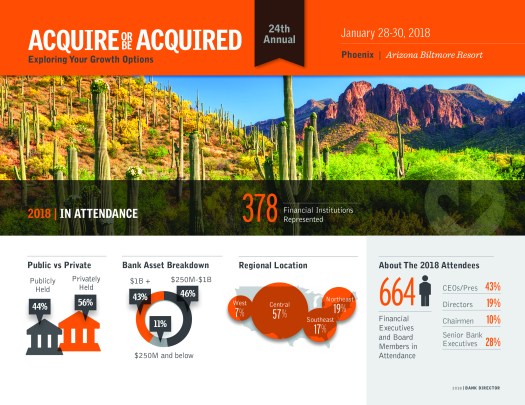
AOBA Demographics

The festivities begin later today with a welcoming reception on the Biltmore’s main lawn for all 1,125 of our registered attendees.  But before my team starts to welcome people, let me share what I am looking forward to over the next 72 hours:

  1. Saying hello to as many of the 241 bank CEOs from banks HQ’d in 45 states as I can;
  2. Greeting 669 members of a bank’s board;
  3. Hosting 127 executives with C-level titles (e.g. CFO, CMO and CTO);
  4. Entertaining predictions related to pricing and consolidation trends;
  5. Hearing how a bank’s CEO & board establishes their pricing discipline;
  6. Confirming that banks with strong tangible book value multiples are dominating M&A;
  7. Listening to the approaches one might take to acquire a privately-held/closely-held institution;
  8. Learning how boards debate the size they need to be in the next five years;
  9. Engaging in conversations about aligning current talent with future growth aspirations;
  10. Juxtaposing economic expectations against the possibilities for de novos and IPOs in 2018;
  11. Getting smarter on the current operating environment for banks — and what it might become;
  12. Popping into Show ’n Tells that showcase models for cooperation between banks and FinTechs;
  13. Predicting the intersection of banking and technology with executives from companies like Salesforce, nCino and PrecisionLender;
  14. Noting the emerging opportunities available to banks vis-a-vis payments, data and analytics;
  15. Moderating this year’s Seidman Panel, one comprised of bank CEOs from Fifth Third, Cross River Bank and Southern Missouri Bancorp;
  16. Identifying due diligence pitfalls — and how to avoid them;
  17. Testing the assumption that buyers will continue to capitalize on the strength of their shares to meet seller pricing expectations to seal stock-driven deals;
  18. Showing how and where banks can invest in cloud-based software;
  19. Encouraging conversations about partnerships, collaboration and enablement;
  20. Addressing three primary risks facing banks — cyber, credit and market; and
  21. Welcoming so many exceptional speakers to the stage, starting with Tom Michaud, President & CEO of Keefe, Bruyette & Woods, Inc., a Stifel Company, tomorrow morning.

For those of you interested in following the conference conversations via our social channels, I invite you to follow me on Twitter via @AlDominick, the host company, @BankDirector and our @Fin_X_Tech platform, and search & follow #AOBA18 to see what is being shared with (and by) our attendees.
Address the Culture Gap Between Banks and FinTechs

By Al Dominick, CEO of DirectorCorps (parent co. to Bank Director & FinXTech) | @aldominick

Quickly

  • A “bank|fintech partnership” narrative dominated the conversation at last week’s FinTech Week NYC events.
  • If I were running a financial institution right now, I’d focus on the word integration instead of innovation.
  • Culture is one of the best things a bank has going for it. It’s also one of the worst.

_ _ _

While I am bullish on the future of banking as a concept, I am admittedly concerned about what’s to come for many banks who struggle with cultural mindsets resistant to change. As I shared in an op-ed that kicked off last week’s FinTech Week NYC, the same dynamics that helped weather the last few years’ regulatory challenges and anemic economic growth may now prevent adoption of strategically important, but operationally risky, relationships with financial technology companies.

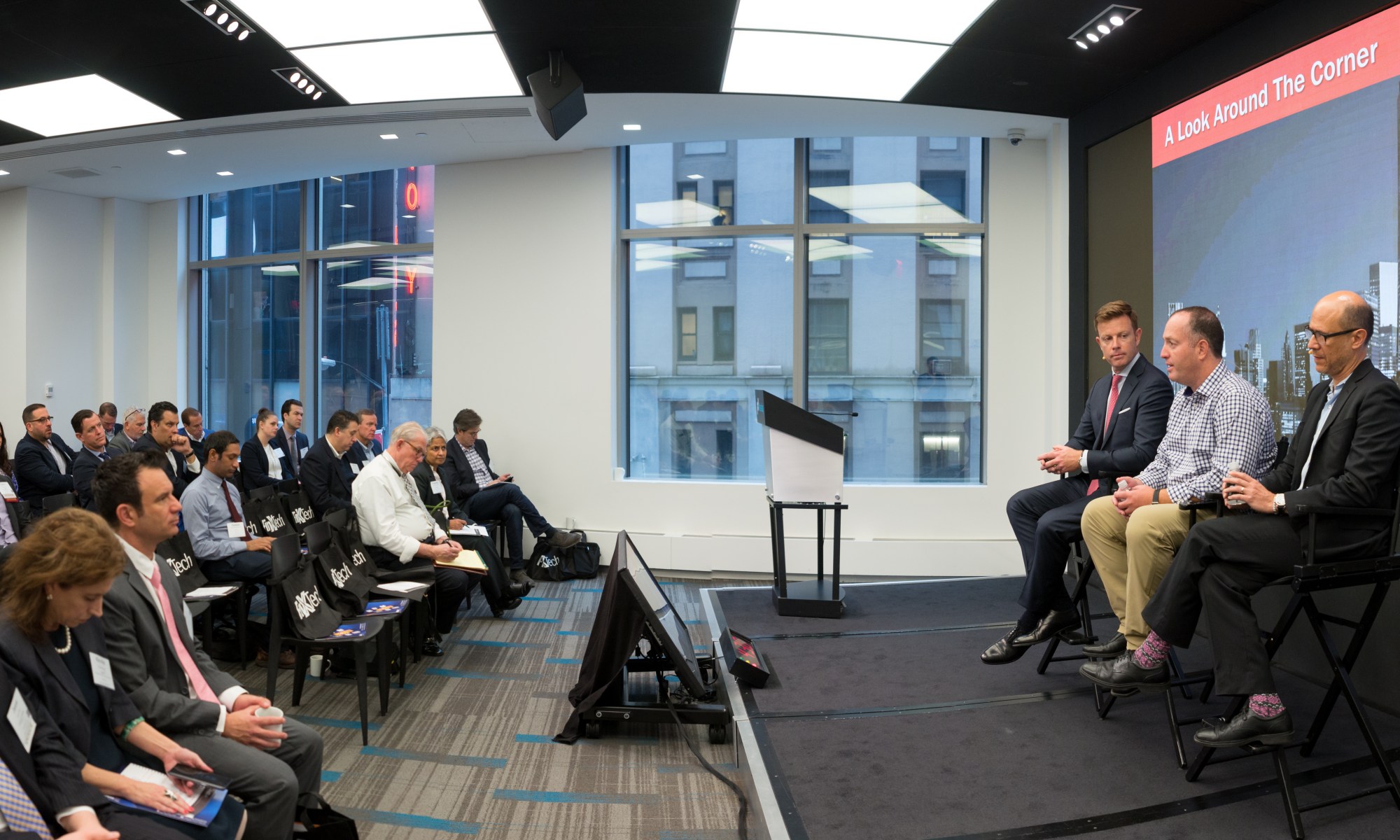
Most banks don’t have business models designed to adapt and respond to rapid change. So how should they think about innovation? I raised that question (and many others) at last Wednesday’s annual FinXTech Summit that we hosted at Nasdaq’s MarketSite. Those in attendance included banks both large and small, as well as numerous financial technology companies — all united around an interest in how technology continues to change the nature of banking.

More so than any regulatory cost or compliance burden, I sense that the organizational design and cultural expectations at many banks present a major obstacle to future growth through technology. While I am buoyed by the idea that smaller, nimble banks can compete with the largest institutions, that concept of agility is inherently foreign to most legacy players.

It doesn’t have to be.

Indeed, Richard Davis, the chairman and CEO of the fifth largest bank in the country, U.S. Bancorp, shared at our Acquire or Be Acquired Conference in Phoenix last January that banks can and should partner with fintech companies on opportunities outside of traditional banking while working together to create better products, better customer service and better recognition of customer needs.

The urgency to adapt and evolve should be evident by now. The very nature of financial services has undergone a major change in recent years, driven in part by digital transformation taking place outside banking. Most banks—big and small—boast legacy investments. They have people doing things on multi-year plans, where the DNA of the bank and culture does not empower change in truly meaningful ways. For some, it may prove far better to avoid major change and build a career on the status quo then to explore the what-if scenarios.

Here, I suggest paying attention to stories like those shared by our Editor-in-Chief Jack Milligan, who just wrote about PNC Financial Services Group in our current issue of Bank Director magazine. As his profile of Bill Demchak reveals, it is possible to be a conservative banker who wants to revolutionize how a company does business. But morphing from a low-risk bank during a time of profound change requires more than just executive courage. It takes enormous smarts to figure out how to move a large, complex organization that has always done everything one way, to one that evolves quickly.

Of course, it’s not just technological innovation where culture can be a roadblock. Indeed, culture is a long-standing impediment to a successful bank M&A deal, as any experienced banker knows. So, just as in M&A deals, I’d suggest setting a tone at the top for digital transformation.  Here are three seemingly simple questions I suggest asking in an executive team meeting:

  • Do you know what problems you’re trying to solve?
  • What areas are most important to profit and near-term growth?
  • Which customer segments are critical for your bank?

From here, it might be easy to create a strategic direction to improve efficiency and bolster growth in the years ahead. But be prepared for false starts, fruitless detours and yes, stretches of inactivity. As Fifth Third Bank CEO Greg Carmichael recently shared in an issue of Bank Director magazine, “Not every problem needs to be solved with technology… But when technology is a solution, what technology do you select? Is it cost efficient? How do you get it in as quickly as possible? You have to maintain it going forward, and hold management accountable for the business outcomes that result if the technology is deployed correctly.”

Be aware that technology companies move at a different speed, and it’s imperative that you are nimble enough to change, and change again, as marketplace demands may be different in the future. Let your team know that you are comfortable taking on certain kinds of risk and will handle them correctly. Some aspects of your business may be harmed by new technology, and you will have to make difficult trade-offs. Just as in M&A, I see this is an opportunity to engage with regulators. Seek out your primary regulator and share what you’re looking for and help regulators craft an appropriate standard for dealing with fintech companies.

Culture should not be mistaken for a destination. If you know that change is here, digital is the expectation and you’re not where you want to be, don’t ignore the cultural roadblocks. Address them.

A Technology Takeover on BankDirector.com

For the next 5 days, I set up shop in my former home of New York City for FinTech Week NYC.  Hosted by Bank Director’s FinXTech in conjunction with Empire Startups, the week can best be understood as a confluence of conferences, round-table discussions, demo days, meetups and networking events across the city.

If you’re not familiar with the various events taking place, here is a quick snapshot of three we’re primarily involved with starting today and running through Friday, the 28th.

The common thread throughout each of these days? A desire to help leaders in the financial sector to better understand how when/where/why to engage with emerging technologies.

Given our cultural mindset to help make others successful, we’re kicking things up a notch with our on-line efforts.  Indeed, we’re “taking over” BankDirector.com and loading the site up with strategic issues and ideas that a bank’s CEO, board and executive team can immediately consider.  In parallel, we’re developing even more content to benefit technology companies keen to work with financial institutions and have some really interesting things planned for our FinXTech.com.  Three examples of this free content:

  • On BankDirector.com, Tips for Working With Fintech Companies by our editor, Naomi Snyder, provides insight from executives at Wells Fargo (one of the country’s biggest) and Radius Bank (a very strong community bank) on how they handle fintech partnerships.
  • On FinXTech.com, Advice for Fintech Companies Working with Banks by our editor-in-chief, Jack Milligan, shares suggestions from SF-based Plaid Technologies and Chicago-based Akouba as to how banks and tech companies can set realistic expectations in terms of cooperating to their mutual benefits.
  • Finally, I authored a piece on a major challenge I see confronting banks when it comes to their digital futures with A Roadblock That Ruins Futures.  As an optimist, things aren’t hopeless; you will see I find inspiration from the CEOs of U.S. Bancorp, PNC and Fifth Third.

10 Banks and Fintechs Doing it Right

In advance of April’s FinXtech Summit
By Al Dominick, CEO of DirectorCorps (parent co. to Bank Director & FinXTech) | @aldominick

Quickly:

  • An increasing number of financial institutions are using partnerships with technology companies to improve operations and better meet customer needs.
  • For the past few months, banks and/or fintechs submitted case studies on specific technology solutions helping financial institutions produce real, quantifiable results to our team at FinXTech.
  • With more then 100 submissions in hand, a committee of FinXTech advisors worked with our team to compile a top-10 list during Bank Director’s Acquire or Be Acquired Conference in Arizona last week.

_ _ _

Throughout Bank Director’s annual Acquire or Be Acquired conference, I found myself in quite a few conversations about the continually changing nature of financial services. Many of these discussions revolved around the possibilities generated by traditional institutions partnering with emerging technology firms.  Some of these took place on-stage; for instance, I opened the second full day of the conference by polling an audience of 900+ on a variety of technology-related issues:

screen-shot-2017-02-08-at-5-06-44-pm

With results like these precipitating editorial coverage from our team and attendees alike, you’ll probably understand why I find the just-released ten finalists for our “Best of FinXTech Awards” so compelling.  Indeed, as the financial landscape continues to evolve, and executives grapple with a fast-changing operating environment that requires partnerships and collaboration, each of these relationships shows what is really possible when leaders explore something new together.

  • Bank of Nova Scotia (Scotiabank) + Sensibill: Scotiabank’s customers can store, organize and retrieve paper and electronic receipts through the Toronto, Canada bank’s mobile banking app and wallet, the result of a partnership with Sensibill, also based in Toronto. The service was launched in October 2016.
  • Franklin Synergy Bank + Built Technologies, Inc.: Built Technologies, in Nashville, Tennessee, improved the loan administration process for Franklin Synergy Bank, in Franklin, Tennessee. The $3 billion asset bank now manages a greater number of construction loans with fewer staff.
  • Green Dot (Go Bank) + Uber: Pasadena, California-based Green Dot Corp., which issues prepaid credit cards, partnered with Uber to provide the San Francisco transportation company’s drivers a fee-free debit card and an instant pay solution that allows drivers to be paid instantly.
  • IDFC Bank + TATA Consultancy Services (TCS): Due to a regulatory mandate, India’s IDFC Bank had just 18 months to expand into rural areas to better serve unbanked customers. The bank’s partnership with TCS, based in Mumbai, India, included the use of micro ATMs, which are modified point-of-sale terminals that expand the bank’s reach in rural areas.
  • National Bank of Kansas City + Roostify: San Francisco-based Roostify improved National Bank of Kansas City’s formerly inefficient and incomplete digital mortgage application process. Customers at the bank, based in Overland Park, Kansas with more than $600 million in assets, can now fill out a mortgage application in a little as 20 minutes, with no need for a phone call or trip to the branch to visit a loan officer.
  • Somerset Trust Company + BOLTS Technologies: BOLTS, based in Bethlehem, Pennsylvania, improved the account opening process at Somerset Trust Company, saving the $1 billion asset community bank in Somerset, Pennsylvania, roughly $200,000 in the first year by better automating the process and reducing error rates. Customers can start and complete the process on multiple channels.
  • Toronto-Dominion Bank (TD Bank) + Moven: TD Bank, based in Toronto, Canada, launched a real-time money management application in April 2016, developed by Moven in New York.
  • USAA + Nuance: USAA, based in San Antonio, Texas, made its website a little smarter in 2016 with the virtual assistant Nina, which provides support for USAA’s members. This use of artificial intelligence is the result of a collaboration with Nuance in Burlington, Massachusetts.
  • Woodforest National Bank + PrecisionLender: Partnering with Charlotte, North Carolina-based PrecisionLender to improve its loan pricing strategy helped $4.8 billion asset Woodforest National Bank, in The Woodlands, Texas, grow commercial loans by 16 percent and gain almost 20 basis points in net interest margin.
  • WSFS Bank + LendKey: WSFS Financial Corp., headquartered in Wilmington, Delaware, with $6.6 billion in assets, partnered with the lending platform LendKey, in New York, to expand the bank’s consumer loan portfolio with a student loan and refinancing product.

All ten of these partnerships demonstrate the strongest combination of collaboration and results.  For those interested, my colleague Kelsey Weaver (the President of our FinXTech platform) announces the three “winners” on April 26, 2017, during the FinXTech Annual Summit, at the Nasdaq MarketSite.

mc_030116_hires-4
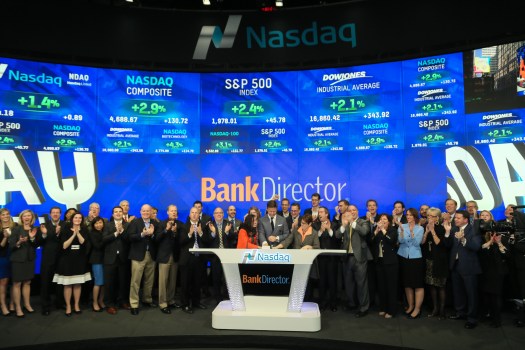
Closing bell ceremony at Nasdaq / Bank Director + FinXTech’s FinTech Day (March 1, 2016)

In advance of that announcement, I invite you to follow me on Twitter via @AlDominick, FinXTech’s President, Kelsey Weaver @KelseyWeaverFXT, @BankDirector and our @Fin_X_Tech platform and/or check out where and how this annual Summit — and these awards — fits into FinTech Week New York that we are hosting along with Empire Startups starting April 24.

We Are On To FinTech Week

#AOBA17 conference intel (Friday)
By Al Dominick, CEO of Bank Director | @aldominick

Quickly

  • The “bank of the future” is not about technology, it is all about customers.
  • For many financial institutions, the time may be right to retire legacy systems for cloud-based platforms.
  • Numerous financial technology companies are developing new strategies, practices and products that will dramatically influence the future of banking..

_ _ _

The intersection of technological innovation with strong depository franchises may lead to more efficient banking processes, reductions in fraud and a win/win/win for banks, financial technology firms (fintechs) and consumers.  Globally, nearly $23 billion of venture capital and growth equity has been deployed to fintechs over the past five years, and this number is growing quickly. Still, the nature and extent of impact that fintechs have on the industry remains unclear.

Throughout this week’s Acquire or Be Acquired conference, bank CEOs talked about the continually changing nature of financial services — with fintech often front and center.  For many, collaboration between traditional institutions and emerging technology firms bodes well for their future.  Here, Bank Director’s FinXTech provides authoritative, relevant and trusted content to a hugely influential audience, specifically:

  • Fintechs who view banks as potentially valuable channels or distribution partners;
  • Banks looking to grow and/or innovate with fintech companies’ help and support; and
  • Institutional investors, venture capitalists, state & federal regulators, government officials and academicians helping to shape the future of banking.

We designed FinXTech as a peer-to-peer resource that connects this hugely influential audience around shared areas of interest and innovation.  As a host of FinTech Week in New York City this April 24 – 28 (along with Empire Startups), we bring together senior executives from banks, technology companies and investment firms from across the U.S. to shine a light on what is really generating top line growth and bottom line profits through partnerships, collaboration and investments.

bank-slide-05

Given the changing nature of banking today, this week-long event in New York City looks at the various issues impacting banks, non-banks and technology companies alike.  So as we move towards FinTech Week in New York City, I invite you to follow me on Twitter via @AlDominick, FinXTech’s President, Kelsey Weaver @KelseyWeaverFXT@BankDirector and our @Fin_X_Tech platform and/or check out the FinTech Week New York website for more.

A New Research Report on Marketplace Lending

#AOBA17 conference intel (Wednesday)
By Al Dominick, CEO of Bank Director | @aldominick

Quickly:

  • Lending is an estimated $15 trillion industry in the United States — and the banking industry’s share in this market is estimated to be around $6.6 trillion (~ 44% of the overall market).
  • Within the FinTech sector, lending is the largest segment in terms of funding from investors, and market altered the lending landscape.
  • Marketplace lenders — online platforms that match borrowers with lenders — will likely see some consolidation in ’17 and continue to converge with banks through partnerships, white label contracting and yes, even mergers.

_ _ _

Fintech lending has grown from $12 billion in 2014 to $23.2 billion in 2015 and is expected to reach $36.7 billion in 2016, a year-over-year growth of 93 percent and 58 percent in 2015 and 2016.  This market, according to Morgan Stanley Research, is expected to grow further and reach $122 billion by 2020.

As noted throughout our Acquire or Be Acquired conference, partnerships between a bank and a tech company can take on many forms — largely based on an institution’s available capital, risk appetite and lending goals.  With FinTech solutions gaining momentum, many advisors here have encouraged banks to look at viable alternatives to meet consumer demands, maintain and expand their lending revenue and give formidable competition to those looking to take that marketshare.

With this in mind, I invite you to take a look at a new Fintech Intelligence Report on Marketplace Lending (to download the PDF version, click: fintech-intelligence-report-lending).  The research paper, developed by Bank Director’s FinXTech platform and MEDICI, a subscription-based offering from LetsTalkPayments.com, explores current market dynamics along with technology & partnership models.  As noted in this report, the gains of new FinTech companies were widely thought to be at the expense of banks; however, many banks recognized the potential value from collaboration and built relationships with FinTechs.

##

While our Acquire or Be Acquired conference wrapped up yesterday, you can take a look back on the conversations + presentations that found their way onto Twitter via @AlDominick, the host company, @BankDirector and our @Fin_X_Tech platform, and search #AOBA17 to see what was shared with (and by) our attendees.

3 Sources of Inspiration for Financial Services Executives

“We keep moving forward, opening new doors, and doing new things, because we’re curious and curiosity keeps leading us down new paths.”  -Walt Disney

Some days just seem to move faster then others.  Fortunately, I found myself on a few airplanes this week without wifi (yes, no wifi!).  What a treat to find a few hours of electronic-interruption free time to catch up on overdue reading.  As I flipped through our soon-to-be-released issue of Bank Director magazine, I took note of a number of issues and trends that I intend to dive deeper into this weekend.  I also pulled up PDFs of articles I’d seen — but had not had a chance to read — that relate to our fast-approaching Acquire or Be Acquired Conference.  Finally, I jotted down a few thoughts on the types of information that I find compelling — notes that inspired this morning’s post.

You see, I really love connecting people with each other… and sharing ideas and insight that I find compelling.  Oftentimes, this takes place in person; however, opportunity exists to do so in digital format.  So if you’re curious about what’s happening in the banking space, let me point you towards these three sources of inspiration:

  • Most Saturday mornings, for me, involve a healthy dose of wit + wisdom from Gregg Schoenberg vis-a-vis The Financial Revolutionist. Powered by Wescott Capital, I appreciate how this weekly newsletter provides sharp and distinctive commentary on financial innovation trends.
  • For those that favor a podcast, take a listen to The Purposeful Banker (backed by PrecisionLender).  Over the past few years, they have assembled a strong library of perspectives relevant to how banks might better perform given various technologies available.
  • Finally, many know of Chris Skinner as an author and independent commentator on the financial markets.  His blog, the Finanser.com, is one I consider a must-read.

As a bonus, Deloitte expects banks to deepen their engagement with the fintech ecosystem as the trend towards digitization accelerates — a theme you’ll recognize if you’ve been on Bank Director’s FinXTech.com*.  The full report from the consultancy can be found here.

##

*As the financial landscape continues to evolve, and executives grapple with a fast-changing operating environment that requires partnerships and collaboration, I am so impressed by the exceptionally astute group of men and women that are helping to shape the future of finance through their day-to-day jobs + as part of FinXTech’s Advisory Group.  FWIW, both Gregg and Chris are members.

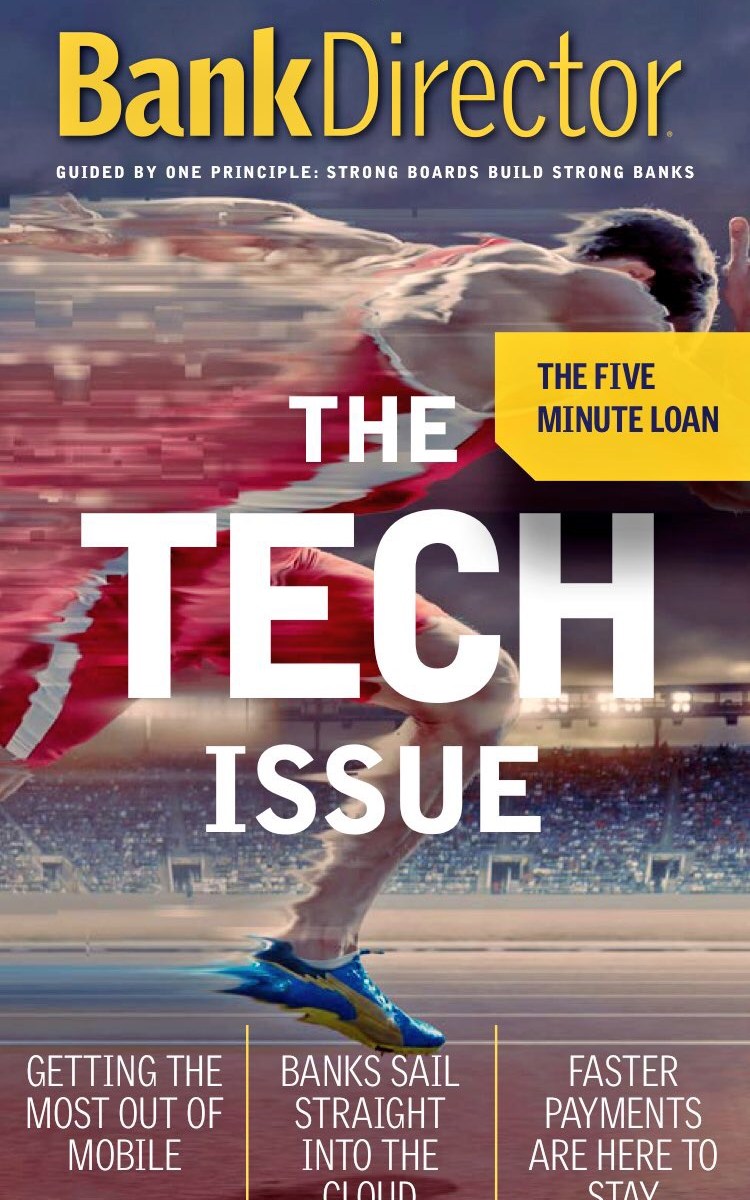
Bank Director’s new Tech Issue

Earlier this week, we published the December issue of Bank Director Magazine, our annual Tech Issue.  Stories range from the changing nature of mobile banking to institutions moving into the cloud to a venture capitalist’s perspective on the future of banking.  I invite you to take a look.

Since starting this blog in 2012, I’ve shared my optimism that the intersection of technological innovation with strong depository franchises may lead to more efficient banking processes, reductions in fraud and a win/win/win for banks, FinTechs and consumers.  So as I read through this current digital issue, a few key takeaways:

  • When San Francisco-based Bank of the West, an $80.7 billion asset subsidiary of BNP Paribas Group, analyzed last year the bottom line impact of customers who are engaged in online banking and mobile banking, it found some surprising results. Digital customers, or those who were active online or on their mobile phones during the previous 90 days, had lower attrition rates than nondigital customers, and they contributed higher levels of revenue and products sold, said Jamie Armistead, head of digital channels at Bank of the West.
  • Automating the small-business lending process requires some deep thinking from boards and management about how much faith they’re willing to place in technology, and their ability to embrace the cultural change implicit in basing lending decisions more on data than judgment. “The marketplace is demanding quicker decisions through technology,” says Pierre Naude, CEO of nCino, a maker of bank operating systems. Bank customers, he says, are clamoring for special products and specialized coding that enable greater automation of the small-business lending process. “Bankers are waking up to the fact that speed and convenience will trump price. You can lose a customer to an alternative lender if you don’t have it.”
  • As our Editor, Naomi Snyder, shares in her welcoming letter, banks tend to have the usual board committees (think audit, compensation and risk).  But we know that few have a board-level technology committee.  So I wonder if 2017 is the year that more institutions decide to create such a group to become better informed and better prepared as the digitization of the banking industry continues?

Concomitant to this issue’s release, Chris Skinner shared his perspectives on the state of FinTech our FinXTech platform.  In his words, “it is apparent that the fintech industry has become mainstream just as fintech investing cools. What I mean by this is that fintech has matured in the last five years, going from something that was embryonic and disruptive to something that is now mainstream and real. You only have to look at firms like Venmo and Stripe to see the change. Or you only have to consider the fact that regulators are now fully awake to the change and have deployed sandboxes and innovation programs. Or that banks are actively discussing their fintech innovation and investment programs… Fintech and innovation is here to stay.”

Clearly, the pace of change in the banking space continues to accelerate.  Accordingly, I encourage you to check out what we’re doing with both Bank Director and FinXTech to help companies who view banks as potentially valuable channels or distribution partners, banks looking to grow and/or innovate with tech companies’ help and support; and institutional investors, venture capitalists, state & federal regulators, government officials and academicians helping to shape the future of banking.

5 Cybersecurity Companies Bank Execs & Board Members Need to Know

When it comes to cybersecurity, the best defense might just be a great offense.  Whereas cybersecurity once focused on how banks could avoid losing money, my team and I are working on a program for 2017 to help officers and directors address potential scenarios (and develop realistic response plans) should a hack, breech or attack occur.  Indeed, protecting the bank against a cyber attack is a core responsibility of every member of a bank’s board and executive team.

In recent posts, I’ve highlighted various fintechs that I find compelling given their relationships with financial institutions.  In terms of cybersecurity, I’ve had the chance to learn more about companies like DefenseStorm (given their support of companies like nCino and LiveOak Bank) that I greatly respect.  Below are five more companies that I think bank leadership teams need to know:

Cognizant

A global cybersecurity solution and service provider, Cognizant supports multiple industry verticals and information security service lines.  I encourage you to take a look at their thoughts on what traditional banks can do to rebuild trust in the digital era.

Centrify

California-based Centrify offers identity & access management solutions to help secure enterprise identities against cyberthreats that target today’s IT environment of cloud computing.  Banking customers include such recognizable names as BB&T, SunTrust, Citi and RBS.

Lookout

Lookout has taken a mobile-first approach to security.  Indeed, one of the world’s largest investment management firms chose Lookout to provide threat and data leakage protection to over 10,000 managed iOS and Android devices.

Feedzai

Founded by data scientists and aerospace engineers, Feedzai’s mission is to “make commerce safe for business customers and create a better experience for their consumers through artificially intelligent machine learning.”

Brighterion

Since the founding of Brighterion, its core technology has been adapted and improved for real-time applications in the fields of payment, healthcare, marketing and homeland security.  For instance, its analysis of payments provides “unprecedented behavioral insights,” from the spending behavior of customers to the constantly evolving techniques of fraudsters.

##

As a complement to these five businesses, let me wrap up by sharing a recent FinXTech article:Emerging Technologies Combat Cybercrime.  As you will read, banks are doing everything they can to reassure customers that their digital information is safe and secure.

FinXTech’s Advisory Group

I’m checking in from the edge of the Rocky Mountains — from the iconic Broadmoor in Colorado Springs — where I’m joined by FinXTech’s President, Kelsey Weaver and Bank Director’s Director of Client Relations, Laura Proffitt.  The three of us are here to participate in the Association for Financial Technology’s (AFT) Fall Summit where later today, I will have the opportunity to introduce a new partnership between AFT and FinXTech.  In advance of those comments, I thought to pull the curtains back on a special  Advisory Group that we are building to develop FinXTech in the “best” possible manner. 

As new approaches to delivering financial services emerge, nearly every technology company here in Colorado has practical tools, techniques and talent to help financial institutions prepare for the future.  It is an exciting time to be part of a community like the one AFT draws, as I believe new players will continue to emerge while traditional participants transform their underlying business models to better participate and compete in the coming years.

As the financial industry continues to evolve, so too does the community that my team supports.  As a peer-to-peer based platform powered by Bank Director, FinXTech connects a hugely influential audience around shared areas of interest and innovation; specifically:

  • FinTech companies who view banks as potentially valuable channels or distribution partners;
  • Banks looking to grow and/or innovate with FinTech companies’ help and support; and
  • Institutional investors, venture capitalists, state & federal regulators, government officials and academicians helping to shape the future of banking.

Rather then create this community in isolation, we are doing so with the help and support of industry leaders with various backgrounds.  Case-in-point, we are recruiting highly opinionated, ridiculously informed thought leaders to “think around the corner” with us as part of FinXTech’s Advisory Group.

So as we get ready to spend a few days with our peers at this week’s conference, Kelsey, Laura and I are proud that the following men and women have accepted our invitation to share their time and intelligence with us as part of FinXTech’s council:

  • Thomas P. Brown, Partner, Paul Hastings LLP
  • Michael Butler, President & CEO, Radius Bank
  • Michael M. Carter, Founder & CEO, BizEquity
  • Ryan Gilbert, General Partner, Propel Venture Partners
  • John C. Gill, Chief Operating Officer & Chief Risk Officer, Somerset Trust Company
  • Joe Guastella, Global & U.S. Managing Principal, Financial Principal, Deloitte Consulting LLP
  • James C. Hale, III, Founding Partner, FTV Capital
  • Aditya Khujekar, CEO & Co-Founder, Let’s Talk Payments
  • Jimmie Lenz, Director of Technology Risk, Wells Fargo, Wealth and Investment Management
  • Vivian Maese, Partner, Latham & Watkins
  • Bill McNulty, Entrepreneur in Residence, Capital One
  • John E. Pizzi, CEO, BaseVenture
  • Gregg M. Schoenberg, Founder, Westcott Capital
  • Chris Skinner, CEO, The Finanser Ltd
  • Christa Steele, Former President, CEO & Board Member, Mechanics Bank; Founder, Boardroom Consulting LLC
  • John Thompson, SVP & Leader, Program Team, CFSI
  • Andres Wolberg-Stok, Director, Citi Fintech
  • Jon Zanoff, Founder, Empire Startups

In addition to this awesome group, we have some pretty powerful folks that we recently invited (so this list can and will expand in the coming weeks).  But for those of you here at AFT, you will hear Kelsey, Laura and me talk about our enthusiasm for this group & the efforts being made to establish FinXTech as a catalyst that (1) connects a highly influential group of people who care about the future of financial services, (2) are committed to meaningful transformation and are (3) empowered to make change happen.

##

To learn more about what we’re doing, I invite you to visit FinXTech.com, a site we designed to deliver authoritative, relevant and trusted content for banks, Fintech companies, investors and services firms.

Without A Destination, What Good Is A Map?

Highlight: as executives grapple with a fast-changing operating environment that requires partnerships and collaboration, many wrestle with where they want to be vs. where they need to be.

In this video, I share my thoughts on growing through partnerships (between traditional banks and financial technology firms), becoming “data richer” and enhancing the customer experience you’re delivering.

FWIW, this video lives on FinXTech.com, a site designed to provide authoritative, relevant and trusted content to a hugely influential audience, specifically:

  • Fintech companies who view banks as potentially valuable channels or distribution partners;
  • Banks looking to grow and/or innovate with fintech companies’ help and support; and
  • Institutional investors, venture capitalists, state & federal regulators, government officials and academicians helping to shape the future of banking.

As a platform powered by Bank Director, FinXTech connects this hugely influential audience around shared areas of interest and innovation.  FinXTech specializes in (1) bringing valuable bank relationships to fintechs, and (2) offering banks valuable relationships with fintechs in a way no one else does.

A Bank’s Future Is _____

Today’s pop quiz

A bank’s future is:

(a)  Bright

(b) Non-existent

(c) Technology-dependent

(d) Unclear

By deliberating before answering this question (and subsequently leaving a reply below), you will better understand how + why my team at Bank Director developed the agenda for our Growing the Bank Conference.

Next Monday and Tuesday, at the Four Seasons Resort and Club Las Colinas in Dallas, we are excited to welcome 230+ executives from traditional and emerging financial services companies to explore:

  • The power of partnerships between banks and fintechs;
  • How to embrace change; and
  • Intelligently experimenting with emerging tools and products.

As I wrote in 3 Quick Takeaways from #fintech16 (aka Bank Director’s FinTech Day at Nasdaq’s MarketSite), many technology companies have developed strategies, practices and new technologies that will dramatically influence how banking gets done in the future.  For example:

  • Nymbus is transforming the way traditional banks and financial institutions support and interact with their customers through its core processing solution;
  • nCino is a leader in cloud banking with a dynamic bank operating system; and
  • Geezeo offers an integrated suite of online tools and services; notably, a sleek Personal Financial Management (PFM) solution.

However, within this period of upheaval — where considerable market share will be up for grabs — ambitious banks can leapfrog both traditional and new rivals.  So if you are joining us, be advised that this is not a place to sit quietly and be told what’s not working in banking. This two-day exchange of ideas allowed for candid conversations and presentations banking leaders from around the United States eager to address challenging issues and emerging opportunities.  If you are interested in following the conversation via Twitter, @bankdirector uses #BDGrow16.  In addition, we will share various takeaways via LinkedIn and I’ll be posting regularly to this site.

P.S. – I’ll read the best answer to today’s question to open the conference, so don’t be shy in sharing your answer below.