Quick Guide: 2015 Growth Strategy Survey (Bank-specific)

Recently, Business Insider and the Wall Street Journal picked up Bank Director’s 2015 Growth Strategy Survey.  The research project reveals how many financial institutions continue to recognize growth in traditional areas — most notably, loans to businesses and commercial real estate — while struggling to attract a decidedly untraditional digital generation.  So in case you missed it, today’s piece highlights key findings from this annual research project. 

By Al Dominick // @aldominick

Over the weekend, our friends at the Wall Street Journal ran a very telling story about the efforts being made by the San Francisco 49ers to better engage with their millennial employee base.  Clearly, the NFL franchise’s challenge to “relate to a generation — generally described as 18-to-34-year-olds — that has been raised on smartphones and instant information” parallels that of most banks in the U.S.  In addition to being a fascinating behind-the-scenes look at what’s happening out in Santa Clara, it also sparked today’s post.

You see, as a 38-year old who runs a great privately-held company that employs quite a few folks under the age of 30, I have to admit that I am tiring of the broad strokes being used to describe millennials’ needs and ambitions.  However, I will admit to being surprised to learn that there are approximately 75 million people in the U.S. under the age of 34.  This is a huge number, especially when you hear that every day, for the next 15 years, 10,000 people will turn 65 (h/t to the CEO of Boston’s Chamber of Commerce for making me aware of this reality).

Surprisingly, 60% of the executives and board members that responded to Bank Director’s 2015 Growth Strategy Survey say their bank might not have the right products, services and delivery methods to serve the vast majority of this demographic.  While I haven’t run this by our very talented Director of Research (*hello Emily McCormick), to me, this shows that the relationships that community bankers nurtured for decades will be increasingly of less value with this emergingly-influential generation who have grown up in a digital world and who, stereotypically, value the speed with which it operates.

As the Wall Street Journal shared when reporting on our research results, “banks have watched less regulated finance companies ranging from mortgage lenders to private-equity firms encroach on many of their main businesses.  But ask an executive or board member at a bank what nonbank company they most fear, and they’re likely to name the world’s biggest technology company, Apple Inc.”  So what were our key findings?  Glad you asked…

Three key findings (click this title link to access the full report):

  1. Apple is the nonbank competitor respondents worry about most, at 40%  — just 18% of respondents indicate their bank offers Apple Pay.
  2. Bank mobile apps may not keep pace with nonbank competitors. Features such as peer-to-peer payments, indicated by 28% of respondents, or merchant discounts and deals, 9%, are less commonly offered within a traditional bank’s mobile channel. 49% of respondents indicate their bank offers personal financial management tools.
  3. Despite the rise of P2P lenders like Lending Club and Prosper in the consumer lending space, just 35% of respondents express concern that these startup companies will syphon loans from traditional banks.

Instead of millennials, banks have been finding most of their growth in loans to businesses and commercial real estate.  Yes, 75% of respondents want to understand how technology can make their bank more efficient… and 72% want to know how technology can improve the customer experience.  But I find it telling that today, loan growth remains the primary driver of profitability for the majority of responding banks.  In fact, 85% of respondents see opportunities to grow through commercial real estate loans.  As we found, executives and board members also expect to grow through commercial & industrial (C&I) lending, for 56%, and residential mortgages, at 45%.  So for those looking to predict the future of banking, I think findings like these are quite telling.  Indeed, it would appear what’s worked in the past may be what to bet on for the future.

##

The 2015 Growth Strategy Survey, sponsored by technology firm CDW, reveals how bankers perceive the opportunities and challenges in today’s marketplace, and technology’s role in strategic growth. The survey was completed by 168 chief executive officers, independent directors and senior executives of U.S. banks with more than $250 million in assets in May, June and July of this year.  Ironically, last year’s survey found that credit unions, not Apple, were the “non-bank” competitor that banks were most worried about.  In fact, can you believe that Apple didn’t even make the cut?  My, how quickly times can change.

Pushing Forward: The Future of Financial Services?

Yesterday, the L.A. Times wrote about a bank that is “part lender, part consultant, part cheerleader and part investor… a nursemaid to countless start-ups — Airbnb, Fitbit, Pinterest and TrueCar, to name some recent ones — as well as banking the venture capitalists who fund them.” Curious to learn more about this California-based innovator with a great reputation for serving software, hardware, biotech and healthcare start-ups? Read on.

By Al Dominick // @aldominick

Bank Director’s managing editor, Naomi Snyder, recently wrote that “banks are used to identifying, monitoring and mitigating risks, more so than they are adept at innovating. But an argument gaining increasing weight is the notion that banks really are technology companies and need to think more like a technology company.”  But what if, instead of transforming one’s business model to resemble a tech firm, an institution instead acted like Silicon Valley Bank, the Santa Clara-based powerhouse that has financed scores of the highest-flying tech companies like those mentioned above.

Certainly, this standout financial institution has a knack for staying close to their customers (*take a look at their Innovation Economy Outlook 2015).  So at a time when many banks are shrinking in relevance despite their important role in local economies, I thought to take a look at this “unusual for an FDIC-regulated bank.”  Billed as the bank of the world’s most innovative companies and their investors, the LA Times shared that with $40.2 billion in assets, Silicon Valley Bank now has “the heft to handle them from start-up to initial public offering, multiplying its profits on larger loans and fees.”  Further,

The bank, which recently opened an office in Santa Monica, is more willing than others to focus on a start-up’s growth prospects rather than its current financial condition and to lend money so businesses can expand while awaiting the next round of venture capital funding, said investor Mark Suster, a client and managing partner at Upfront Ventures in Los Angeles.

Now, this doesn’t preclude the bank from identifying a good thing that can help it to continue to push forward the future of financial services.  Case-in-point, I woke up a few days ago to find, via Twitter, that Standard Treasury team joined SVB Financial’s information technology team “to help it expand the bank’s digital banking platform.”  Just as I looked at Capital One’s recent fintech acquisitions in my last post (How Capital One Can Inspire Your Digital Efforts), the fact that the bank hired the team from startup company Standard Treasury to help accelerate the development of its API (application programming interface) banking services underscores the institutions drive to “enable easier collaboration, product development and integration with… clients.”

While catching up to Silicon Valley Bank — which boasts of having half of all startups in the U.S. as clients — will challenge many traditional institutions, I think it makes far more sense to look at what they have accomplished and suggest banks in markets where venture-backed start-ups are taking off try to pattern their business after SVB’s successes rather than radically shifting the underlying business model to emulate what might work for a technology company.

Of course, the LA Times does remind us that “most also don’t come close to Silicon Valley Bank’s well-connected network of outside experts, mentors, tech executives, venture capitalists and current and former clients ready to help its upstart entrepreneurs — no matter how farfetched an idea might seem.” Nevertheless, at a time when individuals along with business owners have more choices than ever before in terms of where, when and how they bank, I think leadership teams at financial institutions of all sizes should pay attention to how Silicon Valley Bank aligns its services (and product mixes) to suit core customers’ interests and expectations.

What To Do With FinTech

For the 699 financial institutions over $1Bn in asset size today, the drive to improve one’s efficiency ratio is a commonly shared goal.  In my mind, so too should be developing relationships with “friendly” financial technology (FinTech) companies.

By Al Dominick // @aldominick

Small banks in the United States — namely, the 5,705 institutions under $1Bn in assets* — are shrinking in relevance despite their important role in local economies.  At last week’s Bank Audit & Risk Committees Conference in Chicago, Steve Hovde, the CEO of the Hovde Group, cautioned some 260 bankers that the risks facing community banks continue to grow by the day, citing:

  • The rapid adoption of costly technologies at bigger banks;
  • Declining fee revenue opportunities;
  • Competition from credit unions and non-traditional financial services companies;
  • Capital (in the sense that larger banks have more access to it);
  • An ever-growing regulatory burden; and
  • The vulnerability all have when it comes to cyber crime.

While many community banks focus on survival, new FinTech companies have captured both consumer interest and investor confidence.  While some of the largest and most established financial institutions have struck relationships with various technology startups, it occurs to me that there are approximately 650 more banks poised to act — be it by taking the fight back to competitive Fintech companies or collaborating with the friendly ones.

According to John Depman, national leader for KPMG’s regional and community banking practice, “it is critical for community banks to change their focus and to look for new methods, products and services to reach new customer segments to drive growth.”  I agree with John, and approach the intersection of the financial technology companies with traditional institutions in the following manner:

For a bank CEO and his/her executive team, knowing who’s a friend, and who’s a potential foe — regardless of size — is hugely important.  It is also quite challenging when, as this article in Forbes shows, you consider that FinTech companies are easing payment processes, reducing fraud, saving users money, promoting financial planning and ultimately moving our giant industry forward.

This is a two-sided market in the sense that for a FinTech founder and executive team, identifying those banks open to partnering with, investing in, or acquiring emerging technology companies also presents great challenges, and also real upside.  As unregulated competition heats up, bank CEOs and their leadership teams continue to seek ways to not just stay relevant but to stand out.  In my opinion, working together benefits both established organizations and those startups trying to navigate the various barriers to enter this highly regulated albeit potentially lucrative industry.

*As of 6/1, the total number of FDIC-insured Institutions equaled 6,404. Within this universe, banks with assets greater than $1Bn totaled 699. Specifically, there are 115 banks with $10Bn+, 76 with $5Bn-$10Bn and 508 with $1Bn – $5Bn.

Main Areas of Focus for a Bank’s Audit and Risk Committees

What’s top-of-mind for a bank’s Audit and Risk committee members?  Let’s start with cyber security…

By Al Dominick // @aldominick

There are many challenges that bank boards & executives must address, and these two videos (one by our editor, Jack Milligan; the other, by me) briefly review current issues that demand attention + emerging ones that we took note of at this week’s Bank Audit & Risk Committees Conference at the JW Marriott in Chicago.

*For more on the risks facing banks today, take a look at this report from our conference (#BDAudit15).

The Week in Pictures (Inspired by a New App & Dig’Mag)

With Memorial Day jockeying for attention, allow me to reflect on a great week.  Specifically, by sharing pictures from Monday evening at Urban Grub in Nashville, TN where the Bank Director team, along with friends & family, celebrated the development and launch of our new app and digital magazine.  

While many companies in the content business are moving away from print or simply discontinuing operations, we are ramping up to meet the needs of our audience.  Our new digital magazine is not simply a replica of, or replacement for, our print publication.  Rather, it is a dynamic new product that allows us to stay on top of emerging trends specific to a bank’s key leadership team.  What makes the launch so much sweeter for me personally?  All of our “friends” who have decided to take the concept of “imitation as flattery” to ridiculous extremes will have quite the go trying to replicate something built by scratch from our very talented team.

So along with the open bar & champagne toast, what was on the menu? Mmmm, a charcuterie of house cured meats, local & imported cheeses, a roasted oyster & crawfish boil, corn and red potatoes, a whole roasted suckling pig, ham hock collards, white beans and a desert of banana pudding pie.  All deeee-licious.  So a big thank you to the folks at Urban Grub for taking care of us… and a HUGE congratulation to our entire team on a job so very well done!!

*Bank Director’s free app & digital magazine is now available for download through Apple’s App Store, Google Play and Amazon.com.

There’s A New App For That

This morning, my company officially launched a state-of-the-art app to deliver a new monthly digital magazine which complements our quarterly, print-version.  A huge amount of time and effort went into the design, development and approval process, so I am very proud to share that Bank Director’s free app & digital magazine is now available for download through Apple’s App Store, Google Play and Amazon.com.  A HUGE thank you to our team that built it.  Also, my apologies to anyone looking to imitate this new offering.  It is home-grown and totally customized to the informational, educational and training needs of bank officers and directors today.

By Al Dominick // @aldominick

Since 1999, the number of commercial banks and savings institutions in the United States has decreased from 10,220 to approximately 6,500.  On the surface, this would not seem to be a robust market in which to base a business model.  However, among those still in the banking business, there is a tremendous appetite for information that will help a CEO, CFO, General Counsel, Chairman and board of directors to maintain a competitive edge — and that is the role that my team at Bank Director fills.

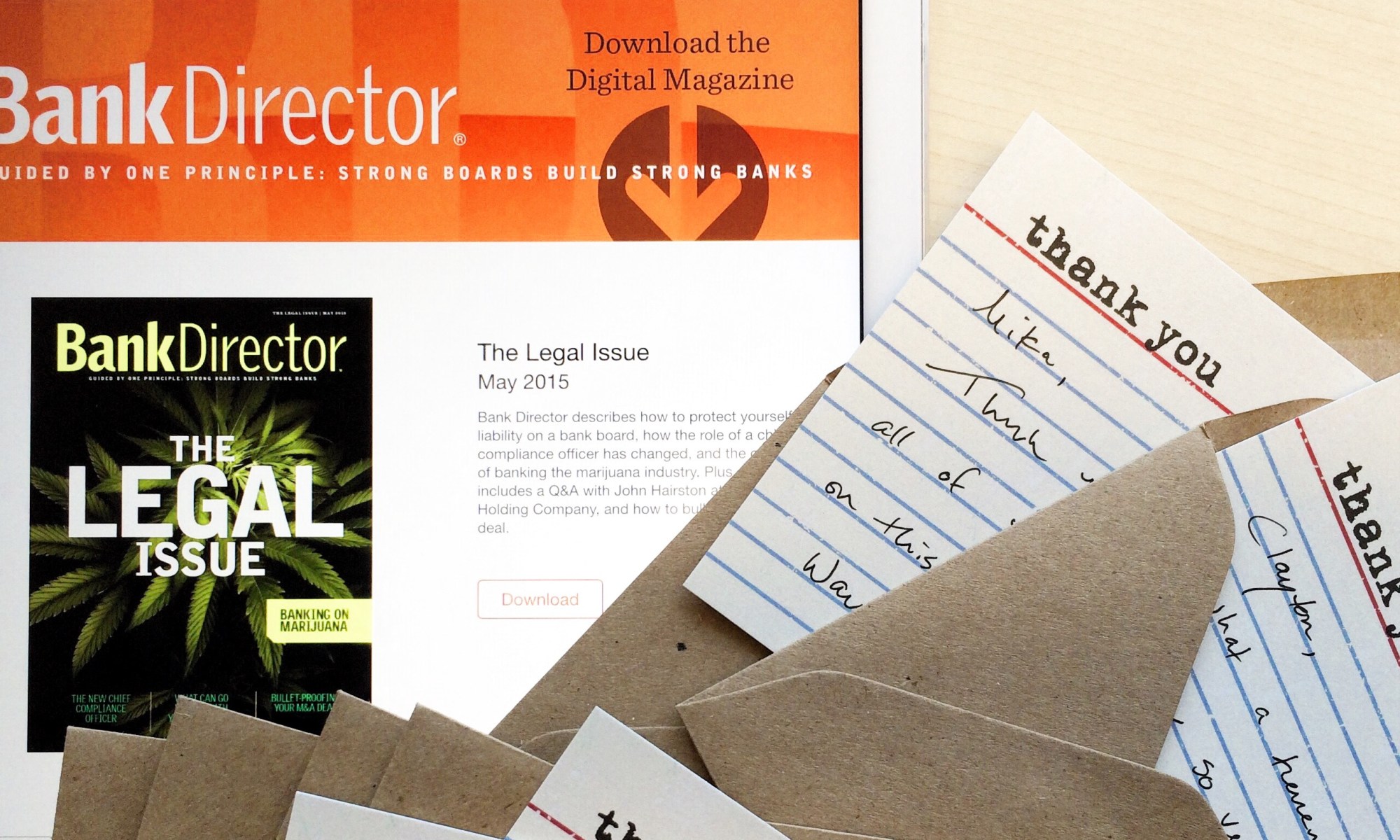
We designed Bank Director’s digital magazine specifically for tablet devices and incorporate interactive features such as animated infographics, video interviews and real-time polling.  Starting today, it can be accessed for free by downloading the app through Apple iTunes, Google Play or Amazon.com.  Unlike the print version — in circulation since 1991 — these digital issues have a distinct editorial focus each month.  Case-in-point, we light up the first issue with a cover story on the legal and compliance issues facing institutions interested in banking the marijuana industry.  Subsequent issues focus on attracting talent, growing the bank, serving on the audit or risk committee, handling governance and overseeing technology.

While many companies in the content business are moving away from print or simply discontinuing operations, we are ramping up to meet the needs of our audience.  This is not simply a replica of, or replacement for, our print publication.  It is a dynamic new product that allows us to stay on top of emerging trends.  For those of you familiar with our quarterly print publication, I hope this provides you added insight each month to the issues facing our industry.  For those of you not as familiar with Bank Director, I invite you to take a moment to experience this great new content now available anytime, anywhere.

IMG_3447

Bank Mergers and Acquisitions

“The reality is organic growth is tough,’’ said Chris Myers, the president and CEO of the $7.2-billion Citizens Business Bank in Ontario, California, who spoke at our Acquire or Be Acquired conference in January.  His bank is one of those in the “sweet spot” for higher valuations and higher profitability, but even he feels the pressure to grow. “A lot of banks are stretching to try to grow [loans] and do things they wouldn’t have done in the past,’’ he said, commenting on the competition for good loans. “ We are going to need to do some acquisitions.”

By Al Dominick // @aldominick

The classic build vs. buy decision confronts executives in every industry.  For bank CEOs and board members today, mergers and acquisitions (M&A) remain attractive inasmuch as successful transactions improve operating leverage, earnings, efficiency and scale.  While I recently wrote that the best acquisition a bank can make is of a new customer, today’s post looks at what’s happening with bank M&A by sharing a few of my monthly columns that live on BankDirector.com:

  • Why Big Banks Aren’t Merging — with global companies announcing huge acquisitions, I look at where the banking industry is today.
  • Stressed Into Selling — after the largest U.S.-based banks passed the Federal Reserve’s stress tests, I write about modeling various economic conditions that might help a bank’s board to anticipate potential challenges and opportunities.
  • Don’t Sell The Bank —  figuring out when a bank should be a buyer—or a seller—had been on my mind since the Royal Bank of Canada announced a deal for “Hollywood’s bank,” City National, and this piece explored why now is not the time to sell.
  • Why Book Value Isn’t the Only Way to Measure a Bank — as the market improves and more acquisitions are announced, why I expect to see more attention to earnings and price to earnings as a way to value banks.
  • Deciding Whether to Sell or Go Public — while the decision to sell a company weighs heavily on every CEO, there comes a point where a deal makes too much financial and cultural sense to ignore.

In addition to these five columns, I invite you to read this month’s column, “Mind These Gaps,” which posts today on BankDirector.com.  It focuses on various pitfalls that have upended deals that, on paper, looked promising (e.g. due diligence and regulatory minefields, the loss of key talent/integration problems and bad timing/market conditions).  With perspectives from some of the country’s leading investment bankers and attorneys, it is one I’m pleased to share.  Don’t worry, unlike other sites, there is no registration — or payment — required.

This Week in Pictures – New Orleans

It has been said that the best acquisition a bank can make is of a new customer.  But let’s face it: for most banks, organic growth is hard. For those wanting to grow revenue, deposits, brand, market size and market share, we hosted a “Growth” conference at the Ritz-Carlton in New Orleans earlier this week.  Below, some pictures from our time in the Crescent City along with links to organic growth & FinTech-specific content.

By Al Dominick // @aldominick

Clearly, there has been an enormous shift in asset concentration and customer loyalty during the past two decades. Today, the ten biggest banks in the U.S. have more assets than all of the other institutions combined.  Concurrently, major consumer brands such as Apple and Google have emerged as significant non-bank competitors.  As such, we designed this year’s Bank Board Growth & Innovation Conference around the concept of building sustainable franchise value.

To stay both relevant and competitive, I believe that building a culture of disciplined growth that encourages creativity and risk taking is essential. For a bank’s CEO, executive team and board, this requires a combination of knowledge, skill and courage – things we designed this conference, a complement to our annual Acquire or Be Acquired Conference, to provide.  Behind the scenes, our team works hard to deliver a “Four Seasons”-level of service — and I am especially proud of how everyone navigated the weather challenges that hit the city on Monday.  It was great to arrive to so many smiling faces!

For those curious about the topics and trends covered at the event, you can up on what was covered by clicking on:

In addition, take a look at what our editor, Jack Milligan, has shared on his blog, The Bank Spot.  And since its Friday, I’ll take the liberty of closing with laissez les bons temps rouler!

How the Math Works for Non-Financial Service Companies

As you probably deduced from the picture above, I’m in Chicago for Bank Director’s annual Chairman & CEO Peer Exchange.  While the conversations between peers took place behind closed doors, we teed things up with various presentations.  An early one — focused on FinTech — inspired today’s post and this specific question: as a bank executive, what do you get when you add these three variables:

Stricter capital requirements (which reduces a bank’s ability to lend) + Increased scrutiny around “high-risk” lending (decreasing the amount of bank financing available) + Increases in consumer product pricing (say goodbye to price-sensitive customers)

The unfortunate answer?

Opportunity; albeit, for non-bank financial services companies to underprice banks and take significant business from traditional players.  Nowhere is this more clear then in the lending space. Through alternative financial service providers, borrowers are able to access credit at lower borrowing costs. So who are banks competing with right now? Here is but a short list:

  • FastPay, who provides specialized credit lines to digital businesses as an advance on receivables.
  • Kabbage, a company primarily engaged in providing short-term working capital and merchant cash advance.
  • OnDeck, in business to provide inventory financing, medium-term business loans.
  • Realty Mogul, a peer-to-peer real estate marketplace for accredited investors to invest in pre-vetted investment properties.
  • BetterFinance, which provides short-term loans for consumers to pay monthly bills and purchase smartphones.
  • Lenddo, an online platform that utilizes a borrower’s social network to determine credit-worthiness.
  • Lendup, a short-term online lender that seeks to help consumers establish credit and avoid the cycle of debt.
  • Prosper, an online marketplace for borrowers to create and list loans, with retail and institutional investors funding the loans.
  • SoFi, an online network helping recent graduates refinance student loans through alumni network.

As unregulated competition heats up, bank CEOs and Chairmen continue to seek ways to not just stay relevant but to stand out.  Unfortunately, the math isn’t always in their favor, especially when alternative lenders enjoy operating costs far below banks and are not subject to the same reserve requirements as an institution.  As we were reminded, consumers and small businesses don’t really care where they borrow money from, as as long as they can borrow the money they want.

##

Thanks to Halle Benett, Managing Director, Head of Diversified Financials Investment Banking, Keefe, Bruyette & Woods, A Stifel Company for inspiring this post. He joined us yesterday morning at the Four Seasons Chicago and laid out the fundamental shifts in banking that have opened the door for these new competitors.  I thought the math he shared with the audience was elegant both in its simplicity — and profound in its potential results.  Let me know what you think with a comment below or message via Twitter (@aldominick).

About That Elephant Coming Out of the Corner (*hello cyber security & banking)

Last summer, a cyberattack on JPMorgan Chase by Russian hackers compromised the accounts of 83 million households and seven million small businesses.  While the New York Times reports the crime did not result in the loss of customer money or the theft of personal information, it was one of the largest such attacks against a bank.  A data breach like this illustrates the clear and present danger cyber criminals pose to the safety and soundness of the financial system.  In my opinion, there can be nothing more damaging to the reputation of, and confidence in, the industry as a whole than major security breaches.

Yesterday, Bank Director released its annual Risk Practices Survey, sponsored by FIS, the world’s largest global provider dedicated to banking and payments technologies. As I read through the results, it became immediately apparent that cyber security is the most alarming risk issue for individuals today.  So while I layout the demographics surveyed at the end of this piece, it is worth noting that 80% of those directors and officers polled represent institutions with between $500 million and $5 billion in assets — banks that are, in my opinion, more vulnerable than their larger counterparts as their investment in cyber protection pales to what JPMorgan Chase, Wells Fargo, etc are spending.  In fact, the banks we surveyed allocated less than 1% of revenues to cybersecurity in 2014.  Accordingly, I’m gearing my biggest takeaway to community bankers since those individuals most frequently cited cyber attacks as a top concern.

Interestingly, individual concern hasn’t yet translated into more focus by bank boards. Indeed, less than 20% say cybersecurity is reviewed at every board meeting — and 51% of risk committees do not review the bank’s cybersecurity plan.  As I read through our report, this has to be a wakeup call for bank boards. While a number of retailers have made the news because of hacks and data thefts, this remains an emerging, nuanced and constantly evolving issue.

It would not surprise me if bank boards start spending more time on this topic as they are more concerned than they were last year. But I do see the need to start requiring management to brief them regularly on this issue, and start educating themselves on the topic.  In terms of where to focus early conversations if you’re not already, let me suggest bank boards focus on:

  • The detection of cyber breaches and penetration testing;
  • Corporate governance related to cyber security;
  • The bank’s current (not planned) defenses against breaches; and
  • The security of third-party vendors.

Personally, I don’t doubt that boards will spend considerably more time on this issue — but things have changed a lot in the last year in terms of news on data breaches.  If bankers want to start assessing the cybersecurity plan in the same way they look at the bank’s credit policies and business plan, well, I’d sleep a lot sounder.

So I’ll go on record and predict that boards will become more aware and take on a more active role in the coming months — and also expect that regulators will start demanding that boards review cybersecurity plans, and that all banks have a cybersecurity plans.  To take this a step further, check out this piece by the law firm Arnold & Porter: Cybersecurity Risk Preparedness: Practical Steps for Financial Firms in the Face of Threats.

About this report

Bank Director’s research team surveyed 149 independent directors and senior executives of U.S. banks with more than $500 million in assets to examine risk management practices and governance trends, as well as how banks govern and manage cybersecurity risk. 43% of participants serve as an independent director or chairmen at their bank. 21% are CEOs, and 17% serve as the bank’s chief risk officer.

Finding That Competitive (FinTech) Edge

On a flight to Boston yesterday morning, I found myself reading various research and analyst reports about forces effecting change on the banking community.  As Bruce Livesay, executive vice president and chief information officer for First Horizon National Corp. in Memphis, Tennessee recently shared with our team, “you can’t have a discussion about banking without having a discussion about technology.”  As such, today’s piece about finding your FinTech edge.

A simple truth with a profound impact: the interaction, communication, coordination and decision-making in a large, regulated bank is vastly different than those of an up-and-coming FinTech company.  No matter how much both sides want to work with the other (to gain access to a wider customer footprint, to incorporate emerging technologies, etc.), the barriers to both entry and innovation are high.  Still, the need for institutions to better target customer segments while rolling out product offerings that differentiate and cross-sell naturally intersect with the use of technology.

Over the past few months, I’ve looked at nine technology companies that I think are doing interesting work (you can find write ups here, here and here).  As I go deeper into this space, I realize defining the FinTech sector might prove as elusive as understanding the genesis of each company’s name.  Still, let me take a crack at it and define “FinTech” as those financial technology companies that sell or enable:

  • Acquisition & engagement tools
  • Mobile payments offerings
  • Lending options
  • Security products
  • Wealth management support
  • Analytics
  • Money transfers
  • Asset management
  • Automated planning / advice

Regardless of the FinTech companies populating each product line, it is clear that the cumulative effect is a transformation of the fabric of the financial industry.   As I read in a recent Deloitte report (2015 Banking Industry Outlook), FinTech applies not just to customer-facing activities, but also to “internal processes, including balance sheet management, risk, and compliance.”  Moreover, learning from non-bank technology firms and establishing partnerships is fait accompli for most bank executives and board members today.

##

As I’ve shared in the past, I am a big believer that many banks of all sizes have immediate opportunities to expand what banking means to individual and business customers.  If you’re curious for examples on what’s working — and why, take a look at this special supplement to Bank Director magazine that highlights a number of interesting technologies that have re-shaped the fortunes of various community banks.  For more on the board’s role in oversight of this important sector, take a look at our Editor, Jack Milligan’s, white paper on the topic.

From Bank Director’s 2015 Acquire or Be Acquired Conference: A 45 Second Video Recap of Day Two

On Tap For Day Three

Last night, I shared three takeaways from our second full day at AOBA (Three Observations From Bank Director’s 2015 Acquire or Be Acquired Conference). Looking ahead to our final half day, we kick things off with a series of discussion groups that address the following issues:

  • New Lending Markets for Community Banks
  • Growing with SBA Loans
  • Everything You Wanted to Know about Civil Money Penalties
  • Capital Plans & Nontraditional Alternatives
  • Incorporating M&A into Your Strategic Planning Process
  • Beyond eMail – Purpose-Built Tools for Mobile Executives

With coffees in hand, we move into our first general session, led by PwC, entitled “What You Can Learn from the Country’s Biggest Banks.” Following that presentation, we have back-to-back breakout sessions available before closing with “The Butterfly Effect of Technology on Banks Today.”  To see an abbreviated PDF version of the three day agenda, please click 2015 AOBA Agenda (Overview).

##

To follow the conversation on Twitter, I invite you to follow me @aldominick, follow @bankdirector and tweet using the hashtag #AOBA15.