Address the Culture Gap Between Banks and FinTechs

By Al Dominick, CEO of DirectorCorps (parent co. to Bank Director & FinXTech) | @aldominick

Quickly

  • A “bank|fintech partnership” narrative dominated the conversation at last week’s FinTech Week NYC events.
  • If I were running a financial institution right now, I’d focus on the word integration instead of innovation.
  • Culture is one of the best things a bank has going for it. It’s also one of the worst.

_ _ _

While I am bullish on the future of banking as a concept, I am admittedly concerned about what’s to come for many banks who struggle with cultural mindsets resistant to change. As I shared in an op-ed that kicked off last week’s FinTech Week NYC, the same dynamics that helped weather the last few years’ regulatory challenges and anemic economic growth may now prevent adoption of strategically important, but operationally risky, relationships with financial technology companies.

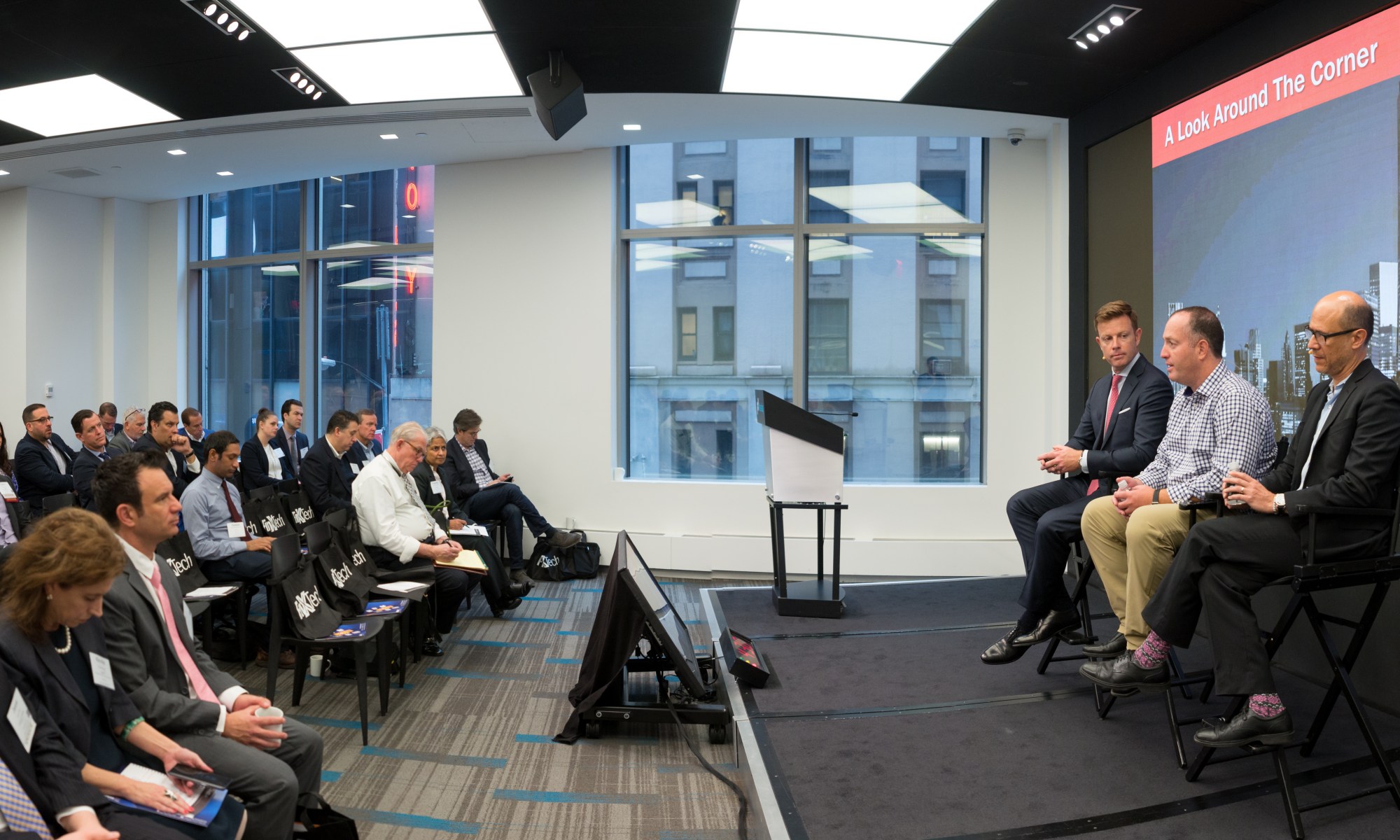
Most banks don’t have business models designed to adapt and respond to rapid change. So how should they think about innovation? I raised that question (and many others) at last Wednesday’s annual FinXTech Summit that we hosted at Nasdaq’s MarketSite. Those in attendance included banks both large and small, as well as numerous financial technology companies — all united around an interest in how technology continues to change the nature of banking.

More so than any regulatory cost or compliance burden, I sense that the organizational design and cultural expectations at many banks present a major obstacle to future growth through technology. While I am buoyed by the idea that smaller, nimble banks can compete with the largest institutions, that concept of agility is inherently foreign to most legacy players.

It doesn’t have to be.

Indeed, Richard Davis, the chairman and CEO of the fifth largest bank in the country, U.S. Bancorp, shared at our Acquire or Be Acquired Conference in Phoenix last January that banks can and should partner with fintech companies on opportunities outside of traditional banking while working together to create better products, better customer service and better recognition of customer needs.

The urgency to adapt and evolve should be evident by now. The very nature of financial services has undergone a major change in recent years, driven in part by digital transformation taking place outside banking. Most banks—big and small—boast legacy investments. They have people doing things on multi-year plans, where the DNA of the bank and culture does not empower change in truly meaningful ways. For some, it may prove far better to avoid major change and build a career on the status quo then to explore the what-if scenarios.

Here, I suggest paying attention to stories like those shared by our Editor-in-Chief Jack Milligan, who just wrote about PNC Financial Services Group in our current issue of Bank Director magazine. As his profile of Bill Demchak reveals, it is possible to be a conservative banker who wants to revolutionize how a company does business. But morphing from a low-risk bank during a time of profound change requires more than just executive courage. It takes enormous smarts to figure out how to move a large, complex organization that has always done everything one way, to one that evolves quickly.

Of course, it’s not just technological innovation where culture can be a roadblock. Indeed, culture is a long-standing impediment to a successful bank M&A deal, as any experienced banker knows. So, just as in M&A deals, I’d suggest setting a tone at the top for digital transformation.  Here are three seemingly simple questions I suggest asking in an executive team meeting:

  • Do you know what problems you’re trying to solve?
  • What areas are most important to profit and near-term growth?
  • Which customer segments are critical for your bank?

From here, it might be easy to create a strategic direction to improve efficiency and bolster growth in the years ahead. But be prepared for false starts, fruitless detours and yes, stretches of inactivity. As Fifth Third Bank CEO Greg Carmichael recently shared in an issue of Bank Director magazine, “Not every problem needs to be solved with technology… But when technology is a solution, what technology do you select? Is it cost efficient? How do you get it in as quickly as possible? You have to maintain it going forward, and hold management accountable for the business outcomes that result if the technology is deployed correctly.”

Be aware that technology companies move at a different speed, and it’s imperative that you are nimble enough to change, and change again, as marketplace demands may be different in the future. Let your team know that you are comfortable taking on certain kinds of risk and will handle them correctly. Some aspects of your business may be harmed by new technology, and you will have to make difficult trade-offs. Just as in M&A, I see this is an opportunity to engage with regulators. Seek out your primary regulator and share what you’re looking for and help regulators craft an appropriate standard for dealing with fintech companies.

Culture should not be mistaken for a destination. If you know that change is here, digital is the expectation and you’re not where you want to be, don’t ignore the cultural roadblocks. Address them.


A Technology Takeover on BankDirector.com

For the next 5 days, I set up shop in my former home of New York City for FinTech Week NYC.  Hosted by Bank Director’s FinXTech in conjunction with Empire Startups, the week can best be understood as a confluence of conferences, round-table discussions, demo days, meetups and networking events across the city.

If you’re not familiar with the various events taking place, here is a quick snapshot of three we’re primarily involved with starting today and running through Friday, the 28th.

The common thread throughout each of these days? A desire to help leaders in the financial sector to better understand how when/where/why to engage with emerging technologies.

Given our cultural mindset to help make others successful, we’re kicking things up a notch with our on-line efforts.  Indeed, we’re “taking over” BankDirector.com and loading the site up with strategic issues and ideas that a bank’s CEO, board and executive team can immediately consider.  In parallel, we’re developing even more content to benefit technology companies keen to work with financial institutions and have some really interesting things planned for our FinXTech.com.  Three examples of this free content:
  • On BankDirector.com, Tips for Working With Fintech Companies by our editor, Naomi Snyder, provides insight from executives at Wells Fargo (one of the country’s biggest) and Radius Bank (a very strong community bank) on how they handle fintech partnerships.
  • On FinXTech.com, Advice for Fintech Companies Working with Banks by our editor-in-chief, Jack Milligan, shares suggestions from SF-based Plaid Technologies and Chicago-based Akouba as to how banks and tech companies can set realistic expectations in terms of cooperating to their mutual benefits.
  • Finally, I authored a piece on a major challenge I see confronting banks when it comes to their digital futures with A Roadblock That Ruins Futures.  As an optimist, things aren’t hopeless; you will see I find inspiration from the CEOs of U.S. Bancorp, PNC and Fifth Third.

Banks Vs. Fintechs

By Al Dominick, CEO of DirectorCorps (parent co. to Bank Director & FinXTech) | @aldominick

Quickly:

  • I’m in from Dallas at the Consumer Bankers’ Association “CBA Live!”
  • Thanks to Richard Hunt, the CEO of the CBA, for inviting me to participate.  Richard spoke at our Acquire or Be Acquired conference in January + I hope to live up to his great speaking standards when I’m given a mic tomorrow.
  • The rapid pace of change in the financial sector took center stage during yesterday’s opening session.

_ _ _

Since arriving in Big D on Sunday evening, I’ve met quite a few interesting men & women from great financial institutions at this annual event for the retail banking industry.  This year, more than 1,300 are at the Gaylord Texan (with some 550 being senior-level bankers) to talk shop.  Personally, I’m looking forward to presenting on “Economic States of America” with Amy Crews Cutts (Chief Economist, Equifax), Robert Dye (Chief Economist) of Comerica Bank and Cathy Nash, the CEO of Woodforest National Bank tomorrow morning.  From credit trends to banking consolidation, if you’re in Dallas, I invite you to join us for this Super Session as we explore the economic state of our union.

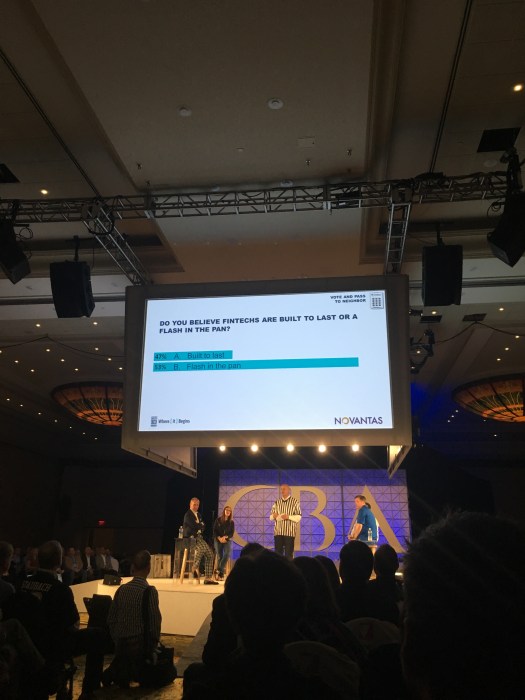
Before then, I thought to share a few interesting takeaways from a “FinTech vs. Bank” general session that pit SoFi and Kabbage “against” PNC and BBVA.  As part of the panel discussion, CBA posed a number of interesting questions to the audience; most notably, “do you believe fintechs are built to last.”  Given our upcoming FinXTech Summit in NYC, I thought the answer (which reflects the thoughts of many of the biggest banks in the U.S.) was interesting, but not surprising.

IMG_8588

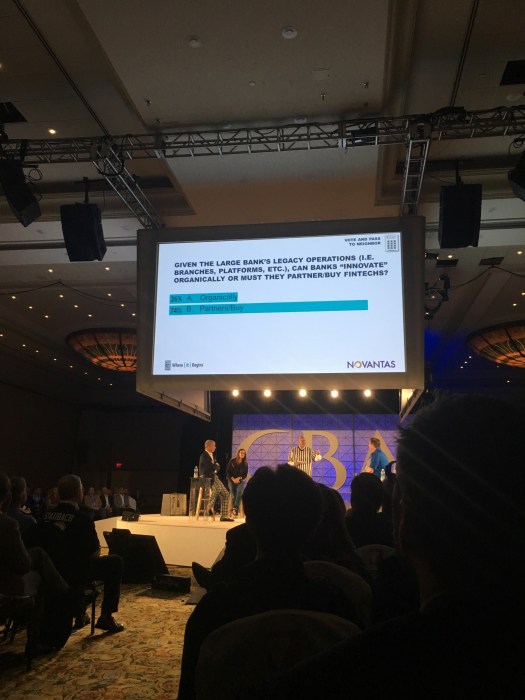
Further, I found the results of this question pretty telling (given we asked a similar question at this year’s Acquire or Be Acquired conference and received a similar response from an audience of CEOs, CFOs, and members of a bank’s board).

IMG_8586

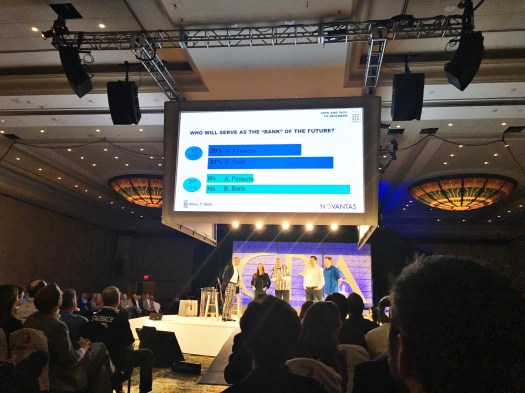
Finally, I think the results of this question best represent the types of conversations I’ve found myself in when I explain what I do + who I meet with.

FullSizeRender 106

As I’ve shared in recent posts, an increasing number of financial institutions are using partnerships with technology companies to improve operations and better meet customer needs.  Given the input on these questions from various heads of retail, product lines and product development + compliance, risk and internal audit, I feel these three pictures are worth noting — and sharing.  Agree or disagree?  Feel free to leave a comment…


“Statement”: I Am All In On IoT

By Al Dominick | @aldominick

Quickly:

  • Thanks to companies like Amazon, we are closing the gap between the physical & digital world.
  • Given our industry’s relentless pace of change, I think banks should place a big bet on figuring out how to “get involved” with the Internet of Things (IoT).
  • I am personally intrigued by the potential of car-based payments.

Getting smarter about the Internet of Things has been a focus of mine since talking with US Bancorp’s CEO, Richard Davis, in January.  He shared various areas of technological interest for the 5th-largest bank in the U.S. (e.g. biometrics & security to machine learning… distributed ledgers to digital identify). However, his take on our interconnected world and the promise of IoT really captured my attention and imagination.  Since then, I have taken much deeper dives into the world of Amazon’s Web Services, IBM’s Watson and Salesforce’s IoT Cloud.  I’ll not break any new ground for those well versed in the underlying technologies or principles with this post, but I would suggest that those in the banking world think about how connected devices might catapult their businesses forward.

IMG_8194

Take, for example, the potential of a Tesla.  Last week, I had a chance to see one of their high-end model S cars here in DC.  Spectacularly designed, I couldn’t shake the idea that the way we bank might radically change given innovations taking place at companies such as this one.  (*To be fair, I had recently read a McKinsey report that suggests a linking of the physical and digital worlds could generate up to $11.1 trillion a year in economic value by 2025).

Still, if I were running a bank today, I would immediately make a commitment to figuring out what we can do to intersect with the waves of new opportunity being created by companies like this.

I would dedicate both time and resources to figuring out how emerging technologies might enhance our institution’s insight into revenue opportunities, areas of unexpected risk and emerging customer expectations.  I’d welcome as many new ideas in now while I have the chance to consider what remains strategically possible.  Basically, I’d stick a sign on our front door with a simple word: Ambitious.

3 Examples of Next’Gen Partnerships

News & Notes from February 13 – 17
By Al Dominick, CEO of DirectorCorps (parent co. to Bank Director & FinXTech) | @aldominick

A few weeks ago, I made note of an interesting new relationship between a bank and a technology firm.  Specifically, BBVA Compass’s announcement that it has been piloting Amazon Lockers in eleven of its Austin-area branches.  This is the first time Amazon Lockers are available with a bank in the United States — and may provide a creative spark to those thinking about how to increase traffic into an existing branch network.

Since sharing my observation on this partnership, I’ve made note of a number of new relationships that reflect the changing nature of the financial industry.  This week, three things caught my eye:

In addition, I took note of Wells Fargo forming a new innovation team (called Payments, Virtual Solutions, and Innovations) to better build out its digital banking experiences.  The three pillars of this effort revolve around payments, artificial intelligence and APIs. For Wells Fargo — and banks in general:

  • Payments are a critical driver of relationships for consumer, small business, and commercial and corporate banking customers.
  • In terms of artificial intelligence, the bank sees an increasing number of opportunities to better leverage data to provide personalized customer service through its bankers and digital channels.
  • Application Programming Interfaces (APIs) technology enables commercial and corporate banking customers to integrate products, services and information into their own digital environments.

So as financial institutions continue to search for new growth opportunities, I intend to share weekly recaps like this as a way to share what I find compelling.  Let me know what you think — and if there are other news & notes I might share.

10 Banks and Fintechs Doing it Right

In advance of April’s FinXtech Summit
By Al Dominick, CEO of DirectorCorps (parent co. to Bank Director & FinXTech) | @aldominick

Quickly:

  • An increasing number of financial institutions are using partnerships with technology companies to improve operations and better meet customer needs.
  • For the past few months, banks and/or fintechs submitted case studies on specific technology solutions helping financial institutions produce real, quantifiable results to our team at FinXTech.
  • With more then 100 submissions in hand, a committee of FinXTech advisors worked with our team to compile a top-10 list during Bank Director’s Acquire or Be Acquired Conference in Arizona last week.

_ _ _

Throughout Bank Director’s annual Acquire or Be Acquired conference, I found myself in quite a few conversations about the continually changing nature of financial services. Many of these discussions revolved around the possibilities generated by traditional institutions partnering with emerging technology firms.  Some of these took place on-stage; for instance, I opened the second full day of the conference by polling an audience of 900+ on a variety of technology-related issues:

screen-shot-2017-02-08-at-5-06-44-pm

With results like these precipitating editorial coverage from our team and attendees alike, you’ll probably understand why I find the just-released ten finalists for our “Best of FinXTech Awards” so compelling.  Indeed, as the financial landscape continues to evolve, and executives grapple with a fast-changing operating environment that requires partnerships and collaboration, each of these relationships shows what is really possible when leaders explore something new together.

  • Bank of Nova Scotia (Scotiabank) + Sensibill: Scotiabank’s customers can store, organize and retrieve paper and electronic receipts through the Toronto, Canada bank’s mobile banking app and wallet, the result of a partnership with Sensibill, also based in Toronto. The service was launched in October 2016.
  • Franklin Synergy Bank + Built Technologies, Inc.: Built Technologies, in Nashville, Tennessee, improved the loan administration process for Franklin Synergy Bank, in Franklin, Tennessee. The $3 billion asset bank now manages a greater number of construction loans with fewer staff.
  • Green Dot (Go Bank) + Uber: Pasadena, California-based Green Dot Corp., which issues prepaid credit cards, partnered with Uber to provide the San Francisco transportation company’s drivers a fee-free debit card and an instant pay solution that allows drivers to be paid instantly.
  • IDFC Bank + TATA Consultancy Services (TCS): Due to a regulatory mandate, India’s IDFC Bank had just 18 months to expand into rural areas to better serve unbanked customers. The bank’s partnership with TCS, based in Mumbai, India, included the use of micro ATMs, which are modified point-of-sale terminals that expand the bank’s reach in rural areas.
  • National Bank of Kansas City + Roostify: San Francisco-based Roostify improved National Bank of Kansas City’s formerly inefficient and incomplete digital mortgage application process. Customers at the bank, based in Overland Park, Kansas with more than $600 million in assets, can now fill out a mortgage application in a little as 20 minutes, with no need for a phone call or trip to the branch to visit a loan officer.
  • Somerset Trust Company + BOLTS Technologies: BOLTS, based in Bethlehem, Pennsylvania, improved the account opening process at Somerset Trust Company, saving the $1 billion asset community bank in Somerset, Pennsylvania, roughly $200,000 in the first year by better automating the process and reducing error rates. Customers can start and complete the process on multiple channels.
  • Toronto-Dominion Bank (TD Bank) + Moven: TD Bank, based in Toronto, Canada, launched a real-time money management application in April 2016, developed by Moven in New York.
  • USAA + Nuance: USAA, based in San Antonio, Texas, made its website a little smarter in 2016 with the virtual assistant Nina, which provides support for USAA’s members. This use of artificial intelligence is the result of a collaboration with Nuance in Burlington, Massachusetts.
  • Woodforest National Bank + PrecisionLender: Partnering with Charlotte, North Carolina-based PrecisionLender to improve its loan pricing strategy helped $4.8 billion asset Woodforest National Bank, in The Woodlands, Texas, grow commercial loans by 16 percent and gain almost 20 basis points in net interest margin.
  • WSFS Bank + LendKey: WSFS Financial Corp., headquartered in Wilmington, Delaware, with $6.6 billion in assets, partnered with the lending platform LendKey, in New York, to expand the bank’s consumer loan portfolio with a student loan and refinancing product.

All ten of these partnerships demonstrate the strongest combination of collaboration and results.  For those interested, my colleague Kelsey Weaver (the President of our FinXTech platform) announces the three “winners” on April 26, 2017, during the FinXTech Annual Summit, at the Nasdaq MarketSite.

mc_030116_hires-4
Closing bell ceremony at Nasdaq / Bank Director + FinXTech’s FinTech Day (March 1, 2016)

In advance of that announcement, I invite you to follow me on Twitter via @AlDominick, FinXTech’s President, Kelsey Weaver @KelseyWeaverFXT, @BankDirector and our @Fin_X_Tech platform and/or check out where and how this annual Summit — and these awards — fits into FinTech Week New York that we are hosting along with Empire Startups starting April 24.

A Look Back at AOBA: A Week in Pictures

#AOBA17 – final conference intel
By Al Dominick, CEO of DirectorCorps (aka Bank Director and FinXTech) | @aldominick

Quickly:

  • 686 bankers comprised the 1,076 registered attendees — a figure that reflects the participation of 379 financial institutions.
  • 24 of our awesome team were on-site hosting this year’s event — all are celebrating what we affectionately refer to as “AOBA Day” by taking today off as a company holiday.

_ _ _

This has become something of a sharing tradition… a look back at a phenomenal week in Arizona.  New this year?  The welcome video we arranged to introduce our team to our guests on Sunday morning.

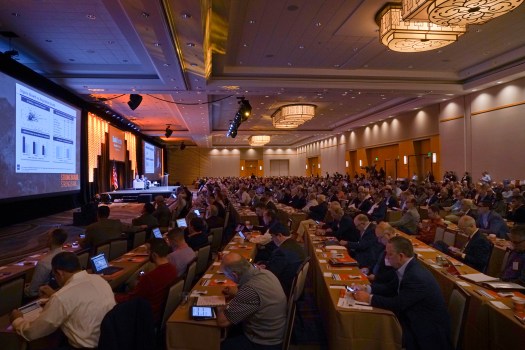
As I shared in a Sunday afternoon post (Trending at Acquire or Be Acquired), the best way to understand this event’s popularity is to look at this picture from Sunday morning at 8:16 AM (e.g. one minute after I turned the stage over to our first speaker, the CEO of KBW, Tom Michaud).  Already, we had 900+ in their seats for this 2.5 day program.  Let me say that one more time… 900+ in their seats on a sunny Sunday Arizona morning.

bank_director_temporary_number_13

So with that in mind, take a look at some of the photos shared by our on-site photographer, Keith Alstrin (Alstrin Photography).

If you’re interested in what is being discussed for the present + future by some of the industry’s most influential executives, I invite you to follow me on Twitter via @AlDominick along with @BankDirector and its @Fin_X_Tech platform.  To take a further trip back and see what was being shared with (and by) our attendees at Acquire or Be Acquired, we encouraged the use of #AOBA17.  We are excited to do this again next year and hope you’ll save the date!!

bank-slide-01


We Are On To FinTech Week

#AOBA17 conference intel (Friday)
By Al Dominick, CEO of Bank Director | @aldominick

Quickly

  • The “bank of the future” is not about technology, it is all about customers.
  • For many financial institutions, the time may be right to retire legacy systems for cloud-based platforms.
  • Numerous financial technology companies are developing new strategies, practices and products that will dramatically influence the future of banking..

_ _ _

The intersection of technological innovation with strong depository franchises may lead to more efficient banking processes, reductions in fraud and a win/win/win for banks, financial technology firms (fintechs) and consumers.  Globally, nearly $23 billion of venture capital and growth equity has been deployed to fintechs over the past five years, and this number is growing quickly. Still, the nature and extent of impact that fintechs have on the industry remains unclear.

Throughout this week’s Acquire or Be Acquired conference, bank CEOs talked about the continually changing nature of financial services — with fintech often front and center.  For many, collaboration between traditional institutions and emerging technology firms bodes well for their future.  Here, Bank Director’s FinXTech provides authoritative, relevant and trusted content to a hugely influential audience, specifically:

  • Fintechs who view banks as potentially valuable channels or distribution partners;
  • Banks looking to grow and/or innovate with fintech companies’ help and support; and
  • Institutional investors, venture capitalists, state & federal regulators, government officials and academicians helping to shape the future of banking.

We designed FinXTech as a peer-to-peer resource that connects this hugely influential audience around shared areas of interest and innovation.  As a host of FinTech Week in New York City this April 24 – 28 (along with Empire Startups), we bring together senior executives from banks, technology companies and investment firms from across the U.S. to shine a light on what is really generating top line growth and bottom line profits through partnerships, collaboration and investments.

bank-slide-05

Given the changing nature of banking today, this week-long event in New York City looks at the various issues impacting banks, non-banks and technology companies alike.  So as we move towards FinTech Week in New York City, I invite you to follow me on Twitter via @AlDominick, FinXTech’s President, Kelsey Weaver @KelseyWeaverFXT@BankDirector and our @Fin_X_Tech platform and/or check out the FinTech Week New York website for more.

A New Research Report on Marketplace Lending

#AOBA17 conference intel (Wednesday)
By Al Dominick, CEO of Bank Director | @aldominick

Quickly:

  • Lending is an estimated $15 trillion industry in the United States — and the banking industry’s share in this market is estimated to be around $6.6 trillion (~ 44% of the overall market).
  • Within the FinTech sector, lending is the largest segment in terms of funding from investors, and market altered the lending landscape.
  • Marketplace lenders — online platforms that match borrowers with lenders — will likely see some consolidation in ’17 and continue to converge with banks through partnerships, white label contracting and yes, even mergers.

_ _ _

Fintech lending has grown from $12 billion in 2014 to $23.2 billion in 2015 and is expected to reach $36.7 billion in 2016, a year-over-year growth of 93 percent and 58 percent in 2015 and 2016.  This market, according to Morgan Stanley Research, is expected to grow further and reach $122 billion by 2020.

As noted throughout our Acquire or Be Acquired conference, partnerships between a bank and a tech company can take on many forms — largely based on an institution’s available capital, risk appetite and lending goals.  With FinTech solutions gaining momentum, many advisors here have encouraged banks to look at viable alternatives to meet consumer demands, maintain and expand their lending revenue and give formidable competition to those looking to take that marketshare.

With this in mind, I invite you to take a look at a new Fintech Intelligence Report on Marketplace Lending (to download the PDF version, click: fintech-intelligence-report-lending).  The research paper, developed by Bank Director’s FinXTech platform and MEDICI, a subscription-based offering from LetsTalkPayments.com, explores current market dynamics along with technology & partnership models.  As noted in this report, the gains of new FinTech companies were widely thought to be at the expense of banks; however, many banks recognized the potential value from collaboration and built relationships with FinTechs.

##

While our Acquire or Be Acquired conference wrapped up yesterday, you can take a look back on the conversations + presentations that found their way onto Twitter via @AlDominick, the host company, @BankDirector and our @Fin_X_Tech platform, and search #AOBA17 to see what was shared with (and by) our attendees.

Inspired by U.S. Bank’s CEO at Acquire or Be Acquired

#AOBA17 conference intel (Monday/Tuesday)
By Al Dominick, CEO of Bank Director | @aldominick

Quickly

  • Most M&A activity will continue to take place among banks with assets between $1 billion and $10 billion.
  • For an acquirer, the level of underwriting for deposits can be more rigorous then underwriting for loans.  Indeed, because of BSA & AML concerns, it takes a high degree of effort to realistically measure the risk of buying “someone else’s cooking.”
  • This year’s keynote, Richard Davis, is the Chairman & CEO of U.S. Bank — which has $446 billion in assets.  FWIW, he started his career as a bank teller at Security Pacific Bank in Los Angeles on his 18th birthday.

_ _ _

Over the past decade, U.S. Bank’s consistent results made it, according to the Wall Street Journal, a darling with investors and analysts.  While impressive, their CEO’s perspectives on where we are now — and where we might be heading — inspired this short video recap.

In addition to his remarks on building a great team, his perspectives on technology struck a real chord given my background (I worked at great technology company in Bethesda, MD for 6+ years).  Specifically, his encouragement to focus on:

  • Tokenization/EMV/mobile
  • Real time payments
  • Open APIs
  • Identity management
  • Distributed ledger / blockchain
  • Internet of things (IoT)
  • Machine learning

In subsequent posts, I’ll elaborate on these issues.  But for those interested in following the conference conversations that are more M&A-oriented via our social channels, I invite you to follow me on Twitter via @AlDominick, the host company, @BankDirector and its @Fin_X_Tech platform, and search & follow #AOBA17 to see what is being shared with (and by) our attendees.

Opportunities Abound at Acquire or Be Acquired

#AOBA17 conference intel (Monday)
By Al Dominick, CEO of Bank Director | @aldominick

Quickly

  • Earnings pressures, regulatory/compliance costs + the impact of technology will continue to make it more difficult for banks to compete and be profitable, which will continue to generate consolidation.
  • The increase in stock prices and capital raising activity is likely to provide an additional catalyst for M&A in early 2017
  • Raising capital is an immediate and viable option for most banks today

_ _ _

Here at Bank Director’s annual Acquire or Be Acquired conference, it is clear that to maximize shareholder value, a bank’s leadership must not only plan for the future but also take advantage of today’s opportunities.

For those interested in following the conference conversations via social channels, I invite you to follow me on Twitter via @AlDominick, the host company, @BankDirector and its @Fin_X_Tech platform, and search & follow #AOBA17 to see what is being shared with (and by) our attendees.

3 Things to Know from Day 1 at Acquire or Be Acquired

#AOBA17 conference intel (Sunday/Monday)
By Al Dominick, CEO of Bank Director | @aldominick

Quickly

  • New competitors and innovations are continually changing the business of financial services.
  • The continued shift towards technology, data, algorithms and smart analytics impacts how value and profit are created.
  • In the last 10 years, this is the best time for banks to access the capital markets.

_ _ _

The possibility of less regulation and a change in corporate tax policy have quite a few attendees feeling bullish on the immediate future of community banking.  Below, I share why I am so optimistic about the state of banking in 2017.

For those interested in following the conference conversations via social channels, I invite you to follow me on Twitter via @AlDominick, the host company, @BankDirector and its @Fin_X_Tech platform, and search & follow #AOBA17 to see what is being shared with (and by) our attendees.  To see what I’ve already shared from this year’s conference, check out my Saturday outlook and yesterday’s mid-day recap.