The Intersection of Leadership and Profitability

By Al Dominick, CEO of DirectorCorps — parent co. to Bank Director & FinXTech

Quickly

  • Key takeaways from one of my favorite summer banking events, Crowe Horwath’s Bank Leadership and Profitability Improvement Conference.

_ _ _

This morning, on the first of my two flights from Washington National to Monterey, California, I learned that Walmart customers might soon be able to get installment loans for big-ticket items through Affirm, a San Francisco-based FinTech I first wrote about in 2014 (For Banks, the Sky IS Falling).  Per the Wall Street Journal, the companies reportedly are nearing an agreement on a pilot program.  This potential partnership caught my eye as I prepared for today and tomorrow’s conference.  Indeed, relationships like these make clear that when it comes to growth and efficiency, the digital distribution of financial goods and services is a significant issue for the banking industry.

This idea took further shape when I walked into the conference center at the Inn at Spanish Bay.  Immediately upon entering the room, I found John Epperson, a partner at Crowe and Jay Tuli, senior vice president retail banking and residential lending at Leader Bank, sharing their opinions on partnership strategies involving banks and FinTechs.  From the stage, they touched on increasing net interest margins via improved pricing strategies on commercial loans, approaches to streamline mortgage application processes, ideas to reduce staff counts for loan administration processes and how to improve customer experiences through online rent payment solutions.

Their perspectives lined up with those we recently shared on BankDirector.com.  To wit, “many banks have realized advantages of bank-FinTech partnerships, including access to assets and customers.  Since most community banks serve discreet markets, even a relatively simple loan purchase arrangement can unlock new customer relationships and diversify geographic concentrations of credit.  Further, a FinTech partnership can help a bank serve its legacy customers; for instance, by enabling the bank to offer small dollar loans to commercial customers that the bank might not otherwise be able to efficiently originate on its own.”

Of all the difficult issues that bank leadership must deal with, I am inclined to place technology at the top of the list.  Banks have long been reliant on technology to run their operations, but in recent years, technology has become a primary driver of retail and small business banking strategy.  John and Jay simply reinforced this belief.

In addition to their thoughts on collaboration, this afternoon’s sessions focused on ‘Liquidity and Balance Sheet Management,’ ‘Fiscal Policy During Regulatory Uncertainty’ and ‘Managing Your Brand in a Digital World.’  While I took note of a number of issues, three points really stood out:

  • Yes, banks can make money while managing decreasing margins and a flat yield curve.
  • Asset growth without earnings growth is a concern for many because of loan pricing.
  • How a CFO sets a target(s) for interest rate risk may start with an “it depends” type response — but gets nuanced quickly thereafter.

Finally, I’m not holding my breath on the industry receiving regulatory relief any time soon.  I get the sense many here aren’t either.  But it would be nice to see some business people brought in to run various agencies and I’m looking forward to the perspectives of tomorrow’s first guest speaker, Congressman John Ratcliffe.

##

My thanks to Crowe Horwath, Stifel, Keefe Bruyette & Woods + Luse Gorman for putting together this year’s Bank Leadership and Profitability Improvement Conference at The Inn at Spanish Bay in Pebble Beach, California.  I’ll check in with additional takeaways based on tomorrow’s presentations.

Looking for Inspiration? Look to USAA

Quickly:

  • Next week, my team hosts 350+ leaders from across the United States at Bank Director’s annual Bank Audit & Risk Committees Conference at the JW Marriott Chicago.
  • In advance of welcoming people to this popular event, it strikes me that the business of banking remains difficult despite improving economic conditions; indeed, the drive to digitize a bank’s operations continues to pose significant challenges to most.
  • Digital is, in my estimation, a CEO topic that requires a healthy dose of creativity and ambition.  As such, I’m sharing the following article on innovation — authored by John Maxwell and featured in Bank Director magazine’s current “Great Ideas” digital issue.  It focuses on how USAA taps the creative side of its employees to pre-position itself for the next new products, tools and technologies to benefit its diverse customer base.

USAA - ASD

“USAA was the first major financial institution to allow customers to deposit physical checks by taking a picture of them on their smartphones, rolling out the service in August 2009. It wasn’t until months later that Bank of America Corp., the nation’s second biggest bank by assets, said it would test the same functionality, by which point upward of 40,000 USAA members had already used the software to deposit more than 100,000 checks. And it wasn’t until the following year that JPMorgan Chase & Co., the nation’s biggest bank by assets, followed suit.

This was neither the first nor the last time that USAA, a niche player in the financial services industry serving current and former members of the military and their families, had beaten larger rivals to the punch in introducing a big, transformative idea. In 2015, the $78 billion asset company became the first major U.S. financial institution to roll out facial and voice recognition technology that allows members to log in to its mobile app without entering a password.

What is it about USAA that explains how it’s regularly at the forefront of big ideas? Is it serendipity, or is there something more at play? And if it’s the latter, are there aspects of USAA’s approach that can be replicated by other banks that want to accelerate their own internal innovation engines?

One explanation for USAA’s success is that the company has always had to think creatively about distribution because of its dispersed member base. With members stationed at military installations around the world, some in active combat zones, simply building more branches has never been a viable distribution strategy. It has a single bank branch at its headquarters in San Antonio, and it wasn’t until 2009 that it began opening a small collection of financial centers near domestic military bases—there are 17 of these centers currently. This is why USAA so readily embraced mobile banking, which enables its members to access their accounts irrespective of location.

Yet, chalking up USAA’s accomplishments in the sphere of innovation to the idea that “necessity is the mother of all invention” doesn’t do the story justice. More than any other major company in the financial services space, USAA has made it a priority to harness each of its 30,000 employees in order to stay on the cutting edge. It began doing so in earnest in 2010 by launching a so-called ideas platform on the company’s intranet. Anyone from the CEO to frontline personnel to security guards can post and vote on ideas that have been entered on the platform. Between 10,000 and 11,000 ideas were submitted in each of the last two years. Ideas that get at least 1,000 favorable employee votes are escalated to USAA’s in-house innovation team overseen by Zack Gipson, USAA’s chief innovation officer.  Last year, 1,206 employee ideas were implemented, while 189 of them have come to fruition thus far in 2017.

USAA also hosts events and challenges for employees that are designed to elicit ideas for new or improved products and services. There are 28 such activities planned this year, taking the form of multi-week coding and design challenges as well as single-day hackathons where teams are tasked with solving a specific problem, says Lea Sims, assistant vice president of employee and member innovation. At an event in 2015, USAA happened upon the idea for voice-guided remote deposit capture, which uses voice commands to guide visually impaired members through the process of depositing checks on a mobile device. The service went live in July of 2016.

On top of these specific initiatives, USAA uses incentives and a consistent messaging campaign to encourage employees to brainstorm and share innovative ideas. Rewards are handed out to winners of challenges, as well as to any employee behind an idea that gets 1,000 votes on the ideas platform—an additional reward is meted out if the idea is implemented, explains Sims. These rewards come in the form of company scrip, which can be redeemed for actual products. A total of 94 percent of USAA employees have participated one way or another in its various innovation channels, with three quarters of a million votes submitted on its internal ideas platform in 2016 alone. “We put a premium on innovation,” says Sims. “It starts in new employee orientation as soon as you walk in the door to be part of our culture.”

USAA has taken steps to crowdsource ideas from its 12 million members, or customers, as well. In February it introduced USAA Labs, where members can sign up to share innovative ideas and participate in pilot programs of experimental products. “The goal of our membership channel is, quite frankly, to replicate the success of our employee channel,” says Sims. Thus far, over 770 members have signed onto the program, which is still in its early stages but could become a major part of USAA’s innovation channel in the future.

Last but not least, sitting atop USAA’s employee and member-based innovation channels is a team of 150 employees who focus solely on bringing new ideas to life. This is its strategic innovation group, which executes on crowdsourced ideas but spends most of its time brainstorming and implementing large, disruptive concepts such as remote deposit capture and biometric logins. It’s this final component of USAA’s strategy that adheres most closely to the institutional structure articulated by Harvard professor Clayton Christensen, a leading expert on the process of innovation. In his seminal book, The Innovator’s Dilemma, Christensen makes the case that established firms should vest the responsibility to bring ideas to life in organizationally independent groups. This is especially important when it comes to disruptive ideas that threaten to cannibalize other products and services sold by the firm, not unlike the way that remote deposit capture reduces the need for physical branches.

In short, the reason USAA has consistently been at the forefront of innovation in the financial services industry has next to nothing to do with serendipity. It traces instead to the company’s strategy of engaging all of its stakeholders in the idea generation process, harnessing the creative power of 30,000 employees, 12 million members and a select team of internal innovators who focus on nothing but bringing new ideas to life. It’s this structural approach to innovation, and the focus on employee engagement in particular, that offers a valuable model for other banks to follow. Indeed, out of the many big ideas USAA has introduced over the years, its strategy of crowdsourcing innovation may very well be the biggest.”

*John J. Maxfield is a writer and frequent contributor to Bank Director.  To read more of this month’s issue (for free), click here.  In full disclosure, I’m a loyal USAA member — as is my entire family — tracing back to my father’s days at the Naval Academy.  I can attest to the “awesomeness” of the bank’s various mobile offerings — like facial recognition, remote check deposit, the integration of Coinbase (that lets me see the balance of my bitcoin and ethereum balances alongside my checking and savings accounts), etc.

“Statement”: I Am All In On IoT

By Al Dominick | @aldominick

Quickly:

  • Thanks to companies like Amazon, we are closing the gap between the physical & digital world.
  • Given our industry’s relentless pace of change, I think banks should place a big bet on figuring out how to “get involved” with the Internet of Things (IoT).
  • I am personally intrigued by the potential of car-based payments.

Getting smarter about the Internet of Things has been a focus of mine since talking with US Bancorp’s CEO, Richard Davis, in January.  He shared various areas of technological interest for the 5th-largest bank in the U.S. (e.g. biometrics & security to machine learning… distributed ledgers to digital identify). However, his take on our interconnected world and the promise of IoT really captured my attention and imagination.  Since then, I have taken much deeper dives into the world of Amazon’s Web Services, IBM’s Watson and Salesforce’s IoT Cloud.  I’ll not break any new ground for those well versed in the underlying technologies or principles with this post, but I would suggest that those in the banking world think about how connected devices might catapult their businesses forward.

IMG_8194

Take, for example, the potential of a Tesla.  Last week, I had a chance to see one of their high-end model S cars here in DC.  Spectacularly designed, I couldn’t shake the idea that the way we bank might radically change given innovations taking place at companies such as this one.  (*To be fair, I had recently read a McKinsey report that suggests a linking of the physical and digital worlds could generate up to $11.1 trillion a year in economic value by 2025).

Still, if I were running a bank today, I would immediately make a commitment to figuring out what we can do to intersect with the waves of new opportunity being created by companies like this.

I would dedicate both time and resources to figuring out how emerging technologies might enhance our institution’s insight into revenue opportunities, areas of unexpected risk and emerging customer expectations.  I’d welcome as many new ideas in now while I have the chance to consider what remains strategically possible.  Basically, I’d stick a sign on our front door with a simple word: Ambitious.

We Are On To FinTech Week

#AOBA17 conference intel (Friday)
By Al Dominick, CEO of Bank Director | @aldominick

Quickly

  • The “bank of the future” is not about technology, it is all about customers.
  • For many financial institutions, the time may be right to retire legacy systems for cloud-based platforms.
  • Numerous financial technology companies are developing new strategies, practices and products that will dramatically influence the future of banking..

_ _ _

The intersection of technological innovation with strong depository franchises may lead to more efficient banking processes, reductions in fraud and a win/win/win for banks, financial technology firms (fintechs) and consumers.  Globally, nearly $23 billion of venture capital and growth equity has been deployed to fintechs over the past five years, and this number is growing quickly. Still, the nature and extent of impact that fintechs have on the industry remains unclear.

Throughout this week’s Acquire or Be Acquired conference, bank CEOs talked about the continually changing nature of financial services — with fintech often front and center.  For many, collaboration between traditional institutions and emerging technology firms bodes well for their future.  Here, Bank Director’s FinXTech provides authoritative, relevant and trusted content to a hugely influential audience, specifically:

  • Fintechs who view banks as potentially valuable channels or distribution partners;
  • Banks looking to grow and/or innovate with fintech companies’ help and support; and
  • Institutional investors, venture capitalists, state & federal regulators, government officials and academicians helping to shape the future of banking.

We designed FinXTech as a peer-to-peer resource that connects this hugely influential audience around shared areas of interest and innovation.  As a host of FinTech Week in New York City this April 24 – 28 (along with Empire Startups), we bring together senior executives from banks, technology companies and investment firms from across the U.S. to shine a light on what is really generating top line growth and bottom line profits through partnerships, collaboration and investments.

bank-slide-05

Given the changing nature of banking today, this week-long event in New York City looks at the various issues impacting banks, non-banks and technology companies alike.  So as we move towards FinTech Week in New York City, I invite you to follow me on Twitter via @AlDominick, FinXTech’s President, Kelsey Weaver @KelseyWeaverFXT@BankDirector and our @Fin_X_Tech platform and/or check out the FinTech Week New York website for more.

Whether They Want To or Not, Banks Need to Open Up

Apart from interest rates, the two biggest issues that bank executives seem to wrestle with are regulatory and compliance costs.  I sense another emerging challenge coming to shore; specifically, how to “open up” one’s business structure in terms of developing partnerships and permitting others to leverage their customer data and/or capabilities.

For bankers, this challenge comes with significant reputation and customer risk.

Now, it is hard to truly disrupt the concept of banking — and I shared this opinion from the stage at Bank Director’s annual Bank Executive & Board Compensation Conference this morning.  However, I did adjust some of my welcoming remarks based on the Consumer Finance Protection Bureau’s position that consumers can control their own financial data, including to let third parties help them manage their finances.  As I learned from Jo Ann Barefoot’s Fireside Chat with CFPB Director Richard Cordray at Money 2020, the CFPB “is not content to sit passively by as mere spectators watching these technologies develop.”  According to his prepared remarks:

Many exciting products we see… depend on consumers permitting companies to access their financial data from financial providers with whom the consumer does business. We recognize that such access can raise various issues, but we are gravely concerned by reports that some financial institutions are looking for ways to limit, or even shut off, access to financial data rather than exploring ways to make sure that such access, once granted, is safe and secure.

Since reading the CFPB’s position, Ms. Barefoot’s recap and the Wall Street Journal’s synopsis, I decided to talk with various bank executives and board members that are here with us at the Ritz-Carlton in Amelia Island about this stance.  As I note in this video, I sense both an ongoing struggle — and a sincere interest — to truly understand the role of technology.  For those I talked with, this is as much about “becoming sticky” to their customers as it is about embracing or defending themselves against “the new.”

##

For more about this year’s conference, I invite you to take a look at BankDirector.com.  Also, a virtual high-five to the team here for a great first day.  You all rock!

_mg_0113

Evaluating Board Performance

New regulations, technological innovations and a highly competitive environment that leaves little room for error have placed unprecedented demands on the time and talents of bank boards and their individual directors.  As many who support the banking space can attest, a strong board begins with a set of enlightened governance policies and procedures that center on honesty, personal integrity and accountability.

At Bank Director, we coined the phrase “strong board, strong bank” in response to the mounting pressures placed on the banking community.  Over the years, we have introduced new research projects, conferences and magazine issues to provide exceptionally timely and relevant information to a hugely influential audience.

As I prepare to head down to Florida (and the Ritz-Carlton, Amelia Island) this weekend for our annual Bank Executive & Board Compensation conference, I am anticipating conversations about potential regulatory changes and current strategic challenges related to a bank’s growth and profitability.  Alongside my colleagues Michelle King and Amanda Wages, I also expect to field questions from the audience (depicted in the image above) about how high performing corporate boards employ evaluation tools that match the talents & experiences of their board members to an organization’s strategic goals.  FWIW, I anticipate such inquiries as many consultants and attorneys encourage such assessments — and the board performance self-evaluation tool we designed & offer to banks has earned a strong reputation for providing an independent review of a board’s effectiveness.

To be sure, the banking industry seems to be doing well based on a variety of measures — profitability is high, credit quality is much improved and tangible capital ratios are stronger than ever. However, such financial measures don’t necessarily reflect the challenges facing many banks and their boards.  So in advance of our annual event, I asked our research team to roll up the results from twenty-two bank boards — all randomly selected — that completed a performance survey this year.

While tempting to look at individual board results and draw conclusions, anonymously lumping this group together allows some interesting patterns to emerge given more then 200 individual responses:

  • 50% recognize a need for more diversity on the board;
  • 55% say they need more expertise/knowledge in technology on the board, and 44% indicate a need for more training on IT issues;
  • 51% are dissatisfied with some aspect of the bank’s succession plan, for the CEO and/or the board; and
  • 56% are certain they have the M&A experience to meet the bank’s growth goals (44% say no or are unsure).

While these four points caught my eye, I asked our Director of Research, Emily McCormick, what stands out to her. In her words:

“Many boards lack a consensus on their succession plan, meaning that they’re often not on the same page regarding the depth of that plan. That, to me, is a red flag.”

Anecdotally, many bank CEOs — and board members — that I’ve talked with in person know they need new skills, particularly in technology, and recognize a need for diversity. But as we find, few want to add additional board members.  A fact to keep in mind next week as we explore how to build and support the best teams based on the strategies and tactics being used by successful companies today.

##

We designed our Bank Service offerings to help board members and senior executives develop strategies to help their bank grow, while demonstrating excellence in corporate governance that shareholders and customers deserve and today’s regulators demand.  To learn more, click here.

Without A Destination, What Good Is A Map?

Highlight: as executives grapple with a fast-changing operating environment that requires partnerships and collaboration, many wrestle with where they want to be vs. where they need to be.

In this video, I share my thoughts on growing through partnerships (between traditional banks and financial technology firms), becoming “data richer” and enhancing the customer experience you’re delivering.

FWIW, this video lives on FinXTech.com, a site designed to provide authoritative, relevant and trusted content to a hugely influential audience, specifically:

  • Fintech companies who view banks as potentially valuable channels or distribution partners;
  • Banks looking to grow and/or innovate with fintech companies’ help and support; and
  • Institutional investors, venture capitalists, state & federal regulators, government officials and academicians helping to shape the future of banking.

As a platform powered by Bank Director, FinXTech connects this hugely influential audience around shared areas of interest and innovation.  FinXTech specializes in (1) bringing valuable bank relationships to fintechs, and (2) offering banks valuable relationships with fintechs in a way no one else does.

Bank Director’s annual Tech Issue is now available for free

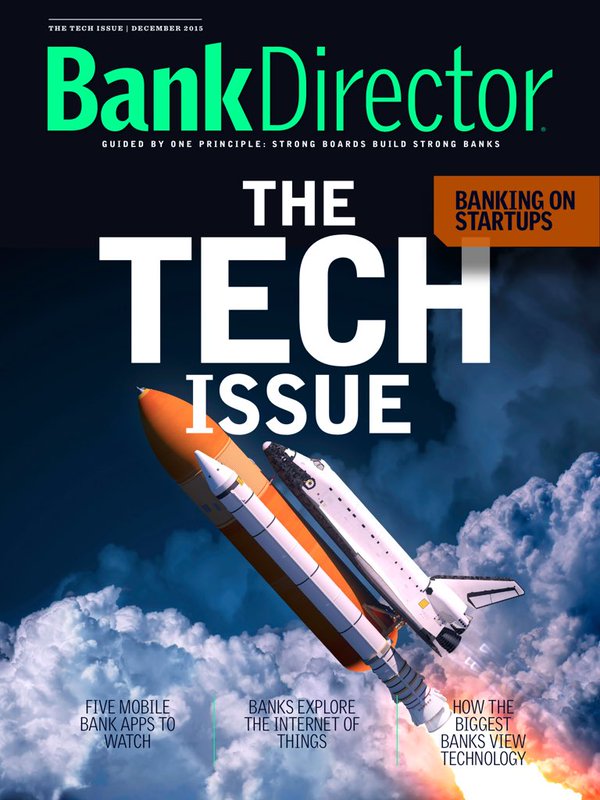
Take a look at Bank Director’s just-published “Tech Issue.” In it, we look at how bank CEOs and executive teams can better engage with fintech companies, what the biggest banks are doing in terms of technology strategy and what the Internet of Things (IoT) means for financial institutions in 2016.

To download this free issue:

  1. On Your Tablet or Mobile Device, Select Apple’s AppStore, Google Play or Amazon’s Apps;
  2. Search “Bank Director Digital Magazine;” and
  3. Download the App to Your Digital Device & Enjoy.

Happy Holidays!

How We Are Taking a Lean Startup Approach to our Grown-up Business

A lean startup methodology enables entrepreneurs to efficiently build a company by searching for product and/or market fit rather than blindly trying to execute.  I find it helps mature companies too — and thought the perspectives of Stanford Professor Steve Blank, Silicon Valley entrepreneur Ben Horowitz and Y Combinator’s Sam Altman might resonate with bankers, fintech companies and other small business CEOs that are thinking about how to adapt their businesses to new challenges and opportunities. 

Paying It Forward

By Al Dominick // @aldominick

As someone who long aspired to build and run a company, I take great pride in leading a profitable, privately-held, twenty-person-strong small business.  In the past, I have written about my “people > products > performance” approach to leading the Bank Director team.  So when Ben Horowitz (co-founder and Partner of the venture capital firm Andreessen Horowitz) shares on his blog, “it’s not about how smart you are or how well you know your business; it’s about how that translates to the team’s performance and output,” I find myself nodding in total agreement.

Look, I am so very proud of our team’s accomplishments… but I am even more excited to adapt the lean startup methodology to scale our business.  The approach we are taking builds on the wisdom and experience of others. So for anyone responsible for growing their business, allow me to recommend two “must reads:”

For me, we are “all-in” in terms of taking a lean startup approach to expanding our business without compromising our reputation for going narrow & deep, providing a “Four Seasons” level of experience at our events and delivering outstanding ideas and insights to a hugely influential audience.  In addition, we are supremely mindful to do as Sam Altman says.  That is, create something that a small number of people love rather than a product that a large number of people simply like.

H1: The Core Business

Admittedly, I am hesitant to call our approach to growing Bank Director a bootstrapping effort since the brand, relationships and revenue being generated enable us certain luxuries that many start-ups simply do not have.  Nonetheless, let me show you how we adapted the Horizon 1 (H1) and Horizon 3 (H3) framework depicted above to our business.

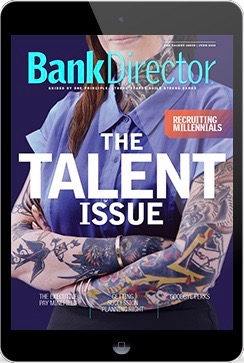
What began in 1991 as a traditional publishing company now operates as a privately-held media enterprise delivering original content to CEOs, executives and board members of financial services companies via digital platforms, exclusive conferences and award-winning publications.  Below is a visual example of our transformation vis-a-vis three magazine covers.  As you can see, we have matured in style while expanding our frequency (from quarterly to monthly) as we expanded our distribution channels.

Going narrow and deep works for us since we generate our revenue from the annual conferences & events we host (e.g. our 800+ person Acquire or Be Acquired conference), publications and research we publish and education & training services we provide.

H3: Where the Wild Ideas Live

With three consecutive years of top line growth (and healthy bottom line results to boot), we are in the wonderful position to grow in some pretty cool ways.  But doing so will take more than simple process improvements and expense control.  As we have a strong business foundation in place, I did have to restructure my management team’s individual roles and responsibilities to better suit our H1/H3 setup.  I did so because as Steve Blank points out, “Horizon 3 is where companies put their crazy entrepreneurs… these innovators want to create new and potentially disruptive business models.” As fun as living/working in H3 sounds, let me emphasize how much I rely on the H1 team to “defend, extend and increase” our core business.

Is it working?  Well, we will formally announce a new venture, FinXTech, on March 1, 2016 at Nasdaq’s MarketSite in New York City.  This is the first — and surely not last — project to emerge from our H3 world.  But time will ultimately tell.

We are a collection of creative men and women and I am very optimistic about our future.  Realizing that we want to continuously push to grow and innovate led me to appreciate “the need to execute (to the) core business model while innovating in parallel.”  So today’s post isn’t an attempt to make me look smart; rather, my attempt to acknowledge the inspiration of others and share what’s working for us.

5 Fintechs I’m Keen On

My first post in 2015 focused on three “up & coming” fintech companies: Wealthfront (an automated investment service), Kabbage (an online business loan provider) and Dwolla (a major player in real-time payment processing).  Since writing that piece, I’ve kept tabs on their successes while learning about other interesting and compelling businesses in the financial community.  So today, five more that I am keen on.

By Al Dominick // @aldominick

With continuous pressure to innovate, I’m not surprised to see traditional financial institutions learning from new challengers, adapting their offerings and identifying opportunities to collaborate with emerging players.  From tokenization to integrated payments, security tools to alternative lending platforms, the investments (and efforts) being made throughout the financial sector continues to impress and amaze me.  As I shared in 15 Banks and Fintechs Doing it Right, there are very real and immediate opportunities to expand what banking means to individual and business customers.  Personally, I am excited by the work being done by quite a few companies and what follows are five businesses I’ve learned more about while recently traveling between D.C., San Francisco and New York City:

logo

i2c, a global card processing company, provides back-end processing and settlement for cards, virtual accounts and mobile payments.  What’s interesting about them? According to a brief shared by Bridge by Deloitte (a web platform connecting enterprises with startups to accelerate innovation and growth), i2c recently teamed up with Oxfam, Visa and Philippines-based UnionBank to channel funds to people in disaster-affected communities through prepaid cards.

adyen-logo

With Money20/20 fast approaching, expect to see a lot of #payments trending on twitter.  Trending in terms of financial investment: Adyen, a company receiving a lot of attention for wrapping up a huge round of funding that values the payment service provider at $2.3B.  Adyen, which provides its services to a number of large organizations including Facebook and Netflix, excels in having a highly integrated platform, unlike others with multiple platforms.

Blend labs

When it comes to technology “powering the new wave of mortgage lending,” take a look at the work being done at BlendLabs.  Developing software & data applications for mortgage lenders, the company acknowledges that “accommodating complex rules and regulation changes is time-consuming and costly.” For this reason, the company has quietly rolled out technology that empowers some of the country’s largest lenders to originate mortgages more efficiently and compliantly than ever before while offering their borrowers a more compelling user experience.

logo

As the head of a company, I know first-hand how much time and effort is spent on efforts and ideas designed to maximize revenue and profits.  So the promise and premise of nCino is hugely attractive.  Co-founded by a fellow W&L grad (and the former CEO of S1) nCino is the leader in cloud banking.  With banks like Enterprise in St. Louis (lead by a CEO that I have huge respect for) as customers, take a look at their Bank Operating System, a comprehensive, fully-integrated banking management system that was created by bankers for bankers that sits alongside a bank’s core operating system.

logo

While not solely focused on the financial industry, Narrative Science is a leader in advanced natural language generation.  Serving customers in a number of industries, including marketing services, education, financial services and government, their relationship with USAA and MasterCard caught my eye.  As FinXTech’s Chief Visionary Officer recently shared with me, the Chicago-based enterprise software company created artificial intelligence that mines data for important information and transforms it into language for written reports.

##

In addition to these U.S.-based companies, you might look at how Fidor, a digital bank in Europe that offers all-electronic consumer banking services, links interest rates to Facebook likes and give cash rewards based on customers’ level of interaction with the bank (e.g. how many customer financial questions answered).  Clearly, the fabric of the financial industry continues to evolve as new technology players emerge, institutions like Fidor expand their footprint and traditional participants transform their business models.  So if you follow me on twitter (@aldominick), let me know of other fintech companies you’re impressed by these days.