What To Do With FinTech

For the 699 financial institutions over $1Bn in asset size today, the drive to improve one’s efficiency ratio is a commonly shared goal.  In my mind, so too should be developing relationships with “friendly” financial technology (FinTech) companies.

By Al Dominick // @aldominick

Small banks in the United States — namely, the 5,705 institutions under $1Bn in assets* — are shrinking in relevance despite their important role in local economies.  At last week’s Bank Audit & Risk Committees Conference in Chicago, Steve Hovde, the CEO of the Hovde Group, cautioned some 260 bankers that the risks facing community banks continue to grow by the day, citing:

  • The rapid adoption of costly technologies at bigger banks;
  • Declining fee revenue opportunities;
  • Competition from credit unions and non-traditional financial services companies;
  • Capital (in the sense that larger banks have more access to it);
  • An ever-growing regulatory burden; and
  • The vulnerability all have when it comes to cyber crime.

While many community banks focus on survival, new FinTech companies have captured both consumer interest and investor confidence.  While some of the largest and most established financial institutions have struck relationships with various technology startups, it occurs to me that there are approximately 650 more banks poised to act — be it by taking the fight back to competitive Fintech companies or collaborating with the friendly ones.

According to John Depman, national leader for KPMG’s regional and community banking practice, “it is critical for community banks to change their focus and to look for new methods, products and services to reach new customer segments to drive growth.”  I agree with John, and approach the intersection of the financial technology companies with traditional institutions in the following manner:

For a bank CEO and his/her executive team, knowing who’s a friend, and who’s a potential foe — regardless of size — is hugely important.  It is also quite challenging when, as this article in Forbes shows, you consider that FinTech companies are easing payment processes, reducing fraud, saving users money, promoting financial planning and ultimately moving our giant industry forward.

This is a two-sided market in the sense that for a FinTech founder and executive team, identifying those banks open to partnering with, investing in, or acquiring emerging technology companies also presents great challenges, and also real upside.  As unregulated competition heats up, bank CEOs and their leadership teams continue to seek ways to not just stay relevant but to stand out.  In my opinion, working together benefits both established organizations and those startups trying to navigate the various barriers to enter this highly regulated albeit potentially lucrative industry.

*As of 6/1, the total number of FDIC-insured Institutions equaled 6,404. Within this universe, banks with assets greater than $1Bn totaled 699. Specifically, there are 115 banks with $10Bn+, 76 with $5Bn-$10Bn and 508 with $1Bn – $5Bn.

Reaching For The Summit

When you say the word summit, what do you think of?  For me, it is a book; specifically, Let My People Go Surfing by Patagonia’s founder, Yvon Chouinard. I was reminded of Yvon’s thoughts while flying home to DC from last week’s Bank Board Growth & Innovation conference in New Orleans.  While there, I had a chance to share time and ideas with some 150 bank CEOs, board members and executives. As most banks wrestle with the concept of banking a generation that doesn’t necessarily see the need for a bank, I think Yvon’s opinion that “how you climb a mountain is more important than reaching the top” is a strong reminder for bankers that the little things really do count with customers today.

By Al Dominick // @aldominick

Having been on numerous airplanes over the last few weeks, I have enjoyed the luxury of time without phone calls and sometimes emails and instant messages.  This digital solitude afforded me a chance to really dive into a number of thought-provoking white papers, analyst reports and research pieces.  Three, in particular, stand out, for looking ahead to what banking might become, not merely stating the obvious that bankers are being challenged as never before.

The World Retail Banking Report (from Capgemini Financial Services and Efma)

Abstract: Retail banking customers today have more choices than ever before in terms of where, when, and how they bank—making it critical for financial institutions to present options that appeal directly to their customers’ desires and expectations.

Growing the Digital Business / Accenture Mobility Research 2015 (from Accenture)

Abstract: The emergence and adoption of digital technologies has rapidly transformed businesses and industries around the globe. Mobile technologies have been especially impactful, as they have enabled companies to not only streamline their operations, but also engage more effectively with customers and tap into new sources of revenue.

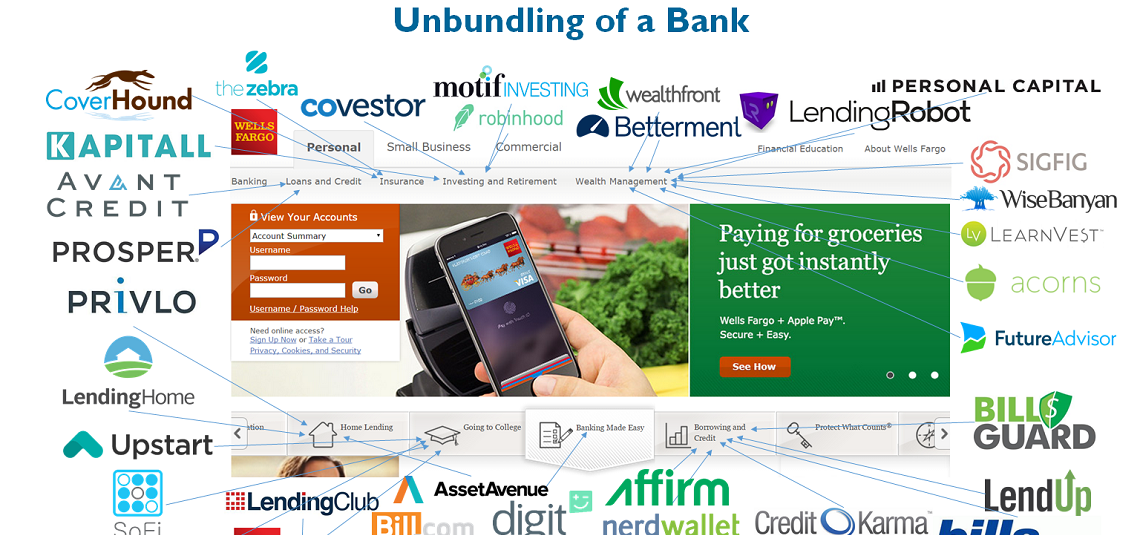
Disrupting Banking: The FinTech Startups That Are Unbundling Wells Fargo, Citi and Bank of America (from CB Insights)

Abstract: Banks run the risk of being out-innovated and may lose their edge not because of their incumbent, large competitors, but because emerging startups inflict upon them a death by a thousand cuts.  And because a picture is worth more than 1,000 words:

source: CB Insights
source: CB Insights

##

Finally, a welcome to our friends at KBW who just hopped into the Twitter pool yesterday. With so many talented men and women working there, I have no qualms suggesting a follow of their handle – @KBWfinthink (h/t to our Emily McCormick for the heads up)

Three Observations from the Bank Board Growth & Innovation Conference

Select news and notes from the first day of Bank Director’s annual growth conference at the Ritz-Carlton New Orleans.

By Al Dominick // @aldominick

I mentioned this from the stage earlier today… every January, Bank Director hosts a huge event in Arizona focused on bank mergers and acquisitions.  Known as “AOBA,” our Acquire or Be Acquired conference has grown significantly over the years (this year, we welcomed some 800 to the desert).  After the banking M&A market tumbled to a 20-year low in 2009 of just 109 transactions, it has gradually recovered from the effects of the crisis. In fact, there were 288 bank and thrift deals last year, which was a considerable improvement on volume of 224 deals in 2013.  As our editorial team has noted, the buying and selling of banks has been the industry’s great game for the last couple of decades, but it’s a game that not all banks can — or want to — play.  Indeed, many bank CEOs have a preference to grow organically, and its to these growth efforts that we base today and tomorrow’s program.

Key Takeaway

To kick things off, we invited Fred Cannon, Executive Vice President & Director of Research at KBW, to share his thoughts on what constitutes franchise value. While he opened with a straight-forward equation to quantify franchise value over time — (ROE – Cost of Equity) × Market Premium — what really stuck with me during his presentation is the fact that a logo does not create franchise value, a brand does.  As he made clear, it is contextual (e.g. by industry’s served, technologies leveraged and clients maintained) and requires focus (e.g. you can’t be all things to all people).  Most notably, small and focused institutions trump small and complex ones.

Trending Topics

Anecdotally, the issues I took note of where, in no particular order:

  • Banks must be selective when integrating new technology into their systems.
  • The ability to analyze data proves fundamental to one’s ability to innovate.
  • When it comes to “data-driven decisions,” the proverbial life cycle can be thought of as (1) capture (2) store (3) analyze (4) act.
  • You don’t need a big deposit franchise to be a strong performing bank (for example, take a look at County Bancorp in Wisconsin)
  • We’ve heard this before, but size does matter… and as the size of bank’s balance sheet progresses to $10 billion, publicly traded banks generate stronger profitability and capture healthier valuations.

Picked Up Pieces

A really full day here in New Orleans, LA — with quite a few spirited discussions/debates.  Here are some of the more salient points I made note of throughout the day:

  • Selling services to large, highly regulated organization is a real challenge to many tech companies.
  • Shadow banking? Maybe its time I start calling them “Challenger banks.”
  • CB Insight’s has a blog called “unbundling the bank” — to understand the FinTech ecosystem, take a look at how they depict how “traditional banks are under attack from a number of emerging specialist startups.”
  • A few sidebar conversations about Wells Fargo’s incubator program, which the San Francisco bank began last August… interest in how the program involves direct investment in a select group of startups and six months of mentoring for their leaders.

To see what’s being written and said here in New Orleans, I invite you to follow @bankdirector, @aldominick + #BDGrow15.

The Fight for Relevancy

I’m sure it is really simple for those not invested in the future of banking to write that CEOs, their boards and executive teams should cut branches and full-time employees to make their banks more efficient.  But I’m of the belief that you can’t save your way to long-term profitability and viability — and not everyone can be like Capital One and reinvent their business model from digital to analog on the fly.

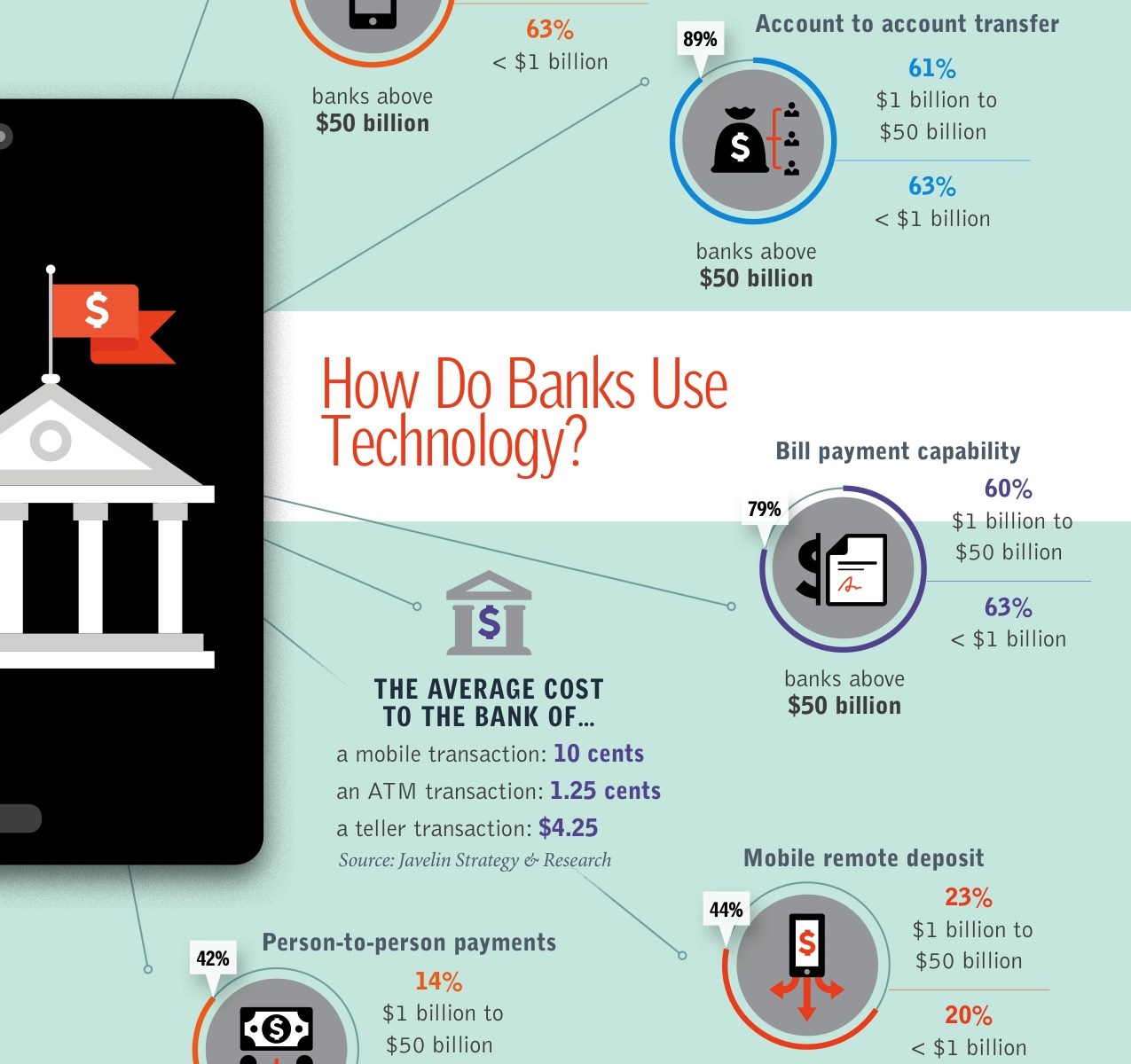
Last October, Richard Fairbank, the Chairman and CEO of Capital One, expressed the following opinion on an earnings call: “Ultimately, the winners in banking will have the capabilities of a world-class software company. Most of the leverage and most of our investment is in building the foundational underpinnings and talent model of a great digital company. To succeed in a digital world (you) can’t just bolt digital capabilities onto the side of an analog business.”  Now, I am a big believer that many banks have immediate opportunities to expand what banking means to individual and business customers. Heck, I wrote as much to open a special supplement to Bank Director magazine that highlights a number of interesting technologies that have re-shaped the fortunes of banks across the U.S.  As you can see in the graphic above (produced for and by our team), the intersection of financial services with technology tools is immense.

Nonetheless, the interaction, communication, coordination and decision-making in regulated banks is vastly different than those of an up-and-coming technology company.  No matter how much both sides want to work with the other (to gain access to a wider customer footprint, to incorporate emerging technologies, etc.), the barriers to both entry and innovation are high.

Keep in mind that there has been an enormous shift in asset concentration and customer loyalty during the past two decades. Today, the ten biggest banks in the U.S. now have more assets than all of the other institutions combined. Concurrently, major consumer brands such as Apple and Google have emerged as significant non-bank competitors while “upstarts” like LendingClub and OnDeck jockey to provide loans to traditional bank customers.

So to stay both relevant and competitive, I believe a bank’s leadership team needs to develop a culture of disciplined growth that encourages creativity and yes, risk taking.  For a leadership team, this requires a combination of knowledge, skill and courage — all things we designed our annual Bank Board Growth & Innovation Conference at the Ritz-Carlton New Orleans to provide (*fwiw, this is a complement to our annual M&A conference — Acquire or Be Acquired).

In the coming days, I’ll be looking at how the processes of interaction, communication, coordination and decision-making in a regulated bank are vastly different than those of a tech firm.  Cleary, the fight for relevancy is on in the banking space… and to see what’s being written and said, I invite you to follow @bankdirector, @aldominick + #BDGrow15.

How the Math Works for Non-Financial Service Companies

As you probably deduced from the picture above, I’m in Chicago for Bank Director’s annual Chairman & CEO Peer Exchange.  While the conversations between peers took place behind closed doors, we teed things up with various presentations.  An early one — focused on FinTech — inspired today’s post and this specific question: as a bank executive, what do you get when you add these three variables:

Stricter capital requirements (which reduces a bank’s ability to lend) + Increased scrutiny around “high-risk” lending (decreasing the amount of bank financing available) + Increases in consumer product pricing (say goodbye to price-sensitive customers)

The unfortunate answer?

Opportunity; albeit, for non-bank financial services companies to underprice banks and take significant business from traditional players.  Nowhere is this more clear then in the lending space. Through alternative financial service providers, borrowers are able to access credit at lower borrowing costs. So who are banks competing with right now? Here is but a short list:

  • FastPay, who provides specialized credit lines to digital businesses as an advance on receivables.
  • Kabbage, a company primarily engaged in providing short-term working capital and merchant cash advance.
  • OnDeck, in business to provide inventory financing, medium-term business loans.
  • Realty Mogul, a peer-to-peer real estate marketplace for accredited investors to invest in pre-vetted investment properties.
  • BetterFinance, which provides short-term loans for consumers to pay monthly bills and purchase smartphones.
  • Lenddo, an online platform that utilizes a borrower’s social network to determine credit-worthiness.
  • Lendup, a short-term online lender that seeks to help consumers establish credit and avoid the cycle of debt.
  • Prosper, an online marketplace for borrowers to create and list loans, with retail and institutional investors funding the loans.
  • SoFi, an online network helping recent graduates refinance student loans through alumni network.

As unregulated competition heats up, bank CEOs and Chairmen continue to seek ways to not just stay relevant but to stand out.  Unfortunately, the math isn’t always in their favor, especially when alternative lenders enjoy operating costs far below banks and are not subject to the same reserve requirements as an institution.  As we were reminded, consumers and small businesses don’t really care where they borrow money from, as as long as they can borrow the money they want.

##

Thanks to Halle Benett, Managing Director, Head of Diversified Financials Investment Banking, Keefe, Bruyette & Woods, A Stifel Company for inspiring this post. He joined us yesterday morning at the Four Seasons Chicago and laid out the fundamental shifts in banking that have opened the door for these new competitors.  I thought the math he shared with the audience was elegant both in its simplicity — and profound in its potential results.  Let me know what you think with a comment below or message via Twitter (@aldominick).

Finding That Competitive (FinTech) Edge

On a flight to Boston yesterday morning, I found myself reading various research and analyst reports about forces effecting change on the banking community.  As Bruce Livesay, executive vice president and chief information officer for First Horizon National Corp. in Memphis, Tennessee recently shared with our team, “you can’t have a discussion about banking without having a discussion about technology.”  As such, today’s piece about finding your FinTech edge.

A simple truth with a profound impact: the interaction, communication, coordination and decision-making in a large, regulated bank is vastly different than those of an up-and-coming FinTech company.  No matter how much both sides want to work with the other (to gain access to a wider customer footprint, to incorporate emerging technologies, etc.), the barriers to both entry and innovation are high.  Still, the need for institutions to better target customer segments while rolling out product offerings that differentiate and cross-sell naturally intersect with the use of technology.

Over the past few months, I’ve looked at nine technology companies that I think are doing interesting work (you can find write ups here, here and here).  As I go deeper into this space, I realize defining the FinTech sector might prove as elusive as understanding the genesis of each company’s name.  Still, let me take a crack at it and define “FinTech” as those financial technology companies that sell or enable:

  • Acquisition & engagement tools
  • Mobile payments offerings
  • Lending options
  • Security products
  • Wealth management support
  • Analytics
  • Money transfers
  • Asset management
  • Automated planning / advice

Regardless of the FinTech companies populating each product line, it is clear that the cumulative effect is a transformation of the fabric of the financial industry.   As I read in a recent Deloitte report (2015 Banking Industry Outlook), FinTech applies not just to customer-facing activities, but also to “internal processes, including balance sheet management, risk, and compliance.”  Moreover, learning from non-bank technology firms and establishing partnerships is fait accompli for most bank executives and board members today.

##

As I’ve shared in the past, I am a big believer that many banks of all sizes have immediate opportunities to expand what banking means to individual and business customers.  If you’re curious for examples on what’s working — and why, take a look at this special supplement to Bank Director magazine that highlights a number of interesting technologies that have re-shaped the fortunes of various community banks.  For more on the board’s role in oversight of this important sector, take a look at our Editor, Jack Milligan’s, white paper on the topic.

Focused on Financial Analytics

When it comes to tapping the creativity and ingenuity of the financial technology sector, I think this equation says it best.

For me, the term “big data” jumped the shark a few years ago.  Much like investment bankers shelved their  “wave of consolidation” pitch, I remain hopeful that the clichéd data term gives way to something more appropriate, descriptive and dare I say agile?  Nonetheless, the concept of sifting through massive amounts of structured and unstructured information to identify meaningful insights is nothing to scoff at.  Truth-be-told, it has interested me since my time at Computech, a leader in agile and lean application software development and IT operations & maintenance that was recently acquired by NCI.

Figuring out discrete patterns to better prepare for the future is huge business — and I continue to see the largest financial institutions in the U.S. making investments in financial analytics.  I was reminded of this drive to leverage new technologies while re-reading my notes from a Q&A session I had with BNY Mellon’s head of Strategy and Innovation last September at our FinTech day at NASDAQ.  There, I made note of three companies — KenshoDiscern and ClearStory — that had the potential to transform part of the financial sector.  FinTech Focused.001With said notes in hand, I dove a deeper into each company’s background and offerings, finding all three bring interesting new models and technologies to bear on automating and enhancing the investment research process.  So as I’ve done with past posts (Three FinTech Companies I’m Keen On and Spotlight on FinTech), let me share a little about each one:

  • Kensho is pioneering “real-time statistical computing systems and scalable analytics architectures — the next-generation of improvements to the global financial system.”  Backed by Goldman Sachs and Google Ventures, and with clients that range from Wall Street’s global banks to several of the best performing hedge funds, think of the 2013 startup as a “Siri-style service for investors, analysts and traders” (h/t to the FT for the comparison).
  • In the interest of fair disclosure, all three of my siblings have worked for investment management firms, so they may buckle at Discern’s description of “conventional” investment research relying “on solo analysts armed with narrow expertise, simple tools and a personal network of resources. Nonetheless, it’s an important juxtaposition when you look at what its data aggregation platform offers.  If you agree with their assertion that the “earlier one becomes aware of a risk or opportunity, the less it costs” the more attracted you might be to this SF-based company.
  • Finally, the data intelligence company ClearStory works with financial institutions on collaborative research and customer acquisition analysis.  Their premise is to both speed and simplify the cycle of research across distributed teams, including “accessing, merging, analyzing files and a variety of external data sources.”  As they share, “competitiveness on the front lines of business is dictated by the speed of data access and the quality of informed decision-making.”

Personally, it is very interesting to learn about, and subsequently watch, companies like these these spur transformation. If you are game to share your thoughts on FinTechs worth watching, feel free to comment below — or via twitter, I’m @AlDominick, about those companies and offerings you find compelling.

Spotlight on FinTech

If forced to pick but one industry that serves as a catalyst for growth and change in the banking space, my answer is “FinTech.” As NJ-based ConnectOne Bank’s CEO, Frank Sorrentino, opined late last week, “financial institutions today operate in a constant state of reevaluation… at the same time, low interest rates and a brand new tech-driven consumer landscape have further contributed to the paradigm shift we’re experiencing in banking.” After I shared “Three FinTech Companies I’m Keen On,” I was asked who else I am taking note of in the financial technology sector; hence today’s spotlight on three additional companies.

Yodlee_logo.svg

The fabric of the banking industry continues to evolve as new technology players emerge in our marketplace.  With banks of all sizes continuing to implement innovative technologies to grow their organizations, companies like Yodlee have emerged “at  the heart of a new digital financial ecosystem.”  The NASDAQ-listed company counts 9 of the 15 largest U.S. banks as customers along with “hundreds of Internet services companies.”  These companies subscribe to the Yodlee platform to power personalized financial apps and services for millions of consumers.  With thousands of data sources and a unique, cloud platform, Yodlee aspires to transform “the distribution of financial services.” It also looks to redefine customer engagement with products like its personal financial management (PFM) service, which pulls together all of a customer’s financial information from multiple accounts.

web-Logo-Malauzai@2x

Now, technology in the financial world encompasses a broad spectrum of tools. For most officers and directors, I have found conversations about what’s happening in this space naturally incites interest in mobile banking.  So let me turn my focus to Malauzai, a company I first learned of while talking with Jay Sidhu (*Jay is the former CEO of Sovereign where he grew the organization from an IPO value of $12 million to the 17th largest banking institution in the US… he is now CEO of the very successful Customer’s Bank).  This past spring, he talked about the benefits of working with the company that was formed in 2009 to “participate in the mobile banking revolution.”  Malauzai works with about 320 community banks and credit unions across the country, providing the tools needed to connect to a customer through smartphone applications.  Specifically, the company builds mobile banking “SmartApps” that run across mobile platforms (e.g. Apple and Android) and several types of devices from smart phones to tablets.

db_logo.ba0411771e22

Certainly, many FinTech companies have a laser-like focus on individual customer needs.  Case-in-point, Openfolio, a startup that “brings the principles and power of social networks – openness, connectivity, collective intelligence – to the world of personal investing” (h/t to Brooks and Gareth at FinTech Collective for sharing their story).  Openfolio’s premise: in our sharing economy, people will divulge investing ideas and “portfolios, in percentage terms, within their networks.”  Accordingly, Openfolio provides a place where investors share insights and ideas, and watch how others put them into action. As they say, “we all learn from each other’s successes (and mistakes).”  As reported in TechCrunch, the company doesn’t reveal dollar amounts folks have invested, preferring to reveal how much weight different categories have in an investor’s portfolio to reveal information about markets.

##

Personally, it is very interesting to watch companies such as these spur transformation.  If you are game to share your thoughts on FinTechs worth watching, feel free to comment below about those companies and offerings you find compelling.

Three FinTech Companies I’m Keen On

It seems not a day goes by where I’m not coming across a story about Venmo.  Maybe I should thank holiday shoppers; more specifically, friends or family member that go in on a joint present for someone.  Rather than accept an IOU, the social payments company has made story titles like “Cash is For Losers!” en vogue by allowing its users to settle debts without cash or check.  So the company’s success had me exploring the world of FinTech and other companies worth taking a look at.  Here are three I’m keen on along with a short overview on what they offer.

wealthfront-logo-e1396828112845

Wealthfront is an automated investment service with over $1 billion in client assets.  The Palo Alto-based company manages a “diversified, continually rebalanced portfolio of index funds” on behalf of its clients.” Their proposition: “Wealthfront takes the guesswork out of sound, long-term investing through effortless automation. Wealthfront manages a personalized online investment account for you that is fully diversified and periodically rebalanced – accessible anytime and anywhere from your desktop, tablet or phone.” For an individual, their service premise is quite attractive, given “the consistent and overwhelming research that proves index funds significantly outperform an actively managed portfolio.”

Unknown

I wrote about Kabbage last year (A Pop Quiz on the Future of Banking) as a platform for online merchants to borrow working capital. Per Time’s Business & Money site, “Kabbage financing resembles a line of credit in that customers only pay for what they use, but it isn’t a loan and doesn’t require merchants to use their personal assets as collateral. Rather, as with a business factor, a Kabbage financing is structured as a cash advance against future sales.”

dwolla-logo

Dwolla is a payment network that allows any business or person to send, request and accept money. As they say, they are “not like those other big payment companies that rely on plastic cards and charge hefty fees.” Instead, the company built its own network that “securely connects to your bank account and allows you to move money for just $0.25 per transaction, or free for transactions $10 or less.”

##

I’m on record with my feelings that bank leaders have real and immediate opportunities to expand what banking means to individual and business customers by offering services that go beyond a traditional business model.  These three companies provide alternatives to traditional lines of business, and are just a few of the many that are working to create a “newer” normal for individuals and businesses.  If you are interested to share your thoughts on FinTechs worth watching, feel free to comment below about those companies you find compelling.

This Week in Pictures

As our editor, Jack Milligan, writes in How One Large Bank Fosters Innovation, “conventional wisdom holds that banks are not very good at innovation — and large banks, with their entrenched bureaucracies and clumsy legacy systems, are probably worst of all. It might then come as a surprise that Bank of New York Mellon Corp. has run a highly successful innovation program that has made a meaningful contribution to the bank’s profitability, and also manages to get most of the company’s 10,000 employees involved in the process.”

Earlier this week, I shared how Declan Denehan, BNY Mellon’s managing director for strategy and innovation, provided his thoughts on staying relevant while engaging with the “startup ecosystem” during Monday’s FinTech Day.  Jack’s article offers a great summation of Declan’s perspectives — and for today’s post, I simply wanted to recap the event as a whole.  The fun for our team started well before the doors opened at 9:00; however, FinTech day kicked off with:

  • A number of video shoots in the NASDAQ studio that we will post to BankDirector.com;
  • Continued with a live-streamed discussion focused on innovation with Declan and me; and
  • Wrapped up with a closing bell ceremony and a lot of great company logos rotating on the exchange’s video board in Times Square.

FinTech Day, a collaboration between Bank Director and NASDAQ OMXattracted over 40 participants from 30 financial technology companies.  For those of you that joined us, I am pleased to share the link to the official photo gallery from the ceremony.  We are happy to send over any that you’d like as our way of saying thank you for joining us.  Simply leave a comment below, reach out via LinkedIn or Twitter and let me know what you’d like.  Below, some of the pictures in the gallery…

Before wishing everyone an Aloha Friday, let me thank the entire Bank Director team — and in particular, Kelsey Weaver, Laura Schield, Michelle King, Mika Moser, Jack Milligan and Joan Susie — for your efforts to make the day a success.  Each of you contributed something special and for that, I am very appreciative and already getting excited for next year (dare we call it FinTech 2.0)!

A Video Recap from FinTech Day at NASDAQ OMX

Before I left NASDAQ’s MarketSite, I had the chance to pop in to one of their studios to film a quick recap of “FinTech Day.”

Thanks again to our friends at NASDAQ for collaborating with us on the day and all those executives from technology firms that joined us in the city.

Waving for the network cameras

Ringing the Closing Bell at NASDAQ

I just received a few pictures from yesterday’s closing bell ceremony at NASDAQ.  With me is our Publisher, Kelsey Weaver, and executives from various technology companies — both established and just starting up.  Thanks to the entire team at Bank Director; specifically, Mika Moser, Laura Schield, Jack Milligan and Michelle King, for making this year’s FinTech Day a wonderful success!

I’ll have more on FinTech Day — a collaboration between the exchange and Bank Director that celebrates the contributions of financial technology companies to banks in the U.S. — later today along with additional pictures and perhaps a video or two.