News and notes from the first day of Bank Director’s annual Acquire or Be Acquired conference.
Key Takeaway
As was the case at last year’s Acquire or Be Acquired, the most successful banks have a clear understanding and focus of their market, strengths and opportunities. One big takeaway from the first full day of Bank Director’s conference (#AOBA15 via @bankdirector): to be a successful player in today’s bank M&A market, one needs adequate capital and earnings for regulatory approval of a deal, the infrastructure in place to both acquire and grow an institution and available sellers in the bank’s target market.
Trending Topics
Overall, the issues I took note of where, in no particular order: $5 to $10Bn public banks are in the sweetest of the sweet spot for investors; cash is often useful to sellers as a form of price protection — and can benefit buyers as fewer shares are issued in a transaction; earnings estimates, not P/E Expansion, will drive bank stocks in 2015; deal pricing has a direct correlation to the size of the seller and the size of the buyer; bank boards should be particularly mindful of shadow banking’s strong relative growth.
Picked Up Pieces
I had a chance to talk with a number of attendees and introduce quite a few of our presenters. Here are some of the anecdotes I made note of throughout the day:
There were 281 bank M&A transactions in ’14 as compared with 214 in ’13.
This M&A activity, in terms of deal value, increased from $14bn in ’13 to $18bn in ’14.
Whereas Mergers-of-Equals (MOEs) were the hot topic at this time last year, I can count on one hand the number of mentions today.
Per KBW, we have had 20 current straight quarters of improving credit quality — the longest since 1991.
According to Curtis Carpenter with Sheshunoff Investment Banking, 19x earnings is becoming a common median deal price.
From a discussion on M&A-related capital raising… “in general, the pool of private placement buyers is increasing and includes many private equity firms as well as traditional institutional investors.”
Bank executives would be wise to plan for this low-rate environment to last “forever.”
More to come from The Phoenician and Acquire or Be Acquired tomorrow.
Former FDIC Chairman and Bank Director’s Publisher, the late Bill Seidman, was a huge advocate of a strong and healthy community bank system. We honor his memory and this sentiment with a CEO panel each year. My thanks to David Brooks, Chairman & CEO of the Independent Bank Group, Mark Grescovich, President & CEO of the Banner Corporation, Edward Garding, President & CEO of First Interstate BancSystem and Daryl Byrd, President & CEO of IBERIABANK, for sharing their thoughts on a variety of growth-related issues earlier today.
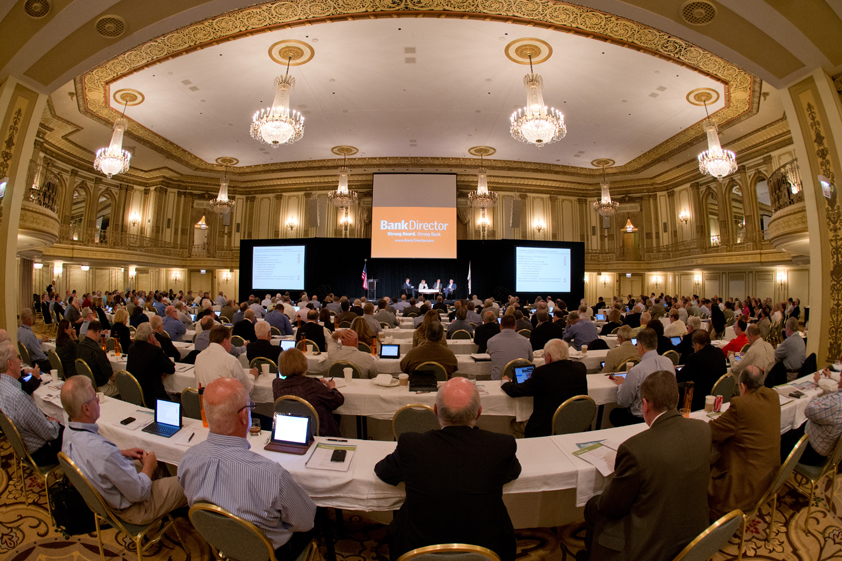
Banks are increasingly interested in the topic of mergers and acquisitions, which must have something to do with our record attendance at this year’s Acquire or Be Acquired Conference in Scottsdale, Arizona.
The fun begins at The Phoenician (pictured above) this weekend with Bank Director’s 21st annual “AOBA.” Last year, we welcomed 435 officers & directors from 271 financial institutions to the Arizona Biltmore. This year, we have 522 bankers and bank board members from more than 300 banks in attendance. Merger activity is clearly gaining steam, and this is bringing more interested parties to the table.
Three Days in the Desert
Why banks are bought (or sold) involves much more than just the numbers making sense. Moreover, to successfully negotiate a merger transaction, buyers and sellers must bridge the gap between a number of financial, legal, accounting and social challenges. So allow me to sketch out what’s on tap for this massive three-day event.
On Sunday…
To kick things off, we take a macro-level look at capital markets and operating conditions for banks nationwide. Additionally, we look at how M&A fits within a broad range of strategic options for a bank’s board and how some successful acquirers have aligned transactions to achieve strategic goals. Of note, we welcome the perspectives of CEOs from high performing banks like Pinnacle National Bank, Banner Corp., First Interstate BancSystem, IBERIABANK and CVB Corp. as part of several presentations. On stage, these men will share their thoughts on what it takes to build and lead successful institutions.
On Monday…
Building on the first day of the conference, we turn our attention to the long-term preparation required by both a buyer and seller. For instance, regulatory planning remains critical to getting deals done for both sides — especially on compliance issues. Thematically, Monday builds on Sunday’s presentations, with sessions dedicated to helping a bank’s board make a rational buy, sell or hold decision.
On Tuesday…
To put a bow on this year’s event, we start with a look at what the biggest banks are doing today followed by a series of breakout sessions on more in-depth topics. To conclude, we welcome the perspectives of our friends from NASDAQ who will look at trends, issues and the “movers and shakers” in the technology world that may impact growth and innovation within the financial community. As much as AOBA explores one’s financial growth opportunities, this final session examines what’s happening outside of our industry that may precipitate new changes or challenges to a bank’s growth aspirations. Oh and in the afternoon… we swap suits for cleats, wrapping up AOBA with our annual golf tournament.
Can’t Make it?
For those not able to join us — but interested in following the conversations — I invite you to follow me on Twitter via @AlDominick, the host company, @BankDirector, and search & follow #AOBA15 to see what is being shared with our attendees.
Admittedly, the question driving today’s title is not the easiest to answer. Without the training programs once offered, without the cache of an Apple and without the stability of a career path, you might wonder why any smart, ambitious and talented professional would take a job in banking. Surprised I’d write this from Chicago and Bank Director’s annual Bank Executive & Board Compensation conference? Read on.
A sunny day in Chicago
As I start to write today’s piece, it strikes me that without the help of LinkedIn, I don’t immediately know a single person my age (37) that works for a traditional bank — let alone operates at an executive level. This is a HUGE problem for the future when one considers the growing divide in public perceptions of banks with the actual business operations in place. Look, I’m not throwing stones. Heck, I would have loved to get into a management training program when I graduated from W&L in 1999. Its just that almost every big bank that historically trained the “next generation” of bankers had shelved their programs.
While I don’t work directly for a financial institution, I am lucky to spend days like today finding inspiration from bank executives, board members and services providers. Mostly, these are people who see the banking space as one that does need change, but does not deserve dismissal. So as the Swissotel starts to fill with “traditional bankers,” I anticipate three big themes; namely, the recruitment, development and compensation of a leadership team and the workforce of the future.
In Terms of Recruitment…
If you subscribe to the idea that “tone from the top” is key for building a culture of success, take heed of our editor’s opinion. Jack Milligan recently blogged on “The Bank Spot” that “the #1 best practice for a bank’s board of directors is to hire a high performance CEO.” In his words:
Of all the things that boards do, this might be the most obvious – and yet it’s also the most important. A good CEO works closely with the board to develop a strategy that fits the bank’s market and has the potential to create a high level of profitability. They bring in good talent and do a good job of motivating and leading them. And they have the ability to execute the strategic plan and deliver what they said they will deliver. Having a high performance CEO doesn’t guarantee success, but I think it will be very hard to be a high performing bank without one.
In Terms of Development…
In my mind, having the right leader in place dramatically improves the attractiveness of an institution to potential employees. Here, I look at what bankers like Ron Samuels and Kent Cleaver are doing in Nashville at Avenue Bank and Mike Fitzgerald at Bank of Georgetown in Washington, D.C. Creating a culture where one is pushed to contribute to the bank’s growth seems obvious. But I can tell you, putting people above products and financial profits isn’t always the easiest thing to do (right as it may be). Developing talented executives takes both patience and confidence. Indeed, one must be comfortable doing more than simply empowering others to be a team player. Here, a passage from L. David Marquet’s (a retired Captain in the U.S. Navy) “Turn the Ship Around” bears quotation. The premise: don’t empower, emancipate.
Emancipation is fundamentally different from empowerment. With emancipation, we are recognizing the inherent genius, energy and creativity in all people, and allowing those talents to emerge. We realize that we don’t have the power to give these talents to others, or ’empower’ them to use them, only the power to prevent them from coming out.
It might be easy in a highly regulated environment to see this logic and find excuses to it not applying to banking. But if a submarine captain can transform one of the worst performing boats into one of the most combat-effective submarines, perhaps these words might be re-read.
In Terms of Compensation…
Not to throw a wet blanket on the last two points, but as our team found in a recent survey, bank boards recognize the need to tie compensation to the performance of the bank in the long term, yet they continue to struggle with how to get the pieces in place to attract and reward the best leaders to meet the institution’s strategic goals. So I find it particularly interesting that less than half of the banks we surveyed tie CEO pay to the strategic plan or corporate goals, and more than one-quarter of respondents say that CEO compensation is not linked to the performance of the bank.
##
I’m checking back in tomorrow from the conference. If you’re on Twitter and interested in the conversation, feel free to follow @BankDirector, @AlDominick and #BDComp14.
This Sunday, I fly to Chicago for Bank Director’s annual Bank Executive & Board Compensation Conference. As I prepare to head towards the city that splits its allegiance between the Cubs & WhiteSox, my thoughts move from baseball — congratulations to the new World Series champion San Francisco Giants — to the people, products and performances of various financial institutions. As I will be blogging and tweeting from our annual event, I thought to use today’s post to tee-up what you can expect on AboutThatRatio.com next Monday, Tuesday and Wednesday.
Since the demise of AIG, Bear Sterns and Lehman Brothers in 2008, take a minute and think about how many significant changes have occurred throughout the entire financial community. From new capital requirements to greater scrutiny on executive compensation, these “Dodd-Frank” years remind me of the aftermath of Sarbanes-Oxley’s introduction in the early 2000s in as much as board members continue to wrestle with the ‘what ifs’ and ‘how comes’ of the regulatory environment.
While much of the action taken by nearly every institutions a few years ago can best be described as reactionary and defensive, it strikes me that there are quite a few banks transforming their operating models to stay both relevant and competitive today. For this reason, I am excited for our team to host several hundred bank executives and outside directors focused on the creation of sustainable long-term value for shareholders next week. In terms of posts:
Monday’s looks at the recruitment, development and compensation of a bank’s most essential talent — both within a bank and on its board.
On Tuesday, the “main day” of our conference, I will share the trending topics from the day. Last year, I wrote how board members and executives continued to struggle with measuring executive performance and retaining key talent. At the same time, I made note that many felt the environment in which banks operate in demands productivity, proficiency with technology and the ability to sell. So I’ll juxtapose last year’s findings with this year’s themes.
Wednesday’s piece will be a bit simpler, a 90 second video I’ll have filmed from the conference.
Next Friday’s column? More of a behind-the-scenes picture recap of the conference as I recently did for Bank Director’s “anniversary.” Throughout, you can keep track of various conversations on Twitter by following @BankDirector and me, @AlDominick and/or by using #BDComp14.
I’m at a 1909 Neoclassical landmark in San Francisco for Bank Director’s “Valuing the Bank” program. Setting up shop in the beautiful Ritz-Carlton on Nob Hill is a real treat, as is welcoming a number of bank CEOs, chairmen, CFOs and outside directors to the Bay Area. Let me share a few of my takeaways from yesterday’s conversations and tee up what’s ahead this morning.
The Ritz-Carlton San Francisco
What Drives Value Creation
To open the day, we reviewed the operating environment in terms of “what drives value creation.” Beginning with a presentations made by the Hovde Group and Moss Adams, we touched on issues like margin compression, deposit funding, efficiency improvements and business model expansion in the context of the current environment. One interesting, M&A-specific fact from this session: the market for high-performing banks is at a 5-year high. Consider the number of deals greater than $25 million in deal value that were priced above 150% of tangible book value: in the last 4 quarters: 44… for the prior 18 quarters: 45.
Understanding Risk in the Context of Determining a Bank’s Worth
I made note that credit unions have seen loans grow 9.8% this past year; far quicker than the 4.9% growth at banks (h/t Hovde Group). So as much as I’ve recently harped on non-bank competition from players like Apple and PayPal, a stark reminder that banks also need to find a way to compete with lower rates offered by credit unions to reverse this trend of losing loans. Back to the M&A side of things, it was suggested that to maximize value, potential sellers should consider selling less profitable/smaller/rural branches.
Today’s Agenda
This morning, we will look at corporate governance and talent-specific opportunities to strengthen one’s institution. After a series of peer exchanges, I am excited to tackle the idea that banks are sold more than they are bought. Indeed, our final session of this program pairs David Brooks, the Chairman & CEO of the NASDAQ-listed Independent Bank Group and Jim Stein, Vice Chairman & Houston Region CEO, Independent Bank. Jim was the CEO at Bank of Houston and sold that bank to David’s, and together, will talk with me about how that deal was struck.
Good morning from the campus of the 9th oldest university in the United States: Washington & Lee. Yes, I am back in Lexington, VA to speak at my alma mater’s 3rd annual Entrepreneurship Summit. So in lieu of my traditional Friday post on banking, today’s column highlights three points (specific to social media) that I will expand upon in a few hours.
I am fortunate to share today’s stage with a number of successful fellow Generals. I love this school, and thought to share the presentation I put together for this two-day event (see: W&L 2014 Presentation). As you will see — and maybe hear — I’ve broken it into three parts that all relate to leveraging social media in a small, growing and profitable business:
You can’t manage what you can’t measure — with a look at “the stats” we use at Bank Director to gauge progress and success;
A juxtaposition of JPMorgan Chase’s #AskJPM fail with TD Bank’s wildly popular Automated Thank You Machine; and
If you are a student at W&L, I hope you will pay close attention to the final slide in this shared presentation. It speaks to the internship opportunities we have for interested and qualified applicants looking for a paid position in Nashville next summer.
Today’s post is something of a “public service announcement.” As we approach the dog days of summer, a sneak peek at an exclusive event for bank CEOs, CFOs, Chairmen, Presidents and members of the board taking place at the Ritz-Carlton in San Francisco this October.
As promised, a special guest author for this Friday’s column: Bank Director magazine’s Managing Editor, Naomi Snyder. Having shared my key takeaways from our annual Bank Audit & Risk Committees conference on Wednesday and Thursday, I invited Naomi to share her post-conference thoughts on my blog. So this morning’s title is as much about truth in advertising as it is an invitation to learn what my friend and colleague deemed timely and relevant.
At Al’s request, I’m going to step in and give a quick recap of Bank Director’s Audit and Risk Committees Conference in Chicago this week. As you can tell from this picture, nearly 300 people attended our conference at The Palmer House hotel and they got a lot of frightening news about risks for their financial institutions, including cyber risk, interest rate risk, compliance and reputation risk in the age of social media. I’m going to address three of those points today.
Interest Rate Risk
Many banks are extending credit at a fixed rate of interest for longer terms in an effort to compete and generate much-needed returns. This will be a problem for some of them when interest rates rise and low cost deposits start fleeing for higher rates elsewhere. You could assume the liability/asset equation will equal out, but will it? Steve Hovde, the president and CEO of the investment bank Hovde Group in Chicago, is worried about a bubble forming, saying he has seen credit unions offer 10- or 15-year fixed rate loans at 3.25 percent interest. “I’m seeing borrowers get better deals with good credit quality than they have ever gotten in history,” he says.
Reputation Risk
In an age of social media, anyone can and does tweet or post on Facebook any complaint against your bank. Cyber attacks, such as the one that befell Target Corp., can be devastating and cost the CEO his or her job. Rhonda Barnat, managing director of The Abernathy MacGregor Group Inc., says it’s important not to cater to TV news, such as telling a reporter that your employee’s laptop was stolen at a McDonald’s with sensitive customer information, prompting a visit by the camera crew to the McDonald’s. Not disclosing how many customer records were stolen could keep you off the front page. Focus on the people who matter most: your customers and investors and possibly, your regulators. They want to know how you are going to fix the problem that impacts them.
Compliance Risk
Regulators are increasingly breathing down the necks of bank directors, wanting evidence the board is actively engaged and challenging management. The official minutes need to reflect this demand, without necessarily going overboard with 25 pages of detailed discussion, for example. Local regulators are increasingly deferring questions to Washington, D.C., where they can get stuck in limbo. When regulators do give guidance, it is often only verbal and can cross the line into making business decisions for the bank, says Robert Fleetwood, a partner at Barack Ferrazzano in Chicago. In such an environment, it’s important to have good relations with your regulators and to keep them informed.
##
About Naomi: Prior to joining our team, she spent 13 years as a business reporter for newspapers in South Carolina, Texas and Tennessee. Most recently, she was a reporter for The Tennessean, Nashville’s daily newspaper. She also was a correspondent for USA Today. Naomi has a bachelor’s degree from the University of Michigan and a master’s degree in Journalism from the University of Illinois. To follow her wit and wisdom on Twitter, follow @naomisnyder.
With all of the information provided at this year’s Bank Audit & Risk Committees conference(#BDAudit14 via @bankdirector), I think it is fair to write that some attendees might be heading home thinking “man, that was like taking a refreshing drink from a firehose.” As I reflect on my time in Chicago this week, it strikes me that many of the rules and requirements being placed on the biggest banks will inevitably trickle down to smaller community banks. Likewise, the risks and challenges being faced by the biggest of the big will also plague the smallest of the small. Below, I share two key takeaways from yesterday’s presentations along with a short video recap that reminds bankers that competition comes in many shapes and sizes.
The Crown Fountain in Millennium Park
Trust, But Verify
To open her “New Audit Committee Playbook” breakout session, Crowe Horwath’sJennifer Burke reinforced lessons from previous sessions that a bank’s audit committee is the first line of defense for the board of directors and shareholders. Whether providing oversight to management’s design and implementation with respect to internal controls to consideration of fraud risks to the bank, she made clear the importance of an engaged and educated director. Let me share three “typical pitfalls” she identified for audit committee members to steer clear of:
Not addressing complex accounting issues;
Lack of open lines of communication to functional managers; and
Failure to respond to warning event.
To these points, let me echo her closing remarks: it is imperative that a board member understand his/her responsibility and get help from outside resources (e.g. attorneys, accountants, consultants, etc.) whenever needed.
Learn From High-profile Corporate Scandals
Many business leaders are increasingly aware of the need to create company-specific anti-fraud measures to address internal corporate fraud and misconduct. For this reason, our final session looked at opening an investigation from the board’s point-of-view. Arnold & Porter’s Brian McCormally kicked things off with a reminder that the high-profile cyber hacks of Neiman Marcus and Target aren’t the only high-profile corporate scandals that bankers can learn from. The former head of enforcement at the OCC warned that regulators today increasingly expect bank directors to actively investigate operational risk management issues. KPMG’s Director of Fraud Risk Management, Ken Jones, echoed his point. Ken noted the challenge for bank executives and board members is “developing a comprehensive effort to (a) understand the US compliance and enforcement mandates — and how this criteria applies to them; (b) identify the types of fraud that impact the organization; (c) understand various control frameworks and the nature of controls; (d) integrate risk assessments, codes of conduct, and whistleblower mechanisms into corporate objectives; and (e) create a comprehensive anti-fraud program that manages and integrates prevention, detection, and response efforts.”
A One-Minute Video Recap
##
To comment on this piece, click on the green circle with the white plus (+) sign on the bottom right. If you are on twitter, I’m @aldominick. P.S. — check back tomorrow for a special guest post on AboutThatRatio.com.
I’m heading out to Chicago and Bank Director’s annual Bank Audit & Risk Committees Conference. The agenda — focused on accounting, risk and regulatory issues — aligns with the information needs of a Chairman of the Board, Audit and/or Risk Committee Chair and Members, Internal Auditors, Chief Financial Officers and Chief Risk Officers. Before I welcome some 300 attendees (representing over 150 financial institutions from 39 states) to the Palmer House, I thought to share three things that would keep me up at night if I traded roles with our attendees.
(1) The Risk of New Competition
For bank executives and board members, competition takes many forms. Not only are banks burdened with regulation, capital requirements and stress testing, they now have the added pressure of competition from non-financial institutions. Companies such as Paypal, as well as traditional consumer brands such as Walmart, are aggressively chipping away at the bank’s customer base and threatening many financial institutions’ core business — a fact made clear by Jamie Dimon, the CEO of JPMorgan Chase, at a shareholder meeting this February.
“You’d be an idiot not to think that the Googles and Apples . . . they all want to eat our lunch. I mean, every single one of them. And they’re going to try.”
To this end, I find myself agreeing with Accenture’s Steve Culp, Accenture’s senior managing director of Finance & Risk Services, when he writes “banks need to keep developing their risk capabilities, skills and talents, and align these skills with their agenda around future growth. If they don’t align their growth agenda with their risk capabilities—building a safe path toward growth opportunities—they will miss out on those growth opportunities.” While I plan on diving much deeper into this topic following the conference, I definitely welcome feedback on the issue below.
(2) The Risk to A Reputation
While the Dodd-Frank Act requires publicly traded banks with more than $10 billion in assets to establish separate risk committees of the board, and banks over $50 billion to additionally hire chief risk officers, I’m seeing smaller banks proactively following suit. Such additions, however, does not absolve directors and senior managers of financial institutions from preparing for the worst… which is easier said then done. In some ways, a bank’s reputation is a hard-to-quantify risk. Anyone can post negative comments online about an institution’s products, services or staff, but one only needs to look at Target’s financial performance post-cyber hack to realize that revenue and reputation goes hand-in-hand.
(3) The Risk of Cyber Criminals
Speaking of Target, earlier this year, Bank Director and FIS collaborated on a risk survey to pinpoint struggles and concerns within the boardrooms of financial institutions. As we found, tying risk management to a strategic plan and measuring its impact on the organization proves difficult for many institutions, although those that have tried to measure their risk management program’s impact report a positive effect on financial performance. What jumps out at me in the results of this research are the concerns over cyber and operational security. Clearly, the number of “bad actors” who want to penetrate the bank’s defenses has increased exponentially, their tools have become remarkably sophisticated, and they learn quickly. I read an interesting piece by an attorney at Dechert (sorry, registration required) that shows the analytical framework for cyber security is very similar to what most directors have focused on in their successful business careers: people, process and technology. But theory is one thing, putting into practice a plan to protect your assets, entirely different.
##
To comment on today’s column, please click on the green circle with the white plus sign on the bottom right. If you are on twitter, I’m @aldominick. Aloha Friday!
Two big takeaways from the second day of Bank Director’s 2nd annual Growth conference (#BDGrow14): institutions of all sizes are challenged when it comes to standing out from the crowd & enhancing your mobile banking presence should be a top priority for all boards of directors.
Keeping it classy in New Orleans
The team post-Growth conference
A 2 Minute Recap on the Past 4 Months
Take No Risk, Make No Money
While some may not think about enterprise risk management in the context of growing one’s bank, Crowe’sJennifer Burke made clear that proactively identifying, mitigating, and in some cases, capitalizing on risks provides a distinct advantage to a bank. Keep in mind that even smaller institutions — with less complex business structures — face myriad risks that might significantly affect their ability to meet their growth plans. As Jennifer shared, those that proactively identify and respond to risks and opportunities gain a competitive advantage over their peers, especially in responding to our ever-changing business environment.
Millennial and the End of Banking?
The Times-Picayune ran a nice story in today’s edition based on The Growth Conference. The newspaper noted that “younger generations report more comfort with online and mobile banking tools, posing a hurdle for banks used to ginning up business through face-to-face interactions.” So it is fair to ask if banks should be scared of the millennial generation. According to Daryl Byrd, president and CEO of IberiaBank, the answer is no. As mentioned in this piece (Will Millennials be the end of banking as we know it? Bank execs weigh in at Growth Conference in New Orleans), Byrd was among a panel of industry leaders gathered at the Bank Director Growth Conference to discuss business trends, including the challenges in reaching younger customers. Byrd, “who noted he is the father of three Millennials, said his children, like many in their generation, aren’t building wealth as much as they are taking on debt. That means their demand for banking services will be limited in the near term,” he said.
Trending Topics
The issues I took note of this morning were, in no particular order:
Just like “synergy” became a cliché, so too might “omni” when it comes to delivering a consistent customer experience (e.g. omni-screen, omni-channel, etc);
Not all customers are created equally;
A bank’s board has the chance to re-set strategies to target, acquire, engage, grow and retain customers… but need to look ahead to what’s possible as opposed to the past to see what has historically delivered results.
To comment on this piece, click on the green circle with the white plus sign on the bottom right. Safe travels home to all who joined us in New Orleans this week (and yes, Aloha Friday!)













 About That Ratio