Acquire or Be Acquired: Don’t Overlook This

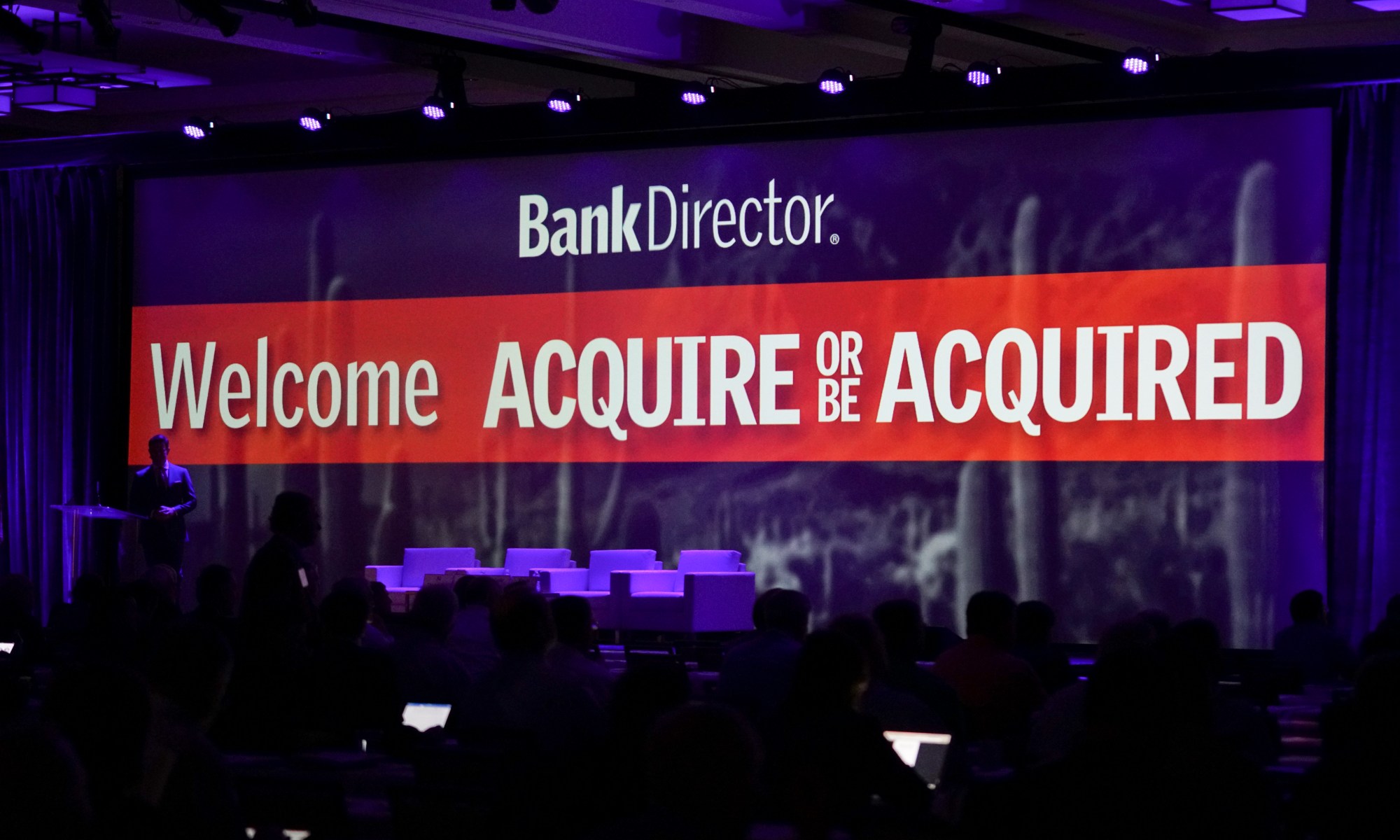
Thanks to our keynote speaker, J. Michael Shepherd, pictured above. The Chairman & CEO, Bank of the West and BancWest Corporation, he inspired quite a few with both his wit and wisdom.

Over the past few days at Bank Director’s annual Acquire or Be Acquired conference, various speakers have touched on a number of key strategic growth issues.  From exploring an acquisition to growing loans, controlling expenses to managing capital, the discussions hit the “timely and relevant” standard that we consider essential.  They also reinforced my sense that more boards and their management teams are seriously considering an acquisition as their primary growth plan than at this time last year.

As our editor-in-chief opined, the heightened level of interest could certainly be explained by the continued margin pressure that banks have been operating under for the last several years.  For those thinking about buying another, my short video recap from the mid-way point of AOBA offers a heads up about a pre-deal consideration not to be overlooked.


What’s Happening at Acquire or Be Acquired

Throughout the first day of Bank Director’s 22nd annual Acquire or Be Acquired Conference, I found quite a few presentations focused on the emergence of mid-sized regional banks that are growing through the consolidation of smaller banks.  Clearly, mergers & acquisitions provide an avenue for some banks to drive improved operating leverage, earnings, efficiency and scale.  At the same time, the pressures prompting larger banks to innovate — sluggish loan demand, depressed revenue, higher compliance costs — are the same ones forcing smaller banks to pursue a sale.

By Al Dominick, President & CEO, Bank Director

For those unfamiliar with “AOBA,” this annual event explores issues like the one mentioned above.  Since the conference kicked off at 8 AM on a Sunday, this morning’s post shares three short video recaps from my time at the Arizona Biltmore followed by links to recent posts specific to this conference.

In addition to these videos, below are links to four of my posts specific to the event:

If these types of conversations interest you, take a look at what we’re sharing on BankDirector.com.  Additionally, I invite you to follow me on Twitter via @AlDominick, the host company, @BankDirector, and search & follow #AOBA16 to see what is being shared with (and by) the 930 men & women in attendance.

Current Challenges Facing Bank Executives in 2016 (a video overview from Acquire or Be Acquired)

The fun began bright & early here at the Arizona Biltmore, home of this year’s Acquire or Be Acquired conference.  This annual event explores a bank’s financial growth opportunities — and brings a significant number of bank CEOs, board members and C-level executives to the desert.  In this short video, I share a few key take aways from this morning’s presentations specific to the challenges being faced by bank CEOs in attendance.  Sorry, no mention of a flat yield curve (even though the interest rate environment certainly merits more then just this mention).

Welcome to the Arizona Biltmore and Bank Director’s 22nd annual AOBA

As we prepare to kick off this year’s Acquire or Be Acquired conference, I offer my take on one theme I anticipate being brought up early — and discussed often: the return of regional acquirers who are positioning themselves to challenge the true big guys in banking.

9 Banks I Bet People Will Be Talking About at Acquire or Be Acquired

I planned to write about a number of banks I was excited to see this weekend at AOBA.  But as Steve Jobs once shared “people don’t know what they want until you show it to them.” In this spirit, let me highlight nine banks that I anticipate our attendees will be talking about in Arizona at Bank Director’s annual M&A conference.

In a few minutes, I’ll hop an American flight to Phoenix for this year’s Acquire or Be Acquired Conference.  Before I depart the cold and slush of D.C. for some warmth and sun in the desert, this is my take on the banks I anticipate people talking about when we’re all together:

  • Bank of the West — and not just because their CEO is keynoting this year’s conference.  The bank, with more than 700 branches in the Midwest and Western United States, has long been a personal favorite of mine and competes in markets where many look for inspiration.
  • Bank of North Carolina — because they’ve been wheeling and dealing and are a great example of how an acquirer successfully integrates cultures (*yes, their CEO also speaks at AOBA this year on a CEO panel entitled Finding the Right Partners).
  • United Bank — having picked up a trophy franchise of their own in my hometown (another personal favorite of mine, Bank of Georgetown) they’ve made a number of interesting deals over the past few years and I bet have more on their mind.
  • BB&T — having dealt for Susquehanna in ’14 and National Penn in ‘15, it is fair to ask: who’s next?

By no means are these all of the banks that will come up in conversation; rather, those that are top of mind.

One final thought before hopping my flight west.  The recent volatility in the stock market may be impacting institutions considering a capital raise, IPO or acquisition — but this week’s deal pace is far different then at this time in recent years.  The patterns I’m beginning to see is a concentrated effort to get to over the $5Bn asset mark and into that sweetest of spots: the $5Bn to $50Bn asset class.  A point I’ll elaborate on in an upcoming post/video.

So if you are interested in following the conference conversations via social channels, I invite you to follow me on Twitter via @AlDominick, the host company, @BankDirector, and search & follow #AOBA16 to see what is being shared with (and by) our attendees.  Safe travels to those 930 men & women joining us this weekend!

Five Reasons Why Banks Might Consider Selling in 2016

You might think every bank CEO I meet wants to talk about buying another institution; truth-be-told, some recognize that tying up with another makes a lot of sense.  So this post looks at why now may be the right time for a bank’s CEO and board to consider a sale.  It plays off the idea that in many markets, organic growth options are limited and times are tough for banks, especially those under $1Bn in asset size.

By Al Dominick, President & CEO, Bank Director

Over the past three years, a number of bank executives and board members have struggled with whether to buy or sell their bank — or pursue growth independently.  Over the same time, Bank Director has welcomed more than 1,300 bankers — from more than 500 financial institutions — to our annual M&A conference to explore their short- and long-term options.

This year, those numbers go up in a BIG way. Indeed, we have 600 bankers from 300+ banks joining us at the Arizona Biltmore for “AOBA” this upcoming Sunday through Tuesday.  To me, this signals that more potential buyers & sellers are getting off the sidelines and into the bank merger and acquisition game.  So in advance of Bank Director’s 22nd annual conference, here are five challenges that a bank’s CEO and board might want to consider.

  • Peer-to-peer lenders, credit unions and some — not all — FinTech startups either are (or will be) fierce competitors to community banks.  In addition, non-bank giants in technology, retail, media, entertainment and telecom are making noise about entering banking.
  • When margins decline, bankers try to compensate by improving operational efficiencies.  While slow growth + strong cost controls may allow for short term survival, such an equation doesn’t bode well for the long-term viability of many institutions where investors expect more significant gains.
  • The pressures prompting larger banks to innovate — sluggish loan demand, depressed revenue, higher compliance costs — are the same ones that will continue to force smaller banks to pursue a sale.
  • Let’s face it: the typical bond between a bank and a customer is is not personal nor very strong and the absence of real customer loyalty undermines the traditional business model most banks operate from (*and yes, I know that banks with dedicated customer bases enjoy significant advantages over any potential competitors. But let’s be honest about how dedicated such customers really are).
  • Finally, at many community banks, older management teams and a dearth of local talent mean there may be no one to hand over the reins to in the coming years.

Now, it has been said that business is not about longevity, it is about relevance.  So as Bank Director’s team continues to gear up for this year’s Acquire or Be Acquired conference, these five questions merit serious conversation and consideration both leading up to, and at, our 22nd annual event. For those not able to join us — but interested in following conversations such as these — I invite you to follow me on Twitter via @AlDominick, the host company, @BankDirector, and search & follow #AOBA16 to see what is being shared by (and with) our attendees.

7 Bank M&A Trends for 2016

With this morning’s news that Huntington and FirstMerit are set to merge, it is clear that more and more buyers & sellers are getting off the sidelines and into the bank merger and acquisition (M&A) game.  So in advance of Bank Director’s 22nd annual Acquire or Be Acquired Conference, seven M&A trends to consider.

By Al Dominick, President & CEO, Bank Director

As I shared in yesterday’s post, we are putting the finishing touches on this year’s Acquire or Be Acquired conference. With nearly 600 bank officers & directors from 300+ banks joining us at the Arizona Biltmore for “AOBA” this Sunday through Tuesday, what follows are seven trends in bank M&A that I expect this hugely influential audience to hear and work to address.

  • Deal volume is holding steady; however, median deal price is on the rise.  One caveat: pricing has a strong correlation to both the size & location of a seller + the size of the potential buyer.
  • Growing banks must seize upon opportunities based on future needs, not just present needs
  • At the same time, more investors are taking a “what have you done for me lately” approach and emphasizing nearer-term results. Further, activist investors are becoming more prominent and driving some of this action.
  • Capturing efficiencies continues to be one of the most compelling forces driving industry consolidation.
  • When people tell you that size doesn’t matter, realize that banks with less than $500 million in assets have had the lowest return on equity for 11 out of the past 12 quarters (per SNL). Expect even more sellers to emerge from this part of the industry.
  • As the regulatory environment becomes increasingly difficult to maneuver, it is safe to anticipate an increase in merger activity — mostly for banks with less than $50 billion of assets.
  • As evidenced by Huntington Bancshares announcing today that it would buy FirstMerit Corporation in a deal worth $3.4 billion in stock and cash, mergers are a viable option for growth among the larger regionals.  While we don’t have the same kinds of national consolidators buying up banks like they once did, deals like this one, KeyCorp announcing it would buy First Niagara Financial Group and New York Community Bancorp that it would buy Astoria Financial at least opens the possibilities of larger players getting back in the merger game.

Whether you are coming to the conference or just interested in following the conversations, I invite you to follow me on Twitter via @AlDominick and/or @BankDirector — and search & follow #AOBA16 to see what is being shared with and by our attendees.

4 Things to Know In Advance of Bank Director’s 2016 Acquire or Be Acquired Conference

Why banks are bought or sold involves much more than just the numbers making sense. Indeed, to successfully negotiate a merger transaction, buyers & sellers must bridge the gap between a number of financial, legal, accounting and social challenges. So in advance of this year’s biggest merger and acquisitions (M&A) conference, a few things I feel attendees of “AOBA” should know.

By Al Dominick, President & CEO, Bank Director

Starting this Sunday at the Arizona Biltmore, Bank Director’s team once again opens the doors to our annual Acquire or Be Acquired Conference — affectionately called “AOBA” (ay-oh-bah).  About this time last year, I wrote about a record turnout, one we will exceed in a few days when 925 men and women arrive at this architectural gem.

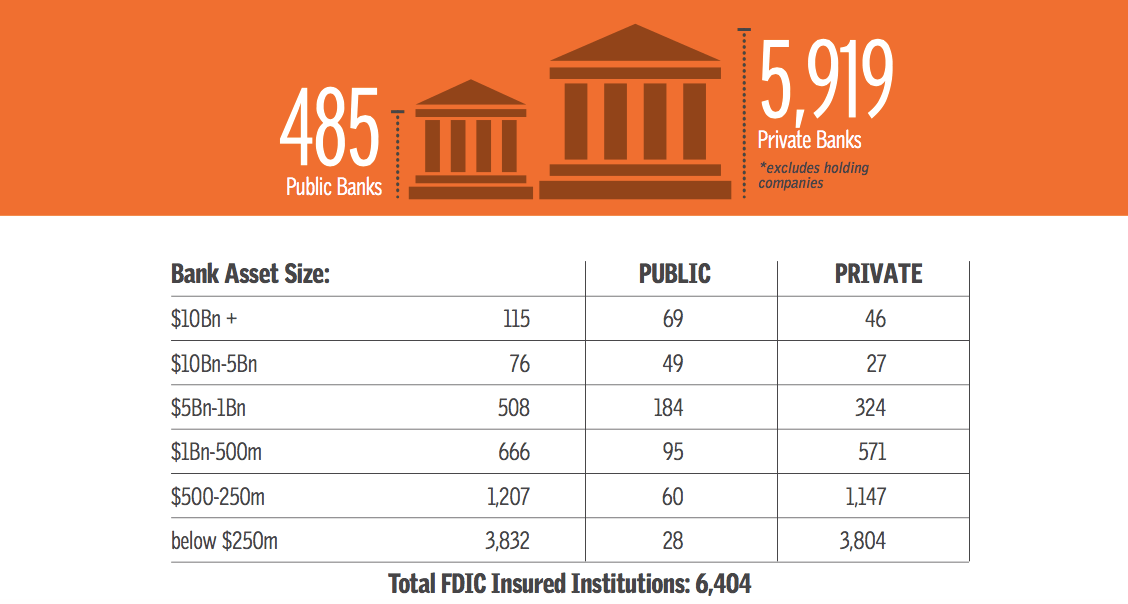
By design, the numbers I share in the image above only reflect key data from the financial institutions attending.  In fact, we are prepared to welcome another 60+ professional services firms and product companies to the Biltmore.   While I am particularly impressed by the caliber of support provided to the industry by our sponsoring companies, today’s post focuses on a handful of issues impacting the officers and directors joining us from strong and well performing community banks.

While big banks typically garner mainstream headlines — Wells Fargo, Citi, JPMorganChase and Bank of America account for a whopping $8.1 Trillion of the $17.3 Trillion assets held by banks in the U.S. — the buying and selling of banks takes place outside their domain.  The overwhelming majority of deals today involve community banks, many of whom have their CEOs attending AOBA.  So for this hugely influential audience, here are my key points to know and consider before the conference kicks off.

  • M&A remains attractive inasmuch as successful transactions improve operating leverage, earnings, efficiency and scale.
  • Today’s regulatory environment can hold up a deal — so it has become popular to note that banks can make acquisitions depending on how “clean” both the buyer and seller are + how big the resulting bank becomes.
  • As seen in their superior financial metrics (e.g. ROAA and ROAE), larger banks are growing and consistently outperforming smaller banks.
  • Small and mid-sized banks’ importance to the overall economy and select business sectors remains in place; however, their earnings potential is less diverse then big banks, making them more vulnerable to new competitors and shifts in pricing of financial products.

Certainly, the buying and selling of banks has been the industry’s “great game” for the last couple of decades.  As the conference agenda reflects, we dive deeper into topics like these and look at pre-deal considerations, post-integration challenges and everything in between.  So for those not able to join us — but interested in following the conversations — I invite you to follow me on Twitter via @AlDominick, the host company, @BankDirector, and search & follow #AOBA16 to see what is being shared with (and by) our attendees.

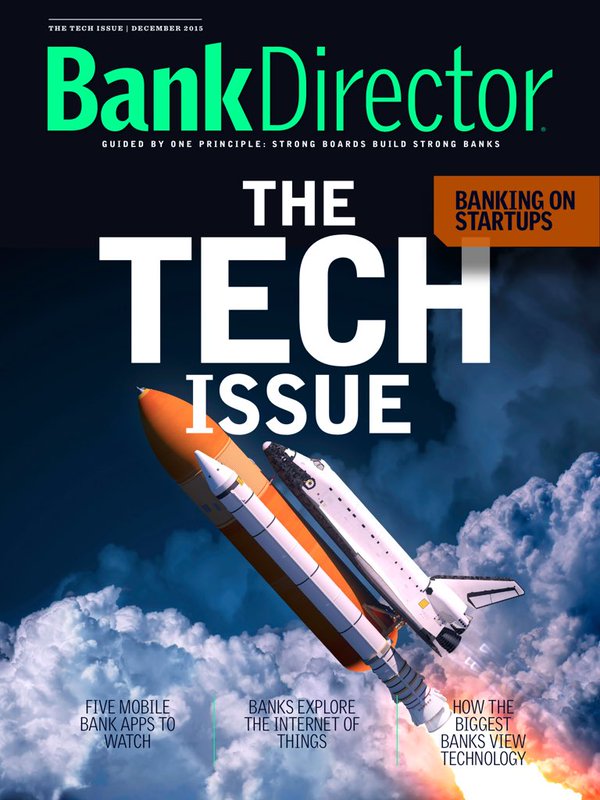
Bank Director’s annual Tech Issue is now available for free

Take a look at Bank Director’s just-published “Tech Issue.” In it, we look at how bank CEOs and executive teams can better engage with fintech companies, what the biggest banks are doing in terms of technology strategy and what the Internet of Things (IoT) means for financial institutions in 2016.

To download this free issue:

  1. On Your Tablet or Mobile Device, Select Apple’s AppStore, Google Play or Amazon’s Apps;
  2. Search “Bank Director Digital Magazine;” and
  3. Download the App to Your Digital Device & Enjoy.

Happy Holidays!

How We Are Taking a Lean Startup Approach to our Grown-up Business

A lean startup methodology enables entrepreneurs to efficiently build a company by searching for product and/or market fit rather than blindly trying to execute.  I find it helps mature companies too — and thought the perspectives of Stanford Professor Steve Blank, Silicon Valley entrepreneur Ben Horowitz and Y Combinator’s Sam Altman might resonate with bankers, fintech companies and other small business CEOs that are thinking about how to adapt their businesses to new challenges and opportunities. 

Paying It Forward

By Al Dominick // @aldominick

As someone who long aspired to build and run a company, I take great pride in leading a profitable, privately-held, twenty-person-strong small business.  In the past, I have written about my “people > products > performance” approach to leading the Bank Director team.  So when Ben Horowitz (co-founder and Partner of the venture capital firm Andreessen Horowitz) shares on his blog, “it’s not about how smart you are or how well you know your business; it’s about how that translates to the team’s performance and output,” I find myself nodding in total agreement.

Look, I am so very proud of our team’s accomplishments… but I am even more excited to adapt the lean startup methodology to scale our business.  The approach we are taking builds on the wisdom and experience of others. So for anyone responsible for growing their business, allow me to recommend two “must reads:”

For me, we are “all-in” in terms of taking a lean startup approach to expanding our business without compromising our reputation for going narrow & deep, providing a “Four Seasons” level of experience at our events and delivering outstanding ideas and insights to a hugely influential audience.  In addition, we are supremely mindful to do as Sam Altman says.  That is, create something that a small number of people love rather than a product that a large number of people simply like.

H1: The Core Business

Admittedly, I am hesitant to call our approach to growing Bank Director a bootstrapping effort since the brand, relationships and revenue being generated enable us certain luxuries that many start-ups simply do not have.  Nonetheless, let me show you how we adapted the Horizon 1 (H1) and Horizon 3 (H3) framework depicted above to our business.

What began in 1991 as a traditional publishing company now operates as a privately-held media enterprise delivering original content to CEOs, executives and board members of financial services companies via digital platforms, exclusive conferences and award-winning publications.  Below is a visual example of our transformation vis-a-vis three magazine covers.  As you can see, we have matured in style while expanding our frequency (from quarterly to monthly) as we expanded our distribution channels.

Going narrow and deep works for us since we generate our revenue from the annual conferences & events we host (e.g. our 800+ person Acquire or Be Acquired conference), publications and research we publish and education & training services we provide.

H3: Where the Wild Ideas Live

With three consecutive years of top line growth (and healthy bottom line results to boot), we are in the wonderful position to grow in some pretty cool ways.  But doing so will take more than simple process improvements and expense control.  As we have a strong business foundation in place, I did have to restructure my management team’s individual roles and responsibilities to better suit our H1/H3 setup.  I did so because as Steve Blank points out, “Horizon 3 is where companies put their crazy entrepreneurs… these innovators want to create new and potentially disruptive business models.” As fun as living/working in H3 sounds, let me emphasize how much I rely on the H1 team to “defend, extend and increase” our core business.

Is it working?  Well, we will formally announce a new venture, FinXTech, on March 1, 2016 at Nasdaq’s MarketSite in New York City.  This is the first — and surely not last — project to emerge from our H3 world.  But time will ultimately tell.

We are a collection of creative men and women and I am very optimistic about our future.  Realizing that we want to continuously push to grow and innovate led me to appreciate “the need to execute (to the) core business model while innovating in parallel.”  So today’s post isn’t an attempt to make me look smart; rather, my attempt to acknowledge the inspiration of others and share what’s working for us.

Size & Scale: The King and Queen of Bank M&A?

Earlier this week, I shared my perspectives on bank M&A with the Wall Street Journal.  What follows builds off the piece that ran in Tuesday’s print edition, highlighting key findings from Bank Director’s annual Bank M&A Survey.

By Al Dominick // @aldominick

At a time when J.P. Morgan is getting smaller, the pressure is on for smaller banks to get bigger.  As KPMG recently shared with BankDirector.com, there was a 25% increase in bank deals in the U.S. in 2014, compared to 2013, and there is a good possibility that the number of deals in 2015 will exceed that of 2014.  One reason for this: a larger institution can spread costs (such as investments and regulatory burdens) across a larger customer and revenue base.

Not surprisingly, 67% of executives and board members responding to Bank Director’s 2016 Bank M&A Survey say they see a need to gain more scale if they are going to be able to survive in a highly competitive industry going forward.  As our director of research, Emily McCormick, shared, “many of these respondents (62%) also see a more favorable climate for bank deals, hinting at a more active market for 2016 as banks seek size and scale through strategies that combine organic growth with the acquisitions of smaller banks.”

While the majority of bank executives and boards surveyed feel a need to grow, respondents don’t agree on the size banks need to be in order to compete today.  A slim majority, 32%, identified $1 billion in assets as the right size… interesting, but not surprising, when you consider that 89% of commercial banks and savings institutions are under $1 billion in assets, according to the FDIC (*personally, I’m of the opinion that $5Bn is the new $1Bn, but that’s a topic for another day).  On to the key findings from this year’s research:

  • Two-thirds report their bank intends to participate in some sort of acquisition over the next 12 months, whether it’s a healthy bank (51%), a branch (20%), a nondepository line of business (14%), a loan portfolio (6%) and/or a financial technology firm (a scant 2%).
  • Respondents indicate that credit culture, at 32%, and retaining key talent that aligns with the buyer’s culture, at 31%, are the most difficult aspects of the post-merger integration process.
  • More institutions are using social media channels to communicate with customers after the close of the deal. 55% of respondents who purchased a bank in 2014 or 2015 used social media, compared to 42% of 2011-2013 deals and just 14% of 2008-2010 deals (*FWIW, Facebook, at 26%, is the most popular channel for respondents).
  • Fifty-six percent of respondents have walked away from a deal in the past three years.  Of the respondents who indicate they declined to buy, 60% cite deal price while 46% blame the credit quality of the target institution.
  • Why do banks sell? Of the executives and board members associated with banks sold from 2012 to 2015, 55% say they sold because shareholders wanted to cash out.  Despite concerns that regulatory costs are causing banks to sell, just 27% cite this burden as a primary motivator.

The full survey results are now available online at BankDirector.com, and will be featured in the 1st quarter, 2016 issue of Bank Director magazine.  In addition, for those executives interested in connecting with many of the key decision makers driving the deals mentioned above, our annual Acquire or Be Acquired Conference will be held at the Arizona Biltmore from January 31 through February 2.

##

Our 2016 Bank M&A Survey, sponsored by Crowe Horwath LLP, examines current attitudes and challenges regarding bank M&A, and what drives banks to buy and sell. The survey was completed in September 2015 by 260 chief executive officers, independent directors and senior executives of U.S. banks, and former executives and directors of banks that have been acquired from 2012-2015.

While Everybody’s Talking About the Future of Banking…

It seems like everyone has an opinion about what the future holds for banking… but what does banking actually look like today?

By Al Dominick // @aldominick

For the past few years, Bank Director magazine’s Editor-in-Chief, Jack Milligan, has spearheaded our Bank Performance Scorecard, a ranking of the largest U.S. publicly traded banks and thrifts. The most recent version, which appears in our third quarter issue, ranked all banks and thrifts listed on the New York Stock Exchange and Nasdaq OMX.  Jack and his team sorted them into three separate asset categories: $1 billion to $5 billion, $50 billion to $50 billion and $50 billion and above — and we ranked them using a set of metrics that measured profitability, capitalization and asset quality based on 2014 calendar year data.

While this data shines a light on some of banking’s standout performers, my last few months of travel across the U.S. has revealed less familiarity with the banking industry then I expected. So today, instead of focusing on economic, political, demographic or technological forces reshaping the banking landscape, allow me to share some statistics I think are important to know:

  1. Banks with less than $10 billion in assets have lost over half of their market share in the past 20 years.
  2. The corollary? The five largest banks now hold almost 44% of all banking assets in the country.
  3. Despite totaling 89% of all banks, institutions under $1B in assets hold only 8.3% of the industry’s assets.

With competition coming from both the top of the market and from non-traditional players, I have talked with numerous bank CEOs and various members of their executive teams who tell me how imperative it is for them to really focus on improving efficiencies and enhancing organic growth prospects.  In addition, as big banks invest in customer acquisition, and non-traditional players continue to eat away at earnings potential, it strikes me that of all of the risks facing a bank’s key leadership team today (for instance, regulatory, market and cyber) knowing when to buy, sell or grow independently has to be high on the list. After all, the most profitable financial companies are often those whose strategies are intentional, focused and differentiated… and are showing current revenue growth with strong visibility towards future performance.

Of course, any discussion about the world in which banks live today has to acknowledge two significant business threats. Since most banking products tend to be commodities that are available at any number of bank and non-bank providers, the first concerns customer acquisition costs. Personally, I believe such costs will increase as existing customers become less likely to refer their bank to others. This leads to the second threat; namely, banks will lose revenue as customers leave for competitors and existing customers buy fewer products.

So a high-level look at where things are today. I realize this takes a very broad brush to a mature industry. Still, to understand where banks might be heading, I find it helpful to be grounded in where they are today.