Cybersecurity and the Fintech Wave

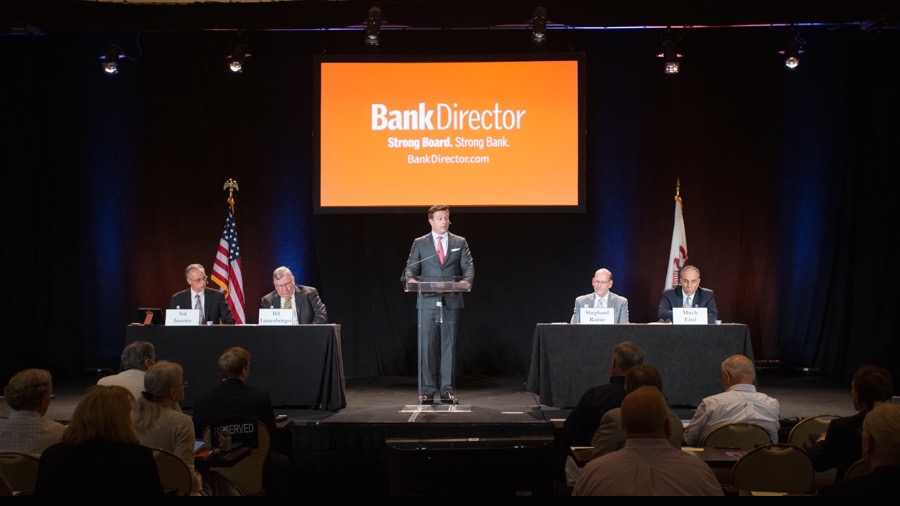
Earlier this month, at Bank Director’s FinTech Day at Nasdaq’s MarketSite in New York City, I noted how many technology firms are developing strategies, practices and tools that will dramatically influence how banking gets done in the future. Concomitantly, I expressed an optimism that banks are learning from these new players, adapting their offerings and identifying opportunities to collaborate with new “digital-first” businesses.  Unfortunately, with great opportunity comes significant risk (and today’s post looks at a major one challenging bank CEOs and their boards). 

By Al Dominick, President & CEO, Bank Director

To grow your revenue, deposits, brand, market size and/or market share requires both strong leadership and business strategy.  Right now, there are a handful of banks developing niche vertical lines of business to compete with the largest institutions. For instance, East West Bancorp, EverBank Financial, First Republic Bank, Opus Bank, PacWest Bancorp, Signature Bank and Texas Capital Bancshares.

Just as compelling as each bank’s approach to growing their business is the idea that new competitors in direct and mobile banking will spur the digitalization of our industry.  I am a firm believer that through partnerships, acquisitions or direct investments, incumbents and upstarts alike have many real and distinct opportunities to grow and scale while improving the fabric of the financial community.

However, with myriad opportunities to leverage new technologies comes significant risk, a fact not lost on the bank executives and board members who responded to Bank Director’s 2016 Risk Practices Survey, sponsored by FIS.  For the second year running, they indicate that cybersecurity is their top risk concern.

More respondents (34 percent) say their boards are reviewing cybersecurity at every board meeting, compared to 18 percent in last year’s survey, indicating an enhanced focus on cybersecurity oversight. Additionally, more banks are now employing a chief information security officer (CISO), who is responsible for day-to-day management of cybersecurity.

However, the survey results also reveal that many banks still aren’t doing enough to protect themselves—and their customers. Less than 20 percent of respondents say their bank has experienced a data breach, but those who do are just as likely to represent a small institution as a large one, further proof that cybersecurity can no longer be discussed as only a “big bank” concern.

For those thinking about the intersection of fintechs and banks, take a look at our just-released 2016 Risk Practices Survey. This year, we examine risk governance trends at U.S. banks, including the role of the chief risk officer and how banks are addressing cybersecurity. The survey was completed in January by 161 independent directors, chief risk officers (CRO), chief executive officers (CEO) and other senior executives of U.S. banks with more than $500 million in assets.

Key Findings Include:

  • Sixty-two percent of respondents indicate their bank has used the cybersecurity assessment tool made available by the Federal Financial Institutions Examination Council, and have completed an assessment. However, only 39 percent have validated the results of the assessment, and only 18 percent have established board-approved triggers for update and reporting. FWIW, bank regulators have started to use the tool in exams, and some states are mandating its use.
  • Seventy-eight percent indicate that their bank employs a full-time CISO, up from 64 percent in last year’s survey.
  • The majority, at 62 percent, say the board primarily oversees cybersecurity within the risk or audit committee. Twenty-six percent govern cybersecurity within the technology committee.
  • Forty-five percent indicate that detecting malicious insider activity or threats is an area where the bank is least prepared for a cyberattack or data breach.
  • Just 35 percent test their bank’s cyber-incident management and response plan quarterly or annually.

Clearly, banks are increasingly relying on complex models to support economic, financial and compliance decision-making processes.  Considering the full board of a bank is ultimately responsible for understanding an institution’s key risks — and credibly challenging management’s assessment and response to those risks — I am pleased to share this year’s report as part of our commitment to providing timely & relevant information to the banking community.

Banking on Fintech DNA

As we talked about at FinTech Day last Tuesday, technology will play a fundamental role in changing the dynamics of banking, be it shining a light on out-dated practices to dramatically enriching the services and experiences being offered to customers.

By Al Dominick, President & CEO, Bank Director

As our editor-in-chief recently wrote, “technology has always been integral to banking, bringing both speed and efficiency to a transaction-intensive business. But in recent years, technology has stepped onto center stage as a prime component in every bank’s growth and distribution strategy. Technology has, in effect, gone from being a way to save money (a crucial function that it still fulfills) to a way to make money. Much of this activity is being driven by the continued growth of mobile and online banking.”

During a panel session entitled “Banking’s New DNA,” I noted how numerous financial technology companies are developing new strategies, practices and products that will dramatically influence the future of banking.  Within this period of transformation, where considerable market share is up for grabs, I believe ambitious banks can leapfrog both traditional and new rivals.

I find the narrative that relates to banks and fintech companies has changed from the confrontational talk that existed just a year or two ago.  As we found at this year’s FinTech Day in New York City, far more fintech players are expressing their enthusiasm to partner and collaborate with banking institutions who count their strengths and advantages as strong adherence to regulations, brand visibility, size, scale, trust and security.  For me, considering such a partnership affords a bank’s leadership team an important chance to look in the mirror and ask:

  1. Are we exceeding our customer’s digital experience expectations?
  2. How do we know if we’re staying relevant?
  3. Do we have a “Department of No” mindset?

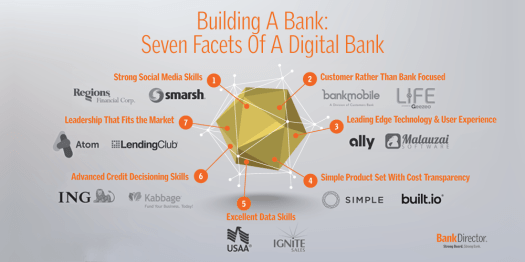
I elaborate on these pieces in an article now up on BankDirector.com; to read it, please click here.  Likewise, take a look at the seven facets of building a digital bank.  When it comes to the DNA one needs to compete in the future, I find these elements essential to any operation. 7 elements of a digital bank - by Bank Director and FinXTech

Feel free to comment on these questions and the elements shared above.  What else do you think could/should be added and considered?

3 Quick Takeaways from #fintech16 (aka Bank Director’s FinTech Day at Nasdaq’s MarketSite)

As evidenced by the various conversations at yesterday’s FinTech Day, the next few years promises to be one of profound transformation in the financial sector.

By Al Dominick, President & CEO, Bank Director

At a time when changing consumer behavior and new technologies are inspiring innovation throughout the financial services community, I had a chance to open this year’s FinTech Day program with a look at how collaboration between traditional institutions and emerging technology firms bodes well for the future.  With continuous pressure to innovate, banks today are learning from new challengers, adapting their offerings and identifying opportunities to collaborate. At the same time, we continue to watch as many fintech companies develop strategies, practices and new technologies that will dramatically influence how banking gets done in the future.

Personally, I believe this is a very exciting time to be in banking — a sentiment shared by the vast majority of the 125+ that were with us at Nasdaq’s MarketSite yesterday.  While I plan to go deeper into some of the presentations made in subsequent posts and columns on BankDirector.com, below are three slides from my welcoming remarks that various attendees asked me to share.

7 elements of a digital bank - by Bank Director and FinXTech

For the above image, my team took a step into an entrepreneurs shoe’s and envisioned an opportunity to build a new, digital-only bank from the ground up.  We consider these seven facets as base elements for success — and the companies listed provide real-life examples of financial institutions & fintechs alike that we see “doing it right.”

FinTech Day Deck1 (dragged)

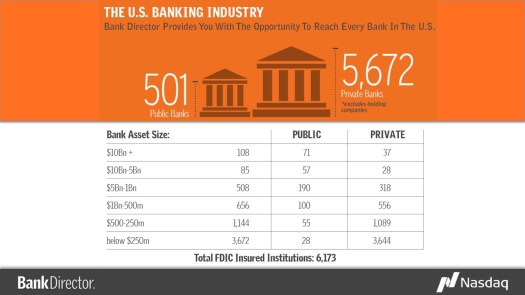
The irony of sharing an idea for a new bank?  Newly chartered banks (de novos) are basically extinct.  So for a program like FinTech Day, I thought it was imperative to provide context to the U.S. banking market by looking at the total number of FDIC-insured institutions.  These numbers are accurate as of last Friday.

FinTech Day Deck1 (dragged) 1

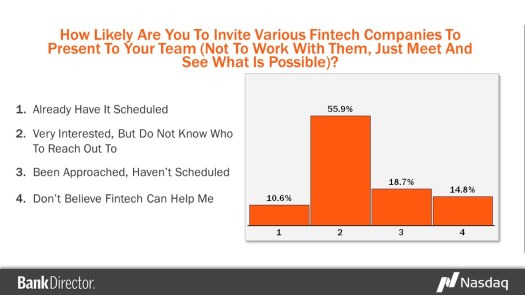
This final slide comes from our annual Acquire or Be Acquired conference in Arizona.  There, we welcomed 930+ to explore financial growth options available to a bank’s CEO and board.  To open our second full day, I polled our audience using a real-time response device to see how likely they are to invite a fintech company in for a conversation.  As you can see from the results above, real opportunities remain for meaningful dialogue and partnership discussions.

##

Thanks to all who joined us, the speakers that shard their insights and opinions and our friends from Nasdaq!

Fintech in 2016: A Whole Lot of Collaboration

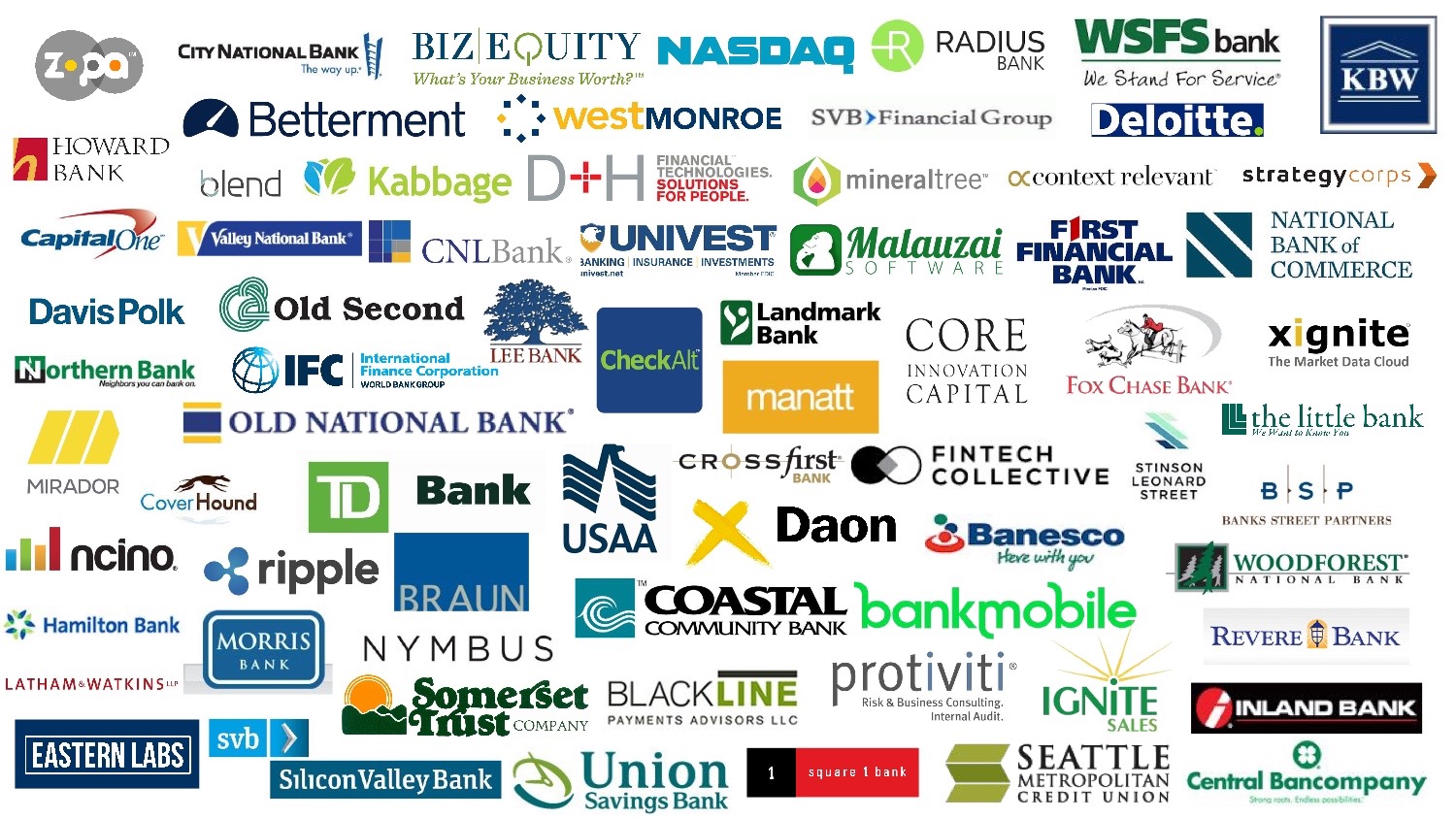
While some of the largest and most established financial institutions have struck relationships with various financial technology firms (and not just startups / early stage), opportunities for meaningful partnerships abound.  At Bank Director’s annual FinTech Day at Nasdaq’s MarketSite in Times Square next Tuesday, we explore — with executives from the companies depicted above — what’s really possible when banks and fintechs collaborate to help each other’s businesses accelerate and scale.

By Al Dominick, President & CEO, Bank Director

A fundamental truth: individuals, along with business owners, have more choices than ever before in terms of where, when and how they bank. So a big challenge — and dare I suggest, opportunity — for leadership teams at financial institutions and fintech companies alike entails aligning services & product mixes to suit core customers’ current interests and prospective one’s expectations.

Yesterday, I shared how the fabric of the financial industry continues to evolve as new technology players emerge and traditional participants transform their business models. Indeed, many fintech companies are developing strategies, practices and new technologies that will dramatically influence how banking “gets done” in the future. However, within this period of change — where considerable market share will be up for grabs — I believe that ambitious organizations can leapfrog both traditional and emerging rivals.

Clearly, bank CEOs and their teams must seek new ways to not just stay relevant but to stand out.  While a number of banks seek to extend their footprint and franchise value through acquisition, many more aspire to build the bank internally. Some show organic growth as they build their base of core deposits and expand their customer relationships; others see the value of collaborating with fintech companies.

For a bank CEO and his/her executive team, knowing who’s a friend, and who’s a potential foe, is hugely important.  Personally, I have found this to be quite difficult for many regardless of their size or market.  Moreover, I find this to be a two-sided challenge in the sense that for a fintech founder or executive, identifying those banks open to partnering with, investing in or even acquiring a company like the one they run presents as great a challenge as it does opportunity.

So as more & more fintech companies look to partner with legacy players — and banks warm to such a dynamic — I am excited to think about the creative new partnerships that can be explored to ease payment processes, reduce fraud, save users money, promote financial planning and ultimately, move our giant industry forward.

FinTech Day is One Week Away

The fabric of the financial industry continues to evolve as new technology players emerge and traditional participants transform their business models. Through partnerships, acquisitions or direct investments, incumbents and upstarts alike have many real and distinct opportunities to grow and scale.  If 2015 was all about startups talking less about disruption and more about cooperation, I see 2016 as the year that banks reciprocate.

By Al Dominick, President & CEO, Bank Director

Next Tuesday, at Nasdaq’s MarketSite in Time Square, our team hosts our annual “FinTech Day.” With so many new companies pushing their way into markets and product lines that traditionally have been considered the banking industry’s turf, we look at what fintech means for traditional banks. Likewise, we explore where emerging fintech players may become catalysts for significant change with the support of traditional players.  When it comes to trends like the personalization of banking, the challenges of scaling a company in our highly regulated industry and what shifting customer expectations portend for banks and fintechs alike, we have a full day planned. Take a look at some of the issues we will address.

Riding The Wave Of Change
Al Dominick, President & CEO, Bank Director
Robert H. McCooey, Jr., Senior Vice President of Listing Services, Nasdaq

At a time when changing consumer behavior and new technologies are inspiring innovation throughout the financial services community, we open this year’s program with a look at how collaboration between traditional institutions and emerging technology firms bodes well for the future.

Banking’s New DNA
Michael M. Carter, CEO, BizEquity
Vivian Maese, Partner, Latham & Watkins
Eduardo Vergara, Head of Payments Services & Global Treasury Product Sales, Silicon Valley Bank
Moderated by: Al Dominick, President & CEO, Bank Director

With continuous pressure to innovate, banks today are learning from new challengers, adapting their offerings and identifying opportunities to collaborate.  With this opening session, we focus on the most pressing issues facing banks as they leverage new tools and technologies to compete.

Who Has the Power to Transform Banking
Jeana Deninger, Senior Vice President, Marketing, CoverHound, Inc.
Brooks Gibbins, Co-Founder & General Partner, FinTech Collective
Colleen Poynton, Vice President, Core Innovation Capital
Moderated by: Al Dominick, President & CEO, Bank Director

While fintech startups continue to spearhead the technological transformation of financial services, recent efforts by systemically important financial institutions call into question who reallly has the power to tranform banking. From an investment perspective, recent market turmoil may put some opportunities on hold – while others now have a higher, sharper bar to clear. In this session, we talk to investors about the traits that they look for when backing a venture in the context of a changing economic environment.

Opportunities to Reinvigorate the Banking Industry
Tom Kimberly, General Manager, Betterment Institutional
Thomas Jankovich, Principal & Innovation Leader, US Financial Services Practice, Deloitte Consulting LLP
Pete Steger, Head of Business Development, Kabbage, Inc.
Moderated by: Al Dominick, President & CEO, Bank Director

Many fintech companies are developing strategies, practices and new technologies that will dramatically influence how banking gets done in the future. However, within this period of upheaval – where considerable market share will be up for grabs – ambitious banks can leapfrog both traditional and new rivals. During this hour, we explore various opportunities for financial services companies to reinvigorate the industry.

Opportunities to Financially Participate in Fintech
Joseph S. Berry, Jr., Managing Director, Co-Head of Depositories Investment Banking, Keefe, Bruyette & Woods, Inc. A Stifel Company
Kai Martin Schmitz, Leader FinTech Investment LatAm, Global FinTech Investment Group, International Finance Corporation
Moderated by: Al Dominick, President & CEO, Bank Director

While large, multinational banks have made a series of investments in the fintech community, there is a huge, untapped market for banks to become an early-stage investor in fintech companies. Based on the day’s prior conversations, this session looks at opportunities for banks to better support emerging companies looking to grow and scale with their support.

##

While this special event on March 1 is sold out, you can follow the conversations by using #Fintech16 @aldominick @bankdirector @finxtech and @bankdirectorpub.  And as a fun fact, I’ll be ringing the closing bell next Tuesday flanked by our Chairman and our Head of Innovation.  So if you are by a television and can turn on CNN, MSNBC, Fox, etc at 3:59, you’ll see some smiling faces waving at the cameras.

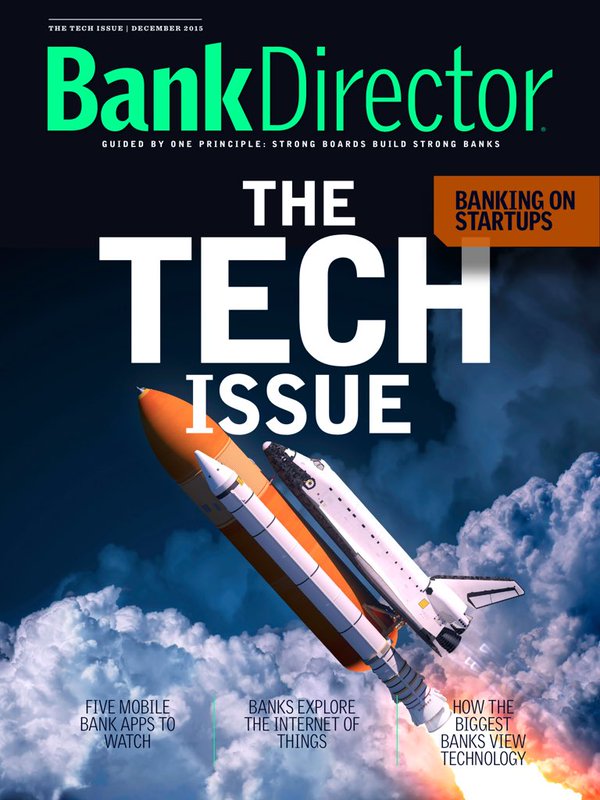
Bank Director’s annual Tech Issue is now available for free

Take a look at Bank Director’s just-published “Tech Issue.” In it, we look at how bank CEOs and executive teams can better engage with fintech companies, what the biggest banks are doing in terms of technology strategy and what the Internet of Things (IoT) means for financial institutions in 2016.

To download this free issue:

  1. On Your Tablet or Mobile Device, Select Apple’s AppStore, Google Play or Amazon’s Apps;
  2. Search “Bank Director Digital Magazine;” and
  3. Download the App to Your Digital Device & Enjoy.

Happy Holidays!

Quick Guide: 2015 Growth Strategy Survey (Bank-specific)

Recently, Business Insider and the Wall Street Journal picked up Bank Director’s 2015 Growth Strategy Survey.  The research project reveals how many financial institutions continue to recognize growth in traditional areas — most notably, loans to businesses and commercial real estate — while struggling to attract a decidedly untraditional digital generation.  So in case you missed it, today’s piece highlights key findings from this annual research project. 

By Al Dominick // @aldominick

Over the weekend, our friends at the Wall Street Journal ran a very telling story about the efforts being made by the San Francisco 49ers to better engage with their millennial employee base.  Clearly, the NFL franchise’s challenge to “relate to a generation — generally described as 18-to-34-year-olds — that has been raised on smartphones and instant information” parallels that of most banks in the U.S.  In addition to being a fascinating behind-the-scenes look at what’s happening out in Santa Clara, it also sparked today’s post.

You see, as a 38-year old who runs a great privately-held company that employs quite a few folks under the age of 30, I have to admit that I am tiring of the broad strokes being used to describe millennials’ needs and ambitions.  However, I will admit to being surprised to learn that there are approximately 75 million people in the U.S. under the age of 34.  This is a huge number, especially when you hear that every day, for the next 15 years, 10,000 people will turn 65 (h/t to the CEO of Boston’s Chamber of Commerce for making me aware of this reality).

Surprisingly, 60% of the executives and board members that responded to Bank Director’s 2015 Growth Strategy Survey say their bank might not have the right products, services and delivery methods to serve the vast majority of this demographic.  While I haven’t run this by our very talented Director of Research (*hello Emily McCormick), to me, this shows that the relationships that community bankers nurtured for decades will be increasingly of less value with this emergingly-influential generation who have grown up in a digital world and who, stereotypically, value the speed with which it operates.

As the Wall Street Journal shared when reporting on our research results, “banks have watched less regulated finance companies ranging from mortgage lenders to private-equity firms encroach on many of their main businesses.  But ask an executive or board member at a bank what nonbank company they most fear, and they’re likely to name the world’s biggest technology company, Apple Inc.”  So what were our key findings?  Glad you asked…

Three key findings (click this title link to access the full report):

  1. Apple is the nonbank competitor respondents worry about most, at 40%  — just 18% of respondents indicate their bank offers Apple Pay.
  2. Bank mobile apps may not keep pace with nonbank competitors. Features such as peer-to-peer payments, indicated by 28% of respondents, or merchant discounts and deals, 9%, are less commonly offered within a traditional bank’s mobile channel. 49% of respondents indicate their bank offers personal financial management tools.
  3. Despite the rise of P2P lenders like Lending Club and Prosper in the consumer lending space, just 35% of respondents express concern that these startup companies will syphon loans from traditional banks.

Instead of millennials, banks have been finding most of their growth in loans to businesses and commercial real estate.  Yes, 75% of respondents want to understand how technology can make their bank more efficient… and 72% want to know how technology can improve the customer experience.  But I find it telling that today, loan growth remains the primary driver of profitability for the majority of responding banks.  In fact, 85% of respondents see opportunities to grow through commercial real estate loans.  As we found, executives and board members also expect to grow through commercial & industrial (C&I) lending, for 56%, and residential mortgages, at 45%.  So for those looking to predict the future of banking, I think findings like these are quite telling.  Indeed, it would appear what’s worked in the past may be what to bet on for the future.

##

The 2015 Growth Strategy Survey, sponsored by technology firm CDW, reveals how bankers perceive the opportunities and challenges in today’s marketplace, and technology’s role in strategic growth. The survey was completed by 168 chief executive officers, independent directors and senior executives of U.S. banks with more than $250 million in assets in May, June and July of this year.  Ironically, last year’s survey found that credit unions, not Apple, were the “non-bank” competitor that banks were most worried about.  In fact, can you believe that Apple didn’t even make the cut?  My, how quickly times can change.

Pushing Forward: The Future of Financial Services?

Yesterday, the L.A. Times wrote about a bank that is “part lender, part consultant, part cheerleader and part investor… a nursemaid to countless start-ups — Airbnb, Fitbit, Pinterest and TrueCar, to name some recent ones — as well as banking the venture capitalists who fund them.” Curious to learn more about this California-based innovator with a great reputation for serving software, hardware, biotech and healthcare start-ups? Read on.

By Al Dominick // @aldominick

Bank Director’s managing editor, Naomi Snyder, recently wrote that “banks are used to identifying, monitoring and mitigating risks, more so than they are adept at innovating. But an argument gaining increasing weight is the notion that banks really are technology companies and need to think more like a technology company.”  But what if, instead of transforming one’s business model to resemble a tech firm, an institution instead acted like Silicon Valley Bank, the Santa Clara-based powerhouse that has financed scores of the highest-flying tech companies like those mentioned above.

Certainly, this standout financial institution has a knack for staying close to their customers (*take a look at their Innovation Economy Outlook 2015).  So at a time when many banks are shrinking in relevance despite their important role in local economies, I thought to take a look at this “unusual for an FDIC-regulated bank.”  Billed as the bank of the world’s most innovative companies and their investors, the LA Times shared that with $40.2 billion in assets, Silicon Valley Bank now has “the heft to handle them from start-up to initial public offering, multiplying its profits on larger loans and fees.”  Further,

The bank, which recently opened an office in Santa Monica, is more willing than others to focus on a start-up’s growth prospects rather than its current financial condition and to lend money so businesses can expand while awaiting the next round of venture capital funding, said investor Mark Suster, a client and managing partner at Upfront Ventures in Los Angeles.

Now, this doesn’t preclude the bank from identifying a good thing that can help it to continue to push forward the future of financial services.  Case-in-point, I woke up a few days ago to find, via Twitter, that Standard Treasury team joined SVB Financial’s information technology team “to help it expand the bank’s digital banking platform.”  Just as I looked at Capital One’s recent fintech acquisitions in my last post (How Capital One Can Inspire Your Digital Efforts), the fact that the bank hired the team from startup company Standard Treasury to help accelerate the development of its API (application programming interface) banking services underscores the institutions drive to “enable easier collaboration, product development and integration with… clients.”

While catching up to Silicon Valley Bank — which boasts of having half of all startups in the U.S. as clients — will challenge many traditional institutions, I think it makes far more sense to look at what they have accomplished and suggest banks in markets where venture-backed start-ups are taking off try to pattern their business after SVB’s successes rather than radically shifting the underlying business model to emulate what might work for a technology company.

Of course, the LA Times does remind us that “most also don’t come close to Silicon Valley Bank’s well-connected network of outside experts, mentors, tech executives, venture capitalists and current and former clients ready to help its upstart entrepreneurs — no matter how farfetched an idea might seem.” Nevertheless, at a time when individuals along with business owners have more choices than ever before in terms of where, when and how they bank, I think leadership teams at financial institutions of all sizes should pay attention to how Silicon Valley Bank aligns its services (and product mixes) to suit core customers’ interests and expectations.

How Capital One Can Inspire Your Digital Efforts

While venture-backed fintech firms continue to garner attention for being “ahead of the times,” don’t sleep on the franchise being built by Capital One.

By Al Dominick // @aldominick

Should you look at the term “innovation” and disassociate it with the banking sector, you are forgiven.  But innovative is exactly the description I favor for Capital One Financial Corp. (NYSE: COF), especially as I define the term as an ability to monetize creative ideas, products and processes.  Indeed, the McLean, VA-based bank ranked first among the 20 publicly-traded banks with assets of more than $50 billion in Bank Director magazine’s annual Bank Performance Scorecard and is widely considered at the forefront of taking a technology-based, consumer-centric focus to banking.

As we see in their financial performance, Capital One managed to increase net income and benefited from the high profitability of a substantial credit card operation and the stable funding of a regional banking franchise.  As you can read, the company rated highly on traditional profitability metrics: they posted a return on average assets (ROAA) of 1.53, a return on average equity (ROAE) of 10.33 and a Tangible Common Equity ratio of 9.82.  So while various fintech companies make news for their valuations (*hello Stripe, which received major funding from Visa and other investors, valuing the startup at $5 billion) or loan volume (**hola Lending Club, which originated nearly $2 billion in loans during Q2), I’m paying attention to Capital One’s performance.

Nonetheless, their financial numbers don’t tell the whole story.

As our editor, Jack Milligan, writes in “How Young and Hungry Fintech Companies are Disrupting the Status Quo,” the digital financial services space “is exploding in activity as new technology companies push their way into markets and product lines that traditionally have been the banking industry’s turf.” To this point, many bank executives should take note of Capital One’s focus on technology and its business model.  Its CEO, Richard Fairbank, is focused on leading the digital transformation of banking and is not shy in stating that “the winners in banking will have the capabilities of a world-class software company.  Most of the leverage and most of our investment is in building the foundational underpinnings and talent model of a great digital company.  To succeed in a digital world (you) can’t just bolt digital capabilities onto the side of an analog business.”

Cases in point, Capital One acquired money management app Level Money earlier this year to help consumers keep track of their spendable cash and savings.  Prior to that, they acquired San Francisco-based design firm Adaptive Path “to further improve its user experience with digital.”  Over the past three years, the company has also added e-commerce platform AmeriCommerce, digital marketing agency Pushpoint, spending tracker Bundle and mobile startup BankOns.  Heck, just last summer, one of Google’s “Wildest Designers” left the tech giant to join the bank.

More and more banks are realizing that they have to fundamentally change to keep up with the industry’s digital transformation.  But shifting an organizational structure — and culture — to become more focused on what customers want and expect in an increasingly digital age is no simple task.  Not everyone can offer a broad spectrum of financial products and services to consumers, small businesses and commercial clients like Capital One does.  But all can certainly learn from the investments, partnerships and efforts being made by this standout institution.

In case you’re wondering…

Bank Director’s Bank Performance Scorecard uses five key metrics that measure profitability, capitalization and asset quality. ROAA and ROAE are used to gauge each bank’s profitability.  KeyCorp (NYSE: KEY), of Cleveland, ranked second, and rated highest for capital adequacy, with a TCE ratio of 9.87. In third place, U.S. Bancorp (NYSE: USB), of Minneapolis, topped the profitability metrics with a 1.55 ROAA and 13.53 ROAE. Wells Fargo & Co. (NYSE: WFC) and Comerica Inc. (NYSE: CMA) rounded out the top five.

Main Areas of Focus for a Bank’s Audit and Risk Committees

What’s top-of-mind for a bank’s Audit and Risk committee members?  Let’s start with cyber security…

By Al Dominick // @aldominick

There are many challenges that bank boards & executives must address, and these two videos (one by our editor, Jack Milligan; the other, by me) briefly review current issues that demand attention + emerging ones that we took note of at this week’s Bank Audit & Risk Committees Conference at the JW Marriott in Chicago.

*For more on the risks facing banks today, take a look at this report from our conference (#BDAudit15).

Three Observations from the Bank Board Growth & Innovation Conference

Select news and notes from the first day of Bank Director’s annual growth conference at the Ritz-Carlton New Orleans.

By Al Dominick // @aldominick

I mentioned this from the stage earlier today… every January, Bank Director hosts a huge event in Arizona focused on bank mergers and acquisitions.  Known as “AOBA,” our Acquire or Be Acquired conference has grown significantly over the years (this year, we welcomed some 800 to the desert).  After the banking M&A market tumbled to a 20-year low in 2009 of just 109 transactions, it has gradually recovered from the effects of the crisis. In fact, there were 288 bank and thrift deals last year, which was a considerable improvement on volume of 224 deals in 2013.  As our editorial team has noted, the buying and selling of banks has been the industry’s great game for the last couple of decades, but it’s a game that not all banks can — or want to — play.  Indeed, many bank CEOs have a preference to grow organically, and its to these growth efforts that we base today and tomorrow’s program.

Key Takeaway

To kick things off, we invited Fred Cannon, Executive Vice President & Director of Research at KBW, to share his thoughts on what constitutes franchise value. While he opened with a straight-forward equation to quantify franchise value over time — (ROE – Cost of Equity) × Market Premium — what really stuck with me during his presentation is the fact that a logo does not create franchise value, a brand does.  As he made clear, it is contextual (e.g. by industry’s served, technologies leveraged and clients maintained) and requires focus (e.g. you can’t be all things to all people).  Most notably, small and focused institutions trump small and complex ones.

Trending Topics

Anecdotally, the issues I took note of where, in no particular order:

  • Banks must be selective when integrating new technology into their systems.
  • The ability to analyze data proves fundamental to one’s ability to innovate.
  • When it comes to “data-driven decisions,” the proverbial life cycle can be thought of as (1) capture (2) store (3) analyze (4) act.
  • You don’t need a big deposit franchise to be a strong performing bank (for example, take a look at County Bancorp in Wisconsin)
  • We’ve heard this before, but size does matter… and as the size of bank’s balance sheet progresses to $10 billion, publicly traded banks generate stronger profitability and capture healthier valuations.

Picked Up Pieces

A really full day here in New Orleans, LA — with quite a few spirited discussions/debates.  Here are some of the more salient points I made note of throughout the day:

  • Selling services to large, highly regulated organization is a real challenge to many tech companies.
  • Shadow banking? Maybe its time I start calling them “Challenger banks.”
  • CB Insight’s has a blog called “unbundling the bank” — to understand the FinTech ecosystem, take a look at how they depict how “traditional banks are under attack from a number of emerging specialist startups.”
  • A few sidebar conversations about Wells Fargo’s incubator program, which the San Francisco bank began last August… interest in how the program involves direct investment in a select group of startups and six months of mentoring for their leaders.

To see what’s being written and said here in New Orleans, I invite you to follow @bankdirector, @aldominick + #BDGrow15.

Looking for Great FinTech Ideas

A fundamental truth about banking today: individuals along with business owners have more choices than ever before in terms of where, when and how they bank. So a big challenge — and dare I suggest, opportunity — for leadership teams at financial institutions of all sizes equates to aligning services and product mixes to suit core customers’ interests and expectations.

By Al Dominick // @aldominick

Sometimes, the temptation to simply copy, paste and quote Bank Director’s editor, Jack Milligan, is too much for me to resist. Recently, Jack made the case that the distinction between a bank and a non-bank has become increasingly meaningless.  In his convincing words:

“The financial service marketplace in the United States has been has crowded with nonbank companies that have competed fiercely with traditional banks for decades. But we seem to be in a particularly fecund period now. Empowered by advances in technology and data analysis, and funded by institutional investors who think they might offer a better play on growth in the U.S. economy than traditional banks, we’re seeing the emergence of a new class of financial technology – or fintech – companies that are taking dead aim at the consumer and small business lending markets that have been banking industry staples for decades.”

Truth-be-told, the fact he successfully employed a word like ‘fecund’ had me hunting down the meaning (*it means fertile).  As a result, that particular paragraph stuck in my mind… a fact worth sharing as it ties into a recent Capgemini World Retail Banking Report that I devoured on a tremendously turbulent, white-knuckling flight from Washington, D.C. to New Orleans this morning (one with a “minor” delay in Montgomery, AL thanks to this morning’s wild weather).

Detailing a stagnating customer experience, the consultancy’s comprehensive study draws attention “to the pressing problem of the middle- and back-office — two areas of the bank that have not kept pace with the digital transformation occurring in the front-office. Plagued by under-investment, the middle- and back-offices are falling short of the high level of support found in the more advanced front-offices, creating a disjointed customer experience and impeding the industry’s ability to attract, retain, and delight customers.”

Per Evan Bakker for Business Insider, the entirety of the 35-page report suggests “banks are facing two significant business threats. First, customer acquisition costs will increase as existing customers are less likely to refer their bank to others. Second, banks will lose revenue as customers leave for competitors and existing customers buy fewer products. The fact that negative sentiment is global and isn’t limited to a particular type of customer activity points to an industry wide problem. Global dissatisfaction with banks is likely a result of internal problems with products and services as well as the growing number of non-bank providers of competing products and services.”

While dealing with attacks from aggressive, non-bank competitors is certainly not a new phenomenon for traditional banks, I have taken a personal interest in those FinTech companies looking to support (and not compete with) financial institutions.  So as I set up shop at the Ritz-Carlton New Orleans through Wednesday for our annual Bank Board Growth & Innovation conference, let me shine the spotlight on eight companies that may help address some of the challenges I just mentioned. While certainly just the tip of the FinTech iceberg, each company brings something interesting to the table:

As unregulated competition heats up, bank CEOs and their teams need to continue to seek ways to not just stay relevant but to stand out.  While a number of banks seek to extend their footprint and franchise value through acquisition, many more aspire to build the bank internally. Some show organic growth as they build their base of core deposits and expand their customer relationships; others see the value of collaborating with FinTech companies.  To see what’s being written and said here in New Orleans, I invite you to follow @bankdirector, @aldominick + #BDGrow15.