Banks, Make Your Move Into the Cloud

Quickly:

  • To deliver a truly end-to-end digital customer experience, banks need to figure out how and when to move into the cloud.

PHOENIX — As we kicked off this year’s FinXTech Summit, I found myself engaged in a conversation about how (and why) banks might “freeze and wrap” their data using their current core system while moving their customer engagement and analytics into the cloud.  While this was my first time hearing that particular description/approach, the underlying logic certainly applies for many of the bankers joining us at the Phoenician.  In fact, it inspired this short video shot during today’s lunch.

As a company, we’ve been writing about banks realizing that the benefits of cloud computing outweigh added security risks for a while now.  But it strikes me that interest in cloud-based platforms has been on the rise of late.  As our friends at Blend shared on BankDirector.com, “the cloud presents opportunities for enhanced efficiencies and flexibility — without any security trade-offs — so it’s no surprise that we’re seeing more organizations shift to the software as a service (SaaS) model.”

Interested to see what a move into the cloud might means for banks?  Take a look at these five cloud-based companies:

  • nCino – expediting loans and workflow on top of force.com;
  • Apiture – an API-banking joint venture between Live Oak and First Data;
  • Payrailz – an API-based payments platform “check-free killer;”
  • Defense Storm – where Big Data meets Cyber for banks; and
  • Greenlight – offering debit cards for kids.

I’ll check in later tonight to recap several presentations that explore what makes for a strong, digitally-solid bank.  Before that posts, I invite you to follow the conference conversations via our social channels.  You can follow me @AlDominick on Twitter — and our team shares ideas and information through @BankDirector plus our @Fin_X_Tech platform. Finally, search & follow #FinXTech18 to see what’s being shared with (and by) our attendees.

##

FWIW, my reference to Amazon.com, Salesforce.com and Oracle in this video traces back to January 2, when Bloomberg reported the first two were “actively working to replace Oracle software running on crucial business systems with lower cost open-source database software.”  For more: Amazon, Salesforce Shifting Business Away From Oracle: Report

Kicking off FinXTech’s Summit

Quickly:

  • Technology continues to transform nearly every aspect of the financial services industry — from mobile payments to peer-to-peer lending to financial management.

PHOENIX — Tomorrow morning, we kick off our annual FinXTech Summit.  As I wrote yesterday, this annual event serves as our “in-person” bridge between banks and qualified technology companies.  Personally, I am so impressed to witness numerous financial institutions transforming how they offer banking products and services to businesses and individuals.  As such, I find myself eager to engage in tomorrow’s conversations around:

  • Partnerships, collaboration and enablement;
  • How and where banks can invest in cloud-based software; and
  • The business potential of machine learning, advanced analytics and natural language processors.

Joining us at the Phoenician are senior executives from high-performance banks like Capital One, Customers Bank, Dime Community Bancshares, First Interstate Bank, IBERIABANK, Mechanics Bank, Mutual of Omaha Bank, PacWest, Pinnacle Financial, Seacoast National Bank, Silicon Valley Bank, South State Bank, TCF National Bank, Umpqua, Union Bank & Trust, USAA and US Bancorp.  Long-time tech players like Microsoft share their opinions alongside strong upstarts like AutoBooks during this two-day program.  So before I welcome nearly 200 men and women to this year’s conference, allow me to share a few of my preliminary thoughts going into the event:

For those with us here in Arizona, you’ll find nearly every presentation explores what makes for a strong, digitally-solid bank.  So to see what’s trending, I invite you to follow the conference conversations via our social channels. For instance, I am @AlDominick on Twitter — and our team shares ideas and information through @BankDirector plus our @Fin_X_Tech platform.  Finally, search & follow #FinXTech18 to see what’s being shared with (and by) our attendees.

The Intersection of Ideas and Opportunities

Quickly:

  • In a few days, the lights come up on the annual FinXTech Summit, a program that explores ways for banks to delight customers, generate top-line growth and enhance bottom-line profits through partnerships and investments in technology companies.

PHOENIX — When I last stepped foot in Arizona, it was to host Bank Director’s annual Acquire or Be Acquired Conference.  The January event attracts a hugely influential audience focused on mergers, acquisitions and growth strategies & tactics.  While there, we noticed quite a few presentations explored how and where financial institutions might invest in, or better integrate, digital opportunities.  So, as a complement to Acquire or Be Acquired, I’m back in the desert to dive deeper into myriad ideas for banks to improve profitability and efficiency with the help of technology firms.

As we prepare to host our FinXTech Annual Summit at the Phoenician, take note: smart banks are investing and/or partnering with technology companies because they realize it’s cheaper and faster than building something themselves.  Further, the largest banks in the U.S. are rapidly evolving with advances in artificial intelligence across chatbots, robo-advisors, claims, underwriting, IoT and soon blockchain — all of which add another layer of potential to further shake-up traditional business models.  In fact, there was a palatable sense among bankers at AOBA about the evolution in financial technology.

Nonetheless, many banks, especially those between $500M and $30Bn in assets, are on the outside looking in — and this is where FinXTech’s Summit story begins.

From exploring data to leveraging cognitive computing to gaining efficiencies in backroom processes, this year’s event surfaces a number of potent ideas.  For instance, we shine a light on how bank leadership can truly unleash the potential of a technology partner.  Further, we pull current quotes and issues like these to discuss and debate:

One thing I love about customers is that they are divinely discontent. Their expectations are never static — they go up. It’s human nature. We didn’t ascend from our hunter-gatherer days by being satisfied. People have a voracious appetite for a better way, and yesterday’s ‘wow’ quickly becomes today’s ‘ordinary’
Jeff Bezos, Founder and Chief Executive Officer

Likewise, we share our takes on key acquisitions — like JP Morgan’s acquisition of WePay — while identifying how institutions leverage newer technologies to improve efficiency ratios and in some cases, boost franchise valuations.

In a sense, FinXTech’s Summit serves as our “in-person” bridge between banks and qualified technology companies.  For those joining us, we’ll touch on various products and services for security, data & analytics, infrastructure, lending, mobile banking, payments and regtech while convening an exceptionally senior audience of 200+.  Throughout the event, I’ll share my thoughts via Twitter, where I’m @AlDominick and using #FinXTech18.  Finally, I’ll author a daily update on this site with my observations from the conference.

3 Key RegTech Themes

Quickly:

  • Machine learning, advanced analytics and natural language processors dominated conversations at yesterday’s RegTech program at NASDAQ’s MarketSite.

NEW YORK — Where will technology take us next?  As many banks embrace digital tools and strategies, they inevitably grapple with regulatory uncertainty.  This naturally creates friction in terms of staffing levels, operational expenses and investment horizons.  With so many regional and national banks continuing to grow in size and complexity, the responsibility to provide appropriate oversight and management escalates in kind.

Likewise, as more and more community banks rely on technology partners to transform how they offer banking products and services, management teams and boards of directors grapple to assess how such relationships impact compliance programs and regulatory expectations.  Can technology truly deliver on its promise of efficiency, risk mitigation and greater insight into customer behavior?

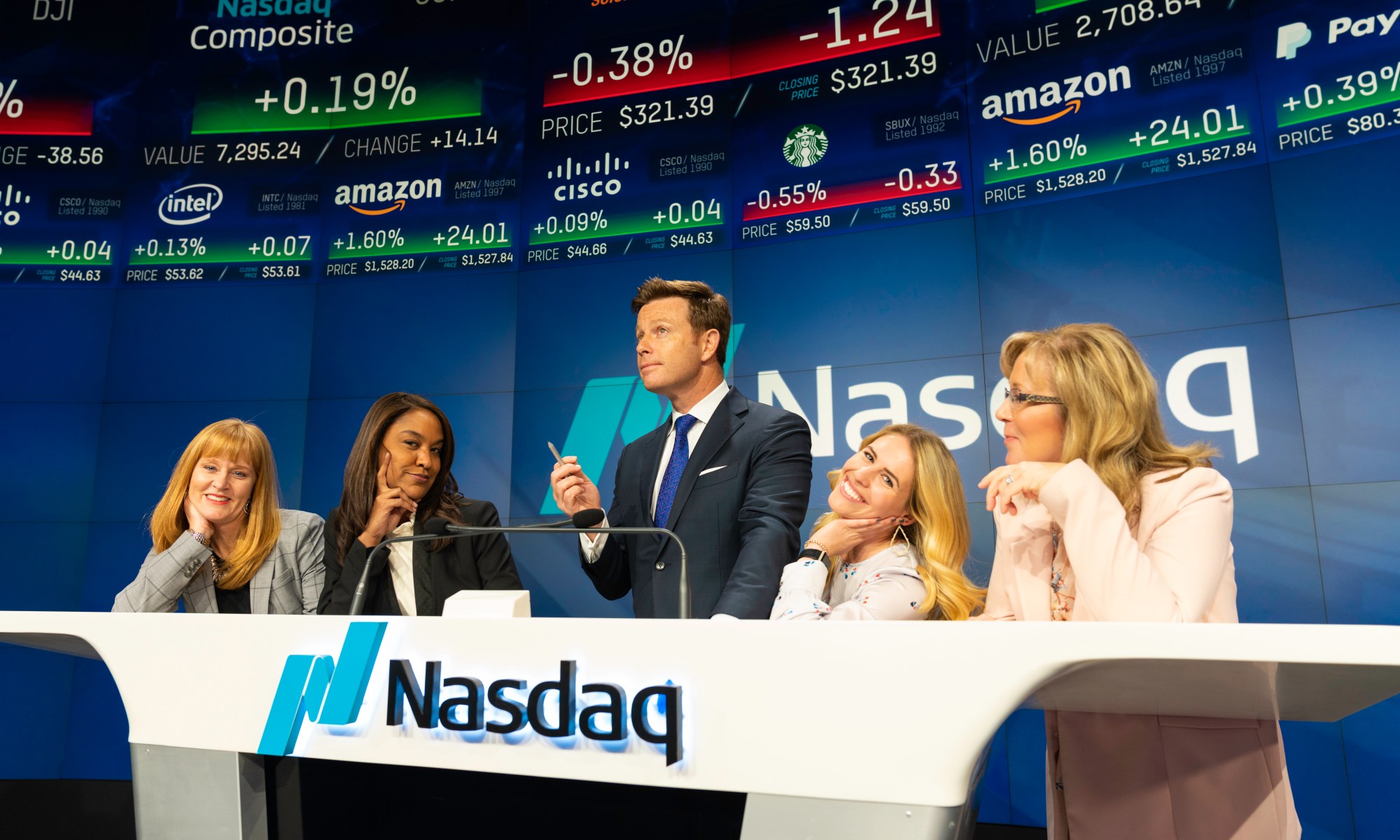
To address questions and observations like these, my team hosted the Reality of RegTech at NASDAQ’s MarketSite on April 18.  Entering the MarketSite, we aspired to surface ideas for banks to better detect compliance and regulatory risks, assess risk exposure and anticipate future threats by engaging with technology partners.

Over the years, our annual one trek to NASDAQ’s New York home afforded us opportunities to:

  • Learn how BNY Mellon encourages innovation on a global scale;
  • Identify where early-stage technology firms realistically collaborate with financial services providers; and
  • Explore lending strategies and solutions for community banks.

This year, we focused on the intersection of technology with regulation, noting that banks can and should expect an overall increase in regulatory constraints on topics including supervision, systemic risk (such as stress tests), data protection and customer protection.

For Forward-Thinking Banks

At Bank Director, we see the emergence of regulatory-focused technology companies helping leadership teams to bridge the need for efficiency and security with growth aspirations. However, understanding how and when to leverage such technologies confounds many executives.  As our Emily McCormick wrote in advance of the event, forward-thinking banks are looking within their own organizations to figure out how the deployment of regtech fits into the institution’s overall strategic goals while matching up with culture, policies, processes and talent.

Key Takeaways

  1. RegTech is, by its very nature, constantly evolving.  Current solutions focus on one of two things: reducing the cost of compliance via automation or leveraging technology to deliver more effective compliance.
  2. The flip side to the promise of these solutions is a skepticism and concern by both regulators and banks that RegTechs really are in this for the long-haul, are reliable and “safe” to work with.
  3. A first step for banks not already using RegTech?  Develop an implementation road map for one specific need (e.g. BSA / AML) which aligns to the overall strategic vision of the organization (in this case, a desire to grow through acquisition).

Interesting Reads on RegTech

Multiple presentations touched on how and where banks can maximize the potential benefits of their RegTech endeavors by addressing key risks; for instance: uncertain development paths, provider reliability, increased regulatory scrutiny, limited judgment and privacy concerns.  For those looking to go deeper on these issues:

  1. PwC authored a Regulatory Brief that discusses (a) how banks are using RegTechs, (b) the current RegTech landscape, and (c) what banks should do to prepare for RegTech.
  2. Continuity offers an e-book along with a step-by-step system for predictable, repeatable compliance results.
  3. Ascent blogs about the impact of artificial intelligence on regulatory compliance in its Top 5 Ways AI in Compliance Will Affect You in 2017.

Multiple members of the team shared insight and inspiration with #RegTech18 on Twitter (usually tying into our @Fin_X_Tech and @BankDirector handles).  Finally, be sure to check out BankDirector.com (no subscription required) as our editorial team offers up a number of perspectives on RegTech and this year’s event.

5 Trending Topics at the Acquire or Be Acquired Conference

Quickly:

  • Large buyers are not in the bank M&A game right now; indeed, banks $25Bn and below continue to drive M&A activity. Case-in-point, 95% of total M&A deals since 2011 have buyer assets less than $25Bn. Might this change in 2018?

By Al Dominick, CEO of DirectorCorps — parent co. to Bank Director & FinXTech.

PHOENIX, AZ — Michael Porter, the noted economist, researcher and teacher, once said, “strategy is about making choices, trade-offs; it’s about deliberately choosing to be different. The essence of strategy is choosing what not to do. No one can tell you which rules to break, but you can acquire more skill in determining which rules to break given your talents and circumstances right now.”

Porter’s perspectives came back to me while listening to KBW’s CEO, Tom Michaud. Yesterday morning, Tom talked about the strategic paths that a bank’s CEO might consider in the years to come. As he shared, pressure from investors to deploy capital stimulated M&A discussions in 2017 — and will continue to impact deals in 2018. He also noted that pressure placed on deposit costs, as interest rates rise, contributes to the potential acceleration of bank consolidation. These were just two of the many notes I jotted down during the first day of our annual event. Broadly speaking, what I heard fell into five categories:

1. Economic trends
2. Regulatory trends
3. Small business lending trends
4. Management succession trends
5. Technological innovation trends

Many banks enter 2018 with steady, albeit slow loan growth — while recognizing modest margin improvement as they continue to focus on controlling expenses. Accordingly, I thought to elaborate on the issues I found interesting and/or compelling. Feel free to comment below if other points caught your eye or ear.

Economic Trends

FJ Capital authored a piece in late October that noted how, as the Fed progresses further into the tightening phase of the interest rate cycle, banks will find it more difficult to fund loan growth by raising new low‐cost deposits. Their view, which I heard echoed here, is banks with low‐cost core deposits will become more valuable over the next few years as banks wrestle with increased funding costs. In addition to this idea, I made note that banks with a strong deposit base could be more attractive to buyers as interest rates rise. However, a remark I’ve heard at past events re-emerged here. Namely, making a small bank profitable is hard; exiting, even harder.

Regulatory Trends

Given the audience here, I wasn’t surprised by the continued talk of removing the synthetic $10Bn designation. If the Fed, FDIC and OCC raise the $50Bn threshold as spelled out in Dodd Frank, we could see more banks in the $20Bn – $40Bn range come together. Given that large regional banks usually can pay high prices for smaller targets, unleashing this capacity could reignite more M&A and boost community bank valuations. In addition, the Community Reinvestment Act remains a major headwind in bank mergers. Many here want improvements in the CRA process, which in turn could reduce regulatory risk for bank M&A.

Small business lending

When it comes to the lifeblood of most banks — small business lending — a recurring question has been where and how community banks can take market share from larger banks. My two cents: closing loans faster is key, as is structuring loans to fit specific borrower profiles while being supremely responsive to the customer. Oh, and credit is a big theme right now — and the best clients typically have the best credit.

Management succession

An inescapable comment / observation: aging management teams and board members has been a primary driver of bank consolidation of late. I noted that the average age of a public bank CEO and Chairman is 60 and 66, respectively. It was suggested that this demographic alone plays a key factor in the next few year’s consolidation activity.

Technological trends

When it comes to bank mergers, one of the big drivers of deals is the rise in technology-driven competition (*along with regulatory costs and executive-succession concerns). I sense that most traditional banks haven’t really figured out the digital migration process we’ve embraced as a world. Finally, it appears that the biggest banks are winning the war for retail deposits.  This is an issue that many management teams and boards should be discussing…

_ _ _

For those of you interested in following the conference conversations via our social channels, I invite you to follow me on Twitter via @AlDominick, the host company, @BankDirector and our @Fin_X_Tech platform, and search & follow #AOBA18 to see what is being shared with (and by) our attendees.

10 Questions I Plan To Ask During Acquire Or Be Acquired

Quickly:

  • Despite improving economic conditions, the business of banking remains difficult.

By Al Dominick, CEO of DirectorCorps — parent co. to Bank Director & FinXTech.

PHOENIX, AZ — For all the talk of bank consolidation, there are still 5,700+ banks in the United States.  But let’s not kid ourselves.  For many community banks today, earnings pressures + regulatory and compliance costs + the continued impact of technology = a recurring challenge.

While the number of banks in business will inevitably shrink over the next 10 years — perhaps being cut in half — I remain bullish on the overall future of this industry. If December’s tax reform spurs capital spending and job creation by small- and medium-sized businesses, many of the banks joining us here in Arizona stand to benefit. But will the recent tax cut induce companies to invest more than they already planned to? This is but one of a number of questions I look forward to asking on stage through the first day of Bank Director’s Acquire or Be Acquired Conference.

Below, ten more questions I anticipate asking:

  1. Are FinTechs the industry’s new de novos?
  2. What does it mean that the banking world is deposit rich yet asset poor?
  3. Why are certain credit unions thinking about about buying banks?
  4. In terms of technology spending levels, where are dollars being earmarked and/or spent?
  5. With respect to small business lending, do credit unions or FinTechs pose a more immediate challenge to community banks?
  6. What is an appropriate efficiency ratio for a bank today?
  7. Will big M&A buyers get back in the game this year?
  8. What are some of the critical items in due diligence that are under appreciated?
  9. What does an activist investor look for in a bank?
  10. Is voice recognition the next huge source of growth for banks?

We have an exciting — and full day — coming up at the Arizona Biltmore. To keep track of the conversations via Twitter, I invite you to follow @AlDominick @BankDirector and @Fin_X_Tech.  In addition, to see all that is shared with (and by) our attendees, we’re using the conference hashtag #AOBA18.

21 Reasons I Am Excited About Acquire or Be Acquired

Quickly:

  • Making banking digital, personalized and in compliance with regulatory expectations remains an ongoing challenge for the financial industry. This is just one reason why a successful merger — or acquisition — involves more than just finding the right cultural match and negotiating a good deal.

By Al Dominick, CEO of DirectorCorps — parent co. to Bank Director & FinXTech.

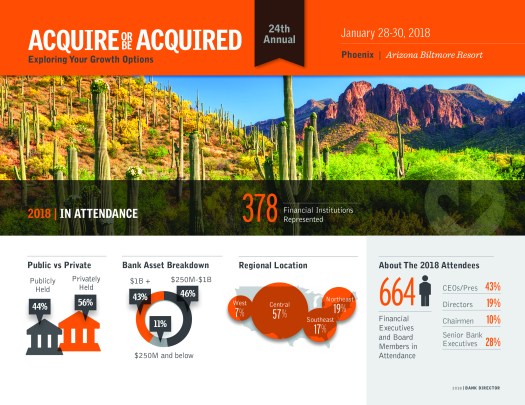
PHOENIX, AZ — As the sun comes up on the Arizona Biltmore, I have a huge smile on my face. Indeed, our team is READY to host the premier financial growth event for bank CEOs, senior management and members of the board: Bank Director’s 24th annual Acquire or Be Acquired Conference. This exclusive event brings together key leaders from across the financial industry to explore merger & acquisition strategies, financial growth opportunities and emerging areas of potential collaboration.

AOBA Demographics

The festivities begin later today with a welcoming reception on the Biltmore’s main lawn for all 1,125 of our registered attendees.  But before my team starts to welcome people, let me share what I am looking forward to over the next 72 hours:

  1. Saying hello to as many of the 241 bank CEOs from banks HQ’d in 45 states as I can;
  2. Greeting 669 members of a bank’s board;
  3. Hosting 127 executives with C-level titles (e.g. CFO, CMO and CTO);
  4. Entertaining predictions related to pricing and consolidation trends;
  5. Hearing how a bank’s CEO & board establishes their pricing discipline;
  6. Confirming that banks with strong tangible book value multiples are dominating M&A;
  7. Listening to the approaches one might take to acquire a privately-held/closely-held institution;
  8. Learning how boards debate the size they need to be in the next five years;
  9. Engaging in conversations about aligning current talent with future growth aspirations;
  10. Juxtaposing economic expectations against the possibilities for de novos and IPOs in 2018;
  11. Getting smarter on the current operating environment for banks — and what it might become;
  12. Popping into Show ’n Tells that showcase models for cooperation between banks and FinTechs;
  13. Predicting the intersection of banking and technology with executives from companies like Salesforce, nCino and PrecisionLender;
  14. Noting the emerging opportunities available to banks vis-a-vis payments, data and analytics;
  15. Moderating this year’s Seidman Panel, one comprised of bank CEOs from Fifth Third, Cross River Bank and Southern Missouri Bancorp;
  16. Identifying due diligence pitfalls — and how to avoid them;
  17. Testing the assumption that buyers will continue to capitalize on the strength of their shares to meet seller pricing expectations to seal stock-driven deals;
  18. Showing how and where banks can invest in cloud-based software;
  19. Encouraging conversations about partnerships, collaboration and enablement;
  20. Addressing three primary risks facing banks — cyber, credit and market; and
  21. Welcoming so many exceptional speakers to the stage, starting with Tom Michaud, President & CEO of Keefe, Bruyette & Woods, Inc., a Stifel Company, tomorrow morning.

For those of you interested in following the conference conversations via our social channels, I invite you to follow me on Twitter via @AlDominick, the host company, @BankDirector and our @Fin_X_Tech platform, and search & follow #AOBA18 to see what is being shared with (and by) our attendees.

Three Things to Know About the Digital Delivery of Financial Products and Services

Quickly:

  • Technology continues to reshape what it means to lead, to innovate and to offer in terms of financial goods and services.

By Al Dominick, CEO of DirectorCorps — parent co. to Bank Director & FinXTech.

WASHINGTON, DC — It is no secret that financial institutions are in a race to figure out how and where innovative technologies can help win and keep loyal customers, improve operational efficiencies and enhance their overall cyber-security measures.  While we might disagree on how fast changes will occur, can we all agree that the ever-expanding expectations for the digital delivery of products and services will dramatically impact banking’s future?

I put this not-quite-rhetorical question out in advance of our annual Acquire or Be Acquired Conference at the Arizona Biltmore.  Indeed, the technological shifts taking place in this industry are significant, and I anticipate quite a few conversations about what our “digital future” might look like.  In the spirit of sharing information and ideas prior to this Sunday’s presentations, this video surfaces a few areas I think a bank’s board needs to pay closer attention to.

If you’re interested in following conversations that focus on issues like these during Acquire or Be Acquired, I invite you to follow me on Twitter via @AlDominick, check out what the team shares through @BankDirector plus our @Fin_X_Tech platform and search & follow #AOBA18 to see what the social shares with (and by) our attendees.

*This video — which is normally available only through our special bank membership program — foreshadows several presentations at Acquire or Be Acquired.  It also tees up our FinXTech Annual Summit.  Held the past few years at the NASDAQ’s MarketSite in NYC, we’ve partnered with Promontory Interfinancial Network to best explore opportunities to generate top line growth and bottom line profits through partnerships, collaboration and investments. Held at The Phoenician in Scottsdale, AZ on May 10th and 11th, I invite you to take a peek at the recently updated agenda.

Blockchain: What It Is and How It Works

Quickly:

  • Many speculate that blockchain could turn out to be one of the most revolutionary technologies ever developed.

By Al Dominick, CEO of DirectorCorps — parent co. to Bank Director & FinXTech

WASHINGTON, DC — J.P. Morgan’s CEO, Jamie Dimon, recently threw some big time shade at bitcoin.  However, as the Wall Street Journal shared this morning, he’s “still enamored with the technology that underpins it and other virtual currencies.”  For those wondering about where and why blockchain might revolutionize the business of banking, take a look at our just-released Q4 issue of Bank Director Magazine.  We dedicated our cover story to “Understanding Blockchain,” and this post teases out some of the key concepts bank executives and board members might focus in on.  Authored by John Engen, the full piece can be found, for free, here.  As you’ll read, the article covers three major points:

What is Blockchain

If you’re on the board of a typical U.S. bank, odds are that you don’t know much about blockchain, or distributed ledgers, except that there’s a heavy buzz around the space—and a lot of big bets being made. As John Engen wrote, being a know-nothing might be fine for now, but going forward could be untenable.

At its most basic, blockchain is a digital-ledger technology that allows market participants, including banks, to transfer assets across the internet quickly and without a centralized third party.

Some describe it as the next, inevitable step in the evolution of the internet; a structure to help confront concerns about security, trust and complexity that have emerged from a technology that has opened the world to sharing information.  To others, it looks more like business-process improvement software—a way to improve transparency, speed up transaction times and eliminate billions of dollars in expenses that markets pay to reconcile things like credit default swaps, corporate syndicated debt and other high-volume assets.

Where are things heading

“Trying to guess how blockchain is going to affect us in the next 20 years is kind of like standing in 1995 and trying to imagine mobile-banking technology,” said Amber Baldet, New York-based JPMorgan Chase & Co.’s blockchain program leader, in an online interview. “I’m sure the ultimate applications are things we can’t even imagine right now.”

For now, the space certainly has the feel of the 1990s internet, with hundreds of startups and billions of investment dollars chasing distributed-ledger initiatives.  Armonk, New York-based IBM Corp., a big blockchain supporter, estimates that 90 percent of “major” banks in the world—mostly those with trading, securities, payments, correspondent banking and trade finance operations—are experimenting with blockchain in some way.

Collaboration is the current buzzword

Most large banks are involved in consortiums with names like Ripple, Hyperledger, R3 and Enterprise Ethereum Alliance.  Smaller banks are taking more of a wait-and-see approach.  For all the promise of speed and efficiency, blockchain’s real power lies in its transparency, which makes data both trackable and immutable.  Ultimately, blockchain could usher in new business models, which require different ways of thinking.

##

For members of a bank’s board, we created this “Blockchain 101” video.  In it, I touch on the potential application of blockchain in terms of digital identities, digital banking and cross-border payments.  In addition, the ten minute video surfaces key concepts and business ideas that remain material to many today.

*This video is just one of the offerings found in our Bank Services program designed to help board members and senior executives develop strategies to help their bank grow, while demonstrating excellence in corporate governance that shareholders and customers deserve and today’s regulators demand.

Bank CEOs and Their Boards Can Lay Claim to These 5 Technologies

Quickly:

▪ Regional and community banks continue to lay claim to innovative technologies that attract new customers, enhance retention efforts, improve efficiencies, cut costs and bolster security.

By Al Dominick, CEO of DirectorCorps — parent co. to Bank Director & FinXTech

ATLANTA — The digital distribution of financial goods and services is a HUGE issue for bank executives and their boards.  Margins on banking products continue to decline due to increased competition.  In my opinion, this provides ample incentivize for banks to seek partnerships with specialized product and service providers.

I shared this thought earlier today at Bank Director’s annual Bank Board Training Forum. During my remarks to an audience of 203 officers and directors (representing 84 financial institutions), I laid out five potential area of collaboration that community bank CEOs and their boards might spend more time discussing:

1. New core technologies;
2. Machine learning / Artificial intelligence applications;
3. RegTech;
4. Payments; and
5. White labeling product offerings.

I elaborated on why I think our audience needs to explore each area before expanding on how banks might take steps to incorporate such technologies into their culture and business.  I wrapped up by providing examples of companies in each space that attendees might learn more about.

For instance, when it comes to the core technological systems offered by Fiserv, Jack Henry and FIS, many banks are investing in “integration layers” to bridge the needs of client‐facing systems with their core system. While these layers have proven valuable, banks are also aware of the need to migrate away from legacy cores should the flexibility they desire not come from these companies.  Hence the advent of companies like Finxact, a cloud banking platform promising to be the most transparent and open core banking system available.

In terms of machine learning and artificial intelligence, I see five potential use cases for banks to consider: smarter customer acquisition, better Know-Your-Customer efforts, improved customer service, smarter and faster account openings and the ability to offer more competitive loans.  Here, I am impressed with the work being done by companies like Kasisto, whose conversational AI platform is pre-loaded with thousands of banking intents and millions of banking sentences.  It promises to fulfill requests, solve problems, predict customers’ needs and improve performance on its own using sophisticated machine learning.

Given the cost and complexity of compliance, RegTech offerings promise to simplify fraud prevention and detection, improve the interpretation of regulation while accelerating reporting functions.  Further, RegTech companies held simplify data access, storage and management while strengthening risk management efforts.  There are quite a few companies in this fast-growing space that I highlighted.  One is Fortress Risk Management, a company whose advanced analytics predict and detect financial crime while its tool enable efficient case management, dispute management, reporting and regulatory compliance.

With respect to payments, our rapidly changing and oh-so-interconnected markets of debit, credit, mobile, prepaid and digital payments proves both a blessing and a potential curse for traditional institutions. As we move toward a cashless society and payments become less visible, banks need to maximize their opportunities to become the default payment method, and keep abreast of innovations in credit scoring, faster payments, analytics, security and fraud detection.  Case-in-point, BluePay delivers non-interest income to banks of all sizes by aggregating customer data coupled with the latest merchant processing technology.

Finally, white label product offerings are nothing new.  However, technology companies like SimplyCredit and StrategyCorps continue to help banks reshape and rethink customer engagement, setting new and higher bars for their’s clients’ experiences.  For banks seeking innovations like rapid loan adjudication, partnering with technology providers like these enables a bank to keep pace with the customer experience expectations set by large technology firms.

##

If you weren’t able to join us in Atlanta and are curious about today’s featured image, here is a link to the pdf: 2017 Bank Board Training Presentation (Tech-focused). As I shared, New Zealand’s All Blacks are the world’s most successful sporting outfit, undefeated in over 75% of their international rugby matches over the last 100 years.  Their willingness to change their game (and their culture) when they were at the top of their game inspired me — and allowed me to challenge our attendees to think if they are willing to do the same with their banks.  I’m also inspired by my colleagues who helped develop this year’s program. From our conference team to editorial group, marketing to data departments, I’m proud to work with a great group dedicated to the idea that a strong board makes contributes to a strong bank.

The Paths High Performing Banks Take to Growth and Innovation

Quickly:

  • I’m in Utah at the Montage Deer Valley for the second day of the Association for Financial Technology’s Fall Summit.
  • This afternoon, I shared my thoughts on the pace of change impacting banks as part of AFT’s Fintech Leadership Industry Update.

By Al Dominick, CEO of DirectorCorps — parent co. to Bank Director & FinXTech

PARK CITY — For those that attended Bank Director’s Acquire or Be Acquired conference this January, you may recall slides illustrating the consolidating nature of the banking industry over the past 25 years.  This decrease in the number of banks is the result of several major factors; most notably, changing banking laws, changing technologies, changing economics and changing consumer behaviors.

Given the audience we share information with (e.g. bank CEOs and their leadership teams), I continue to hear talk about steady, albeit slow, loan growth, some margin improvement and a continued emphasis on expense control.  However, it is apparent from the outside looking in that many banks still lack the true flexibility to continually innovate in terms of both products and services — and how they are delivered.

This is downright scary when you consider that Amazon’s Lending Service surpassed $3 billion in loans to small businesses since it was launched in 2011.  As I shared in my remarks, Amazon loaned over $1 billion to small businesses in the past twelve months.  Over 20,000 small businesses have received a loan from Amazon and more than 50% of the businesses Amazon loans to end up taking a second loan.  This is a major threat to the established financial community, because if there is one thing community banks and large banks agree on, it is that the small business market is important.  This will not change any time soon, and for community banks in particular, a greater share of the small business market may be their only path to survival.

So what I shared this afternoon were real-world examples of bank CEOs focused on carrying out a long-term growth strategy in creative, yet highly focused, ways.  For instance, several of the banks I referenced are attempting to re-engineer their technology and data infrastructure using modern systems and processes, developed internally and augmented through partnerships with fintech companies.  For instance, I cited a newer partnership between First Horizon’s First Tennessee bank unit and D3 Banking. In addition, I used examples like US Bancorp, PNC and Fifth Third before highlighting five more institutions that range from $10Bn to $50Bn in asset size.

I did so because we are witnessing an intense struggle on the part of financial services providers to harness technology in order to maintain relevance in the lives of their customers.  The eight banks I cited today have different leadership approaches; all, however, are considered high-performers. For those interested, here is a link to my presentation: Bank Director and FinXTech 2017 AFT Presentation.

The caveat to my presentation, remarks and writing: it might appear easy to create a strategic direction to improve efficiency and bolster growth in the years ahead. But many bank executives and their boards are being cautioned to prepare for false starts, unexpected detours and yes, stretches of inactivity — all of which impacts tech companies like those here in Park City at AFT.  Still, a vision without action is a dream; action without vision, a nightmare.  For these banks, strong leadership have set a clear course for their futures.

3 Disruptive Forces Confronting Banks – and How Zelle Might Help

By Al Dominick, CEO of DirectorCorps (parent co. to Bank Director & FinXTech) | @aldominick

“The volume and pace of what’s emerging is amazing. I’ve never seen it before in our industry.”

These words, spoken about technology driving an unprecedented pace of change across our financial landscape, came from Greg Carmichael, today’s keynote speaker at Bank Director’s annual Bank Audit & Risk Committees Conference.  Greg serves as president and CEO of Fifth Third Bancorp, a diversified financial services company headquartered in Cincinnati, Ohio.  The company has $142 billion in assets, approximately 18,000 employees, operates 1,191 retail-banking centers in 10 states and has a commercial and consumer lending presence throughout the U.S.

Fifth Third Bancorp’s four main businesses are commercial banking, branch banking, consumer lending and wealth and asset management.  Given this focus, Greg’s remarks addressed how, where and why technology continues to impact the way banks like his operate.  Thinking about his perspective on the digitization of the customer experience, I teed up his presentation with my observations on three risks facing bank leadership today.

Risk #1: Earlier this year, the online lending firm SoFi announced that it had acquired Zenbanx, a startup offering banking, debit, payments and money transfer services to users online and through its mobile app.  As TechCrunch shared, “the combination of the two will allow SoFi to move deeper into the financial lives of its customers. While today it focuses on student-loan refinancing, mortgages and personal loans, integrating Zenbanx will allow it to provide an alternative to the traditional checking and deposit services most of SoFi’s customers today get from banks like Bank of America, Citi or Chase.”  Given that many banks are just beginning their digital transformation, combinations like this create new competition for traditional banks to address.  Cause for further concern?  It came to light that SoFi just applied for an industrial loan bank charter in Utah under the name SoFi Bank.

Risk #2: With so much talk of the need for legacy institutions to pair up fintech companies, I made note of a recent MoneyConf event in Madrid, Spain.  There, BBVA chairman Francisco González said that banks need to shed their past and image as ‘incumbents’ and transform into new digital technology companies if they are to prosper in a banking environment dominated by technologically astute competitors. Transforming the bank “is not just a matter of platforms. The big challenge is changing an incumbent into a new digital company.”  Clearly, transforming one’s underlying business model is not for the faint of heart, and the leadership acumen required is quite substantial.

Risk #3: Finally, when it comes to digital companies doing it right, take a look at TheStreet’s recent post about how “Amazon Has Secretly Become a Giant Bank.”  I had no idea that its Amazon Lending service surpassed $3 billion in loans to small businesses since it was launched in 2011.  Indeed, “the eCommerce giant has loaned over $1 billion to small businesses in the past twelve months… Hiking up the sales for third party merchants is a plus for Amazon, as the company gets a piece of the transaction.” What I found particularly note-worthy is the fact that over 20,000 small businesses have received a loan from Amazon and more than 50% of the businesses Amazon loans to end up taking a second loan.

A Potential Solution

Jack Milligan, our Editor-in-Chief, recently wrote, “disruptive forces confronting banks today are systemic and in some cases accelerating.” In his words, the greatest risk facing bank leadership today is “the epochal change occurring in retail distribution as consumers and businesses embrace digital commerce in ever increasing numbers, while aggressive financial technology companies muscle into the financial services market to meet that demand.”

Against this backdrop, Fifth Third Bank just announced it will be one of more than 30 major financial institutions to roll out Zelle, a new peer-to-peer (P2P) payments service operated by Early Warning.  As Greg shared during his remarks, this will initially be offered through the banks’ mobile banking apps, and positions the bank to better compete with PayPal’s Venmo.

This is big news.  Indeed, Business Insider noted in today’s morning payments brief that the growing crowd of providers will fight over a mobile P2P market set to increase ninefold over the next five years, reaching $336 billion by 2021.  In addition to working directly with financial institutions, let me also note that Early Warning has established strategic partnerships with some of the leading payment processors –– think FIS, Fiserv, and Jack Henry.  These relationships will allow millions more to experience Zelle through community banks and credit unions.

##

Here in Chicago, we have 298 bank officers and directors with us today and tomorrow — and our Bank Audit and Risk Committees Conference itself totals 366 in attendance.  In terms of bank representation, we are proud to host audit committee members, audit committee chairs, CEOs, presidents, risk committee members, risk committee chairs, corporate secretaries, internal auditors, CFOs, CROs and other senior manager who works closely with the audit and/or risk committee.  Curious to see what’s being shared socially? I encourage you to follow @bankdirector and @fin_x_tech and check out #BDAudit17.