On Fee Income + Staying Relevant

Cloud Gate in Millennium Park

So I shared my excitement for the RedSox World Series victory earlier today… Before I pack my things for a trip to the JW Marriott in Chicago, let me share three things I learned this week that relate to bank CEOs and their boards, not baseball and beards.

(1) As our very talented editor, Jack Milligan, wrote in the current issue of Bank Director, when it comes to fee income, “drivers tend to fall into three general categories, beginning with a variety of consumer-based fees from such things as foreign ATM withdrawals, overdraft protection plans, debit card transactions and some checking accounts.”  I bring this up as Jack and the team at Bank Director magazine ranked the top 50 publicly traded banks based on their ratio of non-interest income to total operating revenue for 2011 and 2012. The totals for both years were then averaged, which determined the order of finish. All banks listed on the New York Stock Exchange and NASDAQ Stock Exchange were included in the analysis (which was performed by the investment banking firm Sandler O’Neill + Partners in New York). At the top of the ranking are New York-based Bank of New York Mellon Corp., State Street Corp. in Boston and Chicago-based Northern Trust Corp.  For a full look at the results, click here.  For the story itself, register for free on BankDirector.com to access the digital issue of the magazine.

(2) Clearly, banking’s profit model is going through a period of transition.  Here, companies like StrategyCorps play an interesting role in helping financial institution meet their needs for more fee income without upsetting its customers.  No one — at least, that I know — wants to  pay for basic, traditional retail banking services.  They resent when a new fee is added on to an existing free service or product with no additional value (case-in-point, Bank of America’s $5 debit card fee debacle).  So as Mike Branton wrote in the Financial Brand, “financial institutions must seek new ways to incorporate non-traditional services that connect with consumers’ lifestyles.”  StrategyCorps took to Finovate’s Fall stage in NYC in September to demo, in less than 7 minutes, how financial institutions can use an enhanced mobile experience to successfully bring in fee income.  Take a look.

(3) Finally, I will be tweeting throughout our annual Bank Executive & Board Compensation conference next week (using hashtag #BEBC13).  This year’s 9th annual event focuses on compensation trends, talent acquisition/attraction and retention strategies. In addition, it looks at how the next few years’ merger activity might influence incentive compensation plans and performance-based pay structures.  I intend to post a few “postcards” from Chicago throughout the week — the first (tentatively set for Tuesday) on how companies develop executives, attract leadership and approach compensation in today’s highly competitive and economically challenging world.

Aloha Friday!

A Picture Worth 1,000 Words

slider_game6-7
Bill Greene / The Boston Globe

Before posting my regular column to About That Ratio, a Big congratulations to the Boston RedSox.  As a lifelong fan, this team personifies the “Team > Me” concept.  Beating the St. Louis Cardinals in six games… wow, what a feat.  Doing it in front of the Fenway faithful.  Priceless.

Size Matters – and Other Banking Notes From the Bay Area

The Ritz-Carlton San Francisco
Walking up to the Ritz-Carlton San Francisco

Last week, Lexington, Virginia… this week, San Francisco, California… next week, Chicago, Illinois.  Yes, conference season is back and in full swing.  I’m not looking for sympathy; heck, for the past few days, I’ve set up shop in Nob Hill (at the sublime Ritz-Carlton) to lead our Western Peer Exchange.  Traveling like this, and spending time with a number of interesting CEOs, Chairmen, executives and board members, is why I love my job.  What follows are three observations from my time here in NorCal that I’m excited to share.

(1) On Wednesday, I took a short drive up to San Mateo to learn more about Kony, a company that specializes in meeting multi-channel application needs.  I have written about customer demands for “convenient” banking services in past posts — e.g. Know Thy Customer –and will not try to hide my interest in FinTech success stories.  Learning how their retail banking unit works with financial institutions to deliver a “unified and personalized app experience” proved an inspiring start to my trip.  Consequently, our Associate Publisher and I talked non-stop about the rapid evolution and adoption of technologies after we wrapped things up and drove back towards San Francisco.  We agreed that consumer expectations, relative to how banks should be serving them, continues to challenge many strategically. To this end, Kony may be worth a look for those curious about opportunities inherent in today’s mobile technology.  Indeed, their team will host a webinar that features our old friend Brett King to examine such possibilities.

(2) When it comes to banks, size matters.  To wit, bigger banks benefit from their ability to spread fixed costs over a larger pool of earning assets.  According to Steve Hovde, an investment banker and one of the sponsors of our event, “too big to fail banks have only gotten bigger.”  He observed that the top 15 institutions have grown by nearly 55% over the past six years.  Wells Fargo, in particular, has grown 199% since ’06.  With more than 90% of the banking companies nationwide operating with assets of less than $1 billion, it is inevitable that consolidation will be concentrated at the community bank level.  However, as yesterday’s conversations once again proved, size doesn’t always trump smarts.  I said it yesterday and will write it again today.  Our industry is no longer a big vs. small story; rather, it is a smart vs. stupid one.

(3) That said, “nobody has told banks in the northwestern U.S. that bank M&A is in the doldrums.”  According to the American Banker, two deals were announced and another terminated after the markets closed Wednesday.  Naturally, this should put pressure on banks in the region to keep buying each other.  Here in San Francisco, the one being discussed was Heritage Financial’s combination with Washington Banking Co.  According to The News Tribune, this is “very much a merger between equals, similar in size, culture and how each does business.”  Now, the impetus behind ‘strategic affiliations’ (don’t call them mergers of equals) comes down to creating value through cost cuts and wringing out efficiencies.  The thinking, at least during cocktails last night, was that deals like these happen to build value for the next few years in order to sell at higher multiples.  Certainly, it will be interesting to see how this plays out.  In a few months at our Acquire or Be Acquired conference, I anticipate it generating quite a few opinions.

Aloha Friday!

Creating a Social Business

I am back in Lexington, Virginia today to speak at Washington & Lee’s 2nd Annual Entrepreneurship Summit.  I love it here and am very excited to share my thoughts on “Leveraging Social Media in New Ventures” later today.  While my company, Bank Director, isn’t a “new” play in the traditional sense, I am eager to share what I have learned since I graduated from W&L in ’99.  So, in lieu of my traditional focus on banking, today’s post highlights three points I’ll expand upon in a few hours.

W&L - BD - Social Media cover slide.001

(1) Let me start by sharing the presentation I put together: W&L – BD – Social Media.  As some might know, we began to “re-imagine” our then-20 year old company in September of 2010 upon the sale of our sister company, Corporate Board Member, to the NYSE.  Building a new reputation upon an established brand reflects three tactics I’d picked up in business school, seen applied by technologists at my old firm (Computech) and had reinforced by bank CEOs and Chairmen at our many events.  First, you can’t manage what you can’t measure.  Second, “fail fast” doesn’t always apply, but slow + steady doesn’t necessarily win the race either.  Finally, be open, interested and ready to adopt new practices or strategies while relying on your team to shout things up or down.

(2) We talk a lot about “community building” within Bank Director.  As we focus on issues fundamental to a bank’s CEO, senior leadership team, chairman and independent directors, we are constantly thinking about building strong + lasting relationships with these leaders across the U.S.  Admittedly, we embraced social media pretty quickly — figuring out the best uses of LinkedIn and Twitter — while we designed our digital strategy.  By participating in, and not always driving the, conversations through such channels, we identified various trends and opportunities that made their way into our conferences, research, etc.  Nothing groundbreaking here, but it does surprise me when people ignore the classic marketing adage “know your customer and give them what they want.”

(3) In a sense, you can look at Bank Director as an example of company that is “passionate” about connecting people through shared experiences.  So too are younger ventures like DC-based SocialRadar and Boston-based EverTrue.  I choose to highlight these two companies in my presentation as they share this same commitment.  If you’re not familiar with SocialRadar, it looks to combine your smartphone’s location with your social network – thereby “allowing you to walk into a room and already be aware of the people around you and how you are connected to them.”  EverTrue, started by a football teammate of my brother at Brown, offers colleges and universities “alumni networking platforms” that create stronger communities through an interactive mobile directory and better data from LinkedIn and Facebook.  Two up-and-coming companies that fit nicely with the title of today’s post.

Aloha Friday!

To Zig or Zag

While President Obama’s nomination of Federal Reserve Vice Chair Janet Yellen to lead the central bank garnered significant attention this week, the twittersphere was ablaze with news on emerging payments and financial services.  Personally, I focused a lot of my time on retail banking, advertising and marketing stories — a pleasant diversion from the political showdown here in Washington.  Accordingly, this week’s column highlights the creative side of building relationships and engaging with potential customers.  Please let me know what you think via Twitter (@aldominick) or by commenting below.

(1) How Do You Introduce a Mobile-Only Bank? With a Mobile Orchestra, Of Course.  Now, I realize most banks in the U.S. have nowhere near the budget needed for an advertisement like this. Still, BNP Paribas‘ “Hello Bank!” — which claims to be Europe’s first fully digital mobile bank — pulls off “a smart orchestra stunt.” According to AdAge, “the campaign brought together the talents from the musical and tech world for a one-of-a-kind performance by the orchestra that showed what you could do with just your mobile phone.”  Taped during a performance in Prague, the Czech National Symphony Orchestra’s 60 musicians put aside their instruments for a special performance of “Carmen.”  Take a look:

(2) From your ears to your eyes, a test of your social media savvy: #PACYOURBAGS. Do you get the hashtag?  Here’s a hint: this is a promotion run by Bank of the West (a wholly owned subsidiary of BNP Paribas).  Still confused?  While many still wrestle with a social media strategy, the San Francisco-based bank has taken to Instagram and Facebook to offer exclusive Pac-12 content — including news, events and videos — to better engage with current and potential customers under this hashtag.

Bank of the West hashtag

Visit their Facebook page and you’ll be invited to “capture any great moments from this week’s college football games… Tag them with #PACYOURBAGS on Instagram to enter and you could win $250 and a trip for two to the Rose Bowl Stadium on 1/1/14!”  Dare I say, #Cool.

(3) From Prague to the Pac-12, we’ve covered a lot in a short amount of time.  To wrap things up, let me share a story closer to home.  This one involves a few plucky upstarts taking on the biggest of the big.  No, this isn’t a tale of a community bank competing head on with Bank of America; rather, a link to an article that shows multiple startups trying to disrupt various sectors within the consumer goods industry.  Much like their BofA and Wells Fargo brethren, P&G and Unilever “have scale but are under constant assault from savvy upstarts.”  Yes, I’m drawing a parallel between the razor blades you might find in your bathroom to the battle for bank customers vis-a-vis “How Tiny Startups Like Hello and 800Razors Are Stealing Share From CPG Giants.” The premise: “smaller brands’ ability to break through goes to digital disruption in media and retailing.”  An interesting parallel, especially for those bankers willing “to zig away from the strategic and creative zags of category titans.”

Aloha Friday!

Bank Blogs and the Boston RedSox

438px-BostonRedSox1908logo.svg

Hm, I wonder which will trend higher this evening… bank blogs or the Boston RedSox.  I guess we’re about to find out.

A few weeks ago, The Financial Brand penned a piece called “Top 20 Best Blogs for Financial Marketers.” As they explained: “(we follow) approximately 100 active blogs in the banking space. But in the last six years, more than that have died. That’s right, there are more dead blogs in the bank and credit union marketing world than live ones (108, to be exact). That’s why The Financial Brand thinks it is important to recognize the best of those that are still going.”

I’m just getting through their list of twenty as I prepare for game four of my favorite team’s playoff game.  Quite a few good ones cited by in this list; please allow me share the top nine — in honor of the greatest RedSox of all time, the splendid splinter, Ted Williams.  (*To be clear, 100% credit to the Financial Brand for the summaries on each of the following.)

1. Snarketing 2.0

Primary Author(s): Ron Shevlin, Senior Analyst with Aité Group

Ron has been blogging for a long time now, and his content is consistently some of the most original, insightful, entertaining and thought-provoking material in the financial industry. Ron frequently discusses issues related to data, research and analytics (particularly in the banking space), and even when he does talk about non-financial issues he almost always puts it into a context that bank and credit union marketers will appreciate.

2. ACTON Financial Marketing Insights

Primary Author(s): Steve Topper, Joe Swatek

This blog is about as practical and tactical as a financial marketer will ever find. Steve regularly critiques ads, offers and direct mail pieces from both banks and credit unions, while Joe offers more general advice. It’s a near daily dose of clinical analysis, never off-topic, rarely (if ever) self-promotional, and maintains a constant focus on helping financial marketers sharpen their design and copywriting skills.

3. Bank Marketing Strategy

Primary Author(s): Jim Marous, SVP, Corporate Development at New Control

Of all the banking blogs out there, Jim’s is most similar to The Financial Brand. Jim regularly discusses the design of retail banking products/services, pricing, marketing and the customer experience. Jim’s posts will also frequently gravitate towards new/emerging technologies and channel integration, with a slant towards mobile. Some financial marketers will struggle putting the insights in some of these posts to use, but they will always find the material interesting and engaging.

4. Visible Banking

Primary Author(s): Christophe Langlois

If the subject of social media in the financial industry interests you, then this is the best one out there. There are few people who can match Christophe’s intellect, experience and passion for social channels in finance. He’s also extremely gracious and polite, even when he offers criticism — you can tell he’s a pleasant and affable Frenchman. Christophe’s blog posts are frequently built around case studies. He could be looking at the Twitter activity of a major European insurer one day, then the Facebook page from a U.S. bank the next. You never know exactly what he’ll be covering next, but you can always count on reading a fair analysis of social initiatives from financial institutions only.

5. The Gallup Blog

Primary Author(s): Assorted

This is a special blog Gallup has set up specifically for the financial industry. While they don’t publish as frequently as other blogs, they quality of content and caliber of writing are both top-notch. Their focus tends to skew towards the strategic side, but usually their articles will have relevancy to financial marketers at all levels — from CMOs down to Marketing Managers. And they support all their perspectives, opinions and recommendations with data, as you’d expect from a research firm as prestigious as Gallup.

6. The Raddon Report

Primary Author(s): Louie Lambrou, Pat Bator, et al

The research team at Raddon Financial Group has been pumping out posts that both bank and credit unions marketers would find relevant for at least 4-5 years now. Nearly every post they publish (except for the password-protected ones) offer something a financial marketing executive will find useful. You’ll always find data and charts in articles like “The Top Five Reasons Consumers Close a Checking Account,” ” How Consumers Currently Use Home Equity Lines of Credit” and “Demand for New and Used Auto Loans.” What kind of marketing exec in the retail banking space isn’t interested in that kind of information?

7. Datamonitor Financial

Primary Author(s): Assorted

This is another strong blog from a research firm concentrating on the financial industry. And if there’s one thing bank and credit union marketers can’t get enough of, it’s insight supported by data. Datamonitor’s analysts pay close attention to the major shifts shaping financial services today. There posts are almost always the same length (around 250 words), but they manage to pack a gem or two into their compact format. Some readers might not relate to all the topics, nor find the international coverage particularly useful, but it’s still a blog many financial marketers should consider adding to their reading list.

8. Netbanker

Primary Author(s): Jim Bruene

Long before Jim Bruene founded the Finovate series of conferences, he was publishing fantastic reviews about new developments in the fintech world, skewing heavily towards online — and now mobile — innovations. In fact, he’s been blogging since 1996 — seventeeeeeen years, just about as old as the internet itself. In “blog years,” that would make Netbanker like 150 years old. Financial marketers might not find relevancy in everything Jim publishes, but the truth is: When a guy’s been doing what he’s doing as long as Jim has, you should listen to what he has to say. Everything is moving to digital channels, and financial marketers that want to stay abreast of the latest developments will want to read Netbanker.

9. Financial Services Club Blog

Primary Author(s): Chris Skinner

Chris Skinner is what you could call a “financial philosopher.” He doesn’t write blog posts so much as he publishes essays and treatises. He will frequently wax about some fairly heady subjects like what banking might look like 100 years from now. As engrossing as these discussions can be, it isn’t the kind of stuff many lower-level marketing managers will likely find very applicable in their day jobs. It’s really suited best for CMOs, COOs, CEOs and bank directors.

#WinToday

This part of Washington remains open

Happy hour comes earlier to the District these days...
Happy hour comes earlier to the District these days…

Nothing political on About That Ratio today.  Business as usual here in our D.C. office.  Sure, the streets might be emptier, but as you can tell from this picture of the Dubliner (outside our offices), 5:00 just comes a little earlier these days.

(1) I wrote about payments, and Bitcoin, a few weeks ago.  On Wednesday, Bloomberg ran a piece called “If This Doesn’t Kill Bitcoin, What Will?” In case you missed it, the alleged operator of the Bitcoin-based online marketplace Silk Road was arrested in San Francisco on Tuesday on money-laundering and narcotics-trafficking charges.  While the Bloomberg piece lays out some pretty crazy things (e.g. a murder-for-hire plot), it does invite a broader discussion on the viability of Bitcoin or other virtual currencies.  As the author shares, this week’s event “highlights how using an ostensibly untraceable currency makes for a lovely invitation to blackmailers.”  Lovely indeed, and certainly not the end of the debate about Bitcoin’s future.

(2) As I pondered the future of payment networks like this, I found myself reading a blog authored by Jim Marous: “It’s Time for Banks & Credit Unions to Embrace Change.” Jim’s a good follow on twitter (@JimMarous) and I really like the KPMG report he cites in his post (Reshaping Banking in a Dynamic Business and Regulatory Climate). Jim opens with a disheartening truth: while “technology and distribution channels have changed, banks and credit unions are still faced with many of the same strategic challenges we talked about 20 years ago.”  A good primer for anyone preparing their 2014 strategic plans.

(3) Finally, a tip of the cap to American Banker for their article on Georgia Commerce’s agreement to buy Brookhaven Bank in Atlanta.  As they write, this is a sign that in some parts of the country, “it is becoming more financially advantageous to sell out instead of raising capital.”  When Selling a Bank Becomes Preferable to Raising Capital requires a subscription to AB; however, its clear to me that industry and economic headwinds challenge banks both large and small. In a sense, the boards’ decision to merge shouldn’t surprise but may inspire other community bank CEOs and their directors to consider staging an exit rather than gearing up for a capital raise.

Before wishing everyone a great Friday, let me single out our Associate Publisher, Kelsey Weaver, and wish her the best of luck as she moves home to Nashville next Monday. Fortunately she will remain with our team; our happy little D.C. office, however, will not be the same.  ##WWGS

Aloha Friday!

Three Years Strong

I am taking a break from my regular routine of sharing three things I heard, talked about, learned or read to highlight my last few days at work.  Admittedly, I try to keep the company stuff to a minimum on About That Ratio; today, I feel it is ok to pull the curtain back a bit and share my pride and enthusiasm for our dynamic team at Bank Director. 

Ours is a successful small business, one composed of entrepreneurs and hard workers.  Today, CEOs, CFOs, General Counsels, Presidents, Chairmen and board members of financial institutions nationwide rely on our digital offerings, conferences, research reports, educational programs and Bank Director magazine to keep pace with an ever-changing business landscape.  Yes, we’ve been in business since 1991; however, our relationships with this hugely influential audience didn’t materialize overnight.  In fact, the past 36 months have driven much of our financial and reputational growth.  So as we celebrated our team’s three-year anniversary on Wednesday (I’ll explain below), I thought to share some thoughts and pictures this morning.

Some of our team celebrating 3 years
Some of our team celebrating at Arrington Vineyards

(1) For the Bank Director brand, a big change occurred in mid-2010, when our founder and Chairman sold our sister company, Corporate Board Member, to the NYSE.  Concomitant to that transaction, he began to assemble a team to “modernize” the Bank Director franchise.  This included a new website, new logo and company color scheme, new events, new editorial features, new data, new research, new sales efforts, new marketing campaigns, new PR efforts, and so on and so on.  So it was with real pride that our team of 17 strong celebrated what we’ve done over the past three years to re-build, re-imagine and re-position our company as the information resource for leaders throughout the financial community.

(2) While we work hard, we do play well together.  From snuggies in the office to orange flair being worn at our events, our company’s personality is a fun and creative one.  This was on full display as we laughed it up on Tuesday.  Here are a few fun, SFW pictures that show the lighter side of our crew, both in our Brentwood, Tennessee office and “down the road” at Arrington Vineyards.

(3) Finally, kudos to all those who preceded our team.  While people come and go, our brand and reputation reflects many years of hard work and the collective efforts of many talented men and women.  In addition, big thanks to companies like Circ (supporting our web and hosting needs), Robertson Design (for design), Data Marketing (in terms of fulfillment), Snapshot (videos), PrintWorks (prints materials for our conferences & reprints) and Grafix Solutions (business cards) for helping us look good!

While change is a constant, it is impressive to look back to the very first issue of the magazine and see how far we’ve come.  I’ve shared this proverb before (and will most likely do so again): “If you want to go fast, go alone.  If you want to go far, go together.”   Appropriate for how we got here today… and how we aspire to grow in the future.

Aloha Friday!

Disrupt (or die trying)

Georgia peaches...
Georgia peaches…

If you’ve been on this site before, you probably recognize a pattern to my writing. Each Friday, I share three things I heard, learned or saw during the week.  In past posts, I’ve penned a number of “disruptive” stories that ranged from Brett King’s perspectives on banks (“Does Banking Need a Re-boot”) to John Cantarella’s on Time Inc.’s digital strategies (“Dass de Thing”).  So it should come as no surprise that I furiously began writing today’s column on a flight home from Atlanta on Wednesday evening.  I’d just spent several hours in the offices of the William Mills Agency, one of the nation’s preeminent financial public relations and marketing firms, and left inspired.  What follows are just three of the many Fintech companies the agency represents that are doing some pretty cool things.  IMHO, banks of all sizes might pay attention to these tech companies if they want to disrupt the status quo rather than have their status quo disrupted.

(1) In Bank Director’s home town of Nashville, TN resides the corporate marketing team for CSI, a leading provider of end-to-end technology solutions.  The public company delivers core processing, managed services, mobile and Internet solutions, payments processing along with print and electronic distribution & regulatory compliance solutions to financial institutions.  I like their resource center, but really appreciate their blog that highlights myriad client success stories.  For instance, “How One Bank “does” Social Media Right” shines a light on First Kentucky’s one and only social media strategy.  To wit: not a word about CSI’s involvement with the bank in favor of why the bank decided not to sell things to its social fans and followers.  A “fun and light” client example that shows a more intimate side of the bank vis-a-vis one of their preferred service providers.

(2) For many financial institutions, the gap between the strategy set by the board and subsequent execution can be quite wide.  As Steve Hovde (an investment banker and regular speaker at some of our larger events) shared with us, “bankers are conservative by nature, and the credit crisis served as a stark reminder why they should be. Still, many banks—particularly smaller, community banks—are reluctant to take advantage of strategic opportunities that could significantly enhance shareholder value.” So when First Midwest Bank (a not-so-small $9 billion institution based in Illinois) needed to measure product and customer profitability to support pricing and product offering decisions with accurate contribution margin results, I learned they turned to Axiom EPM.  The company, a provider of financial planning and performance management software, affords “visibility into profitability across the organization.” If you’re keen to learn how First Midwest analyzes profitability at their bank, you might take a look at this on-demand video.

(3) To wrap things up, let me pose a question: how fast would you switch to a different bank if you were the victim of online banking fraud?  Before you answer below (hint, hint), can you guess the percentage of your peers that would immediately?  From a banker’s perspective, such cyber risk poses a real threat to a business model.  Having worked in the IT space for 5+ years, I was curious if its possible to offer online and mobile banking with no possibility of this happening to a customer… ever.  Entersekt, a South African company with designs on the U.S. market, believes it is.  According to a few of the good folks at William Mills, the folks there are the pioneers in transaction authentication.  That is, the company “harnesses the power of electronic certificate technology with the convenience of mobile phones” to provide financial institutions and their customers with full protection from online banking fraud.  Authenticating millions of transactions globally, none of Entersekt’s clients have experienced a successful phishing attack on their systems since implementing the company’s technology.  A pretty impressive accomplishment, and nice way for me to wrap up this week’s column.

Aloha Friday!

The Buying and Selling of Banks

photo
I think I know what’s around the bend…

As we wind down the dog days of summer, I re-read my last eight posts before outlining this week’s piece.  By design, I placed a heavier emphasis on stories that related to building customer relationships and opportunities tied to organic growth rather than multi-national issues and regulatory reform.  To build off these ideas, I thought to share three pieces that address “what’s next” in the United States and Europe.  The first focuses on potential changes overseas; the second, on domestic mergers and acquisitions; to close, I share the thoughts of Wells Fargo’s CEO on the importance of community banks.

(1) “What’s next for the restructuring of Europe’s banks,” a question that parallels many conversations taking place within boardrooms, think tanks, government offices and media rooms across the U.S.  Penned by members of the financial services team at McKinsey, this op-ed shows how Europe’s banks, like their U.S. counterparts, have had to re-evaluate their short and long-term prospects based on stagnant economic conditions.  Many “continue to face pressure from difficult funding conditions, a transition to higher costs of capital, changing regulations and tighter capital requirements.”  The authors make a case that many “need to shed capital-intensive operations and simplify businesses to compete more profitably in fewer market segments.”  All told, this report claims Europe’s banks are “considering the sale of up to 725 business lines across various business segments and geographies.”  If true, this might result in greater numbers of strategic mergers of like-sized banks.  Do you agree that this story sounds eerily familiar to the one playing out here in the States?

(2) Staying closer to home, bankers and advisers alike debate how quickly consolidation will play out in the coming years.  Personally, I see it taking place over a longer period than some might forecast.  To this point, I think I have a friend in Raymond James’ Anthony Polini (their Managing Director of Equity Research).  Anthony shared his perspectives with an audience of CEOs, Chairmen and board members at Bank Director’s Acquire or Be Acquired conference this January.  There, he opined that industry consolidation “is inevitable” as banks come to grips with new regulations, lower growth rates, higher capital/reserve requirements and lower long-term margins/returns.

Earlier this week, he penned a mid-year report that builds on those ideas.  He lays out how “the current slow growth environment fosters M&A as a quicker means for balance sheet growth and to achieve operating efficiencies in this revenue-challenged environment.”  In his team’s estimation, meaningful industry consolidation takes place over the next 5 to 10 years rather than a large wave that occurs over just a few.  This belies his belief that banks are “sold and not bought.”

Using this logic, coupled with an improving (albeit slowly) economy, modestly better asset quality and shades of loan growth, he believes “an M&A target’s view of franchise value will remain above that of potential acquirers. Put another way… expect the disconnect between buyers’ and sellers’ expectations to remain wide but slowly move closer to equilibrium over time.”

(3) Not to be lost amid this consolidation talk is a perspective from John Stumpf, the chairman and chief executive of Wells Fargo, as to why “Community Banks Are Vital to Our Way of Life.”  In his words

“…we need well-managed, well-regulated banks of all sizes—large and small—to meet our nation’s diverse financial needs, and we need public policies that don’t unintentionally damage the very financial ecosystem they should keep healthy. “

He continues that “almost 95% of all U.S. banks are community banks. They provide nearly half of all small loans to U.S. businesses and farms. In one out of five U.S. counties, community banks are the only banking option for local residents and businesses. Many small towns… would have little access to banks, and the services they provide, without our system of community banks.”  Significant words from one of banking’s biggest voices.  Not the first time he’s shared this opinion, and hopefully, not the last.

Aloha Friday!

Three out of Four Say…

rotary-phone

Last week, I shared that Cullen/Frost acquired another institution in Texas.  A stalwart of community banks, many analysts and investors cite their strength as proof that M&A isn’t a necessity to grow one’s business.  Still, organic growth has yet to return to the degree to which was hoped for by many other bankers at this point.  So with apologies to Deloitte, the following three points from members of the accounting world’s “Big Four” focus on the strategies some might consider to build their franchise value without requiring an acquisition.

(1) KPMG’s John Depman writes about the “unprecedented change afoot in the banking industry.”  In his view, technology is rapidly evolving and it’s changing consumer expectations about how banks should be serving them.  He carries this message throughout his “Community Banks That Fail to Leverage Technology May Become Obsolete” piece that is up on BankDirector.com.  According to John, community banks have been slower to embrace technology as a means to interact with and serve customers.  In doing so, they risk becoming obsolete.  To this end, he shares a number of key issues that directors and boards need to consider and subsequently work with senior management to address.  These range from “customer loss vs. investment return” to evaluating bank branch strategies.  Ultimately, “the model that defined our industry for generations has now been turned on its head.  The road to transforming your community bank won’t be short.  But, it’s a road that must be taken.”

(2) Keeping to this transformation theme, PwC’s Financial Services Managing Director, Nate Fisher, highlights how banks can align their pricing structure by using data from customer preferences, purchasing patterns and price sensitivity.


(3) Finally, banks continue to report increases in mobile banking usage, at least, according to a July 30th piece that ran in American Banker’s “Bank Technology News.”  There, they recognize the latest “Mobile Banking Intensity Index” which shows how features like mobile check deposit continue to be adopted quickly.  This lines up with a number of tweets I’ve recently seen from Ernst & Young (“EY”).  Some relate to the banking industry coping with the challenges of the mobile money ecosystem.  Others refer to the strategies that are emerging, and potential pitfalls to be avoided “in a landscape where competitors include businesses (telecoms and tech firms, for instance) that until recently had nothing to do with financial services.”  According to EY, in 2001, there was only one mobile payment system in the market. Today, there are 150 in everyday use and 90 more in development. Wow…

Aloha Friday!

Evidently, bigger isn’t always better

photo (21)

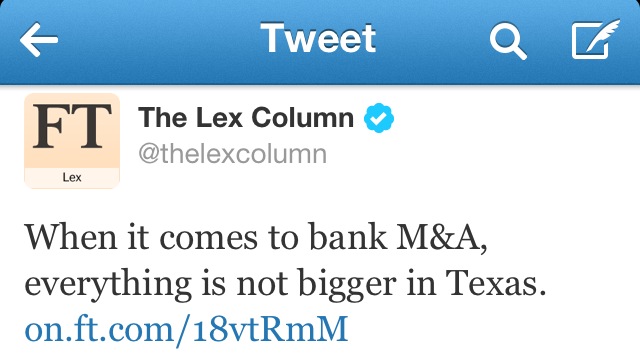
I can’t improve upon the FT’s Lex Column tweet for this week’s post; since it’s behind a paywall, I can’t share any more than the shortened URL either.  Still, it does foreshadow one of three points I’m sharing as we wrap up another summer week.

(1) When it comes to bank M&A, investment bankers “expect slow and steady consolidation.” Analysts point out that in today’s environment of slowed economic growth and regulatory change, bankers and investors continue to eye M&A as a possible opportunity for increasing profits and building strategic franchises.   So I paid close attention to news that Texas-based Cullen/Frost will, for the first time in nearly seven years, acquire another bank. On Tuesday, the NYSE-listed institution announced it will pick up Odessa-based WNB Bancshares, which operates in the heart of the oil-and-gas producing, Friday Night Light’sinspiring Permian Basin in West Texas.  If you’re not familiar with shoppingCullen/Frost, it has $22+ billion in assets and consistently ranks among the top banks in the country (at least, if you pay attention to rankings like the “Nifty Fifty,” which annually identifies the best users of capital).  As I looked for background on the deal, I found this article that ran in the bank’s hometown of San Antonio an interesting summary.  According to the news outlet, Cullen/Frost’s Chairman and CEO, Dick Evans, is fond of saying he is an “aggressive looker and a conservative buyer” when it comes to making acquisitions. So you have to figure this cash and stock deal (valued at $220 million) makes too much strategic sense for both institutions to ignore, especially with the Lone Star state’s surging oil and gas business.

(2) From size to age, you may hear me refer to my company as a 23-year old start up.  But this description cannot hold a candle to “a 110-year-old NorCal startup:” Mechanics Bank.  While I haven’t visited with them, every time I go to San Francisco I hear good things about the team leading the bank (and yes, we have written about their work; for example, “Talking Tech to Directors“).  Within the bank is the author of “Discerning Technologist,” Bradley Leimer.  As the VP of Online and Mobile Strategy at Mechanics Bank, I certainly appreciate his perspectives on change.  In fact, as I work on a growth-focused program for CEOs, executives and a bank’s boards, his “What Inspires Financial Services Innovation?” piece became a must read.  Totally up my tech and design alley and a blog worth following.

(3) Finishing on a technology kick, Fiserv shares a white paper that explores mobile strategies (“Mobile Banking Adoption: Your Frontline Staff Holds the Key to Growth“). Ubiquitous as this conversation feels, they show that for most financial institutions, mobile banking adoption typically hits a glass ceiling of 15% to 20% of online banking customers.  This surprised me, as adoption rates of mobile devices continues to grow.  I am a big fan of what the tech giant does to support the community, but I’ve talked with CEOs like Umpqua’s Ray Davis in the past about their retail concept that includes a big mobile push.  No matter what tone at the top is struck, tactical challenges remain for almost everyone.  So I’m curious to hear how banks account for this plateau as they devise their plans.  Many bank leaders I meet with express an interest in getting more mobile and social.  Fewer, however, have a comfort that their teams are measuring, and subsequently managing, such plans for the future.  Fiserv’s piece, for banks and credit unions alike, provides some interesting context for such strategic conversations.

Aloha Friday!