Building a Higher Performance Bank Board

This is the first of five bank director “education”-type posts on About That Ratio.  Against yet another snowstorm in D.C., I’m gearing up for a Bank Board Training Forum in Nashville later this week and will share various thoughts that tie into our “strong board, strong bank” philosophy.

photo-2

Today’s post is not a “check the box” criteria for how a bank’s board should operate; rather, a personal observation based on numerous conversations with CEOs, Chairmen and outside directors.  Simply, when it comes to building a high performance board, I would ask each member of the board to consider:

  1. Are you prepared to lead when something big happens (e.g. a regulatory agency takes action against the institution… an unexpected takeover attempt, etc.)?
  2. Have you given succession planning serious time and attention for your next generation of leaders?
  3. What kind of diversity of perspective do your fellow board members bring to the table – and how are these used to strengthen the bank?

Although bank boards have certain duties that have been prescribed by law or regulation, I’ve learned that an individual board’s role is defined as much by culture and tradition as by an external requirement.  While building a higher performance board is as much an art as it is a science, I’ve found asking “better questions” leads to better results.

If you’re interested…

Here are three free resources that can help you go deeper into this topic today:

  • Jack Milligan authors The Bank Spot – a must-read blog about banks & banking, written from the perspective of a veteran financial journalist (and yes, Bank Director’s editor)
  • Weil is one of the pre-eminent corporate governance counsel
  • McKinsey recently published “Building a Forward-Looking Board” (registration required)

FI Tip Sheet: The Innovator’s Dilemma

Over the past few years, I have seen significant change within the banking community — much of it defensive or in response to government intervention and oversight.  According to a white paper recently published by McLagan, “a great deal has been said about the excesses and errors of the past; however (sic), the current focus for banks, in particular, must be on the need to innovate or risk becoming stagnant and losing the ability to compete for exceptional talent.”  This morning’s column focuses on the “innovator’s dilemma,” vis-a-vis three questions.

Everything is AwesomeDo We Need Sustainable or Disruptive Technology ?

I have talked with a number of Chairmen and CEOs about their strategic plans that leverage financial technology to strengthen and/or differentiate their bank.  After one recent chat, I went to my bookshelf in search of Clayton Christensen’s “The Innovator’s Dilemma: When New Technologies Cause Great Firms to Fail.”  His book inspired today’s title — and fuels this first question.  Christensen writes about two types of technologies: sustaining and disruptive.  Sustaining technologies are those that improve product performance.  As he sees it, these are technologies that most large companies are familiar with; technologies that involve improving a product that has an established role in the market.  Most large companies are adept at turning sustaining technology challenges into achievements.  However, large companies have problems dealing with disruptive technologies — an observation that, in my view, does not bode well for many traditionally established banks.

“Discovering markets for emerging technologies inherently involves failure, and most individual decision makers find it very difficult to risk backing a project that might fail because the market is not there.”

While risk is inherent to banks of all sizes, taking chances on emerging technologies continues to challenge many officers and directors.  To this end, I thought about the themes explored in Christensen’s book after spending time in Microsoft’s New York City offices last week.  While there, I heard how big banks are generating revenues by acquiring new customers while retaining, up-selling and cross-selling to existing customers.  I left impressed by the various investments being made by the JP Morgans of the banking world, at least in terms of customer relationships and experience management along with analytics and core system modernization.  I do, however, wonder how any entrenched bank can realistically embrace something “uber-esque” (read: disruptive) that could truly transform the industry.

Do We Have the Staff We Need?

Consider the following question from the perspective of a relatively new hire: “I have a great idea for a product or service… who can I talk with?”  A few months ago, Stephen Steinour, the President & Chief Executive Officer at Huntington Bancshares, keynoted Bank Director’s annual Bank Executive & Board Compensation conference and addressed this very thing.  As he shared to an audience of his peers: “the things I assumed from my era of banking are no longer valid.”  Rather than tune out ideas from the field in favor of age and experience, he explained how his $56Bn+ institution re-focused on recruiting “the right” employees for the company they wanted (not necessarily what they had), with a particular emphasis on attracting the millennial generation into banking.  He admitted it’s a challenge heightened by public perception of the industry as one that “takes advantage of people and has benefited from government bailouts.”  Still, he made clear the team they are hiring for reflects a new cultural and staffing model designed to drive real, long-term change.  I wonder how many banks would (or could) be so bold?

Do We Have The Right Business Model?

I’ve heard it said that “forces of change” will compel banks to reinvent their business models.  Take the business model of core retail banking. According to a piece authored by McKinsey (Why U.S. Banks Need a New Business Model), over the past decade, banks continued to invest in branches as a response to free checking and to the rapid growth in consumer borrowing.  But regulations “undermining the assumptions behind free checking and a significant reduction in consumer borrowing have called into question the entire retail model.  In five years, branch banking will probably look fundamentally different as branch layouts, formats, and employee capabilities change.”  Now, I’m not sure banking’s overall business model needs a total overhaul; after all, it still comes back to relationships and reputations.  Nonetheless, many smaller banks appear ripe for a change.  And yes, the question of how they have structured their business is one some are beginning to explore.

##

To comment on this piece, click on the green circle with the white plus sign on the bottom right.  Looking ahead, expect a daily post on About That Ratio next week.  I’ll be in Nashville at the Hermitage Hotel for Bank Director’s Bank Board Training Program.  Leading up to, and at, this educational event, I’ll provide an overview on the various issues being covered.  Namely, risk management and auditing issues, compensation, corporate governance, regulation and strategic planning.  Thanks for reading, and Aloha Friday!
FI Tip Sheet: The Size of the Sandbox

Just as an Apple store conveys a community and market presence, so too does a bank’s branch.  While younger customers may no longer visit more than a front-of-the-house ATM, I do think many of us choose our bank based on their proximity to where we live and work.  Today’s tip sheet builds on this thought — beginning with a look at the economics of deposit taking, followed by a visual reminder of our industry’s size before ending with an acquisition by a a big-bank based in Madrid.

photo

Face-to-Face Trumps Technology?

To borrow a few lines from a recent CDW white paper, as the U.S. financial industry emerges from the recent financial crisis, “the surviving institutions are leaner and more focused than ever before. In some cases, this means lowering overhead — doing more with less — to effectively maintain operations.” While the future of banks proved a popular conversation starter during my travels around Washington D.C. and New York City this week, it is a report shared by Fred Cannon — the Director of Research at Keefe, Bruyette and Woods — that caught my eye. I am a big fan of Fred’s prose and the perspectives he offered in “Branch Banking in Retreat” demonstrates that real branch transformation continues to elude many financial institutions. To wit:

“The economics of bank deposit taking is poor in the age of Bernanke and Yellen (low rates) and Durbin (reduced fees). But beyond rates and politics, technology is also undermining the role of traditional branches as the payment system has moved sharply towards electronics in the last decade… Yet, overall banks are responding slowly to the changes in economics and technology of branching. While the number of bank branches has fallen since 2009, the population per branch in the U.S. is still at the same level as the mid-1990s.”

Most branch transformation initiatives I have seen seek to simultaneously reduce costs while improving sales. Here, size matters. Smaller banks can re-invent themselves faster than the big guys; however, its the biggest banks that can financially absorb the most risk in terms of rolling out something new (and expensive).

A Visual Reminder That Financial Size Matters

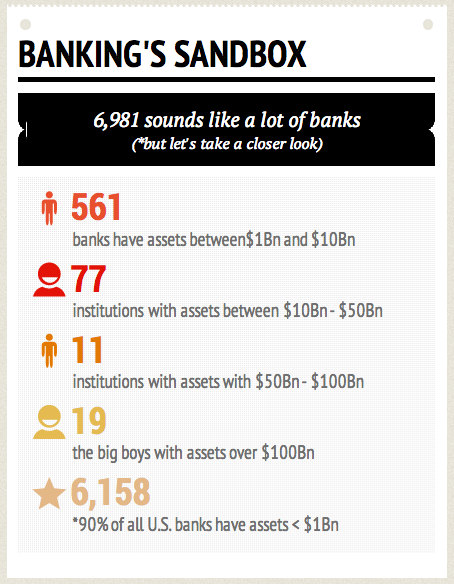
Fred’s research piece, focused on small and mid-sized banks along with the BofA’s and Wells Fargo’s of the country, inspired me to create the following infographic.  I’ve shared variations of these statistics in prior posts — and thought to illustrate how our industry breaks down in terms of asset size.

Screen Shot 2014-02-21 at 9.42.29 AM

(*note: while I hoped to serve this infographic up in a dynamic way, the image I created from Infogr.am isn’t embedding in WordPress.  Still, you get an idea of the market with this screenshot)

Old School Acquires New School

For smaller institutions, the size (and ability to scale) of their larger counterparts can be cause for alarm.  Indeed, Accenture shared “becoming a truly digital business is key to how we innovate and differentiate ourselves from our competitors. And if the last decade has been the playground of the digital start-ups, the coming decade will see the emergence of the traditional companies as the digital giants.”  I was thinking about this as I read the New York Times’ Dealbook story “BBVA Buys Banking Start-Up Simple for $117 Million.

This acquisition is notable as the buyer of this upstart is a 150-year old financial services corporation that operates in a number of markets, is a leading player in the Spanish market, as well as one of the top 15 banks in the U.S. and a strategic investor in banks in Turkey and China.  As noted by TechCrunch, “while not itself a bank, Simple operates as an intermediary between users and FDIC-insured institutions to provide users with access to data around their financial history, as well as tracking of expenditures and savings goals, with automated purchase data collected when its customers use their Simple Visa debit card.”  I wonder if this acquisition starts a consolidation trend of bigger banks buying newer fintech players to accelerate — while differentiating — their offerings…

Aloha Friday!

FI Tip Sheet: Some of Banking’s Best Female CEOs

According to a recent report by Catalyst, 46.9% of the U.S. labor force is female; but only 16.9% of Fortune 500 corporate board seats are held by women and 4.6% of Fortune 500 CEOs are women. This got me thinking about the financial sector and why there are so few… along with wondering who are some of the best. Yes, the number of women serving as chief executives is spectacularly small, and the same is true in the banking industry.  Nonetheless, there are a number that standout and what follows in today’s tip sheet are some of them.

preview

Two CEOs at “Big Brands”
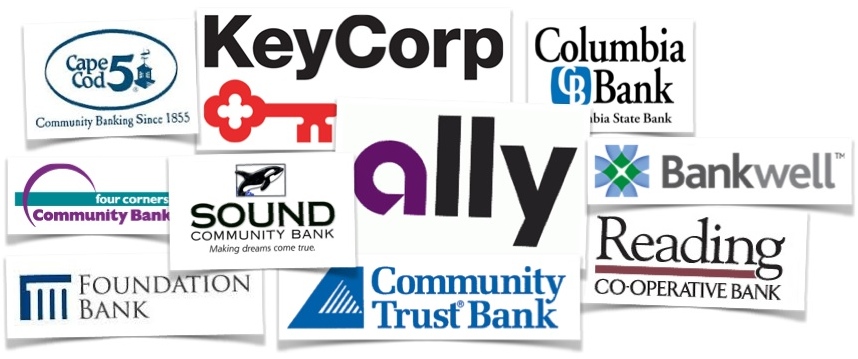
Last month, I wrote how the names and logos of institutions over $50Bn — think M&T with some $83Bn in assets, PNC with $305Bn and US Bancorp with $353Bn – are familiar to most. Leading these massive organizations are some tremendously talented individuals; to today’s focus, Beth Mooney, the CEO of KeyCorp, deserves recognition. The $89 billion Cleveland-based bank operates branches in 14 states from New York to Alaska. Of note, she is the only female CEO running a financial institution included in the S&P 500. So I made immediate note of Ken Usdin’s comments about her success. Ken is the Managing Director of Equity Research for U.S. Banks at Jefferies, and notes “Beth has done a very good job streamlining the organization, improving the business model in retail banking and tightening the focus and integration of Key’s various commercial banking businesses.”

Like Beth, Barbara Yastine, the Chief Executive Officer and President of Ally Bank deserves praise for the role she’s played since assuming the post in May of 2012. Consider that Ally Bank, the direct banking subsidiary of Ally Financial Inc., announced this past year it had crossed the $40 billion threshold in deposits from retail customers.  Quite an accomplishment given its parent company, the former GMAC, was described in an American Banker piece as “a poster child of the financial crisis and could have buckled under the weight of its bad loans without a bailout.” In addition to a portfolio of straightforward products, Ally Bank has introduced popular online and mobile banking tools backed by a robust customer service platform under her care and guidance.

Four CEOs at Strong Community Banks
A dynamo in her own right, Cathy Nash, the former President and CEO at Citizens Republic Bancorp (who orchestrated a great merger deal with FirstMerit last year) pointed me towards Jean Hale of Community Trust Bancorp in Kentucky. Ms. Hale has been CEO since July of 1999 and guides the NASDAQ-listed company with total assets at $3.6 billion.

From the Commonwealth of Kentucky let me move to my first home state of Massachusetts. There, you will find Dorothy Savarese, the president and CEO of The Cape Cod Five Cents Savings Bank, leading 400 employees while presiding over an institution with $2.3Bn in assets. Serving the community since 1855, this is one of those bank logos I always get excited to see come summer vacation.

Separately, I also hear that Melanie Dressel, President and CEO, Columbia Banking System out of Tacoma, Washington, is a female CEO to watch. With the bank’s acquisition of West Coast in 2012, this is one of the largest community banks in the Pacific Northwest: 141 banking offices, including 80 branches in Washington State and 61 branches in Oregon.

Finally, Scott Winslow at RFi applauded Julie Thurlow at Reading Co-op Bank in Massachusetts as “smart, gracious and very focused on leading her team of folks to the right decisions for the bank and her community. One of the sharper CEOs I have met in the community banking world.”

Four I Want to Learn More About
As I prepared for today’s piece, I looked at various analyst reports, stories authored by our team, performance rankings and research notes. I took note of four CEOs — and their institutions — that I am curious to learn more about. For example, Sheila Mathews at Four Corners Community Bank. I also want to learn more about the work Peyton Patterson is doing up in Connecticut as Bankwell’s CEO. Finally, Bank Director’s own CEO, Joan Susie (a woman herself), told me that Diane Dewbrey at Foundation Bank in Bellevue, WA is really smart and interesting and that Laurie Stewart, president and CEO of Sound Community Bank in Seattle, is impressive.

Even with all this snow on the ground, let me close with a very warm Aloha Friday!

Bank Director Education

A simple truth: being a bank leader today demands more time, more attention and more knowledge than ever before. I’m lucky to engage with many exceptional bankers from around the country and am continually impressed with the appetite these executives and board members have for information and insight about our increasingly complex industry.
homeImage
While I’m proud of the online, in-person and on-site work of the Bank Director team, I thought to highlight a series of easy-to-access 25-minute videos we produced for banks that have a relationship with us. As you will see in this short overview, we cover important topics such as the role of the board, risk management, key audit, compensation and governance issues and advice on growing the bank.

.

These videos naturally align with a one and a half day event we will host at the Hermitage Hotel (pictured above) in our company’s hometown of Nashville, TN next month.  Our Bank Board Training Forum provides directors with cutting-edge preparation for the issues and challenges facing them in today’s ever competitive, highly regulated and rapidly evolving banking and financial services industry.  While just one of seven events we host throughout the year, I’m excited to move my attention from our biggest conference — Acquire or Be Acquired — to our newest.

FI Tip Sheet: The Top Women in Banking?

Clearly, there aren’t many female CEOs of major corporations.  According to Spencer Stuart, an executive search firm, the number of women serving as the CEO of an S&P 500 company increased to 22 in 2013. Nonetheless, this represents a mere 4.5% of the companies that comprise the index.  I share this statistic as a preface to this morning’s post, one that asks for your help and feedback on “the best” female CEOs in banking today.

shutterstock118860388

Background

Last month, inspired by a piece that ran on Yahoo Finance (“the Best CEOs of 2013“), I reached out to a number of colleagues that work for professional services firms to ask their thoughts on the top CEOs at financial institutions — along with why they hold them in such regard.  I subsequently shared their thoughts (along with mine) on some of the best CEOs in the business today — broken down into three categories: the “biggest banks” with $50Bn+ in assets, those with more than $5Bn but less than $50Bn and finally, those in the $1Bn to $5Bn size range.

A request for help

While the CEOs I wrote about certainly deserved the recognition, noticeably absent on each list: women.  Yes, I realize the vast majority of CEOs in banking today are male; however, I am keen to identify those female executives at financial institutions that are truly the best in banking.  So here’s the deal.  I’d like your thoughts on the top female CEOs — regardless of their financial institution’s size — and a sentence or two that provides color and context as to why you think so. This can be shared publicly with a comment below or tweet to me at @aldominick. It can be shared directly via email adominick@bankdirector.com or with a message thru LinkedIn.

What will come of this

Next week, I’ll post a piece on the top female CEOs on this site. FWIW, I am happy to attribute comments to an individual or keep things anonymous.

Thanks, and Aloha Friday!

FI Tip Sheet: This Week in Pictures

As I wrap up the week, let me take a look back at Bank Director’s 20th annual Acquire or Be Acquired conference vis-a-vis video recaps and a gallery of pictures from the Arizona Biltmore.

_2441032004

Sunday Recap

If you’re curious for a <90 second summary of our first day in the desert, take a read at what I wrote or look at these two videos. The first, of our talented editor Jack Milligan; the second, my two cents.

.

.

Monday Recap

The second full day of the program built on Sunday’s discussions relative to growth, profitability, efficiency and the need for scale.  Jack and I both shared our thoughts in these video pieces and I also authored a piece that can be found here.

.

.

Photo Gallery

Credit for these great pictures goes to Keith Alstrin of Alstrin Photography.

Aloha Friday!

Wrapping up Acquire or Be Acquired

As we bid adieu to this year’s crowd, it strikes me that efficiency and productivity are key elements in positioning a bank to grow.  While this year’s Acquire or Be Acquired conference (#AOBA14) touched on numerous growth strategies, the common denominator among “organic growth banks” is a robust and diverse lending platform along with a proven credit culture and process.

photo (42)

The future of banking

For those joining us at the Arizona Biltmore on Sunday morning, you saw a video that summarized various thoughts on “the future of banking.”  A number of attendees asked to see the video we used to open the conference again.  Here it is:

Tuesday Takeaways

My “rapid reaction” to this morning’s conversations at the Arizona Biltmore, in no particular order: growth is now driving pricing; efficiency & productivity are both key elements in positioning a bank to grow; and the base reality remains that there is overcapacity in the US banking industry.

Off to the hit ’em long and straight (I hope) as we wrap up our 20th annual conference with our annual golf tournament.  74 and sunny… what a treat!

Acquire or Be Acquired – Monday Recap

Two big takeaways from the second day of Bank Director’s 20th annual Acquire or Be Acquired conference (#AOBA14): given the improving economic environment and low interest rates, lack of top-line growth could lead to further industry consolidation while regulatory burdens are increasing the need for scale in the industry.

_4032230692
Keith Alstrin of Alstrin Photography

90 Second video recap

Peering into a crystal ball

What if I told you that by December 31, 2018, we’d witness a 25% decline in the number of institutions between $500mm and $1bn, a 50% decline in the number of institutions between $1bn and $5bn, a 50% increase in the number of institutions between $5bn and $15bn and 5% annual decrease for all other categories? I can’t take credit for this consolidation prediction… that goes to Ben Plotkin the Executive Vice President, KBW and Stifel and Vice Chairman, Stifel Financial Corporation. He opened today’s conference with a look at merger activity and “its impact on the transformation of the banking industry.” Just one of many thought-provoking parts to today’s program.

Staging a Family Exit

The family dynamic in closely held banks is a powerful driver in bank mergers and acquisitions today, and deals involving closely held financial institutions often take a very different tack than transactions by their publicly traded brethren.  With a number of smaller banks represented here — many of whom are family owned or are thinly held, I wasn’t surprised that one of our best attended breakout sessions focused on how banks, with under 500 shareholders, might consider staging a successful exit.

Trending Topics

Overall, the issues I took note of where, in no particular order: banking is absolutely an “economies of scale” business; investors want to invest in buyers, not try to pick the sellers; the term “merger of equals” may be a misnomer; however, there are real benefits of a strategic partnership as banks look to stay relevant and achieve scale; BSA and AML issues have derailed and/or prevented quite a few deals from ever seeing the light of day.

More to come from the Arizona Biltmore tomorrow afternoon…

Acquire or Be Acquired – Sunday Recap

The most successful banks have a clear understanding and focus of their market, strengths and opportunities.  One big takeaway from the first full day of Bank Director’s Acquire or Be Acquired Conference (#AOBA14 via @bankdirector): it is time for a bank’s CEO and board to reassess their strategic opportunities.

_4323183253
thanks to Keith Alstrin of Alstrin Photography

90 Second video recap

Looking for profitability cures

From the strategies and mechanics behind transactions to the many lingering questions regarding industry consolidation, economies of scale, regulatory burdens and how to build long-term value, today featured some pretty fascinating presentations.  One of the common themes from the afternoon sessions: most bankers are looking to cure profitability challenges through some kind of M&A activity.

How much are you worth
Whether buying, selling or simply growing organically until it’s time for a transaction, a bank’s leadership team needs metrics in place to know and grow its valuation.  As we heard today, valuation is a controversial and complex subject.  To wit: it requires an in-depth understanding of a company, its market and competitors, financial and non-financial information.  In addition, factors such as the legal and regulatory environment proves quite a challenge.

Trending topics
Overall, the issues I took note of where, in no particular order: margin compression, deposit funding, efficiency improvements and business model expansion in the context of the current environment. Also, keep an eye on the the Northeast and greater Atlanta area this year for increased merger and acquisition activity.

More to come from the Arizona Biltmore tomorrow…

FI Tip Sheet: Acquire or Be Acquired

So we had a little snow in D.C. this week… and a bit of wind too. Fortunately, I’m heading west towards Bank Director’s 20th annual Acquire or Be Acquired conference this morning. As I wrote about on Wednesday, I will be checking in on a daily basis from the historic Arizona Biltmore with insight and observations from our flagship “AOBA” conference. Before I hit the desert, let me share three thoughts that tie into the conference themes of bank mergers and acquisitions as I make my way from D.C. towards Phoenix.

img_1174

7,000 is so 2013

Let’s simply start with a number: 6,891. Confused? Don’t be. This is the number of federally-insured institutions nationwide as of last Fall — falling below 7,000 for the first time since federal regulators began keeping track in 1934 (according to the FDIC). Now, let me put this into context; specifically, by asset size. 6,158 banks (90% of all U.S. banks) have assets of less than $1 billion. 562 banks have assets between $1 billion and $10 billion and only 108 institutions have assets greater than $10 billion. The kicker? The “distribution of wealth” heavily favors the biggest of the big. Case-in-point: banks with $10 billion or more in assets controlled 24% of total industry assets in 1984 (according to the American Banker). That share has swelled to over 80% today. When you think about things in these terms, its not surprising to hear the majority of bank M&A will occur in the <$1Bn range.

What’s the deal?

According to SNL Financial, there were 227 M&A transactions in 2013 — up from 218 in 2012. Nonetheless, these numbers pale in comparison to “the halcyon days of late 1990s.” As our editor, Jack Milligan, wrote in a post that ran on this site in December, we may “eventually see the emergence of a new tier of banks in the $10 billion to $50 billion range that will consolidate attractive banking markets… and help drive consolidation into yet another phase.” Still, hurdles to doing a deal remain. For instance:

  1. Higher capital and liquidity requirements;
  2. Today’s regulatory environment presents many significant and ongoing challenges; and
  3. Access to capital markets remains limited to many.

That said, I’m sure we will continue to see the combination of really strong companies — think this week’s union between North Jersey banks ConnectOne and Center Bancorp – and do agree with Jack’s perspective on what the future holds.

Ready to raise your hand?

I’m confident that an advisor (or two, or three or ten) will declare a merger or acquisition to be the principal growth strategy for community banks. I’m also anticipating conversations that entail the need for a bank’s CEO and board to re-examine their branch networks and strategies. Steering clear of anything that relates to the actual structure of deal, here are three questions I think will crop up early (and often) at AOBA:

  1. How do you know your bank has the right team in place to implement, and deliver, sustained results?
  2. If I’m not ready to sell — but am not in a position to buy — how can I grow?
  3. How can I, as a potential acquirer, create a strategic advantage vs. my peers?

If you’re joining us in Arizona this weekend, I’m looking forward to saying hello. If you’re not able to make it but want to follow the conversations from afar, #AOBA14 and @aldominick on Twitter should do the trick.

Aloha Friday!

Banking’s Biggest M+A Conference (#AOBA14)

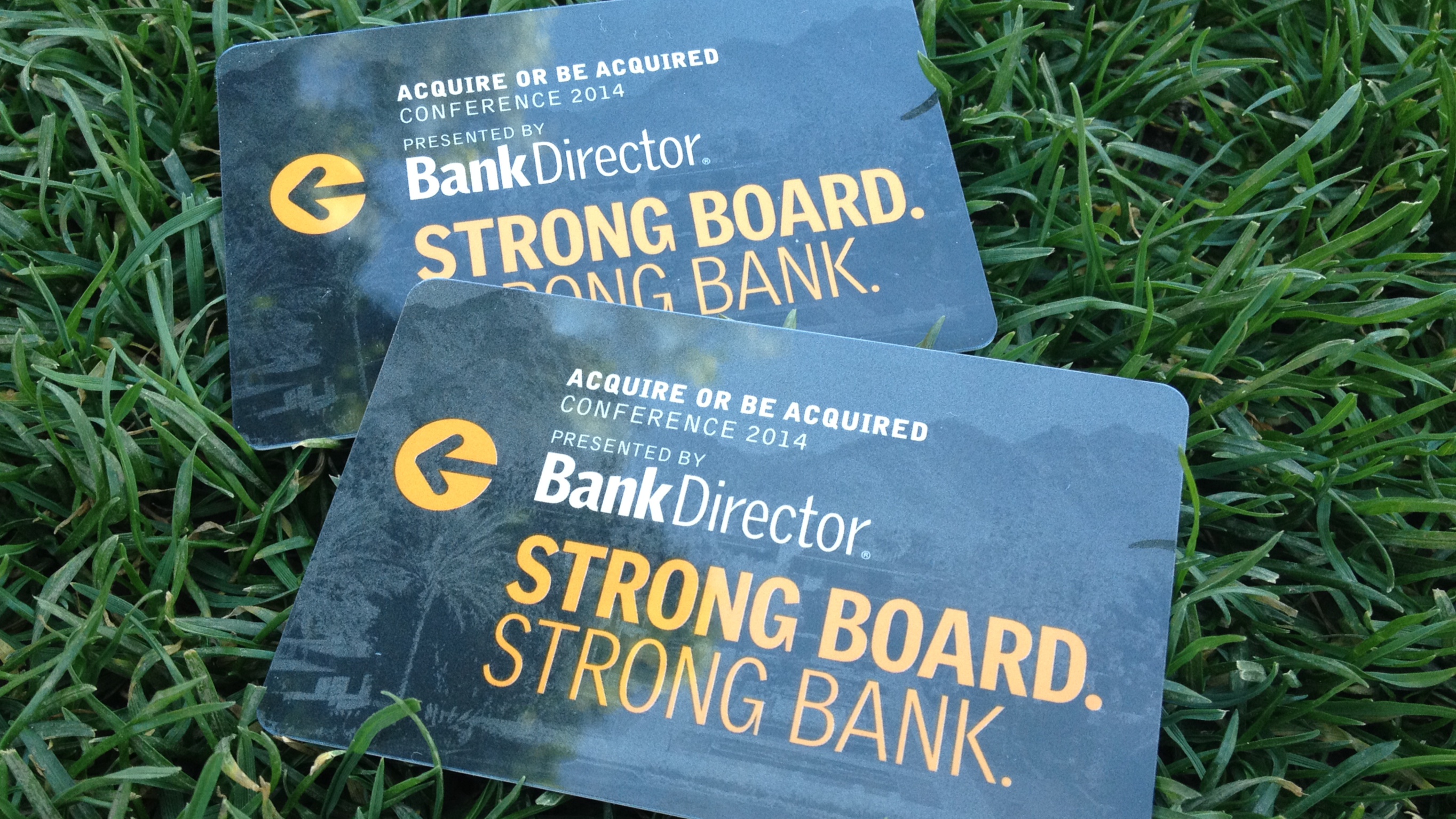
In a few days, I’ll be taking to the stage with our editor, Jack Milligan, to welcome some 830 attendees, guests and staff to Arizona and Bank Director’s annual Acquire or Be Acquired conference.  Widely regarded as the financial industry’s premier M&A event, our 20th annual “AOBA” will bring bank CEOs, CFOs, Chairmen and outside directors to the Arizona Biltmore for three days of presentations, workshops, networking… and hopefully, some sun.  These industry leaders join us to explore issues such as strategic alliances, investors’ interests and whether now is the right time to be a buyer — or a seller.  I thought I’d tee up my blogging plans before leaving the snow and ice of Washington D.C. (see below) for the warmth of the Southwest.

photo (36)

Acquire or Be Acquired

On the merger front, one of the big themes over the past few years has been unrealistic expectations between buyers and sellers of banks.  Not surprisingly, sellers think pricing is too low and buyers think sellers’ expectations are too high.  Now, when managed effectively, mergers and acquisitions present necessary and lucrative opportunities — and this particular conference affords bankers and board members the chance to “go deep” into the M&A process in order to represent and protect the interests of their particular bank.  I’ll be spilling a lot of digital ink on a number of financial, legal, accounting and social issues facing bank executives and board members.  Today’s post simply tees up some of the social tools I’m going to use to keep folks current with the discussions.

Twitter
First and foremost, @bankdirector has a loyal following and does a great job putting info’ out for a bank’s officers and directors.  For this event, we’ve set #AOBA14 as the conference hashtag.  I’ll be tweeting under @aldominick.  Some of my colleagues will be as well; notably, our editor, Jack Milligan via @BankDirectorEd, Managing Editor, Naomi Snyder, with @NaomiSnyder and our Publisher, Kelsey Weaver, with @BankDirectorPub.

LinkedIn

Take a look at Bank Director’s LinkedIn page — and feel free to search under “groups” for Bank Director if you want to join in the discussions.

Instagram + Pinterest

I’ll be sharing behind-the-scenes pix from the Biltmore using the hashtag #AOBA14 on Instagram and will pin to “January’s Acquire or Be Acquired from the Arizona Biltmore” with Pinterest.

More to come as prep continues for January’s official welcome.