Since You Can’t Own a Car Dealership

As my colleague Jack Milligan writes in our 2nd quarter issue of Bank Director magazine, just because a bank can’t own a car dealership doesn’t mean there isn’t “enormous flexibility in determining a bank’s strategy.” Curious what this means? Read on.
2Q14

A Sneak Peek at the Core Revenue Champs

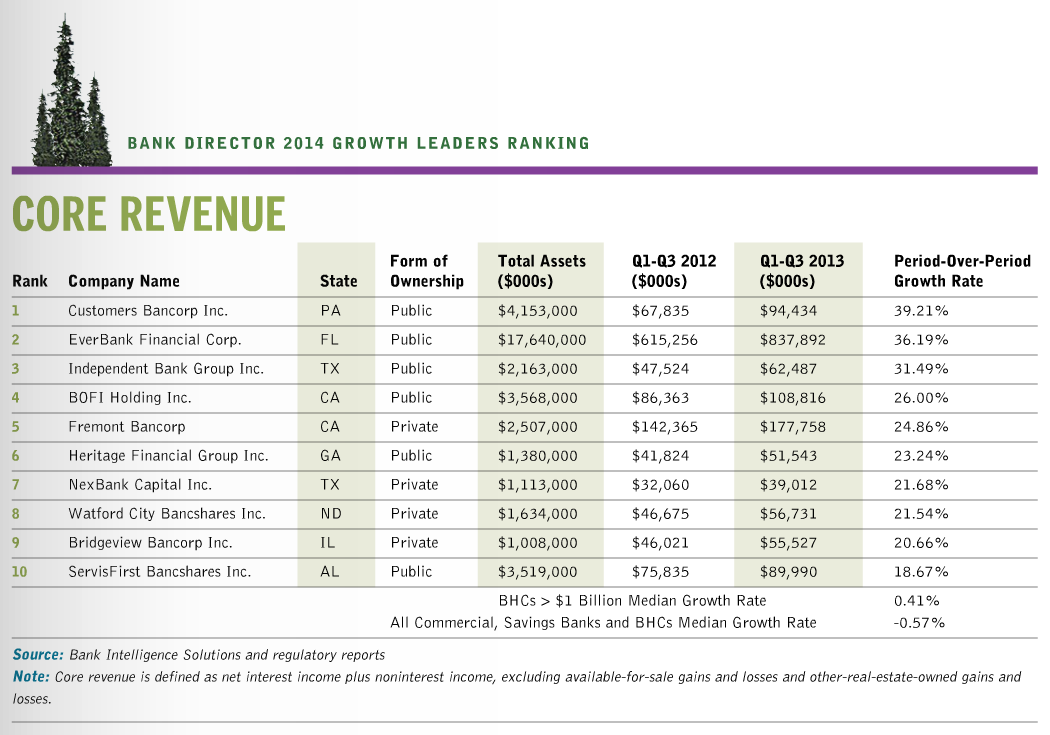
Each year, Bank Director magazine looks at all U.S. banks and thrifts to identify the strongest growth banks. We rank the top performers across four separate categories: core deposits, core noninterest income, net loans and leases and the most important, core revenue. Since the magazine mails today, I thought to offer a sneak peek of the results:
Screen Shot 2014-04-24 at 6.06.07 AM

What I find interesting about the top two banks on this very strong list: both Customers Bank and EverBank Financial designed their business models around technology from their very beginnings.

Find Your Balance

As I read through an advance copy of the issue, it strikes me that many business areas that historically provided revenue growth are simply not growing fast enough to overcome new capital and regulatory requirements.  In this light, you can understand why many say times couldn’t be more challenging for growth in community or regional banking. The corollary to this? Balancing organic and external growth is a key focus area for bank management and boards.

Increasingly, I hear that growth-focused banks are considering (or implementing) strategies that create revenue growth from both net interest income and fee based revenue business lines — think government guaranteed lending, asset based lending, leasing, trust and wealth management services. Clearly, as interest margins and loan volumes remain subject to compression and intense competition, the “optimization” of fee-based revenue is becoming pivotal in enhancing shareholder value.

‘Sup Big Easy

True, a number of banks seek to extend their footprint and franchise value through acquisition. Yet, many more aspire to build the bank internally.  Some show organic growth as they build their base of core deposits and expand their customer relationships; others leverage product innovation or focus on their branch network. I bring these approaches up in advance of next week’s Growth Conference at the Ritz-Carlton, New Orleans. We designed this event to showcase strategies, structures, processes and technologies that a bank’s CEO and board might consider to fuel their own growth.

Unlike trade shows and other events, we limit participation to a financial institution’s key officers and directors to ensure those joining us are not just committed to distinguishing their performance and reputation, but also are appropriate peers to share time and ideas with. From companies like StrategyCorps, Ignite Sales and VerifyValid to PwC, Fiserv and IBM, we have a tremendous roster of companies joining us in Louisiana to share “what’s working” at the myriad banks they support. As I’ve done for our other events (e.g. the sister conference to Growth, Acquire or Be Acquired), I’ll be posting a number of pieces next week from the Crescent City and invite you to follow along on Twitter via @aldominick, @bankdirector and using #BDGrow14.

Aloha Friday!

The Three Ds of Banking

Just as the cherry blossoms provide a welcome personal respite from winter’s cold embrace, so too have stories of creativity and growth diverted my professional attention away from compliance issues and regulatory updates.  As I travel across the country, I’m continually impressed by the close attention being paid by leaders at financial institutions to non-traditional sources of revenue — particularly fee-based income.  Today’s tip sheet reflects these recent travels and commensurate “lessons learned” with three words, a big three if you will, that tie-in to growing one’s business.

photo-4

Diversify

In order for banks to thrive in what, in many regions, remains a crowded marketplace, diversified growth is key.  I’ve heard from a few community bank CEOs that given the nature of the economic recovery and uncertainty over interest rates, quality growth requires a balance between real estate and operating company borrowers and between fixed and floating rate loans.  Without such balance, earnings and shareholder value are at increased risk.

Differentiate

The general public still does not distinguish enough between Wall Street banks and Main Street community banks.  Nonetheless, more and more bankers are making this distinction, thereby helping customers (and potential customers) to understand how important community banks are to the economy and the local region.  It strikes me such efforts will not only educate, but also encourage, more and more people to support community banks with their business.

Deliver

As the workplace becomes more mobile, so must the tools to deliver the financial services to business owners and individuals.  Clearly, the “new generation of consumers” does everything on their mobile phone.  If a bank doesn’t have a mobile app — and a quality mobile offering — I have to believe the bank does not even register to this up and coming audience.  In fact, as more Gen X and Gen Y’rs become a more sizable force in terms of total GDP, I’ve heard that one’s mobile banking solutions will be directly proportional to the amount of clients a bank is able to attract and retain.

Aloha Friday!

FI Tip Sheet: You Can Hang Your Hat On It

It’s been a while since I last called Dallas home; still, the white shirts & gray shorts of St. Mark’s proved a welcome and familiar site during a trip to the Texas city earlier this week.  A flashback to my freshman year of high school?  Absolutely.  Dare I reminisce before diving into today’s post with a few random fun facts.  Heck yeah.  Did you know Dallas lies in a large prairie running through the center of the United States?  Ok, anyone who has visited know it is fairly flat… but did you know it is one of the largest cities in the world not located on a navigable river?  Yes, this is a city where I learned about Coke floats, Suburbans and sayings like “if I say a hen dips Skoal, you can look under her wing for the can.”  Curious how I’m going to relate my time in Big D to the banking space?  Read on.

Roping it in
Roping it in

What Happened to Citi’s Hutzpah?

Even with wifi-enabled planes, I still find travel by air the best way to work uninterrupted.  The luxury of my iPhone laying silent this week?  A chance to catch up on various blogs and articles like those authored by Jack Milligan.  The editor of Bank Director magazine, he took a look at how large U.S. banks, specifically Citigroup, are being dogged by intense regulatory scrutiny and have the challenge of preparing for much stricter capital standards in coming years. By noting Citigroup was the only bank of the six largest U.S. banks to flunk the latest round of stress tests, he sets up his must-read “Where Has the Go-Go Bank Gone?”  In his view, cutting expenses and selling off non-core business units doesn’t seem like a bold enough plan for the behemoth.  Per Jack, “maybe what this Citi needs is a little of the old Citi’s hutzpah.”

Pay Attention to Your Sales Process

On Wednesday, I made it to Preston Road and St. Mark’s School of Texas for a few minutes in large part because of Ignite Sales (the company’s offices are a few miles away from the all-boy school where my parents enrolled my brother and me when my father took a job with the then-6th largest bank in the country, Bank One).  As I talked with Ignite’s CEO, Mitchell Orlowsky, he made clear that non-bank competitors are eating away at banks’ customer base, in part because banks have paid little attention to the sales process. As he shared earlier this month, “banking has never had to focus on a comprehensive sales process. Because of healthy margins from loans and fees, banks have historically shied away from proven sales methods found in other industries. However, now that the market has become competitive, the lack of sales infrastructure hurts.”

A Silver Lining

Mitchell shared how more progressive banks have begun to hire experienced sales management from other industries that bring the expertise needed to change this culture.  I thought about this approach as I dug into a Raymond James report on the outlook for the spring (“Banking Industry Overview“) on my flight home to D.C.  In their view, first quarter 2014 results are “likely be highlighted by continued improvement in credit quality, a pickup in commercial loan growth, net interest margin (NIM) stabilization, and improved profitability.  However, these positives will likely be mitigated by weak year-over-year comparisons for market-related revenue, sluggish balance sheet growth, and a continued decline in mortgage banking activity.”  Of particular note: they expect the M&A discussion to gain prominence given the pickup in deal activity and “outperformanceof stronger acquirers who have recently announced transactions” along with the following catalysts:

  • The modest pace of economic recovery
  • Increased regulation
  • Protracted low rate environment
  • Higher capital requirements
  • Aging management teams/boards

I continue to hear that M&A activity will remain largely relegated to smaller deals for banks with assets of $1 billion or less — and this report certainly reinforced this view.

Aloha Friday!

Bank Director in the Wall Street Journal

images

As the sun shines down on Washington, D.C., some “light” Saturday morning reading on the Wall Street Journal’s Risk + Compliance Journal this morning:

Banks with a separate board-level risk committee report a higher median return on assets and return on equity compared to banks that govern risk within a combined audit/risk committee or within the audit committee, according to the Risk Practices Survey from Bank Director and banking and payments technology company FIS. The survey found smaller banks are adopting risk practices required only of much larger companies, and that almost all banks with more than $1 billion in assets now have a chief risk officer and 63% govern risk within a separate risk committee of the board.

To read the full piece on recent surveys and reports dealing with risk and compliance issues, click here.

FI Tip Sheet: First Quarter Favorites

As I come off of a great week in Chicago and Bank Director’s annual Chairman/CEO Peer Exchange, today’s post takes a look back at the first three months of the year.  Yes, certain discussions during this time focused on tepid loan growth, higher capital requirements and expense pressures & higher regulatory costs hitting banks today.  Nonetheless, many more conversations focused on growth, innovation and “what’s working.”  So, to wrap up this week, three points from the past ninety days that inspired me.

AboutThatRatio = image for Jan 10.001

Some of Banking’s Best

To kick off the year, I put together a two-part series on some of the top CEOs in our industry.  Inspired by my coach and an article entitled the “Best CEOs of 2013” that ran on Yahoo Finance, I reached out to a number of colleagues that work for professional services firms to ask their thoughts on the top CEOs at financial institutions — along with why they hold them in such regard.  Part one shared various thoughts on some of the best CEOs in the business today — broken down into three categories: the “biggest banks” with $50Bn+ in assets, those with more than $5Bn but less than $50Bn and finally, those in the $1Bn to $5Bn size range.  Part two built on that piece, highlighting three exceptional CEOs that lead publicly traded banks before shifting to the thoughts and opinions of two very talented colleagues.

Eat or Be Eaten

As the President of Bank Director, I’m lucky to lead one of the industry’s biggest (and dare I say best?) M&A conferences: Acquire or Be Acquired.  Let me first offer up big time props to my many talented colleagues for everything they did to make this year’s the biggest and best yet!  One of the cool new things I did at the Arizona Biltmore this year?  Film a 90 second or less video each evening that summarized the day’s salient points.  As much as I shared big takeaways in written form on this site (e.g. what if I told you that by December 31, 2018, we’d witness a 25% decline in the number of institutions between $500mm and $1Bn), I’m proud of these two videos from the desert that relayed what caught my eyes and attention on two of the three conference days.


.

The Innovator’s Dilemma

In my role, I find myself talking with Chairmen and CEOs about their strategic plans.  This year, quite a few shared their thoughts for leveraging financial technology to strengthen and/or differentiate their bank.  In a piece I shared at the end of February, I cited Clayton Christensen’s “The Innovator’s Dilemma: When New Technologies Cause Great Firms to Fail.”  His book inspired that Friday’s FI Tip Sheet title – and first point.  If you’re not familiar with his work, the Harvard professor writes about two types of technologies: sustaining and disruptive. Sustaining technologies are those that improve product performance. As he sees it, these are technologies that most large companies are familiar with; technologies that involve improving a product that has an established role in the market.

Most large companies are adept at turning sustaining technology challenges into achievements.  However, large companies have problems dealing with disruptive technologies — an observation that, in my view, does not bode well for many traditionally established banks.  While risk is inherent to banks of all sizes, taking chances on emerging technologies continues to challenge many officers and directors… a theme I anticipate covering in greater detail over the next 90 days.

##

Whether this is your first time or 78th time reading About That Ratio, let me say thank you for doing so.  It is a real treat to share, each Friday, three short stories about what I’m hearing, learning and talking about as I travel around the country.  Being that I meet with so many interesting people — be it a bank’s CEO,  board members or executives at professional services firms and product companies — I find it tremendously rewarding to share anecdotes and insights that might interest others.  As always, Aloha Friday!

Monday Morning Takeaways: Growth-focused

photo-2

As we open up the Four Seasons “dining hall” for lunch, allow me to share some trending topics I took note of this morning at Bank Director’s Bank Chairman & CEO Peer Exchange.  For example, virtually every financial institution cites maximizing shareholder value or franchise value as their overriding strategic objective.  In addition:

  • Four significant challenges face community banks today:
    • Tepid loan growth;
    • Margin compression;
    • Higher capital requirements; and
    • Expense pressure & higher regulatory costs.
  • These five issues confront/confound CEOs and Chairmen:
    • What is our unique strategy for revenue and profitability growth?
    • How do we attract and retain best talent?
    • How do we deal with growing compliance burden?
    • How do we take advantage of technology?
    • How do we lower our efficiency ratios?
  • I wrote about size earlier today; the “sweet spot” for banks, at least from an investor’s perspective, depends on where you are in the country, but think the $5Bn to $15Bn range. A lot of work is being done through IPOs and M&A to get to that spot.
  • Since 2013, the traditional bank IPO market has revived and there have been numerous success stories. According to a presentation made by an EVP at KBW this morning, the capital markets for banks and thrifts with assets less than $10 billion have been dominated by common stock issuance, while larger banks have relied predominantly on senior debt.

Finally, on the M&A front, consolidation is in line with historical rates, and we may see 220-230 mergers done this year.  More to come from Chicago.  Keep current via Twitter and @aldominick, @bankdirector and with #chair14.

The Elephant in the Room

In my opinion, the “elephant in the room” is the fact that 90% of institutions in the U.S. have less than $1Bn of assets… and that many advisers and pundits consider $2Bn to be the “magic number” a bank needs to be at or above in order to be considered viable and competitive.

photo

Against this backdrop, let me tee up today’s Bank Chairman/CEO Peer Exchange.  Only rarely do we limit the size of an “in-person” event; for this annual gathering, we find that small groups tend to optimize the interaction among the CEOs and Chairmen.  Essentially, the two positions that bear primary responsibility for delivering strong bottom line performance.

In a few hours, I will welcome 39 institutions to the Four Seasons — with 24 being publicly traded. The median asset size is $812M – with the biggest bank here checking in at $15.6Bn in size.  By design, we built this exclusive one and a half day event around a small number of presentations and peer exchange sessions where participants share their thoughts in a private, off-the-record setting.  For example:

  • Growth and profitability – how the top banks do it
  • Building a strong franchise
  • Perspectives on cyber security and digital issues
  • Managing risk to ensure growth
  • Compensation techniques to retain and attract new leaders and key staff

This format allows for in-depth discussions of critical, and sometimes sensitive, issues for just a bank’s CEO, Chairman and/or Lead Director to consider with their contemporaries. To kick things off this morning, we will take a look at various growth stories and strategies… and I’ll be sharing some key takeaways around that topic in the late afternoon/early evening. For more “timely” insight on trends or overarching topics, feel free to follow along on twitter where my username is @aldominick and the hashtag I’ll use is #chair14.

FI Tip Sheet: Is 2014 the Year of the Bank IPO?

Good things come in threes — like insightful/inspiring meetings in New York, Nashville and D.C. this week.  By extension, keep an eye out for a Sunday, Monday and Tuesday post on About That Ratio.  Yes, I’m heading to Chicago for Bank Director’s annual Chairman/CEO Peer Exchange at the Four Seasons (#chair14) and plan to share my thoughts and observations on issues like strategic planning, risk management and leveraging emerging technologies each day.  Finally, I hope the three points I share today (e.g. a look at what the future holds for branches to a rise in public offerings) prove my original sentiment correct.

banking2020-hero1

I’ve been surprised… by the # of conversations I’ve had about branch banking.

With many of the mega and super-regional banks focused on expense control, I find myself talking fairly regularly about how these institutions are taking a “fresh look” at reducing their branch networks.  Typically, these conversations trend towards well-positioned regional and community banks — and how many now look to branch acquisitions as low risk and cost effectives ways to enter a new market or bolster an existing market.  I expect these conversations to continue next week in Chicago — but thought to share today as it again came to the fore earlier this week in NYC.  While there, I had a chance to catch up on PwC’s latest offerings and perspectives.  Case-in-point, one of their current research pieces shows that, despite the emergence of new competitors and models:

“the traditional bank has a bright future – the fundamental concept of a trusted institution acting as a store of value, a source of finance and as a facilitator of transactions is not about to change. However, much of the landscape will change significantly, in response to the evolving forces of customer expectations, regulatory requirements, technology, demographics, new competitors, and shifting economics.”

banking2020-hero3

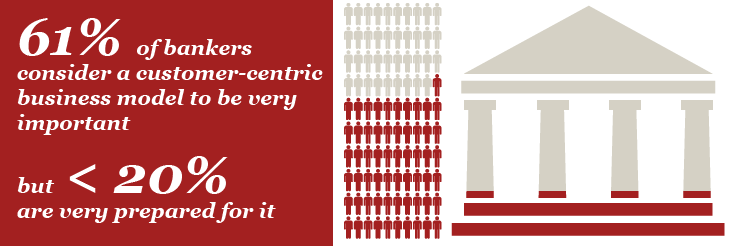
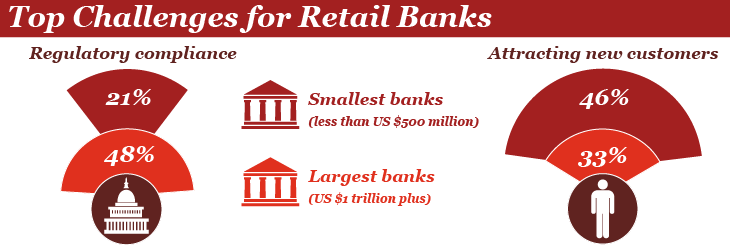
The two images above come from an information-rich micro-site (Retail Banking 2020) PwC shares.  Personally, I found these statistics fascinating and foreshadow my second point about creative approaches to win new business.

I’ve been thinking about… fin’tech companies + their “solutions.”

Here, I want to give major props to our friends at the William Mills Agency in Atlanta.  Their annual “Bankers as Buyers” report shares ideas, concepts and research about financial technology from 30 of the top influencers in the country and those forces driving change today.  This year’s report lays out trends for the coming year, including:

  • Branch Network Transformation;
  • Mobile 3.0;
  • Big Data Drives Marketing & Fights Fraud;
  • Payments Technology Stampede;
  • Banks Focus on Underbanked and Wealthy; and
  • Compliance Strategies.

Take a look at their work and download the free report if you’re interested.

I’ve been talking about… the number of banks going public.

Is 2014 the year of the bank IPO? According to Tom Michaud, the president and CEO of Stifel Financial’s KBW, it just might be.  I had a chance to get together with Tom earlier this week and he got me thinking about how many are going to pursue a public market to raise capital versus doing so privately.  He shared the story of Talmer Bancorp (TLMR), which went public on Valentine’s Day.  When it did, it marked the biggest bank IPO in three years (yes, KBW’s Banking & Capital Markets teams completed the $232 million Initial Public Offering, acting as joint bookrunner).  As he shared their story with me, it became clear that as more banks go public, we will see more buyers entering into the M&A market — since most bank deals are being done with stock these days.  It strikes me that going public presents an alternative for private banks… rather than sell now, they might find a more receptive market should their story be a good one.

Aloha Friday!

FI Tip Sheet: Positive Trends

A few weeks ago, to begin “The Innovator’s Dilemma,” I shared the need for banks to think differently or risk becoming obsolete.  This morning’s column builds on that idea by looking at some of the characteristics of top performing publicly held banks based on a research piece shared by Raymond James.  I studied this list and realized quite a few of the “winners” leverage design trends, the second point in today’s post, to differentiate their messaging.  My third and final point looks at technology expertise making its way into a bank’s boardroom — and provides an excuse to post a number of pictures from my time in Nashville last week. 

Top of the (Performance) Pack
Recently, Raymond James presented its second annual Community Bankers Cup.  This “award” recognizes the top 10% of community banks based on various profitability, operational efficiency and balance sheet metrics culled from a pool of 302 publicly traded community banks with assets between $500 million and $10 billion.  What we see in the firm’s recap is superior financial accomplishment drives superior stock price returns.  These 30 banks (e.g. Eagle Bancorp, First Financial, etc.) demonstrated exceptional results “on a relative basis in one or more of the following measurements of financial performance and stability: non-performing assets to loans and real estate owned, five-year average core deposit percentage, net interest margin, efficiency ratio, return on average assets, and return on average tangible common equity.”  If you are looking for examples of strong + healthy banks that have taken creative ideas to build a business, and subsequently monetized them, take a look at what the Raymond James team writes about these 30 institutions.

Ahead of the Curve
Since the beginning of the most recent global financial crisis in 2008, Getty Images has been tracking the changes in imagery used by financial services providers to represent their brand.  In their words, “gone are the depictions of aspiration and conspicuous wealth as financial services brands try to re-establish trust with their customers.”  In their place comes creative uses of community support “set-up for the long-term to  demonstrate their responsibility for local businesses, communities and the environment.”  Take a look at this “visual trends in financial services marketing” to get a truer sense of what’s working for bank marketers today.


Surprisingly Staffed
Last week, our team welcomed 117 bank officers and directors to the Hermitage in Nashville.  At this spectacularly Southern hotel, we went a bit old school and put pen + paper in front of these decision makers to ask five technology-specific questions.  I don’t normally equate technical proficiency with a bank’s officers and directors; however, the vast majority of attendees shared that their executive team has at least two people with strong technology understanding/experience.  While a small sample size, more then 50% of these key leaders responded to our query… and the results underscore, in my opinion, the importance being placed on  technology at community banks.  In addition, I did hear from several Chairmen that they are adding outside directors with an understanding of issues like cyber security risk and how to oversee vendor management.  If you’re interested to see what an event looks like from my POV, here’s a look (photos courtesy of Don Wright Designs & Photography)

Aloha Friday!

FI Tip Sheet: Strong Board, Strong Bank

As the banking industry continues to regain its health, efficiency and productivity are key elements in positioning a bank to grow.  Still, the reality remains there is an overcapacity in the US banking industry and the consolidation trend that brought the number of bank charters from over 14,000 to under 7,000 over the last 25 years will continue.  So let me sum in up in word letters: OTSS… only the strong survive.  Today’s post builds on this idea and offers a few takeaways from day one of the Bank Board Training Forum.

photo-2

Don’t Cry For Me

Yes, a more demanding regulatory and business environment has placed a substantial burden on bank directors and their boards. However, nearly every conversation/presentation focused on what’s possible — and not what’s broken.  Here are a few characteristics of successful “growth” banks:

  • They have a history of executing accretive transactions that are supported in the market both post-announcement and in terms of performance over time.
  • They tend to under promise and over deliver

While mergers and acquisitions is the principal growth strategy for many of these institutions, don’t sleep on building organically.  Indeed, many of the banks in attendance look at M&A as a complement to their growth plans.

An appetite for technology
We welcomed 117 bank officers and directors to the Hermitage in Nashville yesterday (and I’ll be getting up on stage in a few minutes to do so again this morning).  We went old school and put pen + paper in front of these men and women and asked a few true/false technology-specific questions.  47% have responded so far and here’s what I’m finding:

  • T/F: Our executive team has two people with strong technology understanding/experience…  43 responded true and only 12, false.
  • T/F: I would describe my bank as innovative… 40 responded true and 15 false
  • T/F: Mobile banking is an important part of our strategy… 46 responded true and 8, false

Growing Through Innovation
I heard one bank is consolidating some 200 different software packages, while another introduced concierge banking.  Interestingly, 11 bankers wrote on the survey above that the most innovative “thing” they are doing right now involves mobile banking.

##

I’ll try to post more later today, as several of the afternoon conversations tied growth into risk and audit concerns, two topics I’ve covered earlier this week.  Aloha Friday!

Joining a Bank’s Risk Committee?

Risk committees, chief risk officers, risk appetite programs, stress tests and enterprise risk management programs were not a major part of most board’s focus six years ago — but they are now.  As a risk committee typically coordinates risk oversight with the audit and other committees, today’s post builds on yesterday’s piece, Joining a Bank’s Audit Committee.  Please understand, there are so many risks that can undermine a bank today that this column simply tees up the where a committee member might focus his/her time.

article-0-137DDACE000005DC-975_634x525

Most bankers understand the concept of financial risk.  For those directors joining a risk committee?  Let’s just say they really need to understand the risks of running an operation that relies on numerous internal processes, systems and people to be successful.   Indeed, a committee member must focus on the full range of complex and often interrelated risks, including:

  • Strategic
  • Credit
  • IT
  • Market
  • Operational
  • Compliance
  • Liquidity
  • Legal
  • Reputation

Yes, risk oversight is a fundamental responsibility of the entire board; however, I hear that individual risk committee members should develop a broad view of issues across their organization to both see and know how they relate to one another.  My two cents: (a) its imperative to define your own bank’s risk appetite before communicating risk management plans throughout the bank (b) if you have one, work with your chief risk officer to determine what forward-facing metrics you want consistent focus on in order to identify and react to emerging threats.

If you’re interested…

Here are three resources that can help you go deeper into this topic:

Tomorrow’s focus: a check-in from the Bank Board Training Forum at the Hermitage hotel in Nashville, TN.

Joining a Bank’s Audit Committee?

At most financial institutions, the audit committee is the most important board committee. Indeed, just about everything of significance that happens within an institution ends up passing through the audit committee in some form or fashion.  To build off of yesterday’s post (Building a Higher Performance Bank Board), let me take a quick look at this essential committee.

bank-vault-door-3d-gualtiero-boffi

While a typical audit committee meeting involves matters like a summary of internal audits, regulatory reports and economy/operational/product/market/personnel changes, I thought to share four characteristics of “high performing audit committees” based on numerous conversations with audit committee chairs, members and executives with accounting firms:

  1. Independence from management is critical;
  2. Financial expertise is key;
  3. Access to external experts (e.g. authorized to engage counsel independently) is essential; and
  4. Industry knowledge separates the good from the great.

As my friend and colleague Jack Milligan likes to say, members of a bank’s audit committee are typically the smartest people on the board.  When you look at some of the technical accounting and financial reporting issues they have to deal with, you would at least have to agree that they carry a pretty heavy load — particularly when the audit committee is also responsible for risk governance, which is still the case on most community bank boards.

If you’re interested…

Here are three resources that can help you go deeper into this topic today:

Tomorrow’s focus: joining a bank’s Risk Committee.