Guest Post: Variety is the Spice of Life

As promised, a special guest author for this Friday’s column: Bank Director magazine’s Managing Editor, Naomi Snyder.  Having shared my key takeaways from our annual Bank Audit & Risk Committees conference on Wednesday and Thursday, I invited Naomi to share her post-conference thoughts on my blog.  So this morning’s title is as much about truth in advertising as it is an invitation to learn what my friend and colleague deemed timely and relevant.

012

At Al’s request, I’m going to step in and give a quick recap of Bank Director’s Audit and Risk Committees Conference in Chicago this week.  As you can tell from this picture, nearly 300 people attended our conference at The Palmer House hotel and they got a lot of frightening news about risks for their financial institutions, including cyber risk, interest rate risk, compliance and reputation risk in the age of social media.  I’m going to address three of those points today.

Interest Rate Risk

Many banks are extending credit at a fixed rate of interest for longer terms in an effort to compete and generate much-needed returns. This will be a problem for some of them when interest rates rise and low cost deposits start fleeing for higher rates elsewhere. You could assume the liability/asset equation will equal out, but will it? Steve Hovde, the president and CEO of the investment bank Hovde Group in Chicago, is worried about a bubble forming, saying he has seen credit unions offer 10- or 15-year fixed rate loans at 3.25 percent interest. “I’m seeing borrowers get better deals with good credit quality than they have ever gotten in history,” he says.

Reputation Risk

In an age of social media, anyone can and does tweet or post on Facebook any complaint against your bank. Cyber attacks, such as the one that befell Target Corp., can be devastating and cost the CEO his or her job. Rhonda Barnat, managing director of The Abernathy MacGregor Group Inc., says it’s important not to cater to TV news, such as telling a reporter that your employee’s laptop was stolen at a McDonald’s with sensitive customer information, prompting a visit by the camera crew to the McDonald’s. Not disclosing how many customer records were stolen could keep you off the front page. Focus on the people who matter most: your customers and investors and possibly, your regulators. They want to know how you are going to fix the problem that impacts them.

Compliance Risk

Regulators are increasingly breathing down the necks of bank directors, wanting evidence the board is actively engaged and challenging management. The official minutes need to reflect this demand, without necessarily going overboard with 25 pages of detailed discussion, for example. Local regulators are increasingly deferring questions to Washington, D.C., where they can get stuck in limbo. When regulators do give guidance, it is often only verbal and can cross the line into making business decisions for the bank, says Robert Fleetwood, a partner at Barack Ferrazzano in Chicago. In such an environment, it’s important to have good relations with your regulators and to keep them informed.

##

About Naomi: Prior to joining our team, she spent 13 years as a business reporter for newspapers in South Carolina, Texas and Tennessee. Most recently, she was a reporter for The Tennessean, Nashville’s daily newspaper. She also was a correspondent for USA Today. Naomi has a bachelor’s degree from the University of Michigan and a master’s degree in Journalism from the University of Illinois.  To follow her wit and wisdom on Twitter, follow @naomisnyder.

The Bank Audit & Risk Committees Conference – Day Two Wrap Up

With all of the information provided at this year’s Bank Audit & Risk Committees conference(#BDAudit14 via @bankdirector), I think it is fair to write that some attendees might be heading home thinking “man, that was like taking a refreshing drink from a firehose.”  As I reflect on my time in Chicago this week, it strikes me that many of the rules and requirements being placed on the biggest banks will inevitably trickle down to smaller community banks.  Likewise, the risks and challenges being faced by the biggest of the big will also plague the smallest of the small.  Below, I share two key takeaways from yesterday’s presentations along with a short video recap that reminds bankers that competition comes in many shapes and sizes.

The Crown Fountain in Millennium Park

Trust, But Verify

To open her “New Audit Committee Playbook” breakout session, Crowe Horwath’s Jennifer Burke reinforced lessons from previous sessions that a bank’s audit committee is the first line of defense for the board of directors and shareholders.  Whether providing oversight to management’s design and implementation with respect to internal controls to consideration of fraud risks to the bank, she made clear the importance of an engaged and educated director.  Let me share three “typical pitfalls” she identified for audit committee members to steer clear of:

  1. Not addressing complex accounting issues;
  2. Lack of open lines of communication to functional managers; and
  3. Failure to respond to warning event.

To these points, let me echo her closing remarks: it is imperative that a board member understand his/her responsibility and get help from outside resources (e.g. attorneys, accountants, consultants, etc.) whenever needed.

Learn From High-profile Corporate Scandals

Many business leaders are increasingly aware of the need to create company-specific anti-fraud measures to address internal corporate fraud and misconduct.  For this reason, our final session looked at opening an investigation from the board’s point-of-view.  Arnold & Porter’s Brian McCormally kicked things off with a reminder that the high-profile cyber hacks of Neiman Marcus and Target aren’t the only high-profile corporate scandals that bankers can learn from.  The former head of enforcement at the OCC warned that regulators today increasingly expect bank directors to actively investigate operational risk management issues.  KPMG’s Director of Fraud Risk Management, Ken Jones, echoed his point.  Ken noted the challenge for bank executives and board members is “developing a comprehensive effort to (a) understand the US compliance and enforcement mandates — and how this criteria applies to them; (b) identify the types of fraud that impact the organization; (c) understand various control frameworks and the nature of controls; (d) integrate risk assessments, codes of conduct, and whistleblower mechanisms into corporate objectives; and (e) create a comprehensive anti-fraud program that manages and integrates prevention, detection, and response efforts.”

A One-Minute Video Recap

##

To comment on this piece, click on the green circle with the white plus (+) sign on the bottom right. If you are on twitter, I’m @aldominick.  P.S. — check back tomorrow for a special guest post on AboutThatRatio.com.

The Bank Audit & Risk Committees Conference – Day One Wrap Up

Fundamentally, risk oversight is a responsibility of the board.  One big takeaway from yesterday’s Bank Audit and Risk Committees conference (#BDAudit14 via @bankdirector): the regulatory framework has changed considerably over the past 12 to 18 months — with less focus being placed on things like asset quality and more on operational risks and new product offerings.  To this end, I get the sense officers and directors cannot always wait for the Federal Reserve or other agencies to release guidance to get a sense of the potential impact on their institution.

photo-13
Frank Gehry’s Chicago masterpiece

Trending Topics

Overall, the issues I took note of were, in no particular order: (a) when it comes to formulating a risk appetite, no one size fits all; (b) a bank’s CEO and/or Chairman should establish a formal, ongoing training program for independent directors that provides training on complex products, services, lines of business and risks that have a significant impact on the institution; (c) bank examiners are increasingly asking more probing questions regarding new products and services & third-party vendor risk; (d) the DOJ’s “Operation Chokepoint” use of the banking system to identify fraud and criminal activity in certain areas perceived as high risk was mentioned in three different general sessions; and (e) cyber security is the hot topic.

A Two and a Half Minute Recap

##

To comment on this piece, click on the green circle with the white plus (+) sign on the bottom right. More from the Palmer House in Chicago, IL later today on twitter (@aldominick) and again tomorrow on this site.

Three Thoughts on Banks and Risk

I’m heading out to Chicago and Bank Director’s annual Bank Audit & Risk Committees Conference.  The agenda — focused on accounting, risk and regulatory issues — aligns with the information needs of a Chairman of the Board, Audit and/or Risk Committee Chair and Members, Internal Auditors, Chief Financial Officers and Chief Risk Officers.  Before I welcome some 300 attendees (representing over 150 financial institutions from 39 states) to the Palmer House, I thought to share three things that would keep me up at night if I traded roles with our attendees.

The Bean

(1) The Risk of New Competition

For bank executives and board members, competition takes many forms.  Not only are banks burdened with regulation, capital requirements and stress testing, they now have the added pressure of competition from non-financial institutions.  Companies such as Paypal, as well as traditional consumer brands such as Walmart, are aggressively chipping away at the bank’s customer base and threatening many financial institutions’ core business — a fact made clear by Jamie Dimon, the CEO of JPMorgan Chase, at a shareholder meeting this February.

“You’d be an idiot not to think that the Googles and Apples  .  .  .  they all want to eat our lunch.  I mean, every single one of them.  And they’re going to try.”

To this end, I find myself agreeing with Accenture’s Steve Culp, Accenture’s senior managing director of Finance & Risk Services, when he writes “banks need to keep developing their risk capabilities, skills and talents, and align these skills with their agenda around future growth. If they don’t align their growth agenda with their risk capabilities—building a safe path toward growth opportunities—they will miss out on those growth opportunities.”  While I plan on diving much deeper into this topic following the conference, I definitely welcome feedback on the issue below.

(2) The Risk to A Reputation

While the Dodd-Frank Act requires publicly traded banks with more than $10 billion in assets to establish separate risk committees of the board, and banks over $50 billion to additionally hire chief risk officers, I’m seeing smaller banks proactively following suit.  Such additions, however, does not absolve directors and senior managers of financial institutions from preparing for the worst… which is easier said then done.   In some ways, a bank’s reputation is a hard-to-quantify risk.  Anyone can post negative comments online about an institution’s products, services or staff, but one only needs to look at Target’s financial performance post-cyber hack to realize that revenue and reputation goes hand-in-hand.

(3) The Risk of Cyber Criminals

Speaking of Target, earlier this year, Bank Director and FIS collaborated on a risk survey to pinpoint struggles and concerns within the boardrooms of financial institutions.  As we found, tying risk management to a strategic plan and measuring its impact on the organization proves difficult for many institutions, although those that have tried to measure their risk management program’s impact report a positive effect on financial performance.  What jumps out at me in the results of this research are the concerns over cyber and operational security.  Clearly, the number of “bad actors” who want to penetrate the bank’s defenses has increased exponentially, their tools have become remarkably sophisticated, and they learn quickly.  I read an interesting piece by an attorney at Dechert (sorry, registration required) that shows the analytical framework for cyber security is very similar to what most directors have focused on in their successful business careers: people, process and technology.  But theory is one thing, putting into practice a plan to protect your assets, entirely different.

##

To comment on today’s column, please click on the green circle with the white plus sign on the bottom right. If you are on twitter, I’m @aldominick. Aloha Friday!

Good is the Enemy of Great

Jim Collins once wrote “good is the enemy of great,” opining that the vast majority of companies “never become great, precisely because the vast majority become quite good – and that is their main problem.”  I have heard many use the title of today’s piece to explain the unexpected; most recently, while talking with a friend about Jurgen Klinsmann’s decision to exclude Landon Donovan from his 23-man World Cup roster (hence today’s picture c/o USA Today).  While I’ll steer clear of any soccer talk until the U.S. takes the field against Ghana in a few weeks, Collins’ statement sparked the three thoughts I share today. Indeed, being “just good” will not cut it in our highly competitive financial industry.

usatsi_7848706_168380427_lowres Let’s Be Real — Times Remain Tough

In yesterday’s Wall Street Journal, Robin Sidel and Andrew Johnson began their “Big Profit Engines for Banks Falter” with a simple truth: “it is becoming tougher and tougher being a U.S. bank.  Squeezed by stricter regulations, a sputtering economy and anemic markets, financial institutions are finding profits hard to come by on both Main Street and Wall Street.”  Now, the U.S. financial sector and many bank stocks have “staged a dramatic recovery from the depths of the financial crisis;” as the authors point out, “historically low-interest rates aren’t low enough to spur more mortgage business and are damping market volatility, eating into banks’ trading profits.”  While I’ve written about the significant challenges facing most financial institutions – e.g. tepid loan growth, margin compression, higher capital requirements and expense pressure & higher regulatory costs — the article provides a somber reminder of today’s banking reality.

Still, for Banks Seeking Fresh Capital, the IPO Window is Open

Given how low-interest rates continue to eat into bank profits, its not surprising to hear how “opportunistic banks capable of growing loans through acquisition or market expansion” are attracting investor interest and going public.  To wit, our friends at the Hovde Group note that seven banks have filed for initial public offerings (IPOs) already this year, putting 2014 on pace to become the most active year for bank IPOs in a decade.  Based on the current market appetite for growth, “access to capital is becoming a larger consideration for management and boards, especially if it gives them a public currency with which to acquire and expand.”  If you’re interested in the factors fueling this increase in IPO activity, their “Revival of the Bank IPO” is worth a read.

Mobile Capabilities Have Become Table Stakes

I’m on the record for really disliking the word “omnichannel.”  So I smiled a big smile while reading through a new Deloitte Center for Financial Services report (Mobile Financial Services: Raising the Bar on Customer Engagement) that emphasizes the need for banks to focus more on a “post-channel” world rather than the omnichannel concept.  As their report says, this vision is “where channel distinctions are less important and improving customer experience becomes the supreme goal, no matter where or how customer interactions occur, whether at a branch, an ATM, online, or via a mobile device.”  As mobile is increasingly becoming the primary method of interaction with financial institutions, the information shared is both intuitive and impactful.

##

To comment on today’s column, please click on the green circle with the white plus sign on the bottom right. If you are on twitter, I’m @aldominick.  Aloha Friday!

Time To Sell The Bank?

From the the appeal of spreading into new geographies to the attractiveness of acquiring exceptional talent to drive new sources of revenue, the need and desire to grow exists at virtually every financial institution. For those pursuing another bank, a merger or acquisition (M&A) provides an avenue to drive earnings while improving operating leverage, efficiency and scale. I have written about M&A from a potential buyers point-of-view (e.g. Acquire or Be Acquired – Sunday Recap); today’s piece flips the script and highlights three issues that may precipitate a sale.

Compliance Costs

Banks are facing some very significant challenges in the years ahead — and not just from consolidation.  As KPMG shared in its An Industry At a Pivot Point, “the costs and time stresses created by the regulatory environment are not going away, and will continue to affect four areas for banks: strategy and business models, interactions with customers and client assets, data and reporting structures, and governance and risk capabilities.”  Certainly, the sharply increased cost of regulatory compliance might lead some to seek a buyer; others will respond by trying to get bigger through acquisitions so they can spread the costs over a wider base.

Capital Concerns

Some banks will have to raise capital just to meet the Basel III requirements, while others will have to raise capital to do an acquisition or support their organic growth. The required levels are so much higher now that banks will have to manage their capital much more closely than they did before.  (*If you’re looking for a central resource for the many ongoing regulatory changes that are reshaping bank capital and prudential requirements in the United States, take a look at Davis Polk’s excellent Capital and Prudential Standards Blog.)

Earnings Pressure

As the attractiveness of branch networks and deposit franchises dwindles, lack of top-line growth will lead to further industry consolidation. With little overall changes in our economy, in-market mergers between banks with significant overlap in branches and operations offer tremendous cost-saving opportunities when done skillfully.

##

To comment on this piece, click on the green circle with the white plus sign on the bottom right. Aloha Friday!

In the Face of Intense Competition

Financial institutions face intense competition from non-banks like PayPal, American Express, Walmart and Quicken Loans…  and a rapidly changing demographic that demands new approaches to attract and retain customers (be it individual or business).  Today’s post takes a look at two financial technology companies working to keep banks relevant as customers increasingly expect a“one stop shop” in all areas of their lives.

American-Flag-Wallpaper-Phone

Over on FiveThirtyEight.com

On FiveThirtyEight, Nate Silver’s newly launched website at ESPN, the editorial team leverages statistical analysis to tell compelling stories about politics, science and yes, sports.  While much digital ink has been spilled on this week’s NFL draft,  the site’s chief economics writer, Ben Casselman, authored a piece that caught my eye.  Thanks to a keynote presentation by Fox News’ Juan Williams at this January’s Acquire or Be Acquired conference, I’m far more aware of the changing demographics of the United States — and what that means for financial institutions.


Based on my conversations with Juan in the desert, I found early inspiration for today’s piece while pouring over Ben’s What Baby Boomers’ Retirement Means For the U.S. Economy.  In combination with economic shifts — both domestically and globally — it is clear that changing demographics are transforming businesses.  As we trend towards a younger populace, Ben writes “all else equal, fewer workers means less economic growth… If more of the population is young or old that leaves fewer working-age people to support them and contribute to the economy.”  Clearly, banks need to be prepared to serve a population that will live longer.  Maybe more importantly, they need to court their most valuable customers — Gen X&Y and Millennials (relationships built, “gulp” through online & mobile experiences).

Putting Checks into the Cloud

In the world of checks, VerifyValid acknowledges that “paper is simply a vessel for holding information. The real check is the data fields it contains: the check number, the amount, the routing number, the recipient, and most important of all, the authorizing action which says that the account holder agrees to pay the stated amount to the payee.”  I had a chance to see Paul Doyle, the company’s Founder & CEO, inspire a crowd of CEOs and board members at The Growth Conference last week.  Flying home from New Orleans, I spent some time learning how the company overcame the challenge in providing this information electronically in such a way that prevents fraud.  As I see it, VerifyValid lowers an organization’s costs while increasing efficiency and financial security with every payment.  IMHO, their 2 minute, 25 second video is worth a watch.

Making Money Simple, Attractive and Intelligent

Located “in the heart of Utah’s Silicon Slopes,” MoneyDesktop is redefining the way millions of people interact with their finances.  As one of the fastest-growing financial technology providers, MoneyDesktop positions banks and credit unions as the financial hub of their account holders — think Mint on steroids — with its personal financial management, data-driven analytics and marketing technologies.  Some 450 financial institutions rely on this software-as-a-service vendor… and I saw last night they have plans to grow significantly in the months to come.  They write, and I agree, that account holders are changing.  “There is an ongoing shift away from traditional brick & mortar banking (and) technology is providing better ways for account holders to interact with their money, and with financial institutions.”  An interesting company delivering a very clean and user-friendly experience.

Aloha Friday!

Who Says There Is No Growth In Banking

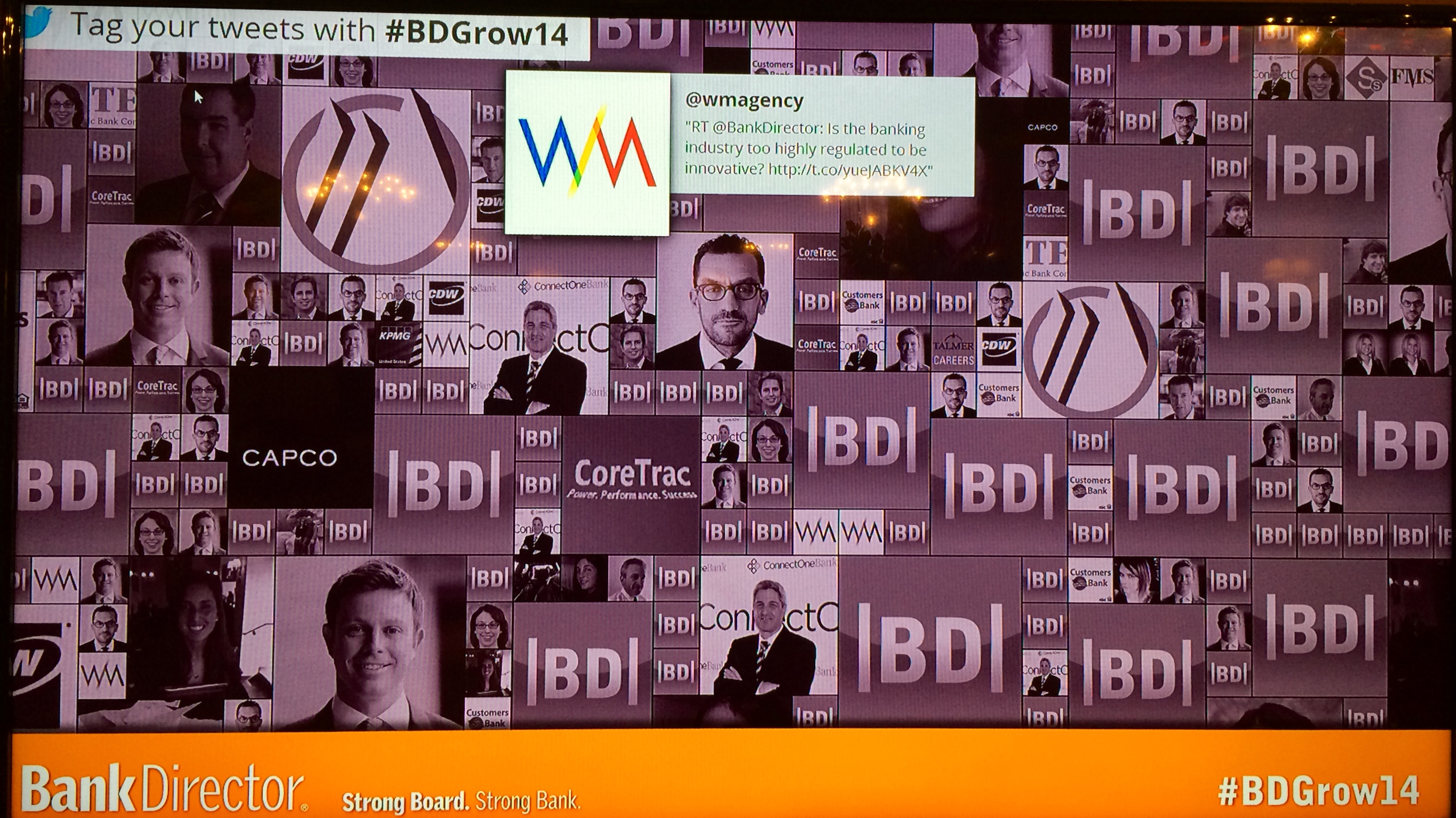
Two big takeaways from the second day of Bank Director’s 2nd annual Growth conference (#BDGrow14): institutions of all sizes are challenged when it comes to standing out from the crowd & enhancing your mobile banking presence should be a top priority for all boards of directors.

A 2 Minute Recap on the Past 4 Months


Take No Risk, Make No Money
While some may not think about enterprise risk management in the context of growing one’s bank, Crowe’s Jennifer Burke made clear that proactively identifying, mitigating, and in some cases, capitalizing on risks provides a distinct advantage to a bank.  Keep in mind that even smaller institutions — with less complex business structures — face myriad risks that might significantly affect their ability to meet their growth plans.  As Jennifer shared, those that proactively identify and respond to risks and opportunities gain a competitive advantage over their peers, especially in responding to our ever-changing business environment.

Millennial and the End of Banking?

The Times-Picayune ran a nice story in today’s edition based on The Growth Conference.  The newspaper noted that “younger generations report more comfort with online and mobile banking tools, posing a hurdle for banks used to ginning up business through face-to-face interactions.”  So it is fair to ask if banks should be scared of the millennial generation.  According to Daryl Byrd, president and CEO of IberiaBank, the answer is no.  As mentioned in this piece (Will Millennials be the end of banking as we know it? Bank execs weigh in at Growth Conference in New Orleans), Byrd was among a panel of industry leaders gathered at the Bank Director Growth Conference to discuss business trends, including the challenges in reaching younger customers.  Byrd, “who noted he is the father of three Millennials, said his children, like many in their generation, aren’t building wealth as much as they are taking on debt. That means their demand for banking services will be limited in the near term,” he said.

Trending Topics

The issues I took note of this morning were, in no particular order:

  • Just like “synergy” became a cliché, so too might “omni” when it comes to delivering a consistent customer experience (e.g. omni-screen, omni-channel, etc);
  • Not all customers are created equally;
  • A bank’s board has the chance to re-set strategies to target, acquire, engage, grow and retain customers… but need to look ahead to what’s possible as opposed to the past to see what has historically delivered results.

To comment on this piece, click on the green circle with the white plus sign on the bottom right. Safe travels home to all who joined us in New Orleans this week (and yes, Aloha Friday!)

The Growth Conference – Thursday Recap

It is obvious that the most successful banks today have a clear understanding of, and laser-like focus on, their markets, strengths and opportunities.  One big takeaway from the first full day of Bank Director’s Growth Conference (#BDGrow14 via @bankdirector): banking is absolutely an economies of scale business.

photo-7

A 2 Minute Recap


Creating Revenue Growth

At events like these, our Publisher, Kelsey Weaver, has a habit of saying “well, that’s the elephant in the room” when I least expect it.  Today, I took her quip during a session about the strategic side of growth as her nod to the significant challenges facing most financial institutions — e.g. tepid loan growth, margin compression, higher capital requirements and expense pressure & higher regulatory costs.  While she’s right, I’m feeling encouraged by anecdotes shared by growth-focused bankers considering (or implementing) strategies that create revenue growth from both net interest income and fee-based revenue business lines. Rather than lament the obstacles preventing a business from flourishing, we heard examples of how and why government-guaranteed lending, asset based lending, leasing, trust and wealth management services are contributing to brighter days.

Trending Topics
Overall, the issues I took note of were, in no particular order: bank executives and board members need to fully embrace technology; there is real concern about non-bank competition entering financial services; the board needs to review its offerings based on generational expectations and demands;  and those that fail to marry strategy with execution are doomed. Lastly, Tom Brown noted that Bank of America’s “race to mediocrity” actually makes it an attractive stock to consider.  Who knew being average can pay off?

##

To comment on this piece, click on the green circle with the white plus (+) sign on the bottom right.  More tomorrow from the Ritz-Carlton New Orleans.

Let the Good Times Roll

Checking in from a rain-soaked Reagan National airport, where I think I see the plane I’ll take down to New Orleans taxiing towards its gate.  Yes, it’s “Growth Week” at Bank Director, and I’m heading to the Crescent City to host bank CEOs, Chairmen and board members keen to focus on big picture business issues surrounding growth (not necessarily associated with mergers and acquisitions) and profitability.

New Orleans

A Deep Dive

I realize the phrase “let the good times roll” is most frequently heard during Mardi Gras celebrations in New Orleans; I’m using it to tee up Bank Director’s Growth Conference that kicks off tomorrow morning at the Ritz-Carlton.  Once the lights come up, I’ll be interested to hear:

  • How growth is driving pricing;
  • Why efficiency & productivity are both key elements in positioning a bank to grow; and
  • If “overcapacity” in the US banking industry offers opportunities.

I’m particularly excited for our opening session with Thomas Brown, CEO, Second Curve Capital.  We’ve asked him to help us “set the table” for the next two days of conversations with an outlook for banks across the country by reviewing the current capital market and operating conditions, thereby providing financial context to the next two days’ presentations.  If I don’t cover his remarks in my post tomorrow, you can bet our editor, Jack Milligan, will on his must-read blog The Bank Spot.

A Look Back

Much of last year’s conversation revolved around technology and the need to adapt to a changing marketplace, as well as the importance of creating a unique niche in a competitive landscape dominated by the biggest banks.  Many of our bank speakers at the conference had a more nuanced view of technological change. Richard Hill, the chief retail banking officer for the $19-billion asset Hancock Holding Co. in Baton Rouge, Louisiana, said when he got into banking in the 1970s, the prediction was that checks would go away and branch banking would go away. That clearly didn’t happen, or at least not at the accelerated pace that many predicted. The problem for his bank and for many others is that profits are getting squeezed with low interest rates, and the bank needs to make investments that expand revenue. As he said, “a great challenge we have is figuring all this out.”

Take Our Your Crystal Balls

Let me wrap up by sharing a 2 minute video our team compiled on the “future” of banking.  We played it at our Acquire or Be Acquired conference in January and the perspectives of KPMG’s national banking leader, the CEO of Congressional Bank, etc. are worth a watch and listen.

Laissez les bons temps rouler!

The Single Greatest Constraint on Growth

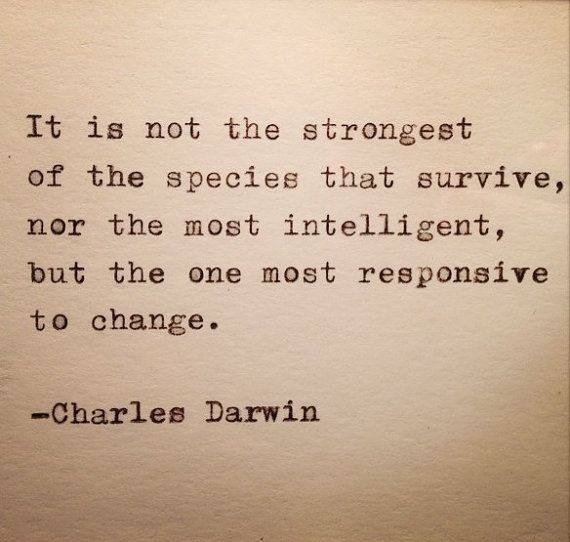
With the revenue pressures facing the banking industry being some of the most intense in decades, banks need to think more constructively about their businesses. At the same time, changing consumer behavior could drive the industry to reallocate its resources to less traditional growth channels in order to stay ahead.  In my view, the words of an English naturalist reflect the single greatest constraint on growth today.

photo-6

Powerful Forces

One of our long-term corporate sponsors, PwC, recently shared their thoughts on the future of the retail banking industry.  In their view, “powerful forces are reshaping the banking industry, creating an imperative for change. Banks need to choose what posture they want to adopt – to lead the change, to follow fast, or to manage for the present. Whatever their chosen strategy, leading banks will need to balance execution against… critical priorities and have a clear sense of the posture they wish to adopt.”  If you, like our friends from PwC, are joining us in New Orleans later this week to dive into this very topic, their compelling “Retail Banking 2020” report might make for good airplane company.

Looking Back in Order to Look Ahead

Last year, John Eggemeyer, a Founder and Managing Principal of Castle Creek Capital LLC, helped me to kick off our inaugural Growth Conference.  As a lead investor in the banking industry since 1990, he shared his views on our “mature industry,” That is, banking follows a historic pattern of other mature industries: excess capacity creates fierce competition for business which in turn makes price, not customer service, the key differentiator.  While offering myriad thoughts on what makes for a great bank,  John did share some hard-to-swallow statistics and opinions for a crowd of nearly 200 bankers and industry executives:

  • Publicly traded banks from $1 billion to $5 billion in assets saw their stock values rise at about half the rate of the broader market as a whole since early 2009.
  • Of the 300 or so publicly traded banks in that size range, only about 60 of them traded at their pre-recession price multiples.
  • In the last 40 years, bank stocks always followed the same pattern in a recession: falling in value quicker than the rest of the market and recovering quicker.

I share these three points to provide context for certain presentations later this week.  Some build on his perspectives while others update market trends and behavior.  Still, an interesting reminder of where we were at this time last year.

Getting Social-er

Yesterday, I shared the hashtag for The Growth Conference (#BDGrow14).  Thanks to our Director of Research — @ehmccormick — and Director of Marketing — @Michelle_M_King — I can tell you that nearly 30% of the attending banks have an active twitter account; 78% of sponsors do.  On the banking side, these include the oldest and largest institution headquartered in Louisiana — @IBERIABANK, a Connecticut bank first chartered in 1825 with over $3.5 billion in assets — @LibertyBank_CT and a Durham, NC-based bank that just went public last month — @Square1Bank.  On the corporate side of things, one of the top marketing and communications firms for financial companies —@wmagency, a tech company that shares Bank Director’s love of orange — @Fiserv and a leading provider of personal financial management — @MoneyDesktop join us.  Just six of many institutions and service providers I’m looking forward to saying hello to.

##

More to come — from New Orleans, not D.C. — tomorrow afternoon.

Its Growth Week

Its finally here… “Growth Week” at Bank Director.  Yes Discovery Channel, you can keep your shark week.  What we’re about to get into is far more interesting (at least, to some): what’s working in banking today.  Most of our team heads down to the Ritz-Carlton in New Orleans tomorrow and Wednesday for our 2014 Growth Conference.  Before they do, the first of five posts dedicated to building a business.

Growth-Key-Card-1

Think Distinct

Innovation means doing things differently.  Not just offering new products or offerings — but doing things differently across the entire business model.  Going into this event, I know many believe there are simply too many banks offering similar products and services.  I tend to think institutions are challenged when it comes to being distinctive compared with the competitor across the street.  This is not a new issue; however, there are more and more strategies emerging and enablers coming to market that can drive brand value, customer satisfaction and profitable growth.  Case-in-point: the work of our friends at StrategyCorps, whose idea is “be bold… go beyond basic mobile banking.”  One of the sponsors of the conference, I am excited to hear how  financial institutions, like First Financial, benefit from their mobile & online consumer checking solutions in order to enhance customer engagement and increase fee income.

Looking Back in Order to Look Ahead

While easy to frame the dynamics of our industry in terms of asset size, competing for business today is more of a “smart vs. not-so-smart” story than a “big vs. small.” During one of my favorite sessions last year — David AND Goliath — Peter Benoist, the president and CEO of St. Louis-based Enterprise Financial Services Corp, reminded his peers that as more banks put their liquidity to work, fierce competition puts pressures on rates and elevates risk.  As I went back to my notes in advance of this week’s event, my biggest takeaway from his presentation was we all talk about scale and net interest margins… but it’s clear that you need growth today regardless of who you are.  It is growth for the sake of existence.

Getting Social

To keep track of the conversation pre-, on-site and post-event on Twitter, use #BDGrow14 and/or @bankdirector + @aldominick.  In addition, I plan to post every day this week to About That Ratio, with tomorrow’s piece touching on the diminished importance of branch networks to underscore the importance of investments in technology.