Reaching For The Summit

When you say the word summit, what do you think of?  For me, it is a book; specifically, Let My People Go Surfing by Patagonia’s founder, Yvon Chouinard. I was reminded of Yvon’s thoughts while flying home to DC from last week’s Bank Board Growth & Innovation conference in New Orleans.  While there, I had a chance to share time and ideas with some 150 bank CEOs, board members and executives. As most banks wrestle with the concept of banking a generation that doesn’t necessarily see the need for a bank, I think Yvon’s opinion that “how you climb a mountain is more important than reaching the top” is a strong reminder for bankers that the little things really do count with customers today.

By Al Dominick // @aldominick

Having been on numerous airplanes over the last few weeks, I have enjoyed the luxury of time without phone calls and sometimes emails and instant messages.  This digital solitude afforded me a chance to really dive into a number of thought-provoking white papers, analyst reports and research pieces.  Three, in particular, stand out, for looking ahead to what banking might become, not merely stating the obvious that bankers are being challenged as never before.

The World Retail Banking Report (from Capgemini Financial Services and Efma)

Abstract: Retail banking customers today have more choices than ever before in terms of where, when, and how they bank—making it critical for financial institutions to present options that appeal directly to their customers’ desires and expectations.

Growing the Digital Business / Accenture Mobility Research 2015 (from Accenture)

Abstract: The emergence and adoption of digital technologies has rapidly transformed businesses and industries around the globe. Mobile technologies have been especially impactful, as they have enabled companies to not only streamline their operations, but also engage more effectively with customers and tap into new sources of revenue.

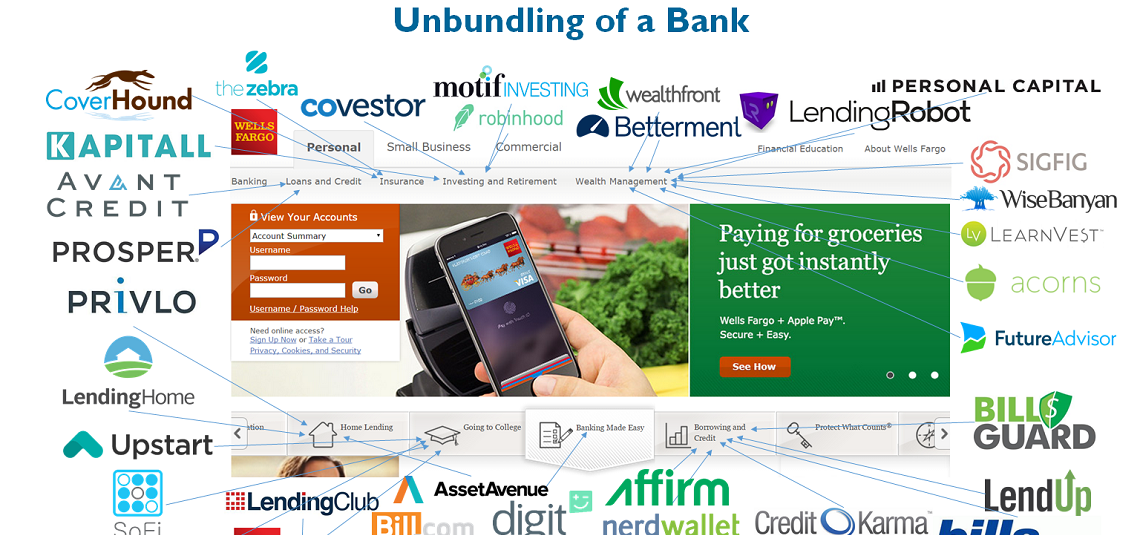
Disrupting Banking: The FinTech Startups That Are Unbundling Wells Fargo, Citi and Bank of America (from CB Insights)

Abstract: Banks run the risk of being out-innovated and may lose their edge not because of their incumbent, large competitors, but because emerging startups inflict upon them a death by a thousand cuts.  And because a picture is worth more than 1,000 words:
source: CB Insights
source: CB Insights

##

Finally, a welcome to our friends at KBW who just hopped into the Twitter pool yesterday. With so many talented men and women working there, I have no qualms suggesting a follow of their handle – @KBWfinthink (h/t to our Emily McCormick for the heads up)

This Week in Pictures – New Orleans

It has been said that the best acquisition a bank can make is of a new customer.  But let’s face it: for most banks, organic growth is hard. For those wanting to grow revenue, deposits, brand, market size and market share, we hosted a “Growth” conference at the Ritz-Carlton in New Orleans earlier this week.  Below, some pictures from our time in the Crescent City along with links to organic growth & FinTech-specific content.

By Al Dominick // @aldominick

Clearly, there has been an enormous shift in asset concentration and customer loyalty during the past two decades. Today, the ten biggest banks in the U.S. have more assets than all of the other institutions combined.  Concurrently, major consumer brands such as Apple and Google have emerged as significant non-bank competitors.  As such, we designed this year’s Bank Board Growth & Innovation Conference around the concept of building sustainable franchise value.

To stay both relevant and competitive, I believe that building a culture of disciplined growth that encourages creativity and risk taking is essential. For a bank’s CEO, executive team and board, this requires a combination of knowledge, skill and courage – things we designed this conference, a complement to our annual Acquire or Be Acquired Conference, to provide.  Behind the scenes, our team works hard to deliver a “Four Seasons”-level of service — and I am especially proud of how everyone navigated the weather challenges that hit the city on Monday.  It was great to arrive to so many smiling faces!

For those curious about the topics and trends covered at the event, you can up on what was covered by clicking on:

In addition, take a look at what our editor, Jack Milligan, has shared on his blog, The Bank Spot.  And since its Friday, I’ll take the liberty of closing with laissez les bons temps rouler!

Banking Millennials

The Millennial generation comprises 80MM people, the largest in U.S. history.  Born between the years of 1980 and 2000, millennials range in age from 15 to 35 years and are just beginning to gain their foothold in the economy.

By Al Dominick // @aldominick

Do we really want to bank millennials? If I borrowed a crystal ball from one of the soothsayers out at Jackson Square in New Orleans’ French Quarter, I imagine this would be the question on most everyone’s mind that joined me at our annual Bank Board Growth & Innovation conference.  With many community banks making their money through C&I lending, the immediate concern (at least at the board’s level) is how do I grow right now?  While many conversations trended towards the opportunities to engage this demographic by leveraging emerging technologies with a bank’s sales and marketing efforts, I was not surprised to hear a concern about the investment costs of bringing new technologies into a bank.  The rationale, as I understood it, is by the time a bank gets a return from its investment, it may be too late.  I’m not saying this is my way of thinking, but I do think it reflects apprehensions by key officers and directors when the conversations comes to these future business owners, inheritors of wealth and digitally demanding individuals.  As shared in a presentation by Ingo Money, in the next five years, the Millennial generation will have the largest income in U.S. history, and any company that can monetize Millennial spending or data may seek to bank them.  Still, regional and community bankers wrestle with the type of client they might be — both now and in the future.

Key Takeaway

To kick things off, we invited Dave DeFazio from StrategyCorps to “look beyond the basics” in terms of mobile banking.  As he shared, over 75% of people in the U.S. own a smartphone in the year — and most everyone has some sort of addiction to their device.  With all of the big banks offering the “big five” today (mobile banking, mobile bill pay, mobile deposits, ATM/Branch locators and P2P payments), bankers should think beyond basic banking transactions to develop a mobile presence that is a “can’t live without” app.  Some of his tips: provide easy authentication, pre-login balances, voice recognition, budgeting tools and coupon and shopping tools.

Trending Topics

Anecdotally, the issues I took note of were, in no particular order:

  • The four biggest banks in the U.S. are among the 10 least loved brands by Millennials.
  • Millennials want banking services designed for their needs that are instant, simple, fair and transparent… which is why new providers are beginning to emerge.
  • For those not familiar with Moven, GoBank and Simple… take a look at what each has to offer.
  • The cultural divide between banks and FinTech companies is getting smaller for bigger banks, but remains high for regional and community banks.  Nonetheless, these banks are in a better position to collaborate and seriously consider new tools and products as the decision making cycle is considerably shorter then at large institutions.

Picked Up Pieces

While today was “just” a half day, some of the more salient points I made note of:

  • Per Jennifer Burke, a partner at Crowe, “proactively identifying, mitigating, and in some cases, capitalizing on these risks provides a distinct advantage to banks.”
  • In terms of building value, the ability for a bank to grow is as important as a bank’s profitability.
  • It was refreshing to be at a banking conference where talk about regulation was at a minimum; in fact, it seemed that the regulatory environment presents more of a distraction than it poses a threat to bank’s looking to grow.
  • The corollary to this point: competition from non-banks is higher then ever before.

To see what’s being written and said as we wrap up our time in New Orleans, I invite you to follow @bankdirector, @aldominick + #BDGrow15.

Three Observations from the Bank Board Growth & Innovation Conference

Select news and notes from the first day of Bank Director’s annual growth conference at the Ritz-Carlton New Orleans.

By Al Dominick // @aldominick

I mentioned this from the stage earlier today… every January, Bank Director hosts a huge event in Arizona focused on bank mergers and acquisitions.  Known as “AOBA,” our Acquire or Be Acquired conference has grown significantly over the years (this year, we welcomed some 800 to the desert).  After the banking M&A market tumbled to a 20-year low in 2009 of just 109 transactions, it has gradually recovered from the effects of the crisis. In fact, there were 288 bank and thrift deals last year, which was a considerable improvement on volume of 224 deals in 2013.  As our editorial team has noted, the buying and selling of banks has been the industry’s great game for the last couple of decades, but it’s a game that not all banks can — or want to — play.  Indeed, many bank CEOs have a preference to grow organically, and its to these growth efforts that we base today and tomorrow’s program.

Key Takeaway

To kick things off, we invited Fred Cannon, Executive Vice President & Director of Research at KBW, to share his thoughts on what constitutes franchise value. While he opened with a straight-forward equation to quantify franchise value over time — (ROE – Cost of Equity) × Market Premium — what really stuck with me during his presentation is the fact that a logo does not create franchise value, a brand does.  As he made clear, it is contextual (e.g. by industry’s served, technologies leveraged and clients maintained) and requires focus (e.g. you can’t be all things to all people).  Most notably, small and focused institutions trump small and complex ones.

Trending Topics

Anecdotally, the issues I took note of where, in no particular order:

  • Banks must be selective when integrating new technology into their systems.
  • The ability to analyze data proves fundamental to one’s ability to innovate.
  • When it comes to “data-driven decisions,” the proverbial life cycle can be thought of as (1) capture (2) store (3) analyze (4) act.
  • You don’t need a big deposit franchise to be a strong performing bank (for example, take a look at County Bancorp in Wisconsin)
  • We’ve heard this before, but size does matter… and as the size of bank’s balance sheet progresses to $10 billion, publicly traded banks generate stronger profitability and capture healthier valuations.

Picked Up Pieces

A really full day here in New Orleans, LA — with quite a few spirited discussions/debates.  Here are some of the more salient points I made note of throughout the day:

  • Selling services to large, highly regulated organization is a real challenge to many tech companies.
  • Shadow banking? Maybe its time I start calling them “Challenger banks.”
  • CB Insight’s has a blog called “unbundling the bank” — to understand the FinTech ecosystem, take a look at how they depict how “traditional banks are under attack from a number of emerging specialist startups.”
  • A few sidebar conversations about Wells Fargo’s incubator program, which the San Francisco bank began last August… interest in how the program involves direct investment in a select group of startups and six months of mentoring for their leaders.

To see what’s being written and said here in New Orleans, I invite you to follow @bankdirector, @aldominick + #BDGrow15.

Looking for Great FinTech Ideas

A fundamental truth about banking today: individuals along with business owners have more choices than ever before in terms of where, when and how they bank. So a big challenge — and dare I suggest, opportunity — for leadership teams at financial institutions of all sizes equates to aligning services and product mixes to suit core customers’ interests and expectations.

By Al Dominick // @aldominick

Sometimes, the temptation to simply copy, paste and quote Bank Director’s editor, Jack Milligan, is too much for me to resist. Recently, Jack made the case that the distinction between a bank and a non-bank has become increasingly meaningless.  In his convincing words:

“The financial service marketplace in the United States has been has crowded with nonbank companies that have competed fiercely with traditional banks for decades. But we seem to be in a particularly fecund period now. Empowered by advances in technology and data analysis, and funded by institutional investors who think they might offer a better play on growth in the U.S. economy than traditional banks, we’re seeing the emergence of a new class of financial technology – or fintech – companies that are taking dead aim at the consumer and small business lending markets that have been banking industry staples for decades.”

Truth-be-told, the fact he successfully employed a word like ‘fecund’ had me hunting down the meaning (*it means fertile).  As a result, that particular paragraph stuck in my mind… a fact worth sharing as it ties into a recent Capgemini World Retail Banking Report that I devoured on a tremendously turbulent, white-knuckling flight from Washington, D.C. to New Orleans this morning (one with a “minor” delay in Montgomery, AL thanks to this morning’s wild weather).

Detailing a stagnating customer experience, the consultancy’s comprehensive study draws attention “to the pressing problem of the middle- and back-office — two areas of the bank that have not kept pace with the digital transformation occurring in the front-office. Plagued by under-investment, the middle- and back-offices are falling short of the high level of support found in the more advanced front-offices, creating a disjointed customer experience and impeding the industry’s ability to attract, retain, and delight customers.”

Per Evan Bakker for Business Insider, the entirety of the 35-page report suggests “banks are facing two significant business threats. First, customer acquisition costs will increase as existing customers are less likely to refer their bank to others. Second, banks will lose revenue as customers leave for competitors and existing customers buy fewer products. The fact that negative sentiment is global and isn’t limited to a particular type of customer activity points to an industry wide problem. Global dissatisfaction with banks is likely a result of internal problems with products and services as well as the growing number of non-bank providers of competing products and services.”

While dealing with attacks from aggressive, non-bank competitors is certainly not a new phenomenon for traditional banks, I have taken a personal interest in those FinTech companies looking to support (and not compete with) financial institutions.  So as I set up shop at the Ritz-Carlton New Orleans through Wednesday for our annual Bank Board Growth & Innovation conference, let me shine the spotlight on eight companies that may help address some of the challenges I just mentioned. While certainly just the tip of the FinTech iceberg, each company brings something interesting to the table:

As unregulated competition heats up, bank CEOs and their teams need to continue to seek ways to not just stay relevant but to stand out.  While a number of banks seek to extend their footprint and franchise value through acquisition, many more aspire to build the bank internally. Some show organic growth as they build their base of core deposits and expand their customer relationships; others see the value of collaborating with FinTech companies.  To see what’s being written and said here in New Orleans, I invite you to follow @bankdirector, @aldominick + #BDGrow15.

The Fight for Relevancy

I’m sure it is really simple for those not invested in the future of banking to write that CEOs, their boards and executive teams should cut branches and full-time employees to make their banks more efficient.  But I’m of the belief that you can’t save your way to long-term profitability and viability — and not everyone can be like Capital One and reinvent their business model from digital to analog on the fly.

Last October, Richard Fairbank, the Chairman and CEO of Capital One, expressed the following opinion on an earnings call: “Ultimately, the winners in banking will have the capabilities of a world-class software company. Most of the leverage and most of our investment is in building the foundational underpinnings and talent model of a great digital company. To succeed in a digital world (you) can’t just bolt digital capabilities onto the side of an analog business.”  Now, I am a big believer that many banks have immediate opportunities to expand what banking means to individual and business customers. Heck, I wrote as much to open a special supplement to Bank Director magazine that highlights a number of interesting technologies that have re-shaped the fortunes of banks across the U.S.  As you can see in the graphic above (produced for and by our team), the intersection of financial services with technology tools is immense.

Nonetheless, the interaction, communication, coordination and decision-making in regulated banks is vastly different than those of an up-and-coming technology company.  No matter how much both sides want to work with the other (to gain access to a wider customer footprint, to incorporate emerging technologies, etc.), the barriers to both entry and innovation are high.

Keep in mind that there has been an enormous shift in asset concentration and customer loyalty during the past two decades. Today, the ten biggest banks in the U.S. now have more assets than all of the other institutions combined. Concurrently, major consumer brands such as Apple and Google have emerged as significant non-bank competitors while “upstarts” like LendingClub and OnDeck jockey to provide loans to traditional bank customers.

So to stay both relevant and competitive, I believe a bank’s leadership team needs to develop a culture of disciplined growth that encourages creativity and yes, risk taking.  For a leadership team, this requires a combination of knowledge, skill and courage — all things we designed our annual Bank Board Growth & Innovation Conference at the Ritz-Carlton New Orleans to provide (*fwiw, this is a complement to our annual M&A conference — Acquire or Be Acquired).

In the coming days, I’ll be looking at how the processes of interaction, communication, coordination and decision-making in a regulated bank are vastly different than those of a tech firm.  Cleary, the fight for relevancy is on in the banking space… and to see what’s being written and said, I invite you to follow @bankdirector, @aldominick + #BDGrow15.

Mid-April Bank Notes

I recently wrote How the Math Works For Non-Financial Service Companies.  Keeping to the quantitative side of our business, I’m finding more and more advisors opining that banks of $500 – $600M in asset size really need to think about how to get to $2B or $3Bn — and when they get there, how to get to $7Bn, $8Bn and then $9Bn.  With organic growth being a bit of a chore, mergers and acquisitions remain a primary catalyst for those looking to build.  But what happens if you don’t have a board (or shareholder base for that matter) that understands what it takes to grow a company through acquisitions?  This question — not deliberately rhetorical — and two more observations, form today’s post.

A Collection of Individual Relationships

Just because a bank is in a position to consider a merger or acquisition doesn’t mean it is always the best approach to building a business.  This thought crossed my mind with Nashville-based Pinnacle Bank’s recent acquisition of Chattanooga’s CapitalMark Bank & Trust — the first deal struck by the bank in the last eight years (h/t to my fellow W&L’er Scott Harrison at the Nashville Business Journal for his writeup).  Run by Terry Turner, the bank enjoys a great reputation as a place to work and business to invest in.  As Terry shared with the audience at this year’s Acquire or Be Acquired conference, he doesn’t hire someone who’s been shopping their resume, a point that stuck with me and resonated with a number of other executives I was seated near.  So when I think of team building, his institution is one I hold in high regard.

The same can be said for First Republic, who like Pinnacle, is known for organic growth and fielding a standout team.  The bank recently posted a 90 second video from its CEO and Founder, Jim Herbert, that gives his thoughts on culture and teamwork.  Having written about Jim as part of a “Best CEO” series, this clip highlights the foundation for their continued success.

General Electric decides it no longer needs to be a bank

If you somehow missed GE’s announcement, the Wall Street Journal reported this is the conglomerate’s most significant strategic move in years.  While I will let others weigh in on the long-term benefits in selling its finance business that long accounted for around half the company’s profits, it was nice to see our friends at Davis Polk advising GE through the sale of most of GE Capital’s assets.  So the assets of the 7th largest bank in the country, some $500 billion in size, will be sold or spun off over the next two years.  Why?  “The company concluded the benefits aren’t worth bearing the regulatory burdens and investor discontent.”  Feel free to share your comments on this below.

How the Math Works for Non-Financial Service Companies

As you probably deduced from the picture above, I’m in Chicago for Bank Director’s annual Chairman & CEO Peer Exchange.  While the conversations between peers took place behind closed doors, we teed things up with various presentations.  An early one — focused on FinTech — inspired today’s post and this specific question: as a bank executive, what do you get when you add these three variables:

Stricter capital requirements (which reduces a bank’s ability to lend) + Increased scrutiny around “high-risk” lending (decreasing the amount of bank financing available) + Increases in consumer product pricing (say goodbye to price-sensitive customers)

The unfortunate answer?

Opportunity; albeit, for non-bank financial services companies to underprice banks and take significant business from traditional players.  Nowhere is this more clear then in the lending space. Through alternative financial service providers, borrowers are able to access credit at lower borrowing costs. So who are banks competing with right now? Here is but a short list:

  • FastPay, who provides specialized credit lines to digital businesses as an advance on receivables.
  • Kabbage, a company primarily engaged in providing short-term working capital and merchant cash advance.
  • OnDeck, in business to provide inventory financing, medium-term business loans.
  • Realty Mogul, a peer-to-peer real estate marketplace for accredited investors to invest in pre-vetted investment properties.
  • BetterFinance, which provides short-term loans for consumers to pay monthly bills and purchase smartphones.
  • Lenddo, an online platform that utilizes a borrower’s social network to determine credit-worthiness.
  • Lendup, a short-term online lender that seeks to help consumers establish credit and avoid the cycle of debt.
  • Prosper, an online marketplace for borrowers to create and list loans, with retail and institutional investors funding the loans.
  • SoFi, an online network helping recent graduates refinance student loans through alumni network.

As unregulated competition heats up, bank CEOs and Chairmen continue to seek ways to not just stay relevant but to stand out.  Unfortunately, the math isn’t always in their favor, especially when alternative lenders enjoy operating costs far below banks and are not subject to the same reserve requirements as an institution.  As we were reminded, consumers and small businesses don’t really care where they borrow money from, as as long as they can borrow the money they want.

##

Thanks to Halle Benett, Managing Director, Head of Diversified Financials Investment Banking, Keefe, Bruyette & Woods, A Stifel Company for inspiring this post. He joined us yesterday morning at the Four Seasons Chicago and laid out the fundamental shifts in banking that have opened the door for these new competitors.  I thought the math he shared with the audience was elegant both in its simplicity — and profound in its potential results.  Let me know what you think with a comment below or message via Twitter (@aldominick).

About That Elephant Coming Out of the Corner (*hello cyber security & banking)

Last summer, a cyberattack on JPMorgan Chase by Russian hackers compromised the accounts of 83 million households and seven million small businesses.  While the New York Times reports the crime did not result in the loss of customer money or the theft of personal information, it was one of the largest such attacks against a bank.  A data breach like this illustrates the clear and present danger cyber criminals pose to the safety and soundness of the financial system.  In my opinion, there can be nothing more damaging to the reputation of, and confidence in, the industry as a whole than major security breaches.

Yesterday, Bank Director released its annual Risk Practices Survey, sponsored by FIS, the world’s largest global provider dedicated to banking and payments technologies. As I read through the results, it became immediately apparent that cyber security is the most alarming risk issue for individuals today.  So while I layout the demographics surveyed at the end of this piece, it is worth noting that 80% of those directors and officers polled represent institutions with between $500 million and $5 billion in assets — banks that are, in my opinion, more vulnerable than their larger counterparts as their investment in cyber protection pales to what JPMorgan Chase, Wells Fargo, etc are spending.  In fact, the banks we surveyed allocated less than 1% of revenues to cybersecurity in 2014.  Accordingly, I’m gearing my biggest takeaway to community bankers since those individuals most frequently cited cyber attacks as a top concern.

Interestingly, individual concern hasn’t yet translated into more focus by bank boards. Indeed, less than 20% say cybersecurity is reviewed at every board meeting — and 51% of risk committees do not review the bank’s cybersecurity plan.  As I read through our report, this has to be a wakeup call for bank boards. While a number of retailers have made the news because of hacks and data thefts, this remains an emerging, nuanced and constantly evolving issue.

It would not surprise me if bank boards start spending more time on this topic as they are more concerned than they were last year. But I do see the need to start requiring management to brief them regularly on this issue, and start educating themselves on the topic.  In terms of where to focus early conversations if you’re not already, let me suggest bank boards focus on:

  • The detection of cyber breaches and penetration testing;
  • Corporate governance related to cyber security;
  • The bank’s current (not planned) defenses against breaches; and
  • The security of third-party vendors.

Personally, I don’t doubt that boards will spend considerably more time on this issue — but things have changed a lot in the last year in terms of news on data breaches.  If bankers want to start assessing the cybersecurity plan in the same way they look at the bank’s credit policies and business plan, well, I’d sleep a lot sounder.

So I’ll go on record and predict that boards will become more aware and take on a more active role in the coming months — and also expect that regulators will start demanding that boards review cybersecurity plans, and that all banks have a cybersecurity plans.  To take this a step further, check out this piece by the law firm Arnold & Porter: Cybersecurity Risk Preparedness: Practical Steps for Financial Firms in the Face of Threats.

About this report

Bank Director’s research team surveyed 149 independent directors and senior executives of U.S. banks with more than $500 million in assets to examine risk management practices and governance trends, as well as how banks govern and manage cybersecurity risk. 43% of participants serve as an independent director or chairmen at their bank. 21% are CEOs, and 17% serve as the bank’s chief risk officer.

Risk Management: Most Certainly An Ongoing Process

Next week, Bank Director releases its annual Risk Practices Survey.  In advance of that report, let me share an excerpt from a risk management-focused piece by KPMG’s Lynn McKenzie and Edmund Green — How a Board Can Credibly Challenge Management on Risk — that foreshadows some of the results. 

As our industry evolves, banks increasingly rely on complex models to support economic, financial and compliance decision-making processes. Considering the full board of a bank is ultimately responsible for understanding an institution’s key risks — and credibly challenging management’s assessment and response to those risks — let me share the eight considerations that KPMG wrote about for board members as they evaluate their risk oversight.

(1) Do our board members (particularly directors on audit or risk committees) know our bank’s top enterprise risks — those that threaten our bank’s strategy, business model, or existence?

(2) Does our bank have a formal risk management process? Do directors know how management identifies and manages risks, both existing and emerging, and if there is a process of accountability? Does the board have comfort that management has the proper talent to manage today’s risks?

(3) Does the bank have a formal risk appetite statement? If not, how does the board oversee that management is not taking risks outside of the bank’s stated risk tolerance? Is there a protocol to escalate a risk issue directly to the board? Is there evidence that management recognizes the critical need to timely communicate risk issues to board members? Is there a process for the board to evaluate the impact of compensation on management’s risk-taking?

(4) As the bank takes on new initiatives or offers new products and services, does the board understand the process to evaluate the risks prior to decisions being made? Is there a clear threshold for when items need to be brought to the board before finalizing a decision?

(5) In examining management’s reporting process, are directors concerned whether they are getting relevant data? Are they getting so much detail that it cannot be absorbed? Are they getting data at such a high level that it’s impossible to evaluate risk?

(6) Does the board recognize that risk management done well adds competitive advantage and value by addressing gaps in operations? Viewing risk management solely as a compliance function increases the chances of wasting time and money.

(7) Is the board ensuring that, in dealing with the regulators, the bank is “getting credit’’ for the risk management activities it is doing well by being able to describe the programs that have been instituted—or actions taken—that will enable the bank to “harvest value” from its enterprise risk management process?

(8) Finally, given the importance of “tone at the top,’’ are directors satisfied that the proper culture of “doing the right thing’’ exists across the organization?

##

As many know by now, the 2,300+ page Dodd-Frank Act requires publicly traded banks with more than $10 billion in assets to establish separate risk committees of the board, and banks over $50 billion to additionally hire chief risk officers.  Not surprisingly, many institutions under these thresholds have similarly established committees and recruited executives into their bank.

By taking a more comprehensive approach to risk management, I continue to see institutions reap the benefits with improved financial performance… and yes, this too foreshadows next week’s research report.  To view the entire KPMG article, here is the link (don’t worry, no registration required).  I’ll post more about the Risk Practices Survey along with a link to both the full results and summary report here next week.

Finding That Competitive (FinTech) Edge

On a flight to Boston yesterday morning, I found myself reading various research and analyst reports about forces effecting change on the banking community.  As Bruce Livesay, executive vice president and chief information officer for First Horizon National Corp. in Memphis, Tennessee recently shared with our team, “you can’t have a discussion about banking without having a discussion about technology.”  As such, today’s piece about finding your FinTech edge.

A simple truth with a profound impact: the interaction, communication, coordination and decision-making in a large, regulated bank is vastly different than those of an up-and-coming FinTech company.  No matter how much both sides want to work with the other (to gain access to a wider customer footprint, to incorporate emerging technologies, etc.), the barriers to both entry and innovation are high.  Still, the need for institutions to better target customer segments while rolling out product offerings that differentiate and cross-sell naturally intersect with the use of technology.

Over the past few months, I’ve looked at nine technology companies that I think are doing interesting work (you can find write ups here, here and here).  As I go deeper into this space, I realize defining the FinTech sector might prove as elusive as understanding the genesis of each company’s name.  Still, let me take a crack at it and define “FinTech” as those financial technology companies that sell or enable:

  • Acquisition & engagement tools
  • Mobile payments offerings
  • Lending options
  • Security products
  • Wealth management support
  • Analytics
  • Money transfers
  • Asset management
  • Automated planning / advice

Regardless of the FinTech companies populating each product line, it is clear that the cumulative effect is a transformation of the fabric of the financial industry.   As I read in a recent Deloitte report (2015 Banking Industry Outlook), FinTech applies not just to customer-facing activities, but also to “internal processes, including balance sheet management, risk, and compliance.”  Moreover, learning from non-bank technology firms and establishing partnerships is fait accompli for most bank executives and board members today.

##

As I’ve shared in the past, I am a big believer that many banks of all sizes have immediate opportunities to expand what banking means to individual and business customers.  If you’re curious for examples on what’s working — and why, take a look at this special supplement to Bank Director magazine that highlights a number of interesting technologies that have re-shaped the fortunes of various community banks.  For more on the board’s role in oversight of this important sector, take a look at our Editor, Jack Milligan’s, white paper on the topic.

Be Skeptical, Diligent and Courageous

While much of Nashville took a snow day, I had the pleasure of spending time with bankers from across the country (who beat this morning’s storm) at the historic Hermitage Hotel for Bank Director’s annual Bank Board Training Forum.  Admittedly, I sometimes take for granted that a board of directors is responsible for monitoring financial performance, management’s performance, compliance issues and risk management.  A program like the one we’ve put together reinforces that the strategic side of running a business really requires a well-functioning, informed and courageous board of directors and men and women who are not afraid to be skeptical, diligent and courageous. So who’s with us in Music City? The demographics are as follows:

Training-Demographic-slide

Key takeaways

A number of presentations noted that financial institutions face a number of risks.  These range from economic factors to regulatory changes, shrinking margins to fee restrictions.  Knowing the extraordinary need for information about our increasingly complex industry, these takeaways stood out in terms of growing an institution:

  • Bank profits have increased significantly post-crisis as problem assets continue to decline.
  • A “combine-and-grow” mindset has driven an uptick in strategic mergers.
  • Efficiency and productivity are both key elements in positioning a bank to grow.
  • One specific common denominator among organic growth banks is a robust and diverse lending platform along with a proven credit culture and process.

When it comes to corporate governance (a term that refers to the structures & processes for the direction and control of a company) and the role of the board, I noticed that bank boards are increasingly independent and active.  In addition, it became clear that as technology changes, proactive input from directors has become even more important.  Finally, in terms of audit committee issues, it bears repeating that audit committee members are required to understand a broad range of highly technical financial, audit and risk management issues.  I was surprised to hear that a typical pitfall of the audit committee is not addressing complex accounting issues… which aligns with the point that board members need to know banking — “not just your bank.”

Now, even if we get more snow & ice, the lights will be on again tomorrow here in Nashville where we continue to cover board-specific issues.  I’ll be checking back in after we wrap up the program and invite you to connect via twitter (@aldominick) or via LinkedIn.