On Bank Branches and a Bank’s Brand

When I think about top performing banks, I typically consider those with the strongest organic growth in terms of core revenue, core noninterest income, core deposit growth and loan growth.  Sure, there has been a lot of talk about growing through acquisition (heck, last week’s post, “Seeking Size and Scale” looked at BB&T’s recent acquisitions and my monthly column on BankDirector.com was entitled “Why Book Value Isn’t the Only Way to Measure a Bank“).  But going beyond M&A, I’m always interested to dive into the strategies and tactics that put profits on a bank’s bottom line.

Build Your Brand or Build Your Branch

Earlier in the week, KBW’s Global Director of Research and Chief Equity Strategist, Fred Cannon, shared a piece entitled “Branch vs. Brand.”  As he notes, “branch banking in the U.S. is at an inflection point; the population per branch has reached a record level in 2014 and is likely to continue to increase indefinitely. The volume of paper transactions peaked long ago and with mobile payment now accelerating the need for branches is waning. As a result, many banks see closing branches as a way to cut costs and grow the bottom line. However, branches have served as more than transactional locations for banks. The presence of branch networks has projected a sense of identity, solidity and ubiquity to customers that has been critical to maintaining a bank’s brand.”  He then poses this doozy of a question:

“If branch networks are reduced, what is the replacement for a bank’s identity?”

Fred and his colleagues at KBW believe banks need to replace branches with greater investments in brand. As he shares, “some of this investment will be in marketing, (as) a brand is more than a logo. We believe banks will also need to invest in systems, people, and processes to project the sense of identity, solidity, and ubiquity that was projected historically by branch networks.”

United Bank, An Example of a High-Performing Bank

One example of a bank that I think is doing this well is United Bank.  On Wednesday, I had the chance to check out their new financial center in Bethesda, MD.  With dual headquarters in Washington, DC and Charleston, WV, the $12.1 billion regional bank holding company is ranked the 48th largest bank holding company in the U.S. based on market capitalization. NASDAQ-listed, they boast an astonishing 41 consecutive years of dividend increases to shareholders – only one other major banking company in the USA has achieved such a record.  Their acquisition history is impressive — as is their post-integration success.  United continues to outperform its peers in asset quality metrics and profitability ratios and I see their positioning as an ideal alternative to the offices Wells Fargo, SunTrust and PNC (to name just three) operate nearby.

A Universal Priority

Clearly, United’s success reflects a superior long-term total return to its shareholders.  While other banks earn similar financial success, many more continue to wrestle with staying both relevant and competitive today.  Hence my interest in Deloitte’s position that “growth will be a universal priority in 2015, yet strategies will vary by bank size and business line.”  A tip of the hat to Chris Faile for sharing their 2015 Banking Outlook report with me.  Released yesterday, they note banks may want to think about:

  • Investing in customer analytics;
  • Leveraging digital technologies to elevate the customer experience in both business and retail banking;
  • Determining whether or not prudent underwriting standards are overlooked; and
  • Learning from nonbank technology firms and establish an exclusive partnership to create innovation and a competitive edge.

With most banks exhibiting a much sharper focus on boosting profitability, I strongly encourage you to see what they share online.

Aloha Friday!

FI Tip Sheet: Is 2014 the Year of the Bank IPO?

Good things come in threes — like insightful/inspiring meetings in New York, Nashville and D.C. this week.  By extension, keep an eye out for a Sunday, Monday and Tuesday post on About That Ratio.  Yes, I’m heading to Chicago for Bank Director’s annual Chairman/CEO Peer Exchange at the Four Seasons (#chair14) and plan to share my thoughts and observations on issues like strategic planning, risk management and leveraging emerging technologies each day.  Finally, I hope the three points I share today (e.g. a look at what the future holds for branches to a rise in public offerings) prove my original sentiment correct.

banking2020-hero1

I’ve been surprised… by the # of conversations I’ve had about branch banking.

With many of the mega and super-regional banks focused on expense control, I find myself talking fairly regularly about how these institutions are taking a “fresh look” at reducing their branch networks.  Typically, these conversations trend towards well-positioned regional and community banks — and how many now look to branch acquisitions as low risk and cost effectives ways to enter a new market or bolster an existing market.  I expect these conversations to continue next week in Chicago — but thought to share today as it again came to the fore earlier this week in NYC.  While there, I had a chance to catch up on PwC’s latest offerings and perspectives.  Case-in-point, one of their current research pieces shows that, despite the emergence of new competitors and models:

“the traditional bank has a bright future – the fundamental concept of a trusted institution acting as a store of value, a source of finance and as a facilitator of transactions is not about to change. However, much of the landscape will change significantly, in response to the evolving forces of customer expectations, regulatory requirements, technology, demographics, new competitors, and shifting economics.”

banking2020-hero3

The two images above come from an information-rich micro-site (Retail Banking 2020) PwC shares.  Personally, I found these statistics fascinating and foreshadow my second point about creative approaches to win new business.

I’ve been thinking about… fin’tech companies + their “solutions.”

Here, I want to give major props to our friends at the William Mills Agency in Atlanta.  Their annual “Bankers as Buyers” report shares ideas, concepts and research about financial technology from 30 of the top influencers in the country and those forces driving change today.  This year’s report lays out trends for the coming year, including:

  • Branch Network Transformation;
  • Mobile 3.0;
  • Big Data Drives Marketing & Fights Fraud;
  • Payments Technology Stampede;
  • Banks Focus on Underbanked and Wealthy; and
  • Compliance Strategies.

Take a look at their work and download the free report if you’re interested.

I’ve been talking about… the number of banks going public.

Is 2014 the year of the bank IPO? According to Tom Michaud, the president and CEO of Stifel Financial’s KBW, it just might be.  I had a chance to get together with Tom earlier this week and he got me thinking about how many are going to pursue a public market to raise capital versus doing so privately.  He shared the story of Talmer Bancorp (TLMR), which went public on Valentine’s Day.  When it did, it marked the biggest bank IPO in three years (yes, KBW’s Banking & Capital Markets teams completed the $232 million Initial Public Offering, acting as joint bookrunner).  As he shared their story with me, it became clear that as more banks go public, we will see more buyers entering into the M&A market — since most bank deals are being done with stock these days.  It strikes me that going public presents an alternative for private banks… rather than sell now, they might find a more receptive market should their story be a good one.

Aloha Friday!

FI Tip Sheet: The Size of the Sandbox

Just as an Apple store conveys a community and market presence, so too does a bank’s branch.  While younger customers may no longer visit more than a front-of-the-house ATM, I do think many of us choose our bank based on their proximity to where we live and work.  Today’s tip sheet builds on this thought — beginning with a look at the economics of deposit taking, followed by a visual reminder of our industry’s size before ending with an acquisition by a a big-bank based in Madrid.

photo

Face-to-Face Trumps Technology?

To borrow a few lines from a recent CDW white paper, as the U.S. financial industry emerges from the recent financial crisis, “the surviving institutions are leaner and more focused than ever before. In some cases, this means lowering overhead — doing more with less — to effectively maintain operations.” While the future of banks proved a popular conversation starter during my travels around Washington D.C. and New York City this week, it is a report shared by Fred Cannon — the Director of Research at Keefe, Bruyette and Woods — that caught my eye. I am a big fan of Fred’s prose and the perspectives he offered in “Branch Banking in Retreat” demonstrates that real branch transformation continues to elude many financial institutions. To wit:

“The economics of bank deposit taking is poor in the age of Bernanke and Yellen (low rates) and Durbin (reduced fees). But beyond rates and politics, technology is also undermining the role of traditional branches as the payment system has moved sharply towards electronics in the last decade… Yet, overall banks are responding slowly to the changes in economics and technology of branching. While the number of bank branches has fallen since 2009, the population per branch in the U.S. is still at the same level as the mid-1990s.”

Most branch transformation initiatives I have seen seek to simultaneously reduce costs while improving sales. Here, size matters. Smaller banks can re-invent themselves faster than the big guys; however, its the biggest banks that can financially absorb the most risk in terms of rolling out something new (and expensive).

A Visual Reminder That Financial Size Matters

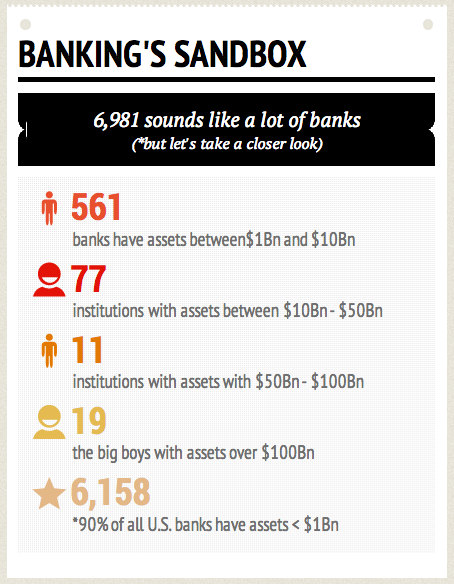
Fred’s research piece, focused on small and mid-sized banks along with the BofA’s and Wells Fargo’s of the country, inspired me to create the following infographic.  I’ve shared variations of these statistics in prior posts — and thought to illustrate how our industry breaks down in terms of asset size.

Screen Shot 2014-02-21 at 9.42.29 AM

(*note: while I hoped to serve this infographic up in a dynamic way, the image I created from Infogr.am isn’t embedding in WordPress.  Still, you get an idea of the market with this screenshot)

Old School Acquires New School

For smaller institutions, the size (and ability to scale) of their larger counterparts can be cause for alarm.  Indeed, Accenture shared “becoming a truly digital business is key to how we innovate and differentiate ourselves from our competitors. And if the last decade has been the playground of the digital start-ups, the coming decade will see the emergence of the traditional companies as the digital giants.”  I was thinking about this as I read the New York Times’ Dealbook story “BBVA Buys Banking Start-Up Simple for $117 Million.

This acquisition is notable as the buyer of this upstart is a 150-year old financial services corporation that operates in a number of markets, is a leading player in the Spanish market, as well as one of the top 15 banks in the U.S. and a strategic investor in banks in Turkey and China.  As noted by TechCrunch, “while not itself a bank, Simple operates as an intermediary between users and FDIC-insured institutions to provide users with access to data around their financial history, as well as tracking of expenditures and savings goals, with automated purchase data collected when its customers use their Simple Visa debit card.”  I wonder if this acquisition starts a consolidation trend of bigger banks buying newer fintech players to accelerate — while differentiating — their offerings…

Aloha Friday!

FI Tip Sheet: Some of Banking’s Best CEOs

Last month on Yahoo Finance, Sydney Finkelstein, professor of management and an associate dean at Dartmouth’s Tuck School of Business, produced a list of the Best CEOs of 2013, one that includes Jeff Bezos of Amazon, Pony Ma of Tencent,  John Idol of Michael Kors, Reed Hastings of Netflix and Akio Toyoda of Toyota.  Inspired by his picks, I reached out to a number of colleagues that work for professional services firms to ask their thoughts on the top CEOs at financial institutions — along with why they hold them in such regard.  What follows in this morning’s tip sheet are myriad thoughts on some of the best CEOs in the business today — broken down into three categories: the “biggest banks” with $50Bn+ in assets, those with more than $5Bn but less than $50Bn and finally, those in the $1Bn to $5Bn size range.

AboutThatRatio = image for Jan 10.001

(1) Top CEOs at financial institutions over $50Bn

The names and logos of institutions over $50Bn — think M&T with some $83Bn in assets, KeyCorps with $90Bn, PNC with $305Bn and US Bancorp with $353Bn — are familiar to most.  Leading these massive organizations are some tremendously talented individuals; for example, John Stumpf, the CEO at Wells Fargo.  Multiple people shared their respect for his leadership of the fourth largest bank in the U.S. (by assets) and the largest bank by market capitalization.  According to Fred Cannon, the Director of Research at Keefe, Bruyette & Woods, John “has created and maintains a unified culture around one brand, (one) that demonstrates strength and stability.  Wells is exhibit #1 in the case for large banks not being bad.”

Similarly, U.S. Bancorp’s Richard Davis garnered near universal respect, with PwC’s Josh Carter remarking “Richard has continued to steer US bank through stormy seas, continuing to stay the course running into the downturn, taking advantage of their position of relative strength, weathering the National Foreclosure issues and managing to avoid being considered part of ‘Wall Street’ even though US Bank is one of the 6 largest banks in the U.S.”

Finally, Steve Steinour, the CEO at Huntington Bancshares, inspired several people to comment on his work at the $56Bn institution.  Case-in-point, Bill Hickey, the co-Head of the Investment Banking Group at Sandler O’Neill, pointed out that since taking the helm in 2009, Steve has led a “remarkable turnaround… Huntington is now a top performer and is positioned to be the dominant regional bank in the Midwest.”

(2) Top CEOs at financial institutions between $5Bn and $50Bn

For banks between $5Bn and $50Bn, Greg Becker at Silicon Valley Bank garnered quite a few votes.  Headquartered in Santa Clara, California, I think they are one of the most innovative banks out there — and several people marveled that it has only grown and diversified under Greg’s leadership.  According to Josh Carter, “what they’re doing is a good example of how a bank can diversify their lending approach while maintaining a prudent credit culture.”  This echoes what Fred Cannon shared with me; specifically, that the $23Bn NASDAQ-listed institution is “the premier growth bank with a differentiated product.”  

Fred also cited the leadership of David Zalman, the Chairman & Chief Executive Officer at Prosperity Bancshares Inc., a $16 billion Houston, Texas-based regional financial holding company listed on the NYSE.  According to Fred, David demonstrates how to grow and integrate through acquisitions that is a model for other bank acquirors.  C.K. Lee, Managing Director for Investment Banking at Commerce Street Capital, elaborated on David’s successes, noting their development “from a small bank outside Houston to one of the most disciplined and practiced acquirers in the country and more than $20 billion in assets. The stock has performed consistently well for investors and the acquired bank shareholders – and now they are looking for additional growth outside Texas.”

Keeping things in the Lone Star state, C.K. also mentioned Dick Evans at Frost Bank.  In C.K.’s words, “this is a bank that stayed true to its Texas roots, maintained a conservative lending philosophy, executed well on targeted acquisitions and a created distinctive brand and culture. As Texas grew into an economic powerhouse, Frost grew with it and Mr. Evans was integral to that success.”

Finally, Nashville’s Terry Turner, the CEO of Pinnacle Financial Partners, drew Bill Hickey’s praise, as he “continues to successfully take market share from the larger regional competitors in Nashville and Knoxville primarily as the result of attracting and retaining high quality bankers. Financial performance has been impressive and as a result, continues to trade at 18x forward earnings and 2.4x tangible book value.”

(3) Top CEOs at financial institutions from $1Bn to $5Bn

For CEOs at banks from $1Bn to $5Bn, men like Rusty Cloutier of MidSouth Bank (“a banker’s banker”), David Brooks of Independent Bank Group (“had a breakout year in 2013”) and Leon Holschbach from Midland States Bancorp (“they’ve not only grown the bank but added significant presence in fee-income businesses like trust/wealth management and merchant processing”) drew praise.  So too did Jorge Gonzalez at City National Bank of Florida.  According to PwC’s Josh Carter, Jorge took over a smaller bank in 2007 “with significant deposit concentrations, large exposures to South Florida Real Estate, weathered a pretty nasty turn in the economy and portfolio value and emerged with a much stronger bank, diversified loan portfolio and retained key relationships.  Jorge has also managed to maintained an exceptional service culture, with a significant efficiency level and has combined relationship driven sales to grow the bank.  Jorge has also diversified the product mix and is one of the few smaller banks that can really deliver on the small bank feel with big bank capabilities.”

In addition, Banner Bank’s CEO, Mark Grescovich, won points for his work at the commercial bank headquartered in Walla Walla, Washington.  Mark became CEO in August 2010 (prior to joining the bank, Mark was the EVP and Chief Corporate Banking Officer for the $24Bn, Ohio-based standout FirstMerit). In Fred Cannon’s words, the transformation “is truly exceptional and Mark accomplished this by encouraging and utilizing a talented team of bankers from legacy Banner.”

Finally, Ashton Ryan at First NBC in New Orleans is one I’ve been told to watch.  Indeed, C.K. Lee shared how “Ryan capitalized on the turmoil in New Orleans banking to turn in strong organic growth, with targeted acquisitions along the way. The bank is recently public and has been rewarded by the market with a strong currency to go with its strong balance sheet and earnings.”

##

In addition to the list above, I have been very impressed by Peter Benoist at Enterprise Bank in St. Louis, look up to Michael Shepherd, the Chairman and Chief Executive Officer for Bank of the West and BancWest Corporation and respect the vision of Frank Sorrentino at ConnectOne.  This is by no means a comprehensive list, and I realize there are many, many more leaders who deserve praise and recognition.  Click the “+” button on the bottom right of this page to comment on this piece and let me know who else might be recognized for their leadership prowess.

Aloha Friday!

Giving Thanks

Winston Churchill once said, “a pessimist sees the difficulty in every opportunity; an optimist sees the opportunity in every difficulty.”  I believe we all aspire to see the proverbial glass as half full — so this quote is one I thought to share as we wrap up this Thanksgiving week.  As I do each Friday, what follows are three things I’m thinking about; in this case, what I’m grateful for — in a professional sense — that reflects Churchill’s sentiment.

(1) The Harvard Business Review ran a piece this April entitled Three Rules for Making a Company Truly Great.  It began “much of the strategy and management advice that business leaders turn to is unreliable or impractical. That’s because those who would guide us underestimate the power of chance.”  Here, I want to pause and give thanks to my tremendous colleagues at Bank Director — dreamers and implementors alike — who prove that fortune really does favor the prepared mind (and team).

(2) I believe that leadership is a choice and not a position.  As a small company with big ambitions, I find that setting specific directions — but not methods — motivates our team to perform at a high level and provide outstanding support and service to our clients.  This parallels the principle value of McKinsey & Co., one eloquent in its simplicity: “we believe we will be successful if our clients are successful.”  I read this statement a number of years ago, and its stuck with me ever since.  As proud as I am for our company’s growth, we owe so much to the trust placed in us by nearly 100 companies and countless banks.  Personally, I am in debt to many executives for accelerating my understanding of issues and ideas that would take years to accumulate in isolation.  Since returning to Bank Director three years ago, I have been privileged to share time with executives from standout professional services firms like KBW, Sandler O’Neill, Raymond James, PwC, KPMG, Crowe, Grant Thornton, Davis Polk, Covington, Fiserv… and the list goes on and on.  These are all great companies that support financial institutions in significant ways.  Spending time with executives within these firms affords me a great chance to hear what’s trending, where challenges may arise and opportunities they anticipate for their clients.  As such, I am thankful to be in a position where no two days are the same — and my chance to learn never expires.

(3) Finally, I so appreciate the support that I receive from my constituents throughout our industry.  It might be an unexpected compliment from a conference attendee, a handwritten thank you note from a speaker or the invitation to share my perspectives with another media outlet.  Regardless of how it takes shape, let me pay forward this feeling by thanking our newest hires, Emily Korab, Taylor Spruell and Dawn Walker, for expressing an interest in the team we’ve assembled and goals we’ve set.  Taking the leap to join a company of 17 strong might scare some towards larger organizations, but I’m really excited to work with all three and expect great things from each.

A late Happy Thanksgiving and of course, Aloha Friday!

Do we have enough banks in the U.S.?

Pirates-baseballAs I do each Friday morning, what follows are three things I’ve learned this week that apply to the financial community.  Let me start with the inspiration for today’s title and end with that for the picture of Pittsburgh’s PNC Park above.

(1) I’ve shared ideas from KBW’s Fred Cannon in the past; let me do so again based on a note he put out this Monday (FSW No New Bank Charters) that I strongly encourage you to read.  In my opinion, Fred is at the top of his field, so when he looks at the decline in new bank charters during the last two years (to zero) and wonders if we have enough banks in place today, its a thought provoking question.  To wit:

U.S. banking is being squeezed from the top, with high levels of concentration, and from the bottom, with no new banks, creating a less dynamic financial sector.  While regulators and legislators worry about the size and concentration of the largest banks, there is an equally concerning trend on the opposite side of the bank size spectrum. There have been no new bank or thrift charters issued during the past two years. This trend stands in sharp contrast to history, with dozens to hundreds of new banks starting each year, including during years of deep recessions. The lack of new bank startups may be causing limited competition for loans for small regional businesses and builders and pushing lending outside the banking system, essentially meaning that there aren’t enough banks in the country to promote maximum economic growth. Concentration and limits on size at the top end, and the dearth of new banks at the small end, will push greater market share of banking into mid-sized banks, in our view. This is good news for profitable mid-sized banks that can take advantage of both trends.

(2) t_1368782681Switching gears to the biggest of the big, we might have to honor Jamie Dimon by making it “his” week if the amount of media coverage continues for the man.  From American Banker to Bloomberg’s Businessweek to the WSJ, not a day went by without some mention of Wall Street’s “Indispensable Man.”  With JPMorgan Chase & Co.’s annual meeting in Tampa next week, our own editor thinks it should be a doozy for Chairman and CEO Jamie Dimon and the company’s 11-member board. The country’s largest bank has come in for some withering criticism ever since it lost a reported $6 billion last year on a disastrous credit derivatives trading strategy.  Ah, trading credit derivatives… I wonder if they will soon replace collateralized debt obligations as the scorn of the American public.

(3) Finally, a tip of the cap to Mars National Bank near Pittsburgh for “tapping a native son’s ties to America’s pastime to raise its local profile.”  According to a piece in the American Banker, the $351 million-asset institution in Mars, Pa., has formed a marketing campaign around pitchman Neil Walker, 27, a second baseman for the Pittsburgh Pirates who grew up seven miles away from the bank’s headquarters.  Mars National is “among several banks that have recently turned to sports stars to build business and spur goodwill;” for those interested in examples of how smaller banks are working to build brand loyalty in their community, this is an easy read that might inspire.

Aloha Friday!

Industry at a Crossroads: the Investor View

photo (9)

A curveball from New Orleans this afternoon… since I was on stage this morning to moderate a panel discussion on what makes a bank successful (to open this year’s Growth Conference at the Ritz-Carlton — #BDGrow13), my friend, colleague and Managing Editor of Bank Director magazine agreed to author today’s column.  The first guest post on About That Ratio, courtesy of Naomi Snyder, summarizes the investor community’s view on banks today.

As an industry veteran of more than 40 years and private equity investor in 15 banking companies, John Eggemeyer loves banks. But the co-founder of Castle Creek Capital LLC and Castle Creek Financial LLC had some hard-to-swallow statistics and opinions for a crowd of nearly 200 bankers and industry executives (198, but who’s counting) at Bank Director’s inaugural “Growth Conference” in New Orleans today.

  • Publicly traded banks from $1 billion to $5 billion in assets have seen their stock values rise at about half the rate of the broader market as a whole since early 2009.
  • Of the 300 or so publicly traded banks in that size range, only about 60 of them are trading at their pre-recession price multiples, he said.  
  • In the last 40 years, bank stocks always followed the same pattern in a recession: falling in value quicker than the rest of the market and recovering quicker.  

That didn’t happen during the latest recession. “We have lost a tremendous amount of value relative to the broader market,’’ he said at a session focused on the views of bank investors.  

It may be that investors are recognizing tough times ahead for the banking industry, where there are simply too many banks offering similar products and services. Low interest rates and a slow economy aren’t helping. Eggemeyer predicts that there will be substantial consolidation in the industry, both in terms of banks gobbling up other banks, and also in terms of branch reduction.

Collyn Gilbert, a managing director at Keefe, Bruyette & Woods, reiterated that view. “At the end of the day, how many unique stories are there?” she said. Eggemeyer says he prefers to invest in banks that have strong pre-tax, pre-provision earnings that are operating in good growth markets. Bank of America can’t outgrow the U.S. economy and it can’t acquire other big banks. A smaller community bank in a good market can do both those things, he said. However, he thinks investors focus too much of their time on growth. In reality, strong profitability will position a bank for growth. Gilbert agreed. “I think there needs to be a much better focus on the earnings side,’’ Gilbert said.

##

Naomi Snyder, awarded the coveted “Gila Monster” moniker at this year’s Acquire or Be Acquired conference, is Managing Editor at Bank Director magazine.  Prior to joining our team, she spent 13 years as a business reporter for newspapers in South Carolina, Texas and Tennessee.  Most recently, she was a reporter for The Tennessean, Nashville’s daily newspaper.  She also was a correspondent for USA Today. Naomi has a bachelor’s degree from the University of Michigan and a master’s degree in Journalism from the University of Illinois.

Expectations +/- Capacity

photo (21)
Heading up to 8 at the Four Seasons

The topic of a seller’s expectations and a buyer’s capacity is particularly relevant in light of what Cathy Nash and Jim Wolohan of Citizens Republic Bancorp shared earlier today.   Given that our economic environment is challenging, valuations are depressed and size and scale matter now more than ever, we turned our attention to matters like pricing expectations and the overall state of our financial community by welcoming Ben Plotkin, Vice Chairman of Stifel, to the stage.

Noticeably absent from the bank M&A market in 2012 were the “mega-deals” of years past that have often helped stimulate takeover activity. As I wrote about earlier today, the market made a modest rebound last year, with 230 acquisitions of healthy banks totaling $13.6 billion. But while there were only 150 bank deals in 2011—the third lowest volume since 1989—they totaled $17 billion.  While low levels of loan growth and continued net interest margin compression continue to challenge banks, there is “good news” according to Ben:

  • Profitability has improved (*primarily due to credit leverage);
  • Capital levels are at 70-year highs;
  • Valuations have improved significantly; and
  • M&A discussions are elevating.

To this last point, Ben cites capital access (or the lack thereof) as the driver of consolidation. Thanks to recent stock appreciation, potential buyers enjoy an increased capacity to pay meaningful premiums for smaller institutions and still preserve tangible book value.  As a result, larger institutions with access to the capital markets will most likely pursue M&A in order to overcome their more organic growth challenges.  

On the flip side, smaller institutions, especially those perceived by the investment community as not being able to earn their cost of equity and unable to access the marekets, may consider an “upstream” partnership.  In closing, Ben reiterated that asset growth is essential in order to create the revenue necessary to overcome the cost of doing business.

As with Cathy and Jim, our thanks to Ben for sharing his time and thoughts with us this morning.

Since the SEC approves…

IMG_1596
Taking a peek at the city…

With trips this week to St Louis, Nashville and New York City in the rear-view mirror, forgive me for asking: is it Friday yet? While AA and Amtrak earned my business, it’s the following points that stick out from the week that was:

  • As I’ve written, quite a few banks continue to shy away from social media tools like Twitter, LinkedIn and Facebook. Well guess what. The SEC said its ok to use ’em to disseminate material information without running afoul of their fair disclosure rule (Reg FD). So I wonder how many public banks — Bank Director counts 487 in its database — will start to announce key information on sites like these and subsequently embrace this medium to engage with investors and consumers alike?
  • I was in the Keefe, Bruyette & Woods’ midtown offices yesterday morning. Fortuitous to be there talking M&A as the Provident New York merger with Sterling Bancorp had been announced just hours earlier. As the firm advised Sterling on the $344 million stock-for-stock deal, I left their offices wondering why more transformational deals that have strategic, and not just financial, value like this one aren’t being struck. One thought: a CEO wants to sell at a realistic price but has to overcome a reluctant investor base that comprises the majority of the board. I’m interested in other perspectives, and welcome your comments below.
  • Finally, TD bank’s CEO announced his retirement earlier this week, about a month after PNC’s CEO, James Rohr, did the same. While these decisions certainly remind us of the need for clear succession plans (both banks appear to have handled things seamlessly), it is Mr. Rohr’s comments about cyber security as he winds down his leadership of the bank that struck a nerve. While he could have been talking about the viability of banks under $1bn in asset size to compete, when asked what he thinks of too big to fail, he answered “I’m more concerned about too small to protect yourself… Because what’s happening with the denial of service stuff is it’s moving downstream to small banks who are going to be less capable of defending themselves.” Scary words from someone who is in the know.

and on that lovely note, Aloha Friday to all!

#FF with a dose of #FI

Sunset in Kona, HI
Three thoughts before the sun sets on the week…

Following the welcome of Pope Francis last week, I’m tempted to call this a slower news cycle and shorten today’s column from three points to two.  But as the sun sets on this week, who am I to short-change the spirit of this #FridayFollow-inspired post?  Especially as I heard/read/saw some pretty darn interesting things since last checking in!

  • Last week, I admitted to a bit of M&A “fatigue.”  Not so seven days later.  With the Koelmel announcement fresh in my head (it should be noted that he led the bank through a period of rapid growth beginning in ’05), I started to think about how history will judge their acquisition of HSBC’s entire upstate New York branch network.  At the time, some thought it would spark what is now a cliché: a “wave of bank consolidation.” So why think back when the purpose of this column is meant to be fresh?  From what I’ve heard (and read), branch acquisitions can present an attractive alternative to traditional M&A.  Case-in-point, a research report put out by Raymond James called Bank M&A: Activity Should Gain Steam in 2013.  While a few months old, their messages remain clear: with the “mega and super regional banks focused on expense control, many are taking a fresh look at reducing their branch networks. In turn, well positioned regional and community banks can look to branch acquisitions, which provide a low risk and cost-effective way to enter a new market or bolster an existing market.”  Not necessarily a new idea, but just as I gave props to Fred Cannon from KBW last week for perspectives like these, let me give a shout out to Anthony Polini and his equity research colleagues for consistently delivering valuable insight and information like this on a regular basis.
  • Turning from M&A to truly organic growth, I was really impressed with a piece Tom Bennett, the Chairman of the three-year old First Oklahoma Bank in Tulsa, Oklahoma, authored for BankDirector.com.  Tom’s piece, The Hidden Capital of Social Networks, introduces the idea of addressing “your equity capital needs and other performance items in your bank… (vis-a-vis) the social capital that exists in your investor group and how it can be utilized as a valuable source of strength.”  With so many CEOs and Chairmen of community banks hoping and wanting their outside directors to generate business for the bank, this piece is definitely worth a read.

Finally, a special thanks to @GilaMonster for providing her input on today’s post… I am very grateful.

Aloha Friday to all!

Follow Friday Fun

Well what do you know.  On Wednesday, D.C.’s “snowquester” came in like a lion and left, sadly, like a lamb.  So what do we have to hang our hat on this week?  Well, the Federal Reserve did release its stress test results for the country’s largest banks yesterday afternoon.  Interesting enough to make today’s week-in-review?  Take a read through these three stories that I read/watched/heard to find out.

Flying into Boston's Logan
An early approach into Boston’s Logan airport
  • While I wasn’t in my hometown of Boston, MA to hear this first hand, I have it on good authority that a number of the bankers presenting at KBW’s regional bank conference two weeks ago spoke on our country’s rapid move towards energy independence — and on the real economic growth they are seeing in their regions as a result.  If you’re interested, this equity research note (FSW Energy and the Regional Banks), authored by Keefe’s Fred Cannon, is definitely worth a read.
  • Juxtaposing energy needs with banking services reminded me of a “debate” between three bank analysts, including Fred, that centered on comparing banks to utility companies.  Building off those perspectives, I found myself talking with John Eggemeyer (the co-Founder & Managing Principal @ Castle Creek Capital) last Friday afternoon about this very thing.  While it didn’t make it into last week’s post, his hypothesis that the financial community bares all the characteristics of a mature industry sent me searching for white papers I worked on while in business school.  John saved me some of the trouble by reminding me that banking follows a historic pattern of other mature industries (e.g. dealing with excess capacity; which, as a consequence, leads to fierce competition for business).  My big takeaway from our conversation: price, not customer service, proves the ultimate differentiator. 
  • Finally, as John and I talked about what bankers might learn based on the commoditization of businesses, I couldn’t help but think about M&A and organic growth.   This leads me to my third point.  The Washington Business Journal recently recognized the top 5 D.C.-area banks based on total return on assets.  In the piece, authored by Bryant Ruiz Switzky, the area’s 37 local banks posted a median annual profit of $3.5 million in 2012. That’s up 44% from 2011.  Yes, many rankings like this focus on growth in terms of ROA; personally, I’m also keen to look at earnings growth.  Nonetheless, some strong banks on this list… with many more making some real strides here in our Nation’s Capital.

As a bonus, a tip of the cap to an American Banker piece on the hows and whys BankUnited’s private-equity backers are giving up a big chunk of their stakes in the $12.2 billion-asset bank.  While a subscription is required to read yesterday’s “BankUnited to Strengthen M&A Buying Power After Stock Offering,” I think its worth considering the short and longer-term views on what reduced private-equity interest might mean to a bank like this one.

Aloha Friday to all!