Banks Are Feeling the Pressure to Grow

Bank executives and board members are feeling significant pressures to grow in 2016, according to Bank Director’s 2016 Bank Mergers & Acquisitions Survey, sponsored by Crowe Horwath LLP.

By Al Dominick, President & CEO, Bank Director

Bank CEOs and their boards face some very significant challenges in the years ahead.  The sharply increased cost of regulatory compliance might lead some to seek a buyer; others have responded by trying to get bigger through acquisitions in order to spread the costs over a wider base.  While transforming a franchise through organic growth is desirable, I continue to see mergers & acquisitions (M&A) remaining the fastest avenue for growth in banking today.

For those who joined us at our annual Acquire or Be Acquired Conference last month, you may recall that Bank Director’s team surveyed 260 chief executive officers, chairmen, independent directors and senior executives of U.S. banks in advance of the conference to examine current attitudes and challenges regarding M&A — and what drives banks to buy and sell.  Three points stand out to me:

  1. Of the respondents who served as a board member or executive of a bank that was sold from 2012 to 2015, a full 55% say they sold because shareholders wanted to cash out.
  2. Despite concerns that regulatory costs are causing banks to sell, just 27% cite this burden as a primary motivator.
  3. Credit quality issues are most often cited barriers for banks being able to complete acquisitions.

Certainly, “why banks are bought or sold” involves much more than just the numbers making sense.  At AOBA, it was made abundantly clear that M&A remains attractive inasmuch as successful transactions improve operating leverage, earnings, efficiency and scale.  Moreover, attendees shared during one of our interactive sessions that earnings potential is the most attractive characteristic of an institution they are interested in acquiring.
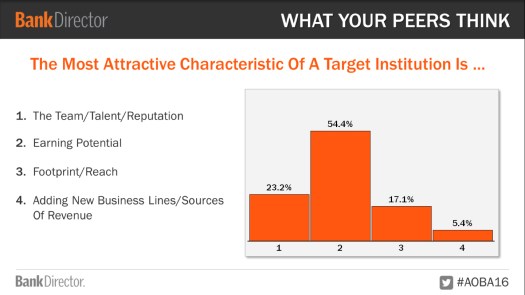
Bank Director and Crowe Horwath LLP AOBA info

In his “Buy Or Die In Phoenix: A Recap Of The 2016 Bank Director’s Acquire Or Be Acquired Conference,” Tim Melvin neatly summarizes the conundrum many bank CEOs face today.  “Competing against their bigger, better funded rivals is… (a) huge obstacle to growth. The days of opening branches on the other side of town, then the next town over and so on to grow a bank are over.”  He concludes by recounting a point made by Steve Hovde, an investment banker we’ve worked with for a number of years: “to thrive, you have to get bigger. To get bigger you probably have to buy and again, if you can’t buy you probably have to sell.”

Acquire or Be Acquired: Don’t Overlook This

Thanks to our keynote speaker, J. Michael Shepherd, pictured above. The Chairman & CEO, Bank of the West and BancWest Corporation, he inspired quite a few with both his wit and wisdom.

Over the past few days at Bank Director’s annual Acquire or Be Acquired conference, various speakers have touched on a number of key strategic growth issues.  From exploring an acquisition to growing loans, controlling expenses to managing capital, the discussions hit the “timely and relevant” standard that we consider essential.  They also reinforced my sense that more boards and their management teams are seriously considering an acquisition as their primary growth plan than at this time last year.

As our editor-in-chief opined, the heightened level of interest could certainly be explained by the continued margin pressure that banks have been operating under for the last several years.  For those thinking about buying another, my short video recap from the mid-way point of AOBA offers a heads up about a pre-deal consideration not to be overlooked.


What’s Happening at Acquire or Be Acquired

Throughout the first day of Bank Director’s 22nd annual Acquire or Be Acquired Conference, I found quite a few presentations focused on the emergence of mid-sized regional banks that are growing through the consolidation of smaller banks.  Clearly, mergers & acquisitions provide an avenue for some banks to drive improved operating leverage, earnings, efficiency and scale.  At the same time, the pressures prompting larger banks to innovate — sluggish loan demand, depressed revenue, higher compliance costs — are the same ones forcing smaller banks to pursue a sale.

By Al Dominick, President & CEO, Bank Director

For those unfamiliar with “AOBA,” this annual event explores issues like the one mentioned above.  Since the conference kicked off at 8 AM on a Sunday, this morning’s post shares three short video recaps from my time at the Arizona Biltmore followed by links to recent posts specific to this conference.

In addition to these videos, below are links to four of my posts specific to the event:

If these types of conversations interest you, take a look at what we’re sharing on BankDirector.com.  Additionally, I invite you to follow me on Twitter via @AlDominick, the host company, @BankDirector, and search & follow #AOBA16 to see what is being shared with (and by) the 930 men & women in attendance.

9 Banks I Bet People Will Be Talking About at Acquire or Be Acquired

I planned to write about a number of banks I was excited to see this weekend at AOBA.  But as Steve Jobs once shared “people don’t know what they want until you show it to them.” In this spirit, let me highlight nine banks that I anticipate our attendees will be talking about in Arizona at Bank Director’s annual M&A conference.

In a few minutes, I’ll hop an American flight to Phoenix for this year’s Acquire or Be Acquired Conference.  Before I depart the cold and slush of D.C. for some warmth and sun in the desert, this is my take on the banks I anticipate people talking about when we’re all together:

  • Bank of the West — and not just because their CEO is keynoting this year’s conference.  The bank, with more than 700 branches in the Midwest and Western United States, has long been a personal favorite of mine and competes in markets where many look for inspiration.
  • Bank of North Carolina — because they’ve been wheeling and dealing and are a great example of how an acquirer successfully integrates cultures (*yes, their CEO also speaks at AOBA this year on a CEO panel entitled Finding the Right Partners).
  • United Bank — having picked up a trophy franchise of their own in my hometown (another personal favorite of mine, Bank of Georgetown) they’ve made a number of interesting deals over the past few years and I bet have more on their mind.
  • BB&T — having dealt for Susquehanna in ’14 and National Penn in ‘15, it is fair to ask: who’s next?

By no means are these all of the banks that will come up in conversation; rather, those that are top of mind.

One final thought before hopping my flight west.  The recent volatility in the stock market may be impacting institutions considering a capital raise, IPO or acquisition — but this week’s deal pace is far different then at this time in recent years.  The patterns I’m beginning to see is a concentrated effort to get to over the $5Bn asset mark and into that sweetest of spots: the $5Bn to $50Bn asset class.  A point I’ll elaborate on in an upcoming post/video.

So if you are interested in following the conference conversations via social channels, I invite you to follow me on Twitter via @AlDominick, the host company, @BankDirector, and search & follow #AOBA16 to see what is being shared with (and by) our attendees.  Safe travels to those 930 men & women joining us this weekend!

7 Bank M&A Trends for 2016

With this morning’s news that Huntington and FirstMerit are set to merge, it is clear that more and more buyers & sellers are getting off the sidelines and into the bank merger and acquisition (M&A) game.  So in advance of Bank Director’s 22nd annual Acquire or Be Acquired Conference, seven M&A trends to consider.

By Al Dominick, President & CEO, Bank Director

As I shared in yesterday’s post, we are putting the finishing touches on this year’s Acquire or Be Acquired conference. With nearly 600 bank officers & directors from 300+ banks joining us at the Arizona Biltmore for “AOBA” this Sunday through Tuesday, what follows are seven trends in bank M&A that I expect this hugely influential audience to hear and work to address.

  • Deal volume is holding steady; however, median deal price is on the rise.  One caveat: pricing has a strong correlation to both the size & location of a seller + the size of the potential buyer.
  • Growing banks must seize upon opportunities based on future needs, not just present needs
  • At the same time, more investors are taking a “what have you done for me lately” approach and emphasizing nearer-term results. Further, activist investors are becoming more prominent and driving some of this action.
  • Capturing efficiencies continues to be one of the most compelling forces driving industry consolidation.
  • When people tell you that size doesn’t matter, realize that banks with less than $500 million in assets have had the lowest return on equity for 11 out of the past 12 quarters (per SNL). Expect even more sellers to emerge from this part of the industry.
  • As the regulatory environment becomes increasingly difficult to maneuver, it is safe to anticipate an increase in merger activity — mostly for banks with less than $50 billion of assets.
  • As evidenced by Huntington Bancshares announcing today that it would buy FirstMerit Corporation in a deal worth $3.4 billion in stock and cash, mergers are a viable option for growth among the larger regionals.  While we don’t have the same kinds of national consolidators buying up banks like they once did, deals like this one, KeyCorp announcing it would buy First Niagara Financial Group and New York Community Bancorp that it would buy Astoria Financial at least opens the possibilities of larger players getting back in the merger game.

Whether you are coming to the conference or just interested in following the conversations, I invite you to follow me on Twitter via @AlDominick and/or @BankDirector — and search & follow #AOBA16 to see what is being shared with and by our attendees.

Size & Scale: The King and Queen of Bank M&A?

Earlier this week, I shared my perspectives on bank M&A with the Wall Street Journal.  What follows builds off the piece that ran in Tuesday’s print edition, highlighting key findings from Bank Director’s annual Bank M&A Survey.

By Al Dominick // @aldominick

At a time when J.P. Morgan is getting smaller, the pressure is on for smaller banks to get bigger.  As KPMG recently shared with BankDirector.com, there was a 25% increase in bank deals in the U.S. in 2014, compared to 2013, and there is a good possibility that the number of deals in 2015 will exceed that of 2014.  One reason for this: a larger institution can spread costs (such as investments and regulatory burdens) across a larger customer and revenue base.

Not surprisingly, 67% of executives and board members responding to Bank Director’s 2016 Bank M&A Survey say they see a need to gain more scale if they are going to be able to survive in a highly competitive industry going forward.  As our director of research, Emily McCormick, shared, “many of these respondents (62%) also see a more favorable climate for bank deals, hinting at a more active market for 2016 as banks seek size and scale through strategies that combine organic growth with the acquisitions of smaller banks.”

While the majority of bank executives and boards surveyed feel a need to grow, respondents don’t agree on the size banks need to be in order to compete today.  A slim majority, 32%, identified $1 billion in assets as the right size… interesting, but not surprising, when you consider that 89% of commercial banks and savings institutions are under $1 billion in assets, according to the FDIC (*personally, I’m of the opinion that $5Bn is the new $1Bn, but that’s a topic for another day).  On to the key findings from this year’s research:

  • Two-thirds report their bank intends to participate in some sort of acquisition over the next 12 months, whether it’s a healthy bank (51%), a branch (20%), a nondepository line of business (14%), a loan portfolio (6%) and/or a financial technology firm (a scant 2%).
  • Respondents indicate that credit culture, at 32%, and retaining key talent that aligns with the buyer’s culture, at 31%, are the most difficult aspects of the post-merger integration process.
  • More institutions are using social media channels to communicate with customers after the close of the deal. 55% of respondents who purchased a bank in 2014 or 2015 used social media, compared to 42% of 2011-2013 deals and just 14% of 2008-2010 deals (*FWIW, Facebook, at 26%, is the most popular channel for respondents).
  • Fifty-six percent of respondents have walked away from a deal in the past three years.  Of the respondents who indicate they declined to buy, 60% cite deal price while 46% blame the credit quality of the target institution.
  • Why do banks sell? Of the executives and board members associated with banks sold from 2012 to 2015, 55% say they sold because shareholders wanted to cash out.  Despite concerns that regulatory costs are causing banks to sell, just 27% cite this burden as a primary motivator.

The full survey results are now available online at BankDirector.com, and will be featured in the 1st quarter, 2016 issue of Bank Director magazine.  In addition, for those executives interested in connecting with many of the key decision makers driving the deals mentioned above, our annual Acquire or Be Acquired Conference will be held at the Arizona Biltmore from January 31 through February 2.

##

Our 2016 Bank M&A Survey, sponsored by Crowe Horwath LLP, examines current attitudes and challenges regarding bank M&A, and what drives banks to buy and sell. The survey was completed in September 2015 by 260 chief executive officers, independent directors and senior executives of U.S. banks, and former executives and directors of banks that have been acquired from 2012-2015.

Quick Guide: 2015 Growth Strategy Survey (Bank-specific)

Recently, Business Insider and the Wall Street Journal picked up Bank Director’s 2015 Growth Strategy Survey.  The research project reveals how many financial institutions continue to recognize growth in traditional areas — most notably, loans to businesses and commercial real estate — while struggling to attract a decidedly untraditional digital generation.  So in case you missed it, today’s piece highlights key findings from this annual research project. 

By Al Dominick // @aldominick

Over the weekend, our friends at the Wall Street Journal ran a very telling story about the efforts being made by the San Francisco 49ers to better engage with their millennial employee base.  Clearly, the NFL franchise’s challenge to “relate to a generation — generally described as 18-to-34-year-olds — that has been raised on smartphones and instant information” parallels that of most banks in the U.S.  In addition to being a fascinating behind-the-scenes look at what’s happening out in Santa Clara, it also sparked today’s post.

You see, as a 38-year old who runs a great privately-held company that employs quite a few folks under the age of 30, I have to admit that I am tiring of the broad strokes being used to describe millennials’ needs and ambitions.  However, I will admit to being surprised to learn that there are approximately 75 million people in the U.S. under the age of 34.  This is a huge number, especially when you hear that every day, for the next 15 years, 10,000 people will turn 65 (h/t to the CEO of Boston’s Chamber of Commerce for making me aware of this reality).

Surprisingly, 60% of the executives and board members that responded to Bank Director’s 2015 Growth Strategy Survey say their bank might not have the right products, services and delivery methods to serve the vast majority of this demographic.  While I haven’t run this by our very talented Director of Research (*hello Emily McCormick), to me, this shows that the relationships that community bankers nurtured for decades will be increasingly of less value with this emergingly-influential generation who have grown up in a digital world and who, stereotypically, value the speed with which it operates.

As the Wall Street Journal shared when reporting on our research results, “banks have watched less regulated finance companies ranging from mortgage lenders to private-equity firms encroach on many of their main businesses.  But ask an executive or board member at a bank what nonbank company they most fear, and they’re likely to name the world’s biggest technology company, Apple Inc.”  So what were our key findings?  Glad you asked…

Three key findings (click this title link to access the full report):

  1. Apple is the nonbank competitor respondents worry about most, at 40%  — just 18% of respondents indicate their bank offers Apple Pay.
  2. Bank mobile apps may not keep pace with nonbank competitors. Features such as peer-to-peer payments, indicated by 28% of respondents, or merchant discounts and deals, 9%, are less commonly offered within a traditional bank’s mobile channel. 49% of respondents indicate their bank offers personal financial management tools.
  3. Despite the rise of P2P lenders like Lending Club and Prosper in the consumer lending space, just 35% of respondents express concern that these startup companies will syphon loans from traditional banks.

Instead of millennials, banks have been finding most of their growth in loans to businesses and commercial real estate.  Yes, 75% of respondents want to understand how technology can make their bank more efficient… and 72% want to know how technology can improve the customer experience.  But I find it telling that today, loan growth remains the primary driver of profitability for the majority of responding banks.  In fact, 85% of respondents see opportunities to grow through commercial real estate loans.  As we found, executives and board members also expect to grow through commercial & industrial (C&I) lending, for 56%, and residential mortgages, at 45%.  So for those looking to predict the future of banking, I think findings like these are quite telling.  Indeed, it would appear what’s worked in the past may be what to bet on for the future.

##

The 2015 Growth Strategy Survey, sponsored by technology firm CDW, reveals how bankers perceive the opportunities and challenges in today’s marketplace, and technology’s role in strategic growth. The survey was completed by 168 chief executive officers, independent directors and senior executives of U.S. banks with more than $250 million in assets in May, June and July of this year.  Ironically, last year’s survey found that credit unions, not Apple, were the “non-bank” competitor that banks were most worried about.  In fact, can you believe that Apple didn’t even make the cut?  My, how quickly times can change.

18 Banks that Fintech Companies Need to Know

To build on last week’s piece (15 Banks and Fintechs Doing it Right), I put myself in the shoes of an early stage fintech company’s Founder.  Specifically, as someone with a new idea looking to develop meaningful financial relationships with regional and community banks in the United States.  With many exciting and creative fintech companies beginning to collaborate with traditional institutions, what follows is a list of 18 banks — all between $1Bn and $25Bn in size — that I think should attract the tech world’s interest.

By Al Dominick // @aldominick

Believe it or not, but bank CEOs and their teams are working hard to grow revenue, deposits, brand, market size and market share.  So a hypothetical situation to tee-up today’s column.

Imagine we developed a new, non-disruptive but potentially profit-enhancing software product (let’s put it in the “know-your-customer” sector since banks already spend money on this).  As the Founders, we want to approach banks that might be ready to do more than simply pilot our product.  While our first instinct would be to focus on recognizable names known for taking a technology-based, consumer-centric focus to banking, the low hanging fruit might be with CEOs and executive teams at publicly traded community banks — many of whom are above $1Bn in asset size and are just scratching the surface of developing meaningful fintech relationships.

With the idea that smaller banks can act faster to at least consider what we’re selling, we cull the field, knowing that as of June 1 of this year, the total number of FDIC-insured institutions equaled 6,404; within this universe, banks with assets greater than $1Bn totaled just 699.

So now we are focused on a manageable number of potential customers and can spend time getting smart on “who’s-doing-what” in this space.  Can we agree that we want to approach banks that share common characteristics; namely, strong financial performance that sets them apart from their peers and operations in strong local markets or big economic states?  Good, because assuming we are starting from scratch in this space, here are our top prospects (listed in no particular order with approximate asset size):

  1. Citizens Business Bank in California ($7.3Bn)
  2. Pinnacle Financial in Tennessee ($6Bn)
  3. Farmers & Merchants in California ($5.5Bn)
  4. Western Alliance in Arizona ($10Bn)
  5. Eagle Bank in DC ($5.2Bn)
  6. Prosperity in Texas ($21.5Bn)
  7. BankUnited in Florida ($19.2Bn)
  8. BofI “on the internet” ($5.2Bn)
  9. First NBC in Louisiana ($3.7Bn)
  10. Burke & Herbert in Virginia ($2.6Bn)
  11. Banner in Washington ($4.7Bn)
  12. Bank of Marin in California ($1.8Bn)
  13. Cardinal Bank in Virginia ($3.4Bn)
  14. State Bank in Georgia ($2.8Bn)
  15. TCF Financial in Minnesota ($19.3Bn)
  16. United Bank in Connecticut ($5.5Bn)
  17. Boston Private in Massachusetts ($6.8Bn)
  18. Opus Bank in California ($5.1Bn)

At a time when the concept of service is fast changing to reflect highly functional technology and “always-available” customer experiences, these eighteen banks — already successful in their own right — strike me as just the types to think about approaching.

##

*Now I’m not suggesting everyone pick up the phone and call each’s institutions CEO.  But If you are with a fintech thinking about partnerships and collaboration, you could do a whole heckuva lot worse than spending some time learning what makes all of these banks more than just financially strong and consumer relevant.

Bank Mergers and Acquisitions

“The reality is organic growth is tough,’’ said Chris Myers, the president and CEO of the $7.2-billion Citizens Business Bank in Ontario, California, who spoke at our Acquire or Be Acquired conference in January.  His bank is one of those in the “sweet spot” for higher valuations and higher profitability, but even he feels the pressure to grow. “A lot of banks are stretching to try to grow [loans] and do things they wouldn’t have done in the past,’’ he said, commenting on the competition for good loans. “ We are going to need to do some acquisitions.”

By Al Dominick // @aldominick

The classic build vs. buy decision confronts executives in every industry.  For bank CEOs and board members today, mergers and acquisitions (M&A) remain attractive inasmuch as successful transactions improve operating leverage, earnings, efficiency and scale.  While I recently wrote that the best acquisition a bank can make is of a new customer, today’s post looks at what’s happening with bank M&A by sharing a few of my monthly columns that live on BankDirector.com:

  • Why Big Banks Aren’t Merging — with global companies announcing huge acquisitions, I look at where the banking industry is today.
  • Stressed Into Selling — after the largest U.S.-based banks passed the Federal Reserve’s stress tests, I write about modeling various economic conditions that might help a bank’s board to anticipate potential challenges and opportunities.
  • Don’t Sell The Bank —  figuring out when a bank should be a buyer—or a seller—had been on my mind since the Royal Bank of Canada announced a deal for “Hollywood’s bank,” City National, and this piece explored why now is not the time to sell.
  • Why Book Value Isn’t the Only Way to Measure a Bank — as the market improves and more acquisitions are announced, why I expect to see more attention to earnings and price to earnings as a way to value banks.
  • Deciding Whether to Sell or Go Public — while the decision to sell a company weighs heavily on every CEO, there comes a point where a deal makes too much financial and cultural sense to ignore.

In addition to these five columns, I invite you to read this month’s column, “Mind These Gaps,” which posts today on BankDirector.com.  It focuses on various pitfalls that have upended deals that, on paper, looked promising (e.g. due diligence and regulatory minefields, the loss of key talent/integration problems and bad timing/market conditions).  With perspectives from some of the country’s leading investment bankers and attorneys, it is one I’m pleased to share.  Don’t worry, unlike other sites, there is no registration — or payment — required.

This Week in Pictures – New Orleans

It has been said that the best acquisition a bank can make is of a new customer.  But let’s face it: for most banks, organic growth is hard. For those wanting to grow revenue, deposits, brand, market size and market share, we hosted a “Growth” conference at the Ritz-Carlton in New Orleans earlier this week.  Below, some pictures from our time in the Crescent City along with links to organic growth & FinTech-specific content.

By Al Dominick // @aldominick

Clearly, there has been an enormous shift in asset concentration and customer loyalty during the past two decades. Today, the ten biggest banks in the U.S. have more assets than all of the other institutions combined.  Concurrently, major consumer brands such as Apple and Google have emerged as significant non-bank competitors.  As such, we designed this year’s Bank Board Growth & Innovation Conference around the concept of building sustainable franchise value.

To stay both relevant and competitive, I believe that building a culture of disciplined growth that encourages creativity and risk taking is essential. For a bank’s CEO, executive team and board, this requires a combination of knowledge, skill and courage – things we designed this conference, a complement to our annual Acquire or Be Acquired Conference, to provide.  Behind the scenes, our team works hard to deliver a “Four Seasons”-level of service — and I am especially proud of how everyone navigated the weather challenges that hit the city on Monday.  It was great to arrive to so many smiling faces!

For those curious about the topics and trends covered at the event, you can up on what was covered by clicking on:

In addition, take a look at what our editor, Jack Milligan, has shared on his blog, The Bank Spot.  And since its Friday, I’ll take the liberty of closing with laissez les bons temps rouler!

Banking Millennials

The Millennial generation comprises 80MM people, the largest in U.S. history.  Born between the years of 1980 and 2000, millennials range in age from 15 to 35 years and are just beginning to gain their foothold in the economy.

By Al Dominick // @aldominick

Do we really want to bank millennials? If I borrowed a crystal ball from one of the soothsayers out at Jackson Square in New Orleans’ French Quarter, I imagine this would be the question on most everyone’s mind that joined me at our annual Bank Board Growth & Innovation conference.  With many community banks making their money through C&I lending, the immediate concern (at least at the board’s level) is how do I grow right now?  While many conversations trended towards the opportunities to engage this demographic by leveraging emerging technologies with a bank’s sales and marketing efforts, I was not surprised to hear a concern about the investment costs of bringing new technologies into a bank.  The rationale, as I understood it, is by the time a bank gets a return from its investment, it may be too late.  I’m not saying this is my way of thinking, but I do think it reflects apprehensions by key officers and directors when the conversations comes to these future business owners, inheritors of wealth and digitally demanding individuals.  As shared in a presentation by Ingo Money, in the next five years, the Millennial generation will have the largest income in U.S. history, and any company that can monetize Millennial spending or data may seek to bank them.  Still, regional and community bankers wrestle with the type of client they might be — both now and in the future.

Key Takeaway

To kick things off, we invited Dave DeFazio from StrategyCorps to “look beyond the basics” in terms of mobile banking.  As he shared, over 75% of people in the U.S. own a smartphone in the year — and most everyone has some sort of addiction to their device.  With all of the big banks offering the “big five” today (mobile banking, mobile bill pay, mobile deposits, ATM/Branch locators and P2P payments), bankers should think beyond basic banking transactions to develop a mobile presence that is a “can’t live without” app.  Some of his tips: provide easy authentication, pre-login balances, voice recognition, budgeting tools and coupon and shopping tools.

Trending Topics

Anecdotally, the issues I took note of were, in no particular order:

  • The four biggest banks in the U.S. are among the 10 least loved brands by Millennials.
  • Millennials want banking services designed for their needs that are instant, simple, fair and transparent… which is why new providers are beginning to emerge.
  • For those not familiar with Moven, GoBank and Simple… take a look at what each has to offer.
  • The cultural divide between banks and FinTech companies is getting smaller for bigger banks, but remains high for regional and community banks.  Nonetheless, these banks are in a better position to collaborate and seriously consider new tools and products as the decision making cycle is considerably shorter then at large institutions.

Picked Up Pieces

While today was “just” a half day, some of the more salient points I made note of:

  • Per Jennifer Burke, a partner at Crowe, “proactively identifying, mitigating, and in some cases, capitalizing on these risks provides a distinct advantage to banks.”
  • In terms of building value, the ability for a bank to grow is as important as a bank’s profitability.
  • It was refreshing to be at a banking conference where talk about regulation was at a minimum; in fact, it seemed that the regulatory environment presents more of a distraction than it poses a threat to bank’s looking to grow.
  • The corollary to this point: competition from non-banks is higher then ever before.

To see what’s being written and said as we wrap up our time in New Orleans, I invite you to follow @bankdirector, @aldominick + #BDGrow15.

Three Observations from the Bank Board Growth & Innovation Conference

Select news and notes from the first day of Bank Director’s annual growth conference at the Ritz-Carlton New Orleans.

By Al Dominick // @aldominick

I mentioned this from the stage earlier today… every January, Bank Director hosts a huge event in Arizona focused on bank mergers and acquisitions.  Known as “AOBA,” our Acquire or Be Acquired conference has grown significantly over the years (this year, we welcomed some 800 to the desert).  After the banking M&A market tumbled to a 20-year low in 2009 of just 109 transactions, it has gradually recovered from the effects of the crisis. In fact, there were 288 bank and thrift deals last year, which was a considerable improvement on volume of 224 deals in 2013.  As our editorial team has noted, the buying and selling of banks has been the industry’s great game for the last couple of decades, but it’s a game that not all banks can — or want to — play.  Indeed, many bank CEOs have a preference to grow organically, and its to these growth efforts that we base today and tomorrow’s program.

Key Takeaway

To kick things off, we invited Fred Cannon, Executive Vice President & Director of Research at KBW, to share his thoughts on what constitutes franchise value. While he opened with a straight-forward equation to quantify franchise value over time — (ROE – Cost of Equity) × Market Premium — what really stuck with me during his presentation is the fact that a logo does not create franchise value, a brand does.  As he made clear, it is contextual (e.g. by industry’s served, technologies leveraged and clients maintained) and requires focus (e.g. you can’t be all things to all people).  Most notably, small and focused institutions trump small and complex ones.

Trending Topics

Anecdotally, the issues I took note of where, in no particular order:

  • Banks must be selective when integrating new technology into their systems.
  • The ability to analyze data proves fundamental to one’s ability to innovate.
  • When it comes to “data-driven decisions,” the proverbial life cycle can be thought of as (1) capture (2) store (3) analyze (4) act.
  • You don’t need a big deposit franchise to be a strong performing bank (for example, take a look at County Bancorp in Wisconsin)
  • We’ve heard this before, but size does matter… and as the size of bank’s balance sheet progresses to $10 billion, publicly traded banks generate stronger profitability and capture healthier valuations.

Picked Up Pieces

A really full day here in New Orleans, LA — with quite a few spirited discussions/debates.  Here are some of the more salient points I made note of throughout the day:

  • Selling services to large, highly regulated organization is a real challenge to many tech companies.
  • Shadow banking? Maybe its time I start calling them “Challenger banks.”
  • CB Insight’s has a blog called “unbundling the bank” — to understand the FinTech ecosystem, take a look at how they depict how “traditional banks are under attack from a number of emerging specialist startups.”
  • A few sidebar conversations about Wells Fargo’s incubator program, which the San Francisco bank began last August… interest in how the program involves direct investment in a select group of startups and six months of mentoring for their leaders.

To see what’s being written and said here in New Orleans, I invite you to follow @bankdirector, @aldominick + #BDGrow15.