Blockchain 101 – a Primer for a Bank’s CEO and Board

The rapid transformation of the financial services industry — due to technological innovations and shifting customer expectations — is quite remarkable. One of the most revolutionary technologies is blockchain, which might transform not just banking but also the media industry, insurance companies and government agencies (to name but three).  Be it digital identities, digital banking or cross-border payments, the potential applications of blockchain are immense.  So for those most responsible for being the champions and evangelists for growth within a bank, we produced this “Blockchain 101” video to highlight potential applications of this database for recording transactions.

*This video is a part of Bank Director’s online training series — exclusively available to a bank’s CEO and their officers & directors as part of their annual Bank Services program relationship.  I thought it was appropriate to make an exception today and share this particular primer in advance of our upcoming Growing The Bank conference.  We will host this program next Monday and Tuesday at the Four Seasons Resort and Club at Las Colinas — and blockchain’s potential will surely be discussed.

The Digitization of Banking

TransferWise, a fintech not shy in touting its “Bye Bye Banks” slogan, recently announced it is shifting course and now intends to partner with banks.  From anti-bank to partnership ready.  Hmm… the times really are a-changin’

Since I filmed this recap at Nasdaq, it has become more and more clear that innovation knows no size. Depending on a given business strategy, it can either be enhanced — or yes, constrained.  As new technologies and approaches to delivering financial services emerge, bank CEOs and their teams will be challenged to meet the future expectations of their customers as well as to assess the additional risks, costs, resources and supervisory concerns associated with providing new financial services and products.

While technology enables change, the evolution and digitization of banking is a business issue.  Banks of all sizes are investing more heavily in order to present more sophisticated capabilities to their clientele.  However, we are still in the early stages of this shift, which is why new technology players will continue to emerge while traditional participants transform their underlying business models to better participate and compete in the coming years.

##

For those champions & evangelists for innovation within a bank, take a look at Bank Director’s recently launched FinXTech.  Think of this new platform as a catalyst — one that brings together a highly influential group of people who (1) care about the future of financial services, (2) are committed to meaningful transformation and (3) are empowered to make change happen.

3 Quick Takeaways from #fintech16 (aka Bank Director’s FinTech Day at Nasdaq’s MarketSite)

As evidenced by the various conversations at yesterday’s FinTech Day, the next few years promises to be one of profound transformation in the financial sector.

By Al Dominick, President & CEO, Bank Director

At a time when changing consumer behavior and new technologies are inspiring innovation throughout the financial services community, I had a chance to open this year’s FinTech Day program with a look at how collaboration between traditional institutions and emerging technology firms bodes well for the future.  With continuous pressure to innovate, banks today are learning from new challengers, adapting their offerings and identifying opportunities to collaborate. At the same time, we continue to watch as many fintech companies develop strategies, practices and new technologies that will dramatically influence how banking gets done in the future.

Personally, I believe this is a very exciting time to be in banking — a sentiment shared by the vast majority of the 125+ that were with us at Nasdaq’s MarketSite yesterday.  While I plan to go deeper into some of the presentations made in subsequent posts and columns on BankDirector.com, below are three slides from my welcoming remarks that various attendees asked me to share.

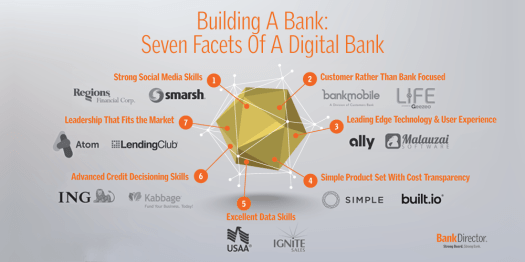
7 elements of a digital bank - by Bank Director and FinXTech

For the above image, my team took a step into an entrepreneurs shoe’s and envisioned an opportunity to build a new, digital-only bank from the ground up.  We consider these seven facets as base elements for success — and the companies listed provide real-life examples of financial institutions & fintechs alike that we see “doing it right.”

FinTech Day Deck1 (dragged)

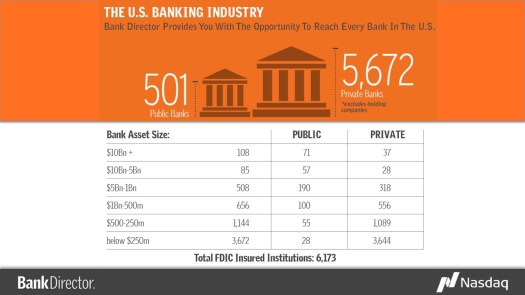
The irony of sharing an idea for a new bank?  Newly chartered banks (de novos) are basically extinct.  So for a program like FinTech Day, I thought it was imperative to provide context to the U.S. banking market by looking at the total number of FDIC-insured institutions.  These numbers are accurate as of last Friday.

FinTech Day Deck1 (dragged) 1

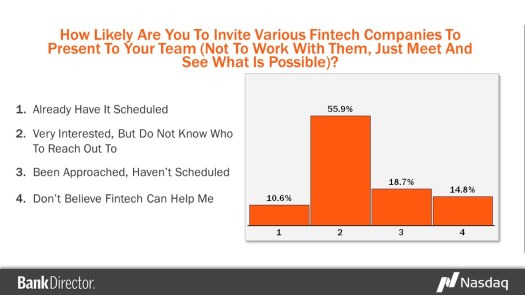
This final slide comes from our annual Acquire or Be Acquired conference in Arizona.  There, we welcomed 930+ to explore financial growth options available to a bank’s CEO and board.  To open our second full day, I polled our audience using a real-time response device to see how likely they are to invite a fintech company in for a conversation.  As you can see from the results above, real opportunities remain for meaningful dialogue and partnership discussions.

##

Thanks to all who joined us, the speakers that shard their insights and opinions and our friends from Nasdaq!

March 1 is FinTech Day

Tomorrow is FinTech Day… here is what you need to know in advance of this exclusive one-day event.

What: Bank Director’s FinTech Day

When: Tuesday, March 1 2016

Where: Nasdaq’s MarketSite (4 Times Square – 43rd & Broadway)

Overview: The next few years promises to be one of profound transformation in the financial sector. Clearly, the fabric of the industry continues to evolve as new technology players emerge and traditional participants transform their business models. At FinTech Day, we address trends like the personalization of banking, the challenges of scaling a company in our highly regulated industry and what shifting customer expectations portend for all.  For the full agenda, click here.

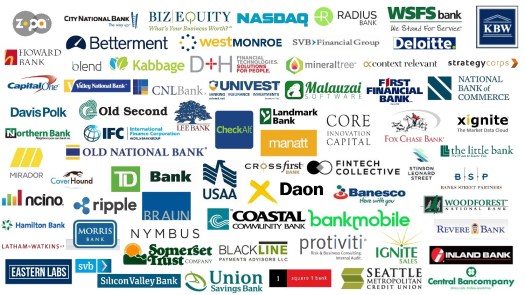
Who is coming: Attendee lists are provided to all confirmed; unfortunately, we are at capacity and cannot accept any additional registrations.  Below, I highlight the various businesses represented.

A look at who is coming to Bank Director and FinXTech's FinTech Day on March 1

FinXTech: In addition to connecting participants from across the community, I am  excited to introduce a new digital division — FinXTech — to provide authoritative, relevant and trusted content for (a) Fintech companies who view banks as potentially valuable channel or distribution partners; (b) Banks over $1B looking to grow and/or innovate with fintech companies’ help and support; and (c) Investors and services firms interested in helping to shape the future of banking.

Misc: To follow the conversation, I invite you to follow me @aldominick or use #FinTech16.  In honor of the occasion, I will be ringing the closing bell (flanked by Joan Susie, Chairman of Bank Director and Kelsey Weaver, Publisher of Bank Director + our speakers and various executives from fintech companies and high performing banks).  So if you want to see how we wrap things up at 4:00 PM ET, I invited you to turn on CNBC, MSNBC, etc.

18 Banks that Fintech Companies Need to Know

To build on last week’s piece (15 Banks and Fintechs Doing it Right), I put myself in the shoes of an early stage fintech company’s Founder.  Specifically, as someone with a new idea looking to develop meaningful financial relationships with regional and community banks in the United States.  With many exciting and creative fintech companies beginning to collaborate with traditional institutions, what follows is a list of 18 banks — all between $1Bn and $25Bn in size — that I think should attract the tech world’s interest.

By Al Dominick // @aldominick

Believe it or not, but bank CEOs and their teams are working hard to grow revenue, deposits, brand, market size and market share.  So a hypothetical situation to tee-up today’s column.

Imagine we developed a new, non-disruptive but potentially profit-enhancing software product (let’s put it in the “know-your-customer” sector since banks already spend money on this).  As the Founders, we want to approach banks that might be ready to do more than simply pilot our product.  While our first instinct would be to focus on recognizable names known for taking a technology-based, consumer-centric focus to banking, the low hanging fruit might be with CEOs and executive teams at publicly traded community banks — many of whom are above $1Bn in asset size and are just scratching the surface of developing meaningful fintech relationships.

With the idea that smaller banks can act faster to at least consider what we’re selling, we cull the field, knowing that as of June 1 of this year, the total number of FDIC-insured institutions equaled 6,404; within this universe, banks with assets greater than $1Bn totaled just 699.

So now we are focused on a manageable number of potential customers and can spend time getting smart on “who’s-doing-what” in this space.  Can we agree that we want to approach banks that share common characteristics; namely, strong financial performance that sets them apart from their peers and operations in strong local markets or big economic states?  Good, because assuming we are starting from scratch in this space, here are our top prospects (listed in no particular order with approximate asset size):

  1. Citizens Business Bank in California ($7.3Bn)
  2. Pinnacle Financial in Tennessee ($6Bn)
  3. Farmers & Merchants in California ($5.5Bn)
  4. Western Alliance in Arizona ($10Bn)
  5. Eagle Bank in DC ($5.2Bn)
  6. Prosperity in Texas ($21.5Bn)
  7. BankUnited in Florida ($19.2Bn)
  8. BofI “on the internet” ($5.2Bn)
  9. First NBC in Louisiana ($3.7Bn)
  10. Burke & Herbert in Virginia ($2.6Bn)
  11. Banner in Washington ($4.7Bn)
  12. Bank of Marin in California ($1.8Bn)
  13. Cardinal Bank in Virginia ($3.4Bn)
  14. State Bank in Georgia ($2.8Bn)
  15. TCF Financial in Minnesota ($19.3Bn)
  16. United Bank in Connecticut ($5.5Bn)
  17. Boston Private in Massachusetts ($6.8Bn)
  18. Opus Bank in California ($5.1Bn)

At a time when the concept of service is fast changing to reflect highly functional technology and “always-available” customer experiences, these eighteen banks — already successful in their own right — strike me as just the types to think about approaching.

##

*Now I’m not suggesting everyone pick up the phone and call each’s institutions CEO.  But If you are with a fintech thinking about partnerships and collaboration, you could do a whole heckuva lot worse than spending some time learning what makes all of these banks more than just financially strong and consumer relevant.