Whether They Want To or Not, Banks Need to Open Up

Apart from interest rates, the two biggest issues that bank executives seem to wrestle with are regulatory and compliance costs.  I sense another emerging challenge coming to shore; specifically, how to “open up” one’s business structure in terms of developing partnerships and permitting others to leverage their customer data and/or capabilities.

For bankers, this challenge comes with significant reputation and customer risk.

Now, it is hard to truly disrupt the concept of banking — and I shared this opinion from the stage at Bank Director’s annual Bank Executive & Board Compensation Conference this morning.  However, I did adjust some of my welcoming remarks based on the Consumer Finance Protection Bureau’s position that consumers can control their own financial data, including to let third parties help them manage their finances.  As I learned from Jo Ann Barefoot’s Fireside Chat with CFPB Director Richard Cordray at Money 2020, the CFPB “is not content to sit passively by as mere spectators watching these technologies develop.”  According to his prepared remarks:

Many exciting products we see… depend on consumers permitting companies to access their financial data from financial providers with whom the consumer does business. We recognize that such access can raise various issues, but we are gravely concerned by reports that some financial institutions are looking for ways to limit, or even shut off, access to financial data rather than exploring ways to make sure that such access, once granted, is safe and secure.

Since reading the CFPB’s position, Ms. Barefoot’s recap and the Wall Street Journal’s synopsis, I decided to talk with various bank executives and board members that are here with us at the Ritz-Carlton in Amelia Island about this stance.  As I note in this video, I sense both an ongoing struggle — and a sincere interest — to truly understand the role of technology.  For those I talked with, this is as much about “becoming sticky” to their customers as it is about embracing or defending themselves against “the new.”

##

For more about this year’s conference, I invite you to take a look at BankDirector.com.  Also, a virtual high-five to the team here for a great first day.  You all rock!

_mg_0113

Evaluating Board Performance

New regulations, technological innovations and a highly competitive environment that leaves little room for error have placed unprecedented demands on the time and talents of bank boards and their individual directors.  As many who support the banking space can attest, a strong board begins with a set of enlightened governance policies and procedures that center on honesty, personal integrity and accountability.

At Bank Director, we coined the phrase “strong board, strong bank” in response to the mounting pressures placed on the banking community.  Over the years, we have introduced new research projects, conferences and magazine issues to provide exceptionally timely and relevant information to a hugely influential audience.

As I prepare to head down to Florida (and the Ritz-Carlton, Amelia Island) this weekend for our annual Bank Executive & Board Compensation conference, I am anticipating conversations about potential regulatory changes and current strategic challenges related to a bank’s growth and profitability.  Alongside my colleagues Michelle King and Amanda Wages, I also expect to field questions from the audience (depicted in the image above) about how high performing corporate boards employ evaluation tools that match the talents & experiences of their board members to an organization’s strategic goals.  FWIW, I anticipate such inquiries as many consultants and attorneys encourage such assessments — and the board performance self-evaluation tool we designed & offer to banks has earned a strong reputation for providing an independent review of a board’s effectiveness.

To be sure, the banking industry seems to be doing well based on a variety of measures — profitability is high, credit quality is much improved and tangible capital ratios are stronger than ever. However, such financial measures don’t necessarily reflect the challenges facing many banks and their boards.  So in advance of our annual event, I asked our research team to roll up the results from twenty-two bank boards — all randomly selected — that completed a performance survey this year.

While tempting to look at individual board results and draw conclusions, anonymously lumping this group together allows some interesting patterns to emerge given more then 200 individual responses:

  • 50% recognize a need for more diversity on the board;
  • 55% say they need more expertise/knowledge in technology on the board, and 44% indicate a need for more training on IT issues;
  • 51% are dissatisfied with some aspect of the bank’s succession plan, for the CEO and/or the board; and
  • 56% are certain they have the M&A experience to meet the bank’s growth goals (44% say no or are unsure).

While these four points caught my eye, I asked our Director of Research, Emily McCormick, what stands out to her. In her words:

“Many boards lack a consensus on their succession plan, meaning that they’re often not on the same page regarding the depth of that plan. That, to me, is a red flag.”

Anecdotally, many bank CEOs — and board members — that I’ve talked with in person know they need new skills, particularly in technology, and recognize a need for diversity. But as we find, few want to add additional board members.  A fact to keep in mind next week as we explore how to build and support the best teams based on the strategies and tactics being used by successful companies today.

##

We designed our Bank Service offerings to help board members and senior executives develop strategies to help their bank grow, while demonstrating excellence in corporate governance that shareholders and customers deserve and today’s regulators demand.  To learn more, click here.

Bank Director’s 2017 Acquire or Be Acquired Conference

Sunday, January 29th, may seem like quite a ways off… but not for my team at Bank Director.  Indeed, we are full-steam ahead as we prepare to host the premier banking event for CEOs, senior management and board members: our Acquire or Be Acquired Conference.  AOBA continues to draw key leaders together in order to explore financial growth options; in 2017, we host this three-day program at the JW Marriott Phoenix Desert Ridge in Phoenix, AZ.

Each month, Tim Melvin shares nuanced observations on the banking space in his Community Bank Investor Newsletter.  In his October 2016 edition, he points out that “scale and earnings growth are still among the main drivers of M&A activity, and that’s not going to change anytime soon.”  Clearly, the need and desire to grow exists at virtually every organization, something I’ve picked up on while talking with bank CEOs about next January’s event.

2016 AOBA Demographics c:o Bank Director and Al Dominick

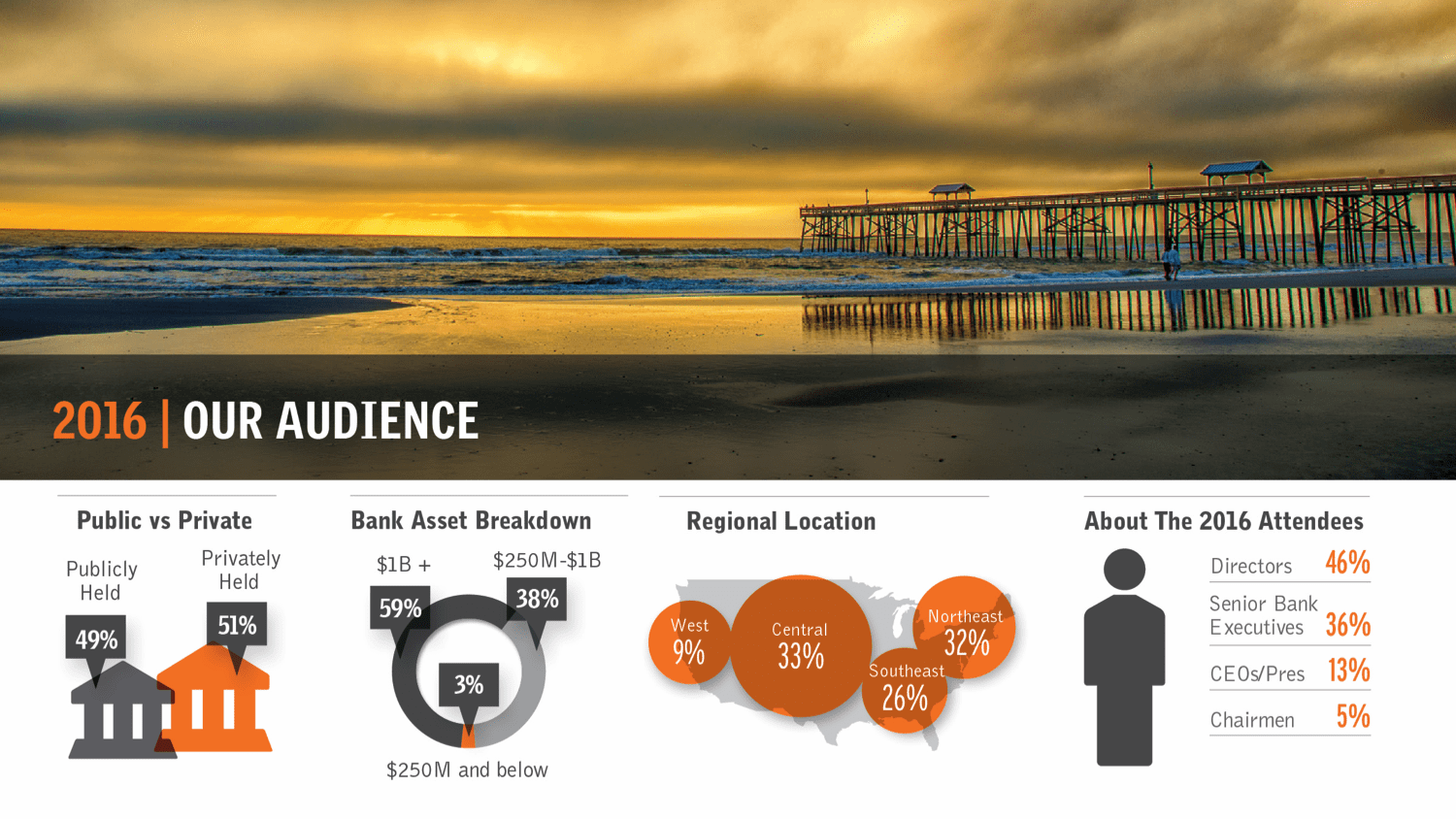
As you can see from this image, our 22nd annual Acquire or Be Acquired Conference brought together key leaders from across the country.  I addition to the 590+ bankers in attendance, an additional 300+ executives from leading professional services and product companies joined us.  During (and following) our time in the desert, I shared various observations on this site (e.g. Five Reasons Why Banks Might Consider Selling in 2016 and Community and Regional Banks are Crucial to the Vibrancy of Our Communities).  In the simplest of terms, I left Arizona with a sense that more bank boards and their management teams were seriously considering M&A as a growth plan than perhaps in previous years — a view formed by the continued margin pressure that banks have been operating under for the last several years.

Ironically, there is a growing likelihood that the bank M&A market in 2016 will see declines in both deal volume and pricing compared to the previous two years, even as the industry’s underlying fundamentals remain relatively unchanged.  Nonetheless, registration patterns for 2017 suggest an increase in bank executive’s appetites to explore a merger, to prepare for an acquisition, to grow loans, to capturing efficiencies & managing capital to partnering with fintech companies (*all topics that will be covered in ’17).  So for those of you looking to refine and/or enhance your growth playbook, I invite you to review the agenda for January’s program that we just updated on BankDirector.com.

##

FWIW: we have welcomed over 5,000 CEOs, Chairmen and members of a bank’s board to this conference over the years, and we anticipate 2017 will be the biggest ever – with over 900 attendees focused on the future of their banks.  Most come with one or more officers of their bank and yes, many bring their spouses.

The Promise of 8 Blockchain Companies

Yesterday, I spent the majority of my day at the Economist Conference’s “Finance Disrupted” in New York City.  As an early hook to their first panel discussion entitled ‘Building the blockchain: The promise and perils’, we learned that venture capitalists invested nearly $500 million in blockchain business last year — up from $2 million just three years ago.  While I’ve shared my perspectives on the potential applications for blockchain in previous posts (Blockchain 101 – a Primer for a Bank’s CEO and Board), panels like these underscore the immense potential of this technology.

“Blockchain technology continues to redefine not only how the exchange sector operates, but the global financial economy as a whole.”

– Bob Greifeld, Chief Executive of NASDAQ

Like many, I see potential for blockchain technology to revolutionize many areas of the financial industry — think securities trading, payments, fraud prevention and regulatory compliance.  Moreover, a new report from Deloitte explores how blockchain could be used in loyalty rewards programs.  Still, as our industry transforms, there is real uncertainty around what the future of the banking industry will look like.

This is why I take note of comments like those from BNY Mellon’s CEO, Gerald Hassell. On his Q1 earnings call, he opined “we think blockchain can be transformative.  We’re spending a lot of time and energy on it, but I think it’s going to take some time to see it play out in a full, meaningful way. We actually see ourselves as one of the major participants in using the technology to improve the efficiency of our operations and the resiliency of our operations.”

While additional big-time players — such as Goldman Sachs, Visa and NASDAQ — garner headlines for their investments in crypto-currencies & blockchain technology, I spent last night and this morning looking at eight blockchain companies that might help you to form your own opinions on the potential of this technology:

For more about these companies — and their funding sources — I encourage you to check out this piece on Lets Talk Payments.  Not familiar with LTP?  It is a fast-growing global destination for news, insights & data-driven research in emerging financial services.  Much like the information shared by both FinXTech and Bank Director, LTP’s content is fiercely independent, thought provoking and always up-to-date, in a way that continues to inform, engage and inspire.

FinXTech’s Advisory Group

I’m checking in from the edge of the Rocky Mountains — from the iconic Broadmoor in Colorado Springs — where I’m joined by FinXTech’s President, Kelsey Weaver and Bank Director’s Director of Client Relations, Laura Proffitt.  The three of us are here to participate in the Association for Financial Technology’s (AFT) Fall Summit where later today, I will have the opportunity to introduce a new partnership between AFT and FinXTech.  In advance of those comments, I thought to pull the curtains back on a special  Advisory Group that we are building to develop FinXTech in the “best” possible manner. 

As new approaches to delivering financial services emerge, nearly every technology company here in Colorado has practical tools, techniques and talent to help financial institutions prepare for the future.  It is an exciting time to be part of a community like the one AFT draws, as I believe new players will continue to emerge while traditional participants transform their underlying business models to better participate and compete in the coming years.

As the financial industry continues to evolve, so too does the community that my team supports.  As a peer-to-peer based platform powered by Bank Director, FinXTech connects a hugely influential audience around shared areas of interest and innovation; specifically:

  • FinTech companies who view banks as potentially valuable channels or distribution partners;
  • Banks looking to grow and/or innovate with FinTech companies’ help and support; and
  • Institutional investors, venture capitalists, state & federal regulators, government officials and academicians helping to shape the future of banking.

Rather then create this community in isolation, we are doing so with the help and support of industry leaders with various backgrounds.  Case-in-point, we are recruiting highly opinionated, ridiculously informed thought leaders to “think around the corner” with us as part of FinXTech’s Advisory Group.

So as we get ready to spend a few days with our peers at this week’s conference, Kelsey, Laura and I are proud that the following men and women have accepted our invitation to share their time and intelligence with us as part of FinXTech’s council:

  • Thomas P. Brown, Partner, Paul Hastings LLP
  • Michael Butler, President & CEO, Radius Bank
  • Michael M. Carter, Founder & CEO, BizEquity
  • Ryan Gilbert, General Partner, Propel Venture Partners
  • John C. Gill, Chief Operating Officer & Chief Risk Officer, Somerset Trust Company
  • Joe Guastella, Global & U.S. Managing Principal, Financial Principal, Deloitte Consulting LLP
  • James C. Hale, III, Founding Partner, FTV Capital
  • Aditya Khujekar, CEO & Co-Founder, Let’s Talk Payments
  • Jimmie Lenz, Director of Technology Risk, Wells Fargo, Wealth and Investment Management
  • Vivian Maese, Partner, Latham & Watkins
  • Bill McNulty, Entrepreneur in Residence, Capital One
  • John E. Pizzi, CEO, BaseVenture
  • Gregg M. Schoenberg, Founder, Westcott Capital
  • Chris Skinner, CEO, The Finanser Ltd
  • Christa Steele, Former President, CEO & Board Member, Mechanics Bank; Founder, Boardroom Consulting LLC
  • John Thompson, SVP & Leader, Program Team, CFSI
  • Andres Wolberg-Stok, Director, Citi Fintech
  • Jon Zanoff, Founder, Empire Startups

In addition to this awesome group, we have some pretty powerful folks that we recently invited (so this list can and will expand in the coming weeks).  But for those of you here at AFT, you will hear Kelsey, Laura and me talk about our enthusiasm for this group & the efforts being made to establish FinXTech as a catalyst that (1) connects a highly influential group of people who care about the future of financial services, (2) are committed to meaningful transformation and are (3) empowered to make change happen.

##

To learn more about what we’re doing, I invite you to visit FinXTech.com, a site we designed to deliver authoritative, relevant and trusted content for banks, Fintech companies, investors and services firms.

What Does a Board Member Get Paid?

The banking industry seems to be doing well based on a variety of measures — profitability is high, credit quality is much improved and tangible capital ratios are stronger than ever. However, such financial measures don’t necessarily reflect the challenges facing many institutions to attract, compensate and retain standout executives and talented board members.  So, in advance of Bank Director’s 12th annual Bank Executive & Board Compensation Conference (held October 25 + 26 at the Ritz-Carlton Amelia Island), I thought to share this snapshot on what a bank pays, on average, to its board members.

compensationwp_printready_revised-dragged

This information comes from our 2016 Compensation Survey, sponsored by Compensation Advisors, a member of Meyer-Chatfield Group.  This annual research report, now available for free on BankDirector.com, examines trends in executive and board compensation, including the compensation related issues faced by boards and senior executives.

This survey tracks salary data for CEOs, chairmen and independent directors & was completed online by 262 directors, chief executive officers, human resources officers and other senior executives from U.S. banks in March 2016. Supplemental data on CEO and board compensation came from the proxy statements of 105 publicly traded institutions for fiscal year 2015.

Can Banks Keep Up?

As the financial industry adapts to various digitization trends, my team continues to field inquiries from bank CEOs and their executive teams specific to emerging technology strategies and opportunities.  One way we attempt to benchmark current interests (and concerns): an annual research project.  This year, we evaluated industry attitudes toward core providers and fintech firms, including marketplace lenders like Lending Club, in our just-released Bank Director Technology Survey.  While a number of findings jumped out at me, three really caught my eye:

  • Eighty-one percent of bank chief information officers and chief technology officers responding say that their core processor is slow to respond to innovations in the marketplace, making it even more difficult for the banking industry to keep up with shifting consumer expectations regarding technology.
  • Thirty percent of bank CIOs and CTOs report that their bank has pulled back on plans to integrate a more innovative product, service or delivery channel due to the inability or unwillingness of the bank’s core processor to support that activity.
  • Banks are highly reliant on core providers for services beyond core processing, which at its most basic contains vital customer data and processes all customer transactions. Ninety-six percent of respondents say their bank uses their core provider for additional services, including mobile banking (71 percent) and bill pay (75 percent).

Our 2016 Technology Survey, sponsored by the technology solutions provider CDW, reflects the opinions of 199 board members and senior executives of U.S. banks surveyed in June and July.  The size of institutions polled fell between $250 million and $20 billion in assets.  In addition to the points shared above, we found:

  • Thirty-one percent of respondents have converted their bank’s core technology within the past five years. Forty-two percent converted their core more than 10 years ago.  Respondents report that their bank works with a median of five technology firms, including the core provider.
  • Sixty-one percent of participants see fintech firms as both competitors and partners.
    Online marketplace lenders should be more heavily regulated, say 60 percent of respondents. Forty-one percent worry that they’ll lose loans to these lenders, but 18 percent don’t think these lenders have long-term viability.
  • Opinions are mixed on the impact that blockchain—the underlying technology behind the digital currency bitcoin—will have on the banking industry. Twenty-four percent believe it will impact all banks. However, 57 percent don’t understand blockchain enough to form an opinion, or have never heard of the technology.

Finally, cybersecurity continues to loom large.  Having a strong technology infrastructure in place to protect against cyberattacks remains the top technology concern for survey participants, at 72 percent.  Seventy percent indicate that their bank could better use data to serve the needs of existing customers, or identify new customers.  Seventy percent of respondents believe that technological innovation is a priority for their board, but less than half discuss technology at every board meeting.  Thirty-four percent of respondents describe themselves as early adopters of technology.

The full survey results are available online at BankDirector.com, and will be featured in the 4th quarter 2016 issue of Bank Director magazine.

Creating Better Banking Experiences

Earlier this week, we published our quarterly print issue of Bank Director magazine.  If you haven’t seen it, our talented editor, Naomi Snyder, shines a light on the “tech bets” being made by Fifth Third, a $142 billion asset institution.  Having worked for an IT firm, I appreciate the three questions their President & CEO, Greg Carmichael, asks his team to consider before investing in new technologies:

  1. Does it improve the bank’s ability to serve customers?
  2. Does it drive efficiency?
  3. Does it create a better experience for customers?

As he shares, “not every problem needs to be solved with technology… But when technology is a solution, what technology do you select? Is it cost efficient? How do you get it in as quickly as possible?  You have to maintain it going forward, and hold management accountable for the business outcomes that result if the technology is deployed correctly.”

“The challenges are how to grow the franchise and reposition the franchise to serve our customers in the way they want to be served, which is more of a digital infrastructure.”

-Greg Carmichael, President & CEO, Fifth Third Bank

While Fifth Third plans to invest some $60M this year in technology, Naomi notes that the bank doesn’t have an R&D lab with a staff separated from the rest of the bank and dedicated to inventing things (like its competitor U.S. Bancorp).  Nor does Fifth Third have the reputation of being highly innovative, like a BBVA.  Nonetheless, the regional bank, headquartered in Cincinnati, has a laser focus on developing practical solutions to everyday problems.

So to build on this issue’s cover story — and the efforts we’re making with our FinXTech platform — let me offer my take on who I consider standouts in the payments, lending and retail space today.  Those addressing “everyday problems” may find inspiration from the work being done and/or want to explore partnership opportunities.

Payments + Transfer

When one thinks about payments — and the movement of  value via cash, credit card, check and other transactions — some big names come to mind: Apple Pay, Chase Pay, Square, Paypal, etc.  But don’t sleep on these companies:

Lending

In the lending sector, a lot of people continue to talk about LendingClub’s travails, scoff at SoFi’s change of heart from anti-bank to pro-partnerships and follow Prosper’s efforts to shore up its business.  Within the lending space, these companies also deserve time and attention:

  • Affirm, a digital lender that provides installment financing;
  • Orchard, a technology and infrastructure provider for marketplace lending;
  • Lendio for small business loans;
  • Even, a new kind of financial app that turns variable pay into a steady, reliable income; and
  • Earnest,  a technology-enabled lender that enables one to consolidate and refinance  student loans.

Retail banking

Considering the core functions of retail banking remain the establishment of deposits and making of loans, those pushing the envelope in a way consumers desire include:

  • Ally Bank, known for its “No Branches = Great Rates” tag line;
  • Atom Bank, one of the first Challenger Banks in the UK;
  • Tandem, a new digital bank in the UK;
  • Moven, a pioneer in smart phone banking; and
  • Simple, part of the BBVA family that is reinventing online banking.

While these banks are pushing forward, many legacy institutions will be challenged to meet the expectations of their customers.  They will need to assess the additional risks, costs and supervisory concerns associated with providing new financial services and products.  Accordingly, I’m not alone in believing that financial institutions need to invest in services “for life’s needs” through collaboration and partnerships with companies like those shared in today’s post.

##

I realize there are a number of companies “doing it right” in these three sectors – and this simply highlights some of the players that standout to me.  Feel free to comment below on others that I might highlight in future posts.

Without A Destination, What Good Is A Map?

Highlight: as executives grapple with a fast-changing operating environment that requires partnerships and collaboration, many wrestle with where they want to be vs. where they need to be.

In this video, I share my thoughts on growing through partnerships (between traditional banks and financial technology firms), becoming “data richer” and enhancing the customer experience you’re delivering.

FWIW, this video lives on FinXTech.com, a site designed to provide authoritative, relevant and trusted content to a hugely influential audience, specifically:

  • Fintech companies who view banks as potentially valuable channels or distribution partners;
  • Banks looking to grow and/or innovate with fintech companies’ help and support; and
  • Institutional investors, venture capitalists, state & federal regulators, government officials and academicians helping to shape the future of banking.

As a platform powered by Bank Director, FinXTech connects this hugely influential audience around shared areas of interest and innovation.  FinXTech specializes in (1) bringing valuable bank relationships to fintechs, and (2) offering banks valuable relationships with fintechs in a way no one else does.

3 Challenges That Comes With Technology

In this brief video, I share three major areas of risk facing financial institutions today.  Filmed during yesterday’s Bank Audit & Risk Committees conference in Chicago, IL, these points reflect my time with Chief Financial Officers, Chief Risk Officers, General Counsels along with Audit and Risk Committee members and various executives from leading professional services and advisory firms.

As new technology players emerge and traditional participants begin to transform their business models, I believe that successful institutions will enable financial services for life’s needs through collaboration and partnerships with the very fintech companies that once threatened to displace them.  In case you’re interested in issues like these, take a look at FinXTech, our “new” platform that promotes collaboration between the most forward thinkers in the industry – in order to create real innovation, change and a better future for all.

3 Key Takeaways from Bank Director’s Audit & Risk Conference

A quick check-in from the Swissotel in Chicago, where we just wrapped up the main day of Bank Director’s 10th annual Bank Audit & Risk Committees Conference.  This is a fascinating event, one focused on key accounting, risk and regulatory issues aligned with the information needs of a bank’s Chairman, CEO, Bank Audit Committee, Bank Risk Committee, CFO, CRO and internal auditor.  Risk + strategy go hand in hand; today, we spent considerable time debating risk in the context of growing the bank.

By Al Dominick, President & CEO of Bank Director

Earlier today, while moderating a panel discussion, I referenced a KPMG report that suggests “good risk management and governance can be compared to the brakes of a car. The better the brakes, the faster the car can drive.”  With anecdotes like this ringing in my head, allow me to share three key takeaways:

  1. A company’s culture & code of conduct are critical factors in creating an environment that encourages compliance with laws and regulations.
  2. Risk appetite is a widely accepted concept that remains difficult, in practice, to apply.
  3. As a member of the board, do not lose sight of the need to maintain your skepticism.

This year’s program brings together 150+ financial institutions and more then 300 attendees. The demographics reflect the audience we serve, so I thought to share three additional trends.  Clearly, boards of directors are under pressure to evolve.  Financial institutions need the right expertise and experience and benefit greatly when their directors have diverse backgrounds.

Further, as more regulatory rules are written, board members need to understand what they mean and how they can affect their bank’s business.  Finally, technology strategies and risks are inextricably linked to corporate strategy; as such, the level of board engagement needs to increase.

Given the many issues — both known and unknown — a bank faces as our industry evolves, today made clear how challenging it can be for an audit or risk committee member to get comfortable addressing risk and issues.  Staying compliant requires a solid defense and appreciation for what’s now.  Staying competitive?  This requires a sharper focus given near constant pressures to reduce costs while dealing with increasing competition and regulation.

##

To see what we’re sharing on our social networks, I encourage you to follow @bankdirector @fin_x_tech and @aldominick.  Questions or comment?  Feel free to leave me a note below.

The FinTech Ecosystem

Last Friday, I had the pleasure to be invited to the White House’s FinTech Summit, where, as the Wall Street Journal reported, the half-day event “largely focused on how government agencies can tap into the innovation, in which new firms are offering small-business owners and consumers faster forms of loans and digital payments.”  Certainly, collaboration between technology companies and traditional financial institutions has increased — think proofs of concept, partnerships and strategic investments — but much still needs to be done.  As I took notes during the event, I did so with an eye towards the platform we built — and the ecosystem beginning to develop — with FinXTech.

FinXTech is a platform that promotes collaboration between the most forward thinkers in the industry – in order to create real innovation, change and a better future for all.

As new technology players emerge and traditional participants begin to transform their business models, there is growing sentiment that successful institutions need to enable financial services for life’s needs through collaboration and partnerships with the very fintech companies that once threatened to displace them.  I tackled this issue in a piece I wrote (A Fear of Missing Out).  A few things didn’t make the final cut that I thought to share here.  Of note:

  • I asked Michael Tang, partner and head of global digital transformation and innovation at Deloitte, how might bank executives determine the amount of money they should allocate to innovation.  He shared that industry metrics range from 2-7% of revenues (and also depend on incremental or moonshots-type initiatives).
  • Even as technology will force narrowing margins, there may be opportunities to develop new profit pools and forcing some incumbents to “move upstream” to serve more sophisticated and profitable cohorts (source: Disaggregating the impact of fintech).
  • The playing field will level as firms of all sizes will be able to take advantage of emerging networks and platform-based services. Ultimately lowering cost, improving compliance, and focusing on markets where they have a true competitive advantage (source: Disaggregating the impact of fintech).

The rapid transformation of the financial services industry — due to technological innovations and shifting customer expectations — is quite remarkable.  If you missed what Adrienne Harris, special assistant to the president for economic policy, wrote in a blog post following the White House FinTech Summit, it is worth your time to read.