A Build vs Buy Banking Story

For the first time in a while, I get the sense that members of the boards at financial institutions across the country are not just ready, but also eager, to embrace various strategies that leverage emerging technologies.  Accordingly, what follows are three things I’m thinking about as the week wraps up that have a distinctly tech spin to them.

pyramid-on-the-us-one-dollar-bill

Bringing IT In-House

Kudos to Scott Mills — President of The William Mills Agency — for sharing this American Banker profile of FirstBank, a $13 billion Denver institution.  With more than 115 locations in Colorado, Arizona and California, the bank is unusual in that it develops its own core banking software — made possible by an in-house IT team of 250+, or 12% of the bank’s 2,100 workers.  According to the piece, having a “homegrown core and in-house expertise enables the bank to be nimble and make changes quickly.”  Obviously, banks continue to use technology to generate efficiencies.  In fact, I’m seeing some community banks come up with creative solutions to meet their needs.  Case-in-point, this recent Bank Board & Executive Survey — conducted by Bank Director and sponsored by consulting firm Grant Thornton LLP — shows 84% of bankers surveyed plan investments in new technologies to make their institutions more efficient.  Still, FirstBank’s efforts to build instead of buying from outside vendors trumps any other bank’s effort that I’ve come across this year.  Oh yeah, their blog is pretty darn good too.

Finding the Right Partner(s)

For those more comfortable collaborating with firms who specialize in developing IT solutions, let me pass along an observation from my time with CEOs in San Francisco and Chicago.  Over the last month or so, I’ve talked with at least 13 CEOs about how they plan to stay — or potentially become — relevant in the markets they serve.  I’m not that surprised to hear that many want to get rid of branches — but do wonder as they turn to technology to fill in the gap if they have the right people in leadership positions.  Many smaller banks are focused on C&I lending and serving their business communities, so I don’t wonder about their branching focus, but do wonder about their hiring practices.  Certainly, it will become even more imperative to understand the various technology opportunities — and risks — what with so many “non-technical” executives and board members setting paths forward.

Square Peg, Round Hole?

Finally, I have something of a payments-focused writing streak going on this site, and I’m keeping it going thanks to this WSJ report vis-a-vis Square, the payments startup with a square credit-card reader.  As I found out, the company is eliminating a monthly flat-fee option for smaller businesses in favor of its usual “per swipe” fee.  The change is “prompting concern among some of Square’s more than four million customers, which include small businesses that were attracted to Square because it offered a cheaper alternative to traditional credit-card processors, which charge swipe fees of 1.5% to 3%.”  I wonder if this is opportunity knocking for community banks?  Certainly other point-of-sale vendors have seen it that way.

##

To comment on this piece, click on the green circle with the white plus (+) sign on the bottom right. If you are on twitter, I’m @aldominick.  Aloha Friday!

The Race is On

ferrari-458-challenge-race-car_100316284_m

The race is on… to expand into new markets, to add new talent, to introduce new technologies that attract and engage customers.  This race, playing out in cities and towns across the country, applies to many industries.  For our purposes, let me build on this theme vis-a-vis three takeaways from Bank Director’s annual Bank Executive & Board Compensation Conference in Chicago.

(1) How companies develop executives, attract leadership and approach compensation in today’s highly competitive and economically challenging world was front-and-center in Chicago.  As I wrote earlier this week, the environment that this country’s 7,000 or so banks operate in demands productivity, proficiency with technology and the ability to sell.  Finding the right people to lead such efforts, especially when you consider that every organization has a different set of “players” with a unique collection of knowledge, experience and skills, proves challenging.   Complicating matters is the fact that all banks are required to regularly assess whether any of their compensation plans encourage unnecessary or excessive risk-taking that could threaten the safety and soundness of the institution.

(2) Putting together compensation plans that reward growth and responsible risk takes many shapes.  However, the “adverse economic cycle” has dampened some employees’ opportunities to earn — and at a corporate level, has slowed the anticipated pace of bank consolidation.  While larger banks continue to increase in size, many smaller institutions are fighting for survival in today’s regulatory and low-interest rate environment.  According to SNL, there were 235 whole-bank M&A transactions announced and 51 failed bank transactions for a total of 286 deals in 2012. Total deals, as a percentage of overall banks in the U.S., have remained relatively consistent over the years between 3% and 4%.  Some interesting stats, courtesy of the Hovde Group:

  • Since 2000, sellers over $1 billion in assets have commanded a 32% premium over those sellers less than $1 billion;
  • In 323 transactions since 2000, sellers over $1 billion averaged a valuation of 246% of tangible book value; and
  • In 2,729 transactions since 2000, sellers less than $1 billion averaged a valuation of 187% of tangible book value.

M&A activity is once again heating up as financial institutions look to achieve necessary scale to compete and thrive… and while I will not wager on the exact number of deals that will mark 2013, I will take the over on 2012’s results.

(3) The relevance of scale, the pace and volume of M&A activity and the dynamic tension between the “bid-and-ask” takes center stage at our next conference: our 20th annual Acquire or Be Acquired Conference.  Held at the Frank Lloyd Wright-inspired Arizona Biltmore, we’ve put together a program that looks at the strategies potential acquirers might consider to the practical considerations the board needs to discuss.  As proud and pleased as I am for this week’s successful event, I am already gearing up to open our biggest conference the week before the Super Bowl.  Widely regarded as one of the financial industry’s premier M&A conferences, I am super excited by the hard work put in by our team and even more stoked to spend the next few months getting ready to welcome everyone to the desert.  To that end, I will begin to expand upon the topics and trends that influenced the development of this year’s program in future posts.

Aloha Friday!

The Buying and Selling of Banks

photo
I think I know what’s around the bend…

As we wind down the dog days of summer, I re-read my last eight posts before outlining this week’s piece.  By design, I placed a heavier emphasis on stories that related to building customer relationships and opportunities tied to organic growth rather than multi-national issues and regulatory reform.  To build off these ideas, I thought to share three pieces that address “what’s next” in the United States and Europe.  The first focuses on potential changes overseas; the second, on domestic mergers and acquisitions; to close, I share the thoughts of Wells Fargo’s CEO on the importance of community banks.

(1) “What’s next for the restructuring of Europe’s banks,” a question that parallels many conversations taking place within boardrooms, think tanks, government offices and media rooms across the U.S.  Penned by members of the financial services team at McKinsey, this op-ed shows how Europe’s banks, like their U.S. counterparts, have had to re-evaluate their short and long-term prospects based on stagnant economic conditions.  Many “continue to face pressure from difficult funding conditions, a transition to higher costs of capital, changing regulations and tighter capital requirements.”  The authors make a case that many “need to shed capital-intensive operations and simplify businesses to compete more profitably in fewer market segments.”  All told, this report claims Europe’s banks are “considering the sale of up to 725 business lines across various business segments and geographies.”  If true, this might result in greater numbers of strategic mergers of like-sized banks.  Do you agree that this story sounds eerily familiar to the one playing out here in the States?

(2) Staying closer to home, bankers and advisers alike debate how quickly consolidation will play out in the coming years.  Personally, I see it taking place over a longer period than some might forecast.  To this point, I think I have a friend in Raymond James’ Anthony Polini (their Managing Director of Equity Research).  Anthony shared his perspectives with an audience of CEOs, Chairmen and board members at Bank Director’s Acquire or Be Acquired conference this January.  There, he opined that industry consolidation “is inevitable” as banks come to grips with new regulations, lower growth rates, higher capital/reserve requirements and lower long-term margins/returns.

Earlier this week, he penned a mid-year report that builds on those ideas.  He lays out how “the current slow growth environment fosters M&A as a quicker means for balance sheet growth and to achieve operating efficiencies in this revenue-challenged environment.”  In his team’s estimation, meaningful industry consolidation takes place over the next 5 to 10 years rather than a large wave that occurs over just a few.  This belies his belief that banks are “sold and not bought.”

Using this logic, coupled with an improving (albeit slowly) economy, modestly better asset quality and shades of loan growth, he believes “an M&A target’s view of franchise value will remain above that of potential acquirers. Put another way… expect the disconnect between buyers’ and sellers’ expectations to remain wide but slowly move closer to equilibrium over time.”

(3) Not to be lost amid this consolidation talk is a perspective from John Stumpf, the chairman and chief executive of Wells Fargo, as to why “Community Banks Are Vital to Our Way of Life.”  In his words

“…we need well-managed, well-regulated banks of all sizes—large and small—to meet our nation’s diverse financial needs, and we need public policies that don’t unintentionally damage the very financial ecosystem they should keep healthy. “

He continues that “almost 95% of all U.S. banks are community banks. They provide nearly half of all small loans to U.S. businesses and farms. In one out of five U.S. counties, community banks are the only banking option for local residents and businesses. Many small towns… would have little access to banks, and the services they provide, without our system of community banks.”  Significant words from one of banking’s biggest voices.  Not the first time he’s shared this opinion, and hopefully, not the last.

Aloha Friday!

Three out of Four Say…

rotary-phone

Last week, I shared that Cullen/Frost acquired another institution in Texas.  A stalwart of community banks, many analysts and investors cite their strength as proof that M&A isn’t a necessity to grow one’s business.  Still, organic growth has yet to return to the degree to which was hoped for by many other bankers at this point.  So with apologies to Deloitte, the following three points from members of the accounting world’s “Big Four” focus on the strategies some might consider to build their franchise value without requiring an acquisition.

(1) KPMG’s John Depman writes about the “unprecedented change afoot in the banking industry.”  In his view, technology is rapidly evolving and it’s changing consumer expectations about how banks should be serving them.  He carries this message throughout his “Community Banks That Fail to Leverage Technology May Become Obsolete” piece that is up on BankDirector.com.  According to John, community banks have been slower to embrace technology as a means to interact with and serve customers.  In doing so, they risk becoming obsolete.  To this end, he shares a number of key issues that directors and boards need to consider and subsequently work with senior management to address.  These range from “customer loss vs. investment return” to evaluating bank branch strategies.  Ultimately, “the model that defined our industry for generations has now been turned on its head.  The road to transforming your community bank won’t be short.  But, it’s a road that must be taken.”

(2) Keeping to this transformation theme, PwC’s Financial Services Managing Director, Nate Fisher, highlights how banks can align their pricing structure by using data from customer preferences, purchasing patterns and price sensitivity.


(3) Finally, banks continue to report increases in mobile banking usage, at least, according to a July 30th piece that ran in American Banker’s “Bank Technology News.”  There, they recognize the latest “Mobile Banking Intensity Index” which shows how features like mobile check deposit continue to be adopted quickly.  This lines up with a number of tweets I’ve recently seen from Ernst & Young (“EY”).  Some relate to the banking industry coping with the challenges of the mobile money ecosystem.  Others refer to the strategies that are emerging, and potential pitfalls to be avoided “in a landscape where competitors include businesses (telecoms and tech firms, for instance) that until recently had nothing to do with financial services.”  According to EY, in 2001, there was only one mobile payment system in the market. Today, there are 150 in everyday use and 90 more in development. Wow…

Aloha Friday!

Evidently, bigger isn’t always better

photo (21)

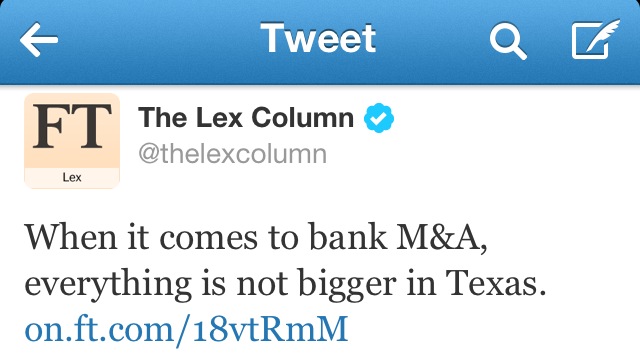
I can’t improve upon the FT’s Lex Column tweet for this week’s post; since it’s behind a paywall, I can’t share any more than the shortened URL either.  Still, it does foreshadow one of three points I’m sharing as we wrap up another summer week.

(1) When it comes to bank M&A, investment bankers “expect slow and steady consolidation.” Analysts point out that in today’s environment of slowed economic growth and regulatory change, bankers and investors continue to eye M&A as a possible opportunity for increasing profits and building strategic franchises.   So I paid close attention to news that Texas-based Cullen/Frost will, for the first time in nearly seven years, acquire another bank. On Tuesday, the NYSE-listed institution announced it will pick up Odessa-based WNB Bancshares, which operates in the heart of the oil-and-gas producing, Friday Night Light’sinspiring Permian Basin in West Texas.  If you’re not familiar with shoppingCullen/Frost, it has $22+ billion in assets and consistently ranks among the top banks in the country (at least, if you pay attention to rankings like the “Nifty Fifty,” which annually identifies the best users of capital).  As I looked for background on the deal, I found this article that ran in the bank’s hometown of San Antonio an interesting summary.  According to the news outlet, Cullen/Frost’s Chairman and CEO, Dick Evans, is fond of saying he is an “aggressive looker and a conservative buyer” when it comes to making acquisitions. So you have to figure this cash and stock deal (valued at $220 million) makes too much strategic sense for both institutions to ignore, especially with the Lone Star state’s surging oil and gas business.

(2) From size to age, you may hear me refer to my company as a 23-year old start up.  But this description cannot hold a candle to “a 110-year-old NorCal startup:” Mechanics Bank.  While I haven’t visited with them, every time I go to San Francisco I hear good things about the team leading the bank (and yes, we have written about their work; for example, “Talking Tech to Directors“).  Within the bank is the author of “Discerning Technologist,” Bradley Leimer.  As the VP of Online and Mobile Strategy at Mechanics Bank, I certainly appreciate his perspectives on change.  In fact, as I work on a growth-focused program for CEOs, executives and a bank’s boards, his “What Inspires Financial Services Innovation?” piece became a must read.  Totally up my tech and design alley and a blog worth following.

(3) Finishing on a technology kick, Fiserv shares a white paper that explores mobile strategies (“Mobile Banking Adoption: Your Frontline Staff Holds the Key to Growth“). Ubiquitous as this conversation feels, they show that for most financial institutions, mobile banking adoption typically hits a glass ceiling of 15% to 20% of online banking customers.  This surprised me, as adoption rates of mobile devices continues to grow.  I am a big fan of what the tech giant does to support the community, but I’ve talked with CEOs like Umpqua’s Ray Davis in the past about their retail concept that includes a big mobile push.  No matter what tone at the top is struck, tactical challenges remain for almost everyone.  So I’m curious to hear how banks account for this plateau as they devise their plans.  Many bank leaders I meet with express an interest in getting more mobile and social.  Fewer, however, have a comfort that their teams are measuring, and subsequently managing, such plans for the future.  Fiserv’s piece, for banks and credit unions alike, provides some interesting context for such strategic conversations.

Aloha Friday!

Quality never goes out of style

Wait... there was something going on other than the Stanley Cup finals this week?
Wait… there was something going on other than the Stanley Cup finals this week?

Today’s title, inspired by my uncle who founded and continues to run Computech, a very successful technology firm here in the D.C. area, is both simple and profound.  I believe the three points shared below reflect the same spirit of craftsmanship and professionalism he built his firm on.  Working smarter, building better, doing it right the first time… themes I picked up this week and thought to share below.  And yes, #LetsGoBruins!

(1) One of the work questions most frequently asked of me at conference cocktail parties and in social settings concerns the future of banks. So the fact that the St. Louis Fed published a study that examines banks that thrived during the recent financial crisis proved irresistible.  After all, “those who cannot remember the past are condemned to repeat it.”  I’ve alluded to this research in a previous post; for me, it is interesting to note that some of the most profitable banks, in the short-term, are not necessarily the best banks.  Instead, the so-called “best banks,” in my opinion, get creative in offering new products. They watch closely what is working for other banks in and out of their own market. They watch what products and services are being brought to market by vendors to our industry.  This survey, in a broad sense, backs this up.

(2) In the St. Louis Fed’s survey, the authors conclude that there is a strong future for well-run community banks.  In their estimation, banks that prosper will be the ones with strong commitments to maintaining risk control standards in all economic environment.  This aligns neatly with most discussions about a board’s role and responsibilities. Indeed, one of the critical functions of any bank’s board of directors is the regular assessment of their activities and those of the bank’s management in terms of driving value. As C.K. Lee from Commerce Street Capital explains, this may be defined as value for shareholders, value for the community and the perception of strength among the bank’s customers and regulators. Over the last few months on BankDirector.com, he’s explored the concept of tangible book value (TBV) and its relationship with bank valuation. He also looked at internal steps, such as promoting efficiency and growing loans, which boards could take to drive more revenue to the bottom line and drive bank value.  The “final installment” of his series is up — and if you are interested in two additional factors that drive value in both earnings production and market perception, a good read.

(3) Over the last few weeks, I have shared my take on a few issues near and dear to audit committee members.  These committee members have direct responsibility to oversee the integrity of a company’s financial statements and to hire, compensate and oversee the bank’s external auditor.  So on the heels of Deloitte’s trouble with New York’s Department of Financial Services comes this week’s final point.  In case you missed it, the state’s regulator cracked down on Deloitte’s financial-consulting business, essentially banning them from consulting with state-regulated banks for the next year.  Big enough news that the American Banker opined “it will send waves through its bank customers, competitors and federal regulators.  Banks will have to scrutinize their relationships with consultants, brace for the possibility of a wave of regulation of consulting practices and have backup plans in case a key advisor ever receives a punishment like the one New York state dealt Deloitte.”  As many begin to re-examine the relationships they have with outside vendors, here is a helpful evaluation assessment tool offered by the Center for Audit Quality, a nonpartisan, nonprofit group based here in Washington, D.C.  While specific to an audit committees needs, the sample questions highlight some of the more important areas for consideration.  As with CK Lee’s articles on building value, this form is worth a look if you’re considering the strength of your vendor relationships.

Aloha Friday!

What you learn at a puppet show

Hank Williams "walking" the red carpet in Nashville

I wrapped up a fairly intense period of travel with a day trip to NYC on Monday and a subsequent overnight in Nashville on Tuesday & Wednesday. While in the Music City, our Chairman invited me to join him at a puppet festival (yes, you read that right). The show, a musical chronicle of the history of country music, benefitted the Nashville Public Library Foundation and the Country Music Hall of Fame. Laugh if you will, but I will tell you, it was amazingly creative. As I mingled with various benefactors of both institutions, I found myself engaged in conversation with the former managing partner at Bass, Berry & Sims. Having led one of the preeminent law firms in the Southeast, his perspective on how dramatically the legal profession has changed in the last fifteen years struck a nerve. The parallels between his profession and the banking space were immediately apparent. So with Patsy Cline playing in the background, we talked about the future of banking, professional services firms and relationship building in general. As we did, I made a mental note to share three thoughts from this week that underscore how things continue to change in our classically conservative industry.

(1) First Republic’s founder and CEO, Jim Herbert, shared some of his Monday morning with me while I was in NYC. Jim founded the San Francisco-based bank in 1985, sold it to Merrill Lynch in 2007, took it private through a management-led buyout in July 2010 after Merrill was acquired by Bank of America, then took it public again this past December through an IPO. For those in the know, First Republic is one of this country’s great banking stories. Not only is it solely focused on organic growth, it’s also solely focused on private banking. While my conversation with Jim was off-the-record, I left his office convinced its the smarts within, not the size of, a bank that will separate the have’s from the have not’s in the years ahead. Clearly, as new regulations and slim profit margins challenge the banking industry, the skills and backgrounds of the employees who work in banking must change.

(2) Speaking of successful banks that have successfully navigated recent challenges… KeyCorp’s Chief Risk Officer, Bill Hartman, joined us last week for Bank Director’s annual Bank Audit Committee Conference in Chicago. Bill is responsible for the bank’s risk management functions, including credit, market, compliance and operational risk, as well as portfolio management, quantitative analytics and asset recovery activities. While I shared some thoughts about that program last week, I thought to elaborate on how KeyCorp divides the roles and responsibilities of its Audit and Risk Committees. Some still think you “retire” to the board; as he showed, that is definitely not the case – especially not at an institution that counts 2 million customers, 15,000 employees and assets of $89 Bn. In terms of Key’s Audit Committee, members oversee Internal Audit, appoint independent auditors and meet with the Chief Risk Officer, Chief Risk Review Officer, and of course, for financial reporting, the CFO. I thought it was interesting to note their Audit Committee met 14 times in 2012 — twice as often as the institution’s Risk Committee convened. With many smaller banks considering the creation of such a committee, let me share the focus of their Risk Committee. Strategically, it is responsible for:

  • Stress testing policy;
  • Dividend and share repurchases;
  • Modeling risk policy;
  • Asset and liability management; and
  • Setting tolerances, key risk indicators and early warning indicators

For those thinking about introducing a Risk Committee into their bank, take a look at what some of our speakers shared leading up to last week’s Audit Committee conference for inspiration.  For a recap of the event, our editor shares his thoughts in today’s Postcard from the Bank Audit Committee Conference.

(3) Yesterday, I was pleased to learn that ConnectOne’s CEO, Frank Sorrentino, agreed to participate in our annual Bank Executive & Board Compensation Conference in November. In addition to being one of the more active bankers I follow on Twitter, I’ve written about his bank going public in a previous post. Today, it’s a WSJ piece that shows U.S. regulators grilling banks over lending standards and “warning them about mounting risks in business loans” that has me citing the NJ-based bank. This particular article quotes the CEO of the Englewood Cliffs, N.J. bank in terms of lending standards (yes, a subscription is required). He reveals that regulators recently asked what he is doing to ensure he isn’t endangering the bank by making risky loans. His response: “the bank is trying to offset the lower revenue from low-interest-rate commercial loans by cutting expenses.” While I get the need for oversight, I do wonder how far the regulatory pendulum will continue to swing left before sanity/reality sets in at the CFPB, FDIC, OCC, etc. I’ll stop before I say something I regret, but do want to at least encourage a Twitter follow of Frank and his “Banking on Main Street” blog.

Aloha Friday!

Swimming without a bathing suit?

A full house in Chicago

A busy week in Chicago… one highlighted by Bank Director’s annual Bank Audit Committee at the JW Marriott that kicked off on Wednesday morning and wrapped up about a few hours ago. For those that missed the event, today’s title comes from a conversation I had with the CEO of Fifth Third before he took the stage as our keynote speaker. Without going into too much detail, it refers to a line favored by our former publisher (and head of the FDIC) Bill Seidman. At conferences like this one, Bill was fond of saying when times are good, no one sees what is happening under water. But when things get tough and the tide goes out, well, you see who has been swimming without a bathing suit. In that spirit, what follows are three things I heard while hosting 350+ men and women, an audience representing 150 banks from 38 states.

(1) To kick off the conference, we invited the head of Hovde Financial to present on “Navigating Complex Financial, Strategic and Regulatory Challenges.” While we welcomed attendees from institutions as large as SunTrust, Fifth Third and KeyCorp, Steve Hovde’s presentation made clear that while larger banks like these continue to increase in size, many smaller community banks are fighting for survival in today’s regulatory and low-interest rate environment. Case-in-point, mobile banking technology is already in place at larger banks, fewer options are available to smaller banks to replace declining fee revenue (which could offset declines in net interest margins) and increased regulatory burdens favor large banks with economies of scale.

All of this suggests M&A should be hot and heavy. However, Steve pointed out that 2013 has not started out strong from a deal volume standpoint. In fact, only 59 deals were announced through April; annualized, this will result in significantly less deals than in 2012. Naturally, this leads many to think about building through more organic means.  To this end, he suggests that bank boards and management teams focus on questions like:

  • Is adequate organic growth even available today?
  • Are branches in urban markets more important than rural markets?
  • How much expense base would need to be added to fund the growth compared to the revenue generated by new loans?
  • Are we better off deepening penetration of existing markets or expanding physical premises into neighboring markets or both?
  • What steps can we take to enhance web and mobile platforms?

(2) In the spirit of asking questions like these, it strikes me that everyone has something to learn as we come through one of the deepest recessions in history. As businesses and regulatory agencies debate what could have been done differently, everyone is looking for an answer to avoid the next one, or at least, minimize its impact. Clearly, as directors and officers search for ways to manage future risks, they need to understand how to work together without impeding the organizations’ efficiency of operations while preparing for unexpected events.

Accordingly, we opened this morning with a session to explore this unique balance of corporate governance. The session included Bill Knibloe, a Partner at Crowe Horwath, Bill Hartmann, the Chief Risk Officer at KeyCorp and Ray Underwood, the Bank Risk Committee Chairman at Union Savings Bank. Together, they emphasized the need for both management and the board to understand current initiatives, future initiatives and various risks embedded in each to design plans for various oversight roles. For me, “plan to manage, not eliminate” stuck out in their comments.  If you were with us in Chicago, I wonder what was yours?

(3) Think about this: ­­­­­­­­­­­­­­it might be easier and safer today to rob banks with a computer than with a gun. While banks design their internal controls to help mitigate risk, our final session of the day looked at how an audit committee needs to properly address cyber risk as more and more attempt to attack an institution through the web. Here’s a link to a piece authored by our Managing Editor, Naomi Snyder, entitled Five questions to ask about cyber security; short, sweet and to the point. I hope to have more on this topic early next week as it kept the room full (I took the picture above just a few minutes before the close). Until next week…

Aloha Friday!

A grown up swinging town

San Francisco, CA

I spent the last few days in San Francisco meeting with various companies (think BlackRock, Fortress, Raymond James, Pillsbury, Manatt Phelps, etc.).  Those conversations caught me up on various trends impacting banks on our west coast. As I do each Friday, what follows are three things I heard, read and learned this week — with a big nod towards the bear republic.  Oh yes, thanks to old blue eyes for inspiring today’s title.  Sinatra certainly knew what he was talking about when it came to the bay area.

(1) Every bank has a story, and the old Farmers National Gold Bank (aka the Bank of the West) certainly has a rich one.  Begun in 1874, it was one of just ten banks nationwide authorized to issue paper currency backed by gold reserves.  Long a favorite of mine thanks to an academic / St Louis connection with their CEO, I had the opportunity to sit down with one of their board members on Tuesday and hear more about the $60Bn+ subsidiary of BNP Paribas.  As I reflect on that conversation, it strikes me that the bank’s growth reflects smart credit underwriting, a diversified loan portfolio and careful risk management. Yes, there have been strategic acquisitions (for example, United California Bank in ‘02, Community First Bank in Fargo in ’04 and Commercial Federal Bank in Omaha in ’05); however, their growth has been more organic of late — fitting for a “community bank” that has grown to more than 700 branch banking and commercial office locations in 19 Western and Midwestern states.  While their geographic footprint continues to grow, take a look at their social media presence. In my opinion, it’s one of the best in the banking space.

(2) From Bank of the West to US Bancorp, First Republic to BofA, bank branches dominate the streets of San Francisco.  As competition for business intensifies, I thought back to an article written by Robin Sidel (Regulatory Move Inhibits Bank Deals) that ran in last week’s Wall Street Journal.  I’m a big fan of her writing, and found myself re-reading her piece on a move by regulators “that put the biggest bank merger of 2012 on ice (and) is sending a chill through midsize financial institutions.”  Her story focuses on M&T, the nation’s 16th-largest bank (and like Bank of the West, operates more than 700 branches) and its $3.8 billion purchase of Hudson City Bancorp.  According to Robin, the deal that was announced last August is on hold after the Federal Reserve raised concerns about M&T’s anti-money-laundering program.  The fallout? Since the Fed’s decision, CEOs of other regional banks “have shelved internal discussions about potential transactions.”  For those interested in bank M&A, this article comes highly recommended.

(3) So if certain deals aren’t going to be considered (let alone closed), it naturally begs the question about how how and where banks can add new customers and increase “share of wallet” to improve profitability.  I brought this up in a conversation with Microsoft on Wednesday and found myself nodding in agreement that financial institutions should “audit their customer knowledge capabilities” to provide an optimal experience.  “Customer centricity” is a big focus for the tech giant, and it is interesting to consider how things like marketing, credit management and compliance might benefit from a well-designed strategy for managing customer knowledge.  I know some smaller banks are doing this (Avenue Bank in Nashville comes to mind) and I’m curious to hear how others might be taking advantage of tools and techniques to out-smart the BofA’s of the world.  If you know of some interesting stories, please feel free to weigh in below.

Aloha Friday!

Standing Out on a Friday

Fenway Park's red seatComing off of last week’s Growth Conference, I found myself planning for next year’s program. As we recognized Customers Bank, State Bank & Trust and Cole Taylor Bank for “winning” our annual Growth rankings, I spent some extra time looking at other banks that performed exceptionally well this past year. So today’s Friday-follow inspired post shares a few thoughts and conversations I’ve had about three very successful banks.

(1) While easy to frame the dynamics of our industry in terms of asset size, competing for business today is more of a “smart vs. not-so-smart” story than a “big vs. small.” During one of my favorite sessions last week — David AND Goliath — Peter Benoist, the president and CEO of St. Louis-based Enterprise Financial Services Corp, reminded his peers that as more banks put their liquidity to work, fierce competition puts pressures on rates and elevates risk. My biggest takeaway from his presentation: we all talk about scale and net interest margins… but it’s clear that you need growth today regardless of who you are. It is growth for the sake of existence.

(2) During the afore mentioned presentation, the participants all agreed that you cannot compete with BofA on price. Consequently, the ability to introduce new products (e.g. increasing deposit platforms) is key for many banks today. So from diversification to differentiation, let me turn my attention to San Francisco-based First Republic. Their story is a fascinating one. While not with us in New Orleans, I heard a lot about them yesterday while I was in NYC visiting with KBW. Subsequently, our editor wrote me with some background: Jim Herbert founded the bank in 1985, sold it to Merrill in 2007 for 360% of book, took it private through a management-led buyout in July 2010 after Merrill was acquired by Bank of America, then took it public again in December through an IPO. First Republic is a great bank: it finished 3rd out of 80+ in the $5-$50 billion category in Bank Director magazine’s 2012 performance rankings. But not only is it solely focused on organic growth, it’s also focused solely on private banking.

(3) Finally, as we move our attention from growth to risk in advance of our annual Bank Audit Committee conference, I started to think about the challenges facing banks of all sizes. Admittedly, I started with Fifth Third as their Vice Chairman & CEO will be joining us in Chicago as our keynote speaker. Yes, I am very interested to hear his perspectives on the future of banking. Quite a few small bank deals have recently been announced, and I have to believe many sales came together thanks to escalating compliance costs and seemingly endless regulation. For larger institutions like Fifth Third, it will be interesting to see what transpires over the next few years and where he thinks the market is moving for banks of all sizes. If you’re interested, take a look at our plans for this year’s event.

Aloha Friday!

##

About today’s picture:

I’m a die-hard Boston RedSox fan, and for anyone whose been early to, or stayed late at, Fenway Park, you’ve probably seen one red seat in the right field bleachers (Section 42, Row 37, Seat 21). Did you know it signifies the longest home run ever hit at Fenway, one struck by the great Ted Williams on June 9, 1946? While a nice chance for me to share my love for the RedSox, I thought the visual made a lot of sense when writing about standing out from the crowd… -AD

Dass de Thing

photo (10)

Today’s Friday Follow-inspired column takes a decidedly cajun turn (I tink dats rite) with a look back on time spent at the Ritz-Carlton in New Orleans. Fancy, for sure. Financially focused? Absolutely, thanks to Bank Director’s inaugural Growth Conference.

The slow economic recovery continues to challenge banks ability to grow as businesses both large and small reduce their leverage. Additionally, tepid growth (or in some cases, continued decline) in real-estate values presents challenges in the growth of consumer and commercial mortgage portfolios. Layer on the increased focus of larger banks on growing their C&I and small business lending portfolios due to increased regulatory pressure on consumer products and you understand how challenging it is for community or regional bank CEOs and boards to devise effective growth strategies. These obstacles did not, however, deter a crowd of nearly 200 bankers and industry executives from sharing their insight and opinions earlier this week.

(1) For example, Josh Carter from PwC covered what some of the fastest growing community banks are doing, both those who have grown through M&A, as well as digging a level deeper into those who are successfully growing organically. In his address, he noted a few bright spots have given the banking industry hope that economic and financial recovery is just around the corner (e.g. consumer confidence continues to improve, unemployment is on the decline and the home price index continues to tick up). As such, he believes there are five key areas that community banks should focus on to drive growth in their respective markets:

  • Emphasize productivity over efficiency;
  • Sharpen your business model; that is, serve niche segments, provide tailored offerings, excel at service quality, etc.;
  • Innovate within your business model, as banks that succeed most often are the ones that continually evolve and out-innovate their peers;
  • Pursue opportunistic M&A deals; and
  • Broaden your product portfolio.

(2) Preceding Josh was Jay Sidhu, the Chairman & CEO at Customers Bank. If you’re looking for a bank that is leading the field in terms of core income, net loans/leases and core non-interest income, look no further than his bank, which is expanding its business in three states — Pennsylvania, New York and New Jersey. Jay captivated his peers with a look at the changing face of banks in the United States and the role of a board and CEO in positioning bank to take advantage of this changing environment. Tops for him: an “absolute clarity of your vision, strategy, goals and tactics; there must be absolute alignment between board and management… (along with a) passion for continuous improvement.”

(3) Bank 3.0Finally, Brett King and Sankar Krishnan explored the “end-game” in the emergence of the mobile wallet and what it means for the “humble bank account.” With more than 60% of the world’s population without a bank account and the ubiquitous nature of mobile phone handsets and the increasingly pervasive pre-paid ‘value store’ – the two openly considered will banks still be able to compete. I’ll have more on this session in a subsequent post that combines Brett’s presentation with one made by John Cantarella, President, Digital, Time Inc. News and Sports Group. For now, let me suggest a trip to Amazon to check out Brett’s latest book, Bank 3.0: Why Banking Is No Longer Somewhere You Go But Something You Do.

##

A big shout out to the entire Bank Director team who made this first conference such a success. Laura, Michelle, Mika, Kelsey, Jack, Misty, Jennifer, Daniel, Naomi, Joan, Bill… way to go!

Aloha Friday!!

Financially Focused on Aloha Friday

From Kona, a reminder about Aloha Fridays...
Hula dancers in Kona

Each Friday morning, I do my best to share three things I heard, watched, discussed or read.  If you’re game to share in the comment section below, I’d be really interested to read what you consider noteworthy from the week-that-was.  And before I forget, the tradition continues: Aloha Friday!

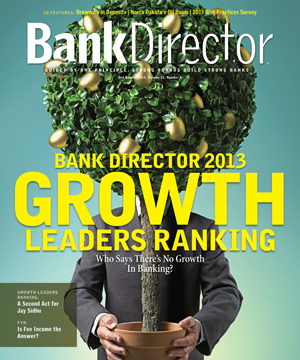
(1) Who says there’s no growth in banking? Certainly not our editor, Jack Milligan, although the lead in to his cover story in the current issue of Bank Director magazine might suggest otherwise:

If you’re not growing, you’re dying. It’s an often-used aphorism that has been attributed to such disparate sources as former college football coach Lou Holtz, the legendary Bob Dylan and a character played by the actor Morgan Freeman in “The Shawshank Redemption.” Unfortunately, it’s also a painful truth that a lot of bankers are living with nowadays as they search for growth in an environment that seems specifically designed to strangle it.

If you’re not familiar with Bank Director, the 23-year old publication reaches over 24,000 officers and directors — a community of virtually every leader in banking.  Published on a quarterly basis, the articles focus on issues fundamental to a bank’s CEO, senior leadership team, chairman and independent directors.  Think big, risky and expensive.  For the last three years, many in this audience struggled to grow their bank’s revenue and sustain a level of profitability.  However, not all are struggling to produce top line growth.  Take a read if you’re interested to learn how some banks today are building their businesses.

(2) Bank Director magazineWhile Jack’s cover article looks at four categories of non-M&A growth*, I’m afraid that our low growth economy looks like it will persist for a while longer.  Not surprisingly, some wonder if its possible to develop a sustainable, differentiable business strategy that has strong organic growth.  This is will be just one of many topics and trends addressed in New Orleans next week during our inaugural Growth Conference at the Ritz-Carlton.  I’ll be sharing my thoughts on the strategies and tactics banks might consider to expand their franchises’ value via twitter (@aldominick) — and know most of our team will as well. If you’re interested, let me suggest a follow of @BankDirectorAP, @BankDirectorEd, @NaomiSnyder and of course, @bankdirector.

(3) While tempted to complete the hat trick with a final point from Bank Director, I defer to Fiserv’s President and CEO Jeff Yabuki remarks as he opened their client conference last week.  In his kickoff, he asked their attendees to “re-imagine the financial experience of the future.”  While the short video is unfortunately more sales speak than suggestion, the firm does post several good related reads.  In particular, one entitled To Better Serve Small Business, Define Their Needs.  The gist?  With “profitability from retail lines of businesses under pressure, many institutions are reviewing their strategies for addressing the small business market. For regional and community institutions, which often serve communities where small businesses play an outsized role in economic development, effectively reaching small business is an imperative.”  Being that I work in a small business that interacts with numerous community banks, two thumbs up to the author and company for this perspective.

___________

*The four categories in Bank Director’s inaugural Growth Leaders Ranking are core income (defined as net-interest income plus non-interest income, excluding available-for-sale gains and losses and other-real-estate-owned gains and losses), core deposits, net loans and leases and core non-interest income. Of the four categories, the most important is core income since it is inclusive of the other three revenue sources.