Good is the Enemy of Great

Jim Collins once wrote “good is the enemy of great,” opining that the vast majority of companies “never become great, precisely because the vast majority become quite good – and that is their main problem.”  I have heard many use the title of today’s piece to explain the unexpected; most recently, while talking with a friend about Jurgen Klinsmann’s decision to exclude Landon Donovan from his 23-man World Cup roster (hence today’s picture c/o USA Today).  While I’ll steer clear of any soccer talk until the U.S. takes the field against Ghana in a few weeks, Collins’ statement sparked the three thoughts I share today. Indeed, being “just good” will not cut it in our highly competitive financial industry.

usatsi_7848706_168380427_lowres Let’s Be Real — Times Remain Tough

In yesterday’s Wall Street Journal, Robin Sidel and Andrew Johnson began their “Big Profit Engines for Banks Falter” with a simple truth: “it is becoming tougher and tougher being a U.S. bank.  Squeezed by stricter regulations, a sputtering economy and anemic markets, financial institutions are finding profits hard to come by on both Main Street and Wall Street.”  Now, the U.S. financial sector and many bank stocks have “staged a dramatic recovery from the depths of the financial crisis;” as the authors point out, “historically low-interest rates aren’t low enough to spur more mortgage business and are damping market volatility, eating into banks’ trading profits.”  While I’ve written about the significant challenges facing most financial institutions – e.g. tepid loan growth, margin compression, higher capital requirements and expense pressure & higher regulatory costs — the article provides a somber reminder of today’s banking reality.

Still, for Banks Seeking Fresh Capital, the IPO Window is Open

Given how low-interest rates continue to eat into bank profits, its not surprising to hear how “opportunistic banks capable of growing loans through acquisition or market expansion” are attracting investor interest and going public.  To wit, our friends at the Hovde Group note that seven banks have filed for initial public offerings (IPOs) already this year, putting 2014 on pace to become the most active year for bank IPOs in a decade.  Based on the current market appetite for growth, “access to capital is becoming a larger consideration for management and boards, especially if it gives them a public currency with which to acquire and expand.”  If you’re interested in the factors fueling this increase in IPO activity, their “Revival of the Bank IPO” is worth a read.

Mobile Capabilities Have Become Table Stakes

I’m on the record for really disliking the word “omnichannel.”  So I smiled a big smile while reading through a new Deloitte Center for Financial Services report (Mobile Financial Services: Raising the Bar on Customer Engagement) that emphasizes the need for banks to focus more on a “post-channel” world rather than the omnichannel concept.  As their report says, this vision is “where channel distinctions are less important and improving customer experience becomes the supreme goal, no matter where or how customer interactions occur, whether at a branch, an ATM, online, or via a mobile device.”  As mobile is increasingly becoming the primary method of interaction with financial institutions, the information shared is both intuitive and impactful.

##

To comment on today’s column, please click on the green circle with the white plus sign on the bottom right. If you are on twitter, I’m @aldominick.  Aloha Friday!

Who Says There Is No Growth In Banking

Two big takeaways from the second day of Bank Director’s 2nd annual Growth conference (#BDGrow14): institutions of all sizes are challenged when it comes to standing out from the crowd & enhancing your mobile banking presence should be a top priority for all boards of directors.

A 2 Minute Recap on the Past 4 Months


Take No Risk, Make No Money
While some may not think about enterprise risk management in the context of growing one’s bank, Crowe’s Jennifer Burke made clear that proactively identifying, mitigating, and in some cases, capitalizing on risks provides a distinct advantage to a bank.  Keep in mind that even smaller institutions — with less complex business structures — face myriad risks that might significantly affect their ability to meet their growth plans.  As Jennifer shared, those that proactively identify and respond to risks and opportunities gain a competitive advantage over their peers, especially in responding to our ever-changing business environment.

Millennial and the End of Banking?

The Times-Picayune ran a nice story in today’s edition based on The Growth Conference.  The newspaper noted that “younger generations report more comfort with online and mobile banking tools, posing a hurdle for banks used to ginning up business through face-to-face interactions.”  So it is fair to ask if banks should be scared of the millennial generation.  According to Daryl Byrd, president and CEO of IberiaBank, the answer is no.  As mentioned in this piece (Will Millennials be the end of banking as we know it? Bank execs weigh in at Growth Conference in New Orleans), Byrd was among a panel of industry leaders gathered at the Bank Director Growth Conference to discuss business trends, including the challenges in reaching younger customers.  Byrd, “who noted he is the father of three Millennials, said his children, like many in their generation, aren’t building wealth as much as they are taking on debt. That means their demand for banking services will be limited in the near term,” he said.

Trending Topics

The issues I took note of this morning were, in no particular order:

  • Just like “synergy” became a cliché, so too might “omni” when it comes to delivering a consistent customer experience (e.g. omni-screen, omni-channel, etc);
  • Not all customers are created equally;
  • A bank’s board has the chance to re-set strategies to target, acquire, engage, grow and retain customers… but need to look ahead to what’s possible as opposed to the past to see what has historically delivered results.

To comment on this piece, click on the green circle with the white plus sign on the bottom right. Safe travels home to all who joined us in New Orleans this week (and yes, Aloha Friday!)

The Growth Conference – Thursday Recap

It is obvious that the most successful banks today have a clear understanding of, and laser-like focus on, their markets, strengths and opportunities.  One big takeaway from the first full day of Bank Director’s Growth Conference (#BDGrow14 via @bankdirector): banking is absolutely an economies of scale business.

photo-7

A 2 Minute Recap


Creating Revenue Growth

At events like these, our Publisher, Kelsey Weaver, has a habit of saying “well, that’s the elephant in the room” when I least expect it.  Today, I took her quip during a session about the strategic side of growth as her nod to the significant challenges facing most financial institutions — e.g. tepid loan growth, margin compression, higher capital requirements and expense pressure & higher regulatory costs.  While she’s right, I’m feeling encouraged by anecdotes shared by growth-focused bankers considering (or implementing) strategies that create revenue growth from both net interest income and fee-based revenue business lines. Rather than lament the obstacles preventing a business from flourishing, we heard examples of how and why government-guaranteed lending, asset based lending, leasing, trust and wealth management services are contributing to brighter days.

Trending Topics
Overall, the issues I took note of were, in no particular order: bank executives and board members need to fully embrace technology; there is real concern about non-bank competition entering financial services; the board needs to review its offerings based on generational expectations and demands;  and those that fail to marry strategy with execution are doomed. Lastly, Tom Brown noted that Bank of America’s “race to mediocrity” actually makes it an attractive stock to consider.  Who knew being average can pay off?

##

To comment on this piece, click on the green circle with the white plus (+) sign on the bottom right.  More tomorrow from the Ritz-Carlton New Orleans.

Let the Good Times Roll

Checking in from a rain-soaked Reagan National airport, where I think I see the plane I’ll take down to New Orleans taxiing towards its gate.  Yes, it’s “Growth Week” at Bank Director, and I’m heading to the Crescent City to host bank CEOs, Chairmen and board members keen to focus on big picture business issues surrounding growth (not necessarily associated with mergers and acquisitions) and profitability.

New Orleans

A Deep Dive

I realize the phrase “let the good times roll” is most frequently heard during Mardi Gras celebrations in New Orleans; I’m using it to tee up Bank Director’s Growth Conference that kicks off tomorrow morning at the Ritz-Carlton.  Once the lights come up, I’ll be interested to hear:

  • How growth is driving pricing;
  • Why efficiency & productivity are both key elements in positioning a bank to grow; and
  • If “overcapacity” in the US banking industry offers opportunities.

I’m particularly excited for our opening session with Thomas Brown, CEO, Second Curve Capital.  We’ve asked him to help us “set the table” for the next two days of conversations with an outlook for banks across the country by reviewing the current capital market and operating conditions, thereby providing financial context to the next two days’ presentations.  If I don’t cover his remarks in my post tomorrow, you can bet our editor, Jack Milligan, will on his must-read blog The Bank Spot.

A Look Back

Much of last year’s conversation revolved around technology and the need to adapt to a changing marketplace, as well as the importance of creating a unique niche in a competitive landscape dominated by the biggest banks.  Many of our bank speakers at the conference had a more nuanced view of technological change. Richard Hill, the chief retail banking officer for the $19-billion asset Hancock Holding Co. in Baton Rouge, Louisiana, said when he got into banking in the 1970s, the prediction was that checks would go away and branch banking would go away. That clearly didn’t happen, or at least not at the accelerated pace that many predicted. The problem for his bank and for many others is that profits are getting squeezed with low interest rates, and the bank needs to make investments that expand revenue. As he said, “a great challenge we have is figuring all this out.”

Take Our Your Crystal Balls

Let me wrap up by sharing a 2 minute video our team compiled on the “future” of banking.  We played it at our Acquire or Be Acquired conference in January and the perspectives of KPMG’s national banking leader, the CEO of Congressional Bank, etc. are worth a watch and listen.

Laissez les bons temps rouler!

The Single Greatest Constraint on Growth

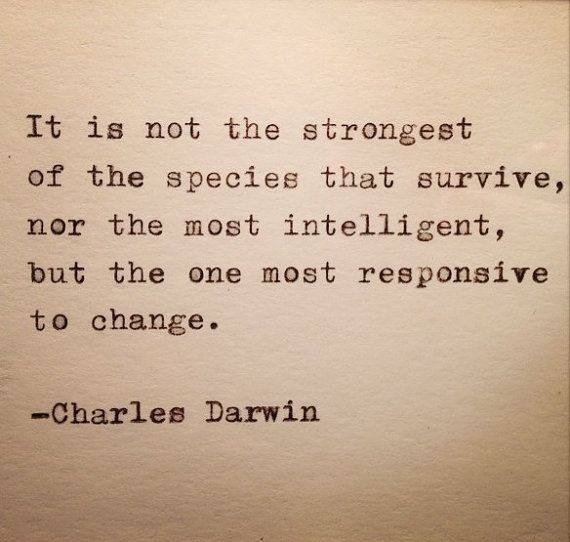
With the revenue pressures facing the banking industry being some of the most intense in decades, banks need to think more constructively about their businesses. At the same time, changing consumer behavior could drive the industry to reallocate its resources to less traditional growth channels in order to stay ahead.  In my view, the words of an English naturalist reflect the single greatest constraint on growth today.

photo-6

Powerful Forces

One of our long-term corporate sponsors, PwC, recently shared their thoughts on the future of the retail banking industry.  In their view, “powerful forces are reshaping the banking industry, creating an imperative for change. Banks need to choose what posture they want to adopt – to lead the change, to follow fast, or to manage for the present. Whatever their chosen strategy, leading banks will need to balance execution against… critical priorities and have a clear sense of the posture they wish to adopt.”  If you, like our friends from PwC, are joining us in New Orleans later this week to dive into this very topic, their compelling “Retail Banking 2020” report might make for good airplane company.

Looking Back in Order to Look Ahead

Last year, John Eggemeyer, a Founder and Managing Principal of Castle Creek Capital LLC, helped me to kick off our inaugural Growth Conference.  As a lead investor in the banking industry since 1990, he shared his views on our “mature industry,” That is, banking follows a historic pattern of other mature industries: excess capacity creates fierce competition for business which in turn makes price, not customer service, the key differentiator.  While offering myriad thoughts on what makes for a great bank,  John did share some hard-to-swallow statistics and opinions for a crowd of nearly 200 bankers and industry executives:

  • Publicly traded banks from $1 billion to $5 billion in assets saw their stock values rise at about half the rate of the broader market as a whole since early 2009.
  • Of the 300 or so publicly traded banks in that size range, only about 60 of them traded at their pre-recession price multiples.
  • In the last 40 years, bank stocks always followed the same pattern in a recession: falling in value quicker than the rest of the market and recovering quicker.

I share these three points to provide context for certain presentations later this week.  Some build on his perspectives while others update market trends and behavior.  Still, an interesting reminder of where we were at this time last year.

Getting Social-er

Yesterday, I shared the hashtag for The Growth Conference (#BDGrow14).  Thanks to our Director of Research — @ehmccormick — and Director of Marketing — @Michelle_M_King — I can tell you that nearly 30% of the attending banks have an active twitter account; 78% of sponsors do.  On the banking side, these include the oldest and largest institution headquartered in Louisiana — @IBERIABANK, a Connecticut bank first chartered in 1825 with over $3.5 billion in assets — @LibertyBank_CT and a Durham, NC-based bank that just went public last month — @Square1Bank.  On the corporate side of things, one of the top marketing and communications firms for financial companies —@wmagency, a tech company that shares Bank Director’s love of orange — @Fiserv and a leading provider of personal financial management — @MoneyDesktop join us.  Just six of many institutions and service providers I’m looking forward to saying hello to.

##

More to come — from New Orleans, not D.C. — tomorrow afternoon.

Its Growth Week

Its finally here… “Growth Week” at Bank Director.  Yes Discovery Channel, you can keep your shark week.  What we’re about to get into is far more interesting (at least, to some): what’s working in banking today.  Most of our team heads down to the Ritz-Carlton in New Orleans tomorrow and Wednesday for our 2014 Growth Conference.  Before they do, the first of five posts dedicated to building a business.

Growth-Key-Card-1

Think Distinct

Innovation means doing things differently.  Not just offering new products or offerings — but doing things differently across the entire business model.  Going into this event, I know many believe there are simply too many banks offering similar products and services.  I tend to think institutions are challenged when it comes to being distinctive compared with the competitor across the street.  This is not a new issue; however, there are more and more strategies emerging and enablers coming to market that can drive brand value, customer satisfaction and profitable growth.  Case-in-point: the work of our friends at StrategyCorps, whose idea is “be bold… go beyond basic mobile banking.”  One of the sponsors of the conference, I am excited to hear how  financial institutions, like First Financial, benefit from their mobile & online consumer checking solutions in order to enhance customer engagement and increase fee income.

Looking Back in Order to Look Ahead

While easy to frame the dynamics of our industry in terms of asset size, competing for business today is more of a “smart vs. not-so-smart” story than a “big vs. small.” During one of my favorite sessions last year — David AND Goliath — Peter Benoist, the president and CEO of St. Louis-based Enterprise Financial Services Corp, reminded his peers that as more banks put their liquidity to work, fierce competition puts pressures on rates and elevates risk.  As I went back to my notes in advance of this week’s event, my biggest takeaway from his presentation was we all talk about scale and net interest margins… but it’s clear that you need growth today regardless of who you are.  It is growth for the sake of existence.

Getting Social

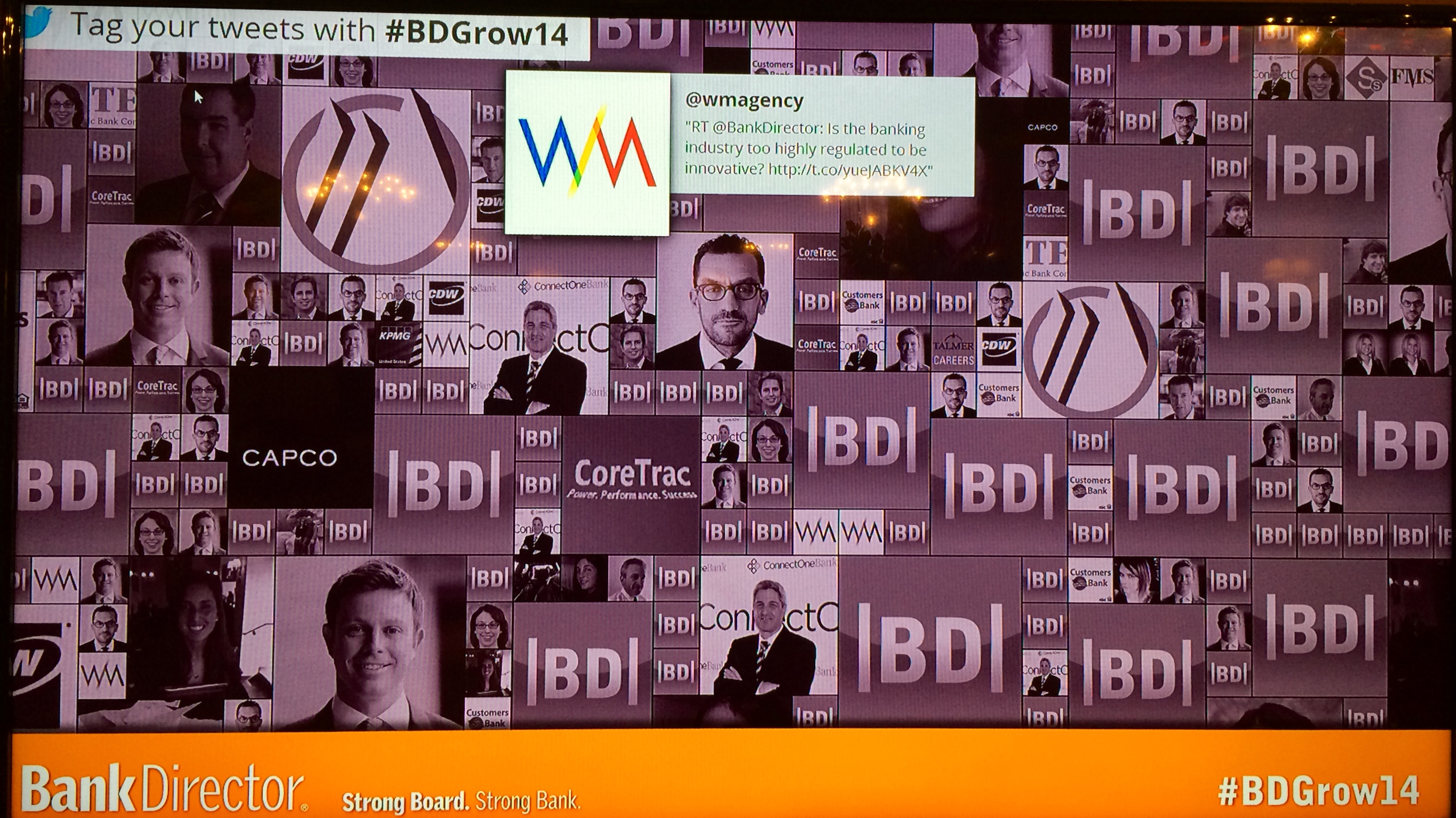
To keep track of the conversation pre-, on-site and post-event on Twitter, use #BDGrow14 and/or @bankdirector + @aldominick.  In addition, I plan to post every day this week to About That Ratio, with tomorrow’s piece touching on the diminished importance of branch networks to underscore the importance of investments in technology.

Since You Can’t Own a Car Dealership

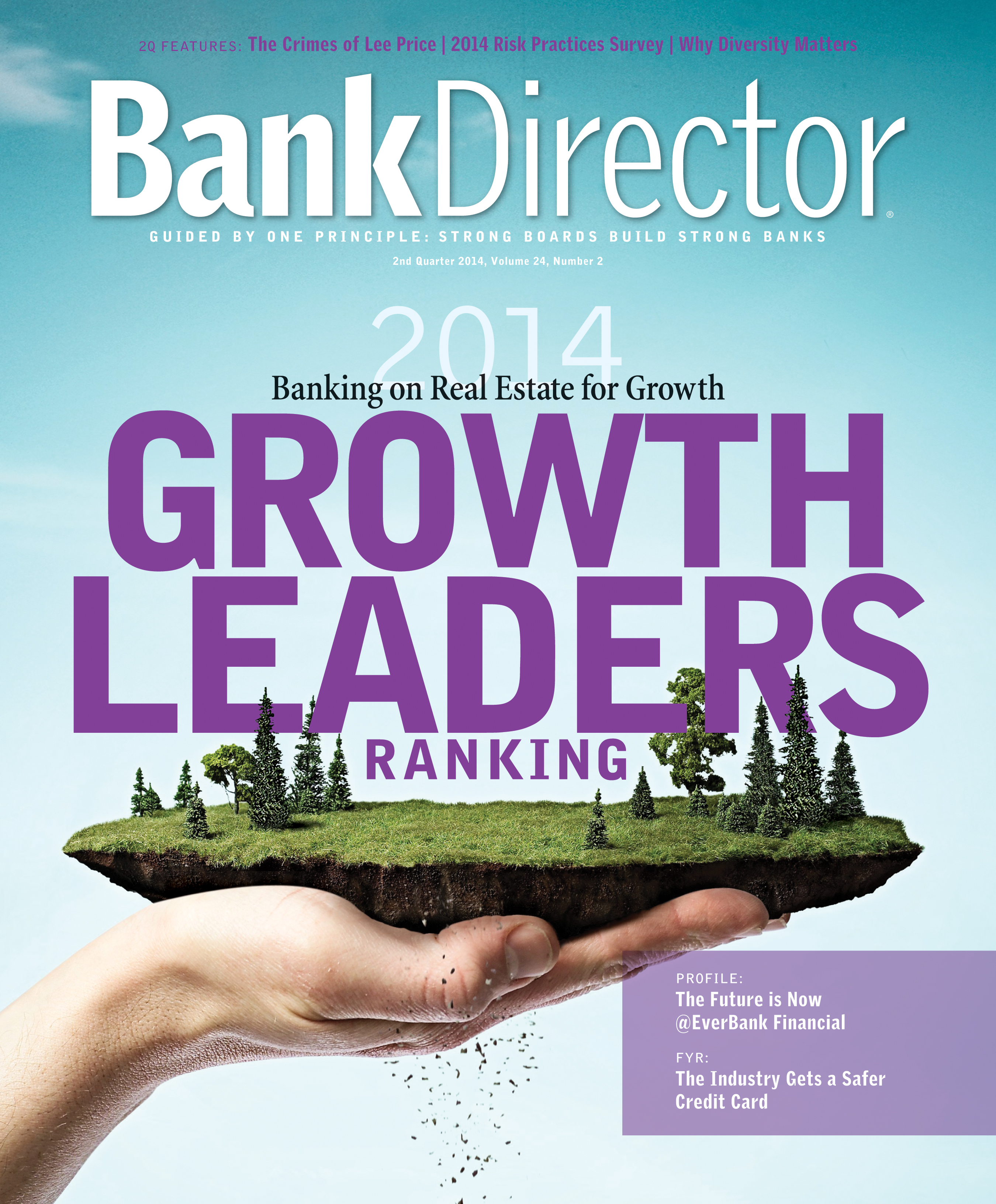
As my colleague Jack Milligan writes in our 2nd quarter issue of Bank Director magazine, just because a bank can’t own a car dealership doesn’t mean there isn’t “enormous flexibility in determining a bank’s strategy.” Curious what this means? Read on.

2Q14

A Sneak Peek at the Core Revenue Champs

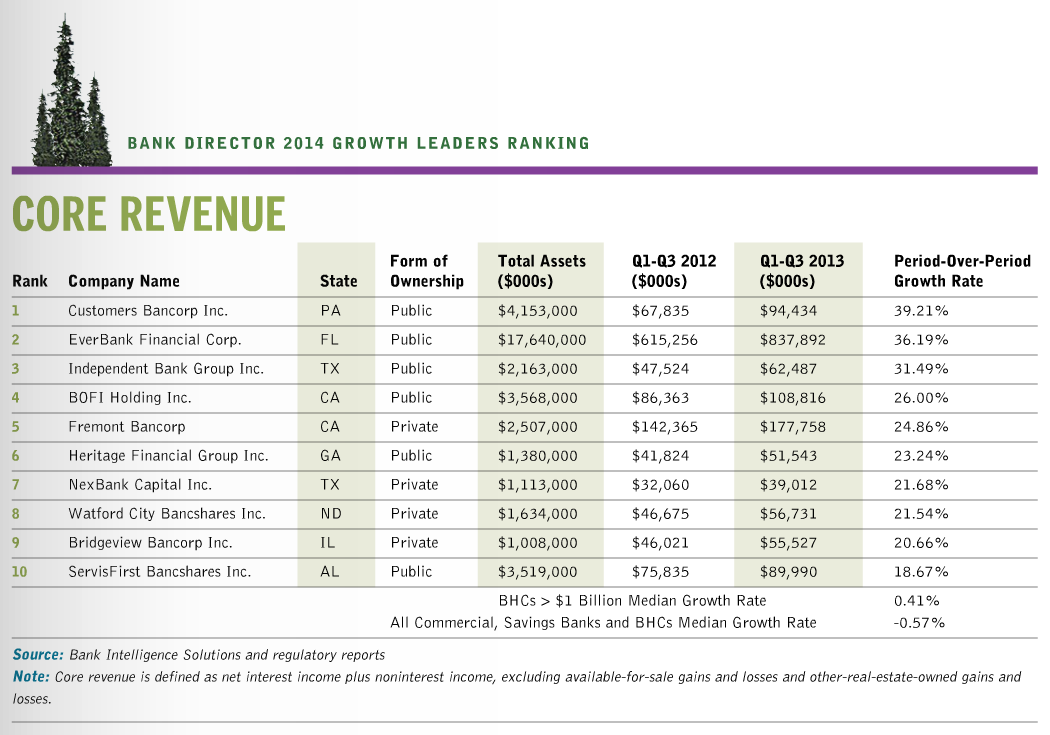
Each year, Bank Director magazine looks at all U.S. banks and thrifts to identify the strongest growth banks. We rank the top performers across four separate categories: core deposits, core noninterest income, net loans and leases and the most important, core revenue. Since the magazine mails today, I thought to offer a sneak peek of the results:

Screen Shot 2014-04-24 at 6.06.07 AM

What I find interesting about the top two banks on this very strong list: both Customers Bank and EverBank Financial designed their business models around technology from their very beginnings.

Find Your Balance

As I read through an advance copy of the issue, it strikes me that many business areas that historically provided revenue growth are simply not growing fast enough to overcome new capital and regulatory requirements.  In this light, you can understand why many say times couldn’t be more challenging for growth in community or regional banking. The corollary to this? Balancing organic and external growth is a key focus area for bank management and boards.

Increasingly, I hear that growth-focused banks are considering (or implementing) strategies that create revenue growth from both net interest income and fee based revenue business lines — think government guaranteed lending, asset based lending, leasing, trust and wealth management services. Clearly, as interest margins and loan volumes remain subject to compression and intense competition, the “optimization” of fee-based revenue is becoming pivotal in enhancing shareholder value.

‘Sup Big Easy

True, a number of banks seek to extend their footprint and franchise value through acquisition. Yet, many more aspire to build the bank internally.  Some show organic growth as they build their base of core deposits and expand their customer relationships; others leverage product innovation or focus on their branch network. I bring these approaches up in advance of next week’s Growth Conference at the Ritz-Carlton, New Orleans. We designed this event to showcase strategies, structures, processes and technologies that a bank’s CEO and board might consider to fuel their own growth.

Unlike trade shows and other events, we limit participation to a financial institution’s key officers and directors to ensure those joining us are not just committed to distinguishing their performance and reputation, but also are appropriate peers to share time and ideas with. From companies like StrategyCorps, Ignite Sales and VerifyValid to PwC, Fiserv and IBM, we have a tremendous roster of companies joining us in Louisiana to share “what’s working” at the myriad banks they support. As I’ve done for our other events (e.g. the sister conference to Growth, Acquire or Be Acquired), I’ll be posting a number of pieces next week from the Crescent City and invite you to follow along on Twitter via @aldominick, @bankdirector and using #BDGrow14.

Aloha Friday!

The Three Ds of Banking

Just as the cherry blossoms provide a welcome personal respite from winter’s cold embrace, so too have stories of creativity and growth diverted my professional attention away from compliance issues and regulatory updates.  As I travel across the country, I’m continually impressed by the close attention being paid by leaders at financial institutions to non-traditional sources of revenue — particularly fee-based income.  Today’s tip sheet reflects these recent travels and commensurate “lessons learned” with three words, a big three if you will, that tie-in to growing one’s business.

photo-4

Diversify

In order for banks to thrive in what, in many regions, remains a crowded marketplace, diversified growth is key.  I’ve heard from a few community bank CEOs that given the nature of the economic recovery and uncertainty over interest rates, quality growth requires a balance between real estate and operating company borrowers and between fixed and floating rate loans.  Without such balance, earnings and shareholder value are at increased risk.

Differentiate

The general public still does not distinguish enough between Wall Street banks and Main Street community banks.  Nonetheless, more and more bankers are making this distinction, thereby helping customers (and potential customers) to understand how important community banks are to the economy and the local region.  It strikes me such efforts will not only educate, but also encourage, more and more people to support community banks with their business.

Deliver

As the workplace becomes more mobile, so must the tools to deliver the financial services to business owners and individuals.  Clearly, the “new generation of consumers” does everything on their mobile phone.  If a bank doesn’t have a mobile app — and a quality mobile offering — I have to believe the bank does not even register to this up and coming audience.  In fact, as more Gen X and Gen Y’rs become a more sizable force in terms of total GDP, I’ve heard that one’s mobile banking solutions will be directly proportional to the amount of clients a bank is able to attract and retain.

Aloha Friday!

FI Tip Sheet: First Quarter Favorites

As I come off of a great week in Chicago and Bank Director’s annual Chairman/CEO Peer Exchange, today’s post takes a look back at the first three months of the year.  Yes, certain discussions during this time focused on tepid loan growth, higher capital requirements and expense pressures & higher regulatory costs hitting banks today.  Nonetheless, many more conversations focused on growth, innovation and “what’s working.”  So, to wrap up this week, three points from the past ninety days that inspired me.

AboutThatRatio = image for Jan 10.001

Some of Banking’s Best

To kick off the year, I put together a two-part series on some of the top CEOs in our industry.  Inspired by my coach and an article entitled the “Best CEOs of 2013” that ran on Yahoo Finance, I reached out to a number of colleagues that work for professional services firms to ask their thoughts on the top CEOs at financial institutions — along with why they hold them in such regard.  Part one shared various thoughts on some of the best CEOs in the business today — broken down into three categories: the “biggest banks” with $50Bn+ in assets, those with more than $5Bn but less than $50Bn and finally, those in the $1Bn to $5Bn size range.  Part two built on that piece, highlighting three exceptional CEOs that lead publicly traded banks before shifting to the thoughts and opinions of two very talented colleagues.

Eat or Be Eaten

As the President of Bank Director, I’m lucky to lead one of the industry’s biggest (and dare I say best?) M&A conferences: Acquire or Be Acquired.  Let me first offer up big time props to my many talented colleagues for everything they did to make this year’s the biggest and best yet!  One of the cool new things I did at the Arizona Biltmore this year?  Film a 90 second or less video each evening that summarized the day’s salient points.  As much as I shared big takeaways in written form on this site (e.g. what if I told you that by December 31, 2018, we’d witness a 25% decline in the number of institutions between $500mm and $1Bn), I’m proud of these two videos from the desert that relayed what caught my eyes and attention on two of the three conference days.


.

The Innovator’s Dilemma

In my role, I find myself talking with Chairmen and CEOs about their strategic plans.  This year, quite a few shared their thoughts for leveraging financial technology to strengthen and/or differentiate their bank.  In a piece I shared at the end of February, I cited Clayton Christensen’s “The Innovator’s Dilemma: When New Technologies Cause Great Firms to Fail.”  His book inspired that Friday’s FI Tip Sheet title – and first point.  If you’re not familiar with his work, the Harvard professor writes about two types of technologies: sustaining and disruptive. Sustaining technologies are those that improve product performance. As he sees it, these are technologies that most large companies are familiar with; technologies that involve improving a product that has an established role in the market.

Most large companies are adept at turning sustaining technology challenges into achievements.  However, large companies have problems dealing with disruptive technologies — an observation that, in my view, does not bode well for many traditionally established banks.  While risk is inherent to banks of all sizes, taking chances on emerging technologies continues to challenge many officers and directors… a theme I anticipate covering in greater detail over the next 90 days.

##

Whether this is your first time or 78th time reading About That Ratio, let me say thank you for doing so.  It is a real treat to share, each Friday, three short stories about what I’m hearing, learning and talking about as I travel around the country.  Being that I meet with so many interesting people — be it a bank’s CEO,  board members or executives at professional services firms and product companies — I find it tremendously rewarding to share anecdotes and insights that might interest others.  As always, Aloha Friday!

FI Tip Sheet: Positive Trends

A few weeks ago, to begin “The Innovator’s Dilemma,” I shared the need for banks to think differently or risk becoming obsolete.  This morning’s column builds on that idea by looking at some of the characteristics of top performing publicly held banks based on a research piece shared by Raymond James.  I studied this list and realized quite a few of the “winners” leverage design trends, the second point in today’s post, to differentiate their messaging.  My third and final point looks at technology expertise making its way into a bank’s boardroom — and provides an excuse to post a number of pictures from my time in Nashville last week. 

Top of the (Performance) Pack
Recently, Raymond James presented its second annual Community Bankers Cup.  This “award” recognizes the top 10% of community banks based on various profitability, operational efficiency and balance sheet metrics culled from a pool of 302 publicly traded community banks with assets between $500 million and $10 billion.  What we see in the firm’s recap is superior financial accomplishment drives superior stock price returns.  These 30 banks (e.g. Eagle Bancorp, First Financial, etc.) demonstrated exceptional results “on a relative basis in one or more of the following measurements of financial performance and stability: non-performing assets to loans and real estate owned, five-year average core deposit percentage, net interest margin, efficiency ratio, return on average assets, and return on average tangible common equity.”  If you are looking for examples of strong + healthy banks that have taken creative ideas to build a business, and subsequently monetized them, take a look at what the Raymond James team writes about these 30 institutions.

Ahead of the Curve
Since the beginning of the most recent global financial crisis in 2008, Getty Images has been tracking the changes in imagery used by financial services providers to represent their brand.  In their words, “gone are the depictions of aspiration and conspicuous wealth as financial services brands try to re-establish trust with their customers.”  In their place comes creative uses of community support “set-up for the long-term to  demonstrate their responsibility for local businesses, communities and the environment.”  Take a look at this “visual trends in financial services marketing” to get a truer sense of what’s working for bank marketers today.


Surprisingly Staffed
Last week, our team welcomed 117 bank officers and directors to the Hermitage in Nashville.  At this spectacularly Southern hotel, we went a bit old school and put pen + paper in front of these decision makers to ask five technology-specific questions.  I don’t normally equate technical proficiency with a bank’s officers and directors; however, the vast majority of attendees shared that their executive team has at least two people with strong technology understanding/experience.  While a small sample size, more then 50% of these key leaders responded to our query… and the results underscore, in my opinion, the importance being placed on  technology at community banks.  In addition, I did hear from several Chairmen that they are adding outside directors with an understanding of issues like cyber security risk and how to oversee vendor management.  If you’re interested to see what an event looks like from my POV, here’s a look (photos courtesy of Don Wright Designs & Photography)

Aloha Friday!

Wrapping up Acquire or Be Acquired

As we bid adieu to this year’s crowd, it strikes me that efficiency and productivity are key elements in positioning a bank to grow.  While this year’s Acquire or Be Acquired conference (#AOBA14) touched on numerous growth strategies, the common denominator among “organic growth banks” is a robust and diverse lending platform along with a proven credit culture and process.

photo (42)

The future of banking

For those joining us at the Arizona Biltmore on Sunday morning, you saw a video that summarized various thoughts on “the future of banking.”  A number of attendees asked to see the video we used to open the conference again.  Here it is:

Tuesday Takeaways

My “rapid reaction” to this morning’s conversations at the Arizona Biltmore, in no particular order: growth is now driving pricing; efficiency & productivity are both key elements in positioning a bank to grow; and the base reality remains that there is overcapacity in the US banking industry.

Off to the hit ’em long and straight (I hope) as we wrap up our 20th annual conference with our annual golf tournament.  74 and sunny… what a treat!

FI Tip Sheet: Great Bank CEOs (part 2)

“You know who’s good” might be one of my favorite conversation starters… be it talking football or baseball, banking or business, it always interests me to hear who others consider leaders in a particular field or discipline.  As the country’s economic recession gives way to recovery and many more banks return to profitability, quite a few executives have success stories to share.  This week’s tip sheet builds on last week’s post by highlighting three exceptional CEOs that lead publicly traded banks before shifting to the thoughts and opinions of two very talented colleagues.

blog image for Jan 17.001

(1) In case you missed it, last week’s tip sheet looked at some of the best CEOs in the business today — broken down into three categories: the “biggest banks” with $50Bn+ in assets, those with more than $5Bn but less than $50Bn and finally, those in the $1Bn to $5Bn size range.  After I posted the piece, I thought about a number of bankers that could have been included in the $5 to $50Bn summary.  For example, Joe DePaolo, the president & CEO of Manhattan-based Signature Bank, a $19.7-billion asset, NASDAQ-listed financial institution.  He’s led the bank’s growth, from a mere $50 million in assets at its founding in 2001 to close to $20 billion today.

Likewise, Jim Herbert’s work to build First Republic Bank (the bank he founded in 1985 and is listed on the NYSE) deserves praise and recognition.  I shared my thoughts on Jim’s bank after meeting him last year.  For those in the know, First Republic is one of this country’s great banks. Not only is it solely focused on organic growth, it’s also focused solely on private banking. While my conversation with Jim was off-the-record, I left his office convinced its the smarts within, not the size of, a bank that will separate the have’s from the have-nots in the years ahead. Clearly, as new regulations and slim profit margins challenge the banking industry, the skills and backgrounds of the employees who work in banking must change too.

Finally, the co-head of Sandler O’Neill’s Investment Banking group, Bill Hickey, praised Vince Delie – the President & Chief Executive Officer of the 11.7Bn, NYSE-listed FNB Corproration.  According to Bill, Vince “has led FNB through four acquisitions in the last three years and three capital raise transactions… FNB continues to deliver above market returns and has been rewarded with a currency that trades at 245% of Tangible Book Value.”

(2) Before joining out team a few years ago, Bank Director Magazine’s Managing Editor, Naomi Snyder, spent 13 years as a business reporter for newspapers in South Carolina, Texas and Tennessee.  Based on this background, and her current responsibilities, I asked for her thoughts on the qualities and characteristics of a successful bank CEO.  In her words, “some of the CEOs of great banks seem to have leadership qualities without being bullies. I don’t think they hire a bunch of “yes” people who will agree with them as the ship is sinking. They don’t have charismatic personalities at the expense of honesty and ethics.”  She noted that in multiple performance rankings in Bank Director magazine, these banks show some consistent themes. “Great banks differentiate themselves from the competition. They often don’t compete on price but on quality of service, and there is no way to do that without hiring a superior staff and motivating employees to do their best.”

(3) To put some color and context to Naomi’s thoughts, I asked Jack Milligan, the Editor of Bank Director magazine, to share his thoughts on three community bank CEOs that are doing some impressive things.  The qualifier?  Keep ’em “local” — he is in Charlottesville, I’m in D.C. — and close to $1Bn size.  Fortunately for me, Jack accepted my challenge and suggested I take a look at Fairfax, VA-based First Virginia Community Bank (FVC).  Led by Chairman & CEO David Pijor, FVC was “a November 2007 de novo that has grown to $422 million in assets as of December 2013.  Pijor, a veteran of the NOVA banking market, raised $23 million in a little over eight weeks and had the bank up and running in just 11 months.  Granted, this was prior to the subprime mortgage crisis and “Great Depression,” and Pijor has had the advantage of being in one of the strongest banking markets in the country, but the bank’s loans, deposits and capital over the past 7+ years have been impressive all the same. Pijor also did a small acquisition in late 2012 that enabled FVC to expand into neighboring Arlington County. I would expect to see big things out of this little bank.”

Next, he pointed me towards Citizens & Northern Corp., a financial institution based in Wellsboro, PA and led by their Chairman & CEO, Chuck Updegraff.  As Jack shared, “C&N is situated in North Central Pennsylvania, not exactly a banking growth market although the local economy has received a bit of a lift from natural gas exploration in the Marcellus Shale Region. This is just a very well-run bank that makes the most of what its market has to offer, and Updegraff deserves credit for running a very tight ship.  C&N has a little over $1.3 billion in assets and was the top ranked $1-$5 billion bank on Bank Director’s 2012 Bank Performance Scorecard and the 2nd ranked bank in 2013.”

Finally, Jack lauded National Bankshares Inc., an organization that counts James Rakes as its Chairman & CEO.  Per Jack: “if you’ve ever been to Blacksburg, VA – the home of Virginia Tech University and a neighbor of nearby Radford University in Christiansburg – you know that it’s a beehive of activity nestled in the mountains and forests of Southwestern Virginia. At just slightly over $1 billion in assets,National Bankshares is another well-managed bank that takes full advantage of everything its market has to offer – in its case a relatively strong local economy that benefits from having two vibrant universities. Virginia Tech is the 2nd largest public college in the state and is a major research institution. National was the 3rd ranked bank in the $1-$5 billion category in the 2012 Bank Performance Scorecard, and placed 6th in 2013.”

Now, I will tease Jack that he could have talked about a number of fine community banks in the Washington, D.C. area (for example, the Bank of Georgetown, which has grown considerably under the leadership of Mike Fitzgerald, their Chairman, President & CEO).  Nonetheless, his is a good look at those institutions that may not have national brand recognition, but are strong and stable pieces of their local communities.

Aloha Friday!