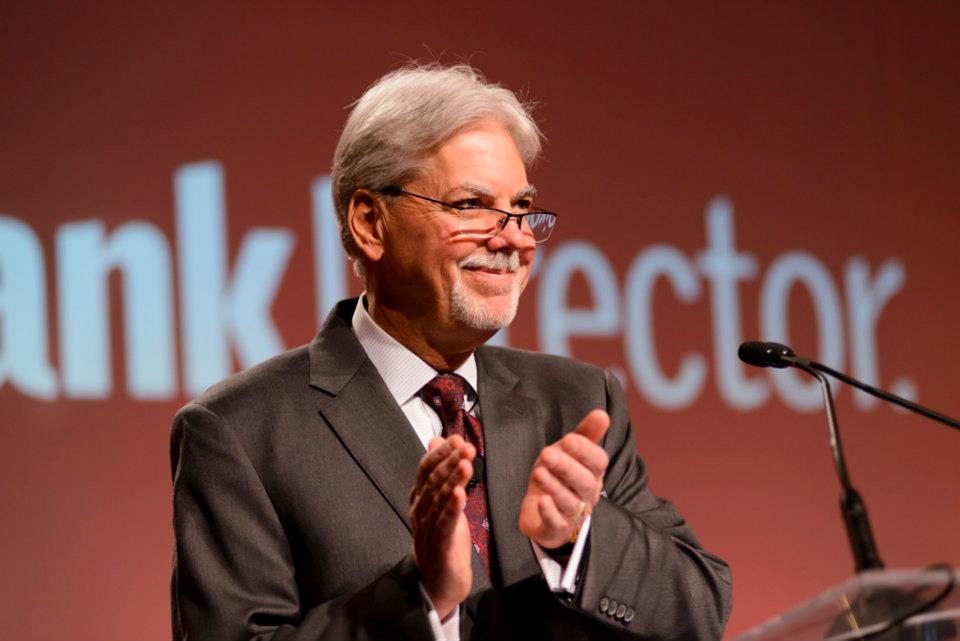
In a few days, I’ll be taking to the stage with our editor, Jack Milligan, to welcome some 830 attendees, guests and staff to Arizona and Bank Director’s annual Acquire or Be Acquired conference. Widely regarded as the financial industry’s premier M&A event, our 20th annual “AOBA”will bring bank CEOs, CFOs, Chairmen and outside directors to the Arizona Biltmore for three days of presentations, workshops, networking… and hopefully, some sun. These industry leaders join us to explore issues such as strategic alliances, investors’ interests and whether now is the right time to be a buyer — or a seller. I thought I’d tee up my blogging plans before leaving the snow and ice of Washington D.C. (see below) for the warmth of the Southwest.
Acquire or Be Acquired
On the merger front, one of the big themes over the past few years has been unrealistic expectations between buyers and sellers of banks. Not surprisingly, sellers think pricing is too low and buyers think sellers’ expectations are too high. Now, when managed effectively, mergers and acquisitions present necessary and lucrative opportunities — and this particular conference affords bankers and board members the chance to “go deep” into the M&A process in order to represent and protect the interests of their particular bank. I’ll be spilling a lot of digital ink on a number of financial, legal, accounting and social issues facing bank executives and board members. Today’s post simply tees up some of the social tools I’m going to use to keep folks current with the discussions.
Twitter
First and foremost, @bankdirector has a loyal following and does a great job putting info’ out for a bank’s officers and directors. For this event, we’ve set #AOBA14 as the conference hashtag. I’ll be tweeting under @aldominick. Some of my colleagues will be as well; notably, our editor, Jack Milligan via @BankDirectorEd, Managing Editor, Naomi Snyder, with @NaomiSnyder and our Publisher, Kelsey Weaver, with @BankDirectorPub.
LinkedIn
Take a look at Bank Director’s LinkedIn page — and feel free to search under “groups” for Bank Director if you want to join in the discussions.
The banking marketplace today is dramatically different from what it was just three years ago. Since returning to the industry in 2010, I’ve seen a lot of change — and not all good. Nonetheless, I am bullish on the future of banking. While some in the media tend to criticize financial institutions and harp on measures like one’s Texas ratio (which models a bank’s risk profile to fail — and also inspired this site’s name), I prefer to focus on financial institutions as the fabric of our neighborhoods and communities. When I write About That Ratio it is in stark contrast to those who deride the importance of banks. I am not blind to the problems facing many bankers today, nor ignorant of errors and indiscretions made by some of our larger names. Still, count me an optimist that better times are ahead. So before my family and I take off for Christmas in Tulum, Mexico, one last About That Ratio for 2013 that shares three things from the week that was.
(1) While many year-end blogs take a look back, Jim Marous authored a comprehensive forward-looking post on his “Bank Marketing Strategies” blog. His 2014 Top 10 Retail Banking Trends and Predictions compiles opinions from 60 global financial services leaders — including bankers, credit union executives, industry providers, financial publishers, editors and bloggers, advisors, analysts and fintech followers. I appreciated his invitation to contribute and thought to share the crowd’s top three trends for 2014:
The “Drive-to-Digital” trend will impact delivery, marketing and service usage;
Payment disruption will increase vis-a-vis new players, technologies and innovations; and
Increased competition from “neobanks” and non-traditional players will accelerate.
Take a read through these and the subsequent seven points offered up. As Jim writes, “disruption will continue at an unprecedented pace and that the industry will look different this time next year.”
(2) It is hard to escape the reshaping of the banking industry through merger activity; in particular, the return of negotiated, strategic bank combinations. While in San Francisco a few months ago, I wrote about Heritage Financial’s combination with Washington Banking Co. Forgive the use of “merger of equals” to describe the deal; however, that misnomer best represents the agreement. Some see these deals becoming more popular as bankers seek to build value for the next few years in order to sell at higher multiples. Others cite a desire to create more immediate value through cost cuts and efficiencies. Regardless of who’s driving and who’s riding, there were quite a few notable deals in 2013; for example, Umpqua and Sterling and the recent “51/49” deal between United Financial Bancorp and Rockville Financial. I get the sense that more boards will consider deals structured like these to accelerate “scaling up” without utilizing cash as the currency for an acquisition. Time will tell if I’m right.
(3) Finally, I readily admit my excitement to welcoming men and women from across the country to various Bank Director events next year. From our BIG M&A conference at the Arizona Biltmore in January to The Growth Conference at the Ritz-Carlton New Orleans in May to a peer exchange for officers & directors at the Ritz-Carlton in San Francisco, we have a lot planned. These events are a big part of our 23 year-old company’s business — and its pretty darn cool to participate in various conversations that relate to growth, innovation and “what’s working.” I’m not alone in thinking it is time for bank CEOs and their boards to go on the offensive. Competing successfully in a marketplace, managing shareholder expectations, overcoming regulatory obstacles, developing talent and leadership for the next generation, and, most of all, ensuring that one’s institution has the option of choosing whether to “acquire or be acquired”… yup, topics galore for me to cover here in 2014.
##
I end every Friday post with a nod to my mother-in-law (who passed away four years ago). She lived on the Big Island for several years and became quite fond of the “Aloha Friday” tradition; hence, the sign off. The only Hawaiian saying that puts a bigger smile on my face is today’s title: Mele Kalikimaka!
This week, I’ve worked with our team to put the finishing touches on Bank Director’s agenda for our 20th annual Acquire or Be Acquired Conference. Widely regarded as the financial industry’s premier M&A event, the conference affectionately referred to as “AOBA” attracts bank CEOs, CFOs, Chairmen and outside directors from across the country to Arizona each January. I keep hearing about the various drivers to doing a deal today — think economics, the burden of government regulation and increasing cost of capital. As industry and economic headwinds challenge banks both large and small, I can think of no better perspective on what’s going on than that from my friend, colleague and Editor of Bank Director magazine, Jack Milligan. While I typically share three of my thoughts on About That Ratio each Friday, Jack graciously agreed to author today’s column and share his. Enjoy!
Today’s guest author, Jack Milligan
I have written about commercial banks since the mid-1980s and during that time have witnessed three banking crises (the thrift crisis in the late ‘80s soon followed by the commercial real estate crisis in the 1990s and, of course, the global financial crisis that occurred in 2007 and 2008), saw the U.S. Congress pass landmark banking legislation like the Gramm-Leach-Bliley Act of 1999 and Dodd-Frank Act of 2010, reflected upon the death of one regulatory agency (Office of Thrift Supervision) and birth of another (Consumer Financial Protection Bureau), and observed a parade of kings like Walt Wriston, Hugh McColl and Sandy Weill come and go. But the most significant thing I’ve watched happen during all that time has been the industry’s profound consolidation into an hourglass distribution where a small number of very large banks control a significant majority of the nation’s deposits, and a very large number of very small banks fight for what’s left.
This trend of consolidation coincidentally also began in earnest in the 1980s – and in fact the first banking story I ever wrote was about (if memory serves) post-merger integration. We just dipped below 7,000 banks in the United States (6,891 to be exact according to the FDIC), which seems like a good time to reflect on the question of how much more consolidation will occur. We all know that bank merger activity has dropped precipitously since the global financial crisis, and we all know why. In the maelstrom of the worst economic downturn since the Great Depression, in which the industry’s asset quality looked like it had been riddled by a machine gun, only a few large banks had the financial strength and appetite to acquire another institution, often with some form of government assistance. Normal M&A was for all practical purposes dead.
Since the crisis has abated and the U.S. economy has gradually stabilized, some level of M&A has returned – but certainly not to pre-crisis levels. Last year there were 129 healthy bank acquisitions for a total of $11.9 billion, and the deal total and aggregate dollar value for 2013 might be even lower. In 2007 there were 235 bank deals for a total value of $71 billion. But even those numbers pale in comparison to the halcyon days of late 1990s, when the average annual deal flow was twice that and aggregate values were in the hundreds of billions of dollars. Many banks, buyers and sellers alike, have been waiting for the M&A market to kick back in – but to what? To the 2007 level? Or to something closer to 1998, when there were 475 bank deals? It is theoretically possible that the M&A market will never revive and the industry won’t consolidate much more than it already has.
In a recent piece in the American Banker, financial writer and researcher Harvey Winters reasons, correctly, that there are many small banks in rural locales like Nebraska that aren’t attractive takeover candidates and won’t ever be consolidated. Winters says there might never be an M&A spring so-to-speak in such isolated and (from the perspective of an acquirer) unattractive markets. The country’s very large banks that are still under the nationwide deposit cap and theoretically could grow larger through acquisitions are also being waved off by their regulators who today are much more concerned about the systemic risk that very large banks pose to the financial system than they were before the crisis.
In the good old days, large aggressive acquirers that were assembling nationwide banking franchises just as fast as they could helped drive the rest of the M&A market. But those buyers are all gone, at least for now. My own view is that bank M&A (and therefore consolidation) isn’t dead, but it is becoming something different. I think we’ll see the rise of middle-market consolidators that have the capital and the skills to assemble their own intrastate, and later regional, franchises.
A perfect example is Richmond, Virginia-based Union First Market Bancshares’ recent acquisition of Charlottesville, Virginia-based StellarOne Corp. Union First had $4 billion in assets and StellarOne $3 billion, and the combined $7-billion asset institution now bills itself as the largest community bank in Virginia — which is to say the largest bank that isn’t named Bank of America, Wells Fargo, etc. The new First Union may continue to consolidate the Virginia market, or perhaps venture into neighboring Maryland or North Carolina, or maybe do all three. If I am correct, we will eventually see the emergence of a new tier of banks in the $10 billion to $50 billion range that will consolidate attractive banking markets like Virginia and help drive consolidation into yet another phase. There are many small banks that will never attract a buyer, and a handful mega-banks that will never do another acquisition, but that doesn’t mean that bank consolidation has reached a dead-end.
##
Jack Milligan is the Editor of Bank Director magazine, a position to which he brings over 30 years of experience in financial journalism organizations. Jack’s professional background includes stints as editor in chief of U.S. Banker, a leading magazine covering the banking industry; editor in chief at SNL Financial, a research and publishing company specializing in financial services; and general editor at Institutional Investor, a prominent financial magazine. He’s on Twitter (@BankDirectorEd) and LinkedIn if you want to follow/connect with him.
The race is on… to expand into new markets, to add new talent, to introduce new technologies that attract and engage customers. This race, playing out in cities and towns across the country, applies to many industries. For our purposes, let me build on this theme vis-a-vis three takeaways from Bank Director’s annual Bank Executive & Board Compensation Conference in Chicago.
(1) How companies develop executives, attract leadership and approach compensation in today’s highly competitive and economically challenging world was front-and-center in Chicago. As I wrote earlier this week, the environment that this country’s 7,000 or so banks operate in demands productivity, proficiency with technology and the ability to sell. Finding the right people to lead such efforts, especially when you consider that every organization has a different set of “players” with a unique collection of knowledge, experience and skills, proves challenging. Complicating matters is the fact that all banks are required to regularly assess whether any of their compensation plans encourage unnecessary or excessive risk-taking that could threaten the safety and soundness of the institution.
(2) Putting together compensation plans that reward growth and responsible risk takes many shapes. However, the “adverse economic cycle” has dampened some employees’ opportunities to earn — and at a corporate level, has slowed the anticipated pace of bank consolidation. While larger banks continue to increase in size, many smaller institutions are fighting for survival in today’s regulatory and low-interest rate environment. According to SNL, there were 235 whole-bank M&A transactions announced and 51 failed bank transactions for a total of 286 deals in 2012. Total deals, as a percentage of overall banks in the U.S., have remained relatively consistent over the years between 3% and 4%. Some interesting stats, courtesy of the Hovde Group:
Since 2000, sellers over $1 billion in assets have commanded a 32% premium over those sellers less than $1 billion;
In 323 transactions since 2000, sellers over $1 billion averaged a valuation of 246% of tangible book value; and
In 2,729 transactions since 2000, sellers less than $1 billion averaged a valuation of 187% of tangible book value.
M&A activity is once again heating up as financial institutions look to achieve necessary scale to compete and thrive… and while I will not wager on the exact number of deals that will mark 2013, I will take the over on 2012’s results.
(3) The relevance of scale, the pace and volume of M&A activity and the dynamic tension between the “bid-and-ask” takes center stage at our next conference: our 20th annual Acquire or Be Acquired Conference. Held at the Frank Lloyd Wright-inspired Arizona Biltmore, we’ve put together a program that looks at the strategies potential acquirers might consider to the practical considerations the board needs to discuss. As proud and pleased as I am for this week’s successful event, I am already gearing up to open our biggest conference the week before the Super Bowl. Widely regarded as one of the financial industry’s premier M&A conferences, I am super excited by the hard work put in by our team and even more stoked to spend the next few months getting ready to welcome everyone to the desert. To that end, I will begin to expand upon the topics and trends that influenced the development of this year’s program in future posts.
Last week, Lexington, Virginia… this week, San Francisco, California… next week, Chicago, Illinois. Yes, conference season is back and in full swing. I’m not looking for sympathy; heck, for the past few days, I’ve set up shop in Nob Hill (at the sublime Ritz-Carlton) to lead our Western Peer Exchange. Traveling like this, and spending time with a number of interesting CEOs, Chairmen, executives and board members, is why I love my job. What follows are three observations from my time here in NorCal that I’m excited to share.
(1) On Wednesday, I took a short drive up to San Mateo to learn more about Kony, a company that specializes in meeting multi-channel application needs. I have written about customer demands for “convenient” banking services in past posts — e.g. Know Thy Customer –and will not try to hide my interest in FinTech success stories. Learning how their retail banking unit works with financial institutions to deliver a “unified and personalized app experience” proved an inspiring start to my trip. Consequently, our Associate Publisher and I talked non-stop about the rapid evolution and adoption of technologies after we wrapped things up and drove back towards San Francisco. We agreed that consumer expectations, relative to how banks should be serving them, continues to challenge many strategically. To this end, Kony may be worth a look for those curious about opportunities inherent in today’s mobile technology. Indeed, their team will host a webinar that features our old friend Brett King to examine such possibilities.
(2) When it comes to banks, size matters. To wit, bigger banks benefit from their ability to spread fixed costs over a larger pool of earning assets. According to Steve Hovde, an investment banker and one of the sponsors of our event, “too big to fail banks have only gotten bigger.” He observed that the top 15 institutions have grown by nearly 55% over the past six years. Wells Fargo, in particular, has grown 199% since ’06. With more than 90% of the banking companies nationwide operating with assets of less than $1 billion, it is inevitable that consolidation will be concentrated at the community bank level. However, as yesterday’s conversations once again proved, size doesn’t always trump smarts. I said it yesterday and will write it again today. Our industry is no longer a big vs. small story; rather, it is a smart vs. stupid one.
(3) That said, “nobody has told banks in the northwestern U.S. that bank M&A is in the doldrums.” According to the American Banker, two deals were announced and another terminated after the markets closed Wednesday. Naturally, this should put pressure on banks in the region to keep buying each other. Here in San Francisco, the one being discussed was Heritage Financial’s combination with Washington Banking Co. According to The News Tribune, this is “very much a merger between equals, similar in size, culture and how each does business.” Now, the impetus behind ‘strategic affiliations’ (don’t call them mergers of equals) comes down to creating value through cost cuts and wringing out efficiencies. The thinking, at least during cocktails last night, was that deals like these happen to build value for the next few years in order to sell at higher multiples. Certainly, it will be interesting to see how this plays out. In a few months at our Acquire or Be Acquired conference, I anticipate it generating quite a few opinions.
Happy hour comes earlier to the District these days…
Nothing political on About That Ratio today. Business as usual here in our D.C. office. Sure, the streets might be emptier, but as you can tell from this picture of the Dubliner (outside our offices), 5:00 just comes a little earlier these days.
(1) I wrote about payments, and Bitcoin, a few weeks ago. On Wednesday, Bloomberg ran a piece called “If This Doesn’t Kill Bitcoin, What Will?” In case you missed it, the alleged operator of the Bitcoin-based online marketplace Silk Road was arrested in San Francisco on Tuesday on money-laundering and narcotics-trafficking charges. While the Bloomberg piece lays out some pretty crazy things (e.g. a murder-for-hire plot), it does invite a broader discussion on the viability of Bitcoin or other virtual currencies. As the author shares, this week’s event “highlights how using an ostensibly untraceable currency makes for a lovely invitation to blackmailers.” Lovely indeed, and certainly not the end of the debate about Bitcoin’s future.
(2) As I pondered the future of payment networks like this, I found myself reading a blog authored by Jim Marous: “It’s Time for Banks & Credit Unions to Embrace Change.” Jim’s a good follow on twitter (@JimMarous) and I really like the KPMG report he cites in his post (Reshaping Banking in a Dynamic Business and Regulatory Climate). Jim opens with a disheartening truth: while “technology and distribution channels have changed, banks and credit unions are still faced with many of the same strategic challenges we talked about 20 years ago.” A good primer for anyone preparing their 2014 strategic plans.
Before wishing everyone a great Friday, let me single out our Associate Publisher, Kelsey Weaver, and wish her the best of luck as she moves home to Nashville next Monday. Fortunately she will remain with our team; our happy little D.C. office, however, will not be the same. ##WWGS
As we wind down the dog days of summer, I re-read my last eight posts before outlining this week’s piece. By design, I placed a heavier emphasis on stories that related to building customer relationships and opportunities tied to organic growth rather than multi-national issues and regulatory reform. To build off these ideas, I thought to share three pieces that address “what’s next” in the United States and Europe. The first focuses on potential changes overseas; the second, on domestic mergers and acquisitions; to close, I share the thoughts of Wells Fargo’s CEO on the importance of community banks.
(1) “What’s next for the restructuring of Europe’s banks,” a question that parallels many conversations taking place within boardrooms, think tanks, government offices and media rooms across the U.S. Penned by members of the financial services team at McKinsey, this op-ed shows how Europe’s banks, like their U.S. counterparts, have had to re-evaluate their short and long-term prospects based on stagnant economic conditions. Many “continue to face pressure from difficult funding conditions, a transition to higher costs of capital, changing regulations and tighter capital requirements.” The authors make a case that many “need to shed capital-intensive operations and simplify businesses to compete more profitably in fewer market segments.” All told, this report claims Europe’s banks are “considering the sale of up to 725 business lines across various business segments and geographies.” If true, this might result in greater numbers of strategic mergers of like-sized banks. Do you agree that this story sounds eerily familiar to the one playing out here in the States?
(2) Staying closer to home, bankers and advisers alike debate how quickly consolidation will play out in the coming years. Personally, I see it taking place over a longer period than some might forecast. To this point, I think I have a friend in Raymond James’Anthony Polini (their Managing Director of Equity Research). Anthony shared his perspectives with an audience of CEOs, Chairmen and board members at Bank Director’s Acquire or Be Acquired conference this January. There, he opined that industry consolidation “is inevitable” as banks come to grips with new regulations, lower growth rates, higher capital/reserve requirements and lower long-term margins/returns.
Earlier this week, he penned a mid-year report that builds on those ideas. He lays out how “the current slow growth environment fosters M&A as a quicker means for balance sheet growth and to achieve operating efficiencies in this revenue-challenged environment.” In his team’s estimation, meaningful industry consolidation takes place over the next 5 to 10 years rather than a large wave that occurs over just a few. This belies his belief that banks are “sold and not bought.”
Using this logic, coupled with an improving (albeit slowly) economy, modestly better asset quality and shades of loan growth, he believes “an M&A target’s view of franchise value will remain above that of potential acquirers. Put another way… expect the disconnect between buyers’ and sellers’ expectations to remain wide but slowly move closer to equilibrium over time.”
“…we need well-managed, well-regulated banks of all sizes—large and small—to meet our nation’s diverse financial needs, and we need public policies that don’t unintentionally damage the very financial ecosystem they should keep healthy. “
He continues that “almost 95% of all U.S. banks are community banks. They provide nearly half of all small loans to U.S. businesses and farms. In one out of five U.S. counties, community banks are the only banking option for local residents and businesses. Many small towns… would have little access to banks, and the services they provide, without our system of community banks.” Significant words from one of banking’s biggest voices. Not the first time he’s shared this opinion, and hopefully, not the last.
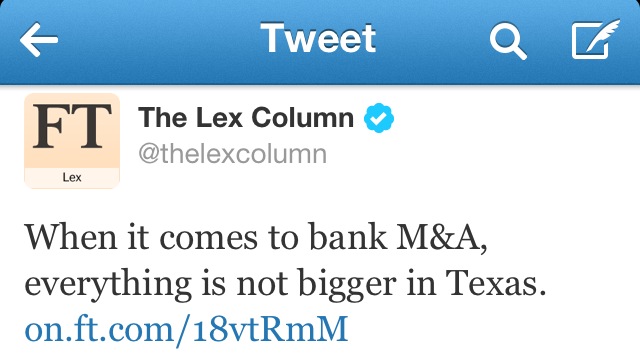
I can’t improve upon the FT’s Lex Column tweet for this week’s post; since it’s behind a paywall, I can’t share any more than the shortened URL either. Still, it does foreshadow one of three points I’m sharing as we wrap up another summer week.
(1) When it comes to bank M&A, investment bankers “expect slow and steady consolidation.” Analysts point out that in today’s environment of slowed economic growth and regulatory change, bankers and investors continue to eye M&A as a possible opportunity for increasing profits and building strategic franchises. So I paid close attention to news that Texas-based Cullen/Frost will, for the first time in nearly seven years, acquire another bank. On Tuesday, the NYSE-listed institution announced it will pick up Odessa-based WNB Bancshares, which operates in the heart of the oil-and-gas producing, Friday Night Light’s–inspiring Permian Basin in West Texas. If you’re not familiar with Cullen/Frost, it has $22+ billion in assets and consistently ranks among the top banks in the country (at least, if you pay attention to rankings like the “Nifty Fifty,” which annually identifies the best users of capital). As I looked for background on the deal, I found this article that ran in the bank’s hometown of San Antonio an interesting summary. According to the news outlet, Cullen/Frost’s Chairman and CEO, Dick Evans, is fond of saying he is an “aggressive looker and a conservative buyer” when it comes to making acquisitions. So you have to figure this cash and stock deal (valued at $220 million) makes too much strategic sense for both institutions to ignore, especially with the Lone Star state’s surging oil and gas business.
(2) From size to age, you may hear me refer to my company as a 23-year old start up. But this description cannot hold a candle to “a 110-year-old NorCal startup:” Mechanics Bank. While I haven’t visited with them, every time I go to San Francisco I hear good things about the team leading the bank (and yes, we have written about their work; for example, “Talking Tech to Directors“). Within the bank is the author of “Discerning Technologist,” Bradley Leimer. As the VP of Online and Mobile Strategy at Mechanics Bank, I certainly appreciate his perspectives on change. In fact, as I work on a growth-focused program for CEOs, executives and a bank’s boards, his “What Inspires Financial Services Innovation?” piece became a must read. Totally up my tech and design alley and a blog worth following.
(3) Finishing on a technology kick, Fiserv shares a white paper that explores mobile strategies (“Mobile Banking Adoption: Your Frontline Staff Holds the Key to Growth“). Ubiquitous as this conversation feels, they show that for most financial institutions, mobile banking adoption typically hits a glass ceiling of 15% to 20% of online banking customers. This surprised me, as adoption rates of mobile devices continues to grow. I am a big fan of what the tech giant does to support the community, but I’ve talked with CEOs like Umpqua’s Ray Davis in the past about their retail concept that includes a big mobile push. No matter what tone at the top is struck, tactical challenges remain for almost everyone. So I’m curious to hear how banks account for this plateau as they devise their plans. Many bank leaders I meet with express an interest in getting more mobile and social. Fewer, however, have a comfort that their teams are measuring, and subsequently managing, such plans for the future. Fiserv’s piece, for banks and credit unions alike, provides some interesting context for such strategic conversations.
It’s been a few weeks since I last shared what I’ve heard, learned or discussed on this site. Yes, vacation treated me well. But I’m excited to get back into the swing of things and especially pleased to welcome two new people to the Bank Director team: Katy Prejeant and Jake Massey. Both can be followed on Twitter @BankDirectorAE and @WJ_Massey. As always, what follows are three things that relate to bank executives and boards that caught my eye and/or ear this week.
(1) Drive a few hours west of our Nashville offices and you can find Memphis-based Mercer Capital. The advisory firm assists banks, thrifts and credit unions with “corporate valuation requirements and transactional services.” Each month, their Bank Watch newsletter pulls together a series of articles from around the web. From stress testing to Basel III, ESOPs to a Midwestern public bank peer report, there are some interesting reads this month. But one that caught my eye wasn’t in their report – it can be found on their main site. It’s a white paper on Creating the Potential for Shared Upside. Authored by Jeff Davis (a speaker at last year’s Acquire or Be Acquired conference), the piece reviews various financial issues arising when community banks merge or sell to a larger, public institution. With many anticipating an upswing in M&A deals in the second half of 2013, it is an interesting perspective to consider.
(2) In past posts, I have noted how the banking industry is a mature one. That is, where competing on price with the BofA’s of the world may best be seen as a fool’s errand. Nonetheless, McKinsey’s classic article on “Setting Value, Not Price” should be a must read this week. While not specific to the financial space, they lay out a reality where ”people buy products and services not on price alone but on customer value: the relationship between costs and benefits.” Although this trade-off has long been recognized as critical for marketing, this month’s “Insights & Publications” shows that businesses frequently get their price–benefit position wrong. They wrote in 1997 that “value” may be one of the most overused and misused terms in marketing and pricing. If you’re game, drop me a line below and let me know if you agree this is still the case.
(3) Spend any time talking with a bank’s CEO, and keeping pace with technology (and by extension, technology risk management) is sure to come up in a discussion that involves improving their business, brand and reputation. According to a new “FS Viewpoints” published by PwC, financial institutions have, for too long, “viewed technology risk management as a defensive tactic or regulatory compliance activity.” Based on the consultancy’s observations, “existing approaches to technology risk management often provide limited value to the business.” They see a real opportunity to leverage technology risk management to provide strategic business value. This piece shows how leading institutions are shifting their focus on risk management, moving from a fragmented and reactive compliance approach to a more balanced, business-aligned, risk-based strategy.
Aloha Friday!
As we wrap up this short week, here are three “stories” that caught my eye. As I pack my family up for a few week’s vacation in New England, please enjoy. Happy 5th of July!
1. On Monday, Curtis Carpenter shared with me the news that Prosperity Bank in Texas acquired First Victoria — a deal struck for approximately 2.3x tangible book and 18x earnings. As Houston’s Business Journal details, Prosperity has been on an acquisition streak for some time. The bank has completed six merger or acquisition agreements in the past 18 months. Maybe this deal portends a busier 2nd half of the year, deal-wise, than the first? Certainly something Curtis and his team at Sheshunoff & Co. stand ready to support.
2. On Tuesday, the Fed held an open meeting to finalize “highly-anticipated rules” needed to implement Basel III’s capital requirements in the United States. Since its proposal last year, many executives from banks under $10Bn in asset size have expressed strong concerns with several aspects of the proposed rule. Now, the plan adopted on Tuesday will force all banks to hold more and higher quality capital. However, smaller banks will have a bit more leeway with their capital — which should allow them to take more risks than their larger competitors. While the Fed’s plan requires the nation’s largest banks to abide by stricter capital requirements than had been originally planned, mid-size and community banks appear to have received several breaks. Fed governors, according to the American Banker, said the final package offered an “appropriate sensitivity” in its treatment of smaller-sized financial institutions, “forgoing placing too much burden on firms while still strengthening overall capital standards.” If you want to dig deeper, this table from the Fed highlights those provisions most relevant to smaller, non-complex banking organizations and compares the new capital requirements to the current standards.
3. A lot of digital ink was spilled on Basel III this week; in my opinion, I think the ABA wrote it best: “the real test for Basel III is whether the rule makes it easier or more difficult for banks to serve their customers. If it makes it harder, that’s not what our still-recovering economy needs.” So on a much lighter note, the ICBA shared a top 50 “Community Bank Leaders in Social Media.” Based on fans/followers, engagement, content and frequency of posts, the small bank advocate lists the social media channels being put to use. All have a Facebook page; interestingly, not all have a Twitter account, few utilize YouTube and shockingly few employ LinkedIn (shh… don’t ask about Pintrest, Instagram or other social sites frequented by their young customers). Taking it a step further, they shared a top 20 “Community Banker Influencers on Twitter.” While I’m not sure how some qualified based on the number of followers and/or tweets, it is a good list of bankers if you’re looking to start or expand your twitter-verse.
Wait… there was something going on other than the Stanley Cup finals this week?
Today’s title, inspired by my uncle who founded and continues to run Computech, a very successful technology firm here in the D.C. area, is both simple and profound. I believe the three points shared below reflect the same spirit of craftsmanship and professionalism he built his firm on. Working smarter, building better, doing it right the first time… themes I picked up this week and thought to share below. And yes, #LetsGoBruins!
(1) One of the work questions most frequently asked of me at conference cocktail parties and in social settings concerns the future of banks. So the fact that the St. Louis Fed published a study that examines banks that thrived during the recent financial crisis proved irresistible. After all, “those who cannot remember the past are condemned to repeat it.” I’ve alluded to this research in a previous post; for me, it is interesting to note that some of the most profitable banks, in the short-term, are not necessarily the best banks. Instead, the so-called “best banks,” in my opinion, get creative in offering new products. They watch closely what is working for other banks in and out of their own market. They watch what products and services are being brought to market by vendors to our industry. This survey, in a broad sense, backs this up.
(2) In the St. Louis Fed’s survey, the authors conclude that there is a strong future for well-run community banks. In their estimation, banks that prosper will be the ones with strong commitments to maintaining risk control standards in all economic environment. This aligns neatly with most discussions about a board’s role and responsibilities. Indeed, one of the critical functions of any bank’s board of directors is the regular assessment of their activities and those of the bank’s management in terms of driving value. As C.K. Lee from Commerce Street Capital explains, this may be defined as value for shareholders, value for the community and the perception of strength among the bank’s customers and regulators. Over the last few months on BankDirector.com, he’s explored the concept of tangible book value (TBV) and its relationship with bank valuation. He also looked at internal steps, such as promoting efficiency and growing loans, which boards could take to drive more revenue to the bottom line and drive bank value. The “final installment” of his series is up — and if you are interested in two additional factors that drive value in both earnings production and market perception, a good read.
(3) Over the last few weeks, I have shared my take on a few issues near and dear to audit committee members. These committee members have direct responsibility to oversee the integrity of a company’s financial statements and to hire, compensate and oversee the bank’s external auditor. So on the heels of Deloitte’s trouble with New York’s Department of Financial Services comes this week’s final point. In case you missed it, the state’s regulator cracked down on Deloitte’s financial-consulting business, essentially banning them from consulting with state-regulated banks for the next year. Big enough news that the American Banker opined “it will send waves through its bank customers, competitors and federal regulators. Banks will have to scrutinize their relationships with consultants, brace for the possibility of a wave of regulation of consulting practices and have backup plans in case a key advisor ever receives a punishment like the one New York state dealt Deloitte.” As many begin to re-examine the relationships they have with outside vendors, here is a helpful evaluation assessment tool offered by the Center for Audit Quality, a nonpartisan, nonprofit group based here in Washington, D.C. While specific to an audit committees needs, the sample questions highlight some of the more important areas for consideration. As with CK Lee’s articles on building value, this form is worth a look if you’re considering the strength of your vendor relationships.
I spent the last few days in San Francisco meeting with various companies (think BlackRock, Fortress, Raymond James, Pillsbury, Manatt Phelps, etc.). Those conversations caught me up on various trends impacting banks on our west coast. As I do each Friday, what follows are three things I heard, read and learned this week — with a big nod towards the bear republic. Oh yes, thanks to old blue eyes for inspiring today’s title. Sinatra certainly knew what he was talking about when it came to the bay area.
(1) Every bank has a story, and the old Farmers National Gold Bank (aka the Bank of the West) certainly has a rich one. Begun in 1874, it was one of just ten banks nationwide authorized to issue paper currency backed by gold reserves. Long a favorite of mine thanks to an academic / St Louis connection with their CEO, I had the opportunity to sit down with one of their board members on Tuesday and hear more about the $60Bn+ subsidiary of BNP Paribas. As I reflect on that conversation, it strikes me that the bank’s growth reflects smart credit underwriting, a diversified loan portfolio and careful risk management. Yes, there have been strategic acquisitions (for example, United California Bank in ‘02, Community First Bank in Fargo in ’04 and Commercial Federal Bank in Omaha in ’05); however, their growth has been more organic of late — fitting for a “community bank” that has grown to more than 700 branch banking and commercial office locations in 19 Western and Midwestern states. While their geographic footprint continues to grow, take a look at their social media presence. In my opinion, it’s one of the best in the banking space.
(2) From Bank of the West to US Bancorp, First Republic to BofA, bank branches dominate the streets of San Francisco. As competition for business intensifies, I thought back to an article written by Robin Sidel (Regulatory Move Inhibits Bank Deals) that ran in last week’s Wall Street Journal. I’m a big fan of her writing, and found myself re-reading her piece on a move by regulators “that put the biggest bank merger of 2012 on ice (and) is sending a chill through midsize financial institutions.” Her story focuses on M&T, the nation’s 16th-largest bank (and like Bank of the West, operates more than 700 branches) and its $3.8 billion purchase of Hudson City Bancorp. According to Robin, the deal that was announced last August is on hold after the Federal Reserve raised concerns about M&T’s anti-money-laundering program. The fallout? Since the Fed’s decision, CEOs of other regional banks “have shelved internal discussions about potential transactions.” For those interested in bank M&A, this article comes highly recommended.
(3) So if certain deals aren’t going to be considered (let alone closed), it naturally begs the question about how how and where banks can add new customers and increase “share of wallet” to improve profitability. I brought this up in a conversation with Microsoft on Wednesday and found myself nodding in agreement that financial institutions should “audit their customer knowledge capabilities” to provide an optimal experience. “Customer centricity” is a big focus for the tech giant, and it is interesting to consider how things like marketing, credit management and compliance might benefit from a well-designed strategy for managing customer knowledge. I know some smaller banks are doing this (Avenue Bank in Nashville comes to mind) and I’m curious to hear how others might be taking advantage of tools and techniques to out-smart the BofA’s of the world. If you know of some interesting stories, please feel free to weigh in below.










 About That Ratio