Three Strategic Issues Shaping Financial Services

By Al Dominick, CEO of DirectorCorps (parent co. to Bank Director & FinXTech) | @aldominick

Quickly:

  • Banks need to think beyond the notion that they can either build a technology solution or buy it — for inspiration, take a look at how Silicon Valley Bank uses APIs to tap into technology from third party providers.
  • Thanks to products like Amazon’s Alexa, financial institutions must now prepare for “hands-free banking.”
  • Various startups are using behavioral economics to nudge people towards making better financial choices for saving & investing.

_ _ _

If you have been to any of our conferences, you’ve probably heard me (and others) encourage participants to get up & out from their offices to see what’s happening with their customers, potential partners and competition.  I do my best to practice what is preached — and have recent trips to San Francisco, New York City and Austin to prove it.  As I re-read hand written notes, dog-eared white papers and highlighted sections of annual reports, I realize just how much time I’ve spent talking about technology-driven trends shaping the financial industry.  To me, three of the bigger issues being discussed right now involve:

  1. The push for retail customers, which may already be spurring dealmaking.
  2. How customers experience and interact with their bank — which broadly ties into the question should an institution buy, partner or mimic a fintech; and
  3. Given all the hype surrounding machine learning and advanced decision modeling, leadership teams want to know how to augment a bank’s revenues & relationships with such technologies.

To these three trends, both our editor-in-chief, Jack Milligan, and I agree that most bankers understand the imperative to innovate around key aspects of their business, whether it’s payments, mobile in all its many permutations, lending, new account onboarding or data.

Personally, when it comes to knowing one’s customer (and potential customer), I find any good experience starts with great data.  As Carl Ryden, the CEO and Co-Founder at PrecisionLender, made clear at their recent Bank of Purpose conference, “if you hold your data close to the vest and you don’t do anything with it, it’s not an asset. It’s a liability.”

So with that in mind, let me close by sharing a link to our newest issue of Bank Director magazine.  This is our “Great Ideas” issue, one in which we highlight companies like USAA who crowdsource upwards of 10,000 ideas per year for products and new technology.  At a time when banks of all sizes are starting to take advantage of platform-based services, this new digital issue is one that I am really proud to share.


Address the Culture Gap Between Banks and FinTechs

By Al Dominick, CEO of DirectorCorps (parent co. to Bank Director & FinXTech) | @aldominick

Quickly

  • A “bank|fintech partnership” narrative dominated the conversation at last week’s FinTech Week NYC events.
  • If I were running a financial institution right now, I’d focus on the word integration instead of innovation.
  • Culture is one of the best things a bank has going for it. It’s also one of the worst.

_ _ _

While I am bullish on the future of banking as a concept, I am admittedly concerned about what’s to come for many banks who struggle with cultural mindsets resistant to change. As I shared in an op-ed that kicked off last week’s FinTech Week NYC, the same dynamics that helped weather the last few years’ regulatory challenges and anemic economic growth may now prevent adoption of strategically important, but operationally risky, relationships with financial technology companies.

Most banks don’t have business models designed to adapt and respond to rapid change. So how should they think about innovation? I raised that question (and many others) at last Wednesday’s annual FinXTech Summit that we hosted at Nasdaq’s MarketSite. Those in attendance included banks both large and small, as well as numerous financial technology companies — all united around an interest in how technology continues to change the nature of banking.

More so than any regulatory cost or compliance burden, I sense that the organizational design and cultural expectations at many banks present a major obstacle to future growth through technology. While I am buoyed by the idea that smaller, nimble banks can compete with the largest institutions, that concept of agility is inherently foreign to most legacy players.

It doesn’t have to be.

Indeed, Richard Davis, the chairman and CEO of the fifth largest bank in the country, U.S. Bancorp, shared at our Acquire or Be Acquired Conference in Phoenix last January that banks can and should partner with fintech companies on opportunities outside of traditional banking while working together to create better products, better customer service and better recognition of customer needs.

The urgency to adapt and evolve should be evident by now. The very nature of financial services has undergone a major change in recent years, driven in part by digital transformation taking place outside banking. Most banks—big and small—boast legacy investments. They have people doing things on multi-year plans, where the DNA of the bank and culture does not empower change in truly meaningful ways. For some, it may prove far better to avoid major change and build a career on the status quo then to explore the what-if scenarios.

Here, I suggest paying attention to stories like those shared by our Editor-in-Chief Jack Milligan, who just wrote about PNC Financial Services Group in our current issue of Bank Director magazine. As his profile of Bill Demchak reveals, it is possible to be a conservative banker who wants to revolutionize how a company does business. But morphing from a low-risk bank during a time of profound change requires more than just executive courage. It takes enormous smarts to figure out how to move a large, complex organization that has always done everything one way, to one that evolves quickly.

Of course, it’s not just technological innovation where culture can be a roadblock. Indeed, culture is a long-standing impediment to a successful bank M&A deal, as any experienced banker knows. So, just as in M&A deals, I’d suggest setting a tone at the top for digital transformation.  Here are three seemingly simple questions I suggest asking in an executive team meeting:

  • Do you know what problems you’re trying to solve?
  • What areas are most important to profit and near-term growth?
  • Which customer segments are critical for your bank?

From here, it might be easy to create a strategic direction to improve efficiency and bolster growth in the years ahead. But be prepared for false starts, fruitless detours and yes, stretches of inactivity. As Fifth Third Bank CEO Greg Carmichael recently shared in an issue of Bank Director magazine, “Not every problem needs to be solved with technology… But when technology is a solution, what technology do you select? Is it cost efficient? How do you get it in as quickly as possible? You have to maintain it going forward, and hold management accountable for the business outcomes that result if the technology is deployed correctly.”

Be aware that technology companies move at a different speed, and it’s imperative that you are nimble enough to change, and change again, as marketplace demands may be different in the future. Let your team know that you are comfortable taking on certain kinds of risk and will handle them correctly. Some aspects of your business may be harmed by new technology, and you will have to make difficult trade-offs. Just as in M&A, I see this is an opportunity to engage with regulators. Seek out your primary regulator and share what you’re looking for and help regulators craft an appropriate standard for dealing with fintech companies.

Culture should not be mistaken for a destination. If you know that change is here, digital is the expectation and you’re not where you want to be, don’t ignore the cultural roadblocks. Address them.


A Technology Takeover on BankDirector.com

For the next 5 days, I set up shop in my former home of New York City for FinTech Week NYC.  Hosted by Bank Director’s FinXTech in conjunction with Empire Startups, the week can best be understood as a confluence of conferences, round-table discussions, demo days, meetups and networking events across the city.

If you’re not familiar with the various events taking place, here is a quick snapshot of three we’re primarily involved with starting today and running through Friday, the 28th.

The common thread throughout each of these days? A desire to help leaders in the financial sector to better understand how when/where/why to engage with emerging technologies.

Given our cultural mindset to help make others successful, we’re kicking things up a notch with our on-line efforts.  Indeed, we’re “taking over” BankDirector.com and loading the site up with strategic issues and ideas that a bank’s CEO, board and executive team can immediately consider.  In parallel, we’re developing even more content to benefit technology companies keen to work with financial institutions and have some really interesting things planned for our FinXTech.com.  Three examples of this free content:

  • On BankDirector.com, Tips for Working With Fintech Companies by our editor, Naomi Snyder, provides insight from executives at Wells Fargo (one of the country’s biggest) and Radius Bank (a very strong community bank) on how they handle fintech partnerships.
  • On FinXTech.com, Advice for Fintech Companies Working with Banks by our editor-in-chief, Jack Milligan, shares suggestions from SF-based Plaid Technologies and Chicago-based Akouba as to how banks and tech companies can set realistic expectations in terms of cooperating to their mutual benefits.
  • Finally, I authored a piece on a major challenge I see confronting banks when it comes to their digital futures with A Roadblock That Ruins Futures.  As an optimist, things aren’t hopeless; you will see I find inspiration from the CEOs of U.S. Bancorp, PNC and Fifth Third.

Banks Vs. Fintechs

By Al Dominick, CEO of DirectorCorps (parent co. to Bank Director & FinXTech) | @aldominick

Quickly:

  • I’m in from Dallas at the Consumer Bankers’ Association “CBA Live!”
  • Thanks to Richard Hunt, the CEO of the CBA, for inviting me to participate.  Richard spoke at our Acquire or Be Acquired conference in January + I hope to live up to his great speaking standards when I’m given a mic tomorrow.
  • The rapid pace of change in the financial sector took center stage during yesterday’s opening session.

_ _ _

Since arriving in Big D on Sunday evening, I’ve met quite a few interesting men & women from great financial institutions at this annual event for the retail banking industry.  This year, more than 1,300 are at the Gaylord Texan (with some 550 being senior-level bankers) to talk shop.  Personally, I’m looking forward to presenting on “Economic States of America” with Amy Crews Cutts (Chief Economist, Equifax), Robert Dye (Chief Economist) of Comerica Bank and Cathy Nash, the CEO of Woodforest National Bank tomorrow morning.  From credit trends to banking consolidation, if you’re in Dallas, I invite you to join us for this Super Session as we explore the economic state of our union.

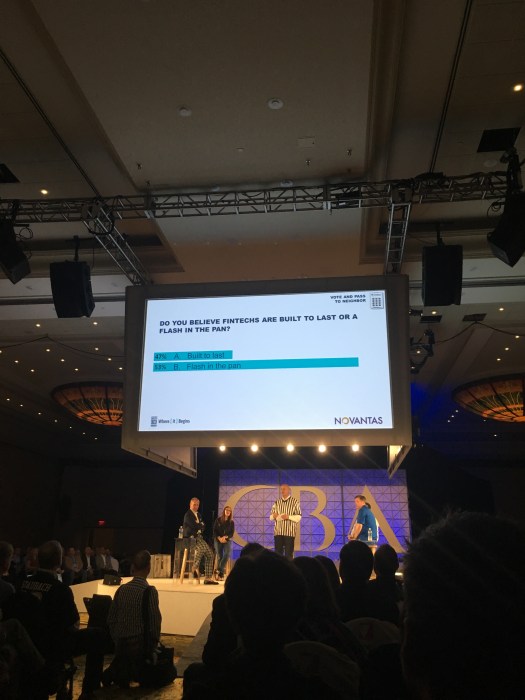
Before then, I thought to share a few interesting takeaways from a “FinTech vs. Bank” general session that pit SoFi and Kabbage “against” PNC and BBVA.  As part of the panel discussion, CBA posed a number of interesting questions to the audience; most notably, “do you believe fintechs are built to last.”  Given our upcoming FinXTech Summit in NYC, I thought the answer (which reflects the thoughts of many of the biggest banks in the U.S.) was interesting, but not surprising.

IMG_8588

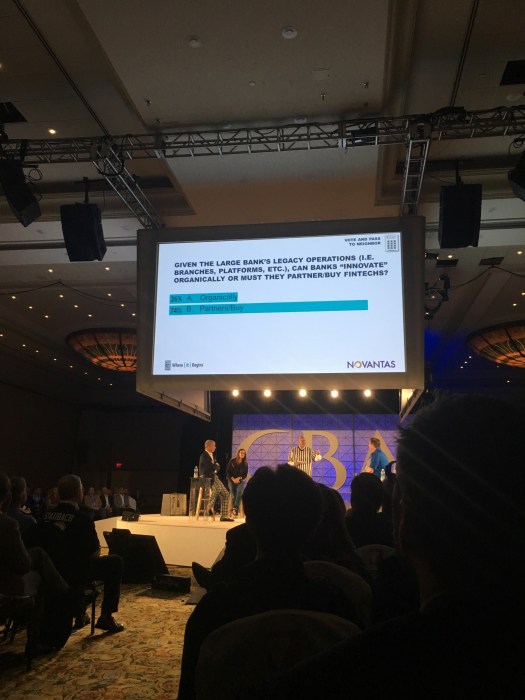
Further, I found the results of this question pretty telling (given we asked a similar question at this year’s Acquire or Be Acquired conference and received a similar response from an audience of CEOs, CFOs, and members of a bank’s board).

IMG_8586

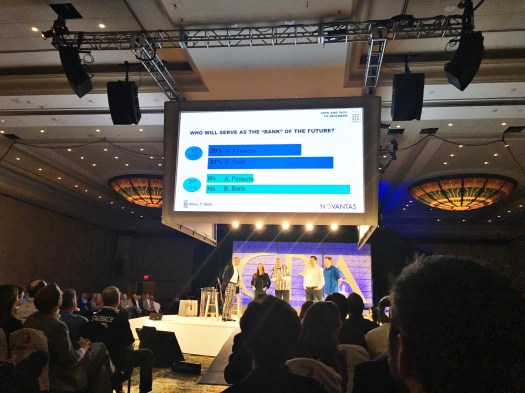
Finally, I think the results of this question best represent the types of conversations I’ve found myself in when I explain what I do + who I meet with.

FullSizeRender 106

As I’ve shared in recent posts, an increasing number of financial institutions are using partnerships with technology companies to improve operations and better meet customer needs.  Given the input on these questions from various heads of retail, product lines and product development + compliance, risk and internal audit, I feel these three pictures are worth noting — and sharing.  Agree or disagree?  Feel free to leave a comment…


We Are On To FinTech Week

#AOBA17 conference intel (Friday)
By Al Dominick, CEO of Bank Director | @aldominick

Quickly

  • The “bank of the future” is not about technology, it is all about customers.
  • For many financial institutions, the time may be right to retire legacy systems for cloud-based platforms.
  • Numerous financial technology companies are developing new strategies, practices and products that will dramatically influence the future of banking..

_ _ _

The intersection of technological innovation with strong depository franchises may lead to more efficient banking processes, reductions in fraud and a win/win/win for banks, financial technology firms (fintechs) and consumers.  Globally, nearly $23 billion of venture capital and growth equity has been deployed to fintechs over the past five years, and this number is growing quickly. Still, the nature and extent of impact that fintechs have on the industry remains unclear.

Throughout this week’s Acquire or Be Acquired conference, bank CEOs talked about the continually changing nature of financial services — with fintech often front and center.  For many, collaboration between traditional institutions and emerging technology firms bodes well for their future.  Here, Bank Director’s FinXTech provides authoritative, relevant and trusted content to a hugely influential audience, specifically:

  • Fintechs who view banks as potentially valuable channels or distribution partners;
  • Banks looking to grow and/or innovate with fintech companies’ help and support; and
  • Institutional investors, venture capitalists, state & federal regulators, government officials and academicians helping to shape the future of banking.

We designed FinXTech as a peer-to-peer resource that connects this hugely influential audience around shared areas of interest and innovation.  As a host of FinTech Week in New York City this April 24 – 28 (along with Empire Startups), we bring together senior executives from banks, technology companies and investment firms from across the U.S. to shine a light on what is really generating top line growth and bottom line profits through partnerships, collaboration and investments.

bank-slide-05

Given the changing nature of banking today, this week-long event in New York City looks at the various issues impacting banks, non-banks and technology companies alike.  So as we move towards FinTech Week in New York City, I invite you to follow me on Twitter via @AlDominick, FinXTech’s President, Kelsey Weaver @KelseyWeaverFXT@BankDirector and our @Fin_X_Tech platform and/or check out the FinTech Week New York website for more.

A New Research Report on Marketplace Lending

#AOBA17 conference intel (Wednesday)
By Al Dominick, CEO of Bank Director | @aldominick

Quickly:

  • Lending is an estimated $15 trillion industry in the United States — and the banking industry’s share in this market is estimated to be around $6.6 trillion (~ 44% of the overall market).
  • Within the FinTech sector, lending is the largest segment in terms of funding from investors, and market altered the lending landscape.
  • Marketplace lenders — online platforms that match borrowers with lenders — will likely see some consolidation in ’17 and continue to converge with banks through partnerships, white label contracting and yes, even mergers.

_ _ _

Fintech lending has grown from $12 billion in 2014 to $23.2 billion in 2015 and is expected to reach $36.7 billion in 2016, a year-over-year growth of 93 percent and 58 percent in 2015 and 2016.  This market, according to Morgan Stanley Research, is expected to grow further and reach $122 billion by 2020.

As noted throughout our Acquire or Be Acquired conference, partnerships between a bank and a tech company can take on many forms — largely based on an institution’s available capital, risk appetite and lending goals.  With FinTech solutions gaining momentum, many advisors here have encouraged banks to look at viable alternatives to meet consumer demands, maintain and expand their lending revenue and give formidable competition to those looking to take that marketshare.

With this in mind, I invite you to take a look at a new Fintech Intelligence Report on Marketplace Lending (to download the PDF version, click: fintech-intelligence-report-lending).  The research paper, developed by Bank Director’s FinXTech platform and MEDICI, a subscription-based offering from LetsTalkPayments.com, explores current market dynamics along with technology & partnership models.  As noted in this report, the gains of new FinTech companies were widely thought to be at the expense of banks; however, many banks recognized the potential value from collaboration and built relationships with FinTechs.

##

While our Acquire or Be Acquired conference wrapped up yesterday, you can take a look back on the conversations + presentations that found their way onto Twitter via @AlDominick, the host company, @BankDirector and our @Fin_X_Tech platform, and search #AOBA17 to see what was shared with (and by) our attendees.

Departing Administration Leaves Gift of Fintech Principles

Quickly:

  • The White House’s National Economic Council left a “Framework for Fintech” for the incoming administration; I’ve been part of several conversations at the White House that helped shape this perspective.

WASHINGTON, D.C. — It may strike some as odd that President Barack Obama’s White House’s National Economic Council just published a “Framework for FinTech” paper on administration policy just before departing, but having been a part of several conversations that helped to shape this policy perspective, I see it from a much different angle.

Given that traditional financial institutions are increasingly investing resources in innovation along with the challenges facing many regulatory bodies to keep pace with the fast-moving FinTech sector, I see this as a pragmatic attempt to provide the incoming administration with ideas upon which to build while making note of current issues. Indeed, we all must appreciate that technology isn’t just changing the financial services industry, it’s changing the way consumers and business owners relate to their finance–and the way institutions function in our financial system.

The Special Assistant to the President for Economic Policy Adrienne Harris and Alex Zerden, a presidential management fellow, wrote a blog that describes the outline of the paper.  I agree with their assertion that FinTech has tremendous potential to revolutionize access to financial services, improve the functioning of the financial system, and promote economic growth. Accordingly, as the fabric of the financial industry continues to evolve, three points from this white paper strike me as especially important:

  • In order for the U.S. financial system to remain competitive in the global economy, the United States must continue to prioritize consumer protection, safety and soundness, while also continuing to lead in innovation. Such leadership requires fostering innovation in financial services, whether from incumbent institutions or FinTech start-ups, while also protecting consumers and being mindful of other potential risks.
  • FinTech companies, financial institutions, and government authorities should consistently engage with one another… [indeed] close collaboration potentially could accelerate innovation and commercialization by surfacing issues sooner or highlighting problems awaiting technological solutions. Such engagement has the potential to add value for consumers, industry and the broader economy.
  • As the financial sector changes, policymakers and regulators must seek to understand the different benefits of and risks posed by FinTech innovations. While new and untested innovations may increase efficiency and have economic benefits, they potentially could pose risks to the existing financial infrastructure and be detrimental to financial stability if their risks are not understood and proactively managed.

A product of ongoing public-private cooperation, I see this just-released whitepaper as a potential roadmap for future collaboration. In fact, as the FinTech ecosystem continues to evolve, this statement of principles could serve as a resource to guide the development of smart, pragmatic and innovative cross-sector engagement much like then-outgoing president Bill Clinton’s “Framework for Global Electronic Commerce” did for internet technology companies some 16 years ago.

Bank Director’s new Tech Issue

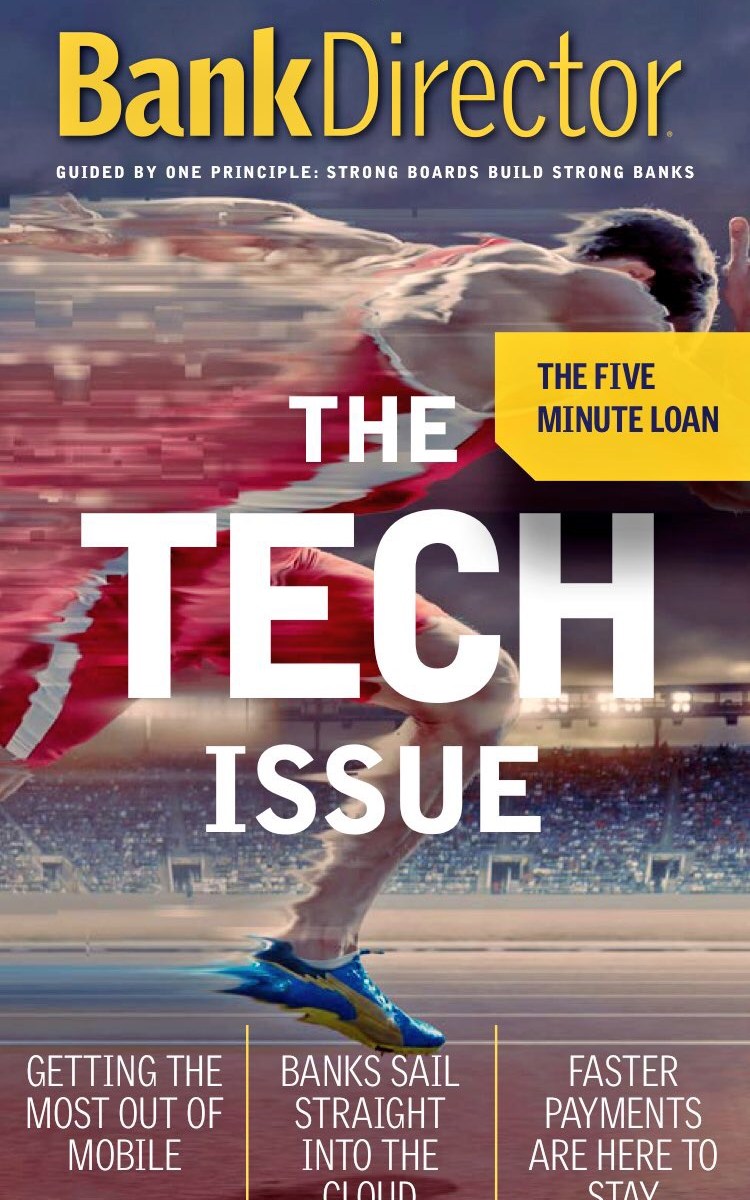
Earlier this week, we published the December issue of Bank Director Magazine, our annual Tech Issue.  Stories range from the changing nature of mobile banking to institutions moving into the cloud to a venture capitalist’s perspective on the future of banking.  I invite you to take a look.

Since starting this blog in 2012, I’ve shared my optimism that the intersection of technological innovation with strong depository franchises may lead to more efficient banking processes, reductions in fraud and a win/win/win for banks, FinTechs and consumers.  So as I read through this current digital issue, a few key takeaways:

  • When San Francisco-based Bank of the West, an $80.7 billion asset subsidiary of BNP Paribas Group, analyzed last year the bottom line impact of customers who are engaged in online banking and mobile banking, it found some surprising results. Digital customers, or those who were active online or on their mobile phones during the previous 90 days, had lower attrition rates than nondigital customers, and they contributed higher levels of revenue and products sold, said Jamie Armistead, head of digital channels at Bank of the West.
  • Automating the small-business lending process requires some deep thinking from boards and management about how much faith they’re willing to place in technology, and their ability to embrace the cultural change implicit in basing lending decisions more on data than judgment. “The marketplace is demanding quicker decisions through technology,” says Pierre Naude, CEO of nCino, a maker of bank operating systems. Bank customers, he says, are clamoring for special products and specialized coding that enable greater automation of the small-business lending process. “Bankers are waking up to the fact that speed and convenience will trump price. You can lose a customer to an alternative lender if you don’t have it.”
  • As our Editor, Naomi Snyder, shares in her welcoming letter, banks tend to have the usual board committees (think audit, compensation and risk).  But we know that few have a board-level technology committee.  So I wonder if 2017 is the year that more institutions decide to create such a group to become better informed and better prepared as the digitization of the banking industry continues?

Concomitant to this issue’s release, Chris Skinner shared his perspectives on the state of FinTech our FinXTech platform.  In his words, “it is apparent that the fintech industry has become mainstream just as fintech investing cools. What I mean by this is that fintech has matured in the last five years, going from something that was embryonic and disruptive to something that is now mainstream and real. You only have to look at firms like Venmo and Stripe to see the change. Or you only have to consider the fact that regulators are now fully awake to the change and have deployed sandboxes and innovation programs. Or that banks are actively discussing their fintech innovation and investment programs… Fintech and innovation is here to stay.”

Clearly, the pace of change in the banking space continues to accelerate.  Accordingly, I encourage you to check out what we’re doing with both Bank Director and FinXTech to help companies who view banks as potentially valuable channels or distribution partners, banks looking to grow and/or innovate with tech companies’ help and support; and institutional investors, venture capitalists, state & federal regulators, government officials and academicians helping to shape the future of banking.

The University of Maryland’s Marketing and Finance Super Day

I’m looking forward to keynoting today’s University of Maryland, Robert H. Smith School of Business’ Marketing and Finance Super Day.  What follows is a sneak peak of my remarks on the intersection of technology with financial services and why FinTech matters to business-school students.

Investments in financial technology have grown exponentially in the past decade – rising from $1.8 billion in 2010 to $19 billion in 2015.  Global investments in financial technology ventures in Q1 2016 were reported to reach $5.3 billion, representing a 67% increase over the same period last year.  Still, profitability remains elusive for many large FinTechs, despite attracting large volumes of customers and creating significant revenue.  So against this backdrop, I developed my remarks for current MBA students and fellow Smith-school alumni.

The opinions I’ll share reflect a number of conversations I’ve had throughout the year.  One, made by Chris Flowers at the International Finance Corporation’s annual FinTech CEO Summit this October, certainly bears mention.  In his words, a bank “is not just a business model, it is a regulatory concept and a social undertaking.”  So as much as some expect recent investments to radically change the nature of banking, I’m far more optimistic that creative new partnerships will emerge that ease payment processes, reduce fraud, save users money and promote financial planning.

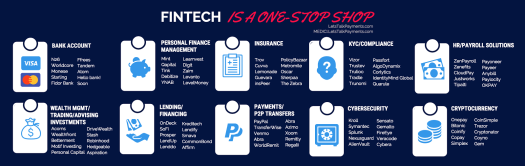
Since this is a more academic audience, my remarks explain how the fabric of the financial industry continues to evolve as new technology players emerge and traditional participants transform their business models.  As part of the school’s Marketing and Finance Super Day, I’ll provide insight into the profound transformations taking place throughout the financial sector while sharing graphics like these from our friends at LetsTalkPayments

bluee

If you’re interested to see the full presentation, I’ll share a link on LinkedIn and Twitter later today after I wrap up my remarks.

5 Cybersecurity Companies Bank Execs & Board Members Need to Know

When it comes to cybersecurity, the best defense might just be a great offense.  Whereas cybersecurity once focused on how banks could avoid losing money, my team and I are working on a program for 2017 to help officers and directors address potential scenarios (and develop realistic response plans) should a hack, breech or attack occur.  Indeed, protecting the bank against a cyber attack is a core responsibility of every member of a bank’s board and executive team.

In recent posts, I’ve highlighted various fintechs that I find compelling given their relationships with financial institutions.  In terms of cybersecurity, I’ve had the chance to learn more about companies like DefenseStorm (given their support of companies like nCino and LiveOak Bank) that I greatly respect.  Below are five more companies that I think bank leadership teams need to know:

Cognizant

A global cybersecurity solution and service provider, Cognizant supports multiple industry verticals and information security service lines.  I encourage you to take a look at their thoughts on what traditional banks can do to rebuild trust in the digital era.

Centrify

California-based Centrify offers identity & access management solutions to help secure enterprise identities against cyberthreats that target today’s IT environment of cloud computing.  Banking customers include such recognizable names as BB&T, SunTrust, Citi and RBS.

Lookout

Lookout has taken a mobile-first approach to security.  Indeed, one of the world’s largest investment management firms chose Lookout to provide threat and data leakage protection to over 10,000 managed iOS and Android devices.

Feedzai

Founded by data scientists and aerospace engineers, Feedzai’s mission is to “make commerce safe for business customers and create a better experience for their consumers through artificially intelligent machine learning.”

Brighterion

Since the founding of Brighterion, its core technology has been adapted and improved for real-time applications in the fields of payment, healthcare, marketing and homeland security.  For instance, its analysis of payments provides “unprecedented behavioral insights,” from the spending behavior of customers to the constantly evolving techniques of fraudsters.

##

As a complement to these five businesses, let me wrap up by sharing a recent FinXTech article:Emerging Technologies Combat Cybercrime.  As you will read, banks are doing everything they can to reassure customers that their digital information is safe and secure.

Whether They Want To or Not, Banks Need to Open Up

Apart from interest rates, the two biggest issues that bank executives seem to wrestle with are regulatory and compliance costs.  I sense another emerging challenge coming to shore; specifically, how to “open up” one’s business structure in terms of developing partnerships and permitting others to leverage their customer data and/or capabilities.

For bankers, this challenge comes with significant reputation and customer risk.

Now, it is hard to truly disrupt the concept of banking — and I shared this opinion from the stage at Bank Director’s annual Bank Executive & Board Compensation Conference this morning.  However, I did adjust some of my welcoming remarks based on the Consumer Finance Protection Bureau’s position that consumers can control their own financial data, including to let third parties help them manage their finances.  As I learned from Jo Ann Barefoot’s Fireside Chat with CFPB Director Richard Cordray at Money 2020, the CFPB “is not content to sit passively by as mere spectators watching these technologies develop.”  According to his prepared remarks:

Many exciting products we see… depend on consumers permitting companies to access their financial data from financial providers with whom the consumer does business. We recognize that such access can raise various issues, but we are gravely concerned by reports that some financial institutions are looking for ways to limit, or even shut off, access to financial data rather than exploring ways to make sure that such access, once granted, is safe and secure.

Since reading the CFPB’s position, Ms. Barefoot’s recap and the Wall Street Journal’s synopsis, I decided to talk with various bank executives and board members that are here with us at the Ritz-Carlton in Amelia Island about this stance.  As I note in this video, I sense both an ongoing struggle — and a sincere interest — to truly understand the role of technology.  For those I talked with, this is as much about “becoming sticky” to their customers as it is about embracing or defending themselves against “the new.”

##

For more about this year’s conference, I invite you to take a look at BankDirector.com.  Also, a virtual high-five to the team here for a great first day.  You all rock!

_mg_0113

The Promise of 8 Blockchain Companies

Yesterday, I spent the majority of my day at the Economist Conference’s “Finance Disrupted” in New York City.  As an early hook to their first panel discussion entitled ‘Building the blockchain: The promise and perils’, we learned that venture capitalists invested nearly $500 million in blockchain business last year — up from $2 million just three years ago.  While I’ve shared my perspectives on the potential applications for blockchain in previous posts (Blockchain 101 – a Primer for a Bank’s CEO and Board), panels like these underscore the immense potential of this technology.

“Blockchain technology continues to redefine not only how the exchange sector operates, but the global financial economy as a whole.”

– Bob Greifeld, Chief Executive of NASDAQ

Like many, I see potential for blockchain technology to revolutionize many areas of the financial industry — think securities trading, payments, fraud prevention and regulatory compliance.  Moreover, a new report from Deloitte explores how blockchain could be used in loyalty rewards programs.  Still, as our industry transforms, there is real uncertainty around what the future of the banking industry will look like.

This is why I take note of comments like those from BNY Mellon’s CEO, Gerald Hassell. On his Q1 earnings call, he opined “we think blockchain can be transformative.  We’re spending a lot of time and energy on it, but I think it’s going to take some time to see it play out in a full, meaningful way. We actually see ourselves as one of the major participants in using the technology to improve the efficiency of our operations and the resiliency of our operations.”

While additional big-time players — such as Goldman Sachs, Visa and NASDAQ — garner headlines for their investments in crypto-currencies & blockchain technology, I spent last night and this morning looking at eight blockchain companies that might help you to form your own opinions on the potential of this technology:

For more about these companies — and their funding sources — I encourage you to check out this piece on Lets Talk Payments.  Not familiar with LTP?  It is a fast-growing global destination for news, insights & data-driven research in emerging financial services.  Much like the information shared by both FinXTech and Bank Director, LTP’s content is fiercely independent, thought provoking and always up-to-date, in a way that continues to inform, engage and inspire.