What’s Happening at Acquire or Be Acquired

Throughout the first day of Bank Director’s 22nd annual Acquire or Be Acquired Conference, I found quite a few presentations focused on the emergence of mid-sized regional banks that are growing through the consolidation of smaller banks.  Clearly, mergers & acquisitions provide an avenue for some banks to drive improved operating leverage, earnings, efficiency and scale.  At the same time, the pressures prompting larger banks to innovate — sluggish loan demand, depressed revenue, higher compliance costs — are the same ones forcing smaller banks to pursue a sale.

By Al Dominick, President & CEO, Bank Director

For those unfamiliar with “AOBA,” this annual event explores issues like the one mentioned above.  Since the conference kicked off at 8 AM on a Sunday, this morning’s post shares three short video recaps from my time at the Arizona Biltmore followed by links to recent posts specific to this conference.

In addition to these videos, below are links to four of my posts specific to the event:

If these types of conversations interest you, take a look at what we’re sharing on BankDirector.com.  Additionally, I invite you to follow me on Twitter via @AlDominick, the host company, @BankDirector, and search & follow #AOBA16 to see what is being shared with (and by) the 930 men & women in attendance.

Five Reasons Why Banks Might Consider Selling in 2016

You might think every bank CEO I meet wants to talk about buying another institution; truth-be-told, some recognize that tying up with another makes a lot of sense.  So this post looks at why now may be the right time for a bank’s CEO and board to consider a sale.  It plays off the idea that in many markets, organic growth options are limited and times are tough for banks, especially those under $1Bn in asset size.

By Al Dominick, President & CEO, Bank Director

Over the past three years, a number of bank executives and board members have struggled with whether to buy or sell their bank — or pursue growth independently.  Over the same time, Bank Director has welcomed more than 1,300 bankers — from more than 500 financial institutions — to our annual M&A conference to explore their short- and long-term options.

This year, those numbers go up in a BIG way. Indeed, we have 600 bankers from 300+ banks joining us at the Arizona Biltmore for “AOBA” this upcoming Sunday through Tuesday.  To me, this signals that more potential buyers & sellers are getting off the sidelines and into the bank merger and acquisition game.  So in advance of Bank Director’s 22nd annual conference, here are five challenges that a bank’s CEO and board might want to consider.

  • Peer-to-peer lenders, credit unions and some — not all — FinTech startups either are (or will be) fierce competitors to community banks.  In addition, non-bank giants in technology, retail, media, entertainment and telecom are making noise about entering banking.
  • When margins decline, bankers try to compensate by improving operational efficiencies.  While slow growth + strong cost controls may allow for short term survival, such an equation doesn’t bode well for the long-term viability of many institutions where investors expect more significant gains.
  • The pressures prompting larger banks to innovate — sluggish loan demand, depressed revenue, higher compliance costs — are the same ones that will continue to force smaller banks to pursue a sale.
  • Let’s face it: the typical bond between a bank and a customer is is not personal nor very strong and the absence of real customer loyalty undermines the traditional business model most banks operate from (*and yes, I know that banks with dedicated customer bases enjoy significant advantages over any potential competitors. But let’s be honest about how dedicated such customers really are).
  • Finally, at many community banks, older management teams and a dearth of local talent mean there may be no one to hand over the reins to in the coming years.

Now, it has been said that business is not about longevity, it is about relevance.  So as Bank Director’s team continues to gear up for this year’s Acquire or Be Acquired conference, these five questions merit serious conversation and consideration both leading up to, and at, our 22nd annual event. For those not able to join us — but interested in following conversations such as these — I invite you to follow me on Twitter via @AlDominick, the host company, @BankDirector, and search & follow #AOBA16 to see what is being shared by (and with) our attendees.

4 Things to Know In Advance of Bank Director’s 2016 Acquire or Be Acquired Conference

Why banks are bought or sold involves much more than just the numbers making sense. Indeed, to successfully negotiate a merger transaction, buyers & sellers must bridge the gap between a number of financial, legal, accounting and social challenges. So in advance of this year’s biggest merger and acquisitions (M&A) conference, a few things I feel attendees of “AOBA” should know.

By Al Dominick, President & CEO, Bank Director

Starting this Sunday at the Arizona Biltmore, Bank Director’s team once again opens the doors to our annual Acquire or Be Acquired Conference — affectionately called “AOBA” (ay-oh-bah).  About this time last year, I wrote about a record turnout, one we will exceed in a few days when 925 men and women arrive at this architectural gem.

By design, the numbers I share in the image above only reflect key data from the financial institutions attending.  In fact, we are prepared to welcome another 60+ professional services firms and product companies to the Biltmore.   While I am particularly impressed by the caliber of support provided to the industry by our sponsoring companies, today’s post focuses on a handful of issues impacting the officers and directors joining us from strong and well performing community banks.

While big banks typically garner mainstream headlines — Wells Fargo, Citi, JPMorganChase and Bank of America account for a whopping $8.1 Trillion of the $17.3 Trillion assets held by banks in the U.S. — the buying and selling of banks takes place outside their domain.  The overwhelming majority of deals today involve community banks, many of whom have their CEOs attending AOBA.  So for this hugely influential audience, here are my key points to know and consider before the conference kicks off.

  • M&A remains attractive inasmuch as successful transactions improve operating leverage, earnings, efficiency and scale.
  • Today’s regulatory environment can hold up a deal — so it has become popular to note that banks can make acquisitions depending on how “clean” both the buyer and seller are + how big the resulting bank becomes.
  • As seen in their superior financial metrics (e.g. ROAA and ROAE), larger banks are growing and consistently outperforming smaller banks.
  • Small and mid-sized banks’ importance to the overall economy and select business sectors remains in place; however, their earnings potential is less diverse then big banks, making them more vulnerable to new competitors and shifts in pricing of financial products.

Certainly, the buying and selling of banks has been the industry’s “great game” for the last couple of decades.  As the conference agenda reflects, we dive deeper into topics like these and look at pre-deal considerations, post-integration challenges and everything in between.  So for those not able to join us — but interested in following the conversations — I invite you to follow me on Twitter via @AlDominick, the host company, @BankDirector, and search & follow #AOBA16 to see what is being shared with (and by) our attendees.

Spotlight on FinTech

If forced to pick but one industry that serves as a catalyst for growth and change in the banking space, my answer is “FinTech.” As NJ-based ConnectOne Bank’s CEO, Frank Sorrentino, opined late last week, “financial institutions today operate in a constant state of reevaluation… at the same time, low interest rates and a brand new tech-driven consumer landscape have further contributed to the paradigm shift we’re experiencing in banking.” After I shared “Three FinTech Companies I’m Keen On,” I was asked who else I am taking note of in the financial technology sector; hence today’s spotlight on three additional companies.

Yodlee_logo.svg

The fabric of the banking industry continues to evolve as new technology players emerge in our marketplace.  With banks of all sizes continuing to implement innovative technologies to grow their organizations, companies like Yodlee have emerged “at  the heart of a new digital financial ecosystem.”  The NASDAQ-listed company counts 9 of the 15 largest U.S. banks as customers along with “hundreds of Internet services companies.”  These companies subscribe to the Yodlee platform to power personalized financial apps and services for millions of consumers.  With thousands of data sources and a unique, cloud platform, Yodlee aspires to transform “the distribution of financial services.” It also looks to redefine customer engagement with products like its personal financial management (PFM) service, which pulls together all of a customer’s financial information from multiple accounts.

web-Logo-Malauzai@2x

Now, technology in the financial world encompasses a broad spectrum of tools. For most officers and directors, I have found conversations about what’s happening in this space naturally incites interest in mobile banking.  So let me turn my focus to Malauzai, a company I first learned of while talking with Jay Sidhu (*Jay is the former CEO of Sovereign where he grew the organization from an IPO value of $12 million to the 17th largest banking institution in the US… he is now CEO of the very successful Customer’s Bank).  This past spring, he talked about the benefits of working with the company that was formed in 2009 to “participate in the mobile banking revolution.”  Malauzai works with about 320 community banks and credit unions across the country, providing the tools needed to connect to a customer through smartphone applications.  Specifically, the company builds mobile banking “SmartApps” that run across mobile platforms (e.g. Apple and Android) and several types of devices from smart phones to tablets.

db_logo.ba0411771e22

Certainly, many FinTech companies have a laser-like focus on individual customer needs.  Case-in-point, Openfolio, a startup that “brings the principles and power of social networks – openness, connectivity, collective intelligence – to the world of personal investing” (h/t to Brooks and Gareth at FinTech Collective for sharing their story).  Openfolio’s premise: in our sharing economy, people will divulge investing ideas and “portfolios, in percentage terms, within their networks.”  Accordingly, Openfolio provides a place where investors share insights and ideas, and watch how others put them into action. As they say, “we all learn from each other’s successes (and mistakes).”  As reported in TechCrunch, the company doesn’t reveal dollar amounts folks have invested, preferring to reveal how much weight different categories have in an investor’s portfolio to reveal information about markets.

##

Personally, it is very interesting to watch companies such as these spur transformation.  If you are game to share your thoughts on FinTechs worth watching, feel free to comment below about those companies and offerings you find compelling.

Let’s Talk Compensation

This Sunday, I fly to Chicago for Bank Director’s annual Bank Executive & Board Compensation Conference.  As I prepare to head towards the city that splits its allegiance between the Cubs & WhiteSox, my thoughts move from baseball — congratulations to the new World Series champion San Francisco Giants — to the people, products and performances of various financial institutions.  As I will be blogging and tweeting from our annual event, I thought to use today’s post to tee-up what you can expect on AboutThatRatio.com next Monday, Tuesday and Wednesday.

FullSizeRender

Since the demise of AIG, Bear Sterns and Lehman Brothers in 2008, take a minute and think about how many significant changes have occurred throughout the entire financial community.  From new capital requirements to greater scrutiny on executive compensation, these “Dodd-Frank” years remind me of the aftermath of Sarbanes-Oxley’s introduction in the early 2000s in as much as board members continue to wrestle with the ‘what ifs’ and ‘how comes’ of the regulatory environment.

While much of the action taken by nearly every institutions a few years ago can best be described as reactionary and defensive, it strikes me that there are quite a few banks transforming their operating models to stay both relevant and competitive today.   For this reason, I am excited for our team to host several hundred bank executives and outside directors focused on the creation of sustainable long-term value for shareholders next week.  In terms of posts:

  • Monday’s looks at the recruitment, development and compensation of a bank’s most essential talent — both within a bank and on its board.
  • On Tuesday, the “main day” of our conference, I will share the trending topics from the day.  Last year, I wrote how board members and executives continued to struggle with measuring executive performance and retaining key talent.
 At the same time, I made note that many felt the environment in which banks operate in demands productivity, proficiency with technology and the ability to sell.  So I’ll juxtapose last year’s findings with this year’s themes.
  • Wednesday’s piece will be a bit simpler, a 90 second video I’ll have filmed from the conference.

Next Friday’s column?  More of a behind-the-scenes picture recap of the conference as I recently did for Bank Director’s “anniversary.”  Throughout, you can keep track of various conversations on Twitter by following @BankDirector and me, @AlDominick and/or by using #BDComp14.

Happy Halloween!

A Pop Quiz on the Future of Banking

I was not planning on a sixth consecutive column focused on non-bank competition; however, as I prepare to present at Moss Adams’ 14th Annual Community Banking conference in Huntington Beach, California on August 26, a “bonus” post on this topic.  As you will see, today’s piece builds on the premise that many community bank leaders have real opportunities to expand what banking means to individual and business customers by offering services that go beyond a traditional business model. So to wrap up this week, sharpen your pencils for this pop quiz.

1280px-Flag_of_California.svg

Are WE the generation that has learned how to live without a bank?
So much has been written about millenials learning to live without a bank… but ask yourself: have you learned how to live without your bank?  If you could not direct deposit your paycheck, do you have ready alternatives?  I thought so.  Financing for your house? Your business?  I am simply pointing out the inconvenient truth that it is not just the wet-behind-the-ears customers that might already know how to live without a bank.  That said, just because many have learned to live “without” a traditional banking relationship doesn’t mean most want to.  I will let a thought from Diebold support this thought, but before I do, have to ask:

Who’s getting that Kabbage?

As a platform for online merchants to borrow working capital, Kabbage fills a small business lending gap that I have to imagine many community banks should desire (h/t Mitchell Orlowsky @ Ignite Sales).  As I learned this week, Kabbage works with small businesses that are unable to obtain credit from traditional sources. According to TechCrunch, “the startup has closed a $270 million credit facility from Guggenheim Securities, the investment banking and capital markets division of Guggenheim Partners. Atlanta, Georgia-based Kabbage will use the funds to build out its financing business both in the U.S. and beyond. This is one of the largest credit facilities ever issued to a small business lender, and possibly the biggest in the online lending space.” Since opening for business almost three years ago, Kabbage has advanced more than $250 million to small businesses, the company says   Just another example of competition facing many business-oriented banks today.

If Diebold can change, why can’t you?
From the outside looking in, one can make the case that the last truly disruptive technology for banks was the ATM. And when you think ATMs, Diebold has to be top-of-mind.  So when the technology company acknowledges the following, why can’t more banks course correct and be where people are going (and not where they might appear to be)?

The retail financial services industry is in the midst of an epic change and will soon look very different than it did just a few years ago. Consumers are changing what they want out of their banks. Our research proves that consumers want additional convenience to access their bank anytime, anywhere, anyhow, all while maintaining a personal connection with their bank.

##

Regardless of how you did on this pop quiz, please feel free to leave a comment below by clicking on the white plus sign (within the grey circle at the bottom of this page).  I invite you to follow me on Twitter (@aldominick) where you can publicly or privately share your thoughts with me.


Aloha Friday!

Don’t Be Crowdsourced Out Of Business

This is the fifth and final piece in my series on emerging threats to banks from non-financial companies — one that shines a light on the pooling of money from many different people to make an idea happen. Click on any of these titles to read my previous posts: For Banks, the Sky IS FallingPayPal is Eating Your Bank’s LunchThe Bank of Facebook and Is WalMart the Next Big Bank.

Next week kicks off Shark Week on the Discovery channel… maybe you’ve been inspired by the endless commercials hyping this programming during Deadliest Catch?  Perhaps so inspired that you’ve come up with a brilliant new idea that just needs some money to get it off the ground!  As a creative type (you watch Shark Week after all), you can’t be bothered with your community bank’s draconian business loan process.  No, you want to start right away and are going all in with a crowdsourcing platform (there are some 700 or so) to rally the capital you need to get your project off the ground.  After all, your “financial backers” on such a platform will not profit financially — unlike those greedy banks that certainly will — while your great idea will flourish thanks to this oh-so-captivated audience that gave you their money with nothing expected in return.

Against this backdrop, banks have no chance, right?

Hyperbole aside, it may be easy to underestimate the impact of crowdfunding on financial institutions, dismissing these “purpose-driven marketplaces” as nothing more than online outposts where wacky ideas attract even wackier investors.  While banks possess inherent competitive advantages in today’s digital world (e.g. large customer bases, vast amounts of customer and transaction data along with the capabilities to enable payments, security, and financing), keep in mind a proverb that “the shark who has eaten cannot swim with the shark that is hungry.”  To this end, let me repurpose the thoughts of  LinkedIn’s co-founder Reid Hoffman, who opines:

“Crowdfunding relies on the wisdom of crowds to identify, fund and unleash entrepreneurial innovation far more efficiently than the credit rules of banks can.”

Having looked at the competitive stances taken by Wal-Mart, Facebook and PayPal in previous posts, let me shift my focus to two of the more well-known crowd funding marketplaces that are “democratizing access to capital, fueling entrepreneurship and innovation, and profoundly changing the face of philanthropy at unprecedented scale and impact.”  Rather than deep dive their business models, let me share, in their words, why people gravitate to their respective sites.

Indiegogo
Founded in 2008 and headquartered in San Francisco, this site was one of the first to offer crowd funding.

Indiegogo is no longer unique; indeed, numerous crowdfunding sites make billions of dollars of capital accessible to upstarts and entrepreneurs alike.  However, it is one of the most established in the space.  As they share “people usually contribute to campaigns for four different reasons: people, passion, participation, and perks. Often, people contribute to support other people—maybe contributing to the campaign of a friend or another inspiring individual. Others contribute because they’re passionate about a mission, such as women’s health or elementary education. Others are motivated by a desire to participate in something big, like building a new community center in their hometown. And often, people contribute to receive perks, the cool things or experiences they get in return for their contributions.”

Kickstarter
A global crowdfunding platform with a stated mission to help bring creative projects to life.

As the company explains, “Mozart, Beethoven, Whitman, Twain, and other artists funded works in similar ways — not just with help from large patrons, but by soliciting money from smaller patrons, often called subscribers. In return for their support, these subscribers might have received an early copy or special edition of the work. Kickstarter is an extension of this model, turbocharged by the web.”

##

The reason I wrote today’s piece — and the previous four — is simple.  I am convinced that many community banks have real opportunities to expand what banking means to its individual and business customers by offering services that go beyond their traditional business model.  While many bankers recognize the threats presented by Bank of America to their long-term survival, I am concerned that non-bank competition poses an even greater threat.  Essentially, I think more bank CEOs and boards need to take their conversations beyond just cutting branches and full-time employees and consider how they make the bank more efficient by reinventing how they do things.

Whether you agree or disagree, I’d be interested in your thoughts. Feel free to leave a comment below by clicking on the white plus sign (within the grey circle at the bottom of this page) and I invite you to follow me on Twitter (@aldominick) where you can publicly or privately share your thoughts with me.

Know Your Tribe

So… I initially planned to dive into interest rate risk this morning. Prevalent in most M&A conversations taking place in bank boardrooms today, I thought to focus on banks working to protect their equity value as interest rates rise. However, in reviewing the outline for today’s piece, I realized a different kind of risk inspired me: the risk of becoming something you are not.  While I do anticipate posting a piece on interest rate risk in the near future, today’s column parallels the thoughts of Seth Godin.  Specifically, a blog he authored this week entitled “In Search of Meaningful.”

cat550006

In his piece, Seth looks at online media and how “people have been transfixed by scale, by numbers, by rankings… how many eyeballs, how big is the audience, what’s the pass along, how many likes, friends, followers, how many hits?  You cannot win this game and I want to persuade you… to stop trying.”  It strikes me that he could just as well be writing about financial institutions competing for relevance in today’s competitive and crowded environment.  While I’ve linked to his post above, see if you follow my logic based on this representative quote:

It’s no longer possible to become important to everyone, not in a reliable, scalable way… But it is possible to become important to a very-small everyone, to a connected tribe that cares about this voice or that story or this particular point of view. It’s still possible to become meaningful, meaningful if you don’t get short-term greedy about any particular moment of mass, betting on the long run instead.

Over the past six months, I have been fortunate to hear how numerous bank CEOs and Chairmen plan to position their institutions for long-term growth.  As I process Godin’s perspective, let me pay his perspectives forward with three of my own specific to community banks:

#1 – You Don’t Have To Be BIG To Be Successful

By this I mean smarts trumps size any day of the week.  While more banks put their liquidity to work, fierce competition puts pressures on rates and elevates risk.  While easy to frame the dynamics of our industry in terms of asset size, competing for business today is more of a “smart vs. stupid” story than a “big vs. small” one.

#2 – You Don’t Have To Be Everywhere

Nor can you be — so stick to what you know best.  I know that margin compression and an extra helping of regulatory burden means times couldn’t be more challenging for growth in community or regional banking.  But that doesn’t mean you have to be all things to all people.  Case-in-point, I was lucky to spend some time with Burke & Herbert Bank’s CEO in Northern Virginia earlier this week.  As they say, “the world has changed quite a bit since 1852 (*the year the bank opened its doors) – that you may be conducting most of your life from your computer, smartphone and/or whatchamajiggy. That’s why we constantly adapt to the way you live and bank.”  Today Burke & Herbert Bank has more than $2 billion in assets and 25 branches throughout Northern Virginia.  Still, they remain a neighborhood bank, choosing to “stay local” as Virginia’s oldest bank.

#3 – You Don’t Have To Do What Everyone Else Does

As Godin writes, the “problem with generic is that it’s easy go as well as easy come.”  Just because USAA rolls out a new mobile offering doesn’t mean you need to — and if BofA decides to reprice a product, can you really compete with them on price?  So which community banks are doing it right in my opinion?  Well, if you’re in Nashville and focused on the medical and music & entertainment industries you probably know Avenue Bank, if you’re a business in the Pacific Northwest, you most likely work with (or at least respect) Banner Bank.  And if you are in the oil and gas business in Texas, First Financial is a big player.  The common thread that binds these three banks together: they have a laser-like focus on their ideal customer base.

##

To comment on this piece, click on the green circle with the white plus (+) sign on the bottom right. If you are on twitter, I’m @aldominick. Aloha Friday!

Three Thoughts on Banks and Risk

I’m heading out to Chicago and Bank Director’s annual Bank Audit & Risk Committees Conference.  The agenda — focused on accounting, risk and regulatory issues — aligns with the information needs of a Chairman of the Board, Audit and/or Risk Committee Chair and Members, Internal Auditors, Chief Financial Officers and Chief Risk Officers.  Before I welcome some 300 attendees (representing over 150 financial institutions from 39 states) to the Palmer House, I thought to share three things that would keep me up at night if I traded roles with our attendees.

The Bean

(1) The Risk of New Competition

For bank executives and board members, competition takes many forms.  Not only are banks burdened with regulation, capital requirements and stress testing, they now have the added pressure of competition from non-financial institutions.  Companies such as Paypal, as well as traditional consumer brands such as Walmart, are aggressively chipping away at the bank’s customer base and threatening many financial institutions’ core business — a fact made clear by Jamie Dimon, the CEO of JPMorgan Chase, at a shareholder meeting this February.

“You’d be an idiot not to think that the Googles and Apples  .  .  .  they all want to eat our lunch.  I mean, every single one of them.  And they’re going to try.”

To this end, I find myself agreeing with Accenture’s Steve Culp, Accenture’s senior managing director of Finance & Risk Services, when he writes “banks need to keep developing their risk capabilities, skills and talents, and align these skills with their agenda around future growth. If they don’t align their growth agenda with their risk capabilities—building a safe path toward growth opportunities—they will miss out on those growth opportunities.”  While I plan on diving much deeper into this topic following the conference, I definitely welcome feedback on the issue below.

(2) The Risk to A Reputation

While the Dodd-Frank Act requires publicly traded banks with more than $10 billion in assets to establish separate risk committees of the board, and banks over $50 billion to additionally hire chief risk officers, I’m seeing smaller banks proactively following suit.  Such additions, however, does not absolve directors and senior managers of financial institutions from preparing for the worst… which is easier said then done.   In some ways, a bank’s reputation is a hard-to-quantify risk.  Anyone can post negative comments online about an institution’s products, services or staff, but one only needs to look at Target’s financial performance post-cyber hack to realize that revenue and reputation goes hand-in-hand.

(3) The Risk of Cyber Criminals

Speaking of Target, earlier this year, Bank Director and FIS collaborated on a risk survey to pinpoint struggles and concerns within the boardrooms of financial institutions.  As we found, tying risk management to a strategic plan and measuring its impact on the organization proves difficult for many institutions, although those that have tried to measure their risk management program’s impact report a positive effect on financial performance.  What jumps out at me in the results of this research are the concerns over cyber and operational security.  Clearly, the number of “bad actors” who want to penetrate the bank’s defenses has increased exponentially, their tools have become remarkably sophisticated, and they learn quickly.  I read an interesting piece by an attorney at Dechert (sorry, registration required) that shows the analytical framework for cyber security is very similar to what most directors have focused on in their successful business careers: people, process and technology.  But theory is one thing, putting into practice a plan to protect your assets, entirely different.

##

To comment on today’s column, please click on the green circle with the white plus sign on the bottom right. If you are on twitter, I’m @aldominick. Aloha Friday!

The Three Ds of Banking

Just as the cherry blossoms provide a welcome personal respite from winter’s cold embrace, so too have stories of creativity and growth diverted my professional attention away from compliance issues and regulatory updates.  As I travel across the country, I’m continually impressed by the close attention being paid by leaders at financial institutions to non-traditional sources of revenue — particularly fee-based income.  Today’s tip sheet reflects these recent travels and commensurate “lessons learned” with three words, a big three if you will, that tie-in to growing one’s business.

photo-4

Diversify

In order for banks to thrive in what, in many regions, remains a crowded marketplace, diversified growth is key.  I’ve heard from a few community bank CEOs that given the nature of the economic recovery and uncertainty over interest rates, quality growth requires a balance between real estate and operating company borrowers and between fixed and floating rate loans.  Without such balance, earnings and shareholder value are at increased risk.

Differentiate

The general public still does not distinguish enough between Wall Street banks and Main Street community banks.  Nonetheless, more and more bankers are making this distinction, thereby helping customers (and potential customers) to understand how important community banks are to the economy and the local region.  It strikes me such efforts will not only educate, but also encourage, more and more people to support community banks with their business.

Deliver

As the workplace becomes more mobile, so must the tools to deliver the financial services to business owners and individuals.  Clearly, the “new generation of consumers” does everything on their mobile phone.  If a bank doesn’t have a mobile app — and a quality mobile offering — I have to believe the bank does not even register to this up and coming audience.  In fact, as more Gen X and Gen Y’rs become a more sizable force in terms of total GDP, I’ve heard that one’s mobile banking solutions will be directly proportional to the amount of clients a bank is able to attract and retain.

Aloha Friday!

FI Tip Sheet: Is 2014 the Year of the Bank IPO?

Good things come in threes — like insightful/inspiring meetings in New York, Nashville and D.C. this week.  By extension, keep an eye out for a Sunday, Monday and Tuesday post on About That Ratio.  Yes, I’m heading to Chicago for Bank Director’s annual Chairman/CEO Peer Exchange at the Four Seasons (#chair14) and plan to share my thoughts and observations on issues like strategic planning, risk management and leveraging emerging technologies each day.  Finally, I hope the three points I share today (e.g. a look at what the future holds for branches to a rise in public offerings) prove my original sentiment correct.

banking2020-hero1

I’ve been surprised… by the # of conversations I’ve had about branch banking.

With many of the mega and super-regional banks focused on expense control, I find myself talking fairly regularly about how these institutions are taking a “fresh look” at reducing their branch networks.  Typically, these conversations trend towards well-positioned regional and community banks — and how many now look to branch acquisitions as low risk and cost effectives ways to enter a new market or bolster an existing market.  I expect these conversations to continue next week in Chicago — but thought to share today as it again came to the fore earlier this week in NYC.  While there, I had a chance to catch up on PwC’s latest offerings and perspectives.  Case-in-point, one of their current research pieces shows that, despite the emergence of new competitors and models:

“the traditional bank has a bright future – the fundamental concept of a trusted institution acting as a store of value, a source of finance and as a facilitator of transactions is not about to change. However, much of the landscape will change significantly, in response to the evolving forces of customer expectations, regulatory requirements, technology, demographics, new competitors, and shifting economics.”

banking2020-hero3

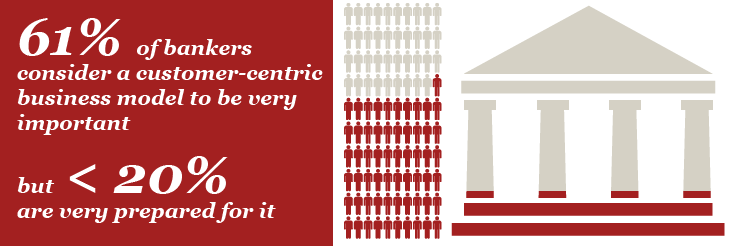
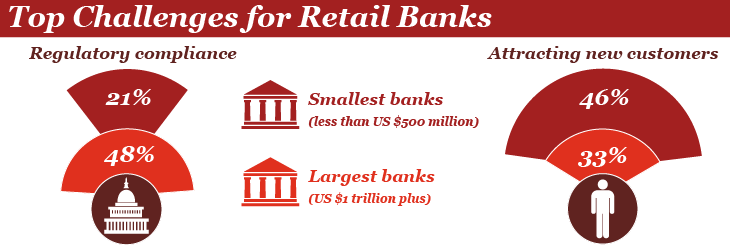
The two images above come from an information-rich micro-site (Retail Banking 2020) PwC shares.  Personally, I found these statistics fascinating and foreshadow my second point about creative approaches to win new business.

I’ve been thinking about… fin’tech companies + their “solutions.”

Here, I want to give major props to our friends at the William Mills Agency in Atlanta.  Their annual “Bankers as Buyers” report shares ideas, concepts and research about financial technology from 30 of the top influencers in the country and those forces driving change today.  This year’s report lays out trends for the coming year, including:

  • Branch Network Transformation;
  • Mobile 3.0;
  • Big Data Drives Marketing & Fights Fraud;
  • Payments Technology Stampede;
  • Banks Focus on Underbanked and Wealthy; and
  • Compliance Strategies.

Take a look at their work and download the free report if you’re interested.

I’ve been talking about… the number of banks going public.

Is 2014 the year of the bank IPO? According to Tom Michaud, the president and CEO of Stifel Financial’s KBW, it just might be.  I had a chance to get together with Tom earlier this week and he got me thinking about how many are going to pursue a public market to raise capital versus doing so privately.  He shared the story of Talmer Bancorp (TLMR), which went public on Valentine’s Day.  When it did, it marked the biggest bank IPO in three years (yes, KBW’s Banking & Capital Markets teams completed the $232 million Initial Public Offering, acting as joint bookrunner).  As he shared their story with me, it became clear that as more banks go public, we will see more buyers entering into the M&A market — since most bank deals are being done with stock these days.  It strikes me that going public presents an alternative for private banks… rather than sell now, they might find a more receptive market should their story be a good one.

Aloha Friday!

FI Tip Sheet: Positive Trends

A few weeks ago, to begin “The Innovator’s Dilemma,” I shared the need for banks to think differently or risk becoming obsolete.  This morning’s column builds on that idea by looking at some of the characteristics of top performing publicly held banks based on a research piece shared by Raymond James.  I studied this list and realized quite a few of the “winners” leverage design trends, the second point in today’s post, to differentiate their messaging.  My third and final point looks at technology expertise making its way into a bank’s boardroom — and provides an excuse to post a number of pictures from my time in Nashville last week. 

Top of the (Performance) Pack
Recently, Raymond James presented its second annual Community Bankers Cup.  This “award” recognizes the top 10% of community banks based on various profitability, operational efficiency and balance sheet metrics culled from a pool of 302 publicly traded community banks with assets between $500 million and $10 billion.  What we see in the firm’s recap is superior financial accomplishment drives superior stock price returns.  These 30 banks (e.g. Eagle Bancorp, First Financial, etc.) demonstrated exceptional results “on a relative basis in one or more of the following measurements of financial performance and stability: non-performing assets to loans and real estate owned, five-year average core deposit percentage, net interest margin, efficiency ratio, return on average assets, and return on average tangible common equity.”  If you are looking for examples of strong + healthy banks that have taken creative ideas to build a business, and subsequently monetized them, take a look at what the Raymond James team writes about these 30 institutions.

Ahead of the Curve
Since the beginning of the most recent global financial crisis in 2008, Getty Images has been tracking the changes in imagery used by financial services providers to represent their brand.  In their words, “gone are the depictions of aspiration and conspicuous wealth as financial services brands try to re-establish trust with their customers.”  In their place comes creative uses of community support “set-up for the long-term to  demonstrate their responsibility for local businesses, communities and the environment.”  Take a look at this “visual trends in financial services marketing” to get a truer sense of what’s working for bank marketers today.


Surprisingly Staffed
Last week, our team welcomed 117 bank officers and directors to the Hermitage in Nashville.  At this spectacularly Southern hotel, we went a bit old school and put pen + paper in front of these decision makers to ask five technology-specific questions.  I don’t normally equate technical proficiency with a bank’s officers and directors; however, the vast majority of attendees shared that their executive team has at least two people with strong technology understanding/experience.  While a small sample size, more then 50% of these key leaders responded to our query… and the results underscore, in my opinion, the importance being placed on  technology at community banks.  In addition, I did hear from several Chairmen that they are adding outside directors with an understanding of issues like cyber security risk and how to oversee vendor management.  If you’re interested to see what an event looks like from my POV, here’s a look (photos courtesy of Don Wright Designs & Photography)

Aloha Friday!