Trending at Bank Director’s Acquire or Be Acquired Conference

#AOBA17 conference intel (Sunday)
By Al Dominick, CEO of Bank Director | @aldominick

Quickly

  • We could see over 200 merger transactions despite a declining number of banks in 2017.
  • There is a clear trend on M&A pricing multiples being driven by bank profitability and asset quality.
  • For banks, too little capital is not the only issue — too much capital and the inability to produce sufficient returns on capital is equally problematic.

_ _ _

What is my bank worth?  How will the changing tax environment affect bank values?  When is the right time to buy (or sell) a bank?  What are the most significant factors affecting bank value?  These were just some of the questions surfaced this morning here in Arizona.  In this video recap of Sunday morning’s presentations at Bank Director’s Acquire or Be Acquired Conference, I share a few observations about the conversations taking place around issues such as these.

Given the focus of this three-day event, I anticipate many subsequent presentations building off of these points.  For those interested in issues such as these, I invite you to follow me on Twitter via @AlDominick, the host company, @BankDirector and its @Fin_X_Tech platform, and search & follow #AOBA17 to see what is being shared with (and by) our attendees.

Welcome to Bank Director’s 2017 Acquire or Be Acquired Conference

#AOBA17 conference intel (Saturday)
By Al Dominick, CEO of Bank Director | @aldominick

Quickly

  • Banks have benefited from rising stock prices and interest rates, which are expected to boost low net interest margins.
  • The change in the U.S. presidency has resulted in a steepened yield curve, as investors predict improved economic growth.
  • Currently, many anticipate regulatory relief for banks and the prospect of major corporate tax cuts.

_ _ _

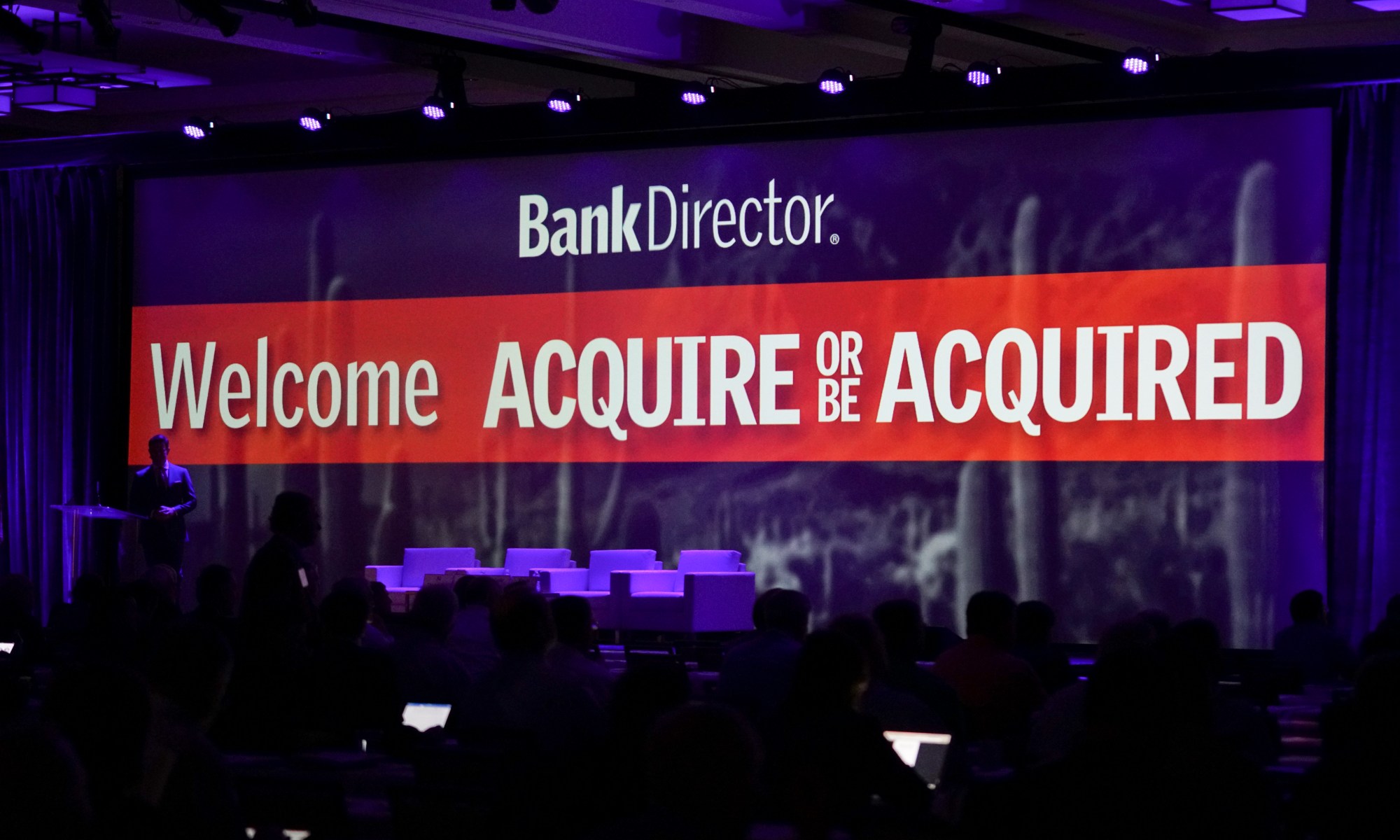
As we prepare to kick off our 23rd Acquire or Be Acquired Conference in Phoenix, Arizona, I anticipate the general mood to be good, even as I “Expect the Unexpected.”  686 bankers comprise the 1,076 attendees at Bank Director’s event here at the JW Marriott Phoenix Desert Ridge Resort & Spa — a figure that reflects the participation of 379 financial institutions.

For those interested in following the conference conversations via social channels, I invite you to follow me on Twitter via @AlDominick, the host company, @BankDirector and its @Fin_X_Tech platform, and search & follow #AOBA17 to see what is being shared with (and by) our attendees.

Expect the Unexpected

“If past history was all that is needed to play the game of money, the richest people would be librarians.” – Warren Buffett

#AOBA17 pre-conference intel
By Al Dominick, CEO of Bank Director | @aldominick

This may be a phenomenal—or scary year—for banks. Banks have benefited from rising stock prices and rising interest rates, which are expected to boost low net interest margins. Indeed, the change in the U.S. presidency has resulted in a steepened yield curve, as investors predict improved economic growth. Currently, many anticipate regulatory relief for banks and the prospect of major corporate tax cuts. Such change could have a significant impact on banks; however, those running financial institutions also need to keep an eye on potential challenges ahead.

As we head to our 23rd Acquire or Be Acquired Conference in Phoenix, Arizona, with a record breaking 1,058 attendees Jan. 29-Jan. 31, I am expecting the mood to be good. Why wouldn’t it be? But what is on the horizon are also fundamental changes in technology that will change the landscape for banking. What will your competitors be doing that you won’t be? Our conference has always been a meeting ground for the banking industry’s key leaders to meet, engage with each other and learn what they need to do deals. It is still that. Indeed, most of the sessions and speakers will be talking about M&A and growth.
But this year, more than 100 executives from fintech companies that provide products and services to banks join us in the desert, on our invitation. We want to help banks start thinking about the challenges ahead and how they might solve them.

Here are some things to consider:

  • How will the Office of the Comptroller of the Currency’s limited-purpose fintech charter enable more established fintech companies to compete with some of the incumbents in the room?
  • If smaller banks are indeed relieved of many of the burdens of big bank regulation, will they use the savings to invest in technology and improvements in customer service?
  • How will customer expectations change, and from whom will customers get their financial services?

To this last point, I intend to spotlight three companies that are changing the way their industries operate to inspire conversations about both the risks and rewards of pursuing a path of change. Yes, it’s OK to think a little bit beyond the banking industry.

Spotify
Rather than buying a CD to get their favorite songs, music-lovers today favor curated playlists where people pick, click and choose whom they listen to and in what order. There is a natural parallel to how people might bank in the future. Just as analytics enable media companies to deliver individually tailored and curated content, so too is technology available to banks that might create a more personalized experience. Much like Spotify gives consumers their choice of music when and where they want it, so too are forward-looking banks developing plans to provide consumer-tailored information “on-demand.”

Airbnb
The popular home-rental site Airbnb is reportedly developing a new service for booking airline flights. Adding an entirely new tool and potential revenue stream could boost the company’s outlook. For banks, I believe Airbnb is the “uber-type” company they need to pay attention to, as their expansion into competitive and mature adjacent markets parallels what some fear Facebook and Amazon might offer in terms of financial services.

WeChat
One of China’s most popular apps, the company counts 768 million daily active users (for context, that’s 55 percent of China’s total population). Of those users, roughly 300 million have added payment information to the wallet. So, WeChat Pay’s dominance in the person-to-person payments space is a model others can emulate. PayPal already is attempting such dominance, which Bank Director magazine describes in our most recent issue.

Many of those attending our conference also have done amazing things in banking. I can’t name all of them, but I’d be remiss to not mention CEO Richard Davis of U.S. Bank, our keynote speaker. After a decade leading one of the most phenomenal and profitable banks in the country, he is stepping down in April. We all have something to learn from him, I’m sure.  Let us think about the lessons the past has taught us, but keep an eye on the future. Let’s expect the unexpected.

*note – this piece first ran on BankDirector.com on January 26, 2017

Look At Who Is Attending Acquire or Be Acquired

In just 20 days, we raise the lights on our 23rd annual Acquire or Be Acquired Conference.  This is Bank Director’s biggest event of the year, one primarily focused on banking’s “great game” — mergers and acquisitions.  My team has spent considerable time and energy developing a spectacular event focused on growth-related topics that range from exploring a merger to preparing for an acquisition; growing loans to capturing efficiencies; managing capital to partnering with fintech companies.  To see the full agenda, click here.

Widely regarded as one of the banking industry’s premier events, we have more than 1,000 people registered to attend AOBA later this month — an all-time high.  We couldn’t do this alone, and over the course of these 2 ½ days, executives from many of our industry’s leading professional services firms and product companies share their perspectives on “what’s now” and “what’s next.”  I invite you to take a look at all of the corporate sponsors joining us:

aoba-sponsors-listed-001

aoba-sponsors-listed-002aoba-sponsors-listed-003aoba-sponsors-listed-004aoba-sponsors-listed-005
As I shared in a recent post, bank executives and their boards face some major issues without clear answers.  Before heading out west, I’ll share more about the banks (and 660+ bankers) joining us at the JW Marriott Phoenix Desert Ridge Resort & Spa.  Until then, I invite you to learn more about the companies supporting this conference by hopping over to bankdirector.com. To follow the conversations happening around this conference on Twitter, I’m @aldominick and we are using #AOBA17.

Eagerly Anticipating Bank Director’s Acquire or Be Acquired Conference

In the face of this month’s political transitions, bank executives and their boards face some major issues without clear answers.  For instance, many continue to speculate on the Fed’s interest rate hikes while others pontificate on potential regulatory changes (hello CFPB).  While convenient to cite November’s election results, keep in mind that we, as an industry, were already in a period of significant transformation.  Still, it’s a titanic-sized understatement to say Republican presidential nominee Donald Trump’s surprise victory shook up the world. 

While change remains a constant in life, I am personally and professionally excited to return to the Arizona desert later this month for a great tradition: Bank Director’s annual Acquire or Be Acquired Conference.  With a record turnout joining us at “AOBA,” I’ve begun to assess various business models of institutions I know will be represented.  For instance, those categorized by:

  • Organic Growth vs. Acquisitive Growth;
  • Branch Light Model vs. Traditional Models; and
  • CRE Focused Lenders vs. C&I Focused Lenders.

I am finding there are multiple dimensions to such business structures — and I anticipate conversations later this month will help me to better understand how the market values such companies.

As AOBA helps participants to explore their financial growth options, I am keen to hear perspectives on the “right size” of a bank today — especially if certain asset-based constraints (think $10B, $50B) are removed.  Given a number of recent conversations, I expect increased IPOs and M&A activity in the banking space and look forward to hearing the opinions of others.

Finally, with the advance of digital services, I’m curious how technology trends might impact bank M&A, and more broadly, banking as a whole given the impact on branch networks.  Indeed, as branches become less important, they become less valuable… which impacts deal valuations and pricing going forward.

##

Between now and the start of the conference, I intend to share a whole lot more about Bank Director’s 23rd annual Acquire or Be Acquired Conference on this site, on LinkedIn and via Twitter. If you’re curious to keep track, I invite you to subscribe to this blog, and follow me on twitter where I’m @aldominick and using #AOBA17.

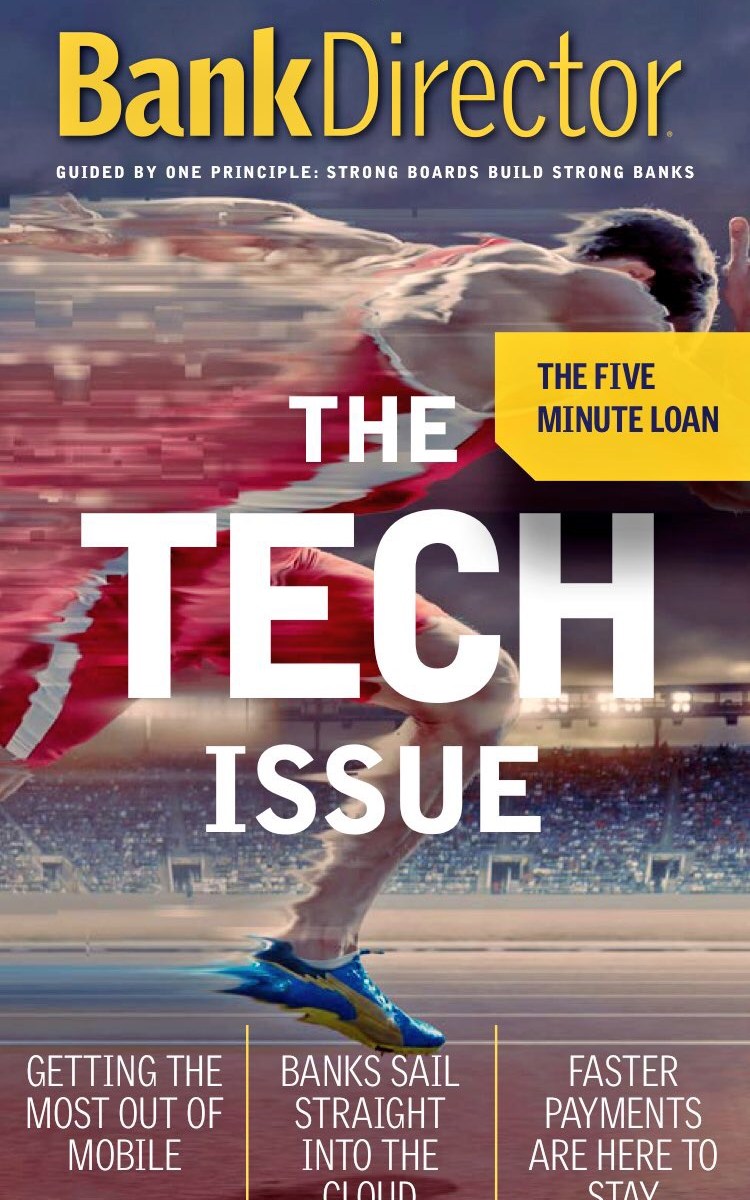
Bank Director’s new Tech Issue

Earlier this week, we published the December issue of Bank Director Magazine, our annual Tech Issue.  Stories range from the changing nature of mobile banking to institutions moving into the cloud to a venture capitalist’s perspective on the future of banking.  I invite you to take a look.

Since starting this blog in 2012, I’ve shared my optimism that the intersection of technological innovation with strong depository franchises may lead to more efficient banking processes, reductions in fraud and a win/win/win for banks, FinTechs and consumers.  So as I read through this current digital issue, a few key takeaways:

  • When San Francisco-based Bank of the West, an $80.7 billion asset subsidiary of BNP Paribas Group, analyzed last year the bottom line impact of customers who are engaged in online banking and mobile banking, it found some surprising results. Digital customers, or those who were active online or on their mobile phones during the previous 90 days, had lower attrition rates than nondigital customers, and they contributed higher levels of revenue and products sold, said Jamie Armistead, head of digital channels at Bank of the West.
  • Automating the small-business lending process requires some deep thinking from boards and management about how much faith they’re willing to place in technology, and their ability to embrace the cultural change implicit in basing lending decisions more on data than judgment. “The marketplace is demanding quicker decisions through technology,” says Pierre Naude, CEO of nCino, a maker of bank operating systems. Bank customers, he says, are clamoring for special products and specialized coding that enable greater automation of the small-business lending process. “Bankers are waking up to the fact that speed and convenience will trump price. You can lose a customer to an alternative lender if you don’t have it.”
  • As our Editor, Naomi Snyder, shares in her welcoming letter, banks tend to have the usual board committees (think audit, compensation and risk).  But we know that few have a board-level technology committee.  So I wonder if 2017 is the year that more institutions decide to create such a group to become better informed and better prepared as the digitization of the banking industry continues?

Concomitant to this issue’s release, Chris Skinner shared his perspectives on the state of FinTech our FinXTech platform.  In his words, “it is apparent that the fintech industry has become mainstream just as fintech investing cools. What I mean by this is that fintech has matured in the last five years, going from something that was embryonic and disruptive to something that is now mainstream and real. You only have to look at firms like Venmo and Stripe to see the change. Or you only have to consider the fact that regulators are now fully awake to the change and have deployed sandboxes and innovation programs. Or that banks are actively discussing their fintech innovation and investment programs… Fintech and innovation is here to stay.”

Clearly, the pace of change in the banking space continues to accelerate.  Accordingly, I encourage you to check out what we’re doing with both Bank Director and FinXTech to help companies who view banks as potentially valuable channels or distribution partners, banks looking to grow and/or innovate with tech companies’ help and support; and institutional investors, venture capitalists, state & federal regulators, government officials and academicians helping to shape the future of banking.

The Changing Nature of Financial Regulation

Last Friday, right before I keynoted the University of Maryland’s Robert H. Smith School of Business’ Marketing & Finance SuperDay, I received an alert from the Wall Street Journal that the Office of the Comptroller of the Currency (OCC) will start issuing bank charters for fintech firms. This move doesn’t come as a surprise; indeed, there have been numerous on-the-record remarks about how and where the fintech sector can benefit smaller “legacy providers” in terms of innovation and scalability.

Until Friday, Thomas Curry, head of the OCC, had taken a firm stance toward FinTechs, making it clear that he would hold them to the standards and regulations written for incumbent financial services institutions. So as the OCC considers the benefits such firms might provide, I’m not surprised the agency will, for the first time, “start granting banking licenses to fintech firms, giving them greater freedom to operate across the country without seeking state-by-state permission or joining with brick-and-mortar banks.”

Now, FinTech is just one area of regulation that is a-changin’. As our Editor-in-Chief, Jack Milligan, recently wrote on BankDirector.com, “one of the more intriguing story lines of the banking industry’s consolidation since the financial crisis is the persistent belief that federal regulators privately want a more concentrated industry with fewer banks because it would be easier for them to supervise, and they signal their support for this laissez-faire policy every time they approve an acquisition.”

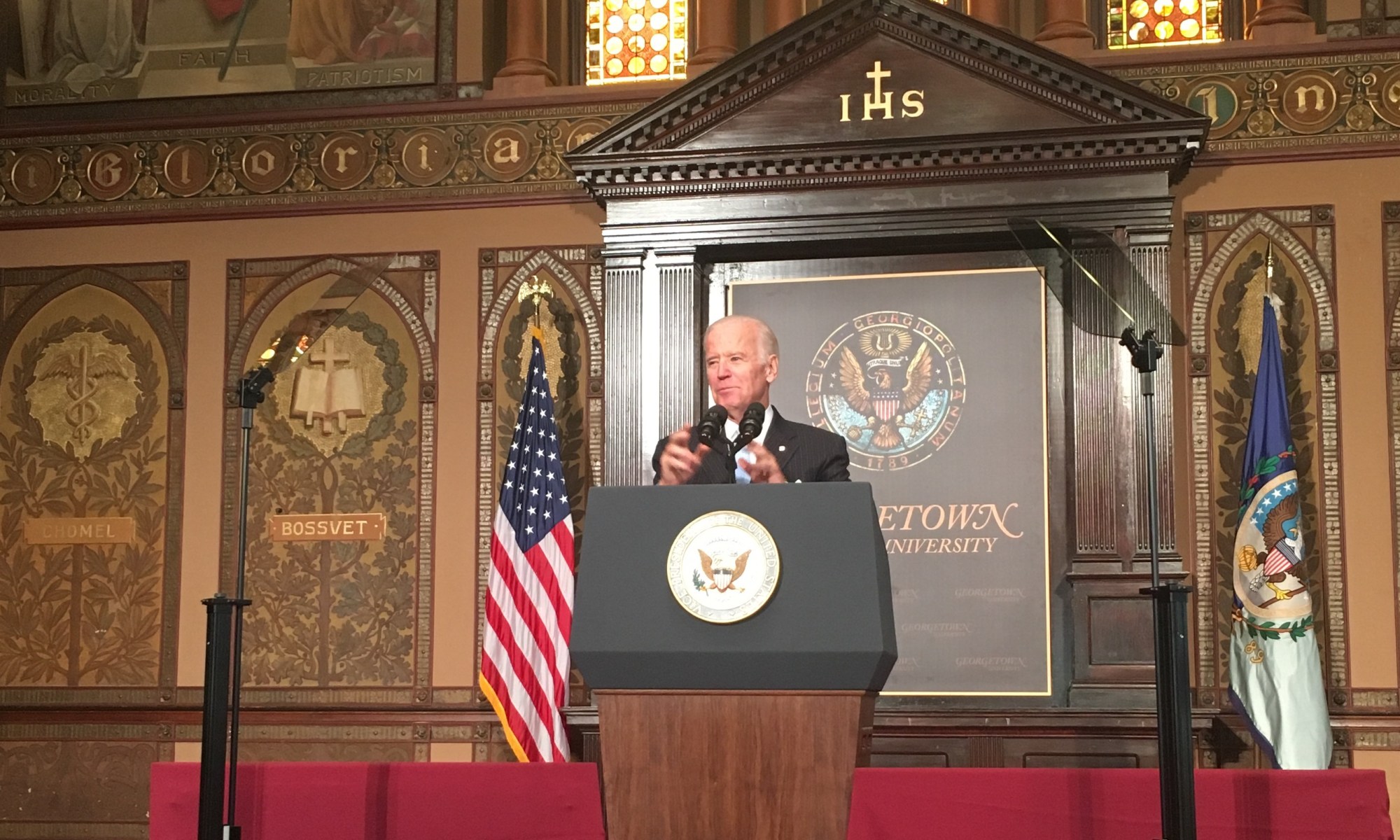
Against this backdrop, I am looking forward to hearing Vice President Joe Biden speak at Georgetown’s McDonough School of Business this afternoon. I have a lot of respect for the Vice President, and find his remarks on “The Importance of Sound Financial Sector Regulation” to fit the timely and relevant standards that we prize at Bank Director and FinXTech. Thanks to the business school’s Center for Financial Markets and Policy for inviting me. As appropriate, I will share my takeaways from this presentation via twitter – @aldominick — and with a follow up post on this blog ASAP.

The #1 Reason That Potential Buyers and Sellers Walk Away From a Bank M&A Deal

According to Bank Director’s 2017 M&A Survey, price is the top reason that potential buyers and sellers have walked away from a deal in the past three years.

With the final days of November upon us, we are a mere 61 days away from hosting Bank Director’s annual Acquire or Be Acquired Conference.  This three-day event explores the various financial growth options available to a bank’s CEO, executives and board members; accordingly, I thought to share some highlights from our just-released Bank M&A Survey that resonate with this audience.

This research project — sponsored by Crowe Horwath LLP and led by our talented Emily McCormick — reflects the opinions of 200+ CEOs, CFOs, Chairmen and directors of U.S. banks.  As Rick Childs, a partner at Crowe, and someone I respect for his opinions and experiences shares, “good markets and good lending teams are the keys for many acquirers, and are the starting point for their analysis of potential bank partners.”  While we cover a lot of ground with this survey, below are five points that stood out to me:

  • An increasing number of respondents feel that the current environment for bank M&A is stagnant or less active: 45% indicate that the environment is more favorable for deals, down 17 points from last year’s survey.
  • 46% indicate that their institution is likely or very likely to purchase another bank by the end of 2017.
  • 25% report that they’re open to selling the bank, considering a sale or actively seeking an acquirer. Of these potential sellers, 54% cite regulatory costs as the reason they would sell the bank, followed by shareholder demand for liquidity (48%) and limited growth opportunities (39%).
  • Price, at 38%, followed by cultural compatibility, at 26%, remain the two greatest challenges faced by boards as they consider potential acquisitions. Price is identified as the top reason that potential buyers and sellers have walked away from a deal in the past three years.
  • 45% report that they are seeing a deterioration in loan underwriting standards within the industry, leading to possible credit quality issues in the future.

Driven by shareholder pressures in a low-growth and highly regulated environment, some community banks could be seeking an exit in the near future. But which banks are positioned to get the best price in today’s market?  This survey provides potential answers to that question — foreshadowing certain conversations I’m sure will occur in January during our 23rd annual Acquire or Be Acquired conference.

##

My thanks to Rick and his colleagues at Crowe for their continued support of this research project.  To see past year’s results — and other board-level research reports we’ve shared — I invite you to take a look at the free-to-access research section on BankDirector.com

5 Cybersecurity Companies Bank Execs & Board Members Need to Know

When it comes to cybersecurity, the best defense might just be a great offense.  Whereas cybersecurity once focused on how banks could avoid losing money, my team and I are working on a program for 2017 to help officers and directors address potential scenarios (and develop realistic response plans) should a hack, breech or attack occur.  Indeed, protecting the bank against a cyber attack is a core responsibility of every member of a bank’s board and executive team.

In recent posts, I’ve highlighted various fintechs that I find compelling given their relationships with financial institutions.  In terms of cybersecurity, I’ve had the chance to learn more about companies like DefenseStorm (given their support of companies like nCino and LiveOak Bank) that I greatly respect.  Below are five more companies that I think bank leadership teams need to know:

Cognizant

A global cybersecurity solution and service provider, Cognizant supports multiple industry verticals and information security service lines.  I encourage you to take a look at their thoughts on what traditional banks can do to rebuild trust in the digital era.

Centrify

California-based Centrify offers identity & access management solutions to help secure enterprise identities against cyberthreats that target today’s IT environment of cloud computing.  Banking customers include such recognizable names as BB&T, SunTrust, Citi and RBS.

Lookout

Lookout has taken a mobile-first approach to security.  Indeed, one of the world’s largest investment management firms chose Lookout to provide threat and data leakage protection to over 10,000 managed iOS and Android devices.

Feedzai

Founded by data scientists and aerospace engineers, Feedzai’s mission is to “make commerce safe for business customers and create a better experience for their consumers through artificially intelligent machine learning.”

Brighterion

Since the founding of Brighterion, its core technology has been adapted and improved for real-time applications in the fields of payment, healthcare, marketing and homeland security.  For instance, its analysis of payments provides “unprecedented behavioral insights,” from the spending behavior of customers to the constantly evolving techniques of fraudsters.

##

As a complement to these five businesses, let me wrap up by sharing a recent FinXTech article:Emerging Technologies Combat Cybercrime.  As you will read, banks are doing everything they can to reassure customers that their digital information is safe and secure.

Whether They Want To or Not, Banks Need to Open Up

Apart from interest rates, the two biggest issues that bank executives seem to wrestle with are regulatory and compliance costs.  I sense another emerging challenge coming to shore; specifically, how to “open up” one’s business structure in terms of developing partnerships and permitting others to leverage their customer data and/or capabilities.

For bankers, this challenge comes with significant reputation and customer risk.

Now, it is hard to truly disrupt the concept of banking — and I shared this opinion from the stage at Bank Director’s annual Bank Executive & Board Compensation Conference this morning.  However, I did adjust some of my welcoming remarks based on the Consumer Finance Protection Bureau’s position that consumers can control their own financial data, including to let third parties help them manage their finances.  As I learned from Jo Ann Barefoot’s Fireside Chat with CFPB Director Richard Cordray at Money 2020, the CFPB “is not content to sit passively by as mere spectators watching these technologies develop.”  According to his prepared remarks:

Many exciting products we see… depend on consumers permitting companies to access their financial data from financial providers with whom the consumer does business. We recognize that such access can raise various issues, but we are gravely concerned by reports that some financial institutions are looking for ways to limit, or even shut off, access to financial data rather than exploring ways to make sure that such access, once granted, is safe and secure.

Since reading the CFPB’s position, Ms. Barefoot’s recap and the Wall Street Journal’s synopsis, I decided to talk with various bank executives and board members that are here with us at the Ritz-Carlton in Amelia Island about this stance.  As I note in this video, I sense both an ongoing struggle — and a sincere interest — to truly understand the role of technology.  For those I talked with, this is as much about “becoming sticky” to their customers as it is about embracing or defending themselves against “the new.”

##

For more about this year’s conference, I invite you to take a look at BankDirector.com.  Also, a virtual high-five to the team here for a great first day.  You all rock!

_mg_0113

Evaluating Board Performance

New regulations, technological innovations and a highly competitive environment that leaves little room for error have placed unprecedented demands on the time and talents of bank boards and their individual directors.  As many who support the banking space can attest, a strong board begins with a set of enlightened governance policies and procedures that center on honesty, personal integrity and accountability.

At Bank Director, we coined the phrase “strong board, strong bank” in response to the mounting pressures placed on the banking community.  Over the years, we have introduced new research projects, conferences and magazine issues to provide exceptionally timely and relevant information to a hugely influential audience.

As I prepare to head down to Florida (and the Ritz-Carlton, Amelia Island) this weekend for our annual Bank Executive & Board Compensation conference, I am anticipating conversations about potential regulatory changes and current strategic challenges related to a bank’s growth and profitability.  Alongside my colleagues Michelle King and Amanda Wages, I also expect to field questions from the audience (depicted in the image above) about how high performing corporate boards employ evaluation tools that match the talents & experiences of their board members to an organization’s strategic goals.  FWIW, I anticipate such inquiries as many consultants and attorneys encourage such assessments — and the board performance self-evaluation tool we designed & offer to banks has earned a strong reputation for providing an independent review of a board’s effectiveness.

To be sure, the banking industry seems to be doing well based on a variety of measures — profitability is high, credit quality is much improved and tangible capital ratios are stronger than ever. However, such financial measures don’t necessarily reflect the challenges facing many banks and their boards.  So in advance of our annual event, I asked our research team to roll up the results from twenty-two bank boards — all randomly selected — that completed a performance survey this year.

While tempting to look at individual board results and draw conclusions, anonymously lumping this group together allows some interesting patterns to emerge given more then 200 individual responses:

  • 50% recognize a need for more diversity on the board;
  • 55% say they need more expertise/knowledge in technology on the board, and 44% indicate a need for more training on IT issues;
  • 51% are dissatisfied with some aspect of the bank’s succession plan, for the CEO and/or the board; and
  • 56% are certain they have the M&A experience to meet the bank’s growth goals (44% say no or are unsure).

While these four points caught my eye, I asked our Director of Research, Emily McCormick, what stands out to her. In her words:

“Many boards lack a consensus on their succession plan, meaning that they’re often not on the same page regarding the depth of that plan. That, to me, is a red flag.”

Anecdotally, many bank CEOs — and board members — that I’ve talked with in person know they need new skills, particularly in technology, and recognize a need for diversity. But as we find, few want to add additional board members.  A fact to keep in mind next week as we explore how to build and support the best teams based on the strategies and tactics being used by successful companies today.

##

We designed our Bank Service offerings to help board members and senior executives develop strategies to help their bank grow, while demonstrating excellence in corporate governance that shareholders and customers deserve and today’s regulators demand.  To learn more, click here.

Bank Director’s 2017 Acquire or Be Acquired Conference

Sunday, January 29th, may seem like quite a ways off… but not for my team at Bank Director.  Indeed, we are full-steam ahead as we prepare to host the premier banking event for CEOs, senior management and board members: our Acquire or Be Acquired Conference.  AOBA continues to draw key leaders together in order to explore financial growth options; in 2017, we host this three-day program at the JW Marriott Phoenix Desert Ridge in Phoenix, AZ.

Each month, Tim Melvin shares nuanced observations on the banking space in his Community Bank Investor Newsletter.  In his October 2016 edition, he points out that “scale and earnings growth are still among the main drivers of M&A activity, and that’s not going to change anytime soon.”  Clearly, the need and desire to grow exists at virtually every organization, something I’ve picked up on while talking with bank CEOs about next January’s event.

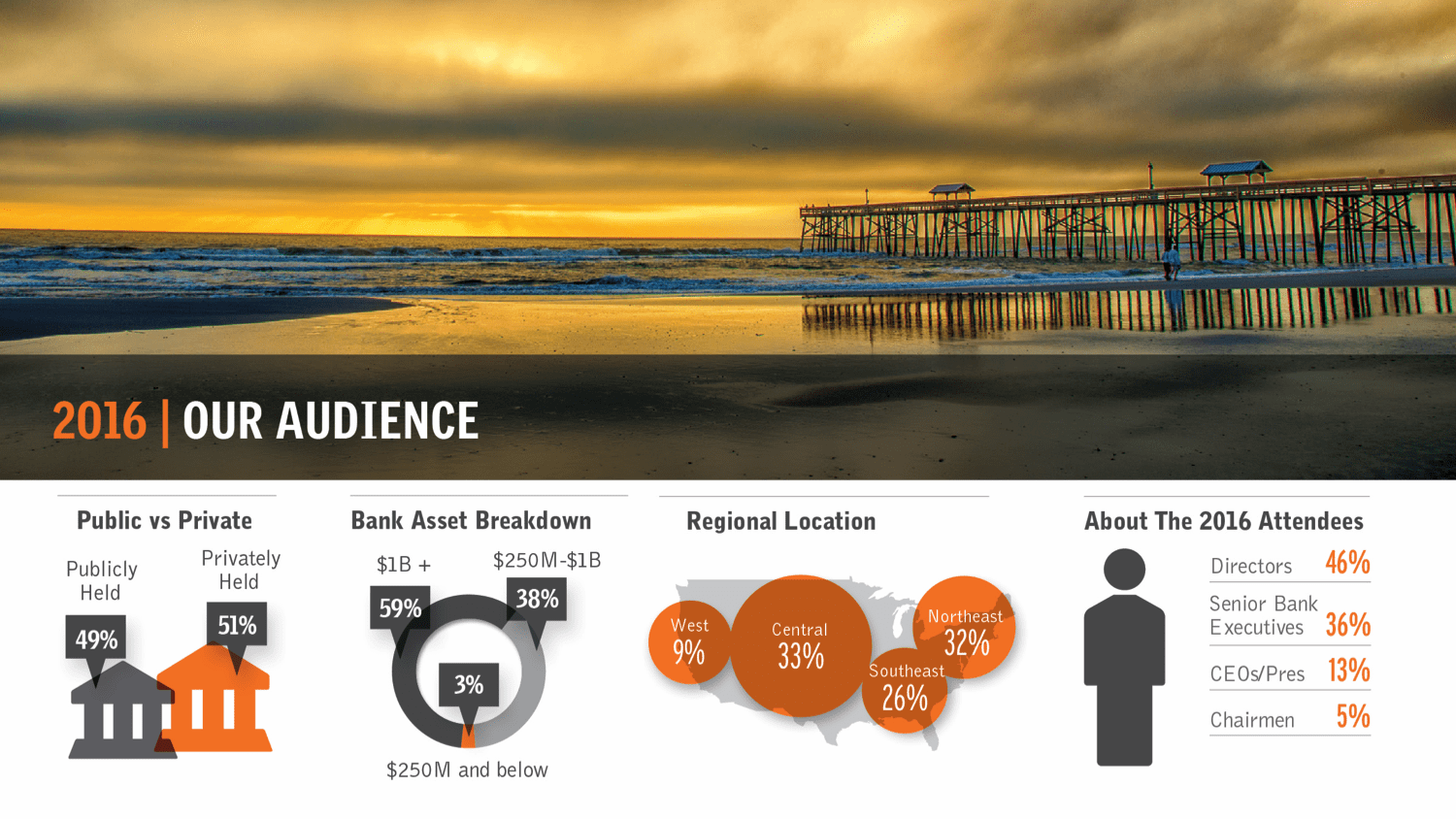
2016 AOBA Demographics c:o Bank Director and Al Dominick

As you can see from this image, our 22nd annual Acquire or Be Acquired Conference brought together key leaders from across the country.  I addition to the 590+ bankers in attendance, an additional 300+ executives from leading professional services and product companies joined us.  During (and following) our time in the desert, I shared various observations on this site (e.g. Five Reasons Why Banks Might Consider Selling in 2016 and Community and Regional Banks are Crucial to the Vibrancy of Our Communities).  In the simplest of terms, I left Arizona with a sense that more bank boards and their management teams were seriously considering M&A as a growth plan than perhaps in previous years — a view formed by the continued margin pressure that banks have been operating under for the last several years.

Ironically, there is a growing likelihood that the bank M&A market in 2016 will see declines in both deal volume and pricing compared to the previous two years, even as the industry’s underlying fundamentals remain relatively unchanged.  Nonetheless, registration patterns for 2017 suggest an increase in bank executive’s appetites to explore a merger, to prepare for an acquisition, to grow loans, to capturing efficiencies & managing capital to partnering with fintech companies (*all topics that will be covered in ’17).  So for those of you looking to refine and/or enhance your growth playbook, I invite you to review the agenda for January’s program that we just updated on BankDirector.com.

##

FWIW: we have welcomed over 5,000 CEOs, Chairmen and members of a bank’s board to this conference over the years, and we anticipate 2017 will be the biggest ever – with over 900 attendees focused on the future of their banks.  Most come with one or more officers of their bank and yes, many bring their spouses.