Pushing Forward: The Future of Financial Services?

Yesterday, the L.A. Times wrote about a bank that is “part lender, part consultant, part cheerleader and part investor… a nursemaid to countless start-ups — Airbnb, Fitbit, Pinterest and TrueCar, to name some recent ones — as well as banking the venture capitalists who fund them.” Curious to learn more about this California-based innovator with a great reputation for serving software, hardware, biotech and healthcare start-ups? Read on.

By Al Dominick // @aldominick

Bank Director’s managing editor, Naomi Snyder, recently wrote that “banks are used to identifying, monitoring and mitigating risks, more so than they are adept at innovating. But an argument gaining increasing weight is the notion that banks really are technology companies and need to think more like a technology company.”  But what if, instead of transforming one’s business model to resemble a tech firm, an institution instead acted like Silicon Valley Bank, the Santa Clara-based powerhouse that has financed scores of the highest-flying tech companies like those mentioned above.

Certainly, this standout financial institution has a knack for staying close to their customers (*take a look at their Innovation Economy Outlook 2015).  So at a time when many banks are shrinking in relevance despite their important role in local economies, I thought to take a look at this “unusual for an FDIC-regulated bank.”  Billed as the bank of the world’s most innovative companies and their investors, the LA Times shared that with $40.2 billion in assets, Silicon Valley Bank now has “the heft to handle them from start-up to initial public offering, multiplying its profits on larger loans and fees.”  Further,

The bank, which recently opened an office in Santa Monica, is more willing than others to focus on a start-up’s growth prospects rather than its current financial condition and to lend money so businesses can expand while awaiting the next round of venture capital funding, said investor Mark Suster, a client and managing partner at Upfront Ventures in Los Angeles.

Now, this doesn’t preclude the bank from identifying a good thing that can help it to continue to push forward the future of financial services.  Case-in-point, I woke up a few days ago to find, via Twitter, that Standard Treasury team joined SVB Financial’s information technology team “to help it expand the bank’s digital banking platform.”  Just as I looked at Capital One’s recent fintech acquisitions in my last post (How Capital One Can Inspire Your Digital Efforts), the fact that the bank hired the team from startup company Standard Treasury to help accelerate the development of its API (application programming interface) banking services underscores the institutions drive to “enable easier collaboration, product development and integration with… clients.”

While catching up to Silicon Valley Bank — which boasts of having half of all startups in the U.S. as clients — will challenge many traditional institutions, I think it makes far more sense to look at what they have accomplished and suggest banks in markets where venture-backed start-ups are taking off try to pattern their business after SVB’s successes rather than radically shifting the underlying business model to emulate what might work for a technology company.

Of course, the LA Times does remind us that “most also don’t come close to Silicon Valley Bank’s well-connected network of outside experts, mentors, tech executives, venture capitalists and current and former clients ready to help its upstart entrepreneurs — no matter how farfetched an idea might seem.” Nevertheless, at a time when individuals along with business owners have more choices than ever before in terms of where, when and how they bank, I think leadership teams at financial institutions of all sizes should pay attention to how Silicon Valley Bank aligns its services (and product mixes) to suit core customers’ interests and expectations.


How Capital One Can Inspire Your Digital Efforts

While venture-backed fintech firms continue to garner attention for being “ahead of the times,” don’t sleep on the franchise being built by Capital One.

By Al Dominick // @aldominick

Should you look at the term “innovation” and disassociate it with the banking sector, you are forgiven.  But innovative is exactly the description I favor for Capital One Financial Corp. (NYSE: COF), especially as I define the term as an ability to monetize creative ideas, products and processes.  Indeed, the McLean, VA-based bank ranked first among the 20 publicly-traded banks with assets of more than $50 billion in Bank Director magazine’s annual Bank Performance Scorecard and is widely considered at the forefront of taking a technology-based, consumer-centric focus to banking.

As we see in their financial performance, Capital One managed to increase net income and benefited from the high profitability of a substantial credit card operation and the stable funding of a regional banking franchise.  As you can read, the company rated highly on traditional profitability metrics: they posted a return on average assets (ROAA) of 1.53, a return on average equity (ROAE) of 10.33 and a Tangible Common Equity ratio of 9.82.  So while various fintech companies make news for their valuations (*hello Stripe, which received major funding from Visa and other investors, valuing the startup at $5 billion) or loan volume (**hola Lending Club, which originated nearly $2 billion in loans during Q2), I’m paying attention to Capital One’s performance.

Nonetheless, their financial numbers don’t tell the whole story.

As our editor, Jack Milligan, writes in “How Young and Hungry Fintech Companies are Disrupting the Status Quo,” the digital financial services space “is exploding in activity as new technology companies push their way into markets and product lines that traditionally have been the banking industry’s turf.” To this point, many bank executives should take note of Capital One’s focus on technology and its business model.  Its CEO, Richard Fairbank, is focused on leading the digital transformation of banking and is not shy in stating that “the winners in banking will have the capabilities of a world-class software company.  Most of the leverage and most of our investment is in building the foundational underpinnings and talent model of a great digital company.  To succeed in a digital world (you) can’t just bolt digital capabilities onto the side of an analog business.”

Cases in point, Capital One acquired money management app Level Money earlier this year to help consumers keep track of their spendable cash and savings.  Prior to that, they acquired San Francisco-based design firm Adaptive Path “to further improve its user experience with digital.”  Over the past three years, the company has also added e-commerce platform AmeriCommerce, digital marketing agency Pushpoint, spending tracker Bundle and mobile startup BankOns.  Heck, just last summer, one of Google’s “Wildest Designers” left the tech giant to join the bank.

More and more banks are realizing that they have to fundamentally change to keep up with the industry’s digital transformation.  But shifting an organizational structure — and culture — to become more focused on what customers want and expect in an increasingly digital age is no simple task.  Not everyone can offer a broad spectrum of financial products and services to consumers, small businesses and commercial clients like Capital One does.  But all can certainly learn from the investments, partnerships and efforts being made by this standout institution.

In case you’re wondering…

Bank Director’s Bank Performance Scorecard uses five key metrics that measure profitability, capitalization and asset quality. ROAA and ROAE are used to gauge each bank’s profitability.  KeyCorp (NYSE: KEY), of Cleveland, ranked second, and rated highest for capital adequacy, with a TCE ratio of 9.87. In third place, U.S. Bancorp (NYSE: USB), of Minneapolis, topped the profitability metrics with a 1.55 ROAA and 13.53 ROAE. Wells Fargo & Co. (NYSE: WFC) and Comerica Inc. (NYSE: CMA) rounded out the top five.

Quick Guide: Banking’s Digital Transformation (#Payments)

Developing faster payments capabilities is a critical element within the banking industry’s digital transformation.

In yesterday’s post (The 5 Corners of Technological Innovation in Financial Services), I looked at the introduction of an Innovation Group at Wells Fargo that, in the words of their CEO, “puts an even larger focus on creating the products, services, and technologies” that will allow the institution to stay competitive and allow its customers to do their banking when, where, and how they would like.

As I dug into the Wells story — which received a lot of play from the press — It strikes me that to successfully transition one’s business model, innovation teams such as this one need to work in concert with major business groups like wholesale and commercial banking, commercial real estate, trust and wealth management, and payments / consumer banking.  As I consider how banks actually operate — e.g. how work is done, the degree of automation, the pricing and design of products and underlying compensation systems — I revisited several videos from Bank Director’s annual FinTech Day @ NASDAQ.  One, of Ben Plotkin, Vice Chairman of Stifel / Executive Vice President of Keefe, Bruyette & Woods, stands out, as he shares his perspective on how banks of all sizes can find success.

Ben touched on the payments space, and I too am curious to explore the role banks must play in the emerging payments ecosystem.  Here, Accenture provides valuable context as the world becomes more digital: “speed in all aspects of financial services is increasingly important. The payments ecosystem is no exception. Faster payments are taking shape across the globe—and may become industry standard.  While faster payments can enhance the customer experience and improve cash flows, it introduces a number of complexities, such as capital costs, and accounting and fraud systems impacts. In the short term, providing the impression of a near-real-time payment through memo posting and verifying the certainty of payment could be implemented sooner, and may meet expected market demand.”

Certainly, the trend toward digital money continues to gain momentum, and when it comes to the payment space, there are emerging technologies that have the potential to dominate the financial landscape (e.g. P2P & Blockchain methods).  Case-in-point, Stripe, the California-based online payments company, has raised new investments which have raised the company valuation to $5 billion.  Per a report in yesterday’s Let’s Talk Payments (h/t Brad Leimer @leimer), the funding “was led by financial giant Visa and experts believe this is a huge endorsement for Stripe. The company had previously raised a total funding of $190 million from high-profile investors including PayPal co-founders, Sequoia Capital, Box CEO Aaron Levie, Khosla Ventures, Andreessen Horowitz and others.”  As The New York Times reported, the companies’ strategic alliance will give Stripe access to Visa’s global network of issuers and acquirers.  BI Intelligence Payments Insider notes the companies will also collaborate to create online checkout solutions and buy buttons that can be plugged into developers’ websites anywhere.

How we pay, borrow and invest continues to change the way we conduct our financial payments.  It is fascinating to watch as companies like Stripe, PayPal, Dwolla, etc hustle to simplify how businesses accept payments through mobile applications while banks like Wells Fargo invest to do the same.

The 5 Corners of Technological Innovation in Financial Services

To grasp what the future of banking holds, look no further than the five areas of focus for Wells Fargo.  Last week, the best performing large bank in the United States launched an “Innovation Group” in San Francisco.  As they share, this team will will work in partnership with its major businesses to meet evolving customer needs and stay ahead of the shifting competitive landscape.  Initially, such efforts will center on five areas:

  • Research and development;
  • Innovation strategies;
  • Payment strategies;
  • Design and delivery; and
  • Analytics.

As a nationwide, diversified, community-based financial services company with $1.7 trillion in assets, Wells Fargo now has six innovation labs along with its startup “accelerator.”  Given that a number of the world’s largest finance sector companies are reviewing their business models following the rapid growth of “fintech” entrants in the sector, the investment in both time and resources by Wells Fargo gives shape to the potential future of banking.

Wells Fargo Labs invite customers to “Come out and Play: Be one of the first to test out latest ideas and technologies – from still-in-development beta offerings to newly launched products.”

Personally, I’m drawn to this new addition to the Wells family in light of a report by the World Economic Forum, supported by Deloitte Consulting, entitled The Future of Financial Services:How disruptive innovations are reshaping the way financial services are structured, provisioned and consumed.

As noted by the paper’s lead author, “for decades, banks and insurers have employed similar, highly profitable business models. But they realize those models are coming under pressure due to fintech innovations… Financial technology companies are deploying online platforms, have small capital bases, and make strategic use of data, to acquire customers and revenues at a fast pace. Banks and insurers noted that, and are contemplating their response.”  So as major players like Wells Fargo explore the “transformative potential of new entrants and innovations on business models in financial services,” seeing the cards they are putting on the table provides real color for what the future holds for many here in the U.S.

What To Do With FinTech

For the 699 financial institutions over $1Bn in asset size today, the drive to improve one’s efficiency ratio is a commonly shared goal.  In my mind, so too should be developing relationships with “friendly” financial technology (FinTech) companies.

By Al Dominick // @aldominick

Small banks in the United States — namely, the 5,705 institutions under $1Bn in assets* — are shrinking in relevance despite their important role in local economies.  At last week’s Bank Audit & Risk Committees Conference in Chicago, Steve Hovde, the CEO of the Hovde Group, cautioned some 260 bankers that the risks facing community banks continue to grow by the day, citing:

  • The rapid adoption of costly technologies at bigger banks;
  • Declining fee revenue opportunities;
  • Competition from credit unions and non-traditional financial services companies;
  • Capital (in the sense that larger banks have more access to it);
  • An ever-growing regulatory burden; and
  • The vulnerability all have when it comes to cyber crime.

While many community banks focus on survival, new FinTech companies have captured both consumer interest and investor confidence.  While some of the largest and most established financial institutions have struck relationships with various technology startups, it occurs to me that there are approximately 650 more banks poised to act — be it by taking the fight back to competitive Fintech companies or collaborating with the friendly ones.

According to John Depman, national leader for KPMG’s regional and community banking practice, “it is critical for community banks to change their focus and to look for new methods, products and services to reach new customer segments to drive growth.”  I agree with John, and approach the intersection of the financial technology companies with traditional institutions in the following manner:

For a bank CEO and his/her executive team, knowing who’s a friend, and who’s a potential foe — regardless of size — is hugely important.  It is also quite challenging when, as this article in Forbes shows, you consider that FinTech companies are easing payment processes, reducing fraud, saving users money, promoting financial planning and ultimately moving our giant industry forward.

This is a two-sided market in the sense that for a FinTech founder and executive team, identifying those banks open to partnering with, investing in, or acquiring emerging technology companies also presents great challenges, and also real upside.  As unregulated competition heats up, bank CEOs and their leadership teams continue to seek ways to not just stay relevant but to stand out.  In my opinion, working together benefits both established organizations and those startups trying to navigate the various barriers to enter this highly regulated albeit potentially lucrative industry.

*As of 6/1, the total number of FDIC-insured Institutions equaled 6,404. Within this universe, banks with assets greater than $1Bn totaled 699. Specifically, there are 115 banks with $10Bn+, 76 with $5Bn-$10Bn and 508 with $1Bn – $5Bn.

Main Areas of Focus for a Bank’s Audit and Risk Committees

What’s top-of-mind for a bank’s Audit and Risk committee members?  Let’s start with cyber security…

By Al Dominick // @aldominick

There are many challenges that bank boards & executives must address, and these two videos (one by our editor, Jack Milligan; the other, by me) briefly review current issues that demand attention + emerging ones that we took note of at this week’s Bank Audit & Risk Committees Conference at the JW Marriott in Chicago.

*For more on the risks facing banks today, take a look at this report from our conference (#BDAudit15).

How to Understand a Bank’s Audit and Risk Committees Issues in Three Steps

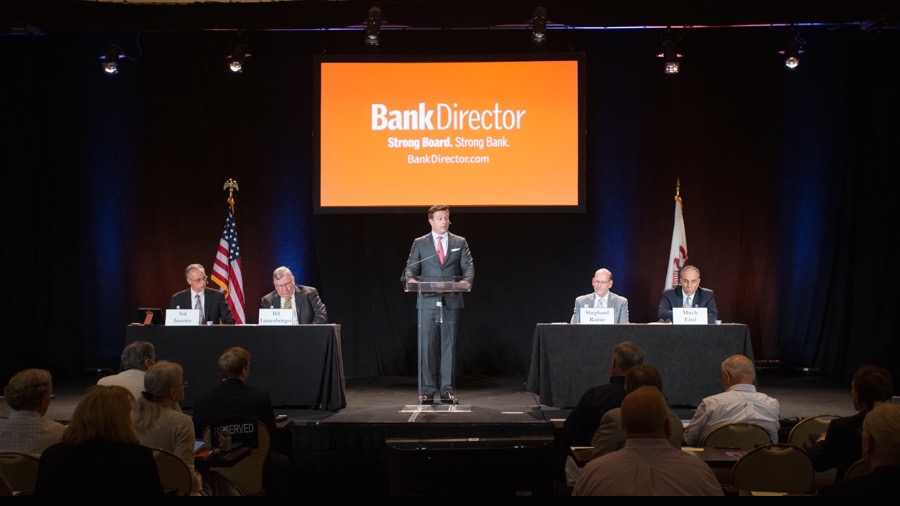
I’m in Chicago at Bank Director’s annual Bank Audit & Risk Committees Conference along with more than 260 bankers and some 315 total attendees.  At a time when audit and risk committees have an increasing amount of responsibilities, I’m impressed with the commitments made by attendees and speakers alike to tackle real issues as opposed to sugar coating the challenges before banks today.

As we move into a series of afternoon breakout sessions, I am taking a pause to share my observations on the day so far.  Having moderated a session that touched on how banks can enhance risk oversight capabilities and effectively challenge management on risk, let me try to make sense of the issues being faced by senior bankers and board members if you are not with us.

Step 1: Know Where We Are Coming From

Now that the worst of the financial crisis is behind them, you might think bank boards might finally breathe a sigh of relief.  You would be mistaken.  For example, we have been in an exceptionally low-interest rate environment — one that has caused net interest margins to decline significantly since 2000.  Moreover, growing the bank organically remains challenging with slow loan growth and changing consumer expectations.  Finally,  compliance costs and uncertainties continue to escalate.  So yes, for banks here with us in Chicago, the storm was weathered.  Still, significant risks and challenges remain in place.

Step 2: Accept Where We Are Today

Per our first speaker, Steve Hovde, it has become exceedingly more difficult to maintain net interest margins without growing loan balances.  As he made clear, banks with lower loan-to-deposit ratios operate with less overhead, but they have been unable to translate their lower operating costs into higher profitability over the long run.  In his words, loan growth is now paramount to profitability — and banks will need to find ways to generate loans either organically or (more likely) through M&A activity.

I know that many banks are struggling to find new revenue sources.  I also hear how bank boards are considering diversifying into new loan products and service offerings to attract and retain new and existing customers.  So, for banks considering new lending strategies or launching a new product or service, I made note that the audit committee, risk committee and internal auditor must collaborate to safeguard the organization by understanding an organization’s initiatives, limits and controls, all while understanding the risk monitoring that exists at the institution.

Step 3: Understand Where Things Are Heading

As we look ahead, it is quite clear that the largest banks in the U.S. (e.g. those above $50Bn in assets) have greatly benefited from their ability to spread fixed costs over a larger pool of earning assets.  They have lower efficiency ratios, more non-interest income and stronger earnings.  Since there are at most 30 banks that are above that $50Bn threshold out of some 6,500 banks, the risks facing most of the industry may take various forms but share similar origins.  That is, banks — and their boards — will continue to wrestle with technology issues, find fewer opportunities to replace declining fee revenue, deal with non-regulated “shadow” banks, struggle with regulatory cost burdens and expectations, face new cyber threats and have to address third-party vendor risks.

##

Tomorrow, I will have more to share on this afternoon’s breakout sessions and our final point/counterpoint session.  In between, I invite you to follow the conversation via Twitter using #BDAudit15, @bankdirector and/or @aldominck.

Quick Guide: Bank Mergers & Acquisitions

Mergers & Acquisitions will continue to serve as one of the biggest revenue drivers for banks in the United States.

By Al Dominick // @aldominick

I’m in Chicago to host Bank Director’s annual Bank Audit & Risk Committees Conference, an exclusive event for Chief Executive Officers, Chief Financial Officers, Chief Risk Officers, Chairmen and members of the board serving on an audit or risk committee.  As I reviewed my speaker notes on yesterday’s flight from D.C., it strikes me that of all of the risks facing a bank’s key leadership team today — e.g. regulatory, market, cyber — knowing when to buy, sell or grow independently has to be high on the list.

While we welcome officers and directors to a series of peer exchanges and workshops today, the main conference kicks off tomorrow morning. To open, we look at the strategic challenges, operating conditions and general outlook for those banks attending this annual event.  With public equities and M&A valuations at multi-year highs, numerous institutions having raised capital to position themselves as opportunistic buyers and sellers continuing to take advantage of a more favorable pricing environment, I thought to share three points about bank M&A for attendees and readers alike:

  1. In 2014, there were 289 whole-bank M&A transactions announced (and 18 failed-bank transactions) for a total of 307 deals. Through the first quarter of this year, there have been 67 whole-bank M&A transactions announced and just 4 failed-bank transactions.
  2. KPMG’s annual Community Banking Outlook Survey illustrates that M&A will be one of the biggest revenue drivers for community banks over the next three years, especially as community banks face the need to transform their businesses in an effort to reach new customer segments and streamline their operations.
  3. The continued strengthening of transaction pricing — with 2015 transaction multiples at the highest levels since 2008 — is an important and emerging trend.

According to Tom Wilson, a director of investment banking with the Hovde Groupmany of the factors driving the current M&A cycle have been well documented and remain largely unchanged.  These include improving industry fundamentals, increased regulatory costs, net interest margin compression in a low rate environment, industry overcapacity and economies of scale.  As he notes, while those themes have been playing out in various forms for several years, some additional themes are emerging that are significantly impacting the M&A environment; for example, “the advantages of scale are translating to a significant currency premium. For years we have seen a significant correlation between size, operating performance and currency strength. Lately, that trend has become a significant currency advantage for institutions with greater than $1 billion in assets and resulted in smaller institutions being constrained in their ability to compete for acquisition partners because of a weaker valuation.”

Moreover, an industry outlook published by Deloitte’s Center for Financial Services earlier this year says that the “M&A activity seen in 2014 is likely to continue through 2015, driven by a number of factors: stronger balance sheets, the pursuit of stable deposit franchises, improving loan origination, revenue growth challenges, and limits to cost efficiencies.” However, their 2015 Banking Outlook also acknowledged that “as banks move from a defensive to an offensive position to seek growth and scale, they should view M&A targets with a sharper focus on factors such as efficiencies, growth prospects, funding profile, technology, and compliance.”

##

For those looking for more on bank M&A, let me suggest a read of our current digital issue (available for free download through Apple’s App Store, Google Play and Amazon.com).  In it, we look at how to “bullet-proof” your deal from shareholder lawsuits and have a great video interview with ConnectOne Bank’s CEO, Frank Sorrentino, who talks about how his bank fought back against fee-seeking shareholder activists.  To follow the conversations from the JW Marriott and Bank Director’s annual Bank Audit & Risk Committees Conference, check out #BDAUDIT15, @bankdirector and @aldominick.

A Complete Guide to Bank Director’s Audit & Risk Committees Conference

Whether it is a complex product, new service or emerging line of business, this year’s Bank Audit & Risk Committees Conference examines the many issues and opportunities being faced in boardrooms at financial institutions of all sizes across the country.

By Al Dominick // @aldominick

While much has been written about how and where banks might grow, with new opportunities come new challenges.  With our industry undergoing significant change, boards must be highly informed in order to proactively oversee the management of security risks, compliance challenges and reputational issues.  At this year’s Bank Audit & Risk Committees Conference, we focus in on key accounting, risk and regulatory issues that challenge bankers and board members alike.  Today’s column tees up this year’s program, one that opens on Wednesday at the JW Marriott in Chicago, IL.

Screen Shot 2015-06-08 at 2.03.43 PM

Wednesday, June 10

Before the curtains officially come up, we offer a series of pre-conference programs; most notably, a series of peer exchanges exclusive to a bank’s audit and risk committee chairs.  Modeled upon our annual Bank Chairman/CEO Peer Exchange, small groups of directors meet in closed door, off-the-record peer exchanges for candid discussions about various hot topics.  In addition, we have added a cyber security workshop that allows attendees to play out various scenarios that involve a hack, breach or attack.  Finally, we offer a primer for newer audit and risk committee members and chairs that provides a framework for both roles and responsibilities.

Thursday, June 11

According to several bankers I have recently talked to, this has become a must-attend event for audit committee members, audit committee chairs, CEOs, CFOs, presidents, corporate secretaries, internal auditors, chief risk managers and other senior executives who works closely with the audit and/or risk committee.  This year, we cover pertinent issues such as enterprise risk management, fraud, relations with internal and external auditors, audit committee oversight and regulatory changes for banks.  It is this ability to focus in on critical concerns and complex scenarios to a very specific group of officers and directors that sets us apart from others.  At a time when audit and risk committee members are being asked to take on more responsibilities and perform at higher levels than ever before, the presentations made on day one are laser-focused on key financial, risk management and regulatory issues.

Friday, June 12

A significant imperative for members of a bank’s board today?  Fully integrate risk management, compliance and ethics “that fit” into a particular bank’s culture.  On day two, we look at how this might be done while addressing many other challenges.  Indeed, some of the key risks facing banks today (that regulators expect boards and senior managers to address) include:

  • Strategic risk as banks adapt business models to respond to the current economic and competitive landscapes;
  • Management succession and retention of key staff;
  • Loosening loan underwriting standards;
  • Expansion into new products and services;
  • Exposure to interest rate risk;
  • Oversight of third party service providers;
  • Increased volume and sophistication of cyber threats;
  • BSA/AML risk from higher-risk services and customer relationships; and
  • Maintaining effective compliance management systems.

The presenters at this event are some of the leading experts in accounting, legal, consulting and regulatory areas, as well as experienced bank officers and directors.  From Sullivan & Cromwell to KPMG, Arnold & Porter to Crowe, Latham & Watkins to FIS, we are pleased to bring some of the industry’s foremost advisors together in Chicago.

##

To follow the conversation via Twitter, check out #BDAUDIT15, @bankdirector and @aldominick.

The Week in Pictures (Inspired by a New App & Dig’Mag)

With Memorial Day jockeying for attention, allow me to reflect on a great week.  Specifically, by sharing pictures from Monday evening at Urban Grub in Nashville, TN where the Bank Director team, along with friends & family, celebrated the development and launch of our new app and digital magazine.  

While many companies in the content business are moving away from print or simply discontinuing operations, we are ramping up to meet the needs of our audience.  Our new digital magazine is not simply a replica of, or replacement for, our print publication.  Rather, it is a dynamic new product that allows us to stay on top of emerging trends specific to a bank’s key leadership team.  What makes the launch so much sweeter for me personally?  All of our “friends” who have decided to take the concept of “imitation as flattery” to ridiculous extremes will have quite the go trying to replicate something built by scratch from our very talented team.

So along with the open bar & champagne toast, what was on the menu? Mmmm, a charcuterie of house cured meats, local & imported cheeses, a roasted oyster & crawfish boil, corn and red potatoes, a whole roasted suckling pig, ham hock collards, white beans and a desert of banana pudding pie.  All deeee-licious.  So a big thank you to the folks at Urban Grub for taking care of us… and a HUGE congratulation to our entire team on a job so very well done!!

*Bank Director’s free app & digital magazine is now available for download through Apple’s App Store, Google Play and Amazon.com.

There’s A New App For That

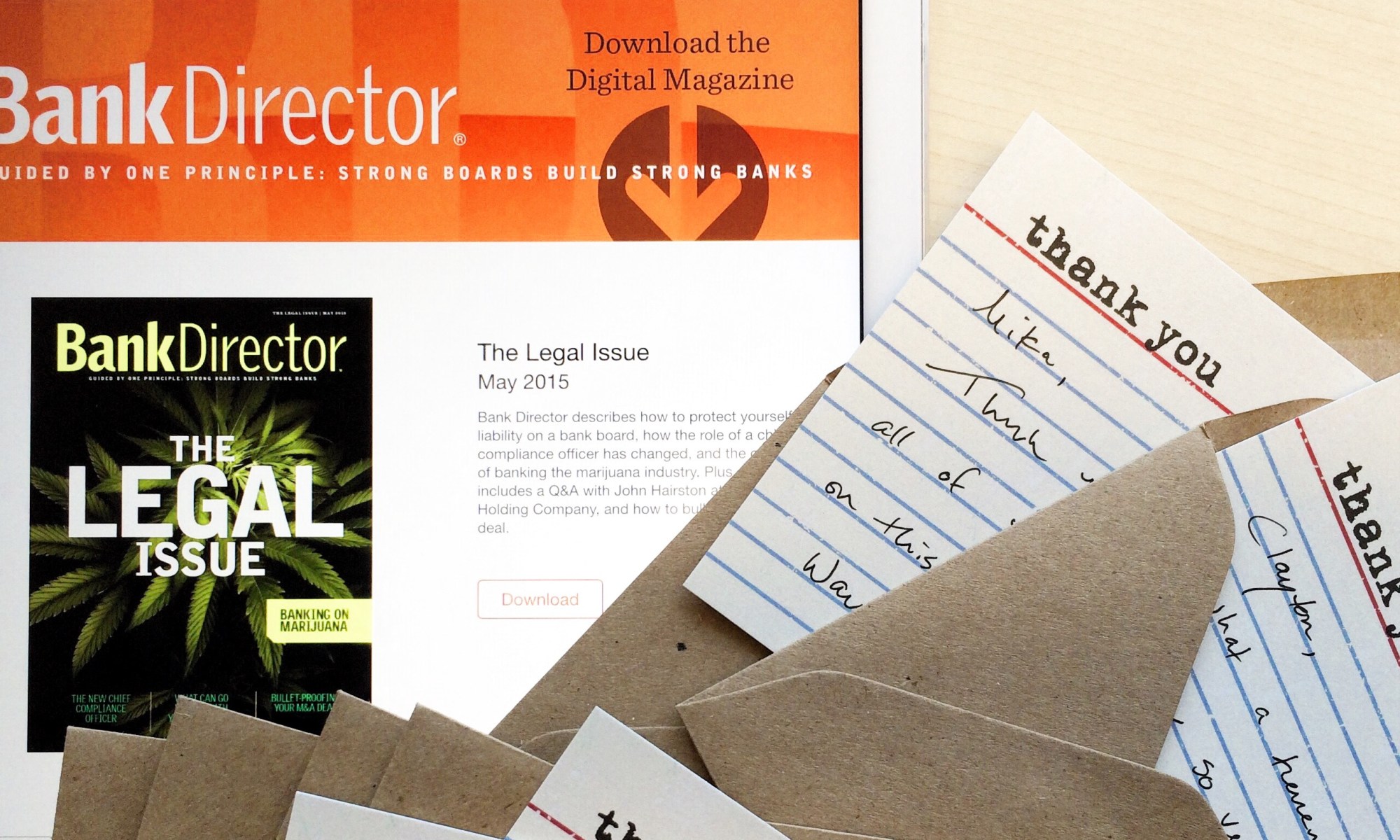
This morning, my company officially launched a state-of-the-art app to deliver a new monthly digital magazine which complements our quarterly, print-version.  A huge amount of time and effort went into the design, development and approval process, so I am very proud to share that Bank Director’s free app & digital magazine is now available for download through Apple’s App Store, Google Play and Amazon.com.  A HUGE thank you to our team that built it.  Also, my apologies to anyone looking to imitate this new offering.  It is home-grown and totally customized to the informational, educational and training needs of bank officers and directors today.

By Al Dominick // @aldominick

Since 1999, the number of commercial banks and savings institutions in the United States has decreased from 10,220 to approximately 6,500.  On the surface, this would not seem to be a robust market in which to base a business model.  However, among those still in the banking business, there is a tremendous appetite for information that will help a CEO, CFO, General Counsel, Chairman and board of directors to maintain a competitive edge — and that is the role that my team at Bank Director fills.

We designed Bank Director’s digital magazine specifically for tablet devices and incorporate interactive features such as animated infographics, video interviews and real-time polling.  Starting today, it can be accessed for free by downloading the app through Apple iTunes, Google Play or Amazon.com.  Unlike the print version — in circulation since 1991 — these digital issues have a distinct editorial focus each month.  Case-in-point, we light up the first issue with a cover story on the legal and compliance issues facing institutions interested in banking the marijuana industry.  Subsequent issues focus on attracting talent, growing the bank, serving on the audit or risk committee, handling governance and overseeing technology.

While many companies in the content business are moving away from print or simply discontinuing operations, we are ramping up to meet the needs of our audience.  This is not simply a replica of, or replacement for, our print publication.  It is a dynamic new product that allows us to stay on top of emerging trends.  For those of you familiar with our quarterly print publication, I hope this provides you added insight each month to the issues facing our industry.  For those of you not as familiar with Bank Director, I invite you to take a moment to experience this great new content now available anytime, anywhere.

IMG_3447

Bank Mergers and Acquisitions

“The reality is organic growth is tough,’’ said Chris Myers, the president and CEO of the $7.2-billion Citizens Business Bank in Ontario, California, who spoke at our Acquire or Be Acquired conference in January.  His bank is one of those in the “sweet spot” for higher valuations and higher profitability, but even he feels the pressure to grow. “A lot of banks are stretching to try to grow [loans] and do things they wouldn’t have done in the past,’’ he said, commenting on the competition for good loans. “ We are going to need to do some acquisitions.”

By Al Dominick // @aldominick

The classic build vs. buy decision confronts executives in every industry.  For bank CEOs and board members today, mergers and acquisitions (M&A) remain attractive inasmuch as successful transactions improve operating leverage, earnings, efficiency and scale.  While I recently wrote that the best acquisition a bank can make is of a new customer, today’s post looks at what’s happening with bank M&A by sharing a few of my monthly columns that live on BankDirector.com:

  • Why Big Banks Aren’t Merging — with global companies announcing huge acquisitions, I look at where the banking industry is today.
  • Stressed Into Selling — after the largest U.S.-based banks passed the Federal Reserve’s stress tests, I write about modeling various economic conditions that might help a bank’s board to anticipate potential challenges and opportunities.
  • Don’t Sell The Bank —  figuring out when a bank should be a buyer—or a seller—had been on my mind since the Royal Bank of Canada announced a deal for “Hollywood’s bank,” City National, and this piece explored why now is not the time to sell.
  • Why Book Value Isn’t the Only Way to Measure a Bank — as the market improves and more acquisitions are announced, why I expect to see more attention to earnings and price to earnings as a way to value banks.
  • Deciding Whether to Sell or Go Public — while the decision to sell a company weighs heavily on every CEO, there comes a point where a deal makes too much financial and cultural sense to ignore.

In addition to these five columns, I invite you to read this month’s column, “Mind These Gaps,” which posts today on BankDirector.com.  It focuses on various pitfalls that have upended deals that, on paper, looked promising (e.g. due diligence and regulatory minefields, the loss of key talent/integration problems and bad timing/market conditions).  With perspectives from some of the country’s leading investment bankers and attorneys, it is one I’m pleased to share.  Don’t worry, unlike other sites, there is no registration — or payment — required.