Banks Are Feeling the Pressure to Grow

Bank executives and board members are feeling significant pressures to grow in 2016, according to Bank Director’s 2016 Bank Mergers & Acquisitions Survey, sponsored by Crowe Horwath LLP.

By Al Dominick, President & CEO, Bank Director

Bank CEOs and their boards face some very significant challenges in the years ahead.  The sharply increased cost of regulatory compliance might lead some to seek a buyer; others have responded by trying to get bigger through acquisitions in order to spread the costs over a wider base.  While transforming a franchise through organic growth is desirable, I continue to see mergers & acquisitions (M&A) remaining the fastest avenue for growth in banking today.

For those who joined us at our annual Acquire or Be Acquired Conference last month, you may recall that Bank Director’s team surveyed 260 chief executive officers, chairmen, independent directors and senior executives of U.S. banks in advance of the conference to examine current attitudes and challenges regarding M&A — and what drives banks to buy and sell.  Three points stand out to me:

  1. Of the respondents who served as a board member or executive of a bank that was sold from 2012 to 2015, a full 55% say they sold because shareholders wanted to cash out.
  2. Despite concerns that regulatory costs are causing banks to sell, just 27% cite this burden as a primary motivator.
  3. Credit quality issues are most often cited barriers for banks being able to complete acquisitions.

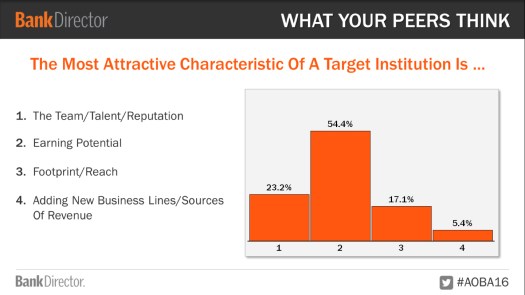
Certainly, “why banks are bought or sold” involves much more than just the numbers making sense.  At AOBA, it was made abundantly clear that M&A remains attractive inasmuch as successful transactions improve operating leverage, earnings, efficiency and scale.  Moreover, attendees shared during one of our interactive sessions that earnings potential is the most attractive characteristic of an institution they are interested in acquiring.

Bank Director and Crowe Horwath LLP AOBA info

In his “Buy Or Die In Phoenix: A Recap Of The 2016 Bank Director’s Acquire Or Be Acquired Conference,” Tim Melvin neatly summarizes the conundrum many bank CEOs face today.  “Competing against their bigger, better funded rivals is… (a) huge obstacle to growth. The days of opening branches on the other side of town, then the next town over and so on to grow a bank are over.”  He concludes by recounting a point made by Steve Hovde, an investment banker we’ve worked with for a number of years: “to thrive, you have to get bigger. To get bigger you probably have to buy and again, if you can’t buy you probably have to sell.”

Community and Regional Banks are Crucial to the Vibrancy of Our Communities

As we head into the final day of Acquire or Be Acquired, its clear to me that there are some great opportunities for community and regional banks to compete effectively and recapture market share in 2016.

*Thanks to our keynote speaker, J. Michael Shepherd, Chairman & CEO, Bank of the West and BancWest Corporation for inspiring today’s title and video.


Acquire or Be Acquired: Don’t Overlook This

Thanks to our keynote speaker, J. Michael Shepherd, pictured above. The Chairman & CEO, Bank of the West and BancWest Corporation, he inspired quite a few with both his wit and wisdom.

Over the past few days at Bank Director’s annual Acquire or Be Acquired conference, various speakers have touched on a number of key strategic growth issues.  From exploring an acquisition to growing loans, controlling expenses to managing capital, the discussions hit the “timely and relevant” standard that we consider essential.  They also reinforced my sense that more boards and their management teams are seriously considering an acquisition as their primary growth plan than at this time last year.

As our editor-in-chief opined, the heightened level of interest could certainly be explained by the continued margin pressure that banks have been operating under for the last several years.  For those thinking about buying another, my short video recap from the mid-way point of AOBA offers a heads up about a pre-deal consideration not to be overlooked.


What’s Happening at Acquire or Be Acquired

Throughout the first day of Bank Director’s 22nd annual Acquire or Be Acquired Conference, I found quite a few presentations focused on the emergence of mid-sized regional banks that are growing through the consolidation of smaller banks.  Clearly, mergers & acquisitions provide an avenue for some banks to drive improved operating leverage, earnings, efficiency and scale.  At the same time, the pressures prompting larger banks to innovate — sluggish loan demand, depressed revenue, higher compliance costs — are the same ones forcing smaller banks to pursue a sale.

By Al Dominick, President & CEO, Bank Director

For those unfamiliar with “AOBA,” this annual event explores issues like the one mentioned above.  Since the conference kicked off at 8 AM on a Sunday, this morning’s post shares three short video recaps from my time at the Arizona Biltmore followed by links to recent posts specific to this conference.

In addition to these videos, below are links to four of my posts specific to the event:

If these types of conversations interest you, take a look at what we’re sharing on BankDirector.com.  Additionally, I invite you to follow me on Twitter via @AlDominick, the host company, @BankDirector, and search & follow #AOBA16 to see what is being shared with (and by) the 930 men & women in attendance.

9 Banks I Bet People Will Be Talking About at Acquire or Be Acquired

I planned to write about a number of banks I was excited to see this weekend at AOBA.  But as Steve Jobs once shared “people don’t know what they want until you show it to them.” In this spirit, let me highlight nine banks that I anticipate our attendees will be talking about in Arizona at Bank Director’s annual M&A conference.

In a few minutes, I’ll hop an American flight to Phoenix for this year’s Acquire or Be Acquired Conference.  Before I depart the cold and slush of D.C. for some warmth and sun in the desert, this is my take on the banks I anticipate people talking about when we’re all together:

  • Bank of the West — and not just because their CEO is keynoting this year’s conference.  The bank, with more than 700 branches in the Midwest and Western United States, has long been a personal favorite of mine and competes in markets where many look for inspiration.
  • Bank of North Carolina — because they’ve been wheeling and dealing and are a great example of how an acquirer successfully integrates cultures (*yes, their CEO also speaks at AOBA this year on a CEO panel entitled Finding the Right Partners).
  • United Bank — having picked up a trophy franchise of their own in my hometown (another personal favorite of mine, Bank of Georgetown) they’ve made a number of interesting deals over the past few years and I bet have more on their mind.
  • BB&T — having dealt for Susquehanna in ’14 and National Penn in ‘15, it is fair to ask: who’s next?

By no means are these all of the banks that will come up in conversation; rather, those that are top of mind.

One final thought before hopping my flight west.  The recent volatility in the stock market may be impacting institutions considering a capital raise, IPO or acquisition — but this week’s deal pace is far different then at this time in recent years.  The patterns I’m beginning to see is a concentrated effort to get to over the $5Bn asset mark and into that sweetest of spots: the $5Bn to $50Bn asset class.  A point I’ll elaborate on in an upcoming post/video.

So if you are interested in following the conference conversations via social channels, I invite you to follow me on Twitter via @AlDominick, the host company, @BankDirector, and search & follow #AOBA16 to see what is being shared with (and by) our attendees.  Safe travels to those 930 men & women joining us this weekend!

Five Reasons Why Banks Might Consider Selling in 2016

You might think every bank CEO I meet wants to talk about buying another institution; truth-be-told, some recognize that tying up with another makes a lot of sense.  So this post looks at why now may be the right time for a bank’s CEO and board to consider a sale.  It plays off the idea that in many markets, organic growth options are limited and times are tough for banks, especially those under $1Bn in asset size.

By Al Dominick, President & CEO, Bank Director

Over the past three years, a number of bank executives and board members have struggled with whether to buy or sell their bank — or pursue growth independently.  Over the same time, Bank Director has welcomed more than 1,300 bankers — from more than 500 financial institutions — to our annual M&A conference to explore their short- and long-term options.

This year, those numbers go up in a BIG way. Indeed, we have 600 bankers from 300+ banks joining us at the Arizona Biltmore for “AOBA” this upcoming Sunday through Tuesday.  To me, this signals that more potential buyers & sellers are getting off the sidelines and into the bank merger and acquisition game.  So in advance of Bank Director’s 22nd annual conference, here are five challenges that a bank’s CEO and board might want to consider.

  • Peer-to-peer lenders, credit unions and some — not all — FinTech startups either are (or will be) fierce competitors to community banks.  In addition, non-bank giants in technology, retail, media, entertainment and telecom are making noise about entering banking.
  • When margins decline, bankers try to compensate by improving operational efficiencies.  While slow growth + strong cost controls may allow for short term survival, such an equation doesn’t bode well for the long-term viability of many institutions where investors expect more significant gains.
  • The pressures prompting larger banks to innovate — sluggish loan demand, depressed revenue, higher compliance costs — are the same ones that will continue to force smaller banks to pursue a sale.
  • Let’s face it: the typical bond between a bank and a customer is is not personal nor very strong and the absence of real customer loyalty undermines the traditional business model most banks operate from (*and yes, I know that banks with dedicated customer bases enjoy significant advantages over any potential competitors. But let’s be honest about how dedicated such customers really are).
  • Finally, at many community banks, older management teams and a dearth of local talent mean there may be no one to hand over the reins to in the coming years.

Now, it has been said that business is not about longevity, it is about relevance.  So as Bank Director’s team continues to gear up for this year’s Acquire or Be Acquired conference, these five questions merit serious conversation and consideration both leading up to, and at, our 22nd annual event. For those not able to join us — but interested in following conversations such as these — I invite you to follow me on Twitter via @AlDominick, the host company, @BankDirector, and search & follow #AOBA16 to see what is being shared by (and with) our attendees.

7 Bank M&A Trends for 2016

With this morning’s news that Huntington and FirstMerit are set to merge, it is clear that more and more buyers & sellers are getting off the sidelines and into the bank merger and acquisition (M&A) game.  So in advance of Bank Director’s 22nd annual Acquire or Be Acquired Conference, seven M&A trends to consider.

By Al Dominick, President & CEO, Bank Director

As I shared in yesterday’s post, we are putting the finishing touches on this year’s Acquire or Be Acquired conference. With nearly 600 bank officers & directors from 300+ banks joining us at the Arizona Biltmore for “AOBA” this Sunday through Tuesday, what follows are seven trends in bank M&A that I expect this hugely influential audience to hear and work to address.

  • Deal volume is holding steady; however, median deal price is on the rise.  One caveat: pricing has a strong correlation to both the size & location of a seller + the size of the potential buyer.
  • Growing banks must seize upon opportunities based on future needs, not just present needs
  • At the same time, more investors are taking a “what have you done for me lately” approach and emphasizing nearer-term results. Further, activist investors are becoming more prominent and driving some of this action.
  • Capturing efficiencies continues to be one of the most compelling forces driving industry consolidation.
  • When people tell you that size doesn’t matter, realize that banks with less than $500 million in assets have had the lowest return on equity for 11 out of the past 12 quarters (per SNL). Expect even more sellers to emerge from this part of the industry.
  • As the regulatory environment becomes increasingly difficult to maneuver, it is safe to anticipate an increase in merger activity — mostly for banks with less than $50 billion of assets.
  • As evidenced by Huntington Bancshares announcing today that it would buy FirstMerit Corporation in a deal worth $3.4 billion in stock and cash, mergers are a viable option for growth among the larger regionals.  While we don’t have the same kinds of national consolidators buying up banks like they once did, deals like this one, KeyCorp announcing it would buy First Niagara Financial Group and New York Community Bancorp that it would buy Astoria Financial at least opens the possibilities of larger players getting back in the merger game.

Whether you are coming to the conference or just interested in following the conversations, I invite you to follow me on Twitter via @AlDominick and/or @BankDirector — and search & follow #AOBA16 to see what is being shared with and by our attendees.

4 Things to Know In Advance of Bank Director’s 2016 Acquire or Be Acquired Conference

Why banks are bought or sold involves much more than just the numbers making sense. Indeed, to successfully negotiate a merger transaction, buyers & sellers must bridge the gap between a number of financial, legal, accounting and social challenges. So in advance of this year’s biggest merger and acquisitions (M&A) conference, a few things I feel attendees of “AOBA” should know.

By Al Dominick, President & CEO, Bank Director

Starting this Sunday at the Arizona Biltmore, Bank Director’s team once again opens the doors to our annual Acquire or Be Acquired Conference — affectionately called “AOBA” (ay-oh-bah).  About this time last year, I wrote about a record turnout, one we will exceed in a few days when 925 men and women arrive at this architectural gem.

By design, the numbers I share in the image above only reflect key data from the financial institutions attending.  In fact, we are prepared to welcome another 60+ professional services firms and product companies to the Biltmore.   While I am particularly impressed by the caliber of support provided to the industry by our sponsoring companies, today’s post focuses on a handful of issues impacting the officers and directors joining us from strong and well performing community banks.

While big banks typically garner mainstream headlines — Wells Fargo, Citi, JPMorganChase and Bank of America account for a whopping $8.1 Trillion of the $17.3 Trillion assets held by banks in the U.S. — the buying and selling of banks takes place outside their domain.  The overwhelming majority of deals today involve community banks, many of whom have their CEOs attending AOBA.  So for this hugely influential audience, here are my key points to know and consider before the conference kicks off.

  • M&A remains attractive inasmuch as successful transactions improve operating leverage, earnings, efficiency and scale.
  • Today’s regulatory environment can hold up a deal — so it has become popular to note that banks can make acquisitions depending on how “clean” both the buyer and seller are + how big the resulting bank becomes.
  • As seen in their superior financial metrics (e.g. ROAA and ROAE), larger banks are growing and consistently outperforming smaller banks.
  • Small and mid-sized banks’ importance to the overall economy and select business sectors remains in place; however, their earnings potential is less diverse then big banks, making them more vulnerable to new competitors and shifts in pricing of financial products.

Certainly, the buying and selling of banks has been the industry’s “great game” for the last couple of decades.  As the conference agenda reflects, we dive deeper into topics like these and look at pre-deal considerations, post-integration challenges and everything in between.  So for those not able to join us — but interested in following the conversations — I invite you to follow me on Twitter via @AlDominick, the host company, @BankDirector, and search & follow #AOBA16 to see what is being shared with (and by) our attendees.

Size & Scale: The King and Queen of Bank M&A?

Earlier this week, I shared my perspectives on bank M&A with the Wall Street Journal.  What follows builds off the piece that ran in Tuesday’s print edition, highlighting key findings from Bank Director’s annual Bank M&A Survey.

By Al Dominick // @aldominick

At a time when J.P. Morgan is getting smaller, the pressure is on for smaller banks to get bigger.  As KPMG recently shared with BankDirector.com, there was a 25% increase in bank deals in the U.S. in 2014, compared to 2013, and there is a good possibility that the number of deals in 2015 will exceed that of 2014.  One reason for this: a larger institution can spread costs (such as investments and regulatory burdens) across a larger customer and revenue base.

Not surprisingly, 67% of executives and board members responding to Bank Director’s 2016 Bank M&A Survey say they see a need to gain more scale if they are going to be able to survive in a highly competitive industry going forward.  As our director of research, Emily McCormick, shared, “many of these respondents (62%) also see a more favorable climate for bank deals, hinting at a more active market for 2016 as banks seek size and scale through strategies that combine organic growth with the acquisitions of smaller banks.”

While the majority of bank executives and boards surveyed feel a need to grow, respondents don’t agree on the size banks need to be in order to compete today.  A slim majority, 32%, identified $1 billion in assets as the right size… interesting, but not surprising, when you consider that 89% of commercial banks and savings institutions are under $1 billion in assets, according to the FDIC (*personally, I’m of the opinion that $5Bn is the new $1Bn, but that’s a topic for another day).  On to the key findings from this year’s research:

  • Two-thirds report their bank intends to participate in some sort of acquisition over the next 12 months, whether it’s a healthy bank (51%), a branch (20%), a nondepository line of business (14%), a loan portfolio (6%) and/or a financial technology firm (a scant 2%).
  • Respondents indicate that credit culture, at 32%, and retaining key talent that aligns with the buyer’s culture, at 31%, are the most difficult aspects of the post-merger integration process.
  • More institutions are using social media channels to communicate with customers after the close of the deal. 55% of respondents who purchased a bank in 2014 or 2015 used social media, compared to 42% of 2011-2013 deals and just 14% of 2008-2010 deals (*FWIW, Facebook, at 26%, is the most popular channel for respondents).
  • Fifty-six percent of respondents have walked away from a deal in the past three years.  Of the respondents who indicate they declined to buy, 60% cite deal price while 46% blame the credit quality of the target institution.
  • Why do banks sell? Of the executives and board members associated with banks sold from 2012 to 2015, 55% say they sold because shareholders wanted to cash out.  Despite concerns that regulatory costs are causing banks to sell, just 27% cite this burden as a primary motivator.

The full survey results are now available online at BankDirector.com, and will be featured in the 1st quarter, 2016 issue of Bank Director magazine.  In addition, for those executives interested in connecting with many of the key decision makers driving the deals mentioned above, our annual Acquire or Be Acquired Conference will be held at the Arizona Biltmore from January 31 through February 2.

##

Our 2016 Bank M&A Survey, sponsored by Crowe Horwath LLP, examines current attitudes and challenges regarding bank M&A, and what drives banks to buy and sell. The survey was completed in September 2015 by 260 chief executive officers, independent directors and senior executives of U.S. banks, and former executives and directors of banks that have been acquired from 2012-2015.

How Fintech Mergers Are Reshaping Banking

I am in Seattle to host a peer exchange at the Four Seasons — one focused on emerging legal, regulatory and risk issues facing members of the board of financial institutions.  As eager as I am to welcome participants to this beautiful property and city, I have to admit that my attention this morning centers on M&A in the fintech space (thanks to this piece I authored for BankDirector.com).  So before the day ramps up, I thought to re-post my perspectives on interesting deals that are reshaping banking.

By Al Dominick // @aldominick

It’s no secret that what has been happening in the fintech space is attracting more attention from the world of banking. It’s hard to ignore the fact that venture capital invested $10 billion in fintech startups in 2014, compared to just $3 billion in 2013, according to an Accenture analysis of CB Insights data.  But watching M&A in the fintech space shows that these startups are much more likely to pair with others or get acquired by incumbents than they are to go public with an initial public offering, as noted by bank analyst Tai DiMaio in a KBW podcast recently.  “Together, through partnerships, acquisitions or direct investments, you can really have a situation where both parties benefit [the fintech company and the established player],’’ he says.  That may lend credence to my initial suspicions that there are more opportunities in fintech for banks than threats to established players and that these startups really need to pair up to be successful.

Take BlackRock’s announcement in August that it will acquire FutureAdvisor, a leading digital wealth management platform with technology-enabled investment advice capabilities (a so-called “robo advisor.”) With some $4.7 trillion in assets under management, BlackRock offers investment management, risk management and advisory services to institutional and retail clients worldwide—so this deal certainly caught my attention.

According to FT Partners, the investment bank that served as exclusive advisor to BlackRock, the combination of FutureAdvisor’s tech-enabled advice capabilities with Blackrock’s investment and risk management solutions “empowers partners to meet the growing demand among consumers to engage with technology to gain insights on their investment portfolios.” This should be seen as a competitive move to traditional institutions, as demand for such information “is particularly strong among the mass-affluent, who account for ~30 percent of investable assets in the U.S.”

Likewise, I am constantly impressed with Capital One Financial Corp., an institution that has very publicly shared its goal of being more of a technology company than a bank. To leapfrog the competition, Capital One is quite upfront in their desire to to deliver new tech-based features faster then any other bank. As our industry changes, the chief financial officer, Rob Alexander, opines that the winners will be the ones that become technology-focused businesses—and not remain old school banking companies. This attitude explains why Capital One was the top performing bank in Bank Director’s Bank Performance Scorecard this year.

Case-in-point, Capital One acquired money management app Level Money earlier this year to help consumers keep track of their spendable cash and savings. Prior to that, it acquired San Francisco-based design firm Adaptive Path “to further improve its user experience with digital.” Over the past three years, the company has also added e-commerce platform AmeriCommerce, digital marketing agency PushPoint, spending tracker Bundle and mobile startup BankOns.

When they aren’t being bought by banks, some tech companies are combining forces instead. Envestnet, a Chicago-based provider of online investment tools, acquired a provider of personal finance tools to banks, Yodlee, in a cash-and-stock transaction that valued Yodlee at about $590 million. By combining wealth management products with personal financial management tools, you see how non-banks are taking steps to stay competitive and gain scale.

Against this backdrop, Prosper Marketplace’s tie up with BillGuard really struck me as compelling. As a leading online marketplace for consumer credit that connects borrowers with investors, Prosper’s acquisition of BillGuard marked the first time an alternative lender is merging with a personal financial management service provider. While the combination of strong lending and financial management services by a non-bank institution is rare, I suspect we will see more deals like this one struck between non-traditional financial players.

There is a pattern I’m seeing when it comes to M&A in the financial space. Banks may get bought for potential earnings and cost savings, in addition to their contributions to the scale of a business. Fintech companies also are bought for scale, but they are mostly bringing in new and innovative ways to meet customers’ needs, as well as top-notch technology platforms. They often offer a more simple and intuitive approach to customer problems. And that is why it’s important to keep an eye on M&A in the fintech space. There may be more opportunity there than threat.

Quick Guide: Bank Mergers & Acquisitions

Mergers & Acquisitions will continue to serve as one of the biggest revenue drivers for banks in the United States.

By Al Dominick // @aldominick

I’m in Chicago to host Bank Director’s annual Bank Audit & Risk Committees Conference, an exclusive event for Chief Executive Officers, Chief Financial Officers, Chief Risk Officers, Chairmen and members of the board serving on an audit or risk committee.  As I reviewed my speaker notes on yesterday’s flight from D.C., it strikes me that of all of the risks facing a bank’s key leadership team today — e.g. regulatory, market, cyber — knowing when to buy, sell or grow independently has to be high on the list.

While we welcome officers and directors to a series of peer exchanges and workshops today, the main conference kicks off tomorrow morning. To open, we look at the strategic challenges, operating conditions and general outlook for those banks attending this annual event.  With public equities and M&A valuations at multi-year highs, numerous institutions having raised capital to position themselves as opportunistic buyers and sellers continuing to take advantage of a more favorable pricing environment, I thought to share three points about bank M&A for attendees and readers alike:

  1. In 2014, there were 289 whole-bank M&A transactions announced (and 18 failed-bank transactions) for a total of 307 deals. Through the first quarter of this year, there have been 67 whole-bank M&A transactions announced and just 4 failed-bank transactions.
  2. KPMG’s annual Community Banking Outlook Survey illustrates that M&A will be one of the biggest revenue drivers for community banks over the next three years, especially as community banks face the need to transform their businesses in an effort to reach new customer segments and streamline their operations.
  3. The continued strengthening of transaction pricing — with 2015 transaction multiples at the highest levels since 2008 — is an important and emerging trend.

According to Tom Wilson, a director of investment banking with the Hovde Groupmany of the factors driving the current M&A cycle have been well documented and remain largely unchanged.  These include improving industry fundamentals, increased regulatory costs, net interest margin compression in a low rate environment, industry overcapacity and economies of scale.  As he notes, while those themes have been playing out in various forms for several years, some additional themes are emerging that are significantly impacting the M&A environment; for example, “the advantages of scale are translating to a significant currency premium. For years we have seen a significant correlation between size, operating performance and currency strength. Lately, that trend has become a significant currency advantage for institutions with greater than $1 billion in assets and resulted in smaller institutions being constrained in their ability to compete for acquisition partners because of a weaker valuation.”

Moreover, an industry outlook published by Deloitte’s Center for Financial Services earlier this year says that the “M&A activity seen in 2014 is likely to continue through 2015, driven by a number of factors: stronger balance sheets, the pursuit of stable deposit franchises, improving loan origination, revenue growth challenges, and limits to cost efficiencies.” However, their 2015 Banking Outlook also acknowledged that “as banks move from a defensive to an offensive position to seek growth and scale, they should view M&A targets with a sharper focus on factors such as efficiencies, growth prospects, funding profile, technology, and compliance.”

##

For those looking for more on bank M&A, let me suggest a read of our current digital issue (available for free download through Apple’s App Store, Google Play and Amazon.com).  In it, we look at how to “bullet-proof” your deal from shareholder lawsuits and have a great video interview with ConnectOne Bank’s CEO, Frank Sorrentino, who talks about how his bank fought back against fee-seeking shareholder activists.  To follow the conversations from the JW Marriott and Bank Director’s annual Bank Audit & Risk Committees Conference, check out #BDAUDIT15, @bankdirector and @aldominick.

Bank Mergers and Acquisitions

“The reality is organic growth is tough,’’ said Chris Myers, the president and CEO of the $7.2-billion Citizens Business Bank in Ontario, California, who spoke at our Acquire or Be Acquired conference in January.  His bank is one of those in the “sweet spot” for higher valuations and higher profitability, but even he feels the pressure to grow. “A lot of banks are stretching to try to grow [loans] and do things they wouldn’t have done in the past,’’ he said, commenting on the competition for good loans. “ We are going to need to do some acquisitions.”

By Al Dominick // @aldominick

The classic build vs. buy decision confronts executives in every industry.  For bank CEOs and board members today, mergers and acquisitions (M&A) remain attractive inasmuch as successful transactions improve operating leverage, earnings, efficiency and scale.  While I recently wrote that the best acquisition a bank can make is of a new customer, today’s post looks at what’s happening with bank M&A by sharing a few of my monthly columns that live on BankDirector.com:

  • Why Big Banks Aren’t Merging — with global companies announcing huge acquisitions, I look at where the banking industry is today.
  • Stressed Into Selling — after the largest U.S.-based banks passed the Federal Reserve’s stress tests, I write about modeling various economic conditions that might help a bank’s board to anticipate potential challenges and opportunities.
  • Don’t Sell The Bank —  figuring out when a bank should be a buyer—or a seller—had been on my mind since the Royal Bank of Canada announced a deal for “Hollywood’s bank,” City National, and this piece explored why now is not the time to sell.
  • Why Book Value Isn’t the Only Way to Measure a Bank — as the market improves and more acquisitions are announced, why I expect to see more attention to earnings and price to earnings as a way to value banks.
  • Deciding Whether to Sell or Go Public — while the decision to sell a company weighs heavily on every CEO, there comes a point where a deal makes too much financial and cultural sense to ignore.

In addition to these five columns, I invite you to read this month’s column, “Mind These Gaps,” which posts today on BankDirector.com.  It focuses on various pitfalls that have upended deals that, on paper, looked promising (e.g. due diligence and regulatory minefields, the loss of key talent/integration problems and bad timing/market conditions).  With perspectives from some of the country’s leading investment bankers and attorneys, it is one I’m pleased to share.  Don’t worry, unlike other sites, there is no registration — or payment — required.