Let the Good Times Roll

Checking in from a rain-soaked Reagan National airport, where I think I see the plane I’ll take down to New Orleans taxiing towards its gate.  Yes, it’s “Growth Week” at Bank Director, and I’m heading to the Crescent City to host bank CEOs, Chairmen and board members keen to focus on big picture business issues surrounding growth (not necessarily associated with mergers and acquisitions) and profitability.

New Orleans

A Deep Dive

I realize the phrase “let the good times roll” is most frequently heard during Mardi Gras celebrations in New Orleans; I’m using it to tee up Bank Director’s Growth Conference that kicks off tomorrow morning at the Ritz-Carlton.  Once the lights come up, I’ll be interested to hear:

  • How growth is driving pricing;
  • Why efficiency & productivity are both key elements in positioning a bank to grow; and
  • If “overcapacity” in the US banking industry offers opportunities.

I’m particularly excited for our opening session with Thomas Brown, CEO, Second Curve Capital.  We’ve asked him to help us “set the table” for the next two days of conversations with an outlook for banks across the country by reviewing the current capital market and operating conditions, thereby providing financial context to the next two days’ presentations.  If I don’t cover his remarks in my post tomorrow, you can bet our editor, Jack Milligan, will on his must-read blog The Bank Spot.

A Look Back

Much of last year’s conversation revolved around technology and the need to adapt to a changing marketplace, as well as the importance of creating a unique niche in a competitive landscape dominated by the biggest banks.  Many of our bank speakers at the conference had a more nuanced view of technological change. Richard Hill, the chief retail banking officer for the $19-billion asset Hancock Holding Co. in Baton Rouge, Louisiana, said when he got into banking in the 1970s, the prediction was that checks would go away and branch banking would go away. That clearly didn’t happen, or at least not at the accelerated pace that many predicted. The problem for his bank and for many others is that profits are getting squeezed with low interest rates, and the bank needs to make investments that expand revenue. As he said, “a great challenge we have is figuring all this out.”

Take Our Your Crystal Balls

Let me wrap up by sharing a 2 minute video our team compiled on the “future” of banking.  We played it at our Acquire or Be Acquired conference in January and the perspectives of KPMG’s national banking leader, the CEO of Congressional Bank, etc. are worth a watch and listen.

Laissez les bons temps rouler!
Since You Can’t Own a Car Dealership

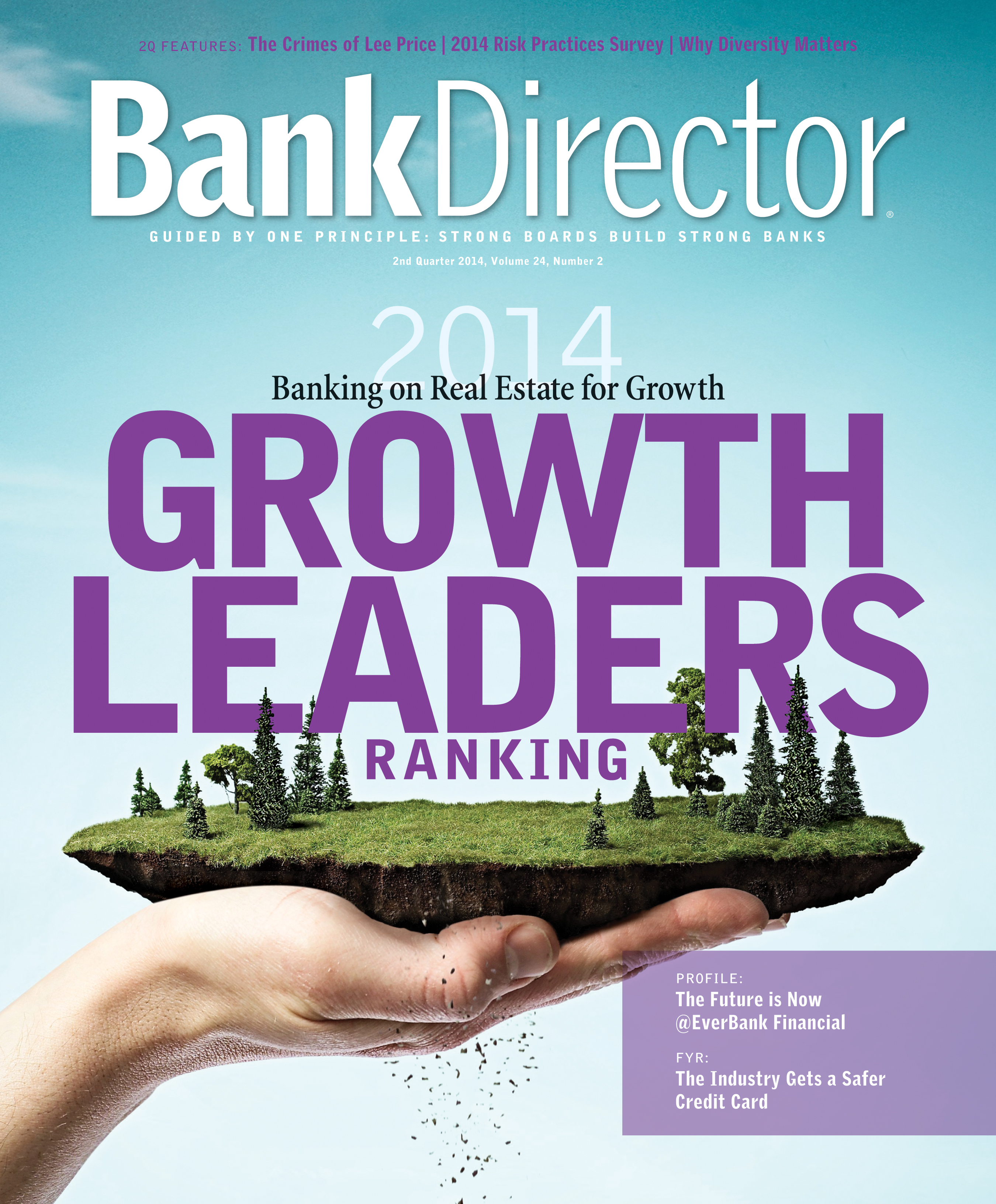
As my colleague Jack Milligan writes in our 2nd quarter issue of Bank Director magazine, just because a bank can’t own a car dealership doesn’t mean there isn’t “enormous flexibility in determining a bank’s strategy.” Curious what this means? Read on.

2Q14

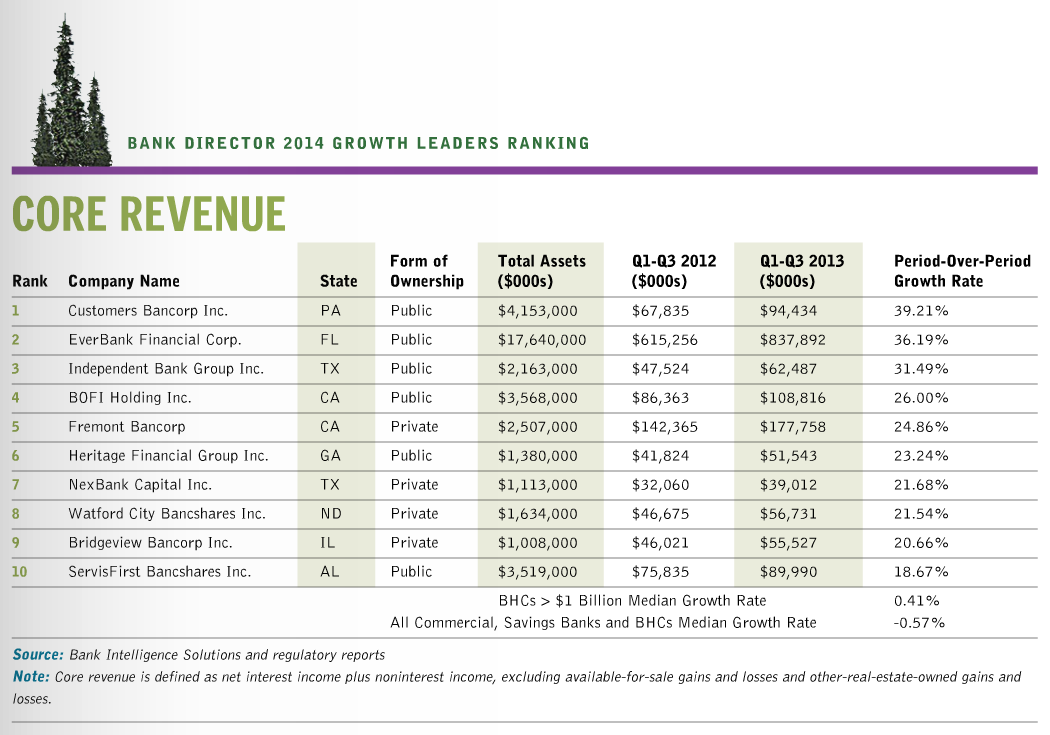
A Sneak Peek at the Core Revenue Champs

Each year, Bank Director magazine looks at all U.S. banks and thrifts to identify the strongest growth banks. We rank the top performers across four separate categories: core deposits, core noninterest income, net loans and leases and the most important, core revenue. Since the magazine mails today, I thought to offer a sneak peek of the results:

Screen Shot 2014-04-24 at 6.06.07 AM

What I find interesting about the top two banks on this very strong list: both Customers Bank and EverBank Financial designed their business models around technology from their very beginnings.

Find Your Balance

As I read through an advance copy of the issue, it strikes me that many business areas that historically provided revenue growth are simply not growing fast enough to overcome new capital and regulatory requirements.  In this light, you can understand why many say times couldn’t be more challenging for growth in community or regional banking. The corollary to this? Balancing organic and external growth is a key focus area for bank management and boards.

Increasingly, I hear that growth-focused banks are considering (or implementing) strategies that create revenue growth from both net interest income and fee based revenue business lines — think government guaranteed lending, asset based lending, leasing, trust and wealth management services. Clearly, as interest margins and loan volumes remain subject to compression and intense competition, the “optimization” of fee-based revenue is becoming pivotal in enhancing shareholder value.

‘Sup Big Easy

True, a number of banks seek to extend their footprint and franchise value through acquisition. Yet, many more aspire to build the bank internally.  Some show organic growth as they build their base of core deposits and expand their customer relationships; others leverage product innovation or focus on their branch network. I bring these approaches up in advance of next week’s Growth Conference at the Ritz-Carlton, New Orleans. We designed this event to showcase strategies, structures, processes and technologies that a bank’s CEO and board might consider to fuel their own growth.

Unlike trade shows and other events, we limit participation to a financial institution’s key officers and directors to ensure those joining us are not just committed to distinguishing their performance and reputation, but also are appropriate peers to share time and ideas with. From companies like StrategyCorps, Ignite Sales and VerifyValid to PwC, Fiserv and IBM, we have a tremendous roster of companies joining us in Louisiana to share “what’s working” at the myriad banks they support. As I’ve done for our other events (e.g. the sister conference to Growth, Acquire or Be Acquired), I’ll be posting a number of pieces next week from the Crescent City and invite you to follow along on Twitter via @aldominick, @bankdirector and using #BDGrow14.

Aloha Friday!

Wrapping up Acquire or Be Acquired

As we bid adieu to this year’s crowd, it strikes me that efficiency and productivity are key elements in positioning a bank to grow.  While this year’s Acquire or Be Acquired conference (#AOBA14) touched on numerous growth strategies, the common denominator among “organic growth banks” is a robust and diverse lending platform along with a proven credit culture and process.

photo (42)

The future of banking

For those joining us at the Arizona Biltmore on Sunday morning, you saw a video that summarized various thoughts on “the future of banking.”  A number of attendees asked to see the video we used to open the conference again.  Here it is:

Tuesday Takeaways

My “rapid reaction” to this morning’s conversations at the Arizona Biltmore, in no particular order: growth is now driving pricing; efficiency & productivity are both key elements in positioning a bank to grow; and the base reality remains that there is overcapacity in the US banking industry.

Off to the hit ’em long and straight (I hope) as we wrap up our 20th annual conference with our annual golf tournament.  74 and sunny… what a treat!

Quality never goes out of style

Wait... there was something going on other than the Stanley Cup finals this week?
Wait… there was something going on other than the Stanley Cup finals this week?

Today’s title, inspired by my uncle who founded and continues to run Computech, a very successful technology firm here in the D.C. area, is both simple and profound.  I believe the three points shared below reflect the same spirit of craftsmanship and professionalism he built his firm on.  Working smarter, building better, doing it right the first time… themes I picked up this week and thought to share below.  And yes, #LetsGoBruins!

(1) One of the work questions most frequently asked of me at conference cocktail parties and in social settings concerns the future of banks. So the fact that the St. Louis Fed published a study that examines banks that thrived during the recent financial crisis proved irresistible.  After all, “those who cannot remember the past are condemned to repeat it.”  I’ve alluded to this research in a previous post; for me, it is interesting to note that some of the most profitable banks, in the short-term, are not necessarily the best banks.  Instead, the so-called “best banks,” in my opinion, get creative in offering new products. They watch closely what is working for other banks in and out of their own market. They watch what products and services are being brought to market by vendors to our industry.  This survey, in a broad sense, backs this up.

(2) In the St. Louis Fed’s survey, the authors conclude that there is a strong future for well-run community banks.  In their estimation, banks that prosper will be the ones with strong commitments to maintaining risk control standards in all economic environment.  This aligns neatly with most discussions about a board’s role and responsibilities. Indeed, one of the critical functions of any bank’s board of directors is the regular assessment of their activities and those of the bank’s management in terms of driving value. As C.K. Lee from Commerce Street Capital explains, this may be defined as value for shareholders, value for the community and the perception of strength among the bank’s customers and regulators. Over the last few months on BankDirector.com, he’s explored the concept of tangible book value (TBV) and its relationship with bank valuation. He also looked at internal steps, such as promoting efficiency and growing loans, which boards could take to drive more revenue to the bottom line and drive bank value.  The “final installment” of his series is up — and if you are interested in two additional factors that drive value in both earnings production and market perception, a good read.

(3) Over the last few weeks, I have shared my take on a few issues near and dear to audit committee members.  These committee members have direct responsibility to oversee the integrity of a company’s financial statements and to hire, compensate and oversee the bank’s external auditor.  So on the heels of Deloitte’s trouble with New York’s Department of Financial Services comes this week’s final point.  In case you missed it, the state’s regulator cracked down on Deloitte’s financial-consulting business, essentially banning them from consulting with state-regulated banks for the next year.  Big enough news that the American Banker opined “it will send waves through its bank customers, competitors and federal regulators.  Banks will have to scrutinize their relationships with consultants, brace for the possibility of a wave of regulation of consulting practices and have backup plans in case a key advisor ever receives a punishment like the one New York state dealt Deloitte.”  As many begin to re-examine the relationships they have with outside vendors, here is a helpful evaluation assessment tool offered by the Center for Audit Quality, a nonpartisan, nonprofit group based here in Washington, D.C.  While specific to an audit committees needs, the sample questions highlight some of the more important areas for consideration.  As with CK Lee’s articles on building value, this form is worth a look if you’re considering the strength of your vendor relationships.

Aloha Friday!