Mele Kalikimaka

The banking marketplace today is dramatically different from what it was just three years ago.  Since returning to the industry in 2010, I’ve seen a lot of change — and not all good.  Nonetheless, I am bullish on the future of banking.  While some in the media tend to criticize financial institutions and harp on measures like one’s Texas ratio (which models a bank’s risk profile to fail — and also inspired this site’s name), I prefer to focus on financial institutions as the fabric of our neighborhoods and communities.  When I write About That Ratio it is in stark contrast to those who deride the importance of banks.  I am not blind to the problems facing many bankers today, nor ignorant of errors and indiscretions made by some of our larger names.  Still, count me an optimist that better times are ahead.  So before my family and I take off for Christmas in Tulum, Mexico, one last About That Ratio for 2013 that shares three things from the week that was.

DSC_0229

(1) While many year-end blogs take a look back,  Jim Marous authored a comprehensive forward-looking post on his “Bank Marketing Strategies” blog.  His 2014 Top 10 Retail Banking Trends and Predictions compiles opinions from 60 global financial services leaders — including bankers, credit union executives, industry providers, financial publishers, editors and bloggers, advisors, analysts and fintech followers.  I appreciated his invitation to contribute and thought to share the crowd’s top three trends for 2014:

  1. The “Drive-to-Digital” trend will impact delivery, marketing and service usage;
  2. Payment disruption will increase vis-a-vis new players, technologies and innovations; and
  3. Increased competition from “neobanks” and non-traditional players will accelerate.

Take a read through these and the subsequent seven points offered up.  As Jim writes, “disruption will continue at an unprecedented pace and that the industry will look different this time next year.”

(2) It is hard to escape the reshaping of the banking industry through merger activity; in particular, the return of negotiated, strategic bank combinations.  While in San Francisco a few months ago, I wrote about Heritage Financial’s combination with Washington Banking Co.  Forgive the use of “merger of equals” to describe the deal; however, that misnomer best represents the agreement.  Some see these deals becoming more popular as bankers seek to build value for the next few years in order to sell at higher multiples.  Others cite a desire to create more immediate value through cost cuts and efficiencies.  Regardless of who’s driving and who’s riding, there were quite a few notable deals in 2013; for example, Umpqua and Sterling and the recent “51/49” deal between United Financial Bancorp and Rockville Financial.  I get the sense that more boards will consider deals structured like these to accelerate “scaling up” without utilizing cash as the currency for an acquisition.  Time will tell if I’m right.

(3) Finally, I readily admit my excitement to welcoming men and women from across the country to various Bank Director events next year.  From our BIG M&A conference at the Arizona Biltmore in January to The Growth Conference at the Ritz-Carlton New Orleans in May to a peer exchange for officers & directors at the Ritz-Carlton in San Francisco, we have a lot planned.  These events are a big part of our 23 year-old company’s business — and its pretty darn cool to participate in various conversations that relate to growth, innovation and “what’s working.”  I’m not alone in thinking it is time for bank CEOs and their boards to go on the offensive.  Competing successfully in a marketplace, managing shareholder expectations, overcoming regulatory obstacles, developing talent and leadership for the next generation, and, most of all, ensuring that one’s institution has the option of choosing whether to “acquire or be acquired”… yup, topics galore for me to cover here in 2014.

##

I end every Friday post with a nod to my mother-in-law (who passed away four years ago).  She lived on the Big Island for several years and became quite fond of the “Aloha Friday” tradition; hence, the sign off.  The only Hawaiian saying that puts a bigger smile on my face is today’s title: Mele Kalikimaka!

The Race is On

ferrari-458-challenge-race-car_100316284_m

The race is on… to expand into new markets, to add new talent, to introduce new technologies that attract and engage customers.  This race, playing out in cities and towns across the country, applies to many industries.  For our purposes, let me build on this theme vis-a-vis three takeaways from Bank Director’s annual Bank Executive & Board Compensation Conference in Chicago.

(1) How companies develop executives, attract leadership and approach compensation in today’s highly competitive and economically challenging world was front-and-center in Chicago.  As I wrote earlier this week, the environment that this country’s 7,000 or so banks operate in demands productivity, proficiency with technology and the ability to sell.  Finding the right people to lead such efforts, especially when you consider that every organization has a different set of “players” with a unique collection of knowledge, experience and skills, proves challenging.   Complicating matters is the fact that all banks are required to regularly assess whether any of their compensation plans encourage unnecessary or excessive risk-taking that could threaten the safety and soundness of the institution.

(2) Putting together compensation plans that reward growth and responsible risk takes many shapes.  However, the “adverse economic cycle” has dampened some employees’ opportunities to earn — and at a corporate level, has slowed the anticipated pace of bank consolidation.  While larger banks continue to increase in size, many smaller institutions are fighting for survival in today’s regulatory and low-interest rate environment.  According to SNL, there were 235 whole-bank M&A transactions announced and 51 failed bank transactions for a total of 286 deals in 2012. Total deals, as a percentage of overall banks in the U.S., have remained relatively consistent over the years between 3% and 4%.  Some interesting stats, courtesy of the Hovde Group:

  • Since 2000, sellers over $1 billion in assets have commanded a 32% premium over those sellers less than $1 billion;
  • In 323 transactions since 2000, sellers over $1 billion averaged a valuation of 246% of tangible book value; and
  • In 2,729 transactions since 2000, sellers less than $1 billion averaged a valuation of 187% of tangible book value.

M&A activity is once again heating up as financial institutions look to achieve necessary scale to compete and thrive… and while I will not wager on the exact number of deals that will mark 2013, I will take the over on 2012’s results.

(3) The relevance of scale, the pace and volume of M&A activity and the dynamic tension between the “bid-and-ask” takes center stage at our next conference: our 20th annual Acquire or Be Acquired Conference.  Held at the Frank Lloyd Wright-inspired Arizona Biltmore, we’ve put together a program that looks at the strategies potential acquirers might consider to the practical considerations the board needs to discuss.  As proud and pleased as I am for this week’s successful event, I am already gearing up to open our biggest conference the week before the Super Bowl.  Widely regarded as one of the financial industry’s premier M&A conferences, I am super excited by the hard work put in by our team and even more stoked to spend the next few months getting ready to welcome everyone to the desert.  To that end, I will begin to expand upon the topics and trends that influenced the development of this year’s program in future posts.

Aloha Friday!

A Postcard from Chicago

photo (28)Sometimes, saying hello is easier than saying goodbye… at least, that’s what I felt (and wound up sharing) as I took to the stage to wrap up today’s Bank Executive & Board Compensation Conference at the always awesome JW Marriott in Chicago.

(1) Leading up to the conference, our editor (Jack Milligan) and I heard from board members and executives that they continue to struggle with measuring executive performance and retaining key talent.
  At the same time, the two of us see the environment that banks operate in today demands productivity, proficiency with technology and the ability to sell.  So for this, our 9th annual event, we took care to focus on compensation trends, talent attraction and retention strategies.  In addition, we made sure to include sessions that look at how the next few years’ merger activity might influence incentive compensation plans and performance-based pay structures.  All told, over 110 banks from 38 states were represented in the audience — each, it seemed, engaged in conversations about how their particular bank might shape its workforce to meet the demands of tomorrow.

(2) Next year, we will almost certainly include breakouts and/or general sessions on nominating/governance committee issues.  We may also take a deeper look at “millennials” in the work force.  But this year, I found several presentations geared to critical questions facing boards and management that tied in to immediate growth opportunities.  For example, Steve Hovde posed questions like:

  • Is adequate organic growth even available today?
  • In today’s hyper-competitive loan market, can sufficient loan growth and loan yields be achieved?
  • Are branches in urban markets more important than rural markets?
  • How many employees must we hire to achieve organic loan growth objectives?
  • Are we better off deepening penetration of existing markets or expanding physical premises into neighboring markets or both?
  • What steps can we take to enhance Web and Mobile platforms?

While larger banks continue to increase in size, many smaller community banks are fighting for survival in today’s regulatory and low-interest rate environment. These questions, when juxtaposed with compensation trends and strategies, were certainly on the minds of many in attendance.

(3) As I walked off the stage today, it was hard not to see banking’s business model being significantly challenged in today’s interest rate environment. With deposit costs near zero and fierce competition for loans driving down yields, many smaller banks appear to be running on fumes. For many, organic loan growth is almost nonexistent, and strategic M&A is the only other way to amass scale today. For this reason, some say that banking’s business model is broken, but I’m not sure I agree.  I posed this question to a panel of CEOs to wrap up yesterday’s program and am curious to hear from readers of About That Ratio.  Is our model broken?  If it is, can it be fixed — or what will replace it?  Feel free to comment below or via a DM on Twitter (@aldominick)

On Fee Income + Staying Relevant

Cloud Gate in Millennium Park

So I shared my excitement for the RedSox World Series victory earlier today… Before I pack my things for a trip to the JW Marriott in Chicago, let me share three things I learned this week that relate to bank CEOs and their boards, not baseball and beards.

(1) As our very talented editor, Jack Milligan, wrote in the current issue of Bank Director, when it comes to fee income, “drivers tend to fall into three general categories, beginning with a variety of consumer-based fees from such things as foreign ATM withdrawals, overdraft protection plans, debit card transactions and some checking accounts.”  I bring this up as Jack and the team at Bank Director magazine ranked the top 50 publicly traded banks based on their ratio of non-interest income to total operating revenue for 2011 and 2012. The totals for both years were then averaged, which determined the order of finish. All banks listed on the New York Stock Exchange and NASDAQ Stock Exchange were included in the analysis (which was performed by the investment banking firm Sandler O’Neill + Partners in New York). At the top of the ranking are New York-based Bank of New York Mellon Corp., State Street Corp. in Boston and Chicago-based Northern Trust Corp.  For a full look at the results, click here.  For the story itself, register for free on BankDirector.com to access the digital issue of the magazine.

(2) Clearly, banking’s profit model is going through a period of transition.  Here, companies like StrategyCorps play an interesting role in helping financial institution meet their needs for more fee income without upsetting its customers.  No one — at least, that I know — wants to  pay for basic, traditional retail banking services.  They resent when a new fee is added on to an existing free service or product with no additional value (case-in-point, Bank of America’s $5 debit card fee debacle).  So as Mike Branton wrote in the Financial Brand, “financial institutions must seek new ways to incorporate non-traditional services that connect with consumers’ lifestyles.”  StrategyCorps took to Finovate’s Fall stage in NYC in September to demo, in less than 7 minutes, how financial institutions can use an enhanced mobile experience to successfully bring in fee income.  Take a look.

(3) Finally, I will be tweeting throughout our annual Bank Executive & Board Compensation conference next week (using hashtag #BEBC13).  This year’s 9th annual event focuses on compensation trends, talent acquisition/attraction and retention strategies. In addition, it looks at how the next few years’ merger activity might influence incentive compensation plans and performance-based pay structures.  I intend to post a few “postcards” from Chicago throughout the week — the first (tentatively set for Tuesday) on how companies develop executives, attract leadership and approach compensation in today’s highly competitive and economically challenging world.

Aloha Friday!

Size Matters – and Other Banking Notes From the Bay Area

The Ritz-Carlton San Francisco
Walking up to the Ritz-Carlton San Francisco

Last week, Lexington, Virginia… this week, San Francisco, California… next week, Chicago, Illinois.  Yes, conference season is back and in full swing.  I’m not looking for sympathy; heck, for the past few days, I’ve set up shop in Nob Hill (at the sublime Ritz-Carlton) to lead our Western Peer Exchange.  Traveling like this, and spending time with a number of interesting CEOs, Chairmen, executives and board members, is why I love my job.  What follows are three observations from my time here in NorCal that I’m excited to share.

(1) On Wednesday, I took a short drive up to San Mateo to learn more about Kony, a company that specializes in meeting multi-channel application needs.  I have written about customer demands for “convenient” banking services in past posts — e.g. Know Thy Customer –and will not try to hide my interest in FinTech success stories.  Learning how their retail banking unit works with financial institutions to deliver a “unified and personalized app experience” proved an inspiring start to my trip.  Consequently, our Associate Publisher and I talked non-stop about the rapid evolution and adoption of technologies after we wrapped things up and drove back towards San Francisco.  We agreed that consumer expectations, relative to how banks should be serving them, continues to challenge many strategically. To this end, Kony may be worth a look for those curious about opportunities inherent in today’s mobile technology.  Indeed, their team will host a webinar that features our old friend Brett King to examine such possibilities.

(2) When it comes to banks, size matters.  To wit, bigger banks benefit from their ability to spread fixed costs over a larger pool of earning assets.  According to Steve Hovde, an investment banker and one of the sponsors of our event, “too big to fail banks have only gotten bigger.”  He observed that the top 15 institutions have grown by nearly 55% over the past six years.  Wells Fargo, in particular, has grown 199% since ’06.  With more than 90% of the banking companies nationwide operating with assets of less than $1 billion, it is inevitable that consolidation will be concentrated at the community bank level.  However, as yesterday’s conversations once again proved, size doesn’t always trump smarts.  I said it yesterday and will write it again today.  Our industry is no longer a big vs. small story; rather, it is a smart vs. stupid one.

(3) That said, “nobody has told banks in the northwestern U.S. that bank M&A is in the doldrums.”  According to the American Banker, two deals were announced and another terminated after the markets closed Wednesday.  Naturally, this should put pressure on banks in the region to keep buying each other.  Here in San Francisco, the one being discussed was Heritage Financial’s combination with Washington Banking Co.  According to The News Tribune, this is “very much a merger between equals, similar in size, culture and how each does business.”  Now, the impetus behind ‘strategic affiliations’ (don’t call them mergers of equals) comes down to creating value through cost cuts and wringing out efficiencies.  The thinking, at least during cocktails last night, was that deals like these happen to build value for the next few years in order to sell at higher multiples.  Certainly, it will be interesting to see how this plays out.  In a few months at our Acquire or Be Acquired conference, I anticipate it generating quite a few opinions.

Aloha Friday!

Creating a Social Business

I am back in Lexington, Virginia today to speak at Washington & Lee’s 2nd Annual Entrepreneurship Summit.  I love it here and am very excited to share my thoughts on “Leveraging Social Media in New Ventures” later today.  While my company, Bank Director, isn’t a “new” play in the traditional sense, I am eager to share what I have learned since I graduated from W&L in ’99.  So, in lieu of my traditional focus on banking, today’s post highlights three points I’ll expand upon in a few hours.

W&L - BD - Social Media cover slide.001

(1) Let me start by sharing the presentation I put together: W&L – BD – Social Media.  As some might know, we began to “re-imagine” our then-20 year old company in September of 2010 upon the sale of our sister company, Corporate Board Member, to the NYSE.  Building a new reputation upon an established brand reflects three tactics I’d picked up in business school, seen applied by technologists at my old firm (Computech) and had reinforced by bank CEOs and Chairmen at our many events.  First, you can’t manage what you can’t measure.  Second, “fail fast” doesn’t always apply, but slow + steady doesn’t necessarily win the race either.  Finally, be open, interested and ready to adopt new practices or strategies while relying on your team to shout things up or down.

(2) We talk a lot about “community building” within Bank Director.  As we focus on issues fundamental to a bank’s CEO, senior leadership team, chairman and independent directors, we are constantly thinking about building strong + lasting relationships with these leaders across the U.S.  Admittedly, we embraced social media pretty quickly — figuring out the best uses of LinkedIn and Twitter — while we designed our digital strategy.  By participating in, and not always driving the, conversations through such channels, we identified various trends and opportunities that made their way into our conferences, research, etc.  Nothing groundbreaking here, but it does surprise me when people ignore the classic marketing adage “know your customer and give them what they want.”

(3) In a sense, you can look at Bank Director as an example of company that is “passionate” about connecting people through shared experiences.  So too are younger ventures like DC-based SocialRadar and Boston-based EverTrue.  I choose to highlight these two companies in my presentation as they share this same commitment.  If you’re not familiar with SocialRadar, it looks to combine your smartphone’s location with your social network – thereby “allowing you to walk into a room and already be aware of the people around you and how you are connected to them.”  EverTrue, started by a football teammate of my brother at Brown, offers colleges and universities “alumni networking platforms” that create stronger communities through an interactive mobile directory and better data from LinkedIn and Facebook.  Two up-and-coming companies that fit nicely with the title of today’s post.

Aloha Friday!

Swimming With Sharks

A resident of the Mandalay Bay in Las Vegas

I’ve been on a lot of planes lately, and while I read a ton, I also listened to several interesting podcasts to pass the time.  One in particular brought statistician Nate Silver and author Malcolm Gladwell together with ESPN’s Bill Simmons to discuss how periodicals are adjusting to the Internet age (ok, some sports came up too). I liked their premise that it doesn’t take much skill to be the first to do something, but the later you are, the smarter you have to be.  Much as the publishing/media industry needs to speed up the creative process, so too do financial institutions of all sizes.  Take a listen to the podcast if you’re interested in their take; for three things I’m thinking about based on the last four days, read on.

(1) Yes, credit unions and banks are both financial institutions; this, however, is where the similarities end in my opinion.  I spend so much of my time with bankers that I decided to flip the script and attend the National Directors’ Convention for credit unions in Las Vegas this week.  As I depart the Mandalay Bay (today’s draft title was “Banking on Sin”), today’s tongue-in-cheek title is a nod to those organizations that compete with banks.  True, I enjoyed the cheerleading aspect of certain sessions; for example, “A Higher Purpose: Why Credit Unions Are Different Than Banks.”  Nonetheless, as session after session juxtaposed a credit union’s marketing, lending and risk & compliance efforts with those of community banks, I’m not sure why credit unions should continue to be exempt from taxes as they are.  Look, my Grandfather helped set up a credit union in Massachusetts, and I appreciate why credit unions were initially granted nonprofit status.  But as they directly compete with banks, the tax question stirs the pot at our conferences… and does have me scratching my head about the fairness of an uneven playing field.

(2) Woody Allen is credited with saying 90% of life is showing up. But John Kanas and his team at Florida-based BankUnited (which has $12.6 billion in assets) are doing a lot more than that.  At least, that’s what I’m thinking after reading “A Steal of a Deal” by our very talented Managing Editor, Naomi Snyder.  While a lot of attention in Bank Director’s current issue goes to “The Top Performing Banks” due to our scorecard that ranks all NYSE and NASDAQ listed banks, Naomi’s piece is a must-read.  As you will see, the best mid-sized bank in the country is headed by an incredible dealmaker with an appetite not just for risk but with an eye for long-term growth.

(3) Thinking about growing a bank puts a board’s role in strategic planning front and center.  So when Promontory’s founder and CEO, Gene Ludwig, writes that “Big Changes Loom for Bank Boards,” I think it’s an appropriate link to share.  In a piece that runs on American Banker, the former head of the OCC writes “the do’s and don’ts of board governance are still emerging, and there is an honest debate over the core topics — how effective new and detailed expectations are at improving safety and soundness, and whether new standards are merging the concepts of governance and management. However, the fact of the matter is that regulators are not going to back away from their enhanced expectations for the board. Board members and managers who do not take heed proceed at their peril.”  Take a read if you’re interested in his nine points a bank and its board might consider in today’s highly charged regulatory environment.

Aloha Friday!

What you learn at a puppet show

Hank Williams "walking" the red carpet in Nashville

I wrapped up a fairly intense period of travel with a day trip to NYC on Monday and a subsequent overnight in Nashville on Tuesday & Wednesday. While in the Music City, our Chairman invited me to join him at a puppet festival (yes, you read that right). The show, a musical chronicle of the history of country music, benefitted the Nashville Public Library Foundation and the Country Music Hall of Fame. Laugh if you will, but I will tell you, it was amazingly creative. As I mingled with various benefactors of both institutions, I found myself engaged in conversation with the former managing partner at Bass, Berry & Sims. Having led one of the preeminent law firms in the Southeast, his perspective on how dramatically the legal profession has changed in the last fifteen years struck a nerve. The parallels between his profession and the banking space were immediately apparent. So with Patsy Cline playing in the background, we talked about the future of banking, professional services firms and relationship building in general. As we did, I made a mental note to share three thoughts from this week that underscore how things continue to change in our classically conservative industry.

(1) First Republic’s founder and CEO, Jim Herbert, shared some of his Monday morning with me while I was in NYC. Jim founded the San Francisco-based bank in 1985, sold it to Merrill Lynch in 2007, took it private through a management-led buyout in July 2010 after Merrill was acquired by Bank of America, then took it public again this past December through an IPO. For those in the know, First Republic is one of this country’s great banking stories. Not only is it solely focused on organic growth, it’s also solely focused on private banking. While my conversation with Jim was off-the-record, I left his office convinced its the smarts within, not the size of, a bank that will separate the have’s from the have not’s in the years ahead. Clearly, as new regulations and slim profit margins challenge the banking industry, the skills and backgrounds of the employees who work in banking must change.

(2) Speaking of successful banks that have successfully navigated recent challenges… KeyCorp’s Chief Risk Officer, Bill Hartman, joined us last week for Bank Director’s annual Bank Audit Committee Conference in Chicago. Bill is responsible for the bank’s risk management functions, including credit, market, compliance and operational risk, as well as portfolio management, quantitative analytics and asset recovery activities. While I shared some thoughts about that program last week, I thought to elaborate on how KeyCorp divides the roles and responsibilities of its Audit and Risk Committees. Some still think you “retire” to the board; as he showed, that is definitely not the case – especially not at an institution that counts 2 million customers, 15,000 employees and assets of $89 Bn. In terms of Key’s Audit Committee, members oversee Internal Audit, appoint independent auditors and meet with the Chief Risk Officer, Chief Risk Review Officer, and of course, for financial reporting, the CFO. I thought it was interesting to note their Audit Committee met 14 times in 2012 — twice as often as the institution’s Risk Committee convened. With many smaller banks considering the creation of such a committee, let me share the focus of their Risk Committee. Strategically, it is responsible for:

  • Stress testing policy;
  • Dividend and share repurchases;
  • Modeling risk policy;
  • Asset and liability management; and
  • Setting tolerances, key risk indicators and early warning indicators

For those thinking about introducing a Risk Committee into their bank, take a look at what some of our speakers shared leading up to last week’s Audit Committee conference for inspiration.  For a recap of the event, our editor shares his thoughts in today’s Postcard from the Bank Audit Committee Conference.

(3) Yesterday, I was pleased to learn that ConnectOne’s CEO, Frank Sorrentino, agreed to participate in our annual Bank Executive & Board Compensation Conference in November. In addition to being one of the more active bankers I follow on Twitter, I’ve written about his bank going public in a previous post. Today, it’s a WSJ piece that shows U.S. regulators grilling banks over lending standards and “warning them about mounting risks in business loans” that has me citing the NJ-based bank. This particular article quotes the CEO of the Englewood Cliffs, N.J. bank in terms of lending standards (yes, a subscription is required). He reveals that regulators recently asked what he is doing to ensure he isn’t endangering the bank by making risky loans. His response: “the bank is trying to offset the lower revenue from low-interest-rate commercial loans by cutting expenses.” While I get the need for oversight, I do wonder how far the regulatory pendulum will continue to swing left before sanity/reality sets in at the CFPB, FDIC, OCC, etc. I’ll stop before I say something I regret, but do want to at least encourage a Twitter follow of Frank and his “Banking on Main Street” blog.

Aloha Friday!

Standing Out on a Friday

Fenway Park's red seatComing off of last week’s Growth Conference, I found myself planning for next year’s program. As we recognized Customers Bank, State Bank & Trust and Cole Taylor Bank for “winning” our annual Growth rankings, I spent some extra time looking at other banks that performed exceptionally well this past year. So today’s Friday-follow inspired post shares a few thoughts and conversations I’ve had about three very successful banks.

(1) While easy to frame the dynamics of our industry in terms of asset size, competing for business today is more of a “smart vs. not-so-smart” story than a “big vs. small.” During one of my favorite sessions last week — David AND Goliath — Peter Benoist, the president and CEO of St. Louis-based Enterprise Financial Services Corp, reminded his peers that as more banks put their liquidity to work, fierce competition puts pressures on rates and elevates risk. My biggest takeaway from his presentation: we all talk about scale and net interest margins… but it’s clear that you need growth today regardless of who you are. It is growth for the sake of existence.

(2) During the afore mentioned presentation, the participants all agreed that you cannot compete with BofA on price. Consequently, the ability to introduce new products (e.g. increasing deposit platforms) is key for many banks today. So from diversification to differentiation, let me turn my attention to San Francisco-based First Republic. Their story is a fascinating one. While not with us in New Orleans, I heard a lot about them yesterday while I was in NYC visiting with KBW. Subsequently, our editor wrote me with some background: Jim Herbert founded the bank in 1985, sold it to Merrill in 2007 for 360% of book, took it private through a management-led buyout in July 2010 after Merrill was acquired by Bank of America, then took it public again in December through an IPO. First Republic is a great bank: it finished 3rd out of 80+ in the $5-$50 billion category in Bank Director magazine’s 2012 performance rankings. But not only is it solely focused on organic growth, it’s also focused solely on private banking.

(3) Finally, as we move our attention from growth to risk in advance of our annual Bank Audit Committee conference, I started to think about the challenges facing banks of all sizes. Admittedly, I started with Fifth Third as their Vice Chairman & CEO will be joining us in Chicago as our keynote speaker. Yes, I am very interested to hear his perspectives on the future of banking. Quite a few small bank deals have recently been announced, and I have to believe many sales came together thanks to escalating compliance costs and seemingly endless regulation. For larger institutions like Fifth Third, it will be interesting to see what transpires over the next few years and where he thinks the market is moving for banks of all sizes. If you’re interested, take a look at our plans for this year’s event.

Aloha Friday!

##

About today’s picture:

I’m a die-hard Boston RedSox fan, and for anyone whose been early to, or stayed late at, Fenway Park, you’ve probably seen one red seat in the right field bleachers (Section 42, Row 37, Seat 21). Did you know it signifies the longest home run ever hit at Fenway, one struck by the great Ted Williams on June 9, 1946? While a nice chance for me to share my love for the RedSox, I thought the visual made a lot of sense when writing about standing out from the crowd… -AD

Dass de Thing

photo (10)

Today’s Friday Follow-inspired column takes a decidedly cajun turn (I tink dats rite) with a look back on time spent at the Ritz-Carlton in New Orleans. Fancy, for sure. Financially focused? Absolutely, thanks to Bank Director’s inaugural Growth Conference.

The slow economic recovery continues to challenge banks ability to grow as businesses both large and small reduce their leverage. Additionally, tepid growth (or in some cases, continued decline) in real-estate values presents challenges in the growth of consumer and commercial mortgage portfolios. Layer on the increased focus of larger banks on growing their C&I and small business lending portfolios due to increased regulatory pressure on consumer products and you understand how challenging it is for community or regional bank CEOs and boards to devise effective growth strategies. These obstacles did not, however, deter a crowd of nearly 200 bankers and industry executives from sharing their insight and opinions earlier this week.

(1) For example, Josh Carter from PwC covered what some of the fastest growing community banks are doing, both those who have grown through M&A, as well as digging a level deeper into those who are successfully growing organically. In his address, he noted a few bright spots have given the banking industry hope that economic and financial recovery is just around the corner (e.g. consumer confidence continues to improve, unemployment is on the decline and the home price index continues to tick up). As such, he believes there are five key areas that community banks should focus on to drive growth in their respective markets:

  • Emphasize productivity over efficiency;
  • Sharpen your business model; that is, serve niche segments, provide tailored offerings, excel at service quality, etc.;
  • Innovate within your business model, as banks that succeed most often are the ones that continually evolve and out-innovate their peers;
  • Pursue opportunistic M&A deals; and
  • Broaden your product portfolio.

(2) Preceding Josh was Jay Sidhu, the Chairman & CEO at Customers Bank. If you’re looking for a bank that is leading the field in terms of core income, net loans/leases and core non-interest income, look no further than his bank, which is expanding its business in three states — Pennsylvania, New York and New Jersey. Jay captivated his peers with a look at the changing face of banks in the United States and the role of a board and CEO in positioning bank to take advantage of this changing environment. Tops for him: an “absolute clarity of your vision, strategy, goals and tactics; there must be absolute alignment between board and management… (along with a) passion for continuous improvement.”

(3) Bank 3.0Finally, Brett King and Sankar Krishnan explored the “end-game” in the emergence of the mobile wallet and what it means for the “humble bank account.” With more than 60% of the world’s population without a bank account and the ubiquitous nature of mobile phone handsets and the increasingly pervasive pre-paid ‘value store’ – the two openly considered will banks still be able to compete. I’ll have more on this session in a subsequent post that combines Brett’s presentation with one made by John Cantarella, President, Digital, Time Inc. News and Sports Group. For now, let me suggest a trip to Amazon to check out Brett’s latest book, Bank 3.0: Why Banking Is No Longer Somewhere You Go But Something You Do.

##

A big shout out to the entire Bank Director team who made this first conference such a success. Laura, Michelle, Mika, Kelsey, Jack, Misty, Jennifer, Daniel, Naomi, Joan, Bill… way to go!

Aloha Friday!!

Industry at a Crossroads: the Investor View

photo (9)

A curveball from New Orleans this afternoon… since I was on stage this morning to moderate a panel discussion on what makes a bank successful (to open this year’s Growth Conference at the Ritz-Carlton — #BDGrow13), my friend, colleague and Managing Editor of Bank Director magazine agreed to author today’s column.  The first guest post on About That Ratio, courtesy of Naomi Snyder, summarizes the investor community’s view on banks today.

As an industry veteran of more than 40 years and private equity investor in 15 banking companies, John Eggemeyer loves banks. But the co-founder of Castle Creek Capital LLC and Castle Creek Financial LLC had some hard-to-swallow statistics and opinions for a crowd of nearly 200 bankers and industry executives (198, but who’s counting) at Bank Director’s inaugural “Growth Conference” in New Orleans today.

  • Publicly traded banks from $1 billion to $5 billion in assets have seen their stock values rise at about half the rate of the broader market as a whole since early 2009.
  • Of the 300 or so publicly traded banks in that size range, only about 60 of them are trading at their pre-recession price multiples, he said.  
  • In the last 40 years, bank stocks always followed the same pattern in a recession: falling in value quicker than the rest of the market and recovering quicker.  

That didn’t happen during the latest recession. “We have lost a tremendous amount of value relative to the broader market,’’ he said at a session focused on the views of bank investors.  

It may be that investors are recognizing tough times ahead for the banking industry, where there are simply too many banks offering similar products and services. Low interest rates and a slow economy aren’t helping. Eggemeyer predicts that there will be substantial consolidation in the industry, both in terms of banks gobbling up other banks, and also in terms of branch reduction.

Collyn Gilbert, a managing director at Keefe, Bruyette & Woods, reiterated that view. “At the end of the day, how many unique stories are there?” she said. Eggemeyer says he prefers to invest in banks that have strong pre-tax, pre-provision earnings that are operating in good growth markets. Bank of America can’t outgrow the U.S. economy and it can’t acquire other big banks. A smaller community bank in a good market can do both those things, he said. However, he thinks investors focus too much of their time on growth. In reality, strong profitability will position a bank for growth. Gilbert agreed. “I think there needs to be a much better focus on the earnings side,’’ Gilbert said.

##

Naomi Snyder, awarded the coveted “Gila Monster” moniker at this year’s Acquire or Be Acquired conference, is Managing Editor at Bank Director magazine.  Prior to joining our team, she spent 13 years as a business reporter for newspapers in South Carolina, Texas and Tennessee.  Most recently, she was a reporter for The Tennessean, Nashville’s daily newspaper.  She also was a correspondent for USA Today. Naomi has a bachelor’s degree from the University of Michigan and a master’s degree in Journalism from the University of Illinois.

Financially Focused on Aloha Friday

From Kona, a reminder about Aloha Fridays...
Hula dancers in Kona

Each Friday morning, I do my best to share three things I heard, watched, discussed or read.  If you’re game to share in the comment section below, I’d be really interested to read what you consider noteworthy from the week-that-was.  And before I forget, the tradition continues: Aloha Friday!

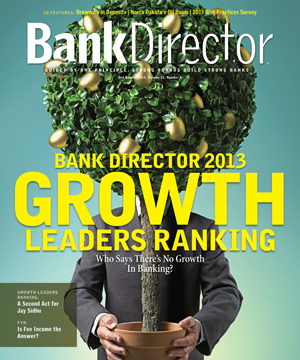
(1) Who says there’s no growth in banking? Certainly not our editor, Jack Milligan, although the lead in to his cover story in the current issue of Bank Director magazine might suggest otherwise:

If you’re not growing, you’re dying. It’s an often-used aphorism that has been attributed to such disparate sources as former college football coach Lou Holtz, the legendary Bob Dylan and a character played by the actor Morgan Freeman in “The Shawshank Redemption.” Unfortunately, it’s also a painful truth that a lot of bankers are living with nowadays as they search for growth in an environment that seems specifically designed to strangle it.

If you’re not familiar with Bank Director, the 23-year old publication reaches over 24,000 officers and directors — a community of virtually every leader in banking.  Published on a quarterly basis, the articles focus on issues fundamental to a bank’s CEO, senior leadership team, chairman and independent directors.  Think big, risky and expensive.  For the last three years, many in this audience struggled to grow their bank’s revenue and sustain a level of profitability.  However, not all are struggling to produce top line growth.  Take a read if you’re interested to learn how some banks today are building their businesses.

(2) Bank Director magazineWhile Jack’s cover article looks at four categories of non-M&A growth*, I’m afraid that our low growth economy looks like it will persist for a while longer.  Not surprisingly, some wonder if its possible to develop a sustainable, differentiable business strategy that has strong organic growth.  This is will be just one of many topics and trends addressed in New Orleans next week during our inaugural Growth Conference at the Ritz-Carlton.  I’ll be sharing my thoughts on the strategies and tactics banks might consider to expand their franchises’ value via twitter (@aldominick) — and know most of our team will as well. If you’re interested, let me suggest a follow of @BankDirectorAP, @BankDirectorEd, @NaomiSnyder and of course, @bankdirector.

(3) While tempted to complete the hat trick with a final point from Bank Director, I defer to Fiserv’s President and CEO Jeff Yabuki remarks as he opened their client conference last week.  In his kickoff, he asked their attendees to “re-imagine the financial experience of the future.”  While the short video is unfortunately more sales speak than suggestion, the firm does post several good related reads.  In particular, one entitled To Better Serve Small Business, Define Their Needs.  The gist?  With “profitability from retail lines of businesses under pressure, many institutions are reviewing their strategies for addressing the small business market. For regional and community institutions, which often serve communities where small businesses play an outsized role in economic development, effectively reaching small business is an imperative.”  Being that I work in a small business that interacts with numerous community banks, two thumbs up to the author and company for this perspective.

___________

*The four categories in Bank Director’s inaugural Growth Leaders Ranking are core income (defined as net-interest income plus non-interest income, excluding available-for-sale gains and losses and other-real-estate-owned gains and losses), core deposits, net loans and leases and core non-interest income. Of the four categories, the most important is core income since it is inclusive of the other three revenue sources.