FI Tip Sheet: Acquire or Be Acquired

So we had a little snow in D.C. this week… and a bit of wind too. Fortunately, I’m heading west towards Bank Director’s 20th annual Acquire or Be Acquired conference this morning. As I wrote about on Wednesday, I will be checking in on a daily basis from the historic Arizona Biltmore with insight and observations from our flagship “AOBA” conference. Before I hit the desert, let me share three thoughts that tie into the conference themes of bank mergers and acquisitions as I make my way from D.C. towards Phoenix.

img_1174

7,000 is so 2013

Let’s simply start with a number: 6,891. Confused? Don’t be. This is the number of federally-insured institutions nationwide as of last Fall — falling below 7,000 for the first time since federal regulators began keeping track in 1934 (according to the FDIC). Now, let me put this into context; specifically, by asset size. 6,158 banks (90% of all U.S. banks) have assets of less than $1 billion. 562 banks have assets between $1 billion and $10 billion and only 108 institutions have assets greater than $10 billion. The kicker? The “distribution of wealth” heavily favors the biggest of the big. Case-in-point: banks with $10 billion or more in assets controlled 24% of total industry assets in 1984 (according to the American Banker). That share has swelled to over 80% today. When you think about things in these terms, its not surprising to hear the majority of bank M&A will occur in the <$1Bn range.

What’s the deal?

According to SNL Financial, there were 227 M&A transactions in 2013 — up from 218 in 2012. Nonetheless, these numbers pale in comparison to “the halcyon days of late 1990s.” As our editor, Jack Milligan, wrote in a post that ran on this site in December, we may “eventually see the emergence of a new tier of banks in the $10 billion to $50 billion range that will consolidate attractive banking markets… and help drive consolidation into yet another phase.” Still, hurdles to doing a deal remain. For instance:

  1. Higher capital and liquidity requirements;
  2. Today’s regulatory environment presents many significant and ongoing challenges; and
  3. Access to capital markets remains limited to many.

That said, I’m sure we will continue to see the combination of really strong companies — think this week’s union between North Jersey banks ConnectOne and Center Bancorp – and do agree with Jack’s perspective on what the future holds.

Ready to raise your hand?

I’m confident that an advisor (or two, or three or ten) will declare a merger or acquisition to be the principal growth strategy for community banks. I’m also anticipating conversations that entail the need for a bank’s CEO and board to re-examine their branch networks and strategies. Steering clear of anything that relates to the actual structure of deal, here are three questions I think will crop up early (and often) at AOBA:

  1. How do you know your bank has the right team in place to implement, and deliver, sustained results?
  2. If I’m not ready to sell — but am not in a position to buy — how can I grow?
  3. How can I, as a potential acquirer, create a strategic advantage vs. my peers?

If you’re joining us in Arizona this weekend, I’m looking forward to saying hello. If you’re not able to make it but want to follow the conversations from afar, #AOBA14 and @aldominick on Twitter should do the trick.

Aloha Friday!

Banking’s Biggest M+A Conference (#AOBA14)

In a few days, I’ll be taking to the stage with our editor, Jack Milligan, to welcome some 830 attendees, guests and staff to Arizona and Bank Director’s annual Acquire or Be Acquired conference.  Widely regarded as the financial industry’s premier M&A event, our 20th annual “AOBA” will bring bank CEOs, CFOs, Chairmen and outside directors to the Arizona Biltmore for three days of presentations, workshops, networking… and hopefully, some sun.  These industry leaders join us to explore issues such as strategic alliances, investors’ interests and whether now is the right time to be a buyer — or a seller.  I thought I’d tee up my blogging plans before leaving the snow and ice of Washington D.C. (see below) for the warmth of the Southwest.

photo (36)

Acquire or Be Acquired

On the merger front, one of the big themes over the past few years has been unrealistic expectations between buyers and sellers of banks.  Not surprisingly, sellers think pricing is too low and buyers think sellers’ expectations are too high.  Now, when managed effectively, mergers and acquisitions present necessary and lucrative opportunities — and this particular conference affords bankers and board members the chance to “go deep” into the M&A process in order to represent and protect the interests of their particular bank.  I’ll be spilling a lot of digital ink on a number of financial, legal, accounting and social issues facing bank executives and board members.  Today’s post simply tees up some of the social tools I’m going to use to keep folks current with the discussions.

Twitter
First and foremost, @bankdirector has a loyal following and does a great job putting info’ out for a bank’s officers and directors.  For this event, we’ve set #AOBA14 as the conference hashtag.  I’ll be tweeting under @aldominick.  Some of my colleagues will be as well; notably, our editor, Jack Milligan via @BankDirectorEd, Managing Editor, Naomi Snyder, with @NaomiSnyder and our Publisher, Kelsey Weaver, with @BankDirectorPub.

LinkedIn

Take a look at Bank Director’s LinkedIn page — and feel free to search under “groups” for Bank Director if you want to join in the discussions.

Instagram + Pinterest

I’ll be sharing behind-the-scenes pix from the Biltmore using the hashtag #AOBA14 on Instagram and will pin to “January’s Acquire or Be Acquired from the Arizona Biltmore” with Pinterest.

More to come as prep continues for January’s official welcome.

FI Tip Sheet: Great Bank CEOs (part 2)

“You know who’s good” might be one of my favorite conversation starters… be it talking football or baseball, banking or business, it always interests me to hear who others consider leaders in a particular field or discipline.  As the country’s economic recession gives way to recovery and many more banks return to profitability, quite a few executives have success stories to share.  This week’s tip sheet builds on last week’s post by highlighting three exceptional CEOs that lead publicly traded banks before shifting to the thoughts and opinions of two very talented colleagues.

blog image for Jan 17.001

(1) In case you missed it, last week’s tip sheet looked at some of the best CEOs in the business today — broken down into three categories: the “biggest banks” with $50Bn+ in assets, those with more than $5Bn but less than $50Bn and finally, those in the $1Bn to $5Bn size range.  After I posted the piece, I thought about a number of bankers that could have been included in the $5 to $50Bn summary.  For example, Joe DePaolo, the president & CEO of Manhattan-based Signature Bank, a $19.7-billion asset, NASDAQ-listed financial institution.  He’s led the bank’s growth, from a mere $50 million in assets at its founding in 2001 to close to $20 billion today.

Likewise, Jim Herbert’s work to build First Republic Bank (the bank he founded in 1985 and is listed on the NYSE) deserves praise and recognition.  I shared my thoughts on Jim’s bank after meeting him last year.  For those in the know, First Republic is one of this country’s great banks. Not only is it solely focused on organic growth, it’s also focused solely on private banking. While my conversation with Jim was off-the-record, I left his office convinced its the smarts within, not the size of, a bank that will separate the have’s from the have-nots in the years ahead. Clearly, as new regulations and slim profit margins challenge the banking industry, the skills and backgrounds of the employees who work in banking must change too.

Finally, the co-head of Sandler O’Neill’s Investment Banking group, Bill Hickey, praised Vince Delie – the President & Chief Executive Officer of the 11.7Bn, NYSE-listed FNB Corproration.  According to Bill, Vince “has led FNB through four acquisitions in the last three years and three capital raise transactions… FNB continues to deliver above market returns and has been rewarded with a currency that trades at 245% of Tangible Book Value.”

(2) Before joining out team a few years ago, Bank Director Magazine’s Managing Editor, Naomi Snyder, spent 13 years as a business reporter for newspapers in South Carolina, Texas and Tennessee.  Based on this background, and her current responsibilities, I asked for her thoughts on the qualities and characteristics of a successful bank CEO.  In her words, “some of the CEOs of great banks seem to have leadership qualities without being bullies. I don’t think they hire a bunch of “yes” people who will agree with them as the ship is sinking. They don’t have charismatic personalities at the expense of honesty and ethics.”  She noted that in multiple performance rankings in Bank Director magazine, these banks show some consistent themes. “Great banks differentiate themselves from the competition. They often don’t compete on price but on quality of service, and there is no way to do that without hiring a superior staff and motivating employees to do their best.”

(3) To put some color and context to Naomi’s thoughts, I asked Jack Milligan, the Editor of Bank Director magazine, to share his thoughts on three community bank CEOs that are doing some impressive things.  The qualifier?  Keep ’em “local” — he is in Charlottesville, I’m in D.C. — and close to $1Bn size.  Fortunately for me, Jack accepted my challenge and suggested I take a look at Fairfax, VA-based First Virginia Community Bank (FVC).  Led by Chairman & CEO David Pijor, FVC was “a November 2007 de novo that has grown to $422 million in assets as of December 2013.  Pijor, a veteran of the NOVA banking market, raised $23 million in a little over eight weeks and had the bank up and running in just 11 months.  Granted, this was prior to the subprime mortgage crisis and “Great Depression,” and Pijor has had the advantage of being in one of the strongest banking markets in the country, but the bank’s loans, deposits and capital over the past 7+ years have been impressive all the same. Pijor also did a small acquisition in late 2012 that enabled FVC to expand into neighboring Arlington County. I would expect to see big things out of this little bank.”

Next, he pointed me towards Citizens & Northern Corp., a financial institution based in Wellsboro, PA and led by their Chairman & CEO, Chuck Updegraff.  As Jack shared, “C&N is situated in North Central Pennsylvania, not exactly a banking growth market although the local economy has received a bit of a lift from natural gas exploration in the Marcellus Shale Region. This is just a very well-run bank that makes the most of what its market has to offer, and Updegraff deserves credit for running a very tight ship.  C&N has a little over $1.3 billion in assets and was the top ranked $1-$5 billion bank on Bank Director’s 2012 Bank Performance Scorecard and the 2nd ranked bank in 2013.”

Finally, Jack lauded National Bankshares Inc., an organization that counts James Rakes as its Chairman & CEO.  Per Jack: “if you’ve ever been to Blacksburg, VA – the home of Virginia Tech University and a neighbor of nearby Radford University in Christiansburg – you know that it’s a beehive of activity nestled in the mountains and forests of Southwestern Virginia. At just slightly over $1 billion in assets,National Bankshares is another well-managed bank that takes full advantage of everything its market has to offer – in its case a relatively strong local economy that benefits from having two vibrant universities. Virginia Tech is the 2nd largest public college in the state and is a major research institution. National was the 3rd ranked bank in the $1-$5 billion category in the 2012 Bank Performance Scorecard, and placed 6th in 2013.”

Now, I will tease Jack that he could have talked about a number of fine community banks in the Washington, D.C. area (for example, the Bank of Georgetown, which has grown considerably under the leadership of Mike Fitzgerald, their Chairman, President & CEO).  Nonetheless, his is a good look at those institutions that may not have national brand recognition, but are strong and stable pieces of their local communities.

Aloha Friday!

FI Tip Sheet: Some of Banking’s Best CEOs

Last month on Yahoo Finance, Sydney Finkelstein, professor of management and an associate dean at Dartmouth’s Tuck School of Business, produced a list of the Best CEOs of 2013, one that includes Jeff Bezos of Amazon, Pony Ma of Tencent,  John Idol of Michael Kors, Reed Hastings of Netflix and Akio Toyoda of Toyota.  Inspired by his picks, I reached out to a number of colleagues that work for professional services firms to ask their thoughts on the top CEOs at financial institutions — along with why they hold them in such regard.  What follows in this morning’s tip sheet are myriad thoughts on some of the best CEOs in the business today — broken down into three categories: the “biggest banks” with $50Bn+ in assets, those with more than $5Bn but less than $50Bn and finally, those in the $1Bn to $5Bn size range.

AboutThatRatio = image for Jan 10.001

(1) Top CEOs at financial institutions over $50Bn

The names and logos of institutions over $50Bn — think M&T with some $83Bn in assets, KeyCorps with $90Bn, PNC with $305Bn and US Bancorp with $353Bn — are familiar to most.  Leading these massive organizations are some tremendously talented individuals; for example, John Stumpf, the CEO at Wells Fargo.  Multiple people shared their respect for his leadership of the fourth largest bank in the U.S. (by assets) and the largest bank by market capitalization.  According to Fred Cannon, the Director of Research at Keefe, Bruyette & Woods, John “has created and maintains a unified culture around one brand, (one) that demonstrates strength and stability.  Wells is exhibit #1 in the case for large banks not being bad.”

Similarly, U.S. Bancorp’s Richard Davis garnered near universal respect, with PwC’s Josh Carter remarking “Richard has continued to steer US bank through stormy seas, continuing to stay the course running into the downturn, taking advantage of their position of relative strength, weathering the National Foreclosure issues and managing to avoid being considered part of ‘Wall Street’ even though US Bank is one of the 6 largest banks in the U.S.”

Finally, Steve Steinour, the CEO at Huntington Bancshares, inspired several people to comment on his work at the $56Bn institution.  Case-in-point, Bill Hickey, the co-Head of the Investment Banking Group at Sandler O’Neill, pointed out that since taking the helm in 2009, Steve has led a “remarkable turnaround… Huntington is now a top performer and is positioned to be the dominant regional bank in the Midwest.”

(2) Top CEOs at financial institutions between $5Bn and $50Bn

For banks between $5Bn and $50Bn, Greg Becker at Silicon Valley Bank garnered quite a few votes.  Headquartered in Santa Clara, California, I think they are one of the most innovative banks out there — and several people marveled that it has only grown and diversified under Greg’s leadership.  According to Josh Carter, “what they’re doing is a good example of how a bank can diversify their lending approach while maintaining a prudent credit culture.”  This echoes what Fred Cannon shared with me; specifically, that the $23Bn NASDAQ-listed institution is “the premier growth bank with a differentiated product.”  

Fred also cited the leadership of David Zalman, the Chairman & Chief Executive Officer at Prosperity Bancshares Inc., a $16 billion Houston, Texas-based regional financial holding company listed on the NYSE.  According to Fred, David demonstrates how to grow and integrate through acquisitions that is a model for other bank acquirors.  C.K. Lee, Managing Director for Investment Banking at Commerce Street Capital, elaborated on David’s successes, noting their development “from a small bank outside Houston to one of the most disciplined and practiced acquirers in the country and more than $20 billion in assets. The stock has performed consistently well for investors and the acquired bank shareholders – and now they are looking for additional growth outside Texas.”

Keeping things in the Lone Star state, C.K. also mentioned Dick Evans at Frost Bank.  In C.K.’s words, “this is a bank that stayed true to its Texas roots, maintained a conservative lending philosophy, executed well on targeted acquisitions and a created distinctive brand and culture. As Texas grew into an economic powerhouse, Frost grew with it and Mr. Evans was integral to that success.”

Finally, Nashville’s Terry Turner, the CEO of Pinnacle Financial Partners, drew Bill Hickey’s praise, as he “continues to successfully take market share from the larger regional competitors in Nashville and Knoxville primarily as the result of attracting and retaining high quality bankers. Financial performance has been impressive and as a result, continues to trade at 18x forward earnings and 2.4x tangible book value.”

(3) Top CEOs at financial institutions from $1Bn to $5Bn

For CEOs at banks from $1Bn to $5Bn, men like Rusty Cloutier of MidSouth Bank (“a banker’s banker”), David Brooks of Independent Bank Group (“had a breakout year in 2013”) and Leon Holschbach from Midland States Bancorp (“they’ve not only grown the bank but added significant presence in fee-income businesses like trust/wealth management and merchant processing”) drew praise.  So too did Jorge Gonzalez at City National Bank of Florida.  According to PwC’s Josh Carter, Jorge took over a smaller bank in 2007 “with significant deposit concentrations, large exposures to South Florida Real Estate, weathered a pretty nasty turn in the economy and portfolio value and emerged with a much stronger bank, diversified loan portfolio and retained key relationships.  Jorge has also managed to maintained an exceptional service culture, with a significant efficiency level and has combined relationship driven sales to grow the bank.  Jorge has also diversified the product mix and is one of the few smaller banks that can really deliver on the small bank feel with big bank capabilities.”

In addition, Banner Bank’s CEO, Mark Grescovich, won points for his work at the commercial bank headquartered in Walla Walla, Washington.  Mark became CEO in August 2010 (prior to joining the bank, Mark was the EVP and Chief Corporate Banking Officer for the $24Bn, Ohio-based standout FirstMerit). In Fred Cannon’s words, the transformation “is truly exceptional and Mark accomplished this by encouraging and utilizing a talented team of bankers from legacy Banner.”

Finally, Ashton Ryan at First NBC in New Orleans is one I’ve been told to watch.  Indeed, C.K. Lee shared how “Ryan capitalized on the turmoil in New Orleans banking to turn in strong organic growth, with targeted acquisitions along the way. The bank is recently public and has been rewarded by the market with a strong currency to go with its strong balance sheet and earnings.”

##

In addition to the list above, I have been very impressed by Peter Benoist at Enterprise Bank in St. Louis, look up to Michael Shepherd, the Chairman and Chief Executive Officer for Bank of the West and BancWest Corporation and respect the vision of Frank Sorrentino at ConnectOne.  This is by no means a comprehensive list, and I realize there are many, many more leaders who deserve praise and recognition.  Click the “+” button on the bottom right of this page to comment on this piece and let me know who else might be recognized for their leadership prowess.

Aloha Friday!

Mele Kalikimaka

The banking marketplace today is dramatically different from what it was just three years ago.  Since returning to the industry in 2010, I’ve seen a lot of change — and not all good.  Nonetheless, I am bullish on the future of banking.  While some in the media tend to criticize financial institutions and harp on measures like one’s Texas ratio (which models a bank’s risk profile to fail — and also inspired this site’s name), I prefer to focus on financial institutions as the fabric of our neighborhoods and communities.  When I write About That Ratio it is in stark contrast to those who deride the importance of banks.  I am not blind to the problems facing many bankers today, nor ignorant of errors and indiscretions made by some of our larger names.  Still, count me an optimist that better times are ahead.  So before my family and I take off for Christmas in Tulum, Mexico, one last About That Ratio for 2013 that shares three things from the week that was.

DSC_0229

(1) While many year-end blogs take a look back,  Jim Marous authored a comprehensive forward-looking post on his “Bank Marketing Strategies” blog.  His 2014 Top 10 Retail Banking Trends and Predictions compiles opinions from 60 global financial services leaders — including bankers, credit union executives, industry providers, financial publishers, editors and bloggers, advisors, analysts and fintech followers.  I appreciated his invitation to contribute and thought to share the crowd’s top three trends for 2014:

  1. The “Drive-to-Digital” trend will impact delivery, marketing and service usage;
  2. Payment disruption will increase vis-a-vis new players, technologies and innovations; and
  3. Increased competition from “neobanks” and non-traditional players will accelerate.

Take a read through these and the subsequent seven points offered up.  As Jim writes, “disruption will continue at an unprecedented pace and that the industry will look different this time next year.”

(2) It is hard to escape the reshaping of the banking industry through merger activity; in particular, the return of negotiated, strategic bank combinations.  While in San Francisco a few months ago, I wrote about Heritage Financial’s combination with Washington Banking Co.  Forgive the use of “merger of equals” to describe the deal; however, that misnomer best represents the agreement.  Some see these deals becoming more popular as bankers seek to build value for the next few years in order to sell at higher multiples.  Others cite a desire to create more immediate value through cost cuts and efficiencies.  Regardless of who’s driving and who’s riding, there were quite a few notable deals in 2013; for example, Umpqua and Sterling and the recent “51/49” deal between United Financial Bancorp and Rockville Financial.  I get the sense that more boards will consider deals structured like these to accelerate “scaling up” without utilizing cash as the currency for an acquisition.  Time will tell if I’m right.

(3) Finally, I readily admit my excitement to welcoming men and women from across the country to various Bank Director events next year.  From our BIG M&A conference at the Arizona Biltmore in January to The Growth Conference at the Ritz-Carlton New Orleans in May to a peer exchange for officers & directors at the Ritz-Carlton in San Francisco, we have a lot planned.  These events are a big part of our 23 year-old company’s business — and its pretty darn cool to participate in various conversations that relate to growth, innovation and “what’s working.”  I’m not alone in thinking it is time for bank CEOs and their boards to go on the offensive.  Competing successfully in a marketplace, managing shareholder expectations, overcoming regulatory obstacles, developing talent and leadership for the next generation, and, most of all, ensuring that one’s institution has the option of choosing whether to “acquire or be acquired”… yup, topics galore for me to cover here in 2014.

##

I end every Friday post with a nod to my mother-in-law (who passed away four years ago).  She lived on the Big Island for several years and became quite fond of the “Aloha Friday” tradition; hence, the sign off.  The only Hawaiian saying that puts a bigger smile on my face is today’s title: Mele Kalikimaka!

Can Banking Be Right-Sized?

Size matters?
Size matters?

Although its been said many times, many ways, I can’t tell you what size really matters in banking today. Pick a number…  $500M in asset size?  $1Bn?  $9.9Bn?  Over $50Bn?  7,000 institutions?  6,000?  3,000? Less?  As a follow-up to last week’s guest post by Bank Director magazine’s editor, I spent some extra time thinking about where we are heading as an industry — and the size and types of banks + bankers leading the way.  What follows are three things I’m thinking about to wrap up the week that shows that size matters; albeit, in different ways.

(1) Not a single de novo institution has been approved in more than two years (astonishing considering 144 were chartered in 2007 alone) and the banking industry is consolidating.  Indeed, the number of federally insured institutions nationwide shrank to 6,891 in the third quarter after this summer — falling below 7,000 for the first time since federal regulators began keeping track in 1934, according to the FDIC.  Per the Wall Street Journal, the decline in bank numbers, from a peak of more than 18,000, has come almost entirely in the form of exits by banks with less than $100 million in assets, with the bulk occurring between 1984 and 2011.   I’ve written about how we are “over-capacity;” however, an article on Slate.com takes things to an entirely different level.  In America’s Microbank Problem, Matthew Yglesias posits America has “far far far too many banks…. (that) are poorly managed… can’t be regulated… can’t compete.”  He says we should want the US Bankcorps and PNCs and Fifth Thirds and BancWests of America to swallow up local franchises and expand their geographical footprints.  He sees the ideal being “effective competition in which dozens rather than thousands of banks exist, and they all actually compete with each other on a national or regional basis rather than carving up turf.”  While I have no problem with fewer banks, limiting competition to just the super regional and megabanks is a terrible thought.  Heck, the CEO of Wells Fargo & Co. wrote in the American Banker this August how vital community banks are to the economy.  So let me cite a rebuttal to Slate’s piece by American Banker’s Washington bureau chief Rob Blackwell.  Rob, I’m 100% with you when you write “small banks’ alleged demise is something to resist, not cheer on” and feel compelled to re-share Mr. Stumpf’s opinion:

…we need well-managed, well-regulated banks of all sizes—large and small—to meet our nation’s diverse financial needs, and we need public policies that don’t unintentionally damage the very financial ecosystem they should keep healthy.

(2) To the consolidation side of things, a recent Bank Director M&A survey found 76% of respondents expect to see more bank deals in 2014.  Within this merger mix exists strategic affiliations.  While the term “merger of equals” is a misnomer, there are real benefits of a strategic partnership when two like-sized banks join forces.  Case-in-point, the recent merger between Rockville Bank and United Bank (which will take the United name).  Once completed, the institution will have about $5 billion in assets and be the 4th largest bank in the Springfield, MA and Hartford, CT metropolitan area.  According to a piece authored by  Jim Kinney in The Republican, United Bank’s $369 million merger with the parent of Connecticut’s Rockville Bank “is a ticket to the big leagues for both banks.”  In my opinion, banks today have a responsibility to invest in their businesses so that they can offer the latest products and services while at the same time keep expenses in check to better weather this low interest rate environment.  United Bank’s president-to-be echoed this sentiment.  He shared their “dual mandate in the banking industry these days is to become more efficient, because it is a tough interest rate environment, and continue to grow… But it is hard to grow and save money because you have to spend money to make money.”   Putting together two banks of similar financial size gives the combined entity a better chance to this end.

(3) In terms of growth — and by extension, innovation — I see new mobile offerings, like those from MoneyDesktop, adding real value to community banks nationwide.  This Utah-based tech firm provides banks and credit unions with a personal financial management solution that integrates directly with online banking platforms.  As they share, “account holders are changing. There is an ongoing shift away from traditional brick & mortar banking. Technology is providing better ways for account holders to interact with their money, and with financial institutions.”  By working directly with online banking, core and payment platforms, MoneyDesktop positions institutions and payment providers as financial hubs and offers marketing tools that dramatically impact loan volume, user acquisition and wallet-share.  As technology levels the playing field upon which institutions compete, banks that leverage account holder banking information to solidify relationships bodes well for bank and customer alike.

Aloha Friday!

A Build vs Buy Banking Story

For the first time in a while, I get the sense that members of the boards at financial institutions across the country are not just ready, but also eager, to embrace various strategies that leverage emerging technologies.  Accordingly, what follows are three things I’m thinking about as the week wraps up that have a distinctly tech spin to them.

pyramid-on-the-us-one-dollar-bill

Bringing IT In-House

Kudos to Scott Mills — President of The William Mills Agency — for sharing this American Banker profile of FirstBank, a $13 billion Denver institution.  With more than 115 locations in Colorado, Arizona and California, the bank is unusual in that it develops its own core banking software — made possible by an in-house IT team of 250+, or 12% of the bank’s 2,100 workers.  According to the piece, having a “homegrown core and in-house expertise enables the bank to be nimble and make changes quickly.”  Obviously, banks continue to use technology to generate efficiencies.  In fact, I’m seeing some community banks come up with creative solutions to meet their needs.  Case-in-point, this recent Bank Board & Executive Survey — conducted by Bank Director and sponsored by consulting firm Grant Thornton LLP — shows 84% of bankers surveyed plan investments in new technologies to make their institutions more efficient.  Still, FirstBank’s efforts to build instead of buying from outside vendors trumps any other bank’s effort that I’ve come across this year.  Oh yeah, their blog is pretty darn good too.

Finding the Right Partner(s)

For those more comfortable collaborating with firms who specialize in developing IT solutions, let me pass along an observation from my time with CEOs in San Francisco and Chicago.  Over the last month or so, I’ve talked with at least 13 CEOs about how they plan to stay — or potentially become — relevant in the markets they serve.  I’m not that surprised to hear that many want to get rid of branches — but do wonder as they turn to technology to fill in the gap if they have the right people in leadership positions.  Many smaller banks are focused on C&I lending and serving their business communities, so I don’t wonder about their branching focus, but do wonder about their hiring practices.  Certainly, it will become even more imperative to understand the various technology opportunities — and risks — what with so many “non-technical” executives and board members setting paths forward.

Square Peg, Round Hole?

Finally, I have something of a payments-focused writing streak going on this site, and I’m keeping it going thanks to this WSJ report vis-a-vis Square, the payments startup with a square credit-card reader.  As I found out, the company is eliminating a monthly flat-fee option for smaller businesses in favor of its usual “per swipe” fee.  The change is “prompting concern among some of Square’s more than four million customers, which include small businesses that were attracted to Square because it offered a cheaper alternative to traditional credit-card processors, which charge swipe fees of 1.5% to 3%.”  I wonder if this is opportunity knocking for community banks?  Certainly other point-of-sale vendors have seen it that way.

##

To comment on this piece, click on the green circle with the white plus (+) sign on the bottom right. If you are on twitter, I’m @aldominick.  Aloha Friday!

A Postcard from Chicago

photo (28)Sometimes, saying hello is easier than saying goodbye… at least, that’s what I felt (and wound up sharing) as I took to the stage to wrap up today’s Bank Executive & Board Compensation Conference at the always awesome JW Marriott in Chicago.

(1) Leading up to the conference, our editor (Jack Milligan) and I heard from board members and executives that they continue to struggle with measuring executive performance and retaining key talent.
  At the same time, the two of us see the environment that banks operate in today demands productivity, proficiency with technology and the ability to sell.  So for this, our 9th annual event, we took care to focus on compensation trends, talent attraction and retention strategies.  In addition, we made sure to include sessions that look at how the next few years’ merger activity might influence incentive compensation plans and performance-based pay structures.  All told, over 110 banks from 38 states were represented in the audience — each, it seemed, engaged in conversations about how their particular bank might shape its workforce to meet the demands of tomorrow.

(2) Next year, we will almost certainly include breakouts and/or general sessions on nominating/governance committee issues.  We may also take a deeper look at “millennials” in the work force.  But this year, I found several presentations geared to critical questions facing boards and management that tied in to immediate growth opportunities.  For example, Steve Hovde posed questions like:

  • Is adequate organic growth even available today?
  • In today’s hyper-competitive loan market, can sufficient loan growth and loan yields be achieved?
  • Are branches in urban markets more important than rural markets?
  • How many employees must we hire to achieve organic loan growth objectives?
  • Are we better off deepening penetration of existing markets or expanding physical premises into neighboring markets or both?
  • What steps can we take to enhance Web and Mobile platforms?

While larger banks continue to increase in size, many smaller community banks are fighting for survival in today’s regulatory and low-interest rate environment. These questions, when juxtaposed with compensation trends and strategies, were certainly on the minds of many in attendance.

(3) As I walked off the stage today, it was hard not to see banking’s business model being significantly challenged in today’s interest rate environment. With deposit costs near zero and fierce competition for loans driving down yields, many smaller banks appear to be running on fumes. For many, organic loan growth is almost nonexistent, and strategic M&A is the only other way to amass scale today. For this reason, some say that banking’s business model is broken, but I’m not sure I agree.  I posed this question to a panel of CEOs to wrap up yesterday’s program and am curious to hear from readers of About That Ratio.  Is our model broken?  If it is, can it be fixed — or what will replace it?  Feel free to comment below or via a DM on Twitter (@aldominick)

Size Matters – and Other Banking Notes From the Bay Area

The Ritz-Carlton San Francisco
Walking up to the Ritz-Carlton San Francisco

Last week, Lexington, Virginia… this week, San Francisco, California… next week, Chicago, Illinois.  Yes, conference season is back and in full swing.  I’m not looking for sympathy; heck, for the past few days, I’ve set up shop in Nob Hill (at the sublime Ritz-Carlton) to lead our Western Peer Exchange.  Traveling like this, and spending time with a number of interesting CEOs, Chairmen, executives and board members, is why I love my job.  What follows are three observations from my time here in NorCal that I’m excited to share.

(1) On Wednesday, I took a short drive up to San Mateo to learn more about Kony, a company that specializes in meeting multi-channel application needs.  I have written about customer demands for “convenient” banking services in past posts — e.g. Know Thy Customer –and will not try to hide my interest in FinTech success stories.  Learning how their retail banking unit works with financial institutions to deliver a “unified and personalized app experience” proved an inspiring start to my trip.  Consequently, our Associate Publisher and I talked non-stop about the rapid evolution and adoption of technologies after we wrapped things up and drove back towards San Francisco.  We agreed that consumer expectations, relative to how banks should be serving them, continues to challenge many strategically. To this end, Kony may be worth a look for those curious about opportunities inherent in today’s mobile technology.  Indeed, their team will host a webinar that features our old friend Brett King to examine such possibilities.

(2) When it comes to banks, size matters.  To wit, bigger banks benefit from their ability to spread fixed costs over a larger pool of earning assets.  According to Steve Hovde, an investment banker and one of the sponsors of our event, “too big to fail banks have only gotten bigger.”  He observed that the top 15 institutions have grown by nearly 55% over the past six years.  Wells Fargo, in particular, has grown 199% since ’06.  With more than 90% of the banking companies nationwide operating with assets of less than $1 billion, it is inevitable that consolidation will be concentrated at the community bank level.  However, as yesterday’s conversations once again proved, size doesn’t always trump smarts.  I said it yesterday and will write it again today.  Our industry is no longer a big vs. small story; rather, it is a smart vs. stupid one.

(3) That said, “nobody has told banks in the northwestern U.S. that bank M&A is in the doldrums.”  According to the American Banker, two deals were announced and another terminated after the markets closed Wednesday.  Naturally, this should put pressure on banks in the region to keep buying each other.  Here in San Francisco, the one being discussed was Heritage Financial’s combination with Washington Banking Co.  According to The News Tribune, this is “very much a merger between equals, similar in size, culture and how each does business.”  Now, the impetus behind ‘strategic affiliations’ (don’t call them mergers of equals) comes down to creating value through cost cuts and wringing out efficiencies.  The thinking, at least during cocktails last night, was that deals like these happen to build value for the next few years in order to sell at higher multiples.  Certainly, it will be interesting to see how this plays out.  In a few months at our Acquire or Be Acquired conference, I anticipate it generating quite a few opinions.

Aloha Friday!

The Buying and Selling of Banks

photo
I think I know what’s around the bend…

As we wind down the dog days of summer, I re-read my last eight posts before outlining this week’s piece.  By design, I placed a heavier emphasis on stories that related to building customer relationships and opportunities tied to organic growth rather than multi-national issues and regulatory reform.  To build off these ideas, I thought to share three pieces that address “what’s next” in the United States and Europe.  The first focuses on potential changes overseas; the second, on domestic mergers and acquisitions; to close, I share the thoughts of Wells Fargo’s CEO on the importance of community banks.

(1) “What’s next for the restructuring of Europe’s banks,” a question that parallels many conversations taking place within boardrooms, think tanks, government offices and media rooms across the U.S.  Penned by members of the financial services team at McKinsey, this op-ed shows how Europe’s banks, like their U.S. counterparts, have had to re-evaluate their short and long-term prospects based on stagnant economic conditions.  Many “continue to face pressure from difficult funding conditions, a transition to higher costs of capital, changing regulations and tighter capital requirements.”  The authors make a case that many “need to shed capital-intensive operations and simplify businesses to compete more profitably in fewer market segments.”  All told, this report claims Europe’s banks are “considering the sale of up to 725 business lines across various business segments and geographies.”  If true, this might result in greater numbers of strategic mergers of like-sized banks.  Do you agree that this story sounds eerily familiar to the one playing out here in the States?

(2) Staying closer to home, bankers and advisers alike debate how quickly consolidation will play out in the coming years.  Personally, I see it taking place over a longer period than some might forecast.  To this point, I think I have a friend in Raymond James’ Anthony Polini (their Managing Director of Equity Research).  Anthony shared his perspectives with an audience of CEOs, Chairmen and board members at Bank Director’s Acquire or Be Acquired conference this January.  There, he opined that industry consolidation “is inevitable” as banks come to grips with new regulations, lower growth rates, higher capital/reserve requirements and lower long-term margins/returns.

Earlier this week, he penned a mid-year report that builds on those ideas.  He lays out how “the current slow growth environment fosters M&A as a quicker means for balance sheet growth and to achieve operating efficiencies in this revenue-challenged environment.”  In his team’s estimation, meaningful industry consolidation takes place over the next 5 to 10 years rather than a large wave that occurs over just a few.  This belies his belief that banks are “sold and not bought.”

Using this logic, coupled with an improving (albeit slowly) economy, modestly better asset quality and shades of loan growth, he believes “an M&A target’s view of franchise value will remain above that of potential acquirers. Put another way… expect the disconnect between buyers’ and sellers’ expectations to remain wide but slowly move closer to equilibrium over time.”

(3) Not to be lost amid this consolidation talk is a perspective from John Stumpf, the chairman and chief executive of Wells Fargo, as to why “Community Banks Are Vital to Our Way of Life.”  In his words

“…we need well-managed, well-regulated banks of all sizes—large and small—to meet our nation’s diverse financial needs, and we need public policies that don’t unintentionally damage the very financial ecosystem they should keep healthy. “

He continues that “almost 95% of all U.S. banks are community banks. They provide nearly half of all small loans to U.S. businesses and farms. In one out of five U.S. counties, community banks are the only banking option for local residents and businesses. Many small towns… would have little access to banks, and the services they provide, without our system of community banks.”  Significant words from one of banking’s biggest voices.  Not the first time he’s shared this opinion, and hopefully, not the last.

Aloha Friday!

Three out of Four Say…

rotary-phone

Last week, I shared that Cullen/Frost acquired another institution in Texas.  A stalwart of community banks, many analysts and investors cite their strength as proof that M&A isn’t a necessity to grow one’s business.  Still, organic growth has yet to return to the degree to which was hoped for by many other bankers at this point.  So with apologies to Deloitte, the following three points from members of the accounting world’s “Big Four” focus on the strategies some might consider to build their franchise value without requiring an acquisition.

(1) KPMG’s John Depman writes about the “unprecedented change afoot in the banking industry.”  In his view, technology is rapidly evolving and it’s changing consumer expectations about how banks should be serving them.  He carries this message throughout his “Community Banks That Fail to Leverage Technology May Become Obsolete” piece that is up on BankDirector.com.  According to John, community banks have been slower to embrace technology as a means to interact with and serve customers.  In doing so, they risk becoming obsolete.  To this end, he shares a number of key issues that directors and boards need to consider and subsequently work with senior management to address.  These range from “customer loss vs. investment return” to evaluating bank branch strategies.  Ultimately, “the model that defined our industry for generations has now been turned on its head.  The road to transforming your community bank won’t be short.  But, it’s a road that must be taken.”

(2) Keeping to this transformation theme, PwC’s Financial Services Managing Director, Nate Fisher, highlights how banks can align their pricing structure by using data from customer preferences, purchasing patterns and price sensitivity.


(3) Finally, banks continue to report increases in mobile banking usage, at least, according to a July 30th piece that ran in American Banker’s “Bank Technology News.”  There, they recognize the latest “Mobile Banking Intensity Index” which shows how features like mobile check deposit continue to be adopted quickly.  This lines up with a number of tweets I’ve recently seen from Ernst & Young (“EY”).  Some relate to the banking industry coping with the challenges of the mobile money ecosystem.  Others refer to the strategies that are emerging, and potential pitfalls to be avoided “in a landscape where competitors include businesses (telecoms and tech firms, for instance) that until recently had nothing to do with financial services.”  According to EY, in 2001, there was only one mobile payment system in the market. Today, there are 150 in everyday use and 90 more in development. Wow…

Aloha Friday!

Evidently, bigger isn’t always better

photo (21)

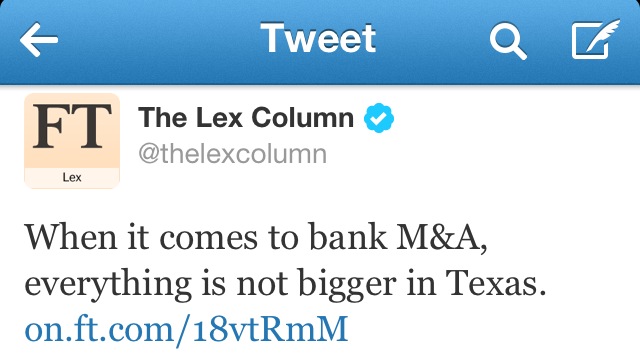
I can’t improve upon the FT’s Lex Column tweet for this week’s post; since it’s behind a paywall, I can’t share any more than the shortened URL either.  Still, it does foreshadow one of three points I’m sharing as we wrap up another summer week.

(1) When it comes to bank M&A, investment bankers “expect slow and steady consolidation.” Analysts point out that in today’s environment of slowed economic growth and regulatory change, bankers and investors continue to eye M&A as a possible opportunity for increasing profits and building strategic franchises.   So I paid close attention to news that Texas-based Cullen/Frost will, for the first time in nearly seven years, acquire another bank. On Tuesday, the NYSE-listed institution announced it will pick up Odessa-based WNB Bancshares, which operates in the heart of the oil-and-gas producing, Friday Night Light’sinspiring Permian Basin in West Texas.  If you’re not familiar with shoppingCullen/Frost, it has $22+ billion in assets and consistently ranks among the top banks in the country (at least, if you pay attention to rankings like the “Nifty Fifty,” which annually identifies the best users of capital).  As I looked for background on the deal, I found this article that ran in the bank’s hometown of San Antonio an interesting summary.  According to the news outlet, Cullen/Frost’s Chairman and CEO, Dick Evans, is fond of saying he is an “aggressive looker and a conservative buyer” when it comes to making acquisitions. So you have to figure this cash and stock deal (valued at $220 million) makes too much strategic sense for both institutions to ignore, especially with the Lone Star state’s surging oil and gas business.

(2) From size to age, you may hear me refer to my company as a 23-year old start up.  But this description cannot hold a candle to “a 110-year-old NorCal startup:” Mechanics Bank.  While I haven’t visited with them, every time I go to San Francisco I hear good things about the team leading the bank (and yes, we have written about their work; for example, “Talking Tech to Directors“).  Within the bank is the author of “Discerning Technologist,” Bradley Leimer.  As the VP of Online and Mobile Strategy at Mechanics Bank, I certainly appreciate his perspectives on change.  In fact, as I work on a growth-focused program for CEOs, executives and a bank’s boards, his “What Inspires Financial Services Innovation?” piece became a must read.  Totally up my tech and design alley and a blog worth following.

(3) Finishing on a technology kick, Fiserv shares a white paper that explores mobile strategies (“Mobile Banking Adoption: Your Frontline Staff Holds the Key to Growth“). Ubiquitous as this conversation feels, they show that for most financial institutions, mobile banking adoption typically hits a glass ceiling of 15% to 20% of online banking customers.  This surprised me, as adoption rates of mobile devices continues to grow.  I am a big fan of what the tech giant does to support the community, but I’ve talked with CEOs like Umpqua’s Ray Davis in the past about their retail concept that includes a big mobile push.  No matter what tone at the top is struck, tactical challenges remain for almost everyone.  So I’m curious to hear how banks account for this plateau as they devise their plans.  Many bank leaders I meet with express an interest in getting more mobile and social.  Fewer, however, have a comfort that their teams are measuring, and subsequently managing, such plans for the future.  Fiserv’s piece, for banks and credit unions alike, provides some interesting context for such strategic conversations.

Aloha Friday!