7 Bank M&A Trends for 2016

With this morning’s news that Huntington and FirstMerit are set to merge, it is clear that more and more buyers & sellers are getting off the sidelines and into the bank merger and acquisition (M&A) game.  So in advance of Bank Director’s 22nd annual Acquire or Be Acquired Conference, seven M&A trends to consider.

By Al Dominick, President & CEO, Bank Director

As I shared in yesterday’s post, we are putting the finishing touches on this year’s Acquire or Be Acquired conference. With nearly 600 bank officers & directors from 300+ banks joining us at the Arizona Biltmore for “AOBA” this Sunday through Tuesday, what follows are seven trends in bank M&A that I expect this hugely influential audience to hear and work to address.

  • Deal volume is holding steady; however, median deal price is on the rise.  One caveat: pricing has a strong correlation to both the size & location of a seller + the size of the potential buyer.
  • Growing banks must seize upon opportunities based on future needs, not just present needs
  • At the same time, more investors are taking a “what have you done for me lately” approach and emphasizing nearer-term results. Further, activist investors are becoming more prominent and driving some of this action.
  • Capturing efficiencies continues to be one of the most compelling forces driving industry consolidation.
  • When people tell you that size doesn’t matter, realize that banks with less than $500 million in assets have had the lowest return on equity for 11 out of the past 12 quarters (per SNL). Expect even more sellers to emerge from this part of the industry.
  • As the regulatory environment becomes increasingly difficult to maneuver, it is safe to anticipate an increase in merger activity — mostly for banks with less than $50 billion of assets.
  • As evidenced by Huntington Bancshares announcing today that it would buy FirstMerit Corporation in a deal worth $3.4 billion in stock and cash, mergers are a viable option for growth among the larger regionals.  While we don’t have the same kinds of national consolidators buying up banks like they once did, deals like this one, KeyCorp announcing it would buy First Niagara Financial Group and New York Community Bancorp that it would buy Astoria Financial at least opens the possibilities of larger players getting back in the merger game.

Whether you are coming to the conference or just interested in following the conversations, I invite you to follow me on Twitter via @AlDominick and/or @BankDirector — and search & follow #AOBA16 to see what is being shared with and by our attendees.

4 Things to Know In Advance of Bank Director’s 2016 Acquire or Be Acquired Conference

Why banks are bought or sold involves much more than just the numbers making sense. Indeed, to successfully negotiate a merger transaction, buyers & sellers must bridge the gap between a number of financial, legal, accounting and social challenges. So in advance of this year’s biggest merger and acquisitions (M&A) conference, a few things I feel attendees of “AOBA” should know.

By Al Dominick, President & CEO, Bank Director

Starting this Sunday at the Arizona Biltmore, Bank Director’s team once again opens the doors to our annual Acquire or Be Acquired Conference — affectionately called “AOBA” (ay-oh-bah).  About this time last year, I wrote about a record turnout, one we will exceed in a few days when 925 men and women arrive at this architectural gem.

By design, the numbers I share in the image above only reflect key data from the financial institutions attending.  In fact, we are prepared to welcome another 60+ professional services firms and product companies to the Biltmore.   While I am particularly impressed by the caliber of support provided to the industry by our sponsoring companies, today’s post focuses on a handful of issues impacting the officers and directors joining us from strong and well performing community banks.

While big banks typically garner mainstream headlines — Wells Fargo, Citi, JPMorganChase and Bank of America account for a whopping $8.1 Trillion of the $17.3 Trillion assets held by banks in the U.S. — the buying and selling of banks takes place outside their domain.  The overwhelming majority of deals today involve community banks, many of whom have their CEOs attending AOBA.  So for this hugely influential audience, here are my key points to know and consider before the conference kicks off.

  • M&A remains attractive inasmuch as successful transactions improve operating leverage, earnings, efficiency and scale.
  • Today’s regulatory environment can hold up a deal — so it has become popular to note that banks can make acquisitions depending on how “clean” both the buyer and seller are + how big the resulting bank becomes.
  • As seen in their superior financial metrics (e.g. ROAA and ROAE), larger banks are growing and consistently outperforming smaller banks.
  • Small and mid-sized banks’ importance to the overall economy and select business sectors remains in place; however, their earnings potential is less diverse then big banks, making them more vulnerable to new competitors and shifts in pricing of financial products.

Certainly, the buying and selling of banks has been the industry’s “great game” for the last couple of decades.  As the conference agenda reflects, we dive deeper into topics like these and look at pre-deal considerations, post-integration challenges and everything in between.  So for those not able to join us — but interested in following the conversations — I invite you to follow me on Twitter via @AlDominick, the host company, @BankDirector, and search & follow #AOBA16 to see what is being shared with (and by) our attendees.

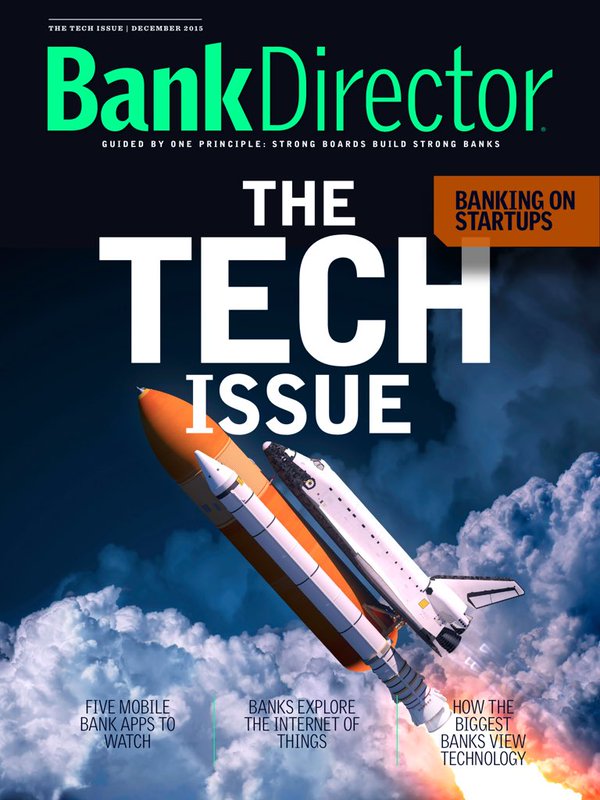
Bank Director’s annual Tech Issue is now available for free

Take a look at Bank Director’s just-published “Tech Issue.” In it, we look at how bank CEOs and executive teams can better engage with fintech companies, what the biggest banks are doing in terms of technology strategy and what the Internet of Things (IoT) means for financial institutions in 2016.

To download this free issue:

  1. On Your Tablet or Mobile Device, Select Apple’s AppStore, Google Play or Amazon’s Apps;
  2. Search “Bank Director Digital Magazine;” and
  3. Download the App to Your Digital Device & Enjoy.

Happy Holidays!

How We Are Taking a Lean Startup Approach to our Grown-up Business

A lean startup methodology enables entrepreneurs to efficiently build a company by searching for product and/or market fit rather than blindly trying to execute.  I find it helps mature companies too — and thought the perspectives of Stanford Professor Steve Blank, Silicon Valley entrepreneur Ben Horowitz and Y Combinator’s Sam Altman might resonate with bankers, fintech companies and other small business CEOs that are thinking about how to adapt their businesses to new challenges and opportunities. 

Paying It Forward

By Al Dominick // @aldominick

As someone who long aspired to build and run a company, I take great pride in leading a profitable, privately-held, twenty-person-strong small business.  In the past, I have written about my “people > products > performance” approach to leading the Bank Director team.  So when Ben Horowitz (co-founder and Partner of the venture capital firm Andreessen Horowitz) shares on his blog, “it’s not about how smart you are or how well you know your business; it’s about how that translates to the team’s performance and output,” I find myself nodding in total agreement.

Look, I am so very proud of our team’s accomplishments… but I am even more excited to adapt the lean startup methodology to scale our business.  The approach we are taking builds on the wisdom and experience of others. So for anyone responsible for growing their business, allow me to recommend two “must reads:”

For me, we are “all-in” in terms of taking a lean startup approach to expanding our business without compromising our reputation for going narrow & deep, providing a “Four Seasons” level of experience at our events and delivering outstanding ideas and insights to a hugely influential audience.  In addition, we are supremely mindful to do as Sam Altman says.  That is, create something that a small number of people love rather than a product that a large number of people simply like.

H1: The Core Business

Admittedly, I am hesitant to call our approach to growing Bank Director a bootstrapping effort since the brand, relationships and revenue being generated enable us certain luxuries that many start-ups simply do not have.  Nonetheless, let me show you how we adapted the Horizon 1 (H1) and Horizon 3 (H3) framework depicted above to our business.

What began in 1991 as a traditional publishing company now operates as a privately-held media enterprise delivering original content to CEOs, executives and board members of financial services companies via digital platforms, exclusive conferences and award-winning publications.  Below is a visual example of our transformation vis-a-vis three magazine covers.  As you can see, we have matured in style while expanding our frequency (from quarterly to monthly) as we expanded our distribution channels.

Going narrow and deep works for us since we generate our revenue from the annual conferences & events we host (e.g. our 800+ person Acquire or Be Acquired conference), publications and research we publish and education & training services we provide.

H3: Where the Wild Ideas Live

With three consecutive years of top line growth (and healthy bottom line results to boot), we are in the wonderful position to grow in some pretty cool ways.  But doing so will take more than simple process improvements and expense control.  As we have a strong business foundation in place, I did have to restructure my management team’s individual roles and responsibilities to better suit our H1/H3 setup.  I did so because as Steve Blank points out, “Horizon 3 is where companies put their crazy entrepreneurs… these innovators want to create new and potentially disruptive business models.” As fun as living/working in H3 sounds, let me emphasize how much I rely on the H1 team to “defend, extend and increase” our core business.

Is it working?  Well, we will formally announce a new venture, FinXTech, on March 1, 2016 at Nasdaq’s MarketSite in New York City.  This is the first — and surely not last — project to emerge from our H3 world.  But time will ultimately tell.

We are a collection of creative men and women and I am very optimistic about our future.  Realizing that we want to continuously push to grow and innovate led me to appreciate “the need to execute (to the) core business model while innovating in parallel.”  So today’s post isn’t an attempt to make me look smart; rather, my attempt to acknowledge the inspiration of others and share what’s working for us.

Size & Scale: The King and Queen of Bank M&A?

Earlier this week, I shared my perspectives on bank M&A with the Wall Street Journal.  What follows builds off the piece that ran in Tuesday’s print edition, highlighting key findings from Bank Director’s annual Bank M&A Survey.

By Al Dominick // @aldominick

At a time when J.P. Morgan is getting smaller, the pressure is on for smaller banks to get bigger.  As KPMG recently shared with BankDirector.com, there was a 25% increase in bank deals in the U.S. in 2014, compared to 2013, and there is a good possibility that the number of deals in 2015 will exceed that of 2014.  One reason for this: a larger institution can spread costs (such as investments and regulatory burdens) across a larger customer and revenue base.

Not surprisingly, 67% of executives and board members responding to Bank Director’s 2016 Bank M&A Survey say they see a need to gain more scale if they are going to be able to survive in a highly competitive industry going forward.  As our director of research, Emily McCormick, shared, “many of these respondents (62%) also see a more favorable climate for bank deals, hinting at a more active market for 2016 as banks seek size and scale through strategies that combine organic growth with the acquisitions of smaller banks.”

While the majority of bank executives and boards surveyed feel a need to grow, respondents don’t agree on the size banks need to be in order to compete today.  A slim majority, 32%, identified $1 billion in assets as the right size… interesting, but not surprising, when you consider that 89% of commercial banks and savings institutions are under $1 billion in assets, according to the FDIC (*personally, I’m of the opinion that $5Bn is the new $1Bn, but that’s a topic for another day).  On to the key findings from this year’s research:

  • Two-thirds report their bank intends to participate in some sort of acquisition over the next 12 months, whether it’s a healthy bank (51%), a branch (20%), a nondepository line of business (14%), a loan portfolio (6%) and/or a financial technology firm (a scant 2%).
  • Respondents indicate that credit culture, at 32%, and retaining key talent that aligns with the buyer’s culture, at 31%, are the most difficult aspects of the post-merger integration process.
  • More institutions are using social media channels to communicate with customers after the close of the deal. 55% of respondents who purchased a bank in 2014 or 2015 used social media, compared to 42% of 2011-2013 deals and just 14% of 2008-2010 deals (*FWIW, Facebook, at 26%, is the most popular channel for respondents).
  • Fifty-six percent of respondents have walked away from a deal in the past three years.  Of the respondents who indicate they declined to buy, 60% cite deal price while 46% blame the credit quality of the target institution.
  • Why do banks sell? Of the executives and board members associated with banks sold from 2012 to 2015, 55% say they sold because shareholders wanted to cash out.  Despite concerns that regulatory costs are causing banks to sell, just 27% cite this burden as a primary motivator.

The full survey results are now available online at BankDirector.com, and will be featured in the 1st quarter, 2016 issue of Bank Director magazine.  In addition, for those executives interested in connecting with many of the key decision makers driving the deals mentioned above, our annual Acquire or Be Acquired Conference will be held at the Arizona Biltmore from January 31 through February 2.

##

Our 2016 Bank M&A Survey, sponsored by Crowe Horwath LLP, examines current attitudes and challenges regarding bank M&A, and what drives banks to buy and sell. The survey was completed in September 2015 by 260 chief executive officers, independent directors and senior executives of U.S. banks, and former executives and directors of banks that have been acquired from 2012-2015.

While Everybody’s Talking About the Future of Banking…

It seems like everyone has an opinion about what the future holds for banking… but what does banking actually look like today?

By Al Dominick // @aldominick

For the past few years, Bank Director magazine’s Editor-in-Chief, Jack Milligan, has spearheaded our Bank Performance Scorecard, a ranking of the largest U.S. publicly traded banks and thrifts. The most recent version, which appears in our third quarter issue, ranked all banks and thrifts listed on the New York Stock Exchange and Nasdaq OMX.  Jack and his team sorted them into three separate asset categories: $1 billion to $5 billion, $50 billion to $50 billion and $50 billion and above — and we ranked them using a set of metrics that measured profitability, capitalization and asset quality based on 2014 calendar year data.

While this data shines a light on some of banking’s standout performers, my last few months of travel across the U.S. has revealed less familiarity with the banking industry then I expected. So today, instead of focusing on economic, political, demographic or technological forces reshaping the banking landscape, allow me to share some statistics I think are important to know:

  1. Banks with less than $10 billion in assets have lost over half of their market share in the past 20 years.
  2. The corollary? The five largest banks now hold almost 44% of all banking assets in the country.
  3. Despite totaling 89% of all banks, institutions under $1B in assets hold only 8.3% of the industry’s assets.

With competition coming from both the top of the market and from non-traditional players, I have talked with numerous bank CEOs and various members of their executive teams who tell me how imperative it is for them to really focus on improving efficiencies and enhancing organic growth prospects.  In addition, as big banks invest in customer acquisition, and non-traditional players continue to eat away at earnings potential, it strikes me that of all of the risks facing a bank’s key leadership team today (for instance, regulatory, market and cyber) knowing when to buy, sell or grow independently has to be high on the list. After all, the most profitable financial companies are often those whose strategies are intentional, focused and differentiated… and are showing current revenue growth with strong visibility towards future performance.

Of course, any discussion about the world in which banks live today has to acknowledge two significant business threats. Since most banking products tend to be commodities that are available at any number of bank and non-bank providers, the first concerns customer acquisition costs. Personally, I believe such costs will increase as existing customers become less likely to refer their bank to others. This leads to the second threat; namely, banks will lose revenue as customers leave for competitors and existing customers buy fewer products.

So a high-level look at where things are today. I realize this takes a very broad brush to a mature industry. Still, to understand where banks might be heading, I find it helpful to be grounded in where they are today.

How Fintech Mergers Are Reshaping Banking

I am in Seattle to host a peer exchange at the Four Seasons — one focused on emerging legal, regulatory and risk issues facing members of the board of financial institutions.  As eager as I am to welcome participants to this beautiful property and city, I have to admit that my attention this morning centers on M&A in the fintech space (thanks to this piece I authored for BankDirector.com).  So before the day ramps up, I thought to re-post my perspectives on interesting deals that are reshaping banking.

By Al Dominick // @aldominick

It’s no secret that what has been happening in the fintech space is attracting more attention from the world of banking. It’s hard to ignore the fact that venture capital invested $10 billion in fintech startups in 2014, compared to just $3 billion in 2013, according to an Accenture analysis of CB Insights data.  But watching M&A in the fintech space shows that these startups are much more likely to pair with others or get acquired by incumbents than they are to go public with an initial public offering, as noted by bank analyst Tai DiMaio in a KBW podcast recently.  “Together, through partnerships, acquisitions or direct investments, you can really have a situation where both parties benefit [the fintech company and the established player],’’ he says.  That may lend credence to my initial suspicions that there are more opportunities in fintech for banks than threats to established players and that these startups really need to pair up to be successful.

Take BlackRock’s announcement in August that it will acquire FutureAdvisor, a leading digital wealth management platform with technology-enabled investment advice capabilities (a so-called “robo advisor.”) With some $4.7 trillion in assets under management, BlackRock offers investment management, risk management and advisory services to institutional and retail clients worldwide—so this deal certainly caught my attention.

According to FT Partners, the investment bank that served as exclusive advisor to BlackRock, the combination of FutureAdvisor’s tech-enabled advice capabilities with Blackrock’s investment and risk management solutions “empowers partners to meet the growing demand among consumers to engage with technology to gain insights on their investment portfolios.” This should be seen as a competitive move to traditional institutions, as demand for such information “is particularly strong among the mass-affluent, who account for ~30 percent of investable assets in the U.S.”

Likewise, I am constantly impressed with Capital One Financial Corp., an institution that has very publicly shared its goal of being more of a technology company than a bank. To leapfrog the competition, Capital One is quite upfront in their desire to to deliver new tech-based features faster then any other bank. As our industry changes, the chief financial officer, Rob Alexander, opines that the winners will be the ones that become technology-focused businesses—and not remain old school banking companies. This attitude explains why Capital One was the top performing bank in Bank Director’s Bank Performance Scorecard this year.

Case-in-point, Capital One acquired money management app Level Money earlier this year to help consumers keep track of their spendable cash and savings. Prior to that, it acquired San Francisco-based design firm Adaptive Path “to further improve its user experience with digital.” Over the past three years, the company has also added e-commerce platform AmeriCommerce, digital marketing agency PushPoint, spending tracker Bundle and mobile startup BankOns.

When they aren’t being bought by banks, some tech companies are combining forces instead. Envestnet, a Chicago-based provider of online investment tools, acquired a provider of personal finance tools to banks, Yodlee, in a cash-and-stock transaction that valued Yodlee at about $590 million. By combining wealth management products with personal financial management tools, you see how non-banks are taking steps to stay competitive and gain scale.

Against this backdrop, Prosper Marketplace’s tie up with BillGuard really struck me as compelling. As a leading online marketplace for consumer credit that connects borrowers with investors, Prosper’s acquisition of BillGuard marked the first time an alternative lender is merging with a personal financial management service provider. While the combination of strong lending and financial management services by a non-bank institution is rare, I suspect we will see more deals like this one struck between non-traditional financial players.

There is a pattern I’m seeing when it comes to M&A in the financial space. Banks may get bought for potential earnings and cost savings, in addition to their contributions to the scale of a business. Fintech companies also are bought for scale, but they are mostly bringing in new and innovative ways to meet customers’ needs, as well as top-notch technology platforms. They often offer a more simple and intuitive approach to customer problems. And that is why it’s important to keep an eye on M&A in the fintech space. There may be more opportunity there than threat.

5 Fintechs I’m Keen On

My first post in 2015 focused on three “up & coming” fintech companies: Wealthfront (an automated investment service), Kabbage (an online business loan provider) and Dwolla (a major player in real-time payment processing).  Since writing that piece, I’ve kept tabs on their successes while learning about other interesting and compelling businesses in the financial community.  So today, five more that I am keen on.

By Al Dominick // @aldominick

With continuous pressure to innovate, I’m not surprised to see traditional financial institutions learning from new challengers, adapting their offerings and identifying opportunities to collaborate with emerging players.  From tokenization to integrated payments, security tools to alternative lending platforms, the investments (and efforts) being made throughout the financial sector continues to impress and amaze me.  As I shared in 15 Banks and Fintechs Doing it Right, there are very real and immediate opportunities to expand what banking means to individual and business customers.  Personally, I am excited by the work being done by quite a few companies and what follows are five businesses I’ve learned more about while recently traveling between D.C., San Francisco and New York City:

logo

i2c, a global card processing company, provides back-end processing and settlement for cards, virtual accounts and mobile payments.  What’s interesting about them? According to a brief shared by Bridge by Deloitte (a web platform connecting enterprises with startups to accelerate innovation and growth), i2c recently teamed up with Oxfam, Visa and Philippines-based UnionBank to channel funds to people in disaster-affected communities through prepaid cards.

adyen-logo

With Money20/20 fast approaching, expect to see a lot of #payments trending on twitter.  Trending in terms of financial investment: Adyen, a company receiving a lot of attention for wrapping up a huge round of funding that values the payment service provider at $2.3B.  Adyen, which provides its services to a number of large organizations including Facebook and Netflix, excels in having a highly integrated platform, unlike others with multiple platforms.

Blend labs

When it comes to technology “powering the new wave of mortgage lending,” take a look at the work being done at BlendLabs.  Developing software & data applications for mortgage lenders, the company acknowledges that “accommodating complex rules and regulation changes is time-consuming and costly.” For this reason, the company has quietly rolled out technology that empowers some of the country’s largest lenders to originate mortgages more efficiently and compliantly than ever before while offering their borrowers a more compelling user experience.

logo

As the head of a company, I know first-hand how much time and effort is spent on efforts and ideas designed to maximize revenue and profits.  So the promise and premise of nCino is hugely attractive.  Co-founded by a fellow W&L grad (and the former CEO of S1) nCino is the leader in cloud banking.  With banks like Enterprise in St. Louis (lead by a CEO that I have huge respect for) as customers, take a look at their Bank Operating System, a comprehensive, fully-integrated banking management system that was created by bankers for bankers that sits alongside a bank’s core operating system.

logo

While not solely focused on the financial industry, Narrative Science is a leader in advanced natural language generation.  Serving customers in a number of industries, including marketing services, education, financial services and government, their relationship with USAA and MasterCard caught my eye.  As FinXTech’s Chief Visionary Officer recently shared with me, the Chicago-based enterprise software company created artificial intelligence that mines data for important information and transforms it into language for written reports.

##

In addition to these U.S.-based companies, you might look at how Fidor, a digital bank in Europe that offers all-electronic consumer banking services, links interest rates to Facebook likes and give cash rewards based on customers’ level of interaction with the bank (e.g. how many customer financial questions answered).  Clearly, the fabric of the financial industry continues to evolve as new technology players emerge, institutions like Fidor expand their footprint and traditional participants transform their business models.  So if you follow me on twitter (@aldominick), let me know of other fintech companies you’re impressed by these days.

Banking on Millennials?

I’m in Newport Beach, California where I just presented at Moss Adams’ 15th annual Community Banking conference.  In tandem with Bank Director’s Publisher, Kelsey Weaver, we focused our remarks on the intersection of fintech companies with traditional banks — and how partnerships potentially position community banks to better serve millennials.

By Al Dominick // @aldominick

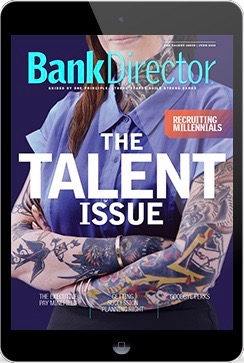
In our recent “talent-focused” digital issue of Bank Director magazine, we reminded readers that “as baby boomers retire and Generation X enters middle age, it’s not surprising that top executives and boards are turning an eye more aggressively toward seeding their banks for the future. But, when it comes to recruiting and retaining younger people, banks have a bit of a public relations problem.”  This opinion formed the early foundation for today’s presentation — one that allowed Kelsey and me to share our thoughts on how and where bankers might invest in a generation consisting of 75 million Americans.  Without re-creating our hour-long remarks, here are three of the points I hope stood out to attendees:

  • Loyalty < Price. In classic economic terms, banking is a mature industry (that is, an industry in which price carries the day over any other offering).  Interestingly, many community banks tout their interests and ability to compete with larger institutions based on their customer service models.  However, the expectations of consumers (be it individual or business) have changed to reflect an “always-on, always available” mindset that does not line up with how many community banks operate.
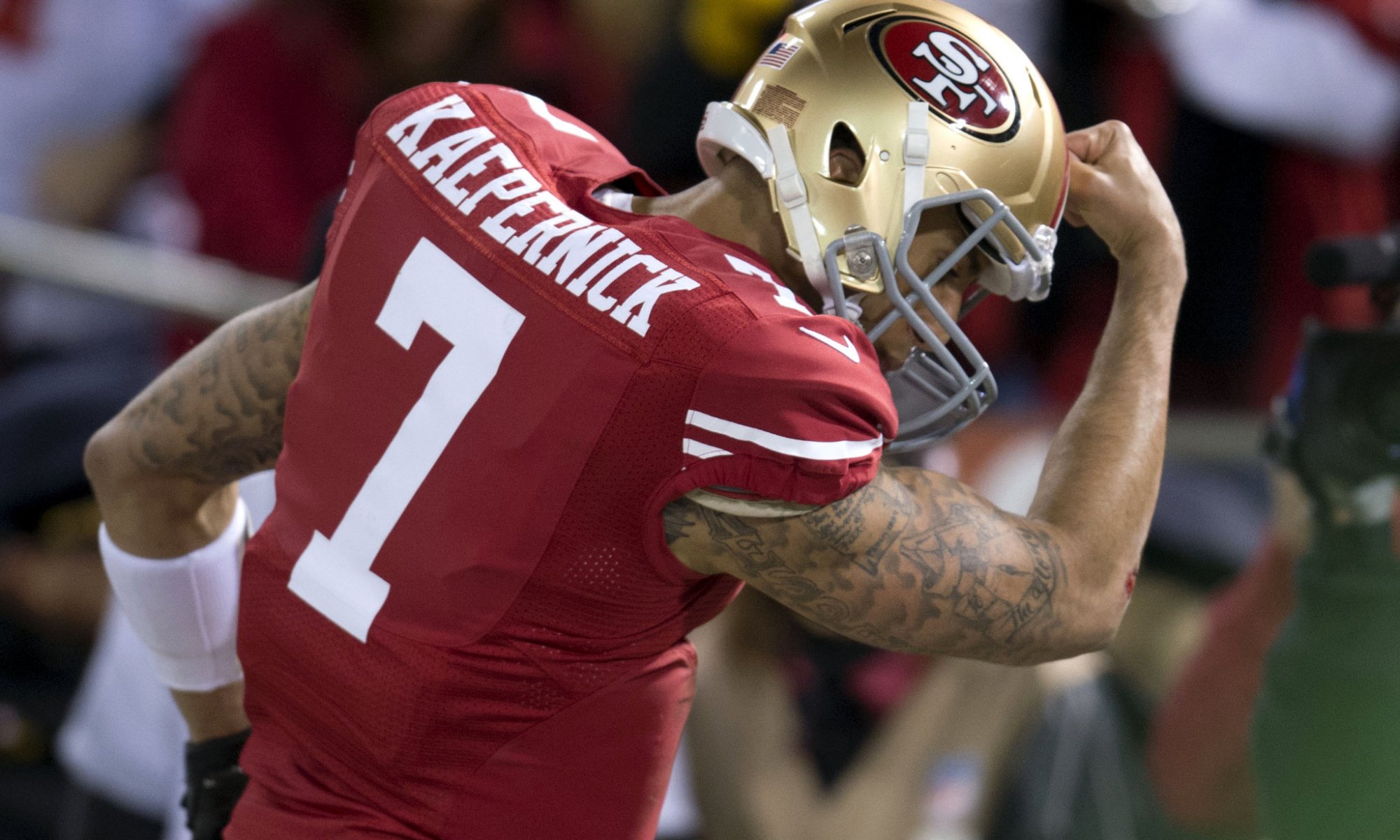
  • You’re not alone.  I mentioned the San Francisco 49ers were recently featured in the Wall Street Journal — not for football purposes; rather, to show how the franchise has taken steps to better engage with their millennial employee base. As I shared, the team’s challenge to “relate to a generation — generally described as 18-to-34-year-olds — that has been raised on smartphones and instant information” parallels that of most banks in the U.S.  I promised attendees I’d post the link to the piece I wrote that features the Journal’s report… Promise fulfilled.
  • There are Friendly Fintech looking for you. Competition comes in many shapes and forms and I believe that banks are acting too slowly when it comes to digital transformations and offerings. Yes, there are truly disruptive fintech companies that have zero interest in aligning with traditional financial institutions.  However, there are quite a few that have built platforms that engage with consumers (both individual and business) that want to support banks as part of a mutually beneficial relationship.  In our presentation, one of the key pieces is a look at who is friendly to banks in the fintech space (juxtaposed with those that are obviously competitive).  If you’re interested, here is a link to the PDF version: Moss Adams 2015 presentation by Bank Director.

Separate from our presentation, let me encourage readers interested in building customer loyalty to check out the work of James Kane.  He opened the conference yesterday morning by presenting “The Loyalty Switch: How to Make Anyone Loyal to You, Your Team, and Your Bank.”  A smart speaker with an even smarter message.  Finally, thanks to our friends at Moss Adams for inviting our participation and the audience of CEOs, CFOs, Controllers, Internal Auditors, and Audit Committee Members from banks here on the west coast.  A privilege to share our perspectives with all of you this afternoon.

Quick Guide: 2015 Growth Strategy Survey (Bank-specific)

Recently, Business Insider and the Wall Street Journal picked up Bank Director’s 2015 Growth Strategy Survey.  The research project reveals how many financial institutions continue to recognize growth in traditional areas — most notably, loans to businesses and commercial real estate — while struggling to attract a decidedly untraditional digital generation.  So in case you missed it, today’s piece highlights key findings from this annual research project. 

By Al Dominick // @aldominick

Over the weekend, our friends at the Wall Street Journal ran a very telling story about the efforts being made by the San Francisco 49ers to better engage with their millennial employee base.  Clearly, the NFL franchise’s challenge to “relate to a generation — generally described as 18-to-34-year-olds — that has been raised on smartphones and instant information” parallels that of most banks in the U.S.  In addition to being a fascinating behind-the-scenes look at what’s happening out in Santa Clara, it also sparked today’s post.

You see, as a 38-year old who runs a great privately-held company that employs quite a few folks under the age of 30, I have to admit that I am tiring of the broad strokes being used to describe millennials’ needs and ambitions.  However, I will admit to being surprised to learn that there are approximately 75 million people in the U.S. under the age of 34.  This is a huge number, especially when you hear that every day, for the next 15 years, 10,000 people will turn 65 (h/t to the CEO of Boston’s Chamber of Commerce for making me aware of this reality).

Surprisingly, 60% of the executives and board members that responded to Bank Director’s 2015 Growth Strategy Survey say their bank might not have the right products, services and delivery methods to serve the vast majority of this demographic.  While I haven’t run this by our very talented Director of Research (*hello Emily McCormick), to me, this shows that the relationships that community bankers nurtured for decades will be increasingly of less value with this emergingly-influential generation who have grown up in a digital world and who, stereotypically, value the speed with which it operates.

As the Wall Street Journal shared when reporting on our research results, “banks have watched less regulated finance companies ranging from mortgage lenders to private-equity firms encroach on many of their main businesses.  But ask an executive or board member at a bank what nonbank company they most fear, and they’re likely to name the world’s biggest technology company, Apple Inc.”  So what were our key findings?  Glad you asked…

Three key findings (click this title link to access the full report):

  1. Apple is the nonbank competitor respondents worry about most, at 40%  — just 18% of respondents indicate their bank offers Apple Pay.
  2. Bank mobile apps may not keep pace with nonbank competitors. Features such as peer-to-peer payments, indicated by 28% of respondents, or merchant discounts and deals, 9%, are less commonly offered within a traditional bank’s mobile channel. 49% of respondents indicate their bank offers personal financial management tools.
  3. Despite the rise of P2P lenders like Lending Club and Prosper in the consumer lending space, just 35% of respondents express concern that these startup companies will syphon loans from traditional banks.

Instead of millennials, banks have been finding most of their growth in loans to businesses and commercial real estate.  Yes, 75% of respondents want to understand how technology can make their bank more efficient… and 72% want to know how technology can improve the customer experience.  But I find it telling that today, loan growth remains the primary driver of profitability for the majority of responding banks.  In fact, 85% of respondents see opportunities to grow through commercial real estate loans.  As we found, executives and board members also expect to grow through commercial & industrial (C&I) lending, for 56%, and residential mortgages, at 45%.  So for those looking to predict the future of banking, I think findings like these are quite telling.  Indeed, it would appear what’s worked in the past may be what to bet on for the future.

##

The 2015 Growth Strategy Survey, sponsored by technology firm CDW, reveals how bankers perceive the opportunities and challenges in today’s marketplace, and technology’s role in strategic growth. The survey was completed by 168 chief executive officers, independent directors and senior executives of U.S. banks with more than $250 million in assets in May, June and July of this year.  Ironically, last year’s survey found that credit unions, not Apple, were the “non-bank” competitor that banks were most worried about.  In fact, can you believe that Apple didn’t even make the cut?  My, how quickly times can change.

18 Banks that Fintech Companies Need to Know

To build on last week’s piece (15 Banks and Fintechs Doing it Right), I put myself in the shoes of an early stage fintech company’s Founder.  Specifically, as someone with a new idea looking to develop meaningful financial relationships with regional and community banks in the United States.  With many exciting and creative fintech companies beginning to collaborate with traditional institutions, what follows is a list of 18 banks — all between $1Bn and $25Bn in size — that I think should attract the tech world’s interest.

By Al Dominick // @aldominick

Believe it or not, but bank CEOs and their teams are working hard to grow revenue, deposits, brand, market size and market share.  So a hypothetical situation to tee-up today’s column.

Imagine we developed a new, non-disruptive but potentially profit-enhancing software product (let’s put it in the “know-your-customer” sector since banks already spend money on this).  As the Founders, we want to approach banks that might be ready to do more than simply pilot our product.  While our first instinct would be to focus on recognizable names known for taking a technology-based, consumer-centric focus to banking, the low hanging fruit might be with CEOs and executive teams at publicly traded community banks — many of whom are above $1Bn in asset size and are just scratching the surface of developing meaningful fintech relationships.

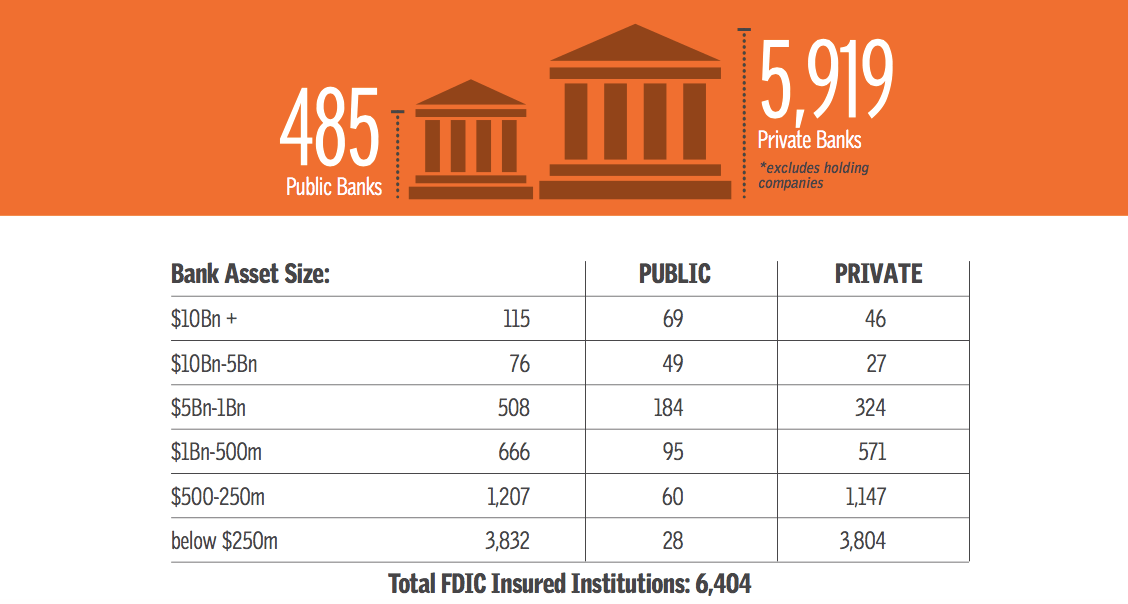
With the idea that smaller banks can act faster to at least consider what we’re selling, we cull the field, knowing that as of June 1 of this year, the total number of FDIC-insured institutions equaled 6,404; within this universe, banks with assets greater than $1Bn totaled just 699.

So now we are focused on a manageable number of potential customers and can spend time getting smart on “who’s-doing-what” in this space.  Can we agree that we want to approach banks that share common characteristics; namely, strong financial performance that sets them apart from their peers and operations in strong local markets or big economic states?  Good, because assuming we are starting from scratch in this space, here are our top prospects (listed in no particular order with approximate asset size):

  1. Citizens Business Bank in California ($7.3Bn)
  2. Pinnacle Financial in Tennessee ($6Bn)
  3. Farmers & Merchants in California ($5.5Bn)
  4. Western Alliance in Arizona ($10Bn)
  5. Eagle Bank in DC ($5.2Bn)
  6. Prosperity in Texas ($21.5Bn)
  7. BankUnited in Florida ($19.2Bn)
  8. BofI “on the internet” ($5.2Bn)
  9. First NBC in Louisiana ($3.7Bn)
  10. Burke & Herbert in Virginia ($2.6Bn)
  11. Banner in Washington ($4.7Bn)
  12. Bank of Marin in California ($1.8Bn)
  13. Cardinal Bank in Virginia ($3.4Bn)
  14. State Bank in Georgia ($2.8Bn)
  15. TCF Financial in Minnesota ($19.3Bn)
  16. United Bank in Connecticut ($5.5Bn)
  17. Boston Private in Massachusetts ($6.8Bn)
  18. Opus Bank in California ($5.1Bn)

At a time when the concept of service is fast changing to reflect highly functional technology and “always-available” customer experiences, these eighteen banks — already successful in their own right — strike me as just the types to think about approaching.

##

*Now I’m not suggesting everyone pick up the phone and call each’s institutions CEO.  But If you are with a fintech thinking about partnerships and collaboration, you could do a whole heckuva lot worse than spending some time learning what makes all of these banks more than just financially strong and consumer relevant.

15 Banks and Fintechs Doing it Right

15 examples - new blog cover image.001

Many bank CEOs and their executive teams are looking for emerging methods, products and services to reach new customer segments to drive growth. Today, I identify fifteen banks in the United States, all under $20Bn in asset size, that are growing with the help of fintech companies.

By Al Dominick // @aldominick

With the rise of many innovative, non-traditional financial services companies, leaders of financial institutions can find themselves overwhelmed when it comes to selecting the right partners.  If you are running a bank that doesn’t have multiple incubators, accelerators and skunk work projects already under way, knowing where to participate with the fintech community can prove quite the challenge.  Should it be with an upstart touting a new credit decisioning models?  What about one with a new lending model?  In the quest to become more “nimble” and responsive to consumer demands, do you partner? Refer business? Accept referrals?  The list of not-so-rhretorical questions goes on and on…

Now, quite a bit of digital ink has been spilled over the creativity and aspirations of the fintech community (and its many investors) to transform banking.  But not nearly as much for banks looking to do the same.  While the efforts of major players like Wells Fargo and Capital One garner well-deserved attention, it is my belief that for fintech companies keen to collaborate (and not compete) with banks, developing relationships with banks from $1Bn to $10Bn — there are approximately 550 — and those from $10Bn to $50Bn — there are approximately 75 — may prove as lucrative over the next few years as working with the 30 banks that have assets from $50Bn up.

With this parameter in mind, I polled a few of my team at Bank Director to compile a list of banks, all under $20Bn in asset size, that “play well” with fintechs to show that you don’t have to be the biggest of the big to benefit from this wave of new market participants.  Here, in no particular order, are fifteen banks with notable relationships and/or efforts.

  1. Eastern Bank checks in at $9.7B in asset size, and the Massachusetts-based bank stands out for bringing on some great fintech talent; notably, hiring ex-Perkstreet CEO Dan O’Malley and several of his colleagues to lead its innovation unit;
  2. California’s Fremont Bank ($2.7B) caught our eye, as the bank was a fast adopter of Apple Pay;
  3. River City Bank ($1.3B, Sacramento) has a fintech guy — Ryan Gilbert, Better Finance — on their board;
  4. The Bancorp ($4.5B) backs a lot of fintech/nonbank firms like Moven and Simple;
  5. Radius Bank (just under $1Bn) is a Boston institution with just two physical locations — but is forming alliances with fintech startups to be “everywhere;”
  6. Union Bank & Trust in Nebraska works with Betterment, an automated investing service, to offer its customers a smart, simple and easy way to invest;
  7. A real pioneer, CBW Bank ($14.5B) is a community bank in Kansas and one of the first U.S. banks to use the Ripple protocol for modern, real-time payments between the U.S. and other countries globally;
  8. In the Pacific Northwest, Washington Trust ($4B) is vocal on being tech-friendly;
  9. In Texas, First Financial ($6B) is big on mobile and being innovative — working with Mitek, they are the first regional bank to offer mobile photo bill pay);
  10. Banc of California ($6B) uses nCino to automate and standardize its commercial and SBA lending;
  11. PacWest ($16B) are all about lending to technology and fintech companies;
  12. The Bank of the Internet, BofI, is a full-service internet bank with $5 billion in assets;
  13. Everbank ($16B) plays well with Fintech while adorning the stadium of the NFL’s Jacksonville Jaguars;
  14. Rockland Trust has a SVP of digital and payments innovation, which is unusual for a $5.6 billion dollar bank; and
  15. The $17 billion-asset First National Bank of Omaha hosts a weekend-long hackathon, a competition common in the tech world but rarely hosted by banks, to attract talent into its ranks.

By no means is this a complete list of community banks collaborating with fintechs in the U.S.  If I was to expand the list up in size, you can bet larger regional standouts like KeyBank would merit recognition for their work with companies like HelloWallet.  In the spirit of learning/sharing, who else should be added to this list?  Let me know via twitter or by leaving a comment below.