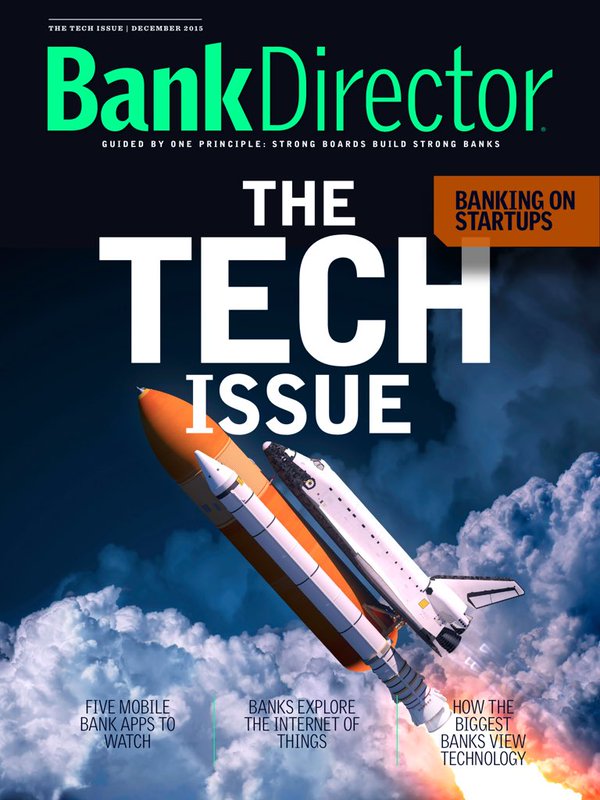
Bank Director’s annual Tech Issue is now available for free

Take a look at Bank Director’s just-published “Tech Issue.” In it, we look at how bank CEOs and executive teams can better engage with fintech companies, what the biggest banks are doing in terms of technology strategy and what the Internet of Things (IoT) means for financial institutions in 2016.

To download this free issue:

  1. On Your Tablet or Mobile Device, Select Apple’s AppStore, Google Play or Amazon’s Apps;
  2. Search “Bank Director Digital Magazine;” and
  3. Download the App to Your Digital Device & Enjoy.

Happy Holidays!

How Fintech Mergers Are Reshaping Banking

I am in Seattle to host a peer exchange at the Four Seasons — one focused on emerging legal, regulatory and risk issues facing members of the board of financial institutions.  As eager as I am to welcome participants to this beautiful property and city, I have to admit that my attention this morning centers on M&A in the fintech space (thanks to this piece I authored for BankDirector.com).  So before the day ramps up, I thought to re-post my perspectives on interesting deals that are reshaping banking.

By Al Dominick // @aldominick

It’s no secret that what has been happening in the fintech space is attracting more attention from the world of banking. It’s hard to ignore the fact that venture capital invested $10 billion in fintech startups in 2014, compared to just $3 billion in 2013, according to an Accenture analysis of CB Insights data.  But watching M&A in the fintech space shows that these startups are much more likely to pair with others or get acquired by incumbents than they are to go public with an initial public offering, as noted by bank analyst Tai DiMaio in a KBW podcast recently.  “Together, through partnerships, acquisitions or direct investments, you can really have a situation where both parties benefit [the fintech company and the established player],’’ he says.  That may lend credence to my initial suspicions that there are more opportunities in fintech for banks than threats to established players and that these startups really need to pair up to be successful.

Take BlackRock’s announcement in August that it will acquire FutureAdvisor, a leading digital wealth management platform with technology-enabled investment advice capabilities (a so-called “robo advisor.”) With some $4.7 trillion in assets under management, BlackRock offers investment management, risk management and advisory services to institutional and retail clients worldwide—so this deal certainly caught my attention.

According to FT Partners, the investment bank that served as exclusive advisor to BlackRock, the combination of FutureAdvisor’s tech-enabled advice capabilities with Blackrock’s investment and risk management solutions “empowers partners to meet the growing demand among consumers to engage with technology to gain insights on their investment portfolios.” This should be seen as a competitive move to traditional institutions, as demand for such information “is particularly strong among the mass-affluent, who account for ~30 percent of investable assets in the U.S.”

Likewise, I am constantly impressed with Capital One Financial Corp., an institution that has very publicly shared its goal of being more of a technology company than a bank. To leapfrog the competition, Capital One is quite upfront in their desire to to deliver new tech-based features faster then any other bank. As our industry changes, the chief financial officer, Rob Alexander, opines that the winners will be the ones that become technology-focused businesses—and not remain old school banking companies. This attitude explains why Capital One was the top performing bank in Bank Director’s Bank Performance Scorecard this year.

Case-in-point, Capital One acquired money management app Level Money earlier this year to help consumers keep track of their spendable cash and savings. Prior to that, it acquired San Francisco-based design firm Adaptive Path “to further improve its user experience with digital.” Over the past three years, the company has also added e-commerce platform AmeriCommerce, digital marketing agency PushPoint, spending tracker Bundle and mobile startup BankOns.

When they aren’t being bought by banks, some tech companies are combining forces instead. Envestnet, a Chicago-based provider of online investment tools, acquired a provider of personal finance tools to banks, Yodlee, in a cash-and-stock transaction that valued Yodlee at about $590 million. By combining wealth management products with personal financial management tools, you see how non-banks are taking steps to stay competitive and gain scale.

Against this backdrop, Prosper Marketplace’s tie up with BillGuard really struck me as compelling. As a leading online marketplace for consumer credit that connects borrowers with investors, Prosper’s acquisition of BillGuard marked the first time an alternative lender is merging with a personal financial management service provider. While the combination of strong lending and financial management services by a non-bank institution is rare, I suspect we will see more deals like this one struck between non-traditional financial players.

There is a pattern I’m seeing when it comes to M&A in the financial space. Banks may get bought for potential earnings and cost savings, in addition to their contributions to the scale of a business. Fintech companies also are bought for scale, but they are mostly bringing in new and innovative ways to meet customers’ needs, as well as top-notch technology platforms. They often offer a more simple and intuitive approach to customer problems. And that is why it’s important to keep an eye on M&A in the fintech space. There may be more opportunity there than threat.

Quick Guide: 2015 Growth Strategy Survey (Bank-specific)

Recently, Business Insider and the Wall Street Journal picked up Bank Director’s 2015 Growth Strategy Survey.  The research project reveals how many financial institutions continue to recognize growth in traditional areas — most notably, loans to businesses and commercial real estate — while struggling to attract a decidedly untraditional digital generation.  So in case you missed it, today’s piece highlights key findings from this annual research project. 

By Al Dominick // @aldominick

Over the weekend, our friends at the Wall Street Journal ran a very telling story about the efforts being made by the San Francisco 49ers to better engage with their millennial employee base.  Clearly, the NFL franchise’s challenge to “relate to a generation — generally described as 18-to-34-year-olds — that has been raised on smartphones and instant information” parallels that of most banks in the U.S.  In addition to being a fascinating behind-the-scenes look at what’s happening out in Santa Clara, it also sparked today’s post.

You see, as a 38-year old who runs a great privately-held company that employs quite a few folks under the age of 30, I have to admit that I am tiring of the broad strokes being used to describe millennials’ needs and ambitions.  However, I will admit to being surprised to learn that there are approximately 75 million people in the U.S. under the age of 34.  This is a huge number, especially when you hear that every day, for the next 15 years, 10,000 people will turn 65 (h/t to the CEO of Boston’s Chamber of Commerce for making me aware of this reality).

Surprisingly, 60% of the executives and board members that responded to Bank Director’s 2015 Growth Strategy Survey say their bank might not have the right products, services and delivery methods to serve the vast majority of this demographic.  While I haven’t run this by our very talented Director of Research (*hello Emily McCormick), to me, this shows that the relationships that community bankers nurtured for decades will be increasingly of less value with this emergingly-influential generation who have grown up in a digital world and who, stereotypically, value the speed with which it operates.

As the Wall Street Journal shared when reporting on our research results, “banks have watched less regulated finance companies ranging from mortgage lenders to private-equity firms encroach on many of their main businesses.  But ask an executive or board member at a bank what nonbank company they most fear, and they’re likely to name the world’s biggest technology company, Apple Inc.”  So what were our key findings?  Glad you asked…

Three key findings (click this title link to access the full report):

  1. Apple is the nonbank competitor respondents worry about most, at 40%  — just 18% of respondents indicate their bank offers Apple Pay.
  2. Bank mobile apps may not keep pace with nonbank competitors. Features such as peer-to-peer payments, indicated by 28% of respondents, or merchant discounts and deals, 9%, are less commonly offered within a traditional bank’s mobile channel. 49% of respondents indicate their bank offers personal financial management tools.
  3. Despite the rise of P2P lenders like Lending Club and Prosper in the consumer lending space, just 35% of respondents express concern that these startup companies will syphon loans from traditional banks.

Instead of millennials, banks have been finding most of their growth in loans to businesses and commercial real estate.  Yes, 75% of respondents want to understand how technology can make their bank more efficient… and 72% want to know how technology can improve the customer experience.  But I find it telling that today, loan growth remains the primary driver of profitability for the majority of responding banks.  In fact, 85% of respondents see opportunities to grow through commercial real estate loans.  As we found, executives and board members also expect to grow through commercial & industrial (C&I) lending, for 56%, and residential mortgages, at 45%.  So for those looking to predict the future of banking, I think findings like these are quite telling.  Indeed, it would appear what’s worked in the past may be what to bet on for the future.

##

The 2015 Growth Strategy Survey, sponsored by technology firm CDW, reveals how bankers perceive the opportunities and challenges in today’s marketplace, and technology’s role in strategic growth. The survey was completed by 168 chief executive officers, independent directors and senior executives of U.S. banks with more than $250 million in assets in May, June and July of this year.  Ironically, last year’s survey found that credit unions, not Apple, were the “non-bank” competitor that banks were most worried about.  In fact, can you believe that Apple didn’t even make the cut?  My, how quickly times can change.

18 Banks that Fintech Companies Need to Know

To build on last week’s piece (15 Banks and Fintechs Doing it Right), I put myself in the shoes of an early stage fintech company’s Founder.  Specifically, as someone with a new idea looking to develop meaningful financial relationships with regional and community banks in the United States.  With many exciting and creative fintech companies beginning to collaborate with traditional institutions, what follows is a list of 18 banks — all between $1Bn and $25Bn in size — that I think should attract the tech world’s interest.

By Al Dominick // @aldominick

Believe it or not, but bank CEOs and their teams are working hard to grow revenue, deposits, brand, market size and market share.  So a hypothetical situation to tee-up today’s column.

Imagine we developed a new, non-disruptive but potentially profit-enhancing software product (let’s put it in the “know-your-customer” sector since banks already spend money on this).  As the Founders, we want to approach banks that might be ready to do more than simply pilot our product.  While our first instinct would be to focus on recognizable names known for taking a technology-based, consumer-centric focus to banking, the low hanging fruit might be with CEOs and executive teams at publicly traded community banks — many of whom are above $1Bn in asset size and are just scratching the surface of developing meaningful fintech relationships.

With the idea that smaller banks can act faster to at least consider what we’re selling, we cull the field, knowing that as of June 1 of this year, the total number of FDIC-insured institutions equaled 6,404; within this universe, banks with assets greater than $1Bn totaled just 699.

So now we are focused on a manageable number of potential customers and can spend time getting smart on “who’s-doing-what” in this space.  Can we agree that we want to approach banks that share common characteristics; namely, strong financial performance that sets them apart from their peers and operations in strong local markets or big economic states?  Good, because assuming we are starting from scratch in this space, here are our top prospects (listed in no particular order with approximate asset size):

  1. Citizens Business Bank in California ($7.3Bn)
  2. Pinnacle Financial in Tennessee ($6Bn)
  3. Farmers & Merchants in California ($5.5Bn)
  4. Western Alliance in Arizona ($10Bn)
  5. Eagle Bank in DC ($5.2Bn)
  6. Prosperity in Texas ($21.5Bn)
  7. BankUnited in Florida ($19.2Bn)
  8. BofI “on the internet” ($5.2Bn)
  9. First NBC in Louisiana ($3.7Bn)
  10. Burke & Herbert in Virginia ($2.6Bn)
  11. Banner in Washington ($4.7Bn)
  12. Bank of Marin in California ($1.8Bn)
  13. Cardinal Bank in Virginia ($3.4Bn)
  14. State Bank in Georgia ($2.8Bn)
  15. TCF Financial in Minnesota ($19.3Bn)
  16. United Bank in Connecticut ($5.5Bn)
  17. Boston Private in Massachusetts ($6.8Bn)
  18. Opus Bank in California ($5.1Bn)

At a time when the concept of service is fast changing to reflect highly functional technology and “always-available” customer experiences, these eighteen banks — already successful in their own right — strike me as just the types to think about approaching.

##

*Now I’m not suggesting everyone pick up the phone and call each’s institutions CEO.  But If you are with a fintech thinking about partnerships and collaboration, you could do a whole heckuva lot worse than spending some time learning what makes all of these banks more than just financially strong and consumer relevant.

Pushing Forward: The Future of Financial Services?

Yesterday, the L.A. Times wrote about a bank that is “part lender, part consultant, part cheerleader and part investor… a nursemaid to countless start-ups — Airbnb, Fitbit, Pinterest and TrueCar, to name some recent ones — as well as banking the venture capitalists who fund them.” Curious to learn more about this California-based innovator with a great reputation for serving software, hardware, biotech and healthcare start-ups? Read on.

By Al Dominick // @aldominick

Bank Director’s managing editor, Naomi Snyder, recently wrote that “banks are used to identifying, monitoring and mitigating risks, more so than they are adept at innovating. But an argument gaining increasing weight is the notion that banks really are technology companies and need to think more like a technology company.”  But what if, instead of transforming one’s business model to resemble a tech firm, an institution instead acted like Silicon Valley Bank, the Santa Clara-based powerhouse that has financed scores of the highest-flying tech companies like those mentioned above.

Certainly, this standout financial institution has a knack for staying close to their customers (*take a look at their Innovation Economy Outlook 2015).  So at a time when many banks are shrinking in relevance despite their important role in local economies, I thought to take a look at this “unusual for an FDIC-regulated bank.”  Billed as the bank of the world’s most innovative companies and their investors, the LA Times shared that with $40.2 billion in assets, Silicon Valley Bank now has “the heft to handle them from start-up to initial public offering, multiplying its profits on larger loans and fees.”  Further,

The bank, which recently opened an office in Santa Monica, is more willing than others to focus on a start-up’s growth prospects rather than its current financial condition and to lend money so businesses can expand while awaiting the next round of venture capital funding, said investor Mark Suster, a client and managing partner at Upfront Ventures in Los Angeles.

Now, this doesn’t preclude the bank from identifying a good thing that can help it to continue to push forward the future of financial services.  Case-in-point, I woke up a few days ago to find, via Twitter, that Standard Treasury team joined SVB Financial’s information technology team “to help it expand the bank’s digital banking platform.”  Just as I looked at Capital One’s recent fintech acquisitions in my last post (How Capital One Can Inspire Your Digital Efforts), the fact that the bank hired the team from startup company Standard Treasury to help accelerate the development of its API (application programming interface) banking services underscores the institutions drive to “enable easier collaboration, product development and integration with… clients.”

While catching up to Silicon Valley Bank — which boasts of having half of all startups in the U.S. as clients — will challenge many traditional institutions, I think it makes far more sense to look at what they have accomplished and suggest banks in markets where venture-backed start-ups are taking off try to pattern their business after SVB’s successes rather than radically shifting the underlying business model to emulate what might work for a technology company.

Of course, the LA Times does remind us that “most also don’t come close to Silicon Valley Bank’s well-connected network of outside experts, mentors, tech executives, venture capitalists and current and former clients ready to help its upstart entrepreneurs — no matter how farfetched an idea might seem.” Nevertheless, at a time when individuals along with business owners have more choices than ever before in terms of where, when and how they bank, I think leadership teams at financial institutions of all sizes should pay attention to how Silicon Valley Bank aligns its services (and product mixes) to suit core customers’ interests and expectations.

How Capital One Can Inspire Your Digital Efforts

While venture-backed fintech firms continue to garner attention for being “ahead of the times,” don’t sleep on the franchise being built by Capital One.

By Al Dominick // @aldominick

Should you look at the term “innovation” and disassociate it with the banking sector, you are forgiven.  But innovative is exactly the description I favor for Capital One Financial Corp. (NYSE: COF), especially as I define the term as an ability to monetize creative ideas, products and processes.  Indeed, the McLean, VA-based bank ranked first among the 20 publicly-traded banks with assets of more than $50 billion in Bank Director magazine’s annual Bank Performance Scorecard and is widely considered at the forefront of taking a technology-based, consumer-centric focus to banking.

As we see in their financial performance, Capital One managed to increase net income and benefited from the high profitability of a substantial credit card operation and the stable funding of a regional banking franchise.  As you can read, the company rated highly on traditional profitability metrics: they posted a return on average assets (ROAA) of 1.53, a return on average equity (ROAE) of 10.33 and a Tangible Common Equity ratio of 9.82.  So while various fintech companies make news for their valuations (*hello Stripe, which received major funding from Visa and other investors, valuing the startup at $5 billion) or loan volume (**hola Lending Club, which originated nearly $2 billion in loans during Q2), I’m paying attention to Capital One’s performance.

Nonetheless, their financial numbers don’t tell the whole story.

As our editor, Jack Milligan, writes in “How Young and Hungry Fintech Companies are Disrupting the Status Quo,” the digital financial services space “is exploding in activity as new technology companies push their way into markets and product lines that traditionally have been the banking industry’s turf.” To this point, many bank executives should take note of Capital One’s focus on technology and its business model.  Its CEO, Richard Fairbank, is focused on leading the digital transformation of banking and is not shy in stating that “the winners in banking will have the capabilities of a world-class software company.  Most of the leverage and most of our investment is in building the foundational underpinnings and talent model of a great digital company.  To succeed in a digital world (you) can’t just bolt digital capabilities onto the side of an analog business.”

Cases in point, Capital One acquired money management app Level Money earlier this year to help consumers keep track of their spendable cash and savings.  Prior to that, they acquired San Francisco-based design firm Adaptive Path “to further improve its user experience with digital.”  Over the past three years, the company has also added e-commerce platform AmeriCommerce, digital marketing agency Pushpoint, spending tracker Bundle and mobile startup BankOns.  Heck, just last summer, one of Google’s “Wildest Designers” left the tech giant to join the bank.

More and more banks are realizing that they have to fundamentally change to keep up with the industry’s digital transformation.  But shifting an organizational structure — and culture — to become more focused on what customers want and expect in an increasingly digital age is no simple task.  Not everyone can offer a broad spectrum of financial products and services to consumers, small businesses and commercial clients like Capital One does.  But all can certainly learn from the investments, partnerships and efforts being made by this standout institution.

In case you’re wondering…

Bank Director’s Bank Performance Scorecard uses five key metrics that measure profitability, capitalization and asset quality. ROAA and ROAE are used to gauge each bank’s profitability.  KeyCorp (NYSE: KEY), of Cleveland, ranked second, and rated highest for capital adequacy, with a TCE ratio of 9.87. In third place, U.S. Bancorp (NYSE: USB), of Minneapolis, topped the profitability metrics with a 1.55 ROAA and 13.53 ROAE. Wells Fargo & Co. (NYSE: WFC) and Comerica Inc. (NYSE: CMA) rounded out the top five.

Quick Guide: Banking’s Digital Transformation (#Payments)

Developing faster payments capabilities is a critical element within the banking industry’s digital transformation.

In yesterday’s post (The 5 Corners of Technological Innovation in Financial Services), I looked at the introduction of an Innovation Group at Wells Fargo that, in the words of their CEO, “puts an even larger focus on creating the products, services, and technologies” that will allow the institution to stay competitive and allow its customers to do their banking when, where, and how they would like.

As I dug into the Wells story — which received a lot of play from the press — It strikes me that to successfully transition one’s business model, innovation teams such as this one need to work in concert with major business groups like wholesale and commercial banking, commercial real estate, trust and wealth management, and payments / consumer banking.  As I consider how banks actually operate — e.g. how work is done, the degree of automation, the pricing and design of products and underlying compensation systems — I revisited several videos from Bank Director’s annual FinTech Day @ NASDAQ.  One, of Ben Plotkin, Vice Chairman of Stifel / Executive Vice President of Keefe, Bruyette & Woods, stands out, as he shares his perspective on how banks of all sizes can find success.

Ben touched on the payments space, and I too am curious to explore the role banks must play in the emerging payments ecosystem.  Here, Accenture provides valuable context as the world becomes more digital: “speed in all aspects of financial services is increasingly important. The payments ecosystem is no exception. Faster payments are taking shape across the globe—and may become industry standard.  While faster payments can enhance the customer experience and improve cash flows, it introduces a number of complexities, such as capital costs, and accounting and fraud systems impacts. In the short term, providing the impression of a near-real-time payment through memo posting and verifying the certainty of payment could be implemented sooner, and may meet expected market demand.”

Certainly, the trend toward digital money continues to gain momentum, and when it comes to the payment space, there are emerging technologies that have the potential to dominate the financial landscape (e.g. P2P & Blockchain methods).  Case-in-point, Stripe, the California-based online payments company, has raised new investments which have raised the company valuation to $5 billion.  Per a report in yesterday’s Let’s Talk Payments (h/t Brad Leimer @leimer), the funding “was led by financial giant Visa and experts believe this is a huge endorsement for Stripe. The company had previously raised a total funding of $190 million from high-profile investors including PayPal co-founders, Sequoia Capital, Box CEO Aaron Levie, Khosla Ventures, Andreessen Horowitz and others.”  As The New York Times reported, the companies’ strategic alliance will give Stripe access to Visa’s global network of issuers and acquirers.  BI Intelligence Payments Insider notes the companies will also collaborate to create online checkout solutions and buy buttons that can be plugged into developers’ websites anywhere.

How we pay, borrow and invest continues to change the way we conduct our financial payments.  It is fascinating to watch as companies like Stripe, PayPal, Dwolla, etc hustle to simplify how businesses accept payments through mobile applications while banks like Wells Fargo invest to do the same.

What To Do With FinTech

For the 699 financial institutions over $1Bn in asset size today, the drive to improve one’s efficiency ratio is a commonly shared goal.  In my mind, so too should be developing relationships with “friendly” financial technology (FinTech) companies.

By Al Dominick // @aldominick

Small banks in the United States — namely, the 5,705 institutions under $1Bn in assets* — are shrinking in relevance despite their important role in local economies.  At last week’s Bank Audit & Risk Committees Conference in Chicago, Steve Hovde, the CEO of the Hovde Group, cautioned some 260 bankers that the risks facing community banks continue to grow by the day, citing:

  • The rapid adoption of costly technologies at bigger banks;
  • Declining fee revenue opportunities;
  • Competition from credit unions and non-traditional financial services companies;
  • Capital (in the sense that larger banks have more access to it);
  • An ever-growing regulatory burden; and
  • The vulnerability all have when it comes to cyber crime.

While many community banks focus on survival, new FinTech companies have captured both consumer interest and investor confidence.  While some of the largest and most established financial institutions have struck relationships with various technology startups, it occurs to me that there are approximately 650 more banks poised to act — be it by taking the fight back to competitive Fintech companies or collaborating with the friendly ones.

According to John Depman, national leader for KPMG’s regional and community banking practice, “it is critical for community banks to change their focus and to look for new methods, products and services to reach new customer segments to drive growth.”  I agree with John, and approach the intersection of the financial technology companies with traditional institutions in the following manner:

For a bank CEO and his/her executive team, knowing who’s a friend, and who’s a potential foe — regardless of size — is hugely important.  It is also quite challenging when, as this article in Forbes shows, you consider that FinTech companies are easing payment processes, reducing fraud, saving users money, promoting financial planning and ultimately moving our giant industry forward.

This is a two-sided market in the sense that for a FinTech founder and executive team, identifying those banks open to partnering with, investing in, or acquiring emerging technology companies also presents great challenges, and also real upside.  As unregulated competition heats up, bank CEOs and their leadership teams continue to seek ways to not just stay relevant but to stand out.  In my opinion, working together benefits both established organizations and those startups trying to navigate the various barriers to enter this highly regulated albeit potentially lucrative industry.

*As of 6/1, the total number of FDIC-insured Institutions equaled 6,404. Within this universe, banks with assets greater than $1Bn totaled 699. Specifically, there are 115 banks with $10Bn+, 76 with $5Bn-$10Bn and 508 with $1Bn – $5Bn.

Reaching For The Summit

When you say the word summit, what do you think of?  For me, it is a book; specifically, Let My People Go Surfing by Patagonia’s founder, Yvon Chouinard. I was reminded of Yvon’s thoughts while flying home to DC from last week’s Bank Board Growth & Innovation conference in New Orleans.  While there, I had a chance to share time and ideas with some 150 bank CEOs, board members and executives. As most banks wrestle with the concept of banking a generation that doesn’t necessarily see the need for a bank, I think Yvon’s opinion that “how you climb a mountain is more important than reaching the top” is a strong reminder for bankers that the little things really do count with customers today.

By Al Dominick // @aldominick

Having been on numerous airplanes over the last few weeks, I have enjoyed the luxury of time without phone calls and sometimes emails and instant messages.  This digital solitude afforded me a chance to really dive into a number of thought-provoking white papers, analyst reports and research pieces.  Three, in particular, stand out, for looking ahead to what banking might become, not merely stating the obvious that bankers are being challenged as never before.

The World Retail Banking Report (from Capgemini Financial Services and Efma)

Abstract: Retail banking customers today have more choices than ever before in terms of where, when, and how they bank—making it critical for financial institutions to present options that appeal directly to their customers’ desires and expectations.

Growing the Digital Business / Accenture Mobility Research 2015 (from Accenture)

Abstract: The emergence and adoption of digital technologies has rapidly transformed businesses and industries around the globe. Mobile technologies have been especially impactful, as they have enabled companies to not only streamline their operations, but also engage more effectively with customers and tap into new sources of revenue.

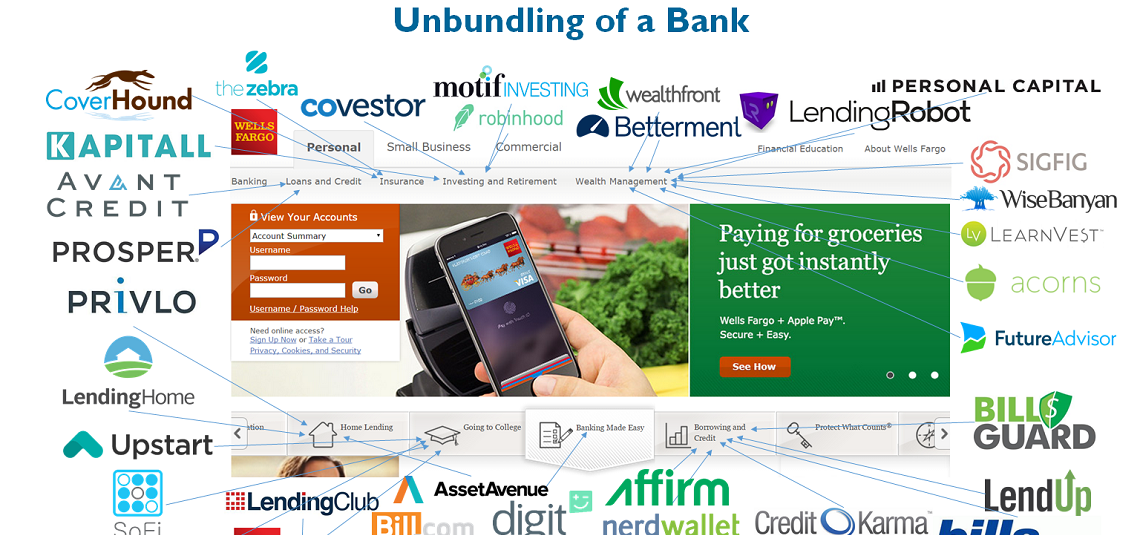
Disrupting Banking: The FinTech Startups That Are Unbundling Wells Fargo, Citi and Bank of America (from CB Insights)

Abstract: Banks run the risk of being out-innovated and may lose their edge not because of their incumbent, large competitors, but because emerging startups inflict upon them a death by a thousand cuts.  And because a picture is worth more than 1,000 words:

source: CB Insights
source: CB Insights

##

Finally, a welcome to our friends at KBW who just hopped into the Twitter pool yesterday. With so many talented men and women working there, I have no qualms suggesting a follow of their handle – @KBWfinthink (h/t to our Emily McCormick for the heads up)

This Week in Pictures – New Orleans

It has been said that the best acquisition a bank can make is of a new customer.  But let’s face it: for most banks, organic growth is hard. For those wanting to grow revenue, deposits, brand, market size and market share, we hosted a “Growth” conference at the Ritz-Carlton in New Orleans earlier this week.  Below, some pictures from our time in the Crescent City along with links to organic growth & FinTech-specific content.

By Al Dominick // @aldominick

Clearly, there has been an enormous shift in asset concentration and customer loyalty during the past two decades. Today, the ten biggest banks in the U.S. have more assets than all of the other institutions combined.  Concurrently, major consumer brands such as Apple and Google have emerged as significant non-bank competitors.  As such, we designed this year’s Bank Board Growth & Innovation Conference around the concept of building sustainable franchise value.

To stay both relevant and competitive, I believe that building a culture of disciplined growth that encourages creativity and risk taking is essential. For a bank’s CEO, executive team and board, this requires a combination of knowledge, skill and courage – things we designed this conference, a complement to our annual Acquire or Be Acquired Conference, to provide.  Behind the scenes, our team works hard to deliver a “Four Seasons”-level of service — and I am especially proud of how everyone navigated the weather challenges that hit the city on Monday.  It was great to arrive to so many smiling faces!

For those curious about the topics and trends covered at the event, you can up on what was covered by clicking on:

In addition, take a look at what our editor, Jack Milligan, has shared on his blog, The Bank Spot.  And since its Friday, I’ll take the liberty of closing with laissez les bons temps rouler!

Banking Millennials

The Millennial generation comprises 80MM people, the largest in U.S. history.  Born between the years of 1980 and 2000, millennials range in age from 15 to 35 years and are just beginning to gain their foothold in the economy.

By Al Dominick // @aldominick

Do we really want to bank millennials? If I borrowed a crystal ball from one of the soothsayers out at Jackson Square in New Orleans’ French Quarter, I imagine this would be the question on most everyone’s mind that joined me at our annual Bank Board Growth & Innovation conference.  With many community banks making their money through C&I lending, the immediate concern (at least at the board’s level) is how do I grow right now?  While many conversations trended towards the opportunities to engage this demographic by leveraging emerging technologies with a bank’s sales and marketing efforts, I was not surprised to hear a concern about the investment costs of bringing new technologies into a bank.  The rationale, as I understood it, is by the time a bank gets a return from its investment, it may be too late.  I’m not saying this is my way of thinking, but I do think it reflects apprehensions by key officers and directors when the conversations comes to these future business owners, inheritors of wealth and digitally demanding individuals.  As shared in a presentation by Ingo Money, in the next five years, the Millennial generation will have the largest income in U.S. history, and any company that can monetize Millennial spending or data may seek to bank them.  Still, regional and community bankers wrestle with the type of client they might be — both now and in the future.

Key Takeaway

To kick things off, we invited Dave DeFazio from StrategyCorps to “look beyond the basics” in terms of mobile banking.  As he shared, over 75% of people in the U.S. own a smartphone in the year — and most everyone has some sort of addiction to their device.  With all of the big banks offering the “big five” today (mobile banking, mobile bill pay, mobile deposits, ATM/Branch locators and P2P payments), bankers should think beyond basic banking transactions to develop a mobile presence that is a “can’t live without” app.  Some of his tips: provide easy authentication, pre-login balances, voice recognition, budgeting tools and coupon and shopping tools.

Trending Topics

Anecdotally, the issues I took note of were, in no particular order:

  • The four biggest banks in the U.S. are among the 10 least loved brands by Millennials.
  • Millennials want banking services designed for their needs that are instant, simple, fair and transparent… which is why new providers are beginning to emerge.
  • For those not familiar with Moven, GoBank and Simple… take a look at what each has to offer.
  • The cultural divide between banks and FinTech companies is getting smaller for bigger banks, but remains high for regional and community banks.  Nonetheless, these banks are in a better position to collaborate and seriously consider new tools and products as the decision making cycle is considerably shorter then at large institutions.

Picked Up Pieces

While today was “just” a half day, some of the more salient points I made note of:

  • Per Jennifer Burke, a partner at Crowe, “proactively identifying, mitigating, and in some cases, capitalizing on these risks provides a distinct advantage to banks.”
  • In terms of building value, the ability for a bank to grow is as important as a bank’s profitability.
  • It was refreshing to be at a banking conference where talk about regulation was at a minimum; in fact, it seemed that the regulatory environment presents more of a distraction than it poses a threat to bank’s looking to grow.
  • The corollary to this point: competition from non-banks is higher then ever before.

To see what’s being written and said as we wrap up our time in New Orleans, I invite you to follow @bankdirector, @aldominick + #BDGrow15.

Three Observations from the Bank Board Growth & Innovation Conference

Select news and notes from the first day of Bank Director’s annual growth conference at the Ritz-Carlton New Orleans.

By Al Dominick // @aldominick

I mentioned this from the stage earlier today… every January, Bank Director hosts a huge event in Arizona focused on bank mergers and acquisitions.  Known as “AOBA,” our Acquire or Be Acquired conference has grown significantly over the years (this year, we welcomed some 800 to the desert).  After the banking M&A market tumbled to a 20-year low in 2009 of just 109 transactions, it has gradually recovered from the effects of the crisis. In fact, there were 288 bank and thrift deals last year, which was a considerable improvement on volume of 224 deals in 2013.  As our editorial team has noted, the buying and selling of banks has been the industry’s great game for the last couple of decades, but it’s a game that not all banks can — or want to — play.  Indeed, many bank CEOs have a preference to grow organically, and its to these growth efforts that we base today and tomorrow’s program.

Key Takeaway

To kick things off, we invited Fred Cannon, Executive Vice President & Director of Research at KBW, to share his thoughts on what constitutes franchise value. While he opened with a straight-forward equation to quantify franchise value over time — (ROE – Cost of Equity) × Market Premium — what really stuck with me during his presentation is the fact that a logo does not create franchise value, a brand does.  As he made clear, it is contextual (e.g. by industry’s served, technologies leveraged and clients maintained) and requires focus (e.g. you can’t be all things to all people).  Most notably, small and focused institutions trump small and complex ones.

Trending Topics

Anecdotally, the issues I took note of where, in no particular order:

  • Banks must be selective when integrating new technology into their systems.
  • The ability to analyze data proves fundamental to one’s ability to innovate.
  • When it comes to “data-driven decisions,” the proverbial life cycle can be thought of as (1) capture (2) store (3) analyze (4) act.
  • You don’t need a big deposit franchise to be a strong performing bank (for example, take a look at County Bancorp in Wisconsin)
  • We’ve heard this before, but size does matter… and as the size of bank’s balance sheet progresses to $10 billion, publicly traded banks generate stronger profitability and capture healthier valuations.

Picked Up Pieces

A really full day here in New Orleans, LA — with quite a few spirited discussions/debates.  Here are some of the more salient points I made note of throughout the day:

  • Selling services to large, highly regulated organization is a real challenge to many tech companies.
  • Shadow banking? Maybe its time I start calling them “Challenger banks.”
  • CB Insight’s has a blog called “unbundling the bank” — to understand the FinTech ecosystem, take a look at how they depict how “traditional banks are under attack from a number of emerging specialist startups.”
  • A few sidebar conversations about Wells Fargo’s incubator program, which the San Francisco bank began last August… interest in how the program involves direct investment in a select group of startups and six months of mentoring for their leaders.

To see what’s being written and said here in New Orleans, I invite you to follow @bankdirector, @aldominick + #BDGrow15.