Three out of Four Say…

rotary-phone

Last week, I shared that Cullen/Frost acquired another institution in Texas.  A stalwart of community banks, many analysts and investors cite their strength as proof that M&A isn’t a necessity to grow one’s business.  Still, organic growth has yet to return to the degree to which was hoped for by many other bankers at this point.  So with apologies to Deloitte, the following three points from members of the accounting world’s “Big Four” focus on the strategies some might consider to build their franchise value without requiring an acquisition.

(1) KPMG’s John Depman writes about the “unprecedented change afoot in the banking industry.”  In his view, technology is rapidly evolving and it’s changing consumer expectations about how banks should be serving them.  He carries this message throughout his “Community Banks That Fail to Leverage Technology May Become Obsolete” piece that is up on BankDirector.com.  According to John, community banks have been slower to embrace technology as a means to interact with and serve customers.  In doing so, they risk becoming obsolete.  To this end, he shares a number of key issues that directors and boards need to consider and subsequently work with senior management to address.  These range from “customer loss vs. investment return” to evaluating bank branch strategies.  Ultimately, “the model that defined our industry for generations has now been turned on its head.  The road to transforming your community bank won’t be short.  But, it’s a road that must be taken.”

(2) Keeping to this transformation theme, PwC’s Financial Services Managing Director, Nate Fisher, highlights how banks can align their pricing structure by using data from customer preferences, purchasing patterns and price sensitivity.


(3) Finally, banks continue to report increases in mobile banking usage, at least, according to a July 30th piece that ran in American Banker’s “Bank Technology News.”  There, they recognize the latest “Mobile Banking Intensity Index” which shows how features like mobile check deposit continue to be adopted quickly.  This lines up with a number of tweets I’ve recently seen from Ernst & Young (“EY”).  Some relate to the banking industry coping with the challenges of the mobile money ecosystem.  Others refer to the strategies that are emerging, and potential pitfalls to be avoided “in a landscape where competitors include businesses (telecoms and tech firms, for instance) that until recently had nothing to do with financial services.”  According to EY, in 2001, there was only one mobile payment system in the market. Today, there are 150 in everyday use and 90 more in development. Wow…

Aloha Friday!
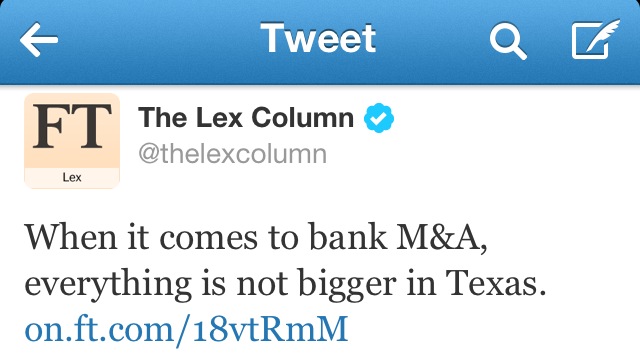
Evidently, bigger isn’t always better

photo (21)

I can’t improve upon the FT’s Lex Column tweet for this week’s post; since it’s behind a paywall, I can’t share any more than the shortened URL either.  Still, it does foreshadow one of three points I’m sharing as we wrap up another summer week.

(1) When it comes to bank M&A, investment bankers “expect slow and steady consolidation.” Analysts point out that in today’s environment of slowed economic growth and regulatory change, bankers and investors continue to eye M&A as a possible opportunity for increasing profits and building strategic franchises.   So I paid close attention to news that Texas-based Cullen/Frost will, for the first time in nearly seven years, acquire another bank. On Tuesday, the NYSE-listed institution announced it will pick up Odessa-based WNB Bancshares, which operates in the heart of the oil-and-gas producing, Friday Night Light’sinspiring Permian Basin in West Texas.  If you’re not familiar with shoppingCullen/Frost, it has $22+ billion in assets and consistently ranks among the top banks in the country (at least, if you pay attention to rankings like the “Nifty Fifty,” which annually identifies the best users of capital).  As I looked for background on the deal, I found this article that ran in the bank’s hometown of San Antonio an interesting summary.  According to the news outlet, Cullen/Frost’s Chairman and CEO, Dick Evans, is fond of saying he is an “aggressive looker and a conservative buyer” when it comes to making acquisitions. So you have to figure this cash and stock deal (valued at $220 million) makes too much strategic sense for both institutions to ignore, especially with the Lone Star state’s surging oil and gas business.

(2) From size to age, you may hear me refer to my company as a 23-year old start up.  But this description cannot hold a candle to “a 110-year-old NorCal startup:” Mechanics Bank.  While I haven’t visited with them, every time I go to San Francisco I hear good things about the team leading the bank (and yes, we have written about their work; for example, “Talking Tech to Directors“).  Within the bank is the author of “Discerning Technologist,” Bradley Leimer.  As the VP of Online and Mobile Strategy at Mechanics Bank, I certainly appreciate his perspectives on change.  In fact, as I work on a growth-focused program for CEOs, executives and a bank’s boards, his “What Inspires Financial Services Innovation?” piece became a must read.  Totally up my tech and design alley and a blog worth following.

(3) Finishing on a technology kick, Fiserv shares a white paper that explores mobile strategies (“Mobile Banking Adoption: Your Frontline Staff Holds the Key to Growth“). Ubiquitous as this conversation feels, they show that for most financial institutions, mobile banking adoption typically hits a glass ceiling of 15% to 20% of online banking customers.  This surprised me, as adoption rates of mobile devices continues to grow.  I am a big fan of what the tech giant does to support the community, but I’ve talked with CEOs like Umpqua’s Ray Davis in the past about their retail concept that includes a big mobile push.  No matter what tone at the top is struck, tactical challenges remain for almost everyone.  So I’m curious to hear how banks account for this plateau as they devise their plans.  Many bank leaders I meet with express an interest in getting more mobile and social.  Fewer, however, have a comfort that their teams are measuring, and subsequently managing, such plans for the future.  Fiserv’s piece, for banks and credit unions alike, provides some interesting context for such strategic conversations.

Aloha Friday!