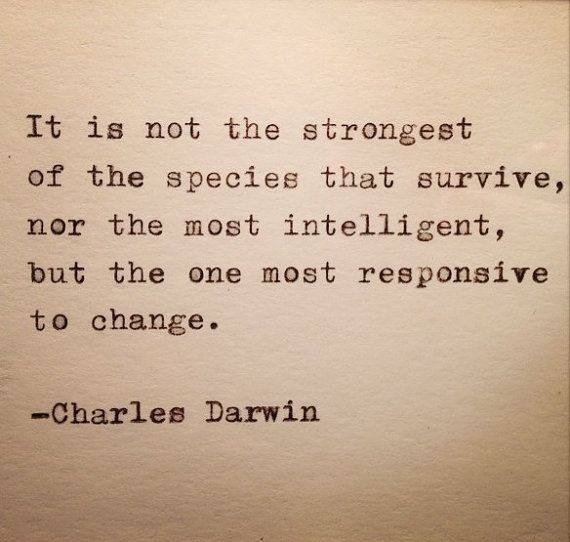
With the revenue pressures facing the banking industry being some of the most intense in decades, banks need to think more constructively about their businesses. At the same time, changing consumer behavior could drive the industry to reallocate its resources to less traditional growth channels in order to stay ahead. In my view, the words of an English naturalist reflect the single greatest constraint on growth today.
Powerful Forces
One of our long-term corporate sponsors, PwC, recently shared their thoughts on the future of the retail banking industry. In their view, “powerful forces are reshaping the banking industry, creating an imperative for change. Banks need to choose what posture they want to adopt – to lead the change, to follow fast, or to manage for the present. Whatever their chosen strategy, leading banks will need to balance execution against… critical priorities and have a clear sense of the posture they wish to adopt.” If you, like our friends from PwC, are joining us in New Orleans later this week to dive into this very topic, their compelling “Retail Banking 2020” report might make for good airplane company.
Looking Back in Order to Look Ahead
Last year, John Eggemeyer, a Founder and Managing Principal of Castle Creek Capital LLC, helped me to kick off our inaugural Growth Conference. As a lead investor in the banking industry since 1990, he shared his views on our “mature industry,” That is, banking follows a historic pattern of other mature industries: excess capacity creates fierce competition for business which in turn makes price, not customer service, the key differentiator. While offering myriad thoughts on what makes for a great bank, John did share some hard-to-swallow statistics and opinions for a crowd of nearly 200 bankers and industry executives:
- Publicly traded banks from $1 billion to $5 billion in assets saw their stock values rise at about half the rate of the broader market as a whole since early 2009.
- Of the 300 or so publicly traded banks in that size range, only about 60 of them traded at their pre-recession price multiples.
- In the last 40 years, bank stocks always followed the same pattern in a recession: falling in value quicker than the rest of the market and recovering quicker.
I share these three points to provide context for certain presentations later this week. Some build on his perspectives while others update market trends and behavior. Still, an interesting reminder of where we were at this time last year.
Getting Social-er
Yesterday, I shared the hashtag for The Growth Conference (#BDGrow14). Thanks to our Director of Research — @ehmccormick — and Director of Marketing — @Michelle_M_King — I can tell you that nearly 30% of the attending banks have an active twitter account; 78% of sponsors do. On the banking side, these include the oldest and largest institution headquartered in Louisiana — @IBERIABANK, a Connecticut bank first chartered in 1825 with over $3.5 billion in assets — @LibertyBank_CT and a Durham, NC-based bank that just went public last month — @Square1Bank. On the corporate side of things, one of the top marketing and communications firms for financial companies —@wmagency, a tech company that shares Bank Director’s love of orange — @Fiserv and a leading provider of personal financial management — @MoneyDesktop join us. Just six of many institutions and service providers I’m looking forward to saying hello to.
##
More to come — from New Orleans, not D.C. — tomorrow afternoon.

 About That Ratio