Size Matters – and Other Banking Notes From the Bay Area

The Ritz-Carlton San Francisco
Walking up to the Ritz-Carlton San Francisco

Last week, Lexington, Virginia… this week, San Francisco, California… next week, Chicago, Illinois.  Yes, conference season is back and in full swing.  I’m not looking for sympathy; heck, for the past few days, I’ve set up shop in Nob Hill (at the sublime Ritz-Carlton) to lead our Western Peer Exchange.  Traveling like this, and spending time with a number of interesting CEOs, Chairmen, executives and board members, is why I love my job.  What follows are three observations from my time here in NorCal that I’m excited to share.

(1) On Wednesday, I took a short drive up to San Mateo to learn more about Kony, a company that specializes in meeting multi-channel application needs.  I have written about customer demands for “convenient” banking services in past posts — e.g. Know Thy Customer –and will not try to hide my interest in FinTech success stories.  Learning how their retail banking unit works with financial institutions to deliver a “unified and personalized app experience” proved an inspiring start to my trip.  Consequently, our Associate Publisher and I talked non-stop about the rapid evolution and adoption of technologies after we wrapped things up and drove back towards San Francisco.  We agreed that consumer expectations, relative to how banks should be serving them, continues to challenge many strategically. To this end, Kony may be worth a look for those curious about opportunities inherent in today’s mobile technology.  Indeed, their team will host a webinar that features our old friend Brett King to examine such possibilities.

(2) When it comes to banks, size matters.  To wit, bigger banks benefit from their ability to spread fixed costs over a larger pool of earning assets.  According to Steve Hovde, an investment banker and one of the sponsors of our event, “too big to fail banks have only gotten bigger.”  He observed that the top 15 institutions have grown by nearly 55% over the past six years.  Wells Fargo, in particular, has grown 199% since ’06.  With more than 90% of the banking companies nationwide operating with assets of less than $1 billion, it is inevitable that consolidation will be concentrated at the community bank level.  However, as yesterday’s conversations once again proved, size doesn’t always trump smarts.  I said it yesterday and will write it again today.  Our industry is no longer a big vs. small story; rather, it is a smart vs. stupid one.

(3) That said, “nobody has told banks in the northwestern U.S. that bank M&A is in the doldrums.”  According to the American Banker, two deals were announced and another terminated after the markets closed Wednesday.  Naturally, this should put pressure on banks in the region to keep buying each other.  Here in San Francisco, the one being discussed was Heritage Financial’s combination with Washington Banking Co.  According to The News Tribune, this is “very much a merger between equals, similar in size, culture and how each does business.”  Now, the impetus behind ‘strategic affiliations’ (don’t call them mergers of equals) comes down to creating value through cost cuts and wringing out efficiencies.  The thinking, at least during cocktails last night, was that deals like these happen to build value for the next few years in order to sell at higher multiples.  Certainly, it will be interesting to see how this plays out.  In a few months at our Acquire or Be Acquired conference, I anticipate it generating quite a few opinions.

Aloha Friday!

Three out of Four Say…

rotary-phone

Last week, I shared that Cullen/Frost acquired another institution in Texas.  A stalwart of community banks, many analysts and investors cite their strength as proof that M&A isn’t a necessity to grow one’s business.  Still, organic growth has yet to return to the degree to which was hoped for by many other bankers at this point.  So with apologies to Deloitte, the following three points from members of the accounting world’s “Big Four” focus on the strategies some might consider to build their franchise value without requiring an acquisition.

(1) KPMG’s John Depman writes about the “unprecedented change afoot in the banking industry.”  In his view, technology is rapidly evolving and it’s changing consumer expectations about how banks should be serving them.  He carries this message throughout his “Community Banks That Fail to Leverage Technology May Become Obsolete” piece that is up on BankDirector.com.  According to John, community banks have been slower to embrace technology as a means to interact with and serve customers.  In doing so, they risk becoming obsolete.  To this end, he shares a number of key issues that directors and boards need to consider and subsequently work with senior management to address.  These range from “customer loss vs. investment return” to evaluating bank branch strategies.  Ultimately, “the model that defined our industry for generations has now been turned on its head.  The road to transforming your community bank won’t be short.  But, it’s a road that must be taken.”

(2) Keeping to this transformation theme, PwC’s Financial Services Managing Director, Nate Fisher, highlights how banks can align their pricing structure by using data from customer preferences, purchasing patterns and price sensitivity.


(3) Finally, banks continue to report increases in mobile banking usage, at least, according to a July 30th piece that ran in American Banker’s “Bank Technology News.”  There, they recognize the latest “Mobile Banking Intensity Index” which shows how features like mobile check deposit continue to be adopted quickly.  This lines up with a number of tweets I’ve recently seen from Ernst & Young (“EY”).  Some relate to the banking industry coping with the challenges of the mobile money ecosystem.  Others refer to the strategies that are emerging, and potential pitfalls to be avoided “in a landscape where competitors include businesses (telecoms and tech firms, for instance) that until recently had nothing to do with financial services.”  According to EY, in 2001, there was only one mobile payment system in the market. Today, there are 150 in everyday use and 90 more in development. Wow…

Aloha Friday!

Evidently, bigger isn’t always better

photo (21)

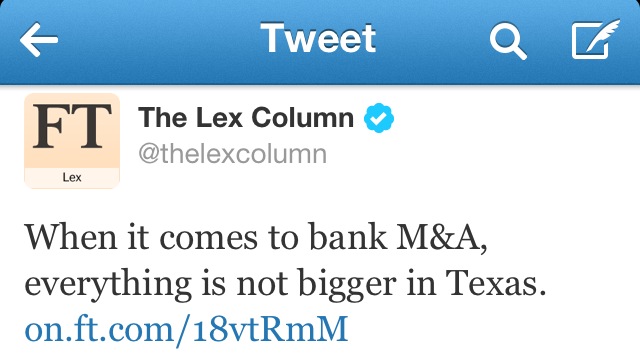
I can’t improve upon the FT’s Lex Column tweet for this week’s post; since it’s behind a paywall, I can’t share any more than the shortened URL either.  Still, it does foreshadow one of three points I’m sharing as we wrap up another summer week.

(1) When it comes to bank M&A, investment bankers “expect slow and steady consolidation.” Analysts point out that in today’s environment of slowed economic growth and regulatory change, bankers and investors continue to eye M&A as a possible opportunity for increasing profits and building strategic franchises.   So I paid close attention to news that Texas-based Cullen/Frost will, for the first time in nearly seven years, acquire another bank. On Tuesday, the NYSE-listed institution announced it will pick up Odessa-based WNB Bancshares, which operates in the heart of the oil-and-gas producing, Friday Night Light’sinspiring Permian Basin in West Texas.  If you’re not familiar with shoppingCullen/Frost, it has $22+ billion in assets and consistently ranks among the top banks in the country (at least, if you pay attention to rankings like the “Nifty Fifty,” which annually identifies the best users of capital).  As I looked for background on the deal, I found this article that ran in the bank’s hometown of San Antonio an interesting summary.  According to the news outlet, Cullen/Frost’s Chairman and CEO, Dick Evans, is fond of saying he is an “aggressive looker and a conservative buyer” when it comes to making acquisitions. So you have to figure this cash and stock deal (valued at $220 million) makes too much strategic sense for both institutions to ignore, especially with the Lone Star state’s surging oil and gas business.

(2) From size to age, you may hear me refer to my company as a 23-year old start up.  But this description cannot hold a candle to “a 110-year-old NorCal startup:” Mechanics Bank.  While I haven’t visited with them, every time I go to San Francisco I hear good things about the team leading the bank (and yes, we have written about their work; for example, “Talking Tech to Directors“).  Within the bank is the author of “Discerning Technologist,” Bradley Leimer.  As the VP of Online and Mobile Strategy at Mechanics Bank, I certainly appreciate his perspectives on change.  In fact, as I work on a growth-focused program for CEOs, executives and a bank’s boards, his “What Inspires Financial Services Innovation?” piece became a must read.  Totally up my tech and design alley and a blog worth following.

(3) Finishing on a technology kick, Fiserv shares a white paper that explores mobile strategies (“Mobile Banking Adoption: Your Frontline Staff Holds the Key to Growth“). Ubiquitous as this conversation feels, they show that for most financial institutions, mobile banking adoption typically hits a glass ceiling of 15% to 20% of online banking customers.  This surprised me, as adoption rates of mobile devices continues to grow.  I am a big fan of what the tech giant does to support the community, but I’ve talked with CEOs like Umpqua’s Ray Davis in the past about their retail concept that includes a big mobile push.  No matter what tone at the top is struck, tactical challenges remain for almost everyone.  So I’m curious to hear how banks account for this plateau as they devise their plans.  Many bank leaders I meet with express an interest in getting more mobile and social.  Fewer, however, have a comfort that their teams are measuring, and subsequently managing, such plans for the future.  Fiserv’s piece, for banks and credit unions alike, provides some interesting context for such strategic conversations.

Aloha Friday!

A #FF-Inspired Financial Roundup

Checking in from St. Louis, the “Gateway to the West”

A somewhat abbreviated Friday Follow-inspired post (coming to you from the great state of Missouri). On this Good Friday, I’m keeping things simple and sharing “just” three things I learned this week.

  • Of the news this week, Senator Tim Johnson’s announcement that he will not seek re-election in 2014 is especially noteworthy.  Why?  Well, the Democrat from South Dakota chairs the powerful Senate Banking Committee.  His departure, according to this report from the Wall Street Journal, sets the stage for a hotly contested race to succeed him.  This should interest many bank executives; “while he is regarded as sympathetic to the concerns of financial firms that operate in his home state, including community banks, Mr. Johnson has also fought GOP attempts to roll back or water down portions of the Dodd-Frank financial overhaul law.” I wonder if the next chair will push for legislation to breakup the big banks as the committee has discussed?  As you can read in the American Banker (subscription required), guessing has already begun.
  • While I’d like to move off the topic of legislation and regulation, our own Chairman forwarded a client alert from the law firm of Goodwin Procter that kept my attention on rules and procedures.  The title, Nasdaq Proposes Rule Requiring Internal Audit Function at All Listed Companies, says a lot.  As you dig in, you’ll see this would go into effect by year-end.  From a bankers point-of-view, financial institutions that are publicly traded already face the pressure of doing more with fewer resources.  Every business function, including internal audit, is expected to bring value to an institution.  So, much like the Senator’s announcement, this proposed rule is one to watch.
  • Finally, on the payments front, there’s been a lot of talk about the mobile consumer and his/her mobile wallet.  For example, how Google Wallet poses a threat to big banks that make $$ off of card products.  Yes, mobile devices have increasingly become tools that consumers use for banking, payments, budgeting and shopping. However, in this WSJ article (Consumer Using Phones to Bank, but Not Buy) we’re told “Americans are increasingly using their phones to avoid a trip to the bank, but they still have little interest in having mobile devices replace their wallets.”  The piece builds on the results of a Federal Reserve survey released on Wednesday.  The Fed finds the adoption of various tools isn’t as robust as one might be led to believe.  If you have the time, it might be worth downloading the Fed’s results.

Aloha Friday!

Financially Focused Friday Fun

1st stop at the Ferry Building in SF
Always my 1st stop at the Ferry Building in SF

What does my favorite, favorite, favorite purveyor of coffee have to do with banking (and payments)? I’ll do my best to connect the dots in this week’s financially focused Friday post. If you missed the last few week’s, take a spin on our way back machine, aka the search button on left.

As I do every Friday, what follows are three stories that I read/watched/heard this week. While tempted to open with a longer mention of seagulls, social media and white smoke, let me see if a picture really is worth a thousand words. This one succinctly captures the feelings that many community bankers have shared with regards to the last few year’s worth of new government regulation and scrutiny. It also sets up the first of this week’s three points:

MI-BU623_HANGOV_G_20130311213640

  • The WSJ ran an interesting piece entitled Small Banks in U.S. Hit by Rising Insurance Costs earlier this week. The premise: thousands of small U.S. banks “are feeling a financial pinch from the government’s efforts to punish executives and directors of banks that collapsed during the height of the financial crisis.” While I promise not to dwell on insurance costs or D+O liability issues today, Robin Sidel’s coverage (which I think originated at our M&A conference in January?) echoes what I’ve heard from bank executives. Namely, “the insurance squeeze is the latest headache for community banks that are still grappling with fallout from the financial crisis. Low interest rates, new regulations and tepid loan demand are pressuring profit. Many small banks would like to get out of the jam by selling themselves but can’t find buyers.”

Truth be told, I’m a bit talked out about bank M&A this week, so I won’t go down that path for point number two. Organic growth proves far more interesting — as its currently far more elusive:

  • On the same day I sat down with the founder and CEO of the Bank of Georgetown (who I think is doing a heckuva job building his bank), I had the chance to catch up with John Cantarella, President, Digital, News & Sports Group at Time Inc. Both talked about how banks are growing/changing; albeit, in much different terms. While Bank of Georgetown continues to build through commercial lending, let me share some thoughts inspired by John. In full disclosure, he recently sat down with our Chairman and agreed to speak to bank CEOs, board members and C-level execs our Growth conference in New Orleans. Subsequently, John and I talked about the focus of his presentation, “Standing Out in a Digital World,” and how he might introduce disruptive technologies and the companies bringing them to market (e.g. Simple and Square). If you’re not familiar with Square, its considered one of the hottest companies in the mobile payments space. When I hopped on their site to dig deeper, I saw that Blue Bottle Coffee Co. recently adopted Square for its point-of-sale. You should DM our Associate Publisher to find out how long she thinks it took for me to add this to today’s piece. So consider this my nod to both companies, our conference and this DC community bank. All interesting stories that really should have their own posts. Hmmm…. next week?

Finally, I do take comfort knowing a pendulum can swing only so far. While strictly my opinion, I believe too many folks within the various regulatory bodies focused on financial institutions (not hedge funds, not multi-national financial services organizations) are missing huge opportunities to contribute to — and communicate with — the banks they oversee. While I get off my soapbox, let me conclude with my third and final point from this week:

  • I saw the Comptroller of the Currency discussed community bank supervision at the Independent Community Bankers of America Annual Convention yesterday. I’m not in Las Vegas nor attending their event, so I simply hope the OCC’s lawyers didn’t totally overhaul his remarks. There are a lot of very real questions/concerns I know bankers would like addressed (e.g. Basel III, the tax benefits credit unions enjoy compared to community banks, etc.). If you were there and care to share, I’d be interested in any feedback/insight…

Aloha Friday to all!