Strong Board. Strong Bank

Quickly:

  • A bank’s CEO, Chairman and board of directors face a number of challenges in today’s ever competitive, highly regulated and rapidly evolving financial services industry.

By Al Dominick, CEO of DirectorCorps — parent co. to Bank Director & FinXTech

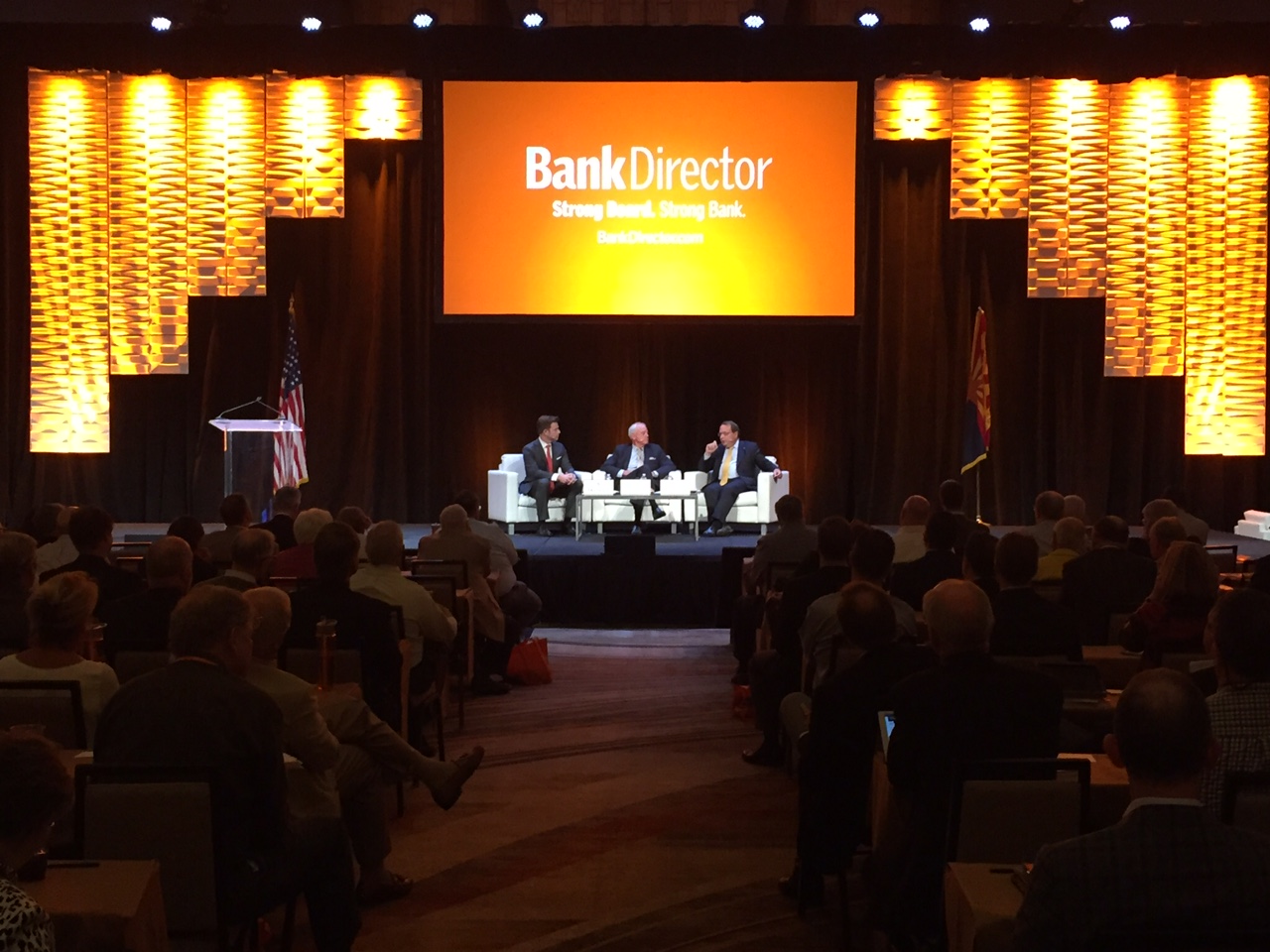
ATLANTA — Complex regulations, technological innovations and a highly competitive environment that leaves little room for error have placed unprecedented demands on the time and talents of bank boards.  Still, no one I’m with today seems interested in pity or sympathy.  To wit, I’m in Atlanta, at the Ritz-Carlton Buckhead, as we host Bank Director’s annual Bank Board Training Forum.  With us are 200+ men and women committed to strengthening their bank’s performance by enhancing the skills and abilities of their boards.

I’m buoyed by their collective optimism, especially having surfaced myriad governance issues, compliance challenges, audit responsibilities, risk concerns and areas of potential liability. What follows are five takeaways from presentations made today that are growth, risk or team-oriented.

  1. When it comes to growing one’s bank, an acquisition of another institution certainly helps a buyer achieve operating scale efficiencies, which in turn increases its valuation.
  2. In addition to traditional M&A as a driver of growth, we are seeing more partnerships with (and outright acquisitions of) non-banks in order to enhance non-interest income and the expansion of net interest margins.
  3. Personally, I appreciated Jim McAlpin (a partner at the law firm of Bryan Cave) for elaborating on the phrase “Strong Governance Culture.” As he explained, the regulatory community takes this to mean a well developed system of internal oversight and a board culture focused on risk management.
  4. When it comes to risk, financial institutions face a quite a few. Indeed, Eve Rogers, a Partner at Crowe Horwath, touched on cybersecurity, economic factors, regulatory changes, shrinking margins and fee restrictions. As she made clear, proactively identifying, mitigating, and, in some cases, capitalizing on these risks provides a distinct advantage to the banks here with us.
  5. In terms of compensation, a good checklist for all banks includes (a) the bank’s compensation philosophy, (b) specific details for how to incorporate a performance plan against a strategic plan and (c) details around how one’s compensation peer group was formed — and when was it last updated.

Tomorrow morning, I share some new ideas for approaching technology in terms of growth and efficiency given the digital distribution of financial goods and services.  As I noted from the stage, we’re seeing some banks, rather than hire from the ground up, take a plug-and-play approach for partnering (or acquiring) FinTech companies. While I certainly intend to talk about the culture and team aspects of technology tomorrow, my focus goes to how and where machine learning, RegTech, payments, white labeling opportunities and core providers allow financial institutions to present a cutting-edge looks and feels to its customers under the bank’s brand.  (*If you’re interested, click here.)

Consolidation Trends in Banking

By Al Dominick, CEO of DirectorCorps — parent co. to Bank Director & FinXTech

Quickly:

  • Nationwide consolidation in the banking space will continue; at least, that is my sense based on conversations and presentations at Crowe Horwath’s Bank Leadership and Profitability Improvement Conference.

_ _ _

So much of this morning was spent talking about growth through mergers and acquisitions (M&A) that I couldn’t help but flash back to January’s Acquire or Be Acquired conference.  Thematically, I went into that event expecting the unexpected.  Given this morning’s presentations on growing one’s bank, I believe that mindset still holds water.

For example, Tom Michaud, the president and CEO of Keefe, Bruyette & Woods, described 2016 and 2017 as one bumpy ride.  From recession fears to lower-for-longer rates, the initial euphoria after the presidential election (at least in terms of stock prices, which went up 27% – 30%) to the uncertainty of regulatory relief, he reminded us of where we are coming from relative to where we might be heading.  I am always curious to hear what Tom thinks about the state of banking; below, ten things I learned from him this morning:

  1. The interest rate outlook is a bit cloudier than it was in November;
  2. Regional banks have had excellent earnings per share growth relative to the overall market;
  3. We have an active pace of consolidation — nearly 5% of the industry is merging;
  4. The most prolific acquirers can buy 2, maybe 3 banks, at best each year;
  5. M&A deals are getting bigger — not ’97 or ’98 levels, but bigger than where they’ve been;
  6. Large buyers are not in the game right now — buyers $25Bn and below continue to drive M&A activity (case-in-point, 95% of total M&A deals since 2011 have buyer assets less than $25Bn);
  7. Buyers are completing their acquisitions in 6 months or less;
  8. Banks with strong tangible book value multiples are dominating M&A;
  9. There have been 37 bank IPOs since 2013 — and the market today is open to small bank IPOs; and
  10. If you’re running a bank, you better be watching (like a hawk) the FinTech charters being pursued by companies like SoFi.

Following Tom’s presentation, we doubled down on growing-the-bank type topics with a session involving Rick Childs, a partner at Crowe Horwath, Jim Ryan, the CFO at Old National Bancorp, Jim Consagra, EVP and COO at United Bancshares and Bryce Fowler, chief financial officer at Triumph Bancorp.

From pricing discipline to acquisitions of privately-held/closely-held companies, the guys made clear that “there are only so many deals out there.”  They shared how boards need to determine the size they want to be, honestly assess the talent they have relative to such aspirations and determine how growth through M&A aligns with enterprise risk management positioning.  Essentially, their remarks made clear that a successful merger or acquisition involves more than just finding the right match and negotiating a good deal.

##

As I shared with yesterday’s post, my thanks to Crowe Horwath, Stifel, Keefe Bruyette & Woods and Luse Gorman for putting together this year’s Bank Leadership and Profitability Improvement Conference at The Inn at Spanish Bay in Pebble Beach, California.

A New Research Report on Marketplace Lending

#AOBA17 conference intel (Wednesday)
By Al Dominick, CEO of Bank Director | @aldominick

Quickly:

  • Lending is an estimated $15 trillion industry in the United States — and the banking industry’s share in this market is estimated to be around $6.6 trillion (~ 44% of the overall market).
  • Within the FinTech sector, lending is the largest segment in terms of funding from investors, and market altered the lending landscape.
  • Marketplace lenders — online platforms that match borrowers with lenders — will likely see some consolidation in ’17 and continue to converge with banks through partnerships, white label contracting and yes, even mergers.

_ _ _

Fintech lending has grown from $12 billion in 2014 to $23.2 billion in 2015 and is expected to reach $36.7 billion in 2016, a year-over-year growth of 93 percent and 58 percent in 2015 and 2016.  This market, according to Morgan Stanley Research, is expected to grow further and reach $122 billion by 2020.

As noted throughout our Acquire or Be Acquired conference, partnerships between a bank and a tech company can take on many forms — largely based on an institution’s available capital, risk appetite and lending goals.  With FinTech solutions gaining momentum, many advisors here have encouraged banks to look at viable alternatives to meet consumer demands, maintain and expand their lending revenue and give formidable competition to those looking to take that marketshare.

With this in mind, I invite you to take a look at a new Fintech Intelligence Report on Marketplace Lending (to download the PDF version, click: fintech-intelligence-report-lending).  The research paper, developed by Bank Director’s FinXTech platform and MEDICI, a subscription-based offering from LetsTalkPayments.com, explores current market dynamics along with technology & partnership models.  As noted in this report, the gains of new FinTech companies were widely thought to be at the expense of banks; however, many banks recognized the potential value from collaboration and built relationships with FinTechs.

##

While our Acquire or Be Acquired conference wrapped up yesterday, you can take a look back on the conversations + presentations that found their way onto Twitter via @AlDominick, the host company, @BankDirector and our @Fin_X_Tech platform, and search #AOBA17 to see what was shared with (and by) our attendees.

Opportunities Abound at Acquire or Be Acquired

#AOBA17 conference intel (Monday)
By Al Dominick, CEO of Bank Director | @aldominick

Quickly

  • Earnings pressures, regulatory/compliance costs + the impact of technology will continue to make it more difficult for banks to compete and be profitable, which will continue to generate consolidation.
  • The increase in stock prices and capital raising activity is likely to provide an additional catalyst for M&A in early 2017
  • Raising capital is an immediate and viable option for most banks today

_ _ _

Here at Bank Director’s annual Acquire or Be Acquired conference, it is clear that to maximize shareholder value, a bank’s leadership must not only plan for the future but also take advantage of today’s opportunities.

For those interested in following the conference conversations via social channels, I invite you to follow me on Twitter via @AlDominick, the host company, @BankDirector and its @Fin_X_Tech platform, and search & follow #AOBA17 to see what is being shared with (and by) our attendees.

3 Things to Know from Day 1 at Acquire or Be Acquired

#AOBA17 conference intel (Sunday/Monday)
By Al Dominick, CEO of Bank Director | @aldominick

Quickly

  • New competitors and innovations are continually changing the business of financial services.
  • The continued shift towards technology, data, algorithms and smart analytics impacts how value and profit are created.
  • In the last 10 years, this is the best time for banks to access the capital markets.

_ _ _

The possibility of less regulation and a change in corporate tax policy have quite a few attendees feeling bullish on the immediate future of community banking.  Below, I share why I am so optimistic about the state of banking in 2017.

For those interested in following the conference conversations via social channels, I invite you to follow me on Twitter via @AlDominick, the host company, @BankDirector and its @Fin_X_Tech platform, and search & follow #AOBA17 to see what is being shared with (and by) our attendees.  To see what I’ve already shared from this year’s conference, check out my Saturday outlook and yesterday’s mid-day recap.

Trending at Bank Director’s Acquire or Be Acquired Conference

#AOBA17 conference intel (Sunday)
By Al Dominick, CEO of Bank Director | @aldominick

Quickly

  • We could see over 200 merger transactions despite a declining number of banks in 2017.
  • There is a clear trend on M&A pricing multiples being driven by bank profitability and asset quality.
  • For banks, too little capital is not the only issue — too much capital and the inability to produce sufficient returns on capital is equally problematic.

_ _ _

What is my bank worth?  How will the changing tax environment affect bank values?  When is the right time to buy (or sell) a bank?  What are the most significant factors affecting bank value?  These were just some of the questions surfaced this morning here in Arizona.  In this video recap of Sunday morning’s presentations at Bank Director’s Acquire or Be Acquired Conference, I share a few observations about the conversations taking place around issues such as these.

Given the focus of this three-day event, I anticipate many subsequent presentations building off of these points.  For those interested in issues such as these, I invite you to follow me on Twitter via @AlDominick, the host company, @BankDirector and its @Fin_X_Tech platform, and search & follow #AOBA17 to see what is being shared with (and by) our attendees.

Welcome to Bank Director’s 2017 Acquire or Be Acquired Conference

#AOBA17 conference intel (Saturday)
By Al Dominick, CEO of Bank Director | @aldominick

Quickly

  • Banks have benefited from rising stock prices and interest rates, which are expected to boost low net interest margins.
  • The change in the U.S. presidency has resulted in a steepened yield curve, as investors predict improved economic growth.
  • Currently, many anticipate regulatory relief for banks and the prospect of major corporate tax cuts.

_ _ _

As we prepare to kick off our 23rd Acquire or Be Acquired Conference in Phoenix, Arizona, I anticipate the general mood to be good, even as I “Expect the Unexpected.”  686 bankers comprise the 1,076 attendees at Bank Director’s event here at the JW Marriott Phoenix Desert Ridge Resort & Spa — a figure that reflects the participation of 379 financial institutions.

For those interested in following the conference conversations via social channels, I invite you to follow me on Twitter via @AlDominick, the host company, @BankDirector and its @Fin_X_Tech platform, and search & follow #AOBA17 to see what is being shared with (and by) our attendees.

Expect the Unexpected

“If past history was all that is needed to play the game of money, the richest people would be librarians.” – Warren Buffett

#AOBA17 pre-conference intel
By Al Dominick, CEO of Bank Director | @aldominick

This may be a phenomenal—or scary year—for banks. Banks have benefited from rising stock prices and rising interest rates, which are expected to boost low net interest margins. Indeed, the change in the U.S. presidency has resulted in a steepened yield curve, as investors predict improved economic growth. Currently, many anticipate regulatory relief for banks and the prospect of major corporate tax cuts. Such change could have a significant impact on banks; however, those running financial institutions also need to keep an eye on potential challenges ahead.

As we head to our 23rd Acquire or Be Acquired Conference in Phoenix, Arizona, with a record breaking 1,058 attendees Jan. 29-Jan. 31, I am expecting the mood to be good. Why wouldn’t it be? But what is on the horizon are also fundamental changes in technology that will change the landscape for banking. What will your competitors be doing that you won’t be? Our conference has always been a meeting ground for the banking industry’s key leaders to meet, engage with each other and learn what they need to do deals. It is still that. Indeed, most of the sessions and speakers will be talking about M&A and growth.
But this year, more than 100 executives from fintech companies that provide products and services to banks join us in the desert, on our invitation. We want to help banks start thinking about the challenges ahead and how they might solve them.

Here are some things to consider:

  • How will the Office of the Comptroller of the Currency’s limited-purpose fintech charter enable more established fintech companies to compete with some of the incumbents in the room?
  • If smaller banks are indeed relieved of many of the burdens of big bank regulation, will they use the savings to invest in technology and improvements in customer service?
  • How will customer expectations change, and from whom will customers get their financial services?

To this last point, I intend to spotlight three companies that are changing the way their industries operate to inspire conversations about both the risks and rewards of pursuing a path of change. Yes, it’s OK to think a little bit beyond the banking industry.

Spotify
Rather than buying a CD to get their favorite songs, music-lovers today favor curated playlists where people pick, click and choose whom they listen to and in what order. There is a natural parallel to how people might bank in the future. Just as analytics enable media companies to deliver individually tailored and curated content, so too is technology available to banks that might create a more personalized experience. Much like Spotify gives consumers their choice of music when and where they want it, so too are forward-looking banks developing plans to provide consumer-tailored information “on-demand.”

Airbnb
The popular home-rental site Airbnb is reportedly developing a new service for booking airline flights. Adding an entirely new tool and potential revenue stream could boost the company’s outlook. For banks, I believe Airbnb is the “uber-type” company they need to pay attention to, as their expansion into competitive and mature adjacent markets parallels what some fear Facebook and Amazon might offer in terms of financial services.

WeChat
One of China’s most popular apps, the company counts 768 million daily active users (for context, that’s 55 percent of China’s total population). Of those users, roughly 300 million have added payment information to the wallet. So, WeChat Pay’s dominance in the person-to-person payments space is a model others can emulate. PayPal already is attempting such dominance, which Bank Director magazine describes in our most recent issue.

Many of those attending our conference also have done amazing things in banking. I can’t name all of them, but I’d be remiss to not mention CEO Richard Davis of U.S. Bank, our keynote speaker. After a decade leading one of the most phenomenal and profitable banks in the country, he is stepping down in April. We all have something to learn from him, I’m sure.  Let us think about the lessons the past has taught us, but keep an eye on the future. Let’s expect the unexpected.

*note – this piece first ran on BankDirector.com on January 26, 2017

Look At Who Is Attending Acquire or Be Acquired

In just 20 days, we raise the lights on our 23rd annual Acquire or Be Acquired Conference.  This is Bank Director’s biggest event of the year, one primarily focused on banking’s “great game” — mergers and acquisitions.  My team has spent considerable time and energy developing a spectacular event focused on growth-related topics that range from exploring a merger to preparing for an acquisition; growing loans to capturing efficiencies; managing capital to partnering with fintech companies.  To see the full agenda, click here.

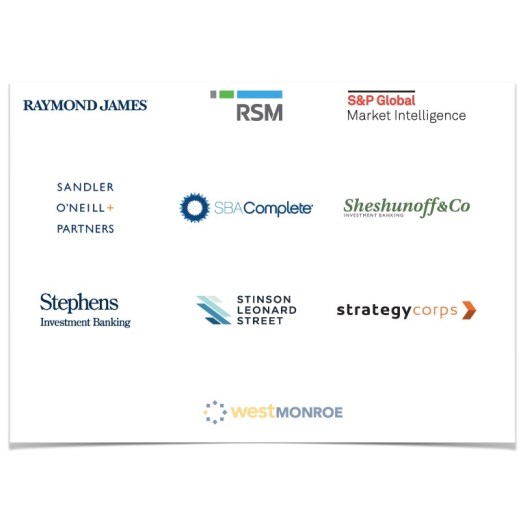
Widely regarded as one of the banking industry’s premier events, we have more than 1,000 people registered to attend AOBA later this month — an all-time high.  We couldn’t do this alone, and over the course of these 2 ½ days, executives from many of our industry’s leading professional services firms and product companies share their perspectives on “what’s now” and “what’s next.”  I invite you to take a look at all of the corporate sponsors joining us:

aoba-sponsors-listed-001

aoba-sponsors-listed-002aoba-sponsors-listed-003aoba-sponsors-listed-004aoba-sponsors-listed-005
As I shared in a recent post, bank executives and their boards face some major issues without clear answers.  Before heading out west, I’ll share more about the banks (and 660+ bankers) joining us at the JW Marriott Phoenix Desert Ridge Resort & Spa.  Until then, I invite you to learn more about the companies supporting this conference by hopping over to bankdirector.com. To follow the conversations happening around this conference on Twitter, I’m @aldominick and we are using #AOBA17.

Eagerly Anticipating Bank Director’s Acquire or Be Acquired Conference

In the face of this month’s political transitions, bank executives and their boards face some major issues without clear answers.  For instance, many continue to speculate on the Fed’s interest rate hikes while others pontificate on potential regulatory changes (hello CFPB).  While convenient to cite November’s election results, keep in mind that we, as an industry, were already in a period of significant transformation.  Still, it’s a titanic-sized understatement to say Republican presidential nominee Donald Trump’s surprise victory shook up the world. 

While change remains a constant in life, I am personally and professionally excited to return to the Arizona desert later this month for a great tradition: Bank Director’s annual Acquire or Be Acquired Conference.  With a record turnout joining us at “AOBA,” I’ve begun to assess various business models of institutions I know will be represented.  For instance, those categorized by:

  • Organic Growth vs. Acquisitive Growth;
  • Branch Light Model vs. Traditional Models; and
  • CRE Focused Lenders vs. C&I Focused Lenders.

I am finding there are multiple dimensions to such business structures — and I anticipate conversations later this month will help me to better understand how the market values such companies.

As AOBA helps participants to explore their financial growth options, I am keen to hear perspectives on the “right size” of a bank today — especially if certain asset-based constraints (think $10B, $50B) are removed.  Given a number of recent conversations, I expect increased IPOs and M&A activity in the banking space and look forward to hearing the opinions of others.

Finally, with the advance of digital services, I’m curious how technology trends might impact bank M&A, and more broadly, banking as a whole given the impact on branch networks.  Indeed, as branches become less important, they become less valuable… which impacts deal valuations and pricing going forward.

##

Between now and the start of the conference, I intend to share a whole lot more about Bank Director’s 23rd annual Acquire or Be Acquired Conference on this site, on LinkedIn and via Twitter. If you’re curious to keep track, I invite you to subscribe to this blog, and follow me on twitter where I’m @aldominick and using #AOBA17.

The #1 Reason That Potential Buyers and Sellers Walk Away From a Bank M&A Deal

According to Bank Director’s 2017 M&A Survey, price is the top reason that potential buyers and sellers have walked away from a deal in the past three years.

With the final days of November upon us, we are a mere 61 days away from hosting Bank Director’s annual Acquire or Be Acquired Conference.  This three-day event explores the various financial growth options available to a bank’s CEO, executives and board members; accordingly, I thought to share some highlights from our just-released Bank M&A Survey that resonate with this audience.

This research project — sponsored by Crowe Horwath LLP and led by our talented Emily McCormick — reflects the opinions of 200+ CEOs, CFOs, Chairmen and directors of U.S. banks.  As Rick Childs, a partner at Crowe, and someone I respect for his opinions and experiences shares, “good markets and good lending teams are the keys for many acquirers, and are the starting point for their analysis of potential bank partners.”  While we cover a lot of ground with this survey, below are five points that stood out to me:

  • An increasing number of respondents feel that the current environment for bank M&A is stagnant or less active: 45% indicate that the environment is more favorable for deals, down 17 points from last year’s survey.
  • 46% indicate that their institution is likely or very likely to purchase another bank by the end of 2017.
  • 25% report that they’re open to selling the bank, considering a sale or actively seeking an acquirer. Of these potential sellers, 54% cite regulatory costs as the reason they would sell the bank, followed by shareholder demand for liquidity (48%) and limited growth opportunities (39%).
  • Price, at 38%, followed by cultural compatibility, at 26%, remain the two greatest challenges faced by boards as they consider potential acquisitions. Price is identified as the top reason that potential buyers and sellers have walked away from a deal in the past three years.
  • 45% report that they are seeing a deterioration in loan underwriting standards within the industry, leading to possible credit quality issues in the future.

Driven by shareholder pressures in a low-growth and highly regulated environment, some community banks could be seeking an exit in the near future. But which banks are positioned to get the best price in today’s market?  This survey provides potential answers to that question — foreshadowing certain conversations I’m sure will occur in January during our 23rd annual Acquire or Be Acquired conference.

##

My thanks to Rick and his colleagues at Crowe for their continued support of this research project.  To see past year’s results — and other board-level research reports we’ve shared — I invite you to take a look at the free-to-access research section on BankDirector.com

Banks Are Feeling the Pressure to Grow

Bank executives and board members are feeling significant pressures to grow in 2016, according to Bank Director’s 2016 Bank Mergers & Acquisitions Survey, sponsored by Crowe Horwath LLP.

By Al Dominick, President & CEO, Bank Director

Bank CEOs and their boards face some very significant challenges in the years ahead.  The sharply increased cost of regulatory compliance might lead some to seek a buyer; others have responded by trying to get bigger through acquisitions in order to spread the costs over a wider base.  While transforming a franchise through organic growth is desirable, I continue to see mergers & acquisitions (M&A) remaining the fastest avenue for growth in banking today.

For those who joined us at our annual Acquire or Be Acquired Conference last month, you may recall that Bank Director’s team surveyed 260 chief executive officers, chairmen, independent directors and senior executives of U.S. banks in advance of the conference to examine current attitudes and challenges regarding M&A — and what drives banks to buy and sell.  Three points stand out to me:

  1. Of the respondents who served as a board member or executive of a bank that was sold from 2012 to 2015, a full 55% say they sold because shareholders wanted to cash out.
  2. Despite concerns that regulatory costs are causing banks to sell, just 27% cite this burden as a primary motivator.
  3. Credit quality issues are most often cited barriers for banks being able to complete acquisitions.

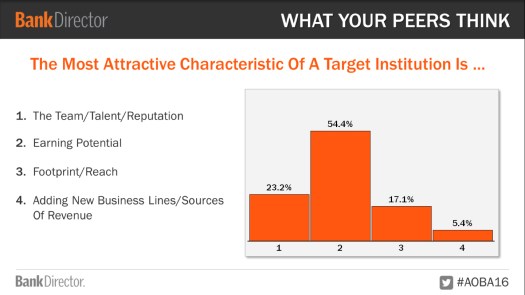
Certainly, “why banks are bought or sold” involves much more than just the numbers making sense.  At AOBA, it was made abundantly clear that M&A remains attractive inasmuch as successful transactions improve operating leverage, earnings, efficiency and scale.  Moreover, attendees shared during one of our interactive sessions that earnings potential is the most attractive characteristic of an institution they are interested in acquiring.

Bank Director and Crowe Horwath LLP AOBA info

In his “Buy Or Die In Phoenix: A Recap Of The 2016 Bank Director’s Acquire Or Be Acquired Conference,” Tim Melvin neatly summarizes the conundrum many bank CEOs face today.  “Competing against their bigger, better funded rivals is… (a) huge obstacle to growth. The days of opening branches on the other side of town, then the next town over and so on to grow a bank are over.”  He concludes by recounting a point made by Steve Hovde, an investment banker we’ve worked with for a number of years: “to thrive, you have to get bigger. To get bigger you probably have to buy and again, if you can’t buy you probably have to sell.”