Eagerly Anticipating Bank Director’s Acquire or Be Acquired Conference

In the face of this month’s political transitions, bank executives and their boards face some major issues without clear answers.  For instance, many continue to speculate on the Fed’s interest rate hikes while others pontificate on potential regulatory changes (hello CFPB).  While convenient to cite November’s election results, keep in mind that we, as an industry, were already in a period of significant transformation.  Still, it’s a titanic-sized understatement to say Republican presidential nominee Donald Trump’s surprise victory shook up the world. 

While change remains a constant in life, I am personally and professionally excited to return to the Arizona desert later this month for a great tradition: Bank Director’s annual Acquire or Be Acquired Conference.  With a record turnout joining us at “AOBA,” I’ve begun to assess various business models of institutions I know will be represented.  For instance, those categorized by:

  • Organic Growth vs. Acquisitive Growth;
  • Branch Light Model vs. Traditional Models; and
  • CRE Focused Lenders vs. C&I Focused Lenders.

I am finding there are multiple dimensions to such business structures — and I anticipate conversations later this month will help me to better understand how the market values such companies.

As AOBA helps participants to explore their financial growth options, I am keen to hear perspectives on the “right size” of a bank today — especially if certain asset-based constraints (think $10B, $50B) are removed.  Given a number of recent conversations, I expect increased IPOs and M&A activity in the banking space and look forward to hearing the opinions of others.

Finally, with the advance of digital services, I’m curious how technology trends might impact bank M&A, and more broadly, banking as a whole given the impact on branch networks.  Indeed, as branches become less important, they become less valuable… which impacts deal valuations and pricing going forward.

##

Between now and the start of the conference, I intend to share a whole lot more about Bank Director’s 23rd annual Acquire or Be Acquired Conference on this site, on LinkedIn and via Twitter. If you’re curious to keep track, I invite you to subscribe to this blog, and follow me on twitter where I’m @aldominick and using #AOBA17.

5 Cybersecurity Companies Bank Execs & Board Members Need to Know

When it comes to cybersecurity, the best defense might just be a great offense.  Whereas cybersecurity once focused on how banks could avoid losing money, my team and I are working on a program for 2017 to help officers and directors address potential scenarios (and develop realistic response plans) should a hack, breech or attack occur.  Indeed, protecting the bank against a cyber attack is a core responsibility of every member of a bank’s board and executive team.

In recent posts, I’ve highlighted various fintechs that I find compelling given their relationships with financial institutions.  In terms of cybersecurity, I’ve had the chance to learn more about companies like DefenseStorm (given their support of companies like nCino and LiveOak Bank) that I greatly respect.  Below are five more companies that I think bank leadership teams need to know:

Cognizant

A global cybersecurity solution and service provider, Cognizant supports multiple industry verticals and information security service lines.  I encourage you to take a look at their thoughts on what traditional banks can do to rebuild trust in the digital era.

Centrify

California-based Centrify offers identity & access management solutions to help secure enterprise identities against cyberthreats that target today’s IT environment of cloud computing.  Banking customers include such recognizable names as BB&T, SunTrust, Citi and RBS.

Lookout

Lookout has taken a mobile-first approach to security.  Indeed, one of the world’s largest investment management firms chose Lookout to provide threat and data leakage protection to over 10,000 managed iOS and Android devices.

Feedzai

Founded by data scientists and aerospace engineers, Feedzai’s mission is to “make commerce safe for business customers and create a better experience for their consumers through artificially intelligent machine learning.”

Brighterion

Since the founding of Brighterion, its core technology has been adapted and improved for real-time applications in the fields of payment, healthcare, marketing and homeland security.  For instance, its analysis of payments provides “unprecedented behavioral insights,” from the spending behavior of customers to the constantly evolving techniques of fraudsters.

##

As a complement to these five businesses, let me wrap up by sharing a recent FinXTech article:Emerging Technologies Combat Cybercrime.  As you will read, banks are doing everything they can to reassure customers that their digital information is safe and secure.

FinXTech’s Advisory Group

I’m checking in from the edge of the Rocky Mountains — from the iconic Broadmoor in Colorado Springs — where I’m joined by FinXTech’s President, Kelsey Weaver and Bank Director’s Director of Client Relations, Laura Proffitt.  The three of us are here to participate in the Association for Financial Technology’s (AFT) Fall Summit where later today, I will have the opportunity to introduce a new partnership between AFT and FinXTech.  In advance of those comments, I thought to pull the curtains back on a special  Advisory Group that we are building to develop FinXTech in the “best” possible manner. 

As new approaches to delivering financial services emerge, nearly every technology company here in Colorado has practical tools, techniques and talent to help financial institutions prepare for the future.  It is an exciting time to be part of a community like the one AFT draws, as I believe new players will continue to emerge while traditional participants transform their underlying business models to better participate and compete in the coming years.

As the financial industry continues to evolve, so too does the community that my team supports.  As a peer-to-peer based platform powered by Bank Director, FinXTech connects a hugely influential audience around shared areas of interest and innovation; specifically:

  • FinTech companies who view banks as potentially valuable channels or distribution partners;
  • Banks looking to grow and/or innovate with FinTech companies’ help and support; and
  • Institutional investors, venture capitalists, state & federal regulators, government officials and academicians helping to shape the future of banking.

Rather then create this community in isolation, we are doing so with the help and support of industry leaders with various backgrounds.  Case-in-point, we are recruiting highly opinionated, ridiculously informed thought leaders to “think around the corner” with us as part of FinXTech’s Advisory Group.

So as we get ready to spend a few days with our peers at this week’s conference, Kelsey, Laura and I are proud that the following men and women have accepted our invitation to share their time and intelligence with us as part of FinXTech’s council:

  • Thomas P. Brown, Partner, Paul Hastings LLP
  • Michael Butler, President & CEO, Radius Bank
  • Michael M. Carter, Founder & CEO, BizEquity
  • Ryan Gilbert, General Partner, Propel Venture Partners
  • John C. Gill, Chief Operating Officer & Chief Risk Officer, Somerset Trust Company
  • Joe Guastella, Global & U.S. Managing Principal, Financial Principal, Deloitte Consulting LLP
  • James C. Hale, III, Founding Partner, FTV Capital
  • Aditya Khujekar, CEO & Co-Founder, Let’s Talk Payments
  • Jimmie Lenz, Director of Technology Risk, Wells Fargo, Wealth and Investment Management
  • Vivian Maese, Partner, Latham & Watkins
  • Bill McNulty, Entrepreneur in Residence, Capital One
  • John E. Pizzi, CEO, BaseVenture
  • Gregg M. Schoenberg, Founder, Westcott Capital
  • Chris Skinner, CEO, The Finanser Ltd
  • Christa Steele, Former President, CEO & Board Member, Mechanics Bank; Founder, Boardroom Consulting LLC
  • John Thompson, SVP & Leader, Program Team, CFSI
  • Andres Wolberg-Stok, Director, Citi Fintech
  • Jon Zanoff, Founder, Empire Startups

In addition to this awesome group, we have some pretty powerful folks that we recently invited (so this list can and will expand in the coming weeks).  But for those of you here at AFT, you will hear Kelsey, Laura and me talk about our enthusiasm for this group & the efforts being made to establish FinXTech as a catalyst that (1) connects a highly influential group of people who care about the future of financial services, (2) are committed to meaningful transformation and are (3) empowered to make change happen.

##

To learn more about what we’re doing, I invite you to visit FinXTech.com, a site we designed to deliver authoritative, relevant and trusted content for banks, Fintech companies, investors and services firms.

Without A Destination, What Good Is A Map?

Highlight: as executives grapple with a fast-changing operating environment that requires partnerships and collaboration, many wrestle with where they want to be vs. where they need to be.

In this video, I share my thoughts on growing through partnerships (between traditional banks and financial technology firms), becoming “data richer” and enhancing the customer experience you’re delivering.

FWIW, this video lives on FinXTech.com, a site designed to provide authoritative, relevant and trusted content to a hugely influential audience, specifically:

  • Fintech companies who view banks as potentially valuable channels or distribution partners;
  • Banks looking to grow and/or innovate with fintech companies’ help and support; and
  • Institutional investors, venture capitalists, state & federal regulators, government officials and academicians helping to shape the future of banking.

As a platform powered by Bank Director, FinXTech connects this hugely influential audience around shared areas of interest and innovation.  FinXTech specializes in (1) bringing valuable bank relationships to fintechs, and (2) offering banks valuable relationships with fintechs in a way no one else does.

3 Quick Takeaways from #fintech16 (aka Bank Director’s FinTech Day at Nasdaq’s MarketSite)

As evidenced by the various conversations at yesterday’s FinTech Day, the next few years promises to be one of profound transformation in the financial sector.

By Al Dominick, President & CEO, Bank Director

At a time when changing consumer behavior and new technologies are inspiring innovation throughout the financial services community, I had a chance to open this year’s FinTech Day program with a look at how collaboration between traditional institutions and emerging technology firms bodes well for the future.  With continuous pressure to innovate, banks today are learning from new challengers, adapting their offerings and identifying opportunities to collaborate. At the same time, we continue to watch as many fintech companies develop strategies, practices and new technologies that will dramatically influence how banking gets done in the future.

Personally, I believe this is a very exciting time to be in banking — a sentiment shared by the vast majority of the 125+ that were with us at Nasdaq’s MarketSite yesterday.  While I plan to go deeper into some of the presentations made in subsequent posts and columns on BankDirector.com, below are three slides from my welcoming remarks that various attendees asked me to share.

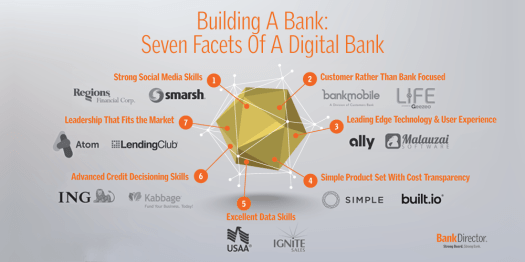
7 elements of a digital bank - by Bank Director and FinXTech

For the above image, my team took a step into an entrepreneurs shoe’s and envisioned an opportunity to build a new, digital-only bank from the ground up.  We consider these seven facets as base elements for success — and the companies listed provide real-life examples of financial institutions & fintechs alike that we see “doing it right.”

FinTech Day Deck1 (dragged)

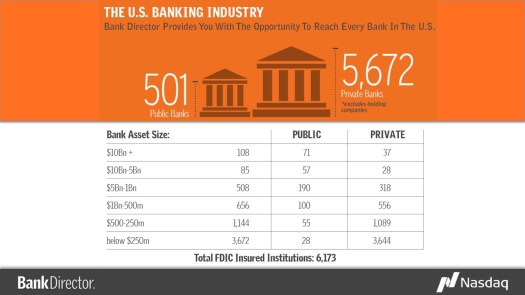
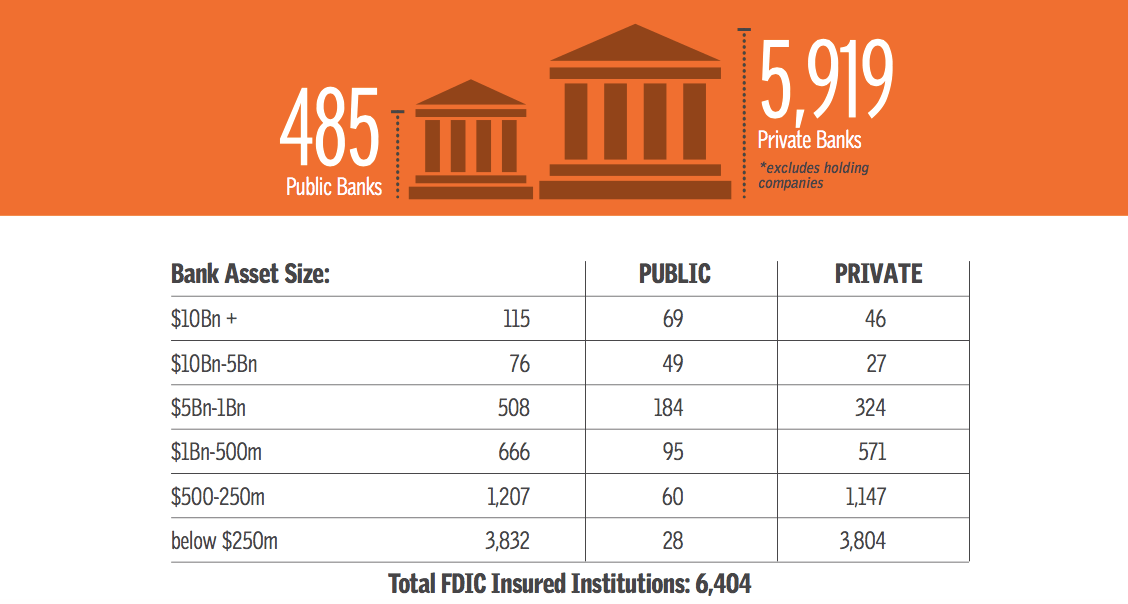
The irony of sharing an idea for a new bank?  Newly chartered banks (de novos) are basically extinct.  So for a program like FinTech Day, I thought it was imperative to provide context to the U.S. banking market by looking at the total number of FDIC-insured institutions.  These numbers are accurate as of last Friday.

FinTech Day Deck1 (dragged) 1

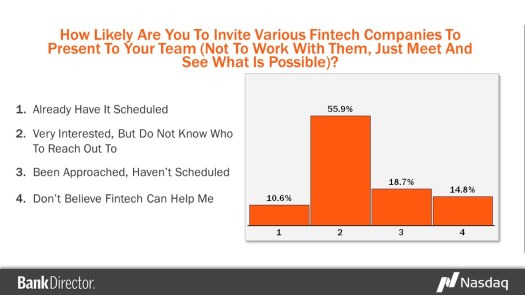
This final slide comes from our annual Acquire or Be Acquired conference in Arizona.  There, we welcomed 930+ to explore financial growth options available to a bank’s CEO and board.  To open our second full day, I polled our audience using a real-time response device to see how likely they are to invite a fintech company in for a conversation.  As you can see from the results above, real opportunities remain for meaningful dialogue and partnership discussions.

##

Thanks to all who joined us, the speakers that shard their insights and opinions and our friends from Nasdaq!

Fintech in 2016: A Whole Lot of Collaboration

While some of the largest and most established financial institutions have struck relationships with various financial technology firms (and not just startups / early stage), opportunities for meaningful partnerships abound.  At Bank Director’s annual FinTech Day at Nasdaq’s MarketSite in Times Square next Tuesday, we explore — with executives from the companies depicted above — what’s really possible when banks and fintechs collaborate to help each other’s businesses accelerate and scale.

By Al Dominick, President & CEO, Bank Director

A fundamental truth: individuals, along with business owners, have more choices than ever before in terms of where, when and how they bank. So a big challenge — and dare I suggest, opportunity — for leadership teams at financial institutions and fintech companies alike entails aligning services & product mixes to suit core customers’ current interests and prospective one’s expectations.

Yesterday, I shared how the fabric of the financial industry continues to evolve as new technology players emerge and traditional participants transform their business models. Indeed, many fintech companies are developing strategies, practices and new technologies that will dramatically influence how banking “gets done” in the future. However, within this period of change — where considerable market share will be up for grabs — I believe that ambitious organizations can leapfrog both traditional and emerging rivals.

Clearly, bank CEOs and their teams must seek new ways to not just stay relevant but to stand out.  While a number of banks seek to extend their footprint and franchise value through acquisition, many more aspire to build the bank internally. Some show organic growth as they build their base of core deposits and expand their customer relationships; others see the value of collaborating with fintech companies.

For a bank CEO and his/her executive team, knowing who’s a friend, and who’s a potential foe, is hugely important.  Personally, I have found this to be quite difficult for many regardless of their size or market.  Moreover, I find this to be a two-sided challenge in the sense that for a fintech founder or executive, identifying those banks open to partnering with, investing in or even acquiring a company like the one they run presents as great a challenge as it does opportunity.

So as more & more fintech companies look to partner with legacy players — and banks warm to such a dynamic — I am excited to think about the creative new partnerships that can be explored to ease payment processes, reduce fraud, save users money, promote financial planning and ultimately, move our giant industry forward.

FinTech Day is One Week Away

The fabric of the financial industry continues to evolve as new technology players emerge and traditional participants transform their business models. Through partnerships, acquisitions or direct investments, incumbents and upstarts alike have many real and distinct opportunities to grow and scale.  If 2015 was all about startups talking less about disruption and more about cooperation, I see 2016 as the year that banks reciprocate.

By Al Dominick, President & CEO, Bank Director

Next Tuesday, at Nasdaq’s MarketSite in Time Square, our team hosts our annual “FinTech Day.” With so many new companies pushing their way into markets and product lines that traditionally have been considered the banking industry’s turf, we look at what fintech means for traditional banks. Likewise, we explore where emerging fintech players may become catalysts for significant change with the support of traditional players.  When it comes to trends like the personalization of banking, the challenges of scaling a company in our highly regulated industry and what shifting customer expectations portend for banks and fintechs alike, we have a full day planned. Take a look at some of the issues we will address.

Riding The Wave Of Change
Al Dominick, President & CEO, Bank Director
Robert H. McCooey, Jr., Senior Vice President of Listing Services, Nasdaq

At a time when changing consumer behavior and new technologies are inspiring innovation throughout the financial services community, we open this year’s program with a look at how collaboration between traditional institutions and emerging technology firms bodes well for the future.

Banking’s New DNA
Michael M. Carter, CEO, BizEquity
Vivian Maese, Partner, Latham & Watkins
Eduardo Vergara, Head of Payments Services & Global Treasury Product Sales, Silicon Valley Bank
Moderated by: Al Dominick, President & CEO, Bank Director

With continuous pressure to innovate, banks today are learning from new challengers, adapting their offerings and identifying opportunities to collaborate.  With this opening session, we focus on the most pressing issues facing banks as they leverage new tools and technologies to compete.

Who Has the Power to Transform Banking
Jeana Deninger, Senior Vice President, Marketing, CoverHound, Inc.
Brooks Gibbins, Co-Founder & General Partner, FinTech Collective
Colleen Poynton, Vice President, Core Innovation Capital
Moderated by: Al Dominick, President & CEO, Bank Director

While fintech startups continue to spearhead the technological transformation of financial services, recent efforts by systemically important financial institutions call into question who reallly has the power to tranform banking. From an investment perspective, recent market turmoil may put some opportunities on hold – while others now have a higher, sharper bar to clear. In this session, we talk to investors about the traits that they look for when backing a venture in the context of a changing economic environment.

Opportunities to Reinvigorate the Banking Industry
Tom Kimberly, General Manager, Betterment Institutional
Thomas Jankovich, Principal & Innovation Leader, US Financial Services Practice, Deloitte Consulting LLP
Pete Steger, Head of Business Development, Kabbage, Inc.
Moderated by: Al Dominick, President & CEO, Bank Director

Many fintech companies are developing strategies, practices and new technologies that will dramatically influence how banking gets done in the future. However, within this period of upheaval – where considerable market share will be up for grabs – ambitious banks can leapfrog both traditional and new rivals. During this hour, we explore various opportunities for financial services companies to reinvigorate the industry.

Opportunities to Financially Participate in Fintech
Joseph S. Berry, Jr., Managing Director, Co-Head of Depositories Investment Banking, Keefe, Bruyette & Woods, Inc. A Stifel Company
Kai Martin Schmitz, Leader FinTech Investment LatAm, Global FinTech Investment Group, International Finance Corporation
Moderated by: Al Dominick, President & CEO, Bank Director

While large, multinational banks have made a series of investments in the fintech community, there is a huge, untapped market for banks to become an early-stage investor in fintech companies. Based on the day’s prior conversations, this session looks at opportunities for banks to better support emerging companies looking to grow and scale with their support.

##

While this special event on March 1 is sold out, you can follow the conversations by using #Fintech16 @aldominick @bankdirector @finxtech and @bankdirectorpub.  And as a fun fact, I’ll be ringing the closing bell next Tuesday flanked by our Chairman and our Head of Innovation.  So if you are by a television and can turn on CNN, MSNBC, Fox, etc at 3:59, you’ll see some smiling faces waving at the cameras.


Community and Regional Banks are Crucial to the Vibrancy of Our Communities

As we head into the final day of Acquire or Be Acquired, its clear to me that there are some great opportunities for community and regional banks to compete effectively and recapture market share in 2016.

*Thanks to our keynote speaker, J. Michael Shepherd, Chairman & CEO, Bank of the West and BancWest Corporation for inspiring today’s title and video.


9 Banks I Bet People Will Be Talking About at Acquire or Be Acquired

I planned to write about a number of banks I was excited to see this weekend at AOBA.  But as Steve Jobs once shared “people don’t know what they want until you show it to them.” In this spirit, let me highlight nine banks that I anticipate our attendees will be talking about in Arizona at Bank Director’s annual M&A conference.

In a few minutes, I’ll hop an American flight to Phoenix for this year’s Acquire or Be Acquired Conference.  Before I depart the cold and slush of D.C. for some warmth and sun in the desert, this is my take on the banks I anticipate people talking about when we’re all together:

  • Bank of the West — and not just because their CEO is keynoting this year’s conference.  The bank, with more than 700 branches in the Midwest and Western United States, has long been a personal favorite of mine and competes in markets where many look for inspiration.
  • Bank of North Carolina — because they’ve been wheeling and dealing and are a great example of how an acquirer successfully integrates cultures (*yes, their CEO also speaks at AOBA this year on a CEO panel entitled Finding the Right Partners).
  • United Bank — having picked up a trophy franchise of their own in my hometown (another personal favorite of mine, Bank of Georgetown) they’ve made a number of interesting deals over the past few years and I bet have more on their mind.
  • BB&T — having dealt for Susquehanna in ’14 and National Penn in ‘15, it is fair to ask: who’s next?

By no means are these all of the banks that will come up in conversation; rather, those that are top of mind.

One final thought before hopping my flight west.  The recent volatility in the stock market may be impacting institutions considering a capital raise, IPO or acquisition — but this week’s deal pace is far different then at this time in recent years.  The patterns I’m beginning to see is a concentrated effort to get to over the $5Bn asset mark and into that sweetest of spots: the $5Bn to $50Bn asset class.  A point I’ll elaborate on in an upcoming post/video.

So if you are interested in following the conference conversations via social channels, I invite you to follow me on Twitter via @AlDominick, the host company, @BankDirector, and search & follow #AOBA16 to see what is being shared with (and by) our attendees.  Safe travels to those 930 men & women joining us this weekend!

Five Reasons Why Banks Might Consider Selling in 2016

You might think every bank CEO I meet wants to talk about buying another institution; truth-be-told, some recognize that tying up with another makes a lot of sense.  So this post looks at why now may be the right time for a bank’s CEO and board to consider a sale.  It plays off the idea that in many markets, organic growth options are limited and times are tough for banks, especially those under $1Bn in asset size.

By Al Dominick, President & CEO, Bank Director

Over the past three years, a number of bank executives and board members have struggled with whether to buy or sell their bank — or pursue growth independently.  Over the same time, Bank Director has welcomed more than 1,300 bankers — from more than 500 financial institutions — to our annual M&A conference to explore their short- and long-term options.

This year, those numbers go up in a BIG way. Indeed, we have 600 bankers from 300+ banks joining us at the Arizona Biltmore for “AOBA” this upcoming Sunday through Tuesday.  To me, this signals that more potential buyers & sellers are getting off the sidelines and into the bank merger and acquisition game.  So in advance of Bank Director’s 22nd annual conference, here are five challenges that a bank’s CEO and board might want to consider.

  • Peer-to-peer lenders, credit unions and some — not all — FinTech startups either are (or will be) fierce competitors to community banks.  In addition, non-bank giants in technology, retail, media, entertainment and telecom are making noise about entering banking.
  • When margins decline, bankers try to compensate by improving operational efficiencies.  While slow growth + strong cost controls may allow for short term survival, such an equation doesn’t bode well for the long-term viability of many institutions where investors expect more significant gains.
  • The pressures prompting larger banks to innovate — sluggish loan demand, depressed revenue, higher compliance costs — are the same ones that will continue to force smaller banks to pursue a sale.
  • Let’s face it: the typical bond between a bank and a customer is is not personal nor very strong and the absence of real customer loyalty undermines the traditional business model most banks operate from (*and yes, I know that banks with dedicated customer bases enjoy significant advantages over any potential competitors. But let’s be honest about how dedicated such customers really are).
  • Finally, at many community banks, older management teams and a dearth of local talent mean there may be no one to hand over the reins to in the coming years.

Now, it has been said that business is not about longevity, it is about relevance.  So as Bank Director’s team continues to gear up for this year’s Acquire or Be Acquired conference, these five questions merit serious conversation and consideration both leading up to, and at, our 22nd annual event. For those not able to join us — but interested in following conversations such as these — I invite you to follow me on Twitter via @AlDominick, the host company, @BankDirector, and search & follow #AOBA16 to see what is being shared by (and with) our attendees.

While Everybody’s Talking About the Future of Banking…

It seems like everyone has an opinion about what the future holds for banking… but what does banking actually look like today?

By Al Dominick // @aldominick

For the past few years, Bank Director magazine’s Editor-in-Chief, Jack Milligan, has spearheaded our Bank Performance Scorecard, a ranking of the largest U.S. publicly traded banks and thrifts. The most recent version, which appears in our third quarter issue, ranked all banks and thrifts listed on the New York Stock Exchange and Nasdaq OMX.  Jack and his team sorted them into three separate asset categories: $1 billion to $5 billion, $50 billion to $50 billion and $50 billion and above — and we ranked them using a set of metrics that measured profitability, capitalization and asset quality based on 2014 calendar year data.

While this data shines a light on some of banking’s standout performers, my last few months of travel across the U.S. has revealed less familiarity with the banking industry then I expected. So today, instead of focusing on economic, political, demographic or technological forces reshaping the banking landscape, allow me to share some statistics I think are important to know:

  1. Banks with less than $10 billion in assets have lost over half of their market share in the past 20 years.
  2. The corollary? The five largest banks now hold almost 44% of all banking assets in the country.
  3. Despite totaling 89% of all banks, institutions under $1B in assets hold only 8.3% of the industry’s assets.

With competition coming from both the top of the market and from non-traditional players, I have talked with numerous bank CEOs and various members of their executive teams who tell me how imperative it is for them to really focus on improving efficiencies and enhancing organic growth prospects.  In addition, as big banks invest in customer acquisition, and non-traditional players continue to eat away at earnings potential, it strikes me that of all of the risks facing a bank’s key leadership team today (for instance, regulatory, market and cyber) knowing when to buy, sell or grow independently has to be high on the list. After all, the most profitable financial companies are often those whose strategies are intentional, focused and differentiated… and are showing current revenue growth with strong visibility towards future performance.

Of course, any discussion about the world in which banks live today has to acknowledge two significant business threats. Since most banking products tend to be commodities that are available at any number of bank and non-bank providers, the first concerns customer acquisition costs. Personally, I believe such costs will increase as existing customers become less likely to refer their bank to others. This leads to the second threat; namely, banks will lose revenue as customers leave for competitors and existing customers buy fewer products.

So a high-level look at where things are today. I realize this takes a very broad brush to a mature industry. Still, to understand where banks might be heading, I find it helpful to be grounded in where they are today.